Scrolling at midnight with a sore back tooth can make every small sensation feel like a warning. The question isn't always whether a tooth hurts, it's whether that tooth still has a realistic path to staying in the mouth. At Ultra Smile DentalSpa in Downtown Miami, Midtown Miami, and Hallandale Beach, that decision is approached carefully, with comfort, clear explanations, and a focus on saving teeth whenever that still makes sense.
The answer begins with a threshold. Dentists do not pull teeth because they're inconvenient. They recommend extraction when decay, infection, gum disease, fracture, or crowding has gone far enough that repair is no longer predictable, or when keeping the tooth would put nearby teeth or the person's health at risk.
Table of Contents
- The Moment You Wonder Whether a Tooth Has to Go
- The Most Common Reasons Dentists Pull Teeth
- Warning Signs You Can Notice at Home
- Save It or Pull It How Dentists Make the Call
- Urgent vs Elective When Timing Really Matters
- What a Gentle Extraction Actually Feels Like
- Questions to Ask Before You Agree to an Extraction
- Getting a Calm Second Opinion in Miami
The Moment You Wonder Whether a Tooth Has to Go
A patient often notices it in a quiet moment. The tooth hurts when chewing, the gum feels irritated, and the phone search starts with a simple question, whether it really needs to be pulled. That fear makes sense, because extraction sounds final, but the clinical decision is usually much narrower than people think.
The real question is predictability
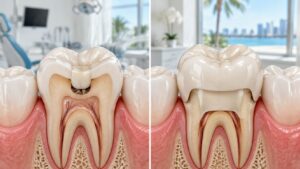
Dentists usually start with one question, can this tooth still be restored in a way that will last? If the answer is yes, they look at fillings, crowns, root canal therapy, or periodontal care first. If the answer is no, because there isn't enough sound tooth structure left or the supporting bone has deteriorated too far, extraction becomes the safer choice.
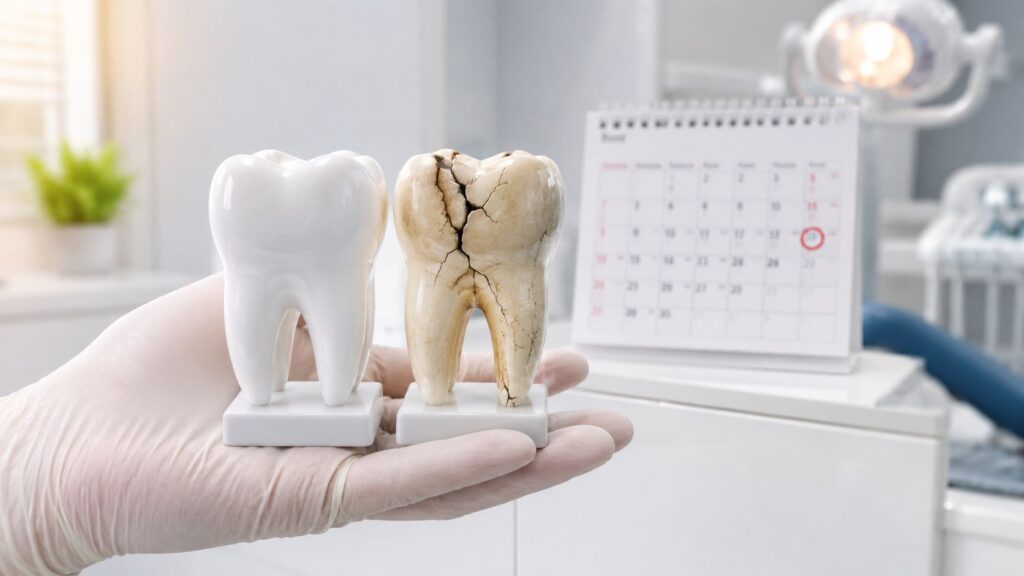
A tooth is often removed only after the dentist decides that saving it would be unreliable or would keep leading to pain, leakage, repeat infection, or repeated repairs. That is why the phrase unrestorable tooth matters. It means the tooth has crossed from repairable into a zone where treatment can't be made durable.
Practical rule: A tooth doesn't have to be “hopeless to be pulled. It only has to be so compromised that the next repair would be unlikely to hold.
That distinction helps anxious patients. A tooth can look like “just a bad cavity from the outside, but inside it may have deep decay, a cracked root, or enough breakdown that a crown won't stay sealed. In a comfort-focused Miami practice, the conversation should feel like a calm review of options, not a rushed push toward removal.
For patients near Downtown Miami, Midtown Miami, or Hallandale Beach, that caution matters. A spa-like setting can lower the stress of the visit, but the clinical standard stays the same, save the tooth when it's realistically savable, and recommend extraction when it isn't.
The Most Common Reasons Dentists Pull Teeth
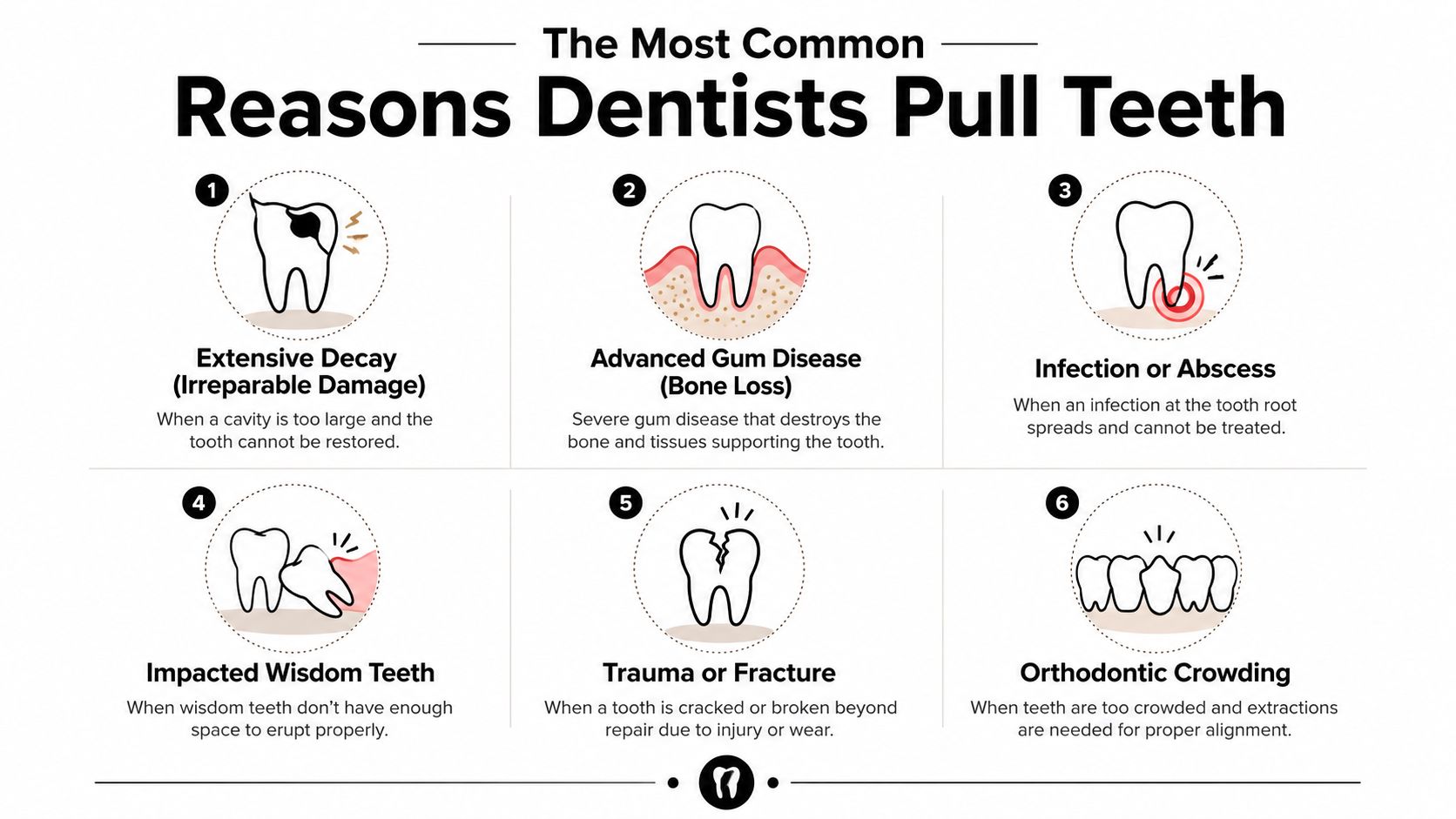
The most common reason teeth get pulled is damage that has gone too far to repair reliably. A systematic review of adult extractions found that caries accounted for 36.0% to 55.3% of extractions and periodontitis for 24.8% to 38.1%, while orthodontic reasons were only 2.5% to 7.2% and trauma 0.8% to 4.4% in the included studies (systematic review). That pattern helps explain how dentists think. They try to preserve the tooth first, then recommend extraction once the structure or support is no longer dependable.
Decay, gum disease, infection, and crowding
Extensive decay becomes an extraction issue when too much of the tooth has been destroyed to hold a filling, crown, or root canal in a way that will last. Deep cavities can reach the pulp, and once the crown is too broken down, the tooth may no longer be sealable or rebuildable in a durable way (clinical review). A tooth in that state can still be visible in the mouth, but inside it may already be beyond a predictable repair.
Advanced gum disease follows a different path. The tooth may not be badly decayed, yet the bone and ligament around it may have broken down. Once that support is severely reduced, the tooth can become loose and harder to keep clean, which is why removal is often recommended when the root no longer has enough support to function safely (periodontal reference).
Infection or abscess can turn a tooth into a repeated source of pain and swelling. If the infection keeps returning, or if the tooth cannot be saved in a way that is likely to hold, pulling it removes the source of trouble instead of repeatedly calming it down.
Trauma or fracture can also cross the line. A tooth broken below the gumline may leave too little structure for a strong restoration, especially if the crack extends into the root or splits the tooth in a way that cannot be stabilized.
A tooth can look fine from the outside and still fail the basic test that matters most, can it stay in place and stay sealed. Dentists are judging support, seal, and long-term stability, not appearance alone.
Why wisdom teeth are their own category
Wisdom teeth are the third molars, and they cause problems in a different way from the front and middle teeth. They often erupt in the late teen and early adult years, when there may not be enough room at the back of the mouth. In the U.S., about 10 million wisdom teeth are removed each year, affecting roughly 5 million Americans annually, and extraction is typically indicated for pain, infection, cysts, decay, or orthodontic need (wisdom tooth statistics).
For many patients, the question is not whether a wisdom tooth exists in the mouth. It is whether it is coming in cleanly, pressing on the second molar, or becoming trapped under gum and bone. That is why a wisdom tooth may be removed even when it is not rotten, if it is likely to create repeated problems later.
Save the Tooth vs Pull the Tooth
| Situation | Often Try to Save With | Often Pull Because |
|---|---|---|
| Deep decay with enough structure left | Filling, crown, root canal | The tooth can still be sealed and rebuilt predictably |
| Deep decay with too little structure | Sometimes endodontic retreatment or crown lengthening | There isn't enough sound crown or root for a durable repair |
| Gum disease with remaining support | Deep cleaning, periodontal treatment | Bone support is too reduced for the tooth to stay stable |
| Cracked tooth above the gumline | Crown or root canal in selected cases | The fracture extends too far down or splits the root |
| Wisdom tooth causing pressure or infection | Monitoring in mild cases | It is impacted, symptomatic, or damaging the molar ahead of it |

Warning Signs You Can Notice at Home
Pain alone doesn't tell the whole story, but it gives clues. A tooth that only hurts with sweets may still be savable. A tooth that throbs, feels loose, or keeps flaring up after antibiotics deserves a closer look.
What the symptoms usually suggest
Lingering hot or cold sensitivity can point to a nerve that's irritated or inflamed. That doesn't automatically mean extraction, but it does mean the inside of the tooth may be under stress.
Throbbing pain often suggests infection or pressure inside the tooth. If the discomfort wakes someone up at night, the tooth is usually asking for attention sooner rather than later.
A tooth that feels loose needs context. A loose crown on a healthy tooth is one problem. A loose natural tooth with bone loss is another. The latter is more concerning because the support system around the root may be failing.
Swollen or bleeding gums around one tooth can signal localized disease or a draining infection. A recurring pimple on the gum is a classic sign that pus is finding a way out, which means the tooth needs an exam.
Write this down before the appointment: which tooth hurts, what sets it off, whether swelling comes and goes, whether there's bad taste or drainage, and whether chewing makes it worse.
That short list helps the dentist move faster once the patient is in the chair. It also keeps the conversation focused on the issue, whether the tooth can be saved or whether the underlying problem has already passed the point where conservative care is likely to hold.
What makes a prompt visit worthwhile
A tooth can go from “annoying to “urgent when infection starts spreading, the bite changes, or chewing becomes unreliable. The safest move is a dental exam with X-rays before the pain becomes a bigger problem.
For Miami patients, that visit may happen through a dentist near me search, an emergency dentist call, or a routine cleaning and exam that catches the problem early. Either way, the goal is the same, figure out whether the tooth is still worth saving while there's still time to choose.
Save It or Pull It How Dentists Make the Call
A patient may sit down expecting a simple filling and hear something different. The core question is whether the tooth can still be kept stable for the long term, or whether treatment would only buy a little more time before the same problem returns.
If the answer points toward stability, a filling, crown, root canal, or retreatment may still make sense. If the answer points the other way, extraction can spare the tooth from repeated repair attempts that are unlikely to hold.
The threshold dentists look for
A tooth is usually called unrestorable when decay, fracture, or earlier treatment has taken away so much structure that there is not enough crown or root left to support a durable filling, crown, or root canal. That is the line many patients never see from the outside, because the tooth can look intact enough until the X-ray and exam show how little sound structure remains.
Support matters too. If advanced periodontal disease has reduced the bone around the root to the point that the tooth no longer has a firm foundation, the tooth may still be present but no longer practical to keep. Chewing forces, cleaning difficulty, and ongoing inflammation can keep working against it.
Gray-zone cases are where judgment matters most. A cracked root that runs below the gumline, a failed root canal, or a wisdom tooth injuring the molar next to it can sit right at the edge of the decision. In those situations, a dentist may compare the chance of predictable repair with the chance that removal will solve the problem more cleanly, including the type of choice described in this comparison of root canal treatment and extraction.
| Situation | Often Try to Save With | Often Pull Because |
|---|---|---|
| Decay but enough structure remains | Filling or crown | Restorability is still predictable |
| Nerve infection with a repairable tooth | Root canal and crown | Not usually first choice if the tooth can be preserved |
| Severe fracture below the gumline | Sometimes none | The seal and structure can't be made durable |
| Advanced bone loss | Periodontal care in early cases | The tooth no longer has enough support |
| Failed prior treatment | Retreatment in selected cases | Repeated repair is unlikely to hold |
A calm dentist should show the X-ray, point to the area of concern, and explain why the tooth crosses the line. That conversation matters more than the label on the treatment, because a patient deserves to understand why extraction is being recommended instead of being left to guess.
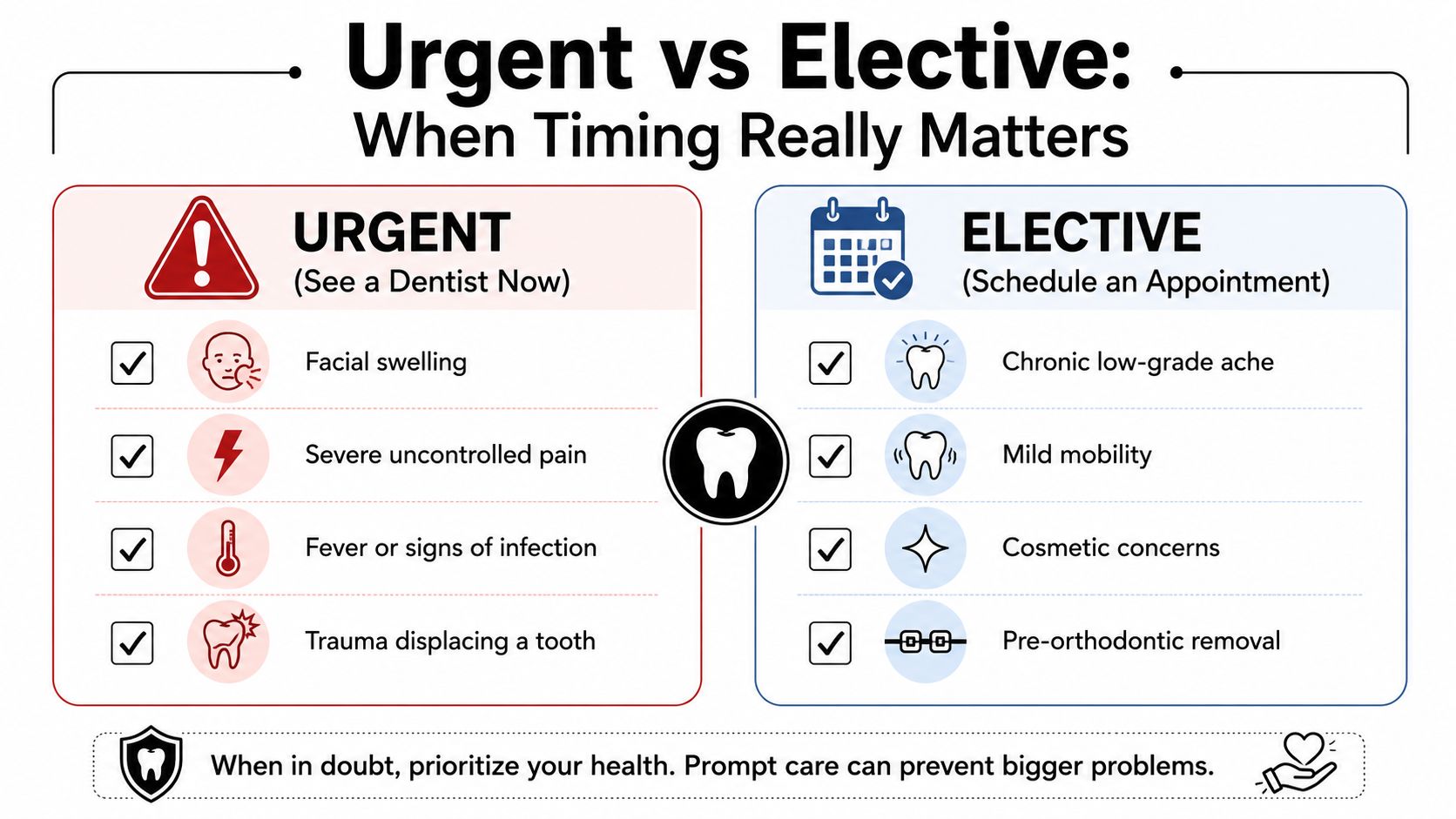
Urgent vs Elective When Timing Really Matters
A tooth can cross from “we should plan this to “we need to act now quickly. The difference is not just the tooth itself, it is what the surrounding tissues are doing. If the problem stays local, a scheduled visit may be fine. If the body is showing a wider reaction, the appointment moves into urgent territory.
When the clock is moving fast
Facial swelling, trouble swallowing or breathing, fever with a toothache, uncontrolled bleeding, or trauma that has knocked a tooth loose or out all deserve urgent attention. Those signs mean the problem is no longer acting like a simple cavity or a mild gum flare. The concern is less about pain alone and more about whether infection, bleeding, or injury is spreading beyond the tooth.
A painful wisdom tooth can sit in either category. If it aches off and on, it may be something to plan around. If swelling, fever, or drainage shows up, the conversation changes and the tooth may need faster treatment. The decision is really about the threshold, whether the tooth is still causing a local problem or has started affecting the rest of the mouth and face.
When planning is reasonable
A non-restorable tooth that is quiet right now may not need an emergency slot if there's no swelling, fever, or spreading infection. A planned extraction before Invisalign or other orthodontic treatment is usually scheduled in advance. A wisdom tooth that hasn't caused damage yet may be watched until the timing makes more sense for the patient and the mouth.
That timing question comes up often with wisdom teeth, because many of them are removed only after they begin to crowd, inflame, or damage nearby teeth. The decision is often less dramatic than people expect. A dentist is usually asking a simple question, is this tooth likely to become a bigger problem if it stays, or is it safer to remove it before it causes more trouble?
A simple rule of thumb
If the tooth hurts but the face is not swelling and the person can eat, breathe, and swallow normally, a prompt appointment is usually enough. If any of those red flags are present, an emergency dentist visit is the smarter move. That is the line many dentists use when they decide whether a tooth can wait for a calm, planned visit or needs same-day attention.
For adults searching dentist in Miami, FL, that distinction can lower a lot of anxiety. Some teeth are watched and scheduled carefully. Others are treated sooner because waiting would give the problem room to spread. If the next step is a planned extraction, aftercare guidance for extraction recovery can help you know what the first days should look like.
What a Gentle Extraction Actually Feels Like
Modern extraction is usually quieter than people expect. The appointment starts with numbing, and after that the sensation is typically pressure, movement, and sound, not sharp pain. A comfortable setting matters here, especially for anxious patients who already arrive tense.
During the visit
The dentist first confirms the tooth, reviews the X-ray, and numbs the area thoroughly. For many straightforward cases, the tooth is loosened and removed without drama. If the case is more complex, such as a fractured root or a wisdom tooth that needs surgical removal, the approach changes, but the goal stays the same, keep the patient comfortable while removing the problem tooth.
In a practice that offers a spa-like environment, the small details matter, from calming seating to a slower pace of explanation. Ultra Smile DentalSpa is one local option in Miami that pairs extraction care with a comfort-first setting for patients who don't do well with dental stress.
After the visit
The first day usually centers on gauze, soft foods, and protecting the area from disturbance. Patients are commonly told to keep the site clean, avoid poking it, and follow the instructions on pain control and rinsing. If healing is planned with a future implant in mind, the team may also discuss socket preservation or bone grafting before the appointment ends. Aftercare guidance for extraction recovery
Practical expectation: The goal after a simple extraction is steady, boring healing. Pain that worsens instead of easing, persistent bleeding, fever, or a bad taste that won't go away should prompt a call to the office.
For many anxious patients, the biggest relief is learning that the visit has a clear sequence and a clear end point. There is a beginning, a numbing phase, a removal phase, and a recovery plan. That predictability is often what changes fear into action.
Questions to Ask Before You Agree to an Extraction
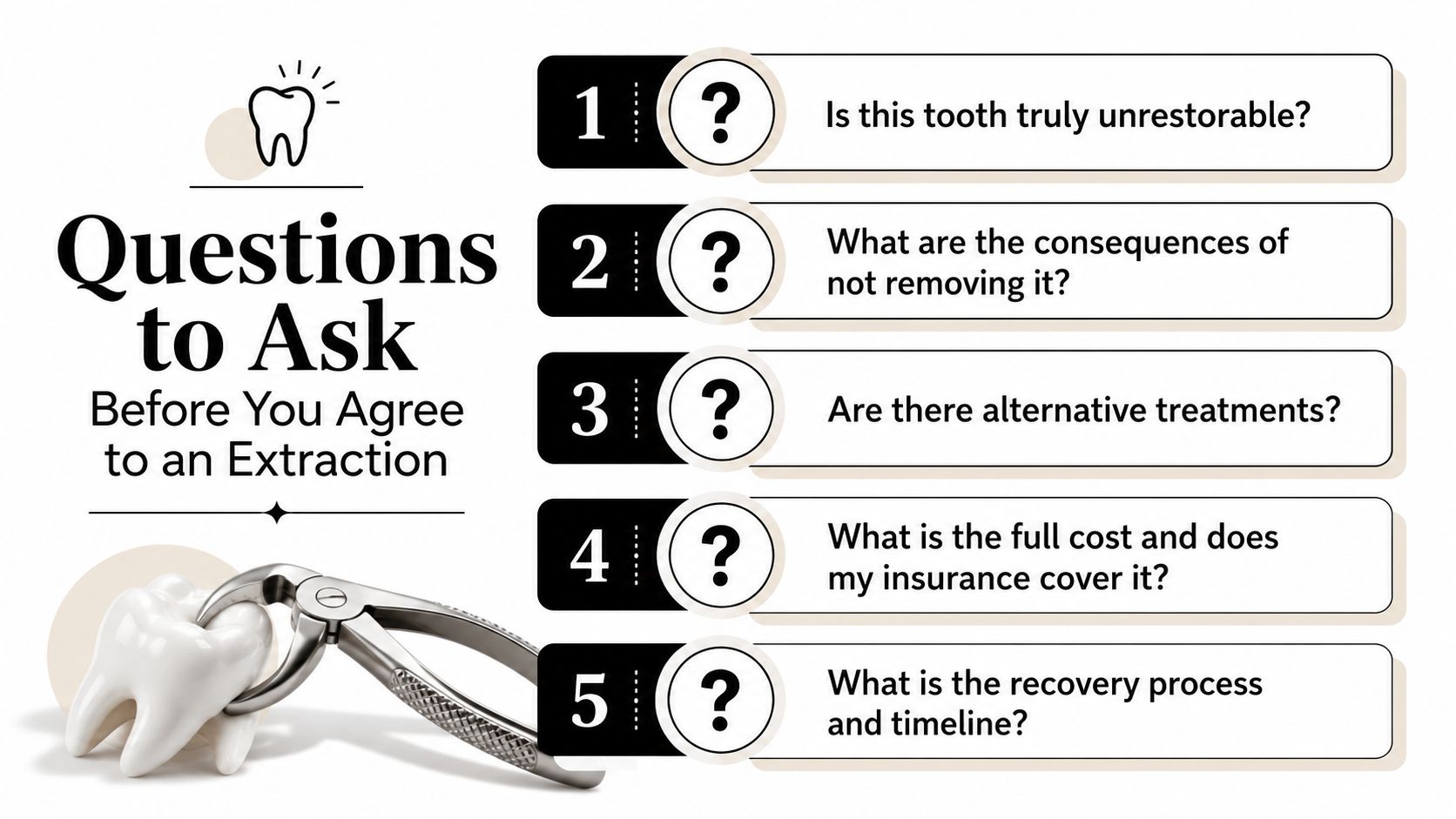
A good extraction conversation shouldn't feel one-sided. Patients deserve enough information to understand why the tooth is being recommended for removal and whether there's still a realistic path to save it.
Questions that keep the plan honest
- Is this tooth unrestorable? That question gets to the core of the decision, because if enough structure remains, preservation may still be possible.
- What happens if it stays in place for now? Some teeth are stable for a while, others keep flaring up or harming the tooth beside them.
- What are the alternatives? Depending on the case, those may include root canal therapy, retreatment, crown work, or periodontal treatment.
- Will healing be different because of my health history? Diabetes, osteoporosis, blood thinners, and medications like bisphosphonates can affect the surgical plan.
- Will an implant or bone graft be needed later? That matters because jawbone preservation can influence future restorative options.
There is no strict age limit for extraction, but older adults often need jawbone-density assessment and sometimes bone grafting, and patients with complex health histories or irregular root structure may be referred to an oral surgeon for safety (age and complexity guidance).
Why those questions matter
The right answer isn't always “pull it now or “save it forever. The right answer is the one that matches the tooth's condition, the person's overall health, and the long-term plan for the mouth.
A patient who asks good questions usually gets a better explanation and a clearer written plan. That helps everyone, especially when the next step may involve restorative dentistry, dental implants near me, or a later cosmetic repair after the extraction site heals.
Getting a Calm Second Opinion in Miami
Extraction should stay what it really is, a last-resort decision when saving the tooth is no longer predictable. The right dentist should show the X-ray, explain the threshold in plain language, and walk through the alternatives before anything is scheduled.
For patients in Downtown Miami, Midtown Miami, and Hallandale Beach who are dealing with pain, looseness, swelling, or just uncertainty, a calm evaluation can make the difference between panic and a plan. Ultra Smile DentalSpa offers new-patient exams and consultation-based care in a comfort-focused setting, with refreshments, aromatherapy, streaming entertainment, and a hot towel finish for patients who want dentistry to feel less stressful and more manageable.
If the tooth is bothering someone at night, flaring up again after treatment, or feeling like it may not last, that's the moment to stop guessing. A dentist near me search can start the process, but a real exam is what gives the answer. For people also thinking ahead about cosmetic dentist near me, dental implants near me, or broader restorative care, a clear diagnosis is the first step before any of those plans make sense.
A CTA for Ultra Smile DentalSpa. Schedule a consultation or new-patient exam in Miami for a calm, judgment-free evaluation, and get a clear treatment plan before deciding whether to save a tooth or pull it.