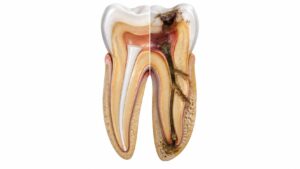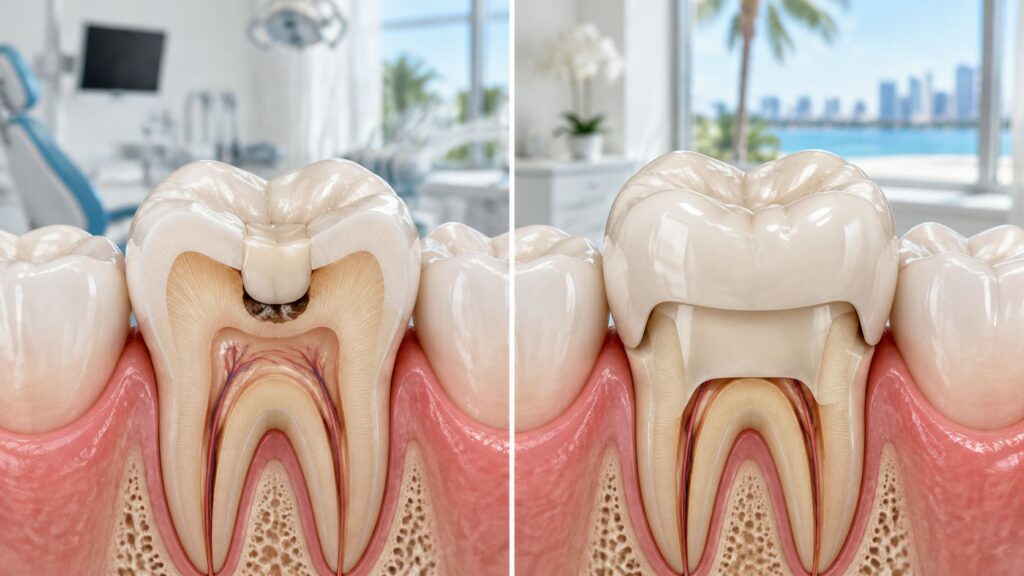
A filling repairs a contained hole in a tooth that keeps most of its walls, while a crown is needed when the tooth has lost enough structure that it requires full coverage to stay strong. Cavity size alone doesn't settle that call, because a deep but narrow cavity and a wide, shallow one can leave very different amounts of sound tooth behind.
What if the stronger-looking option is sometimes the weaker choice for the tooth underneath? A crown covers everything, but fitting it also removes healthy structure on every side. Patients in Miami, FL weighing pain, sensitivity, or a chipped edge against the cost and time of treatment need that trade-off explained against their own X-ray, not against a generic rule.
Table of Contents
- Crown or Filling Near Me in Miami, FL
- Clinical Thresholds That Decide the Choice
- Root Canal-Treated and Cracked Teeth
- Large Decay, Old Fillings and the Middle Ground
- How Long Each Option Lasts
- What Happens During a Filling or Crown Visit
- What a Filling or Crown Costs in Miami
- Book Your Exam to Get a Clear Answer
Crown or Filling Near Me in Miami, FL
A filling is usually right when decay or damage stays contained and the tooth keeps most of its outer walls. A crown is usually needed when the tooth is weakened enough that a filling cannot reliably hold it together. The NHS describes fillings as repairs for a hole caused by decay, while a crown is a fixed cap that completely covers the natural tooth, as explained in NHS guidance on dental treatments.
That difference shapes every when do you need a crown vs filling decision. Preserving enamel matters when enough of it remains, and covering the tooth matters when it doesn't.
A filling replaces what is missing, while a crown protects what is left.
Filling vs crown side by side
| Factor | Filling | Crown |
|---|---|---|
| What it does | Repairs a contained hole left by decay or a small chip | Covers the whole tooth like a protective cap |
| Tooth removed | Only the damaged or decayed area | Tooth reshaped on all sides to fit the cap |
| Typical use | Small to moderate decay, minor damage with sound walls | Large damage, cracks, weakened cusps, root-treated teeth |
| Common materials | Tooth-colored composite, silver amalgam for some back teeth | Porcelain, zirconia, porcelain-fused-to-metal, metal |
| Visits | Usually one | One same-day visit, or two visits when a lab makes the crown |
| Same-day option | Typically available | Available as same-day milled crowns |
The table gives the shape of the choice, not the final answer for a specific tooth. A clinical exam with dental x-rays shows how much sound structure remains once decay is removed, whether a crack hides under an old restoration, and how the bite loads the tooth. Material choice also depends on the tooth involved, with tooth-colored options often favored where appearance shows and amalgam still considered for some back teeth.
Patients searching for a dentist near me or dentist in Miami, FL can ask Ultra Smile DentalSpa about composite fillings and same-day crowns during one visit. Finding the column that matches the tooth in question, then confirming it at a new patient exam, is the practical order. Restorative dentistry works best when the recommendation follows the structure in the mouth rather than a price or a habit.
Clinical Thresholds That Decide the Choice
Dentists start with how much of the tooth is still standing, not how big the cavity looks on a screen. A back tooth keeps working when its walls and cusps, the raised points that take the bite, carry chewing force without flexing. Once walls thin out or cusps lose support underneath, a filling packed inside the tooth can act like a wedge instead of a reinforcement.
Clinical thresholds for filling vs crown
| Factor | Filling usually enough | Crown usually needed | Grey zone |
|---|---|---|---|
| Intact walls (living back tooth) | 3 or more walls | 1 wall or fewer | Exactly 2 walls, cusp thickness and bite decide |
| Surfaces lost to decay or damage | 1 to 2 surfaces | 4 or more surfaces | 3 surfaces, especially with already thin walls |
| Cracks | No crack reaching the bite surface | Crack extending into a cusp or across the tooth | Hairline crack whose path is unclear |
| Root canal treatment | Minimal to moderate structural loss | At least one proximal wall lost, or undermined cusps | Minimal loss with thin cusps |
| Bite load and grinding | Normal bite, cusps barely flex | Heavy grinding, cusps flex under load | Mild grinding with sound walls |
| Existing large filling | Sound, no decay or crack beneath it | Decay under it, leakage, or weakened walls | Old filling with unclear margins |
Treat these counts as a clinical rule of thumb rather than a verdict. They give the exam a starting grid, and cusp thickness, wall height, and bite force move a tooth between columns. Leeds Teaching Hospitals guidance on crowns describes a crown as an artificial cap fitted over a prepared tooth to restore its shape and strength, which is the job description for a tooth that has lost most of its own walls. Two intact walls sit in the grey zone on purpose. A two-wall premolar with thick cusps can carry a filling for years, while a two-wall molar under grinding force may flex around the same restoration and split.
At the exam: Ask how many walls remain, which row the tooth falls into, and request that reasoning in writing.
Counting surfaces never settles the case alone. Cracks, wall thickness, tooth position, chewing load, moisture control, gum support, and whether the nerve is alive all shift the answer. A molar under heavy grinding load tolerates a large filling poorly; a smaller premolar with sound walls may hold one for years.
The same math applies to old restorations. Drilling out a sound, intact silver filling means cutting healthy tooth away with it, and a tooth that went in with a moderate filling can leave the appointment needing a crown. When an amalgam shows no decay, crack, or leakage underneath, monitoring it preserves structure. For small defects generally, a direct filling remains the conservative repair because it sacrifices the least tissue; indirect coverage earns its place as less tooth remains.
Root Canal-Treated and Cracked Teeth
Not every root-canal-treated tooth automatically needs a crown, despite how often that rule gets repeated. Root canal treatment removes the nerve and blood supply, and the access opening plus any prior decay can leave the remaining tooth more prone to fracture under load. How much structure survives that process matters more than the fact that a root canal happened.
In endodontically treated back teeth with minimal to moderate structural loss, pooled fracture-survival estimates reached 94% to 100% for crowns and 91.9% to 100% for direct resin composites, with no statistically significant difference, as reported in a systematic review of restorations for root-treated posterior teeth. A separate review found survival against fracture was not significantly different between crowns and resin composites with one to three surfaces of structure loss, per the Saudi Endodontic Journal evidence review.
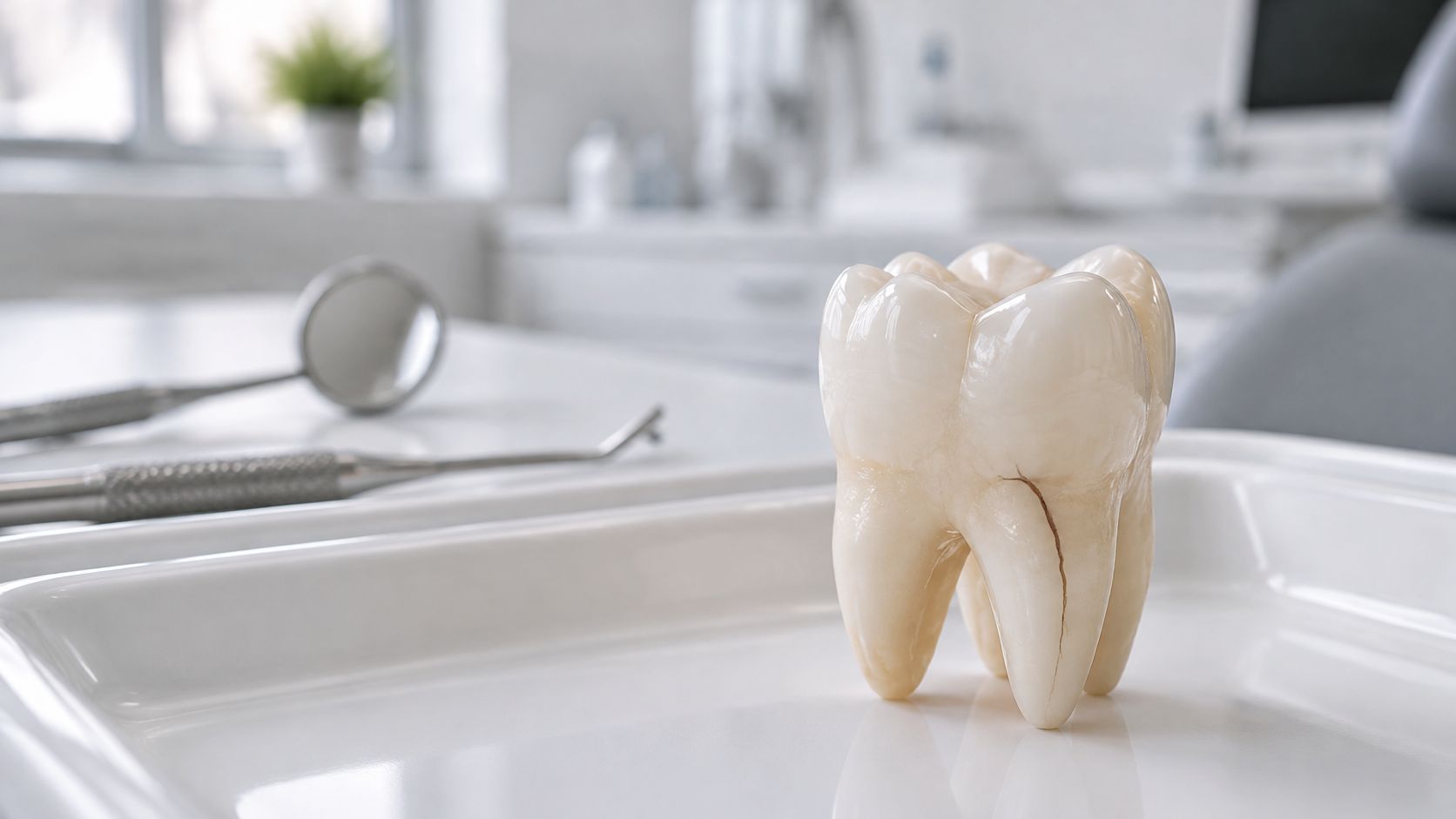
A close look at how a crown fits and covers a prepared tooth helps explain why coverage gets recommended for the weaker cases.
Findings that move the answer toward a crown
- Proximal wall lost: Loss of at least one side wall in a root-filled premolar or molar supports cuspal coverage.
- Undermined cusps: Cusps that flex under bite pressure need covering and splinting, not a large filling between them.
- Large existing filling: Root-filled teeth already carrying big restorations often have little sound wall left.
- Grinding habits: Parafunctional load raises fracture risk on an already thinned tooth.
- Existing crack: A crack that has started can keep traveling under normal chewing.
The path of a crack matters more than its length. A short crack running toward the root or across the bite surface carries more risk than a long surface line that stays in enamel, and the dentist checks direction with bite tests, light, and imaging. Front teeth get assessed differently because biting forces there are lower, and tooth-colored composite often restores them where structure allows.
Bringing root canal records to the exam helps, along with one direct question about whether the remaining cusps are fully supported. Patients with sharp pain on release of bite, swelling, or a piece broken off shouldn't wait for a routine slot. An emergency dentist can assess the crack before it splits further.
Large Decay, Old Fillings and the Middle Ground
Between a filling and a full crown sits a middle ground many patients never hear described. Selective caries removal means the dentist removes the softest decayed tissue and seals the remaining affected dentin instead of chasing every stained trace toward the nerve. The ADA supports selectively removing decayed tissue and sealing what remains, including for moderate or advanced decay in permanent teeth, in the ADA guideline on tooth decay treatment.
Three options instead of two
- Direct filling: Composite placed in the mouth for contained damage with sound walls and supported cusps.
- Inlay or onlay: A bonded partial-coverage restoration that covers weakened cusps while keeping more healthy enamel than a crown, with repair options described under composite filling repair.
- Full crown: Complete coverage when cusps and walls can no longer carry the load on their own.
Remaining cusp thickness, crack location, bite forces, moisture control, decay risk, and pulp health decide between those three. A crown requires substantially more tooth reduction than a filling, so stronger coverage doesn't mean better treatment when adequate structure remains. Cosmetic dentistry goals, including color match and shape, also carry more weight on teeth that show in a smile.
Old silver fillings deserve the same restraint. The FDA advises specified higher-risk groups to avoid new amalgam when possible and appropriate, but says existing amalgam fillings in good condition generally shouldn't be removed without a medical reason, in FDA recommendations on dental amalgam fillings. Replacing an intact silver filling only because it's silver removes healthy tooth, enlarges the restoration, and can push that tooth closer to needing a crown.
Replacement makes sense when the filling is failing, decay sits beneath it, a crack appears, margins leak, or a documented sensitivity to amalgam components exists. Amalgam can remain advantageous for large posterior fillings, high decay risk, or difficult moisture control, while resin alternatives may be less durable under heavy molar forces. A candid material discussion covers isolation, bite stress, decay risk, aesthetics, repairability, and how much tooth removal each option requires.
How Long Each Option Lasts
Patients ask me for a number: how many years will this filling or crown give me? The honest answer depends less on the material label than on restoration size and clinical conditions. A small filling wrapped in sound enamel lives in a different world from a wide filling stretched across several surfaces between thin cusps. That gap explains most of the spread in published figures.
Reported longevity for fillings and crowns
| Restoration | Reported figure | What it means for you |
|---|---|---|
| Composite filling, single surface | Longest-lived composite category in NICE data | Small, single-surface fillings are the most predictable |
| Composite filling, overall | Median survival 17 years; 56% still in place at 10 years (NICE) | Plan for possible replacement within one to two decades |
| Composite filling, general | About 90% success after 10 years (ADA-cited 2012 study) | Roughly comparable to amalgam in the same review |
| Large back composite, multi-surface | Elevated annual failure rate (ADA-cited 2020 systematic review) | Larger repairs need closer monitoring |
| Crowned posterior tooth | 71% survival at 8 years, versus 58% without cuspal coverage (ESE-cited study) | Full coverage extends the working life of weakened teeth |
ADA guidance on materials for direct restorations cites a 2020 systematic review reporting a higher yearly failure rate for large posterior composite restorations, and a 2012 study showing about 90% composite success after 10 years, comparable to amalgam in that same review. Separate UK data from the National Institute for Health and Care Excellence puts median composite survival at 17 years, with 56% still in place at the 10-year mark. Read plainly, half of composite fillings outlast that median and half are replaced sooner, and single-surface work outperforms multi-surface work.
Crowns fail for their own reasons. Recurrent decay at the margin, fracture, wear, leakage, or changes in the supporting tooth can force a repair or replacement on any restoration. One retrospective study reported 71% survival for crowned posterior teeth versus 58% without cuspal coverage over 8 years, as summarized in European Society of Endodontology guidance on restoring root-filled teeth. In other words, most crowned teeth in that group were still functioning past the eight-year mark.
These are population averages, and no statistic sets a deadline for your tooth. A single-surface filling in a low-stress bite can run well past its median, while a big filling under heavy load may need attention far earlier. Each replacement also removes a little more healthy tooth, so a filling replaced repeatedly can end up with walls thin enough to need a crown. At a new-patient exam, surface count, bite load, cracks, hygiene, and previous treatment let me estimate how long a specific restoration should last. Ask for that estimate, and what monitoring it implies, and the statistics turn into a plan.
What Happens During a Filling or Crown Visit
Both visits start the same way, with an exam and dental x-rays confirming the decay, the health of the nerve, and the bone support around the tooth. After that shared first step, the paths separate. The infographic below lays the two lanes side by side so the visit counts are easy to compare.
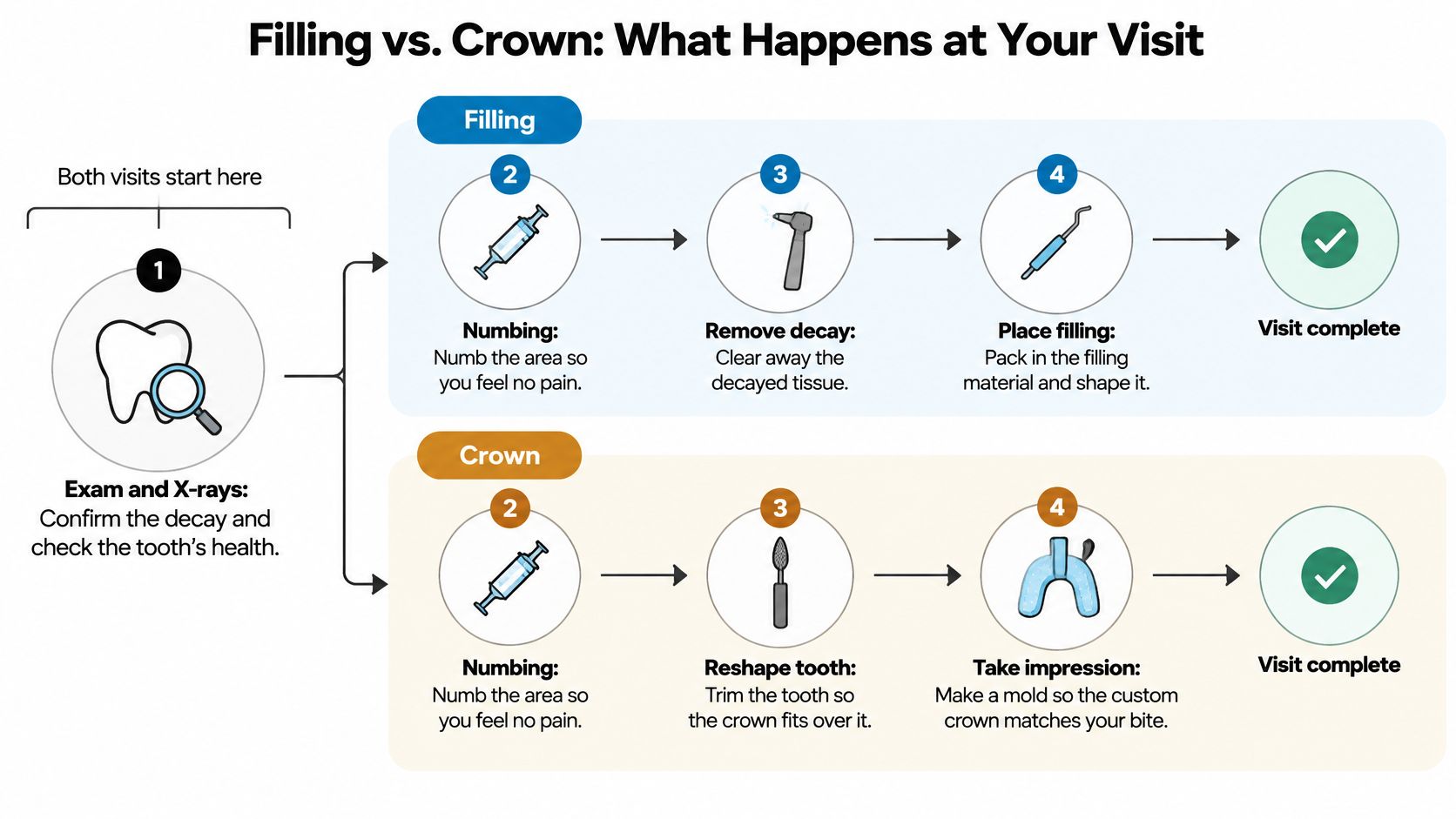
The filling sequence
- Exam and X-rays confirm the extent of decay before anything is removed.
- Numbing keeps the area comfortable during the work.
- Decay removal clears the damaged tissue, sometimes selectively near the nerve.
- Placement builds tooth-colored composite or amalgam in layers and shapes it to the missing contours.
- Bite check and polish finish the surface so chewing feels even.
A filling is usually completed in one appointment. Sensitivity afterward tends to track with how deep the decay sat, and the team explains what's expected before the patient leaves.
The crown sequence
- Exam and X-rays confirm the restoration choice and check whether root canal treatment is needed first.
- Reshaping trims the tooth on all sides after numbing so the cap can fit over it.
- Scan or impression records the prepared tooth and the bite relationship.
- Temporary crown protects the tooth while a lab fabricates the permanent porcelain, zirconia, or metal crown.
- Final bonding seats and cements the permanent crown at the return visit.
Details of each stage appear in the dental crown procedure overview. A same-day crown compresses steps three through five into one visit, with a digital scan, in-office milling, then adjustment, bonding, and polishing before the patient heads home.
The short video below walks through what these steps look like in practice.
Numbing keeps both procedures comfortable, and patients can ask the team to pause at any point. The honest summary is simple. A filling usually takes one visit, a traditional crown usually takes two, and a same-day crown finishes in one.
What a Filling or Crown Costs in Miami
How much does the choice between a filling and a crown cost in practice? The honest starting point is a national benchmark, since every Miami office sets its own fees. Investopedia's overview of dental costs without insurance lists average out-of-pocket prices of $146 for an amalgam filling, $174 for a composite filling, and $1,416 for a crown, drawn from an American Dental Association survey. Miami quotes land above or below those averages depending on the practice, the lab it uses, and the neighborhood.
Average out-of-pocket cost by restoration
| Treatment | Average out-of-pocket | What drives the final price |
|---|---|---|
| Amalgam filling | $146 | Number of surfaces repaired |
| Composite filling | $174 | Surfaces, tooth position, size of repair |
| Crown | $1,416 | Material, lab or in-office fabrication, build-up |
The biggest price gaps sit in the work around the restoration. A filling quote climbs with each added surface, so catching decay while it still occupies one face of the tooth keeps the fee low. Crown quotes move with material: porcelain, zirconia, porcelain-fused-to-metal, and full metal each carry different lab costs. A core build-up or a root canal completed before the crown appears as separate line items, and root canal fees vary by which tooth is treated and how many canals it holds. Same-day crowns shift the math again, trading an outside lab fee for in-office milling.
One cost patients rarely count is replacing a silver filling that still works. Cutting out an intact amalgam removes healthy tooth along with it, and that lost structure can push a borderline tooth into needing a crown. Leaving a sound filling alone is often the cheaper path on both fronts.
Coverage varies by plan, so Miami, FL patients do well to confirm their share with the insurer and request a written, itemized estimate for each option before deciding.
Book Your Exam to Get a Clear Answer
A little preparation makes the first visit far more useful. Patients do well to arrive ready to describe the tooth in concrete terms rather than general discomfort.
What to note before the appointment
- Symptoms: Sensitivity to cold, pain when biting, a visible crack, a chipped edge, or a filling that feels loose, plus when each started.
- Treatment history: The date and material of any past filling, crown, or root canal on that tooth.
- Habits: Grinding, clenching, or waking with a sore jaw, since bite load changes the recommendation.
Five questions worth asking
- How many walls remain on the tooth once decay is removed?
- Is there a crack, and where does it run?
- Filling or crown, and what's the reasoning for that specific tooth?
- Can it be done same-day, or does it need a lab and a temporary?
- What will it cost in writing, itemized for each option?
A new patient exam pairs dental x-rays with a clinical look at the tooth, often alongside cleaning and exams for the rest of the mouth. That combination turns the when do you need a crown vs filling question from a guess into a documented plan. Severe pain, swelling, or a broken tooth needs faster attention through emergency dentist care rather than waiting for a routine opening.
Patients searching for a cosmetic dentist near me or dental implants near me often discover the aching back tooth needs attention first, because whitening and cosmetic work sit better on a stable foundation. One call or consultation request, tied to the sensitivity or broken edge already causing trouble, gets a clear answer for that tooth.
Patients with a sensitive, cracked, or heavily filled tooth can get a straight filling-versus-crown assessment, including composite fillings and same-day crowns, at Ultra Smile DentalSpa in Miami, FL. The team walks through the X-ray, the remaining tooth structure, and an itemized estimate before any work begins. Booking a consultation is the simplest way to stop guessing about that one tooth and start treating it.