Most dental plans cover part of a crown, usually around 50 percent of the plan's allowed fee after the deductible, not the full price the dentist quotes. Full payment is the exception, and the paperwork often decides the bill more than the percentage on the card.
A cracked or heavily filled tooth can ache when you chew, and the worry about the bill arrives right after the pain. Searching for a dentist near me in Miami, FL usually starts with that mix of discomfort and cost questions. A dentist in Miami, FL can restore the tooth, but the insurer treats the crown as major care, so the check you write is rarely half of the first number you hear.
Patients near Downtown Miami, Midtown Miami, and Hallandale Beach run into the same surprise. The plan may help, then a waiting period, a yearly cap, or a replacement rule shrinks that help. The sections below walk through those rules in the order they change the bill.
Table of Contents
- Most Plans Cover Part of a Crown, Not All of It
- When Insurers Consider a Crown Medically Necessary
- How Insurers Calculate Your Share of a Crown
- Waiting Periods, Annual Maximums and Replacement Limits
- How to Verify Crown Coverage Before You Book
- What to Do When Coverage Falls Short
- Book a Crown Consultation in Miami, FL
Most Plans Cover Part of a Crown, Not All of It
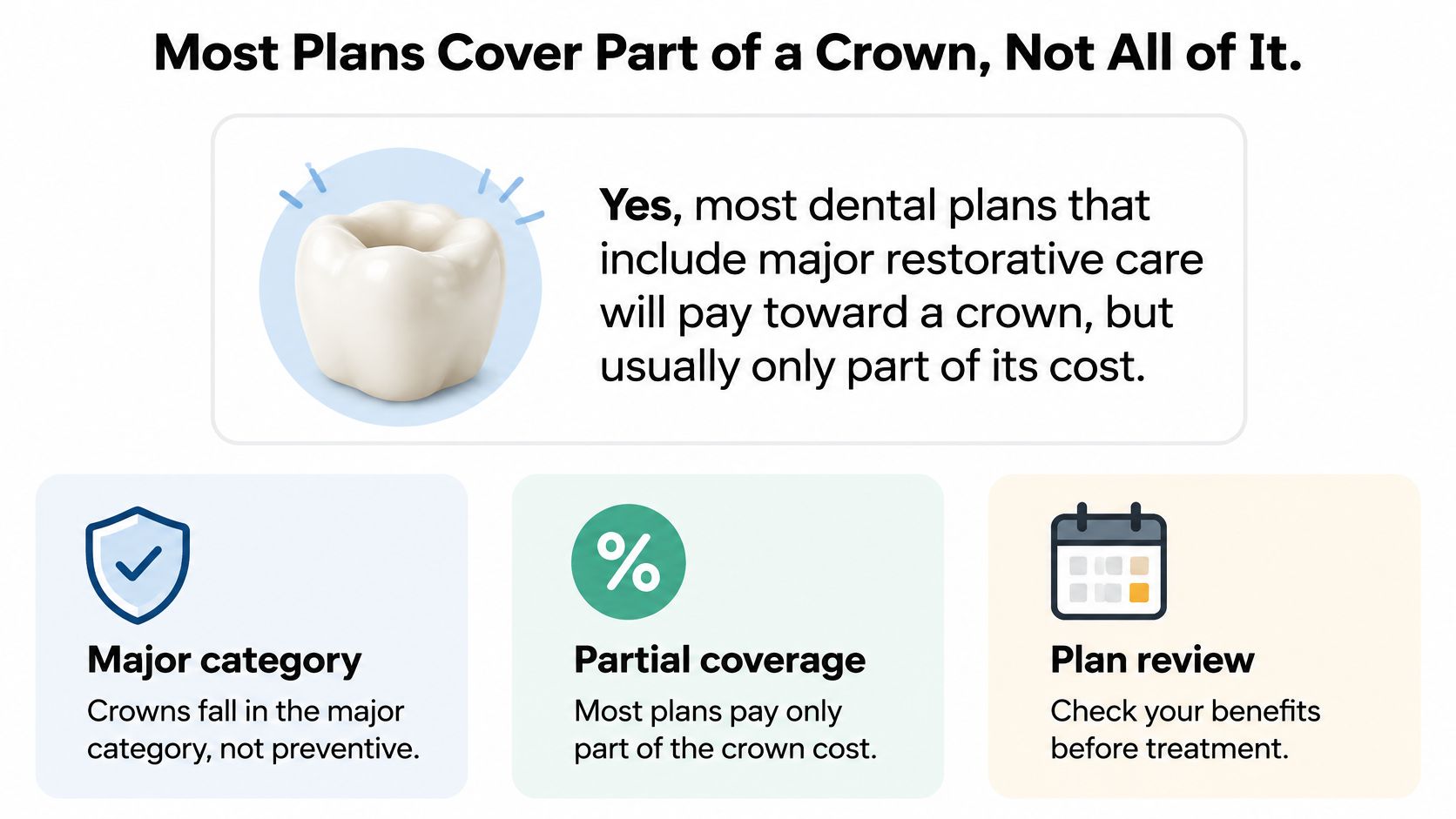
Yes, most dental plans that include major restorative care will pay toward a crown. They usually pay only part of the cost, because a crown is not preventive care and it is not a basic filling.
Dental coverage works more like a coupon with conditions than a blank check. In the United States, plans commonly treat crowns as a major restorative service, and the American Dental Association describes a typical split: 100% of preventive services such as examinations and cleanings, approximately 80% of basic procedures such as fillings, and about 50% of major procedures such as crowns and bridges.
| Service Category | Typical Plan Payment | Examples | Where Crowns Fall |
|---|---|---|---|
| Preventive | 100% | Exams, cleanings, X-rays | No crown coverage |
| Basic | About 80% | Fillings | No crown coverage |
| Major | About 50% | Crowns, bridges, sometimes root canals | Where a crown claim is paid |
Why the patient share stays large
The percentage on the benefits card is only the starting point. A root canal followed by a crown can run past many plans' yearly maximums, so the patient often ends up paying a large share of the combined total. Once that maximum is reached, the insurer generally stops paying for additional covered care during the plan year.
Every percentage also applies after the deductible and against the plan's allowed fee, not against every dollar on the treatment plan. If the allowed fee comes in lower than the quoted price, that gap lands on the patient too. Coinsurance, the network fee, replacement rules, and clinical necessity each trim the insurer's share further, which is why the paperwork around a claim can matter as much as the rate printed in the benefits summary.
A pre-treatment estimate is the practical way to see the insurer's expected payment before the tooth is prepared. Patients in Miami, FL who check the major-services percentage, the remaining annual maximum, and any waiting period before a first visit get a clearer number than the benefits card alone suggests.
When Insurers Consider a Crown Medically Necessary
A crown that rebuilds a damaged tooth is judged differently from one chosen only to change shape or color. Insurers generally pay when the crown restores substantial damage from decay, fracture, a failed restoration, or extensive root-canal access. They commonly exclude work placed only for looks.
Common triggers look like this in plain terms.
- Deep decay: The cavity has weakened so much tooth that a filling has little healthy structure left to grip.
- A fracture: A break removes a cusp or splits a wall, so chewing force would crack a filling.
- A large filling that is failing: The old restoration is leaking, cracked, or so wide that another filling would not hold.
- A tooth after a root canal: The access opening and lost structure leave the tooth brittle, and a crown protects what remains.
The same reason can be scored differently on a back tooth and a front tooth. New York Medicaid dental clinical criteria treat a posterior crown as medically necessary when decay or fracture affects at least three surfaces and one or more cusps. An anterior tooth may need loss across four or more surfaces plus at least one-third of the incisal edge. The plan may also want proof that a filling cannot predictably restore the tooth, that the gums are in good enough shape, and that the tooth has a reasonable prognosis.
| Clinical Situation | Usually Covered? | Documentation Often Needed |
|---|---|---|
| Tooth with root canal treatment | Often yes | Radiographs showing treatment and remaining structure |
| Large failing filling | Often yes if a filling cannot restore the tooth | X-rays and a note on why a filling is inadequate |
| Fractured or broken tooth | Often yes | Photos and imaging of the break |
| Back tooth with decay on three or more surfaces | Often yes under some plans | Clinical findings matched to plan criteria |
| Cosmetic change of shape or color only | Usually no | Not applicable |
| Replacement of an existing crown | Only after the plan's frequency interval | Original placement date and records |
What the claim file needs
The dentist should send diagnostic radiographs, intraoral photographs, periodontal findings, and a short narrative explaining why a direct filling is inadequate. Preauthorization matters most for a ceramic crown, a crown after endodontic therapy, a replacement crown, or a tooth with little structure left. A clinician who needs a clear narrative can create a medical necessity letter so the clinical story matches what the plan asks to see.
Practical rule: If the crown is mainly meant to change color or shape, expect an exclusion even when you would still like the result.
Cosmetic veneers and crowns intended primarily to change tooth shape or color are commonly left out. When the choice is really between another filling and a crown, the crown versus filling comparison helps you see which tooth still has enough structure for a filling. Strong notes, matched to the plan's surface and cusp rules, are often what separates a denied claim from an approved one.
How Insurers Calculate Your Share of a Crown
The percentage printed on your plan applies to the insurer's number rather than the dentist's. Under the American Dental Association's guidance on annual maximums, crown benefits are calculated against the plan's allowed or negotiated fee, after the deductible, and payments stop once the annual maximum is used up. The allowed fee works like a price the plan and the in-network dentist agreed on in advance. When a plan reimburses a crown at 50% or less of that fee, the rest lands on the patient's side of the ledger.
A $1,500 quote, line by line
Say the office quotes $1,500 and the in-network allowed fee is $1,100. The deductible still owed is $50, and the plan pays 50% of what remains.
| Line Item | Amount | How It Is Calculated |
|---|---|---|
| Dentist's quoted crown fee | $1,500 | Office's full charge |
| Plan's allowed fee | $1,100 | Negotiated in-network amount |
| In-network write-off | $400 | Quoted fee minus allowed fee |
| Remaining deductible | $50 | Paid by the patient first |
| Insurer payment | $525 | 50% of the $1,050 left after the deductible |
| Patient balance | $575 | $50 deductible plus $525 coinsurance |
Three steps happen in order. The in-network dentist writes off the $400 gap between the quote and the allowed fee. You pay the $50 deductible first, before any percentage applies. The insurer then covers half of the remaining $1,050, which is $525, and you owe the deductible plus the uncovered half, $575 in this illustration.
An out-of-network dentist can bill above the allowed amount, and that extra gap belongs to you as well. With the same 50% plan, the same tooth can cost noticeably more purely because of network status.
The yearly cap changes the arithmetic
The annual maximum caps what the insurer pays for the whole benefit year, and once it is reached you pay 100% of additional covered care until the year resets. This is why the same 50% crown plan can produce two very different bills: a crown approved early in the year draws on a full maximum, while a crown approved after fillings or other work may find the cap partly spent.
If the dental plan comes through an employer, it sits inside a larger employer benefits package, and the 2026 employer health coverage rules explain how employer-sponsored coverage is regulated. The plan's own benefit documents are still where your dental cost sharing lives, so ask the office or the benefits administrator for them rather than guessing.
Before booking, request a pre-treatment estimate showing the procedure code, the allowed fee, the deductible still owed, the estimated insurer payment, the remaining annual maximum, and the dentist's network status. That paperwork lets you rerun every line of the table with your own numbers instead of the example's. For a local fee range to plug into that math, the crown and bridge cost guide is a useful starting point. When it is clinically safe, timing treatment across two benefit years can put more of the bill on the insurer's side. A tooth that needs protection now should not wait for a new benefit year.
Waiting Periods, Annual Maximums and Replacement Limits
Three rules decide when a crown benefit starts and how far it goes. A waiting period is the time after enrollment before major services are covered. An annual maximum is the total the plan pays in one benefit year. A frequency limit is how soon another crown can be covered on the same tooth.
Waiting periods delay the first payment
New dental insurance may impose a waiting period before it pays for a crown. Guardian Life notes that major procedures commonly have waiting periods of six to twelve months, while preventive care may be available when coverage begins. Some plans list a nine-month or twelve-month wait for crowns. Certain policies waive the wait or offer no-waiting-period coverage.
The wait is separate from the percentage. A plan might eventually pay 50% of an eligible crown and pay nothing if the tooth is treated before the wait ends. People who just enrolled, or who switched jobs, should confirm the enrollment date before they book.
Annual maximums shrink what is left
Many plans historically used annual maximums of about $1,000 to $1,500, and one plan disclosure lists ceramic crowns as a major service reimbursed at 40%, according to an Aetna dental summary of benefits. One crown can use much of a low yearly limit, especially if fillings or a root canal were already paid in the same year.
National figures show the cap is not a rare paperwork quirk. In 2024, 2.9% of group dental PPO enrollees reached their annual benefit maximum, according to the National Association of Dental Plans as reported by MoneyGeek. In the same year, approximately 32 million insured U.S. adults reached or exceeded their annual dental benefit maximum, according to CareQuest Institute for Oral Health as reported by DOCS Education.
Frequency limits can block a replacement
A frequency limit is not the same thing as a waiting period. The wait delays your first eligibility. The frequency rule restricts how soon another crown on that tooth can be covered, even when the new crown is clinically justified.
One current UnitedHealthcare plan example limits crowns to one per tooth every 60 months and excludes replacement of restorations placed before coverage began, as shown in a UnitedHealthcare plan document. A replacement can still be denied if that interval has not elapsed. Exceptions sometimes exist, such as extraction of a functioning tooth or documented provider error, so the original placement date and the clinical records matter.
Ask for three dates before you schedule: the day coverage started, the day the benefit year resets, and the day any existing crown was placed.
Those three answers show whether the benefit is delayed, already partly spent, or blocked by a replacement interval.
How to Verify Crown Coverage Before You Book
A percentage on a benefits card is not a price. The useful check is a short call to the insurer plus a written estimate from the dental office. Skip the written estimate and the percentage becomes a guess.
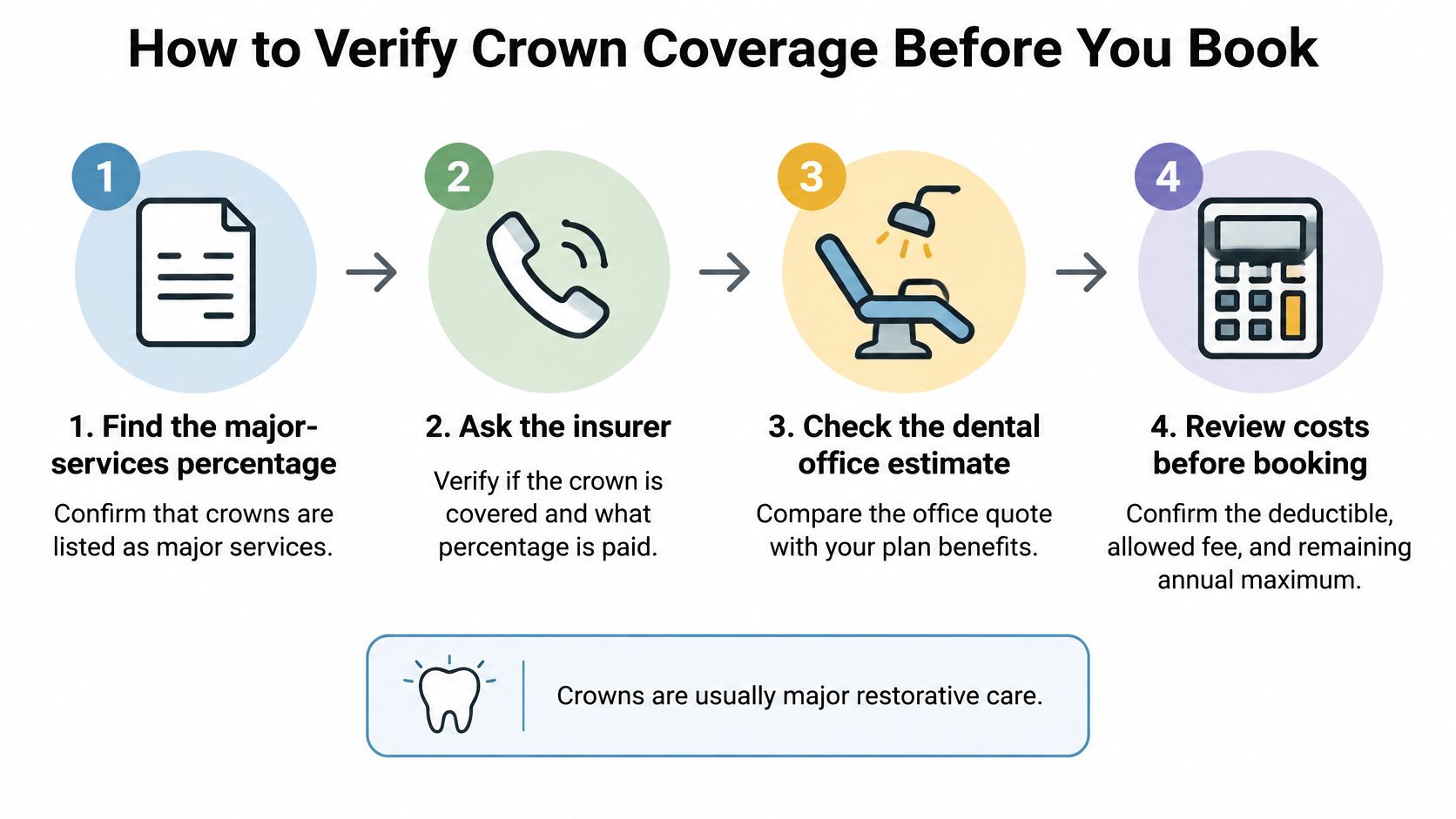
- Find the major-services percentage. Confirm that crowns are listed as major care, not basic care. The usual slip is assuming a crown pays like a filling because both "fix a tooth."
- Check the waiting period against your enrollment date. Ask whether major services are active yet. People often count from the day they picked a dentist, not from the day the policy started.
- Ask for the remaining annual maximum. Include recent fillings, a root canal, or gum treatment already paid this benefit year. Forgetting those claims is how a crown looks covered on paper and unpaid at checkout.
- Ask about the replacement interval. If a crown is already on the tooth, get the placement date the insurer has on file. A clinically sound replacement can still fall inside a locked interval.
- Request a pre-treatment estimate. The office submits this predetermination before treatment. It should show the procedure code, allowed fee, deductible, estimated insurer payment, and remaining maximum. A verbal "you're covered" is the slip to avoid.
- Confirm the dentist is in network for this plan. Network status changes the write-off. An out-of-network visit can add the gap between the allowed fee and the full charge.
- Ask about a material downgrade. Some plans pay a ceramic or porcelain crown at the rate of a less expensive material. Get the upgrade cost in writing so the tooth-colored option is a choice, not a surprise.
What a complete estimate looks like
A finished estimate states a dollar figure for your balance. It does not stop at "50 percent." You should be able to see the code, the allowed fee, what the insurer expects to pay, and what you would owe if you proceed. If any line is blank, ask the office to resubmit before you reserve the chair time.
Bring the insurance card, a photo of the front and back, and any prior explanation of benefits. Those papers let the front desk match the subscriber, the group number, and the benefit year on the first call.
What to Do When Coverage Falls Short
A thin benefit, a used-up annual maximum, or no dental plan at all changes the paperwork. It does not end the conversation. The crown can still be planned; the path just looks different.
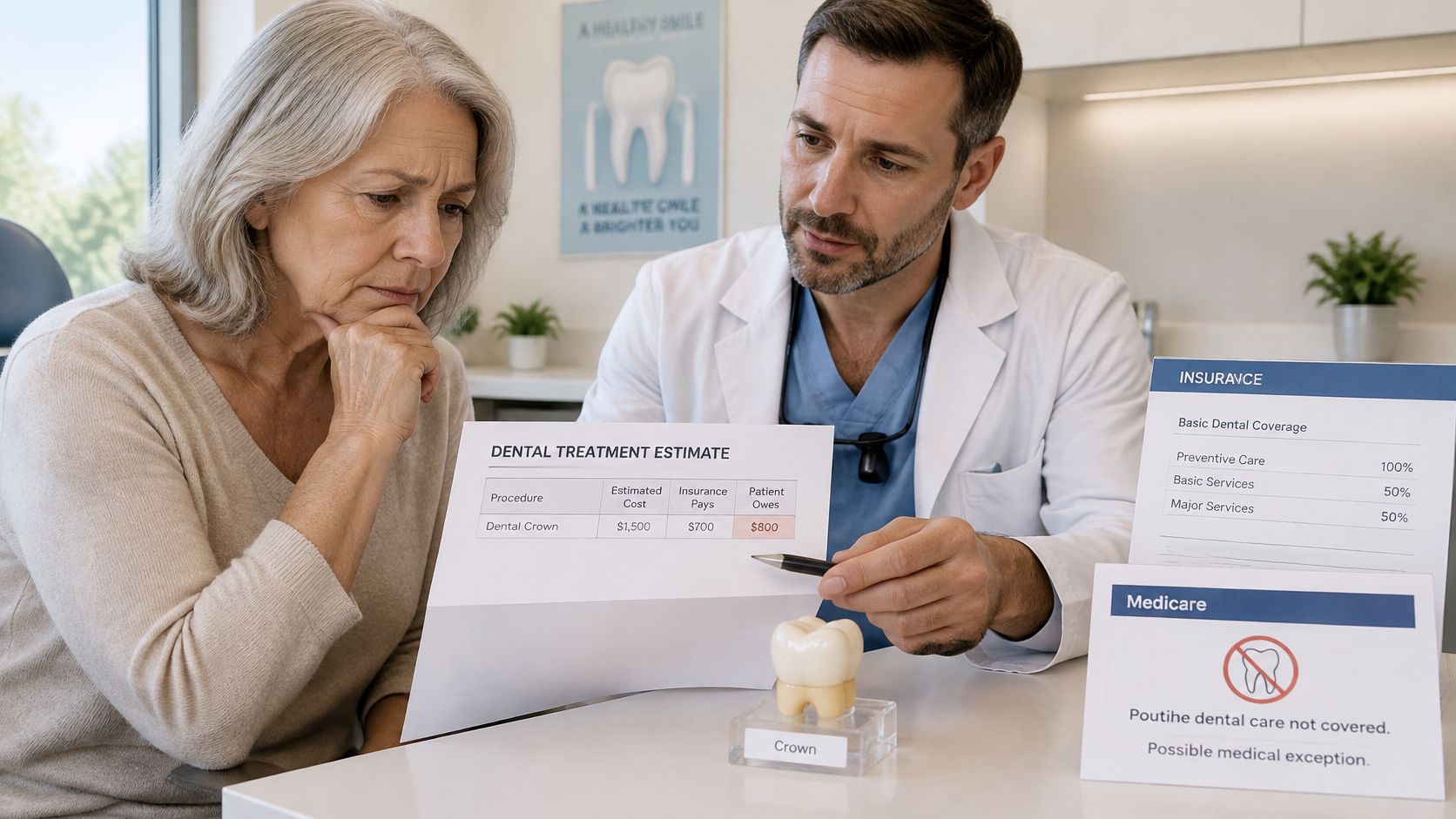
Original Medicare generally does not pay for routine dental care, so an ordinary crown falls outside it. Payment becomes possible when dental work is inseparable from a covered medical procedure, or when hospitalization is required because of an underlying medical condition or the severity of the dental procedure. Some Medicare Advantage plans carry dental benefits that may include crowns, each with its own annual limit and cost sharing.
Who has a dental benefit at all
Age and coverage source matter as much as the tooth. Among U.S. adults ages 19–64, 64% had private dental benefits, 15% had public dental benefits, and 21% had no dental benefits; among adults 65 and older, 34% had private dental benefits, 11% had public dental benefits, and 54% had no dental benefits, excluding Medicare Advantage, in dental coverage data reported by the ADA and cited by CMS.
That gap is why a retired patient in Miami and a working adult with a PPO can hear two different answers about the same broken molar.
| Option | Best For | Trade-off |
|---|---|---|
| Covered standard material | Patients whose plan pays for basic crown materials | Plan may not pay anything toward a premium material |
| Upgraded material, patient pays the difference | Front teeth or patients who want ceramic | Patient pays the gap between the plan rate and the upgrade |
| Payment plan or third-party financing | Patients with no coverage or a large remaining balance | Interest or fees may apply; confirm terms in writing |
| Same-day crown in one visit | Patients who want to avoid a temporary crown and a second appointment | Fees can differ from standard crowns; compare estimates |
| Medicare Advantage dental benefit | Medicare beneficiaries with a dental rider | Annual limits and cost-sharing vary by plan |
A covered standard material keeps the insurer's share, and you skip the upgrade cost. A ceramic upgrade on a front tooth often looks better in a smile, and you pay the difference the plan will not. Financing spreads a large balance, but interest and fees belong in the comparison before you sign. A same-day crown avoids a temporary and a second visit, and its fee should sit beside a traditional crown estimate for comparison rather than be assumed to match it. A Medicare Advantage dental rider can include crowns, yet its own yearly limit and copay still apply. Patients with no plan at all can ask whether the office offers insurance prices for self-pay treatment; Ultra Smile DentalSpa does.
Timing is one more lever. A crown placed after a new benefit year starts draws on a full annual maximum, while the same crown placed late in the year may find the limit already spent on earlier claims. If the tooth can safely wait a few weeks, ask the office how the placement date changes the estimate.
Patients in Miami can ask the dental office for an itemized estimate and compare those paths on one page. A lower-cost material is worth choosing only when it still suits the tooth's location and bite. A back molar that takes heavy chewing force and a front tooth that shows in conversation are not the same decision, so the estimate should name the material and the price for each option.
Some teeth will not wait for benefit paperwork. A painful, swollen, or broken tooth should be seen promptly, and a dentist can advise whether the tooth can be saved. The coverage decision comes after the tooth is stable.
Book a Crown Consultation in Miami, FL
Most plans cover part of a crown. The amount you pay depends on medical necessity, the allowed fee, the deductible, and what is left of the annual maximum.
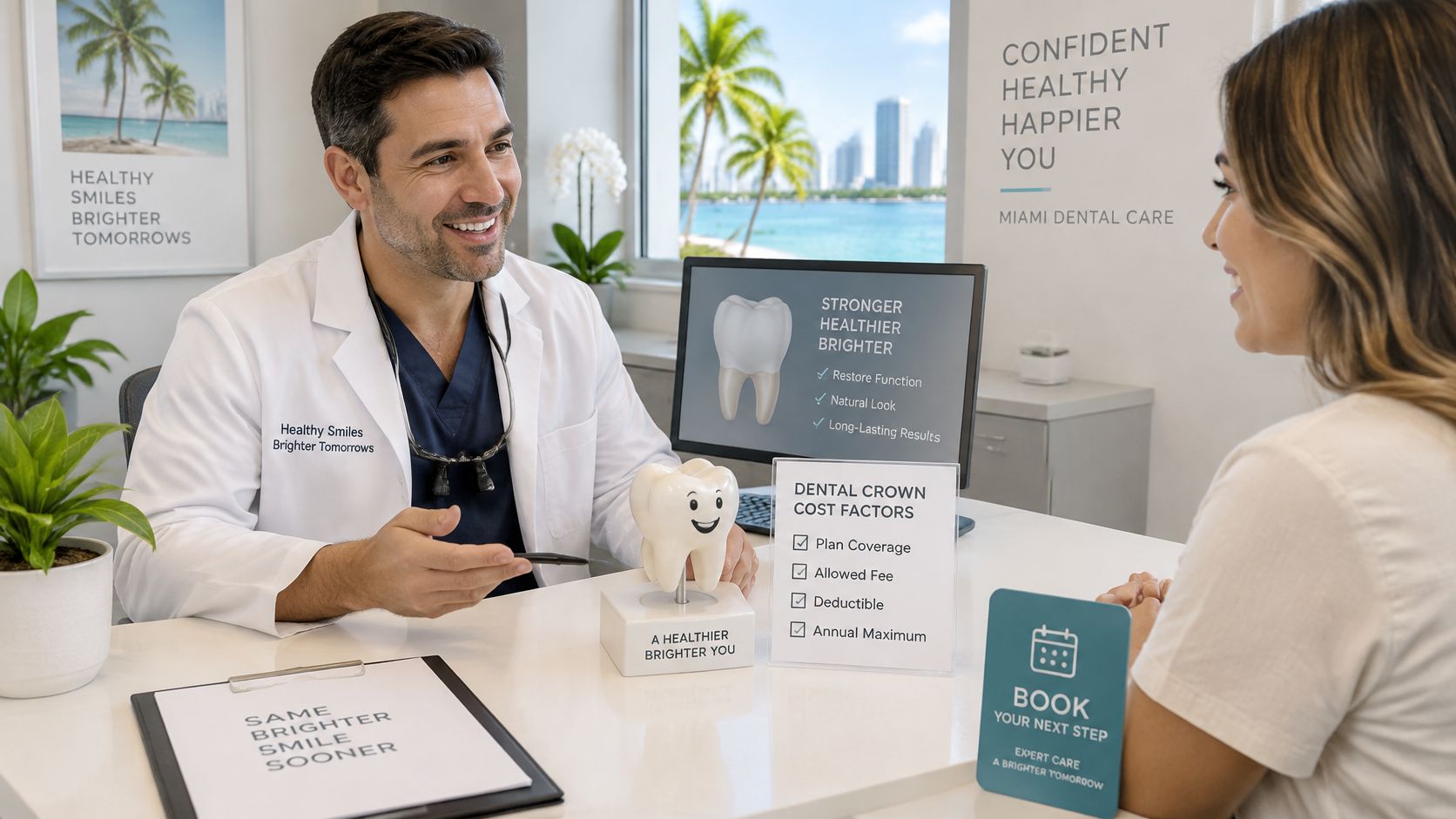
Schedule a crown consultation with Ultra Smile DentalSpa in Miami, FL through ultrasmilemiami.com. Dr. Neda Bahmadi, DMD, and the team review the tooth, the clinical need, and the plan details at the visit. Ultra Smile DentalSpa accepts insurance, and a full list of accepted plans is on the website, so you can confirm your plan before you book. Patients without insurance can be offered insurance prices.
Bring your insurance card, any prior X-rays, and any crown quote you already have. Ask for a written estimate that shows the procedure code, allowed fee, deductible, estimated insurer payment, and your balance. Same-day crowns are available to all patients, and CEREC crowns and bridges can be made in one visit without a temporary or a second appointment. Ask whether that option fits your tooth.
A clear estimate makes the decision easier, and the team can explain each figure before any treatment begins.
Ultra Smile DentalSpa helps Miami patients sort crown coverage, clinical need, and out-of-pocket cost before treatment starts, with same-day crowns and a written plan you can read in plain numbers. If a damaged tooth is worrying you, or you want a dentist near me who will walk through the estimate first, visit Ultra Smile DentalSpa to request a consultation.