The tooth extraction is finished, but the calendar still shows a client meeting, a workout, and dinner reservations in Miami. As the numbness fades and the cheek starts feeling fuller, the immediate question is practical: which symptoms belong to healing, and which deserve a phone call?
Impacted wisdom tooth removal recovery requires more than a return-to-work date. Adults searching for a dentist near me or a dentist in Miami, FL need clear aftercare, realistic activity planning, and access to clinical advice when symptoms change. The most useful recovery plan considers both the procedure's complexity and the direction symptoms take afterward.
Table of Contents
- The First 24 Hours After Impacted Wisdom Tooth Removal
- Controlling Bleeding, Pain, and Clot Protection on Day One
- Days 2 Through 7 and the Swelling Peak
- Getting Back to Work, Workouts, Eating Out, and Sleep in Miami
- Warning Signs, Dry Socket, and When to Call the Dentist
- Eating, Drinking, and Cleaning Around the Socket
- Key Takeaways and When to Book Your Miami Consultation
The First 24 Hours After Impacted Wisdom Tooth Removal
The first afternoon can feel unfamiliar. A patient may notice saliva around the gauze, awkward swallowing, and soreness becoming more noticeable as the anesthetic wears off. Settling onto the sofa with the recommended ice pack can make the procedure suddenly feel more real than it did in the treatment chair.
Mild oozing isn't the same as uncontrolled bleeding. The immediate priority is supporting the fresh blood clot, which protects the extraction site during early healing. Repeatedly checking the socket, moving the gauze, or testing the area with the tongue makes an already uncomfortable afternoon harder to manage.
Settle In Before Making Plans
The first day should be deliberately uneventful. Written discharge instructions, the medication plan, suitable food, and the treating office's contact information should stay within easy reach. The surgeon's directions take precedence over generalized recovery graphics, especially after a difficult extraction.
The checklist below provides a visual reminder of early aftercare tasks.
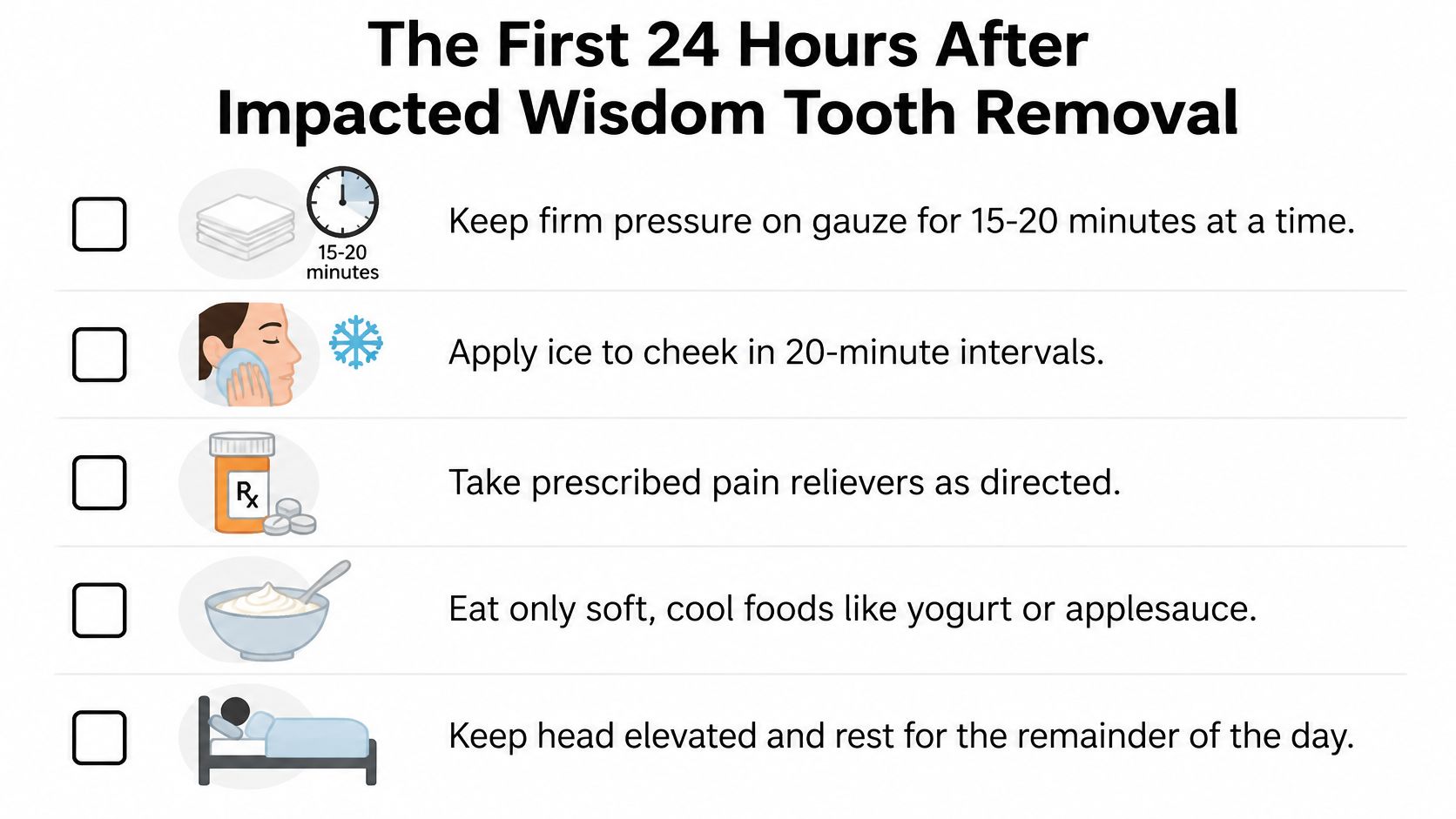
A quiet evening doesn't mean recovery must be completely symptom-free. Soreness, bruising, and difficulty moving the jaw can accompany healing; NHS wisdom tooth removal guidance notes that pain, swelling, and bruising can continue for up to two weeks, although many people resume ordinary activities much sooner.
First-day priorities: Protect the clot, control discomfort according to the prescribed plan, and rest.
Leave With a Clear Contact Plan
Before leaving the dental office, patients should know which symptoms warrant a call and how to obtain advice outside regular opening hours. A discharge sheet isn't useful if its medication instructions are unclear or its contact details are buried in a bag.
The practice's role during this period is practical: explain the instructions, clarify medication questions, and assess concerns that can't safely be judged at home. A calm first evening is helpful, but it doesn't guarantee that the next morning will bring the smallest amount of swelling.
Controlling Bleeding, Pain, and Clot Protection on Day One
Steady pressure works better than repeated inspection. When bleeding occurs, gauze should sit over the surgical area with firm, continuous biting pressure rather than being loosely tucked into the cheek.
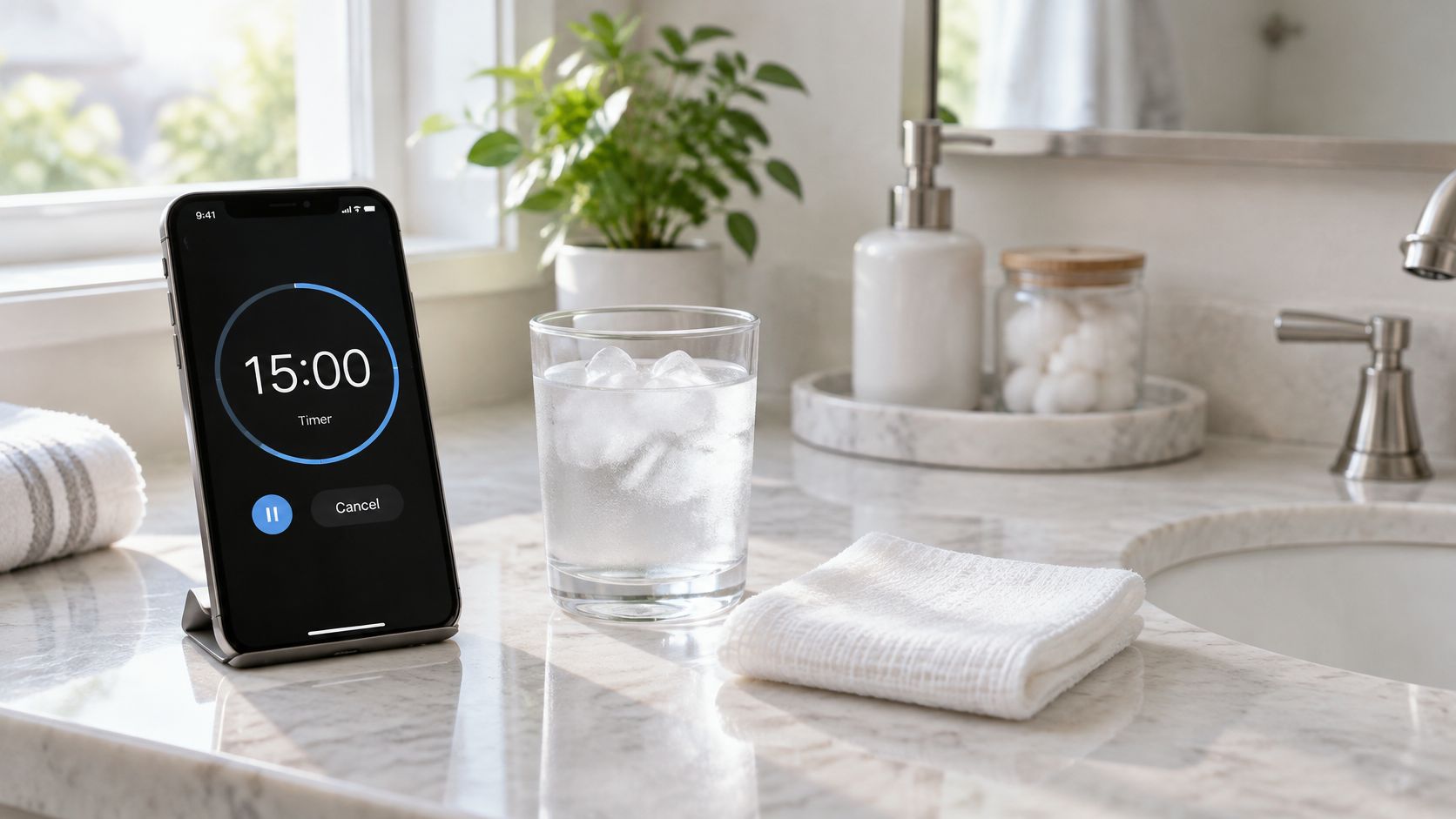
The University Hospitals Dorset aftercare instructions recommend approximately 15–20 minutes of firm gauze pressure, avoiding rinsing and forceful spitting during the first 24 hours, and urgent review for bleeding that persists despite 30 minutes of continuous pressure.
Keep the Routine Simple
A timer helps patients avoid lifting the gauze repeatedly to check progress.
The practical restrictions are straightforward:
- Keep pressure gentle elsewhere. Avoid vigorous gargling, forceful spitting, and drinking through a straw. The mouth shouldn't be repeatedly suctioned or flushed.
- Avoid smoking and vaping. Follow the treating clinician's restrictions rather than assuming a small amount is harmless.
- Skip alcohol and very hot drinks. Choose food and drink that won't disturb or irritate the fresh surgical area.
- Leave the socket alone. Fingers, cotton swabs, and repeated tongue checks aren't useful recovery tools.
Very hot food doesn't belong near a fresh extraction wound. Describing heat as “dissolving the clot oversimplifies the issue; the safer practical instruction is to follow the temperature restrictions and avoid disturbing the site.
Use a Medication Plan, Not Guesswork
Pain relief should follow the clinician-approved schedule rather than improvised extra doses when discomfort becomes difficult. Before combining over-the-counter and prescription products, patients should confirm the ingredients, suitability for their medical history, and maximum label or prescribed amounts.
More involved surgery may require a different prescription plan. That decision belongs with the treating clinician, not a borrowed prescription or an online recommendation.
Patients researching complementary options may encounter HempWell USA's article on topical CBD techniques for pain. That resource shouldn't be treated as evidence for extraction-socket care: CBD products shouldn't be placed in the socket or substituted for prescribed treatment, and any proposed use should be discussed with the dental team.
Days 2 Through 7 and the Swelling Peak
A fuller cheek after the first night can be unsettling, especially when the extraction itself seemed manageable. Early inflammation doesn't follow a perfectly smooth decline, and jaw stiffness can make speaking or eating feel more demanding than expected.
NHS Inform's wisdom tooth removal guidance describes swelling and discomfort as particularly noticeable during the first three days. The useful distinction isn't whether the cheek remains swollen, but whether the overall recovery begins moving toward improvement.
Track Change Without Constant Inspection
The following comparison uses the recovery milestones described in the impacted wisdom tooth recovery discussion, which places the swelling peak around day 2 and substantial improvement around days 5–7. These are planning guides, not guarantees.
Day-by-Day Recovery vs. Warning Signs After Impacted Wisdom Tooth Removal
| Timeframe | Expected Symptoms | Call the Office If… |
|---|---|---|
| Days 2–3 | Noticeable swelling, jaw stiffness, and uncomfortable chewing | Swelling escalates rapidly or occurs with fever |
| Days 4–5 | An overall movement toward easier eating and less discomfort | Pain increases after previously settling |
| Days 5–7 | A clearer improvement in function and swelling | Opening the mouth becomes progressively harder or symptoms remain concerning |
A brief daily note about eating, mouth opening, and medication needs is often more useful than repeatedly comparing mirror images. A photograph may help the office understand visible swelling, but it can't replace an examination when symptoms are worsening.
Progress From Protection to Gentle Cleaning
Once the initial no-rinsing period has passed, the previously cited hospital aftercare guidance recommends gentle warm salt-water rinsing three to four times daily for roughly 7–10 days, particularly after eating. Brushing should continue around the remaining teeth without directly traumatizing the socket or sutures.
For patients considering compresses, MEDISTIK heat ice advice offers general background rather than surgery-specific clearance. The practice's guidance on reducing swelling after oral surgery can support the individual discharge plan; neither resource should override the surgeon's instructions.
Antibiotics aren't an automatic recovery aid. A Cochrane review of third-molar surgical techniques found no clear routine recovery benefit for pain, fever, swelling, or restricted mouth opening in the antibiotic evidence discussed, with very low certainty. Prescribing should reflect the patient's findings and risks, not a general expectation that every extraction needs antibiotics.
Getting Back to Work, Workouts, Eating Out, and Sleep in Miami
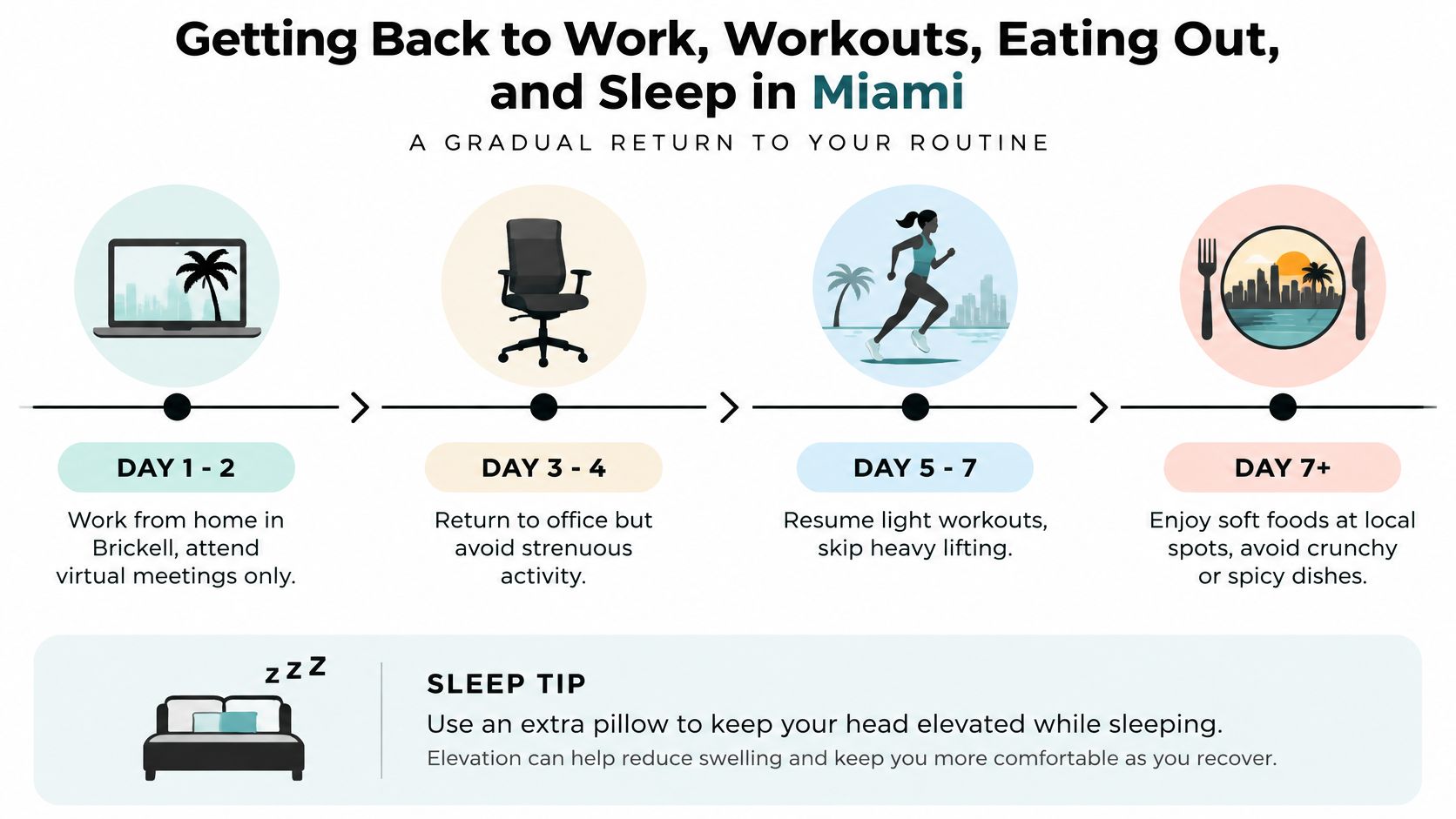
A laptop meeting in Brickell and a physically demanding shift aren't equivalent recovery activities. Neither is a short walk comparable to Barry's bootcamp or a run along the beach. Returning to a routine should reflect what that routine requires.
Cleveland Clinic's impacted wisdom teeth guidance explains that many people return to work or school after a few days, while recovery commonly takes one to two weeks. Feeling ready to answer emails doesn't mean the extraction site has finished healing.
The timeline below is a planning aid, not automatic clearance for exercise or office work.
Match Commitments to Actual Function
A Midtown professional might manage quiet administrative work before feeling comfortable delivering a client presentation. A parent may need help with lifting and errands even while feeling well enough to supervise homework. The practical question is whether an activity allows rest, regular meals, and adherence to the medication plan.
Mayo Clinic's wisdom tooth extraction guidance advises avoiding strenuous activity for at least a week. Heavy lifting and intense training shouldn't resume solely because a calendar graphic suggests a particular day.
Being able to work doesn't automatically mean being ready to train.
Plan Around Miami Life
Heat and humidity are reasons to make recovery logistics easier, not reasons to invent a separate healing timetable. An indoor recovery space, accessible drinks, and fewer outdoor obligations make more sense than testing endurance during errands.
Restaurant plans should remain flexible. A soft meal ordered for delivery may be more comfortable than a long dinner involving extensive conversation, alcohol, and difficult-to-chew dishes.
Sleep and travel deserve discussion before surgery. Patients should follow the office's positioning advice, keep the medication schedule accessible, and ask about an upcoming flight rather than assuming a universal safe departure date.
This video may support a preoperative conversation about recovery expectations.
Warning Signs, Dry Socket, and When to Call the Dentist
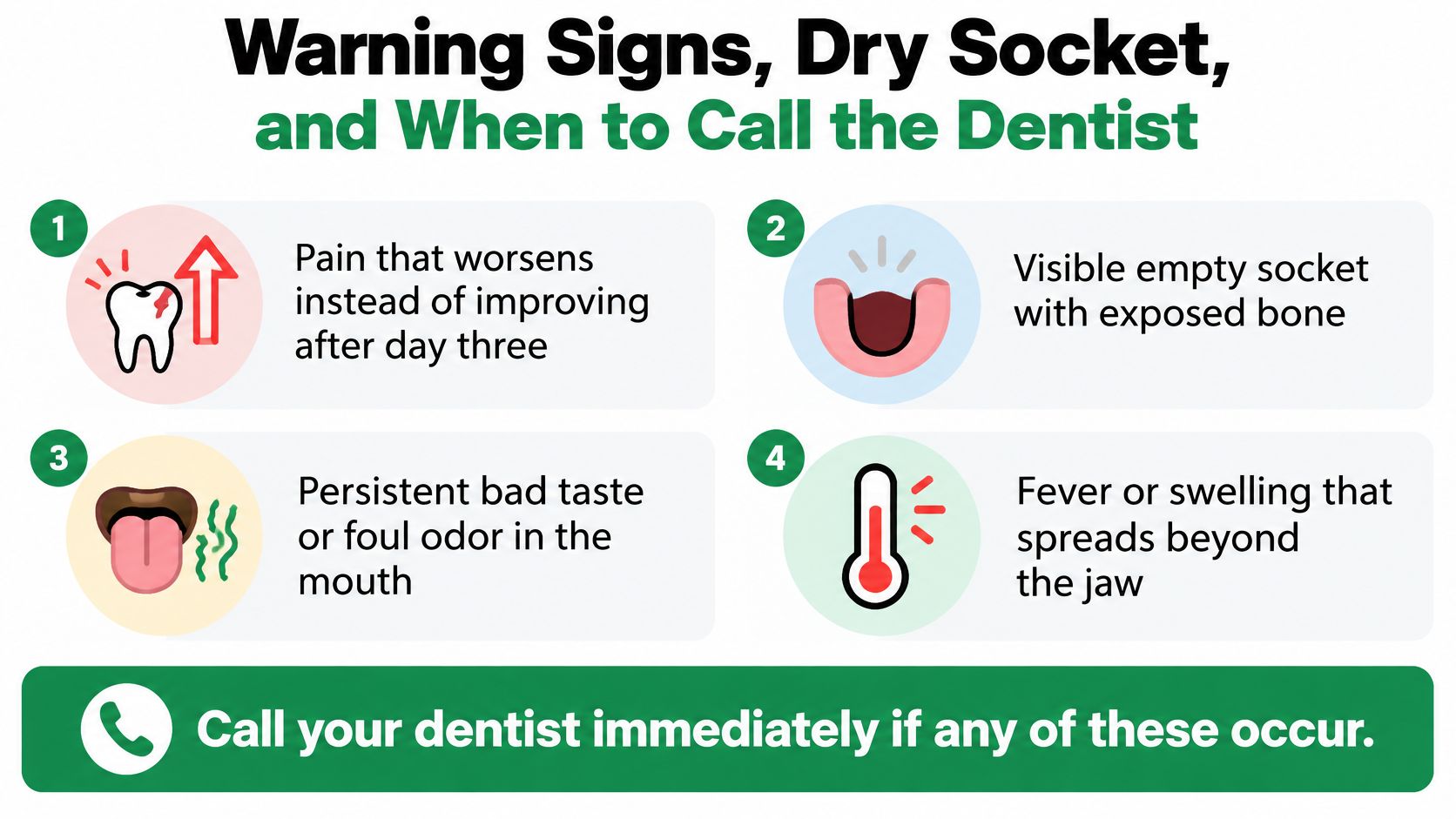
The direction of symptoms matters more than the calendar alone. A swollen cheek that gradually becomes less tender is different from swelling that spreads while swallowing becomes harder. Persistent or worsening symptoms deserve assessment rather than reassurance based only on the day of recovery.
Dry socket, also called alveolar osteitis, is a characteristic complication after impacted wisdom tooth surgery. Cochrane's dry socket evidence review reports rates of approximately 1%–5% after routine extractions, with rates exceeding 30% in some surgically extracted third-molar settings. Those figures describe different clinical circumstances, not an individual patient's predicted risk.
Recognize Patterns Without Self-Diagnosing
The hospital aftercare guidance cited earlier describes dry socket as worsening, throbbing pain around postoperative days 3–5, often accompanied by a bad taste or odor. That pattern warrants a dental assessment rather than repeated extra medication or aggressive rinsing.
The warning-sign graphic offers a quick reminder, but fever and spreading swelling shouldn't be assumed to mean dry socket specifically.
Dry socket and infection aren't interchangeable diagnoses. Patients don't need to identify the complication correctly before contacting the office, and attempting to inspect exposed bone with a tool can cause additional trauma.
The practice's guidance on how to prevent dry socket can help patients understand preventive habits. Once concerning symptoms begin, prevention advice isn't a substitute for treatment.
Choose the Appropriate Level of Help
A plain-language symptom checklist helps patients in Downtown Miami, Midtown Miami, and Hallandale Beach communicate clearly, including when an interpreter or bilingual staff member assists:
- Pain and timing. Report whether discomfort is improving, unchanged, or worsening, and whether it returned after improvement.
- Bleeding and swelling. Describe ongoing bleeding, swelling that is spreading, or changes that interfere with normal function.
- Temperature and sensation. Report fever, feeling generally unwell, or continuing lip or tongue numbness.
- Breathing and swallowing. Difficulty breathing or significant difficulty swallowing requires emergency medical attention, not a routine appointment request.
After hours, patients should use the discharge instructions' urgent-contact pathway. A photo, voicemail, or online message mustn't delay emergency evaluation for breathing problems or rapidly progressive symptoms.
Eating, Drinking, and Cleaning Around the Socket
The most workable recovery diet is food that requires little effort to eat. For the early soft-food period described in the hospital guidance, practical choices include smooth yogurt, applesauce, mashed avocado, and smoothies eaten with a spoon rather than a straw.
Shopping before surgery prevents the familiar problem of arriving home to a refrigerator full of food that requires substantial chewing. Small, manageable meals are easier to plan than relying on a single restaurant order when the jaw already feels tired.
Build Meals Around Comfort
As chewing becomes easier, suitable options may include scrambled eggs, flaky fish, soft pasta, and well-cooked vegetables. These are meal ideas, not mandatory stages tied to a particular date.
Across the following recovery period, texture should advance according to comfort and the treating clinician's advice. A patient still struggling with mouth opening shouldn't force a normal restaurant meal because a milestone has passed.
Crunchy chips, loose seeds, and hard crusts are poor early choices because they can irritate the area or leave debris near the socket. Spicy dishes can also be uncomfortable; tolerance isn't a reason to ignore the written aftercare restrictions.
Food rule: Choose meals that can be eaten comfortably without working the jaw hard or disturbing the surgical area.
Clean the Mouth Without Digging Into the Wound
The cleaning routine introduced earlier should remain gentle. The rest of the mouth still needs brushing, but the socket doesn't need scrubbing, probing, or repeated attempts to remove material with household tools.
Cleaning near sutures should follow the clinician's instructions. If food seems trapped or the area develops an unpleasant taste that persists, the safer response is to ask the office how to manage it rather than improvising an irrigation technique.
Common avoidable mistakes include:
- Overcleaning. Aggressive swishing isn't a stronger version of gentle rinsing.
- Testing harder food too soon. Comfortable chewing matters more than enthusiasm for a usual meal.
- Adding products without approval. Mouthwash, supplements, and topical preparations aren't automatically appropriate for a healing socket.
- Neglecting ordinary dental care. The nonsurgical areas still need attention, even while the extraction site receives special protection.
Key Takeaways and When to Book Your Miami Consultation
A useful recovery plan combines clot protection, manageable food, gentle hygiene, and attention to symptom direction. The earlier timeline provides context, but a date alone can't determine readiness for work, exercise, or a normal meal.
Patients comparing local tooth extraction options should ask what their own procedure is likely to involve and how follow-up concerns will be handled. A consultation can address the examination, dental x-rays, medical history, medication safety, and realistic time away from demanding commitments.
Keep Immediate and Future Care Separate
Routine cleaning and exams, restorative dentistry, and cosmetic goals can be discussed without crowding the surgical recovery plan. Searches such as dental implants near me or cosmetic dentist near me may reflect separate needs, including implants, bone grafts, teeth whitening, or other later treatment. Those services require their own assessment rather than being assumed necessary after wisdom tooth surgery.
For patients seeking an emergency dentist, worsening symptoms should take priority over elective planning. Comfortable surroundings matter, but accessible clinical guidance and a transparent treatment plan are what help patients act confidently when recovery doesn't feel straightforward.
For adults planning wisdom tooth extraction, Ultra Smile DentalSpa offers personalized dental care, a calming spa-like setting, bilingual staff, and transparent treatment planning for patients across Downtown Miami, Midtown Miami, and Hallandale Beach. Schedule a consultation to discuss the tooth, likely recovery needs, and follow-up arrangements, or call the office promptly about concerning postoperative symptoms.