Adults choosing teeth straightening options should start with diagnosis, not aesthetics or price alone. Adults represented 28.31% of orthodontic patients in 2016, compared with 4.37% in 1960, showing how thoroughly adult orthodontic care has entered modern dentistry.
A professional in Brickell may notice crowded lower incisors while preparing for a presentation, or a patient in Midtown Miami may realize that an old bite problem no longer feels comfortable. Many adults postpone treatment because traditional braces seemed too visible for work, the cost felt uncertain, or orthodontics seemed like something that should have happened years earlier. Those concerns are understandable, but age itself is no longer a practical barrier to treatment.
The key question isn't which appliance looks most discreet in a photograph. It's which option can correct the actual tooth positions, bite relationship, and supporting tissues without creating avoidable problems during work, travel, meals, or daily dental care.
Crowding, spacing, overbite, crossbite, relapse, gum health, existing fillings, crowns, implants, and bone support all influence the recommendation. A consultation with a dentist in Miami, FL should therefore include an examination and, when clinically indicated, dental x-rays before an appliance is selected. Clear aligners may suit a carefully selected case, while fixed braces may offer more reliable control for demanding movements.
Table of Contents
- Why Adults in Miami Are Rethinking Their Smile
- How Clear Aligners Actually Work
- Fixed Braces for Adults Still Have a Place
- Lingual Braces and At-Home Aligners Worth Considering
- Matching the Right Option to Your Case
- Why Supervision Is Required Even for Discreet Options
- Starting Your Treatment at Ultra Smile DentalSpa in Miami
Why Adults in Miami Are Rethinking Their Smile
A Brickell attorney may notice a rotated front tooth before a major presentation. A hospitality manager may want to improve a crowded smile without wearing conspicuous metal brackets at work. In Miami, treatment decisions often come down to visibility, schedule, confidence, and whether the proposed correction will hold up over time.
Adult orthodontic care now reaches far beyond a small group of late starters. A more recent estimate placed approximately 1.91 million adults in treatment through AAO-member orthodontists in the United States in 2024, rising to 2.37 million when nonmembers were included, according to the AAO economic survey report.
That demand reflects practical changes in adult life. People in sales, healthcare, technology, modeling, hospitality, and other client-facing roles may want treatment that fits meetings, travel, photos, and long workdays. Clear aligners reduce visibility for selected cases, while ceramic braces offer fixed control with a less noticeable appearance. Payment arrangements can affect timing, but affordability should never determine whether a clinically unsuitable appliance is chosen.
The smile may not show the whole problem
A front view can make mild crowding look simple even when the bite is not. One tooth may be rotated, the roots may require careful positioning, or the arches may meet unevenly. Gum inflammation, recession, or limited bone support can also change the treatment plan before any appliance is placed.
Adults commonly seek correction for crowding, spacing, overbite, crossbite, or relapse after earlier braces. Treatment may also improve how the teeth contact and make difficult areas easier to clean, as described in the NHS guide to braces and orthodontics. That benefit depends on the teeth, gums, bite, and supporting bone being assessed together.
Practical rule: Choose the appliance after the diagnosis. A digital preview and an attractive fee cannot show whether the roots, gums, bite, and bone can support the planned movement.
A sensible Miami decision
Patients looking for a cosmetic dentist in Miami should expect questions about previous braces, fillings or crowns, gum bleeding, jaw symptoms, oral hygiene, work demands, and their ability to follow daily instructions. Those answers help determine whether discreet trays, ceramic brackets, or another approach is realistic.
There is no universal winner between aligners and braces. Choose the treatment that can correct the specific problem, fit the patient's routine, and support a stable bite with healthy tissues.
How Clear Aligners Actually Work
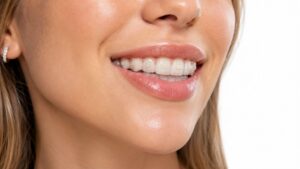
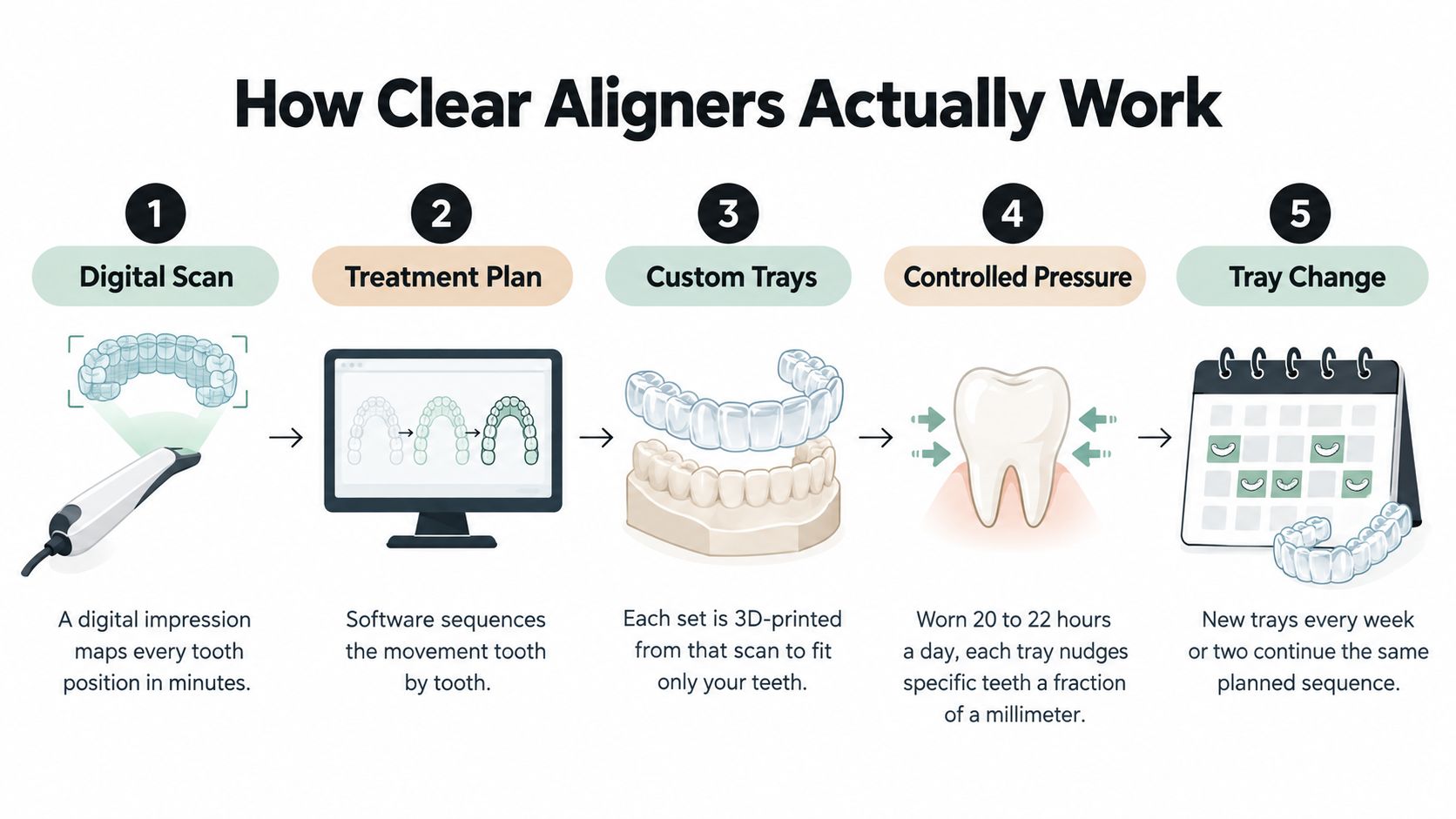
Clear aligners use a series of custom trays to apply controlled pressure to selected teeth. Each tray is designed for a particular stage, so the process resembles a slow, deliberate push rather than a forced shift. Bone around the tooth remodels as the tooth moves, which is why orthodontic treatment takes time and why wearing the trays inconsistently can disrupt the sequence.
The American Association of Orthodontists states that aligners are typically worn for at least 22 hours per day, and each tray is commonly used for about one week. Each tray moves teeth only a fraction of a millimeter, according to the AAO explanation of aligners.
What daily wear involves
A typical routine is straightforward:
- Remove the trays for meals. Water is generally the safest drink while trays are in place. Food trapped under an aligner can increase plaque exposure.
- Brush before reinserting them. The goal is to avoid sealing food debris against the teeth.
- Clean the trays gently. Lukewarm water and a soft brush help remove buildup without exposing the plastic to excessive heat.
- Store them in a case. Outdoor dining in Miami creates a familiar risk. A tray wrapped in a napkin can disappear with the plate.
- Change trays only as directed. Advancing early doesn't make teeth move faster and may make the next tray fit poorly.
Small tooth-colored attachments may be bonded to selected teeth. These raised shapes give the tray more grip for movements such as rotation or extrusion. Attachments can make aligners more visible up close, but they may improve control when a smooth tray alone can't apply force in the required direction.
Patients considering the Invisalign treatment timeline should ask which movements the plan includes. Mild crowding isn't the same clinical challenge as significant rotation, spacing, overbite, or posterior bite correction.
Compliance determines whether convenience works
Removable treatment gives adults control over eating and appearance, but that control creates responsibility. A patient who regularly removes trays for long periods may lose tracking, meaning the teeth no longer sit where the software expected. The result can be additional refinement, delayed progress, or a revised plan.
A 2024 adult clinical study reported 43.8% excellent compliance, 38.3% good compliance, and 18.0% poor compliance among 128 participants, illustrating why wear behavior matters, as documented in the Journal of Orthodontic Science adult treatment study.
Clear aligners are convenient, not effortless. They work best when the patient can maintain a dependable routine through meetings, flights, restaurant meals, and busy Miami schedules.
Fixed Braces for Adults Still Have a Place
A patient with significant crowding, rotated teeth, extraction spaces, or a difficult bite often needs more than discreet treatment. Fixed braces remain the more dependable option when the orthodontist must control several tooth movements at once. Brackets and archwires stay attached to the teeth, so force continues around the clock without relying on the patient to replace an appliance after meals.
The evidence supports that choice. A systematic review and meta-analysis involving mostly adult patients found that aligner treatment produced American Board of Orthodontics Objective Grading System scores averaging 9.9 points worse than fixed appliances. Patients treated with aligners were also 1.6 times more likely to have an unacceptable result in that analysis, according to the European Journal of Orthodontics meta-analysis.
Aligners can be appropriate for selected mild-to-moderate cases, but fixed appliances generally offer stronger control when rotations, vertical discrepancies, extraction spaces, or complex bite corrections matter.
Metal and ceramic braces compared
Metal braces remain visible, but they are versatile and mechanically reliable. Ceramic braces use tooth-colored or translucent brackets, making them less noticeable from a normal speaking distance. They also demand careful cleaning, since discoloration around elastic ties can make the appliance more apparent.
| Feature | Metal Braces | Ceramic Braces | Clear Aligners |
|---|---|---|---|
| Visibility | Most noticeable | Less noticeable, but still visible | Usually discreet |
| Appliance type | Fixed | Fixed | Removable |
| Patient compliance | Braces remain in place | Braces remain in place | Requires consistent daily wear |
| Complex movement | Strong option | Strong option, depending on case | More limited in complex cases |
| Eating routine | Food restrictions and cleaning changes | Food restrictions and cleaning changes | Trays removed for meals |
| Best fit | Full correction and demanding movements | Patients wanting fixed treatment with a subtler appearance | Carefully selected alignment and bite problems |
For significant crowding or a demanding bite correction, fixed treatment may provide the most direct route to a stable result. The appliance stays active between appointments, while the orthodontist can adjust wires, brackets, and elastics as the teeth respond.
Treatment time requires an honest estimate
Orthodontic treatment usually lasts about 12 months to 2.5 years, with appointments commonly scheduled every 4 to 10 weeks, according to patient guidance on orthodontic treatment. Those figures are a general range, not a personal forecast. Diagnosis, tooth position, bite relationships, bone support, and missed appointments all affect the schedule.
A review comparing aligners and fixed appliances found no statistically significant overall difference in treatment duration. It reported a mean difference of -1.48 months, a 95% confidence interval from -5.45 to 2.49 months, and a p-value of 0.46, as shown in the comparative treatment-duration review. That finding does not make every treatment plan equivalent. A promise of faster treatment should never replace an examination and diagnosis.
Lingual Braces and At-Home Aligners Worth Considering
Lingual braces attach to the tongue side of the teeth, keeping the brackets out of view from the front. They can appeal to adults in public-facing roles who consider visible braces unacceptable, but the hidden position creates practical demands. Speech may feel different during the adjustment period, cleaning is harder, and appointments can be more technically involved.
Lingual treatment is best reserved for patients who understand the trade-off between invisibility and maintenance. It isn't automatically more comfortable or simpler than front-facing braces, and it won't be appropriate for every tooth shape, bite, or treatment objective.
The remote-only appeal has limits
At-home aligner companies often market convenience and lower prices. The central clinical limitation is not the plastic tray itself. It's the lack of a complete in-person diagnosis, including evaluation of the gums, roots, bone, restorations, and bite.
The FDA states that clear aligners are prescription devices intended for supervision by a licensed dentist or orthodontist. The agency has received reports associated with unauthorized direct-to-consumer use involving worsening misalignment, new gaps, jaw pain, and bite problems, as explained in the FDA guidance on clear dental aligners.
| Factor | Lingual Braces | At-Home Aligners |
|---|---|---|
| Visibility | Hidden from the front | Usually discreet |
| Clinical oversight | In-person clinician supervision | May be remote-only |
| Cleaning | More difficult around tongue-side brackets | Requires tray cleaning and careful tooth brushing |
| Speech | May be temporarily affected | Temporary phonetic changes can occur |
| Complex correction | Can suit selected demanding cases | Generally limited to carefully selected mild cases |
| Main trade-off | Technical adjustment and maintenance | Convenience paired with reduced diagnostic access |
A 2025 review identified only two direct-to-consumer studies among 37 clear-aligner studies, indicating that the evidence base for remote-only treatment remains thin. If the problem appears more complicated than one or two mildly rotated front teeth, an in-office system with clinical oversight is the safer investment.
Matching the Right Option to Your Case
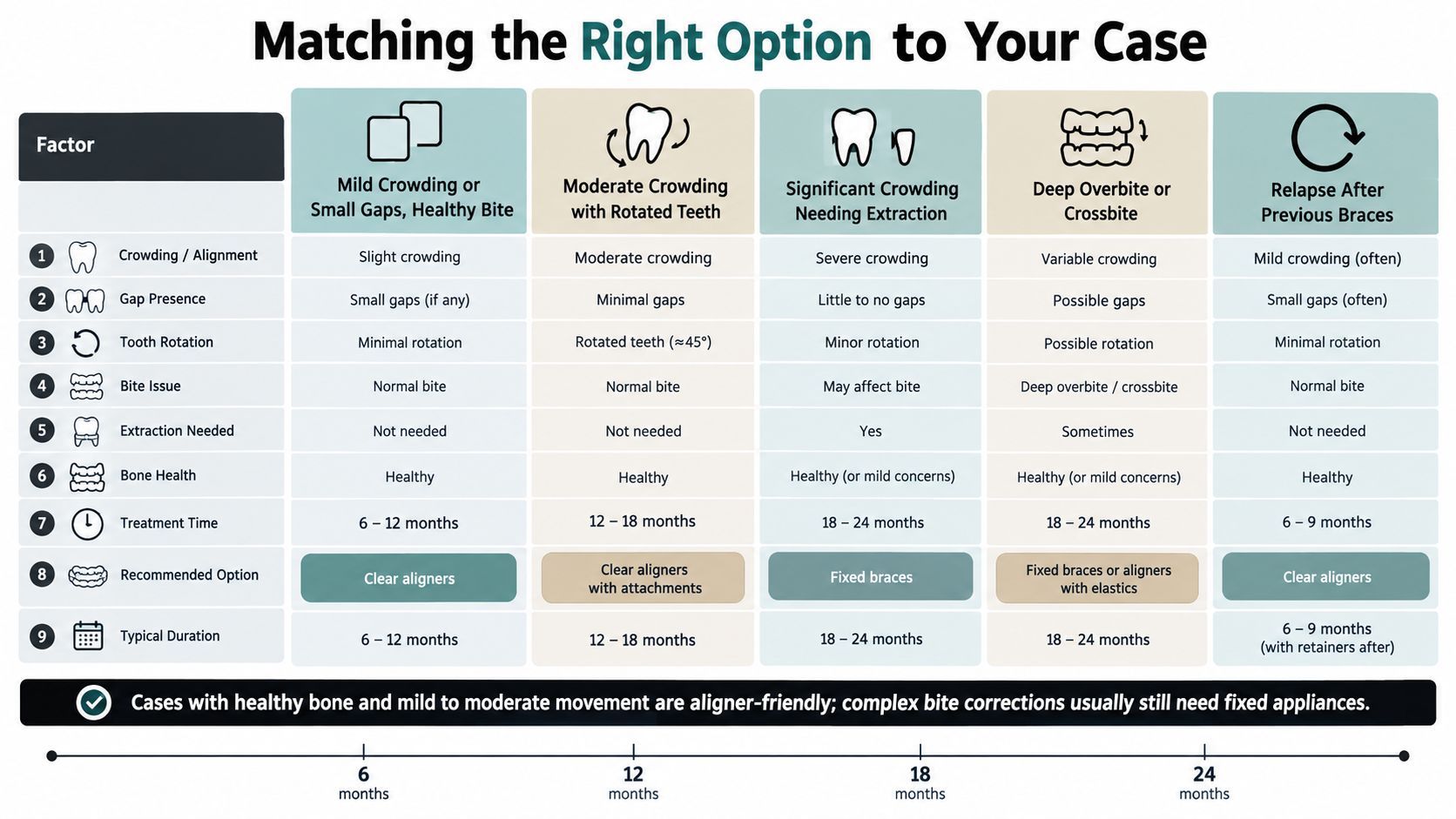
A useful decision framework starts with the movement required, then considers appearance and routine. The following categories are not a substitute for an examination, but they show why a brand name shouldn't lead the conversation.
Five patterns adults commonly bring to consultation
Mild crowding or small gaps with a healthy bite often makes clear aligners a reasonable starting point. The plan still needs an examination, but removable trays can provide discreet control when the roots and bite don't require major correction.
Moderate crowding with rotated teeth may need attachments or fixed braces. Rotation is a useful example of why a front-facing photograph can mislead. The visible crown may seem close to its target while the root and neighboring contacts need more controlled movement.
Severe crowding, a substantial overbite or underbite, or a jaw discrepancy generally points toward fixed appliances or a combined treatment plan. Orthodontics may not solve a skeletal relationship by itself, and some patients require evaluation for surgical coordination.
Relapse after previous braces can sometimes be addressed with a focused aligner refinement when the bite remains stable and the movement is limited. Relapse still deserves a full assessment, rather than an assumption that an old retainer problem is automatically simple.
High aesthetic demand with complex movement may make lingual braces worth discussing. They hide the appliance from the front, but patients must accept more demanding cleaning and adjustment.
Compliance test: If removable trays won't be worn for at least 22 hours each day, fixed treatment deserves serious consideration. Travel, frequent snacking, long presentations, and irregular routines can make compliance harder than expected.
The consultation should narrow the shortlist
A clinician should evaluate tooth position, root direction, overbite, overjet, posterior occlusion, periodontal health, restorations, and radiographic findings when indicated. The plan should also explain what happens if a tray stops fitting, an attachment comes loose, or the patient falls behind.
Adults don't need to arrive knowing the brand they want. They need enough diagnostic information to compare the two or three options that can address the mouth in front of them.
Why Supervision Is Required Even for Discreet Options
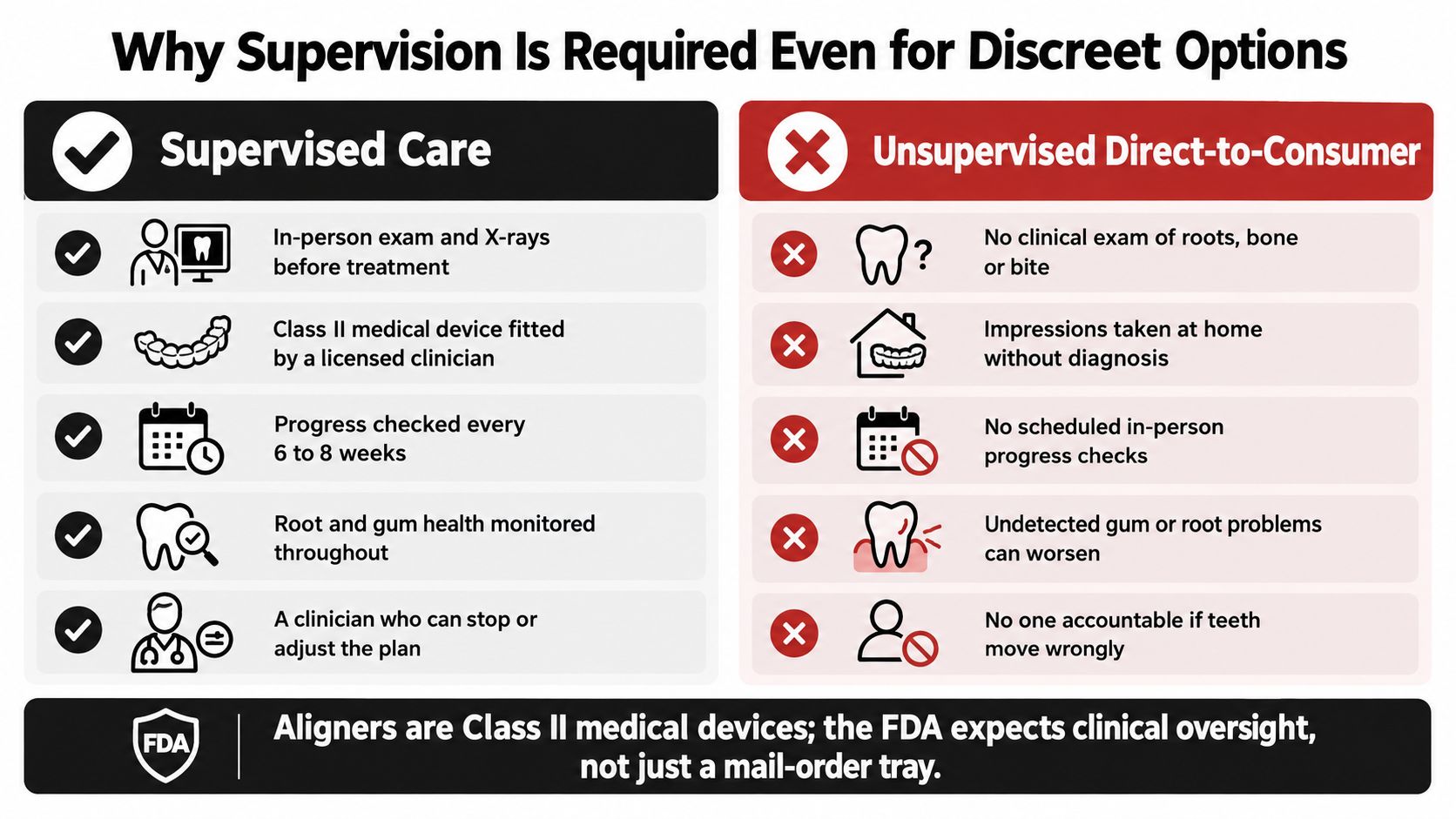
Discreet doesn't mean risk-free. A photograph or smartphone scan can show the visible crowns, but it can't reliably reveal bone support, root shape, active periodontal inflammation, hidden decay, or the full relationship between the upper and lower teeth.
Tooth movement occurs through bone remodeling. Adults with periodontal disease may face additional risks, which is why active inflammation should be stabilized before orthodontic treatment. In a CBCT study of adults receiving orthodontic treatment alongside periodontal therapy, external apical root resorption occurred in a median 80.7% of single-rooted teeth, with mean loss of approximately 1.2 millimeters. The study also found mean resorption of 1.3 millimeters when treatment exceeded 18 months, compared with 1.0 millimeter for treatment lasting 18 months or less, as reported in the European Journal of Orthodontics periodontal study.
What an examination can uncover
A proper evaluation can identify:
- Gum disease: Inflammation or attachment loss can make tooth movement less predictable.
- Bone support concerns: Radiographs may reveal changes that photographs cannot show.
- Root limitations: Root shape and position can restrict safe movement.
- Existing dental work: Crowns, fillings, implants, and bridges affect planning.
- Bite relationships: A visually straighter smile can still leave an unstable or uncomfortable bite.
- Untreated decay: Cavities should be managed before an appliance makes cleaning more difficult.
The FDA specifically warns that unsupervised aligner treatment can contribute to uneven bites, unintended movement, pain, or tooth loss. That doesn't mean every remote model produces a poor result. It means legal market availability doesn't prove that a particular adult is clinically suitable for remote treatment.
Questions worth asking before payment
Before committing to any aligner or braces plan, patients should ask:
- Who completes the examination and reviews the treatment plan?
- Are dental x-rays taken when clinically indicated?
- How are gum health, root position, and bone support assessed?
- Which movements are included, and which are outside the plan?
- What happens if the bite worsens or the trays stop fitting?
- Who handles an urgent problem during treatment?
- What retention plan protects the result afterward?
The comparison of clear aligners and Invisalign treatment should remain a clinical discussion, not a decision based only on appearance or an online simulation.
Starting Your Treatment at Ultra Smile DentalSpa in Miami
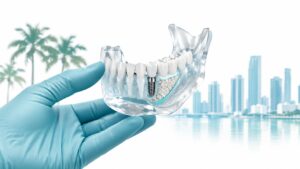
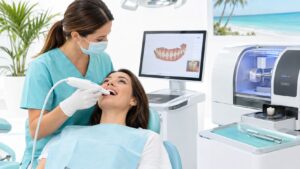
A consultation at Ultra Smile DentalSpa can translate the broad teeth straightening options for adults into a case-specific recommendation. The practice uses iTero digital scanning rather than goopy traditional impressions, along with panoramic and cephalometric imaging, bite analysis, and an examination of the teeth and supporting tissues.
The important part is not the technology by itself. A scan can map tooth positions, but the clinician still has to interpret the bite, assess oral health, identify restorations, and decide whether clear aligners, ceramic braces, or a different approach can deliver the required movement. A same-day preview may help patients visualize a projected result, but it doesn't replace diagnosis or a conversation about limitations.
What the treatment sequence can include
Orthodontic care may begin with preparatory dental work. Depending on the findings, that can include:
- Cleaning and periodontal care before tooth movement.
- Caries treatment or restorative dentistry for teeth that need stabilization.
- Dental x-rays when roots, bone, or developing pathology require evaluation.
- Whitening or bonding planned at an appropriate stage for the final smile.
- Orthodontic treatment with invisible braces, Invisalign, ceramic braces, metal braces, or another suitable system.
- Retention after active movement, because straight teeth still need long-term support.
Patients who also need a tooth extraction, wisdom teeth extraction, a root canal, crowns, bridges, or dental implants near me can ask how those services affect the orthodontic sequence. Orthodontics moves natural teeth, so missing teeth and planned implants require coordinated timing. A patient searching for an emergency dentist should address urgent pain, swelling, trauma, or infection before beginning elective tooth movement.
A Miami visit should fit real life
The practice is located on Biscayne Boulevard and serves patients connected with Downtown Miami, Midtown Miami, and Hallandale Beach. Its setting combines a relaxed, spa-style environment with clinical care, including refreshments, custom aromatherapy, streaming entertainment during procedures, and a hot towel finish.
Practical planning matters as much as comfort. Patients can discuss CareCredit financing, insurance coordination, payment options for those without coverage, and the expected appointment schedule. Orthodontic appointments are commonly arranged every 4 to 10 weeks, although the exact cadence depends on the appliance and treatment stage, according to the NHS orthodontic treatment guidance.
The first visit should end with clarity, not pressure. Patients should understand the diagnosis, the recommended appliance, alternative options, expected responsibilities, pre-treatment dental work, retention plan, and what could change the timeline. A thorough in-person examination remains the reliable way to choose among clear aligners, ceramic braces, metal braces, and lingual systems.
Ultra Smile DentalSpa offers adult clear-aligner and invisible-braces consultations alongside preventive, cosmetic, restorative, and surgical dental care in Miami. Adults comparing teeth straightening options can visit Ultra Smile DentalSpa to request an evaluation and discuss the option that fits the diagnosis, schedule, and long-term oral-health goals.