A Miami professional may be researching clear aligners late at night, comparing “clear aligners vs Invisalign while wondering whether a discreet treatment can correct crowding, gaps, or teeth that shifted after braces. The appeal is understandable. Removable trays fit a busy schedule, look subtle in photographs, and support a more comfortable alternative to metal braces.
The harder question isn't which logo appears on the case. It's whether the treatment plan matches the patient's teeth, bite, bone support, expectations, and ability to wear the trays consistently. For someone searching for a cosmetic dentist near me, a dentist in Miami, FL, or a provider serving Downtown and Midtown Miami, that distinction matters. Ultra Smile DentalSpa evaluates the whole smile rather than treating a brand name as a diagnosis.
| Consideration | Clear aligners | Invisalign |
|---|---|---|
| What it is | A category of removable, transparent orthodontic trays | A specific clear-aligner brand |
| Best-established use | Mild to moderate alignment concerns, depending on case design | Similar cases, with a branded planning and manufacturing platform |
| Main clinical limitation | Certain rotations, extrusions, torque, and complex movements can be difficult | Attachments and refinements may still be needed for difficult movements |
| Patient responsibility | Usually requires about 20 to 22 hours of daily wear (cohort study) | Requires the same practical commitment to wear and follow-up |
| Deciding factor | Case selection and professional supervision | Case selection and professional supervision |
Table of Contents
- Navigating Your Smile Options in Miami
- The Evolution of Clear Aligner Technology
- Comparing Predictability and Clinical Oversight
- Matching Your Specific Dental Needs to the Right System
- Daily Wear and Treatment Timelines: What Aligner Therapy Demands
- Why Local Provider Expertise Outweighs Brand Names
- Scheduling Your Clear Aligner Consultation in Miami
Navigating Your Smile Options in Miami
Consider a common consultation scenario. An adult who works with clients in Miami wants a straighter smile but doesn't want brackets visible during presentations, dinners, or family photographs. The patient may already have compared prices online, watched aligner videos, and searched for a dentist near me, yet still can't tell whether a generic system or Invisalign would deliver the safer result.
A careful dental evaluation starts somewhere else. The provider examines the bite, tooth position, gum health, existing restorations, and the amount of movement required. Dental x-rays and a new patient exam may reveal concerns that aren't visible in a front-facing smile photograph, such as bone limitations, root position, decay, or a tooth that needs restorative care before orthodontic movement.
A discreet option with clinical boundaries
Clear aligners can be appealing because patients remove them for meals, brushing, and flossing. They also offer a quieter appearance than traditional braces, which suits adults seeking cosmetic dentistry without making orthodontic treatment the center of every conversation. Those advantages are real, but they don't mean every patient is a candidate.
The provider must also determine whether the desired result involves simple tipping of a tooth or more demanding movement of the root, tooth height, rotation, or posterior bite. A tray can look beautifully designed on a digital screen while the biological response still requires attachments, additional stages, or a different appliance.
Practical rule: Choose the treatment plan first, then consider the brand. The brand can't compensate for a poor diagnosis or an unrealistic movement plan.
Care that fits Miami patients
A local practice can assess orthodontic needs alongside broader dental care. A patient may need cleaning and exams before starting, teeth whitening after alignment, a composite filling, a crown, or another cosmetic dentistry service to complete the smile. Someone searching for dental implants near me, tooth extraction, or an emergency dentist may also need those concerns addressed before elective smile treatment.
The calm setting matters, too, particularly for patients with dental anxiety. A personalized consultation in Downtown or Midtown Miami should leave the patient with a clear explanation of what aligners can do, what they may not do predictably, and how the practice will respond if the teeth don't track exactly as planned.
The Evolution of Clear Aligner Technology
A patient may arrive at a Miami consultation expecting a simple choice between clear aligner brands. Clinically, the more important questions are how the teeth need to move, whether the bone and gums can support that movement, and how closely the treatment plan will be monitored.
Clear aligners use a series of custom trays to apply controlled pressure to selected teeth. The dentist determines which teeth move first, how much movement each stage attempts, and whether attachments or other auxiliaries are needed. The plastic is only one part of the treatment system.
The concept has a long history. A 2025 orthodontic review notes that Kesling first conceptualized the approach in 1946, while Align Technology made it commercially viable with the launch of Invisalign in 1998 (orthodontic review). Since then, digital planning and manufacturing have made clear trays widely available, but the underlying biology still determines the result.

How the tray sequence works
A typical workflow includes these clinical steps:
Assessment comes first. The dentist evaluates the teeth, bite, gums, restorations, and supporting structures. X-rays may be needed because a scan cannot show every factor that affects safe movement.
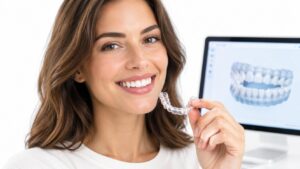
The teeth are digitized. An intraoral scan or impression creates a three-dimensional model. The provider then plans incremental changes rather than expecting one tray to complete the correction.
The plan is checked against biology. Digital simulations help explain and organize treatment, but they remain predictions. Attachment design, daily wear, bone and gum conditions, root position, and individual response all affect tracking.
The patient advances through stages. Each aligner is worn as directed and replaced according to the clinical protocol. Follow-up visits show whether the teeth are tracking and whether refinement or a change in approach is needed.
Market reporting estimates the global clear-aligners market at about USD 8.3 billion in 2025, with projections reaching USD 56.8 billion by 2033 and a projected 27.0% CAGR from 2026 to 2033 (clear-aligners market report). This growth reflects broad adoption, not proof that one brand fits every case.
The category is broader than one name
Invisalign is one brand within the larger clear-aligner category. Other systems may differ in software, materials, manufacturing, and clinical protocols. The useful comparison concerns diagnosis, movement control, monitoring, and the plan for teeth that do not respond as predicted.
A Miami provider should therefore match the system to the correction, not the other way around. Case selection and clinical oversight usually matter more than the name printed on the tray.
Comparing Predictability and Clinical Oversight
The central clinical issue in clear aligner therapy is predictability. Trays can be effective for straightforward alignment, but certain movements are harder because the plastic must grip a smooth tooth surface and deliver force in a carefully controlled direction. Rotations, extrusion, root control, and torque often require more than a simple sequence of transparent trays.
A 2025 systematic review of Invisalign rotational movement reported accuracy ranging from 36% to 85%, averaging about 65%, with a mean absolute error of approximately 2.3° (systematic review). The same source reports clinical limit values from 0.7° to 4.5°. An umbrella review also concluded that clear aligners are less accurate for rotations above 15° and for vertical movements such as molar extrusion beyond 1.5 mm, with overall movement accuracy commonly ranging from 55% to 82%.
| Tooth movement type | Predictability level | Common clinical requirements |
|---|---|---|
| Mild anterior crowding | Generally favorable when the case is well selected | Consistent wear, planned staging, routine monitoring |
| Small spacing corrections | Generally favorable for controlled movement | Tray progression and retention planning |
| Rotation | Variable, especially as the rotation becomes larger | Attachments, staging changes, and possible refinements |
| Extrusion | Less predictable than simple alignment | Attachments, auxiliaries, and close clinical review |
| Torque and bodily movement | More demanding than basic tipping | Attachments, additional stages, or another orthodontic approach |
Why attachments don't make every movement predictable
Composite attachments are small tooth-colored shapes bonded to selected teeth. They give the aligner a better surface for applying force and can improve control over rotation, extrusion, or torque. They can also make trays slightly more noticeable and may require careful cleaning around their edges.
Attachments help, but they aren't magic. One Invisalign attachment study reported mean movement accuracy of 63.2% for rotation and 47.6% for extrusion, while another review found that no attachment type fully achieved the movement predicted in ClinCheck (attachment research). The practical message is reassuring rather than alarming. A good provider plans for the possibility that teeth may need additional stages instead of treating a digital projection as a promise.
Refinements are part of responsible planning
A 2026 scoping review reported that refinements were required in over 50% of cases and described over-correction strategies for movements such as intrusion, rotation, torque, and arch expansion (refinement review). A refinement means the provider reassesses the result, records the current tooth positions, and orders or designs additional aligners when the original sequence hasn't produced the intended movement.
Clinical perspective: A refinement isn't automatically a treatment failure. It becomes a concern when a provider doesn't explain the possibility, monitor progress, or reassess the diagnosis when tracking changes.
A dentist supervising treatment can identify whether a tray is fitting poorly, whether an attachment has detached, or whether the plan needs revision. That oversight matters more than a brand comparison conducted without an examination.
Matching Your Specific Dental Needs to the Right System
Clear aligners work best when the movement request is modest, the teeth and gums are healthy, and the patient can follow the wear protocol. Minor crowding, small spaces, and limited relapse after prior orthodontic treatment may fit this profile. Even then, “mild describes the movement, not the entire mouth. A patient with a small cosmetic concern may still have decay, gum inflammation, an old crown, or a bite issue that changes the plan.
A 2023 systematic review found a significant efficiency advantage for clear aligner therapy in treatment time, but concluded that evidence for superior efficacy was insufficient across heterogeneous studies (systematic review of clinical outcomes). In one comparative study of simple Class I cases, aligners required about 4.8 additional months versus braces, while end-of-treatment and 6-month post-treatment occlusal outcomes were similar. The finding supports a careful conclusion: treatment efficiency and finishing quality aren't the same thing, and case selection remains central.

Cases that may suit aligners
A consultation may support clear aligner treatment when the main concern involves:
- Mild crowding: The front teeth need controlled alignment without major root repositioning.
- Small gaps: Spaces can sometimes be closed through a carefully staged sequence.
- Limited relapse: Teeth that shifted after earlier orthodontic care may respond when the relapse is modest.
- Aesthetic preference: The patient accepts removable trays and understands that nearly invisible treatment still requires discipline.
Patients comparing clear aligners and braces in Miami should ask how the proposed system will manage the bite, not only how discreet the trays will look.
When another approach may be safer
Extraction-based orthodontic treatment deserves particular caution. Recent evidence found that aligners produced inferior root control and occlusal contact scores compared with fixed appliances in extraction-based treatment (extraction-treatment evidence). That doesn't mean aligners are never used in complex cases. It means the provider should explain the limitations, the auxiliaries required, the likelihood of refinements, and whether fixed appliances offer more dependable control.
Severe skeletal discrepancies may also require an orthodontic or surgical strategy rather than a cosmetic tray sequence. In other patients, the visible concern isn't primarily tooth position. A damaged tooth may need a crown, a missing tooth may require dental implants, and a non-restorable tooth may need tooth extraction before replacement. Veneers or composite dentistry may address shape and color, but they shouldn't be used to disguise an untreated bite or unhealthy foundation.
A new patient exam with dental x-rays helps separate a cosmetic alignment concern from a broader dental problem. That evaluation is the safest way to determine whether clear aligners, Invisalign, braces, restorative dentistry, or a combination makes sense.
Daily Wear and Treatment Timelines: What Aligner Therapy Demands
A clear aligner plan succeeds only when the trays stay on the teeth as directed. Most protocols call for about 20 to 22 hours of wear per day. One cohort study instructed patients to wear each tray for at least 22 hours daily, removing it for meals, hot drinks, and oral hygiene (wear-time cohort study). In that study, 45.5% of 2,644 patients maintained the schedule throughout treatment.
A long lunch, an afternoon coffee, or a social evening without the trays can extend treatment. The issue is mechanical, not moral. Plastic aligners apply their planned forces only while they are seated on the teeth.

A manageable routine
Patients tend to stay on track when aligner care fits into habits they already follow:
- Morning: Remove the trays for breakfast, brush and floss, then put them back in.
- Workday: Keep the case nearby and drink water while the trays are in place.
- Meals: Remove the aligners before eating or drinking anything excluded by the clinical instructions.
- Evening: Clean your teeth and trays before bed, then wear the aligners overnight.
- Travel: Carry the case and a backup cleaning option. Never wrap trays in a napkin, where they can be discarded accidentally.
The guide to cleaning Invisalign aligners offers practical hygiene steps for patients balancing work, travel, and family schedules.
Technology can support accountability
Digital monitoring can connect the prescribed plan with daily habits. A 2025 study of AI-enabled clear aligner therapy reported app engagement rising from 4.2 to 7.3 and clinical tracking adherence improving from 85% to 92% (AI-enabled aligner study). An app does not replace a dentist. Reminders, photo tracking, and earlier detection of fit problems can support patients who benefit from regular digital prompts.
The same source describes patient-reported evidence as fragmented, with only 55 studies and 3.6% of items focused on adherence, as well as no standardized clear-aligner-specific outcome tools. Ask the provider how progress is monitored, what happens if a tray stops fitting, and when an in-person assessment is required. Those answers often matter more than the brand printed on the packaging.
The practice's video resource can offer another visual introduction to the process:
Why Local Provider Expertise Outweighs Brand Names
The dentist who designs and monitors the treatment determines how the system is used. A branded platform may provide software and manufacturing, but the software doesn't examine gum inflammation, diagnose decay, evaluate a failing restoration, or decide whether a tooth can safely move in the planned direction.
A local provider also sees the patient when reality differs from the digital plan. An attachment may loosen. A tray may not seat fully. A patient may develop sensitivity or discover that the original goal was based on a cosmetic concern that requires restorative dentistry instead. In-person oversight allows the provider to respond before a small tracking issue becomes a larger delay.
Comprehensive care protects the final smile
Clear aligners shouldn't be planned in isolation from routine dental care. Professional cleanings and exams support gum health, while dental x-rays help evaluate roots, bone, hidden decay, and existing dental work. Patients may also want teeth whitening, composite fillings, veneers, crowns, or implants as part of a broader smile plan.
That coordination is especially useful for adults who want cosmetic improvement but also need restorative services. An emergency dentist can address urgent pain or injury, while planned orthodontic treatment can wait until the mouth is stable. A patient who needs wisdom teeth extraction, a root canal, or a bone graft requires sequencing that a simple online tray order can't provide.
A calmer treatment experience
Ultra Smile DentalSpa offers Invisalign and clear-aligner treatment as part of its dental services in Miami. The practice combines digital treatment planning with thorough care and a calming setting that includes refreshments, custom aromatherapy, streaming entertainment during procedures, and a soothing hot towel finish.
The patient should still receive direct answers about movement limitations, attachments, refinements, wear time, retention, and alternatives. A spa-like environment improves comfort, but clinical transparency remains the foundation of a safe decision.
The strongest aligner experience combines three elements: an accurate diagnosis, a realistic movement plan, and a patient who can follow the daily protocol.
For adults in Downtown Miami, Midtown Miami, and nearby service areas, local access also makes follow-up more practical. The provider can perform cleanings and exams, evaluate progress, and coordinate cosmetic or restorative care without forcing the patient to manage separate treatment plans in isolation.
Scheduling Your Clear Aligner Consultation in Miami
A consultation should feel like a conversation supported by clinical information, not a sales presentation. Patients searching for a dentist in Miami, FL can prepare by bringing a clear description of their goals, previous orthodontic history, concerns about appearance, and any difficulty with chewing, jaw comfort, or dental hygiene.
The first visit generally begins with an examination and discussion. Digital scans can show the current alignment and help the dentist explain possible tooth movements. Dental x-rays may be recommended to evaluate structures that a surface scan cannot reveal. The provider then considers whether the patient needs preliminary dental care, such as a cleaning, filling, crown, extraction, or treatment for gum concerns.
What patients should ask
A useful consultation includes practical questions:
- Which teeth are expected to move, and which movements may be difficult?
- Will attachments be needed?
- How will the practice monitor whether the trays are tracking?
- What happens if refinement aligners are required?
- How much daily wear does the proposed protocol require?
- Could braces, veneers, restorative dentistry, or another option be more appropriate?
- How will retainers protect the result after active treatment?
Dr. Neda Bahmadi and the team at Ultra Smile DentalSpa can use the examination findings and digital records to build a treatment discussion around the patient's goals. Bilingual staff support can make communication easier for families and professionals who prefer discussing care in more than one language.
Comfort and clarity from the first visit
Patients with dental anxiety can mention that concern before the appointment. A practice that offers custom aromatherapy, streaming entertainment, refreshments, and a hot towel finish can make the experience feel more relaxed, while transparent treatment planning keeps the clinical decisions understandable.
The right next step isn't to choose a tray based only on price, appearance, or a digital preview. It's to schedule an in-person evaluation with a Miami dental provider who can confirm whether aligners are appropriate and explain what the complete care plan involves.
Contact Ultra Smile DentalSpa to request a clear-aligner consultation in Miami and discuss Invisalign, alternative aligners, braces, or restorative options according to the actual condition of the smile.
Ultra Smile DentalSpa provides personalized Invisalign and clear-aligner consultations alongside preventive, cosmetic, restorative, and emergency dental care in Miami. Visit Ultra Smile DentalSpa to request an appointment and discuss a discreet smile plan with a local dental team.