What if the brighter smile isn't the problem to solve, but the shape, depth of stain, or old dental work sitting underneath it? That's where most comparisons of Teeth Whitening vs Veneers mislead patients. Cost and shade matter, but the deciding question is simpler: what's wrong with the tooth itself?
A healthy tooth with surface stain requires a different approach than a grey tooth, a chipped corner, or a smile filled with crowns that do not change color. Ultra Smile DentalSpa begins with that diagnosis, then recommends whitening, veneers, or a combination of both. For those looking for a dentist near me in Miami, that order is more important than any price list.
Table of Contents
- Teeth Whitening and Veneers Side by Side
- What Each Treatment Changes in Your Smile
- How Long Results Last and What Keeps Them
- Timeline and Cost From First Visit to Final Result
- Risks, Sensitivity and Permanent Changes
- Which Option Fits Your Smile
- Book Your Smile Consultation in Miami
Teeth Whitening and Veneers Side by Side
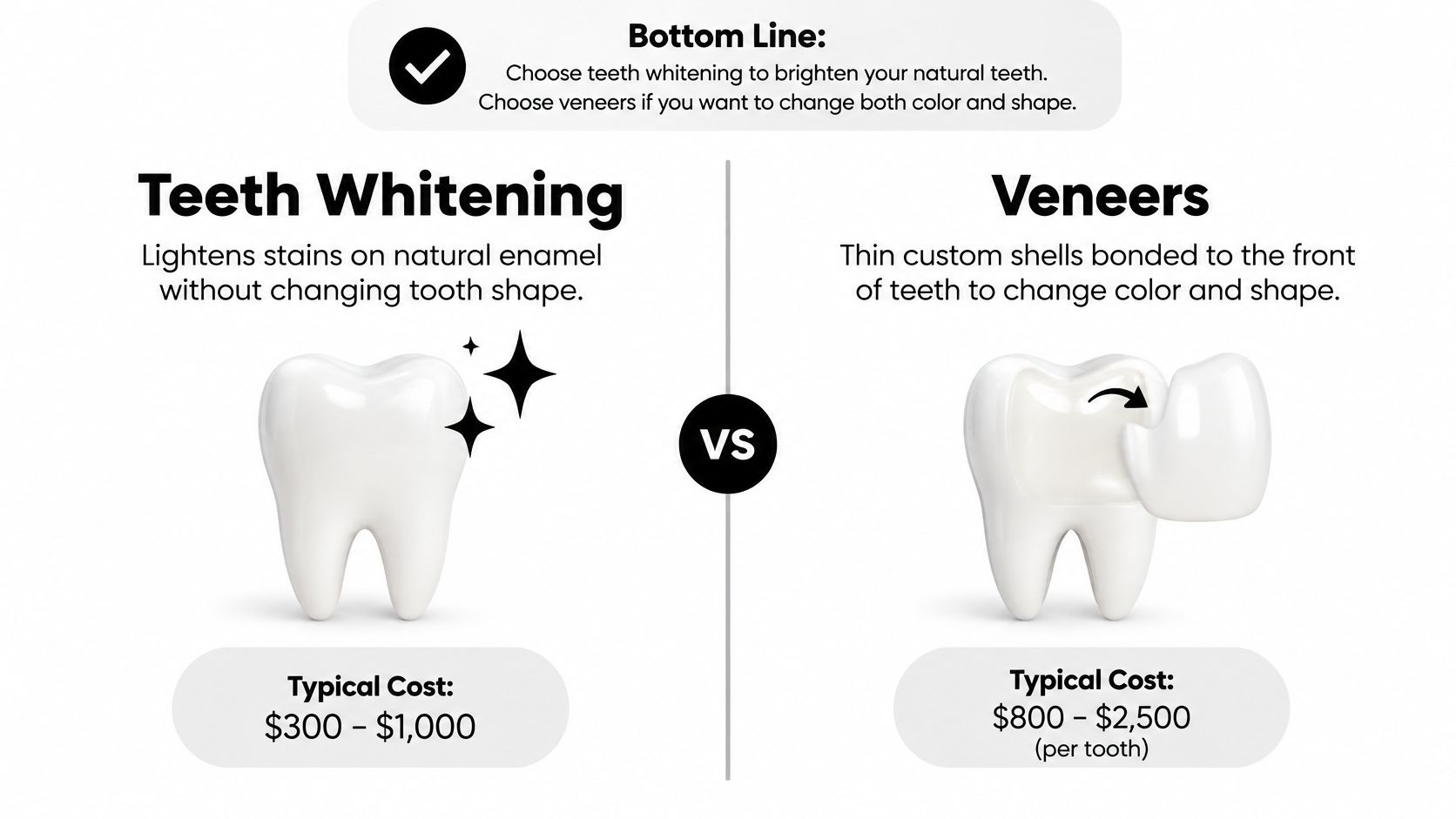
Teeth whitening lightens stains on natural enamel without changing tooth shape. Porcelain veneers are thin custom shells bonded to the front of teeth to change color, shape, and length. That's the direct answer, and everything else follows from it.
| Factor | Teeth Whitening | Porcelain Veneers |
|---|---|---|
| Main job | Lightens stains on natural tooth structure | Covers the front surface to change color, shape and length |
| Enamel removed | None | Minimal enamel removed to make room for veneers |
| Shape and alignment | No change | Can reshape teeth, close small gaps and correct mild crowding |
| Crowns, fillings and existing veneers | Do not change color | Cover the surface as a new restoration |
| Reversible | Results fade and repeat treatment is possible | Enamel change is permanent and replacement may be needed later |
What the Table Means in Practice
Whitening is conservative because the tooth stays intact. The trade off is reach: it can't reshape a tooth, close a gap, or lighten a crown sitting next to a natural tooth. Patients comparing professional options, including guides on cosmetic whitening for Dubai adults, will see the same limit repeated for a reason. Bleaching chemistry works on natural structure, not on restorative materials.
Veneers solve more problems at once, but they ask more of the tooth. Once enamel is altered to make room for porcelain, that change doesn't reverse. The tooth will need a covering from that point forward, even if a veneer is later replaced.
Choose whitening first when healthy teeth carry surface stain. Choose veneers when stain resists bleaching or shape itself needs correction.
For patients searching for a dentist in Miami, FL or a cosmetic dentist near me, Ultra Smile DentalSpa in Miami runs the dental exam that settles this choice. Cavities, gum health, cracks, and existing restorations are checked before either treatment is promised. That exam isn't a formality. It's the step that prevents whitening a tooth that needs repair, or preparing a tooth for porcelain when simple bleaching would have worked.
What Each Treatment Changes in Your Smile
Two kinds of discoloration drive almost every decision in cosmetic dentistry. The first sits on or near the outer enamel and builds up from coffee, tea, tobacco, red wine, and normal aging. Dentists call this extrinsic staining, and it's the kind whitening handles well.
The second kind lives deeper inside the tooth. Intrinsic discoloration can follow childhood medication, trauma to a tooth, or internal changes after injury or root canal treatment. Peroxide may lighten the surface around it while the deeper grey, brown, or banded color stays visible.
How Whitening Changes Color Only
Whitening uses peroxide based products to lift stain from natural tooth structure. The tooth keeps its original length, edge shape, spacing, and alignment. A slightly rotated front tooth stays rotated, only brighter.
Say a patient has straight, intact front teeth darkened by years of coffee. No chips, no gaps, no large fillings showing when smiling. That patient is usually a straightforward whitening candidate, and veneers would be unnecessary removal of healthy enamel.
How Veneers Mask Color and Rebuild Shape
A veneer doesn't bleach the tooth underneath. It covers the visible front surface with porcelain made to a planned shade and contour, so the underlying color is masked rather than chemically changed. That's why porcelain veneers can correct discoloration that cannot be corrected with whitening.
Say a different patient has one grey front tooth, a chipped corner on its neighbor, and a small gap between them. Whitening might brighten the healthy teeth and make the grey tooth stand out more. Veneers can address all three concerns in one plan because porcelain veneers can alter the shape of teeth and lengthen teeth that appear too short, and porcelain veneers can restore the appearance of cracked or chipped teeth.
Veneers can also refine proportions that whitening never touches:
- Length: Adding visual length to worn or naturally short teeth
- Edges: Evening out uneven or flattened biting edges
- Spacing: Closing small gaps without orthodontic treatment
- Rotation: Improving the appearance of mild crowding or rotation
Before and After Expectations
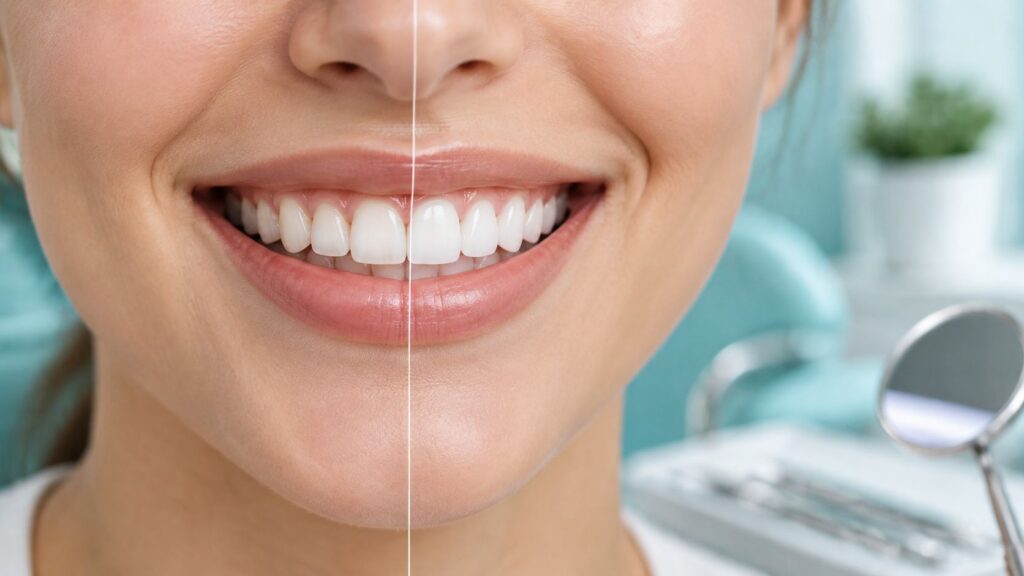
Whitening brightens gradually and preserves each tooth's individual character, including minor irregularities that patients may appreciate. Veneers provide a more uniform result because shade, length, and contour are planned with the patient during consultation before any tooth is prepared.
The same stain can still have different causes in different mouths. A yellow tooth may be surface stained, thinned by wear, or darkened from inside. Examining the tooth first prevents a patient from paying for repeated whitening on a stain that was never going to lift.
How Long Results Last and What Keeps Them
Whitening fades. That is the honest starting point, and it should shape the plan from day one. Veneers hold their change longer, but they are a restorative commitment with eventual maintenance. Neither is a one-time purchase you can forget.
The longevity gap is real and documented. Evidence summarized in peer reviewed dental literature on porcelain veneer survival reports that one retrospective study found survival of 94.4% after 5 years and 93.5% after 10 years, while a randomized clinical trial reported 96% survival after 10 years and 91% after 20 years. A newer literature review likewise concluded that veneers generally show survival above 90% beyond 10 years, although pooled randomized trial data were lower at 88%, with a 95% confidence interval of 81% to 94%.
Survival means the veneer remains clinically in service. It does not promise every veneer stays free of chipping, surface change, or eventual replacement. Material choice shifts those odds. Ceramic veneers have generally outlasted composite veneers, which more often show surface defects and marginal staining.
The upkeep schedule follows the diagnosis. If the problem is stain on healthy enamel, whitening is the lower-commitment route and repeat treatment is normal. If the color sits deeper in the tooth or the enamel is worn thin, repeated whitening buys little. Veneers hold the change because they cover the surface that keeps staining.
| Treatment | Typical Longevity | What Shortens It | Upkeep |
|---|---|---|---|
| Teeth whitening | Fades over time; repeat treatment keeps the shade | Coffee, tea, tobacco and age related staining | Repeat treatment and steady stain avoidance |
| Porcelain veneers | Often 10 years or longer with proper care | Fracture, debonding and color change | Brushing, flossing, routine check ups and staining avoidance |
Upkeep That Protects Veneers
After placement, patients receive guidance on maintaining their veneers, including brushing and flossing techniques suited to the margins where porcelain meets tooth. Routine dental check ups are used to monitor veneers and overall oral health, catching small chips, gum changes, or bite problems before they become replacement decisions.
Veneer patients are advised to avoid substances that stain veneers, such as coffee, tea, or tobacco, especially at the edges where bonding material can pick up color. Porcelain resists stain well. The surrounding natural teeth do not, and a mismatch develops when habits stay unchanged.
Upkeep That Protects Whitening
Whitening upkeep is simpler but less forgiving. The same drinks and tobacco that caused the original stain will rebuild it, so touch up sessions are part of the plan, not a sign of failure. Patients who want realistic timing should read the practice guide on how long professional whitening results typically last before booking around a wedding or photos.
Durability versus reversibility: whitening preserves tooth structure but fades. Veneers hold their change longer and require ongoing restorative care.
Neither option removes the need for cleaning and exams. Longevity figures assume teeth and gums stay healthy underneath the cosmetic result.
Timeline and Cost From First Visit to Final Result
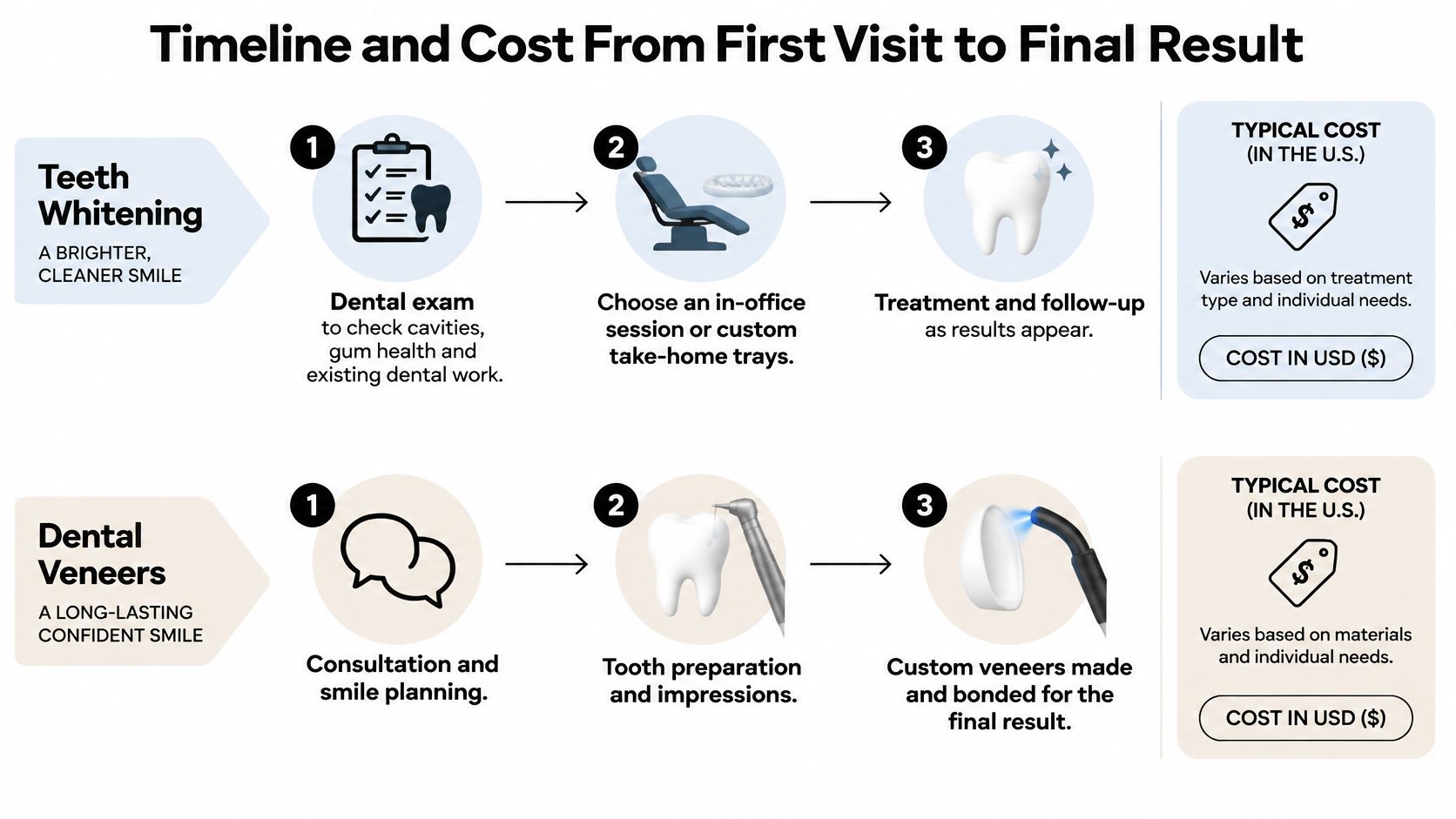
The timeline for each treatment looks different from the first appointment. The comparison below sets out both paths before the step by step detail.
Whitening Steps
- Dental exam: Cavities, gum health, cracks, and existing dental work are checked, often with dental x rays during new patient exams.
- Format choice: The patient chooses an in office session or custom take home trays fitted to the teeth.
- Treatment schedule: Trays are worn as directed while the shade lifts gradually.
- Shade review: The result is assessed and touch up timing is planned.
The American Dental Association whitening topic page reports that at home systems commonly contain 10% to 38% carbamide peroxide, with daily use ranging from 2 to 10 hours over 6 to 28 days. That range explains why one patient's trays finish in a week and another's run nearly a month. Product strength and starting shade set the schedule, not impatience.
The short video below walks through how these cosmetic visits are sequenced in practice.
Veneer Steps
- Detailed consultation: Veneer treatment starts with a detailed consultation to assess the patient's dental needs and cosmetic goals.
- Impressions: An impression of the teeth is taken and used to custom make the veneers.
- Preparation: Minimal enamel is removed to make space so the final tooth doesn't look bulky.
- Temporaries: Temporary coverings protect prepared teeth while the porcelain is made.
- Final bonding: Once the veneers are ready, they are carefully placed, adjusted, and bonded to the teeth.
| Factor | Teeth Whitening | Porcelain Veneers |
|---|---|---|
| Starting steps | Dental exam, then in office session or custom take home trays | Detailed consultation, impressions, minimal enamel removal, temporary placement, final bonding |
| Active treatment time | At home schedule commonly 6 to 28 days, 2 to 10 hours daily | Multiple visits from consultation and preparation through custom fabrication to final bonding |
| Upfront cost | Usually lower, with little preparation needed | Higher per tooth, based on number of teeth, material and extra work |
| Insurance | Cosmetic treatment, so request an itemized estimate before starting | Cosmetic work often not covered, so request an itemized estimate |
Planning Cost Honestly
Whitening usually carries the lower upfront cost because no laboratory work or tooth preparation is involved. Veneers cost more per tooth, and the total depends on how many teeth show in the smile, the material selected, and whether restorative dentistry such as fillings or gum treatment must come first.
Patients should ask for an itemized estimate that separates exam, preparation, laboratory, and follow up costs. A clear plan with no surprises is a reasonable expectation, and the exam is what makes that estimate accurate.
Risks, Sensitivity and Permanent Changes
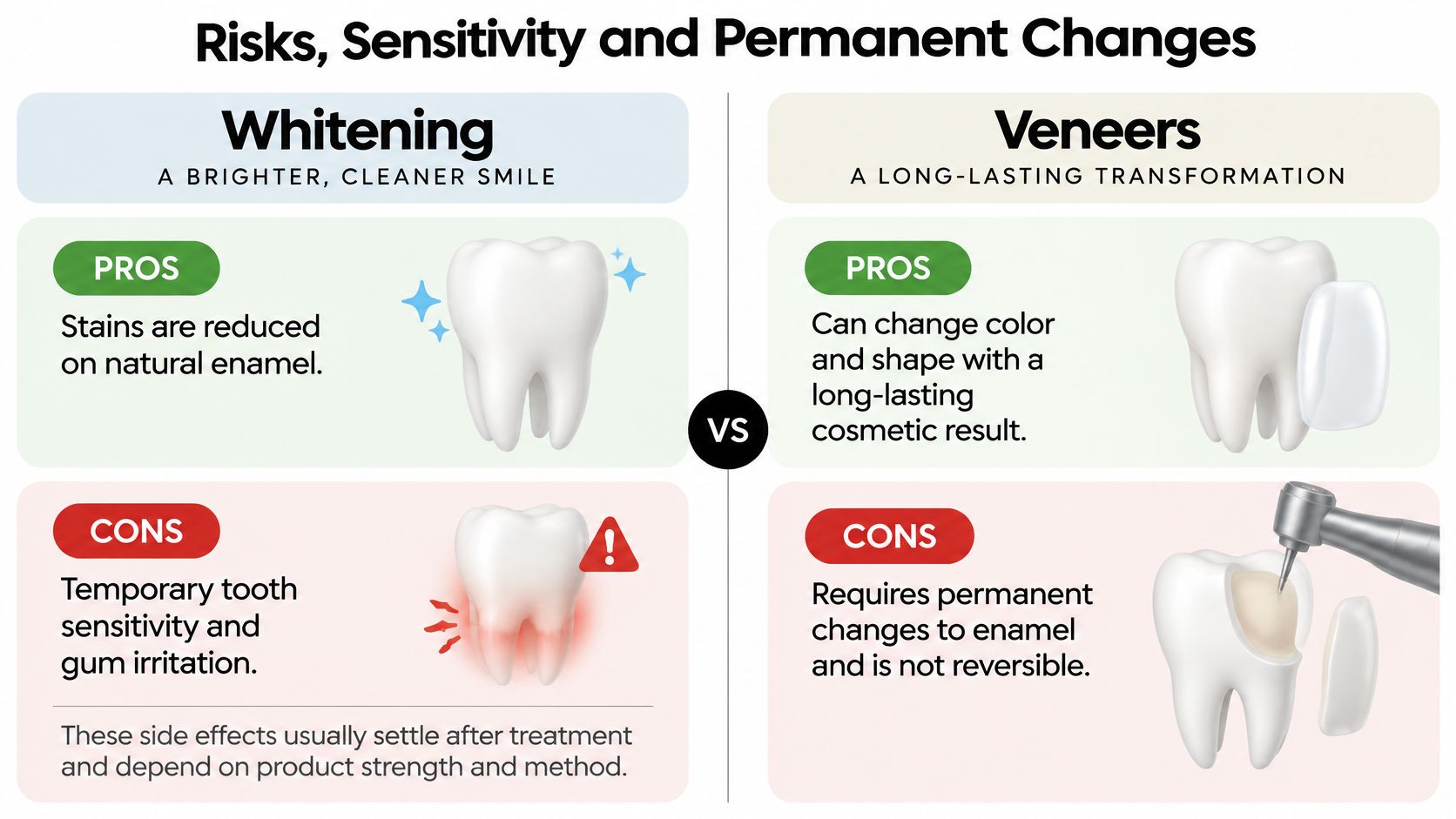
Veneers aren't the risk free upgrade they're often marketed as, and whitening isn't side effect free either. The risks differ in kind. One treatment causes temporary symptoms, the other creates a permanent change that must be maintained for life.
Whitening Sensitivity
The common whitening side effects are temporary tooth sensitivity and gum irritation. Cold drinks may sting during treatment, and gums can feel sore if gel contacts soft tissue. These effects usually settle after treatment ends and depend on product strength and method.
Whitening doesn't remove enamel, which is precisely why dentists consider it conservative. A patient who dislikes the result, or finds sensitivity hard to tolerate, can stop. The tooth remains structurally what it was before treatment started.
Sensitivity can be managed rather than endured. Lower strength products, shorter daily wear, rest days between sessions, and desensitizing toothpaste all help, and the treating dentist should adjust the plan if symptoms escalate instead of telling the patient to push through.
Veneer Failure Modes
Veneer risks are mechanical and biological rather than temporary. A systematic review of porcelain laminate veneer outcomes estimated a 10 year cumulative survival rate of 95.5% for porcelain laminate veneers, with estimated 10 year survival of 96.3% for fracture, 99.2% for debonding, 99.3% for secondary caries, and 99.0% for the need for root canal treatment. A separate meta analysis reported an overall veneer survival rate of 89% at a median nine year follow up, with debonding in approximately 2%, fracture or chipping in 4%, and secondary caries in 1% of cases.
Those are strong numbers, and they still mean some veneers chip, loosen, or develop decay at the margin. Grinding at night, biting ice, and opening packaging with front teeth raise fracture risk considerably. Patients are advised to avoid biting on hard objects or using their teeth as tools, and grinders may need a night guard.
The Permanent Part
A minimal amount of enamel is removed to make space for veneers, and removed enamel doesn't grow back. Patients weighing that trade off should read the practice explanation of whether veneers damage natural teeth underneath before consenting. Prepared teeth will always need coverage, so replacement cost belongs in the original decision, not as a surprise years later.
Veneers also don't end preventive care. Decay prevention, bite protection, and gum maintenance continue exactly as before, and neglected margins are a common reason otherwise sound veneers fail early.
Choose veneers when the benefit justifies a lasting change to the tooth, not simply because whitening was tried once and underdelivered.
That principle protects patients from escalating to porcelain for a stain that a second, properly supervised whitening approach might have solved. It also protects patients with resistant discoloration from wasting money on repeated bleaching.
Which Option Fits Your Smile
Start with eligibility, not preference. The NHS teeth whitening guidance notes that whitening is not permanent, with results lasting around three years when patients follow dental advice, that it is generally limited to patients over age 17, and that it should not proceed when teeth or gums are unhealthy. The same guidance confirms that crowns, dentures, implants, fillings, and existing veneers do not change color, which can create a mismatch after treatment.
That last point changes more treatment plans than any other. A patient with two front crowns and stained natural teeth beside them won't get an even smile from whitening alone. The natural teeth brighten, the crowns stay put, and the contrast can look worse than the original uniform dullness.
| Your Situation | Usually Better Starting Point | Why |
|---|---|---|
| Healthy teeth with surface or age related stains | Teeth whitening | Lightens natural enamel without removing it |
| Deep or medication related discoloration | Porcelain veneers | Whitening often cannot reach intrinsic stains |
| Chipped or cracked tooth | Porcelain veneers | Covers and restores the visible surface |
| Minor gaps, crowding or rotation | Porcelain veneers | Can close gaps and correct mild positional issues |
| Uneven color around existing crowns or fillings | Discuss at the exam | Whitening cannot change restorations, so matching may need replacement |
| Under 18 years old | Whitening generally not recommended yet | Whitening is generally limited to patients over 17 |
Reading the Table Honestly
Healthy teeth with surface stain belong to whitening because nothing structural needs fixing. Deep discoloration belongs to veneers because masking works when bleaching chemistry can't reach the source. Chips, gaps, and mild rotation belong to veneers because only a new front surface changes shape.
Mixed cases are common and often give the best value. A patient planning veneers on two front teeth may whiten the remaining natural teeth first, so the porcelain is made to match the brighter final shade. Doing it in reverse locks the veneers to a duller shade the patient never wanted.
- Whitening first, then restorations: New crowns or veneers match the lighter shade
- Veneers on problem teeth only: Sound neighboring teeth stay untouched
- Health treatment first: Decay, gum disease, or a needed tooth extraction is handled before any cosmetic work
Who Does Well With Veneers
Veneer candidates typically have good overall oral health and a commitment to veneer care. That commitment is practical, not cosmetic. Daily cleaning at the margins, regular check ups, and sensible habits with hard foods determine whether the investment reaches its expected lifespan.
Patients who grind heavily, skip dental visits, or expect veneers to need no attention are poor candidates until those issues are addressed. An honest cosmetic dentist near me search should end with a dentist willing to say so.
The governing rule stays constant across every row of the table. The best option is the one that solves the actual problem with the least permanent change to the tooth.
Book Your Smile Consultation in Miami
The right choice depends on findings no article can see. An exam with dental x rays checks cavities beneath old fillings, gum health around front teeth, bite forces on the teeth being considered, and every existing crown, filling, or veneer that could affect color matching.
What the Consultation Covers
Patients should expect four things to be settled at that visit. First, the cosmetic goal is defined in specific terms, such as brighter only, or brighter with a closed gap. Second, the teeth involved are identified. Third, the options that fit those teeth are compared. Fourth, an estimated plan sets out cost, timeline, and upkeep before any treatment begins.
Ultra Smile DentalSpa is a Miami dental practice serving Downtown Miami, Midtown Miami, and Hallandale Beach, with bilingual staff and transparent treatment planning. The first visit can include a dental exam, cleaning, and x rays, which support the plan for teeth whitening, veneers, and other cosmetic dentistry options, as well as related care such as dental implants when a missing tooth is part of the picture.
Two offers fit naturally into that first conversation. Complimentary teeth whitening once a year is offered to all patients, which suits the whitening first path for healthy teeth. A free consultation can be requested through the form on the treatment pages, so the initial conversation costs nothing.
Three Questions to Bring
- Which option suits these teeth: Ask what the exam found and why one treatment fits better
- What upkeep each option needs: Ask about touch ups, check up intervals, and habits to change
- What the total estimate includes: Ask whether preparation, temporaries, laboratory work, and follow up are itemized
Those questions separate a considered plan from a sales pitch, whether the search began with dentist near me, dental implants near me, or emergency dentist after a chipped front tooth. Pain, swelling, or a broken tooth should always be treated before cosmetic planning anyway, and the same visit can address both.
Patients in Miami who want a direct answer about whitening, veneers, or a combined plan can schedule an appointment or request a consultation and leave with a written plan. The exam takes less time than many people spend comparing before and after photos online, and it replaces guessing with findings.
Ultra Smile DentalSpa provides professional teeth whitening, custom porcelain veneers, and full cosmetic and restorative dental care for patients across Miami in a calm, spa like setting. Anyone weighing whitening against veneers can request a free consultation, get an exam based recommendation with an itemized plan, and start with the least permanent option that solves the problem. Visit Ultra Smile DentalSpa to schedule an appointment or request a consultation today.