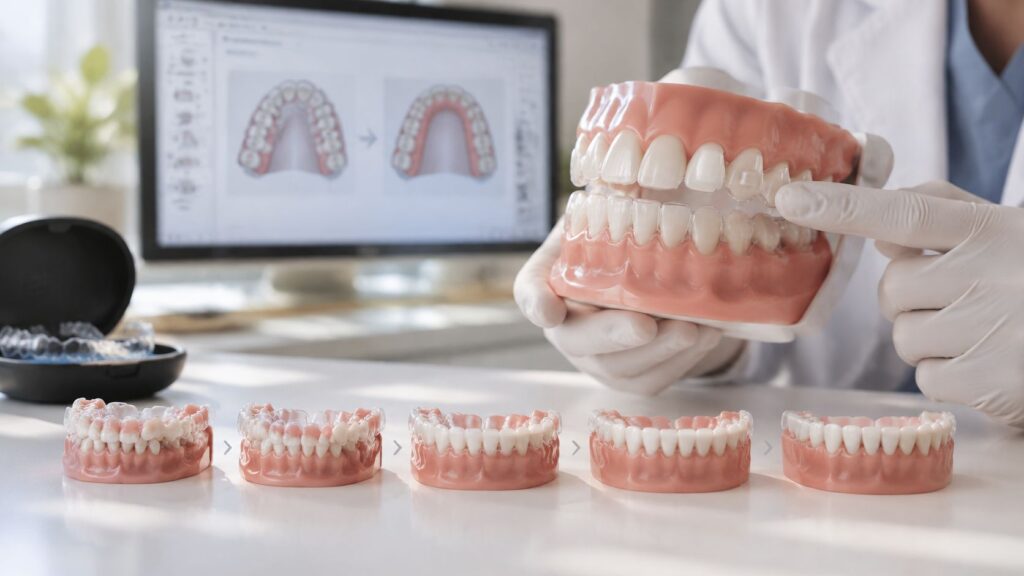
The animation ends with straight teeth, a balanced smile, and an appealing finish date. For an adult comparing a dentist in Miami, FL, the harder question is what happens between the first scan and that final image, especially when crowding, uneven spacing, or an uncomfortable bite prompted the appointment.
Invisalign treatment plans should explain more than appearance. At Ultra Smile DentalSpa in Miami, the doctor takes as much time as needed to review the treatment plan and all possible options. A useful consultation turns the preview into practical decisions about tooth movement, appointments, daily wear, and long-term maintenance.
Table of Contents
- What an Invisalign Treatment Plan Includes
- How the Digital Plan Is Built, Step by Step
- Who Is a Good Candidate for Clear Aligners
- Which Movements Predict Well and Which Need Refinements
- How Long Treatment Takes and Why Estimates Vary
- How Wear Time and Check-Ups Keep Your Plan on Track
- Book Your Invisalign Consultation in Miami
What an Invisalign Treatment Plan Includes
After seeing an animated smile preview, a patient may reasonably assume that accepting treatment means accepting that exact result. In reality, an Invisalign treatment plan connects a clinical assessment, a proposed sequence of movements, and opportunities to adjust treatment as the teeth respond.
The simulation is the intended destination, not a guarantee. The clinician still needs to decide whether the proposed movements are suitable, how the aligners will apply force, and what should happen if a tooth doesn't follow the planned path.
The parts that turn a preview into treatment
Records establish the starting point. Intraoral scans or impressions describe tooth shape and position, while dental X-rays and photographs help the dentist assess structures and relationships that a surface scan alone cannot show.
The remaining components organize how treatment proceeds and how the result will be maintained.
Components of an Invisalign treatment plan
| Component | What it includes | Why it matters |
|---|---|---|
| Digital assessment | Intraoral scans or impressions, X-rays and photos | Creates the three-dimensional model and clinical records underlying the plan |
| Treatment simulation | Digital preview of the planned tooth positions | Shows the intended destination, not a guaranteed result |
| Aligner schedule | Number of trays and wear time per tray | Sets the pace, commonly with changes every one to two weeks when prescribed |
| Attachments | Small tooth-colored bumps bonded to specific teeth | Give aligners grip for rotations and other difficult movements |
| Elastics | Small rubber bands worn between upper and lower trays | Help correct bite relationships when the plan calls for them |
| Refinement aligners | Extra trays made after the original series | Fine-tune movements that didn't track as predicted |
| Check-ins | Scheduled scans and visits | Catch tracking problems before they grow |
| Retainers | Custom retainers worn after active movement | Hold the result in place over time |
Attachments and elastics aren't interchangeable. An attachment helps the aligner engage a particular tooth; an elastic adds force between the upper and lower arches when the bite needs additional correction.
Likewise, a refinement isn't another routine tray change. It involves reassessing the current tooth positions and planning additional movement rather than continuing to rely on an outdated starting model.
What should be clear before approval
A written plan should separate essential components from possibilities. Patients benefit from knowing which attachments are already planned, whether elastics are anticipated, and which findings would trigger a new scan.
Practical rule: A treatment proposal should describe what the clinician will check, not just what the computer displays.
Useful consultation questions include:
- Movement support: Which planned movements will need attachments?
- Additional correction: How many refinement stages seem likely for this particular case?
- Long-term maintenance: What will retention involve after active treatment?
Those answers help patients understand the commitment behind the preview.
How the Digital Plan Is Built, Step by Step
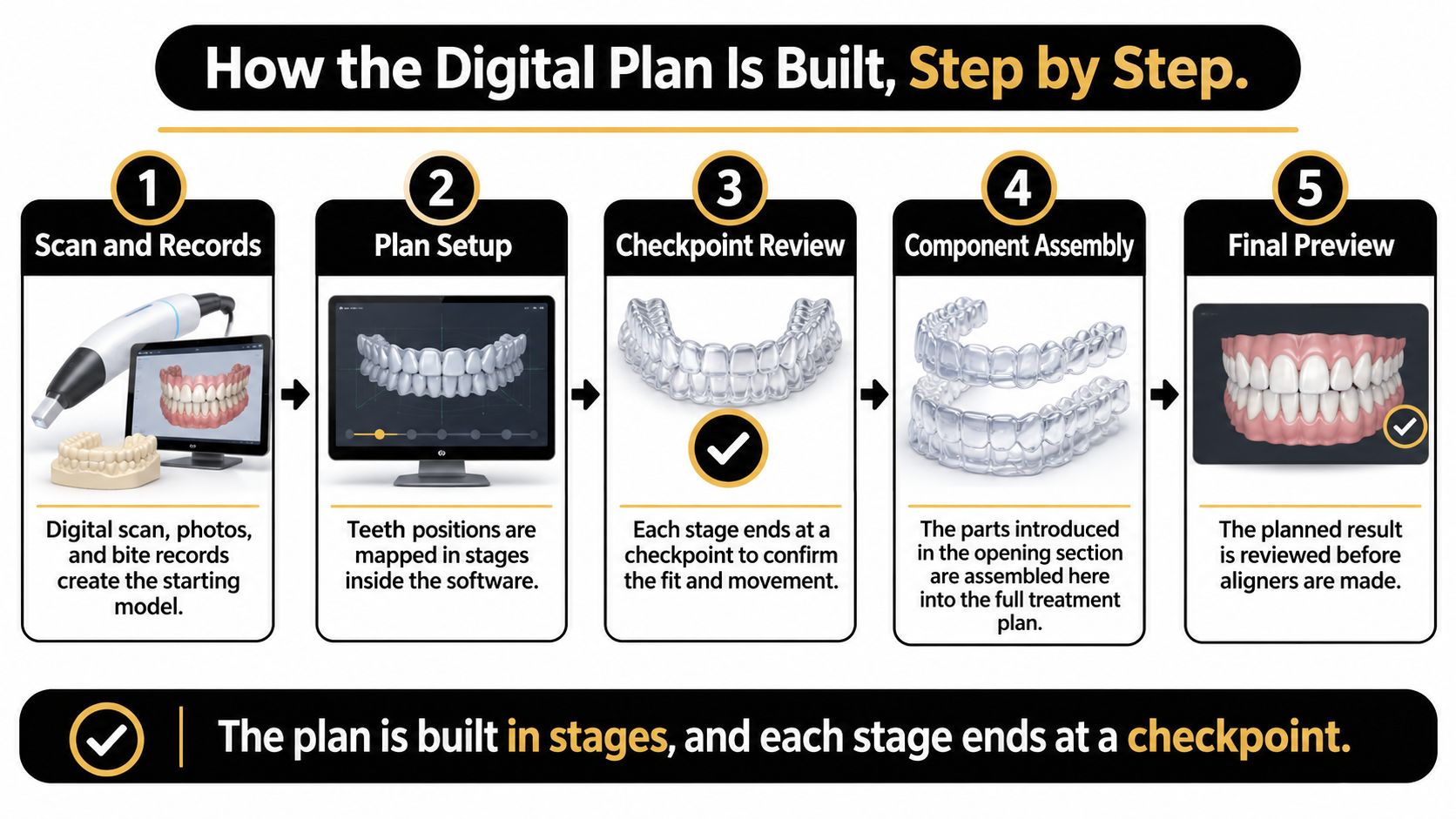
The digital plan develops through clinical decisions, not a single software command. Each stage needs a checkpoint before the next commitment, whether that means approving the setup, manufacturing trays, or advancing to another aligner.
The infographic outlines the planning workflow before treatment begins.
From records to approved treatment
Consultation and records. The dentist reviews smile goals, symptoms, dental health, and the way the teeth meet, then obtains scans, appropriate X-rays, and photographs. At Ultra Smile DentalSpa in Miami, the doctor spends as much time as needed discussing the treatment plan and all possible options. Arriving without a current medication list or available previous X-rays can leave important questions unresolved.
Digital setup. Software models the starting arrangement and a staged route toward the proposed result. The clinician must review that route rather than accept the software's first arrangement as final. A common misunderstanding is assuming that a technically possible animation is automatically an appropriate clinical plan.
Plan review. The patient and dentist review the proposed changes, including the bite rather than only the visible front teeth. This is the time to identify difficult movements, alternatives, and limitations. Approving an attractive screen image without discussing those issues can create unrealistic expectations.
Attachment decision. The clinician specifies which teeth need extra grip and when attachments should be placed. Bonding generally occurs at the appropriate treatment-start appointment rather than necessarily before tray production. Omitting prescribed attachments for convenience can undermine the movements they were designed to support.
From manufacturing to maintenance
Tray production. The approved setup becomes the custom aligner sequence. Before manufacture, unresolved questions about the intended result or treatment approach should be settled. Treating production as the moment to reconsider major goals can create avoidable disruption.
Start and wear. At delivery, the team checks seating and explains insertion, removal, cleaning, and the prescribed change schedule. Patients shouldn't advance just because a calendar reminder appears if the current tray isn't fitting properly. Forcing the next aligner isn't a substitute for a fit assessment.
Check-ins and refinement. The dentist compares actual progress with the intended movements and determines whether a different schedule or updated scan is needed. Missing a check-in can leave a poorly tracking tooth unnoticed while later trays become harder to fit.
Retention. Once active movement is complete, the clinician checks the finishing result and provides the retention instructions. Stopping retention early because the teeth look straight confuses the end of movement with the end of maintenance.
A snugly seated tray and a subsequent aligner that fits without force are encouraging signs. Fit alone doesn't confirm that the bite and roots are finished, so clinical review remains necessary.
Who Is a Good Candidate for Clear Aligners
The strongest evidence supports non-growing patients with mild-to-moderate alignment or bite problems who don't need tooth extraction, according to a systematic review of Invisalign clinical outcomes. That includes adults and teens whose growth is substantially complete, but it doesn't mean that every apparently mild case is straightforward.
Suitability is a range. Small gaps may require relatively simple crown movement, while a similarly sized space elsewhere may involve difficult root positioning or a bite relationship that changes the treatment decision.
Matching the starting problem to the approach
Case types and typical suitability for clear aligners
| Case type | Typical suitability | What the plan usually needs |
|---|---|---|
| Mild crowding or small gaps | Strongest candidate | Standard tray series with few attachments when clinically appropriate |
| Moderate crowding or spacing | Good candidate with planning | Attachments and possibly refinement trays |
| Rotated rounded teeth | Possible but less predictable | Attachments and a refinement strategy |
| Large vertical or bite discrepancies | Limited, needs specialist review | Possible braces or a combined approach |
| Cases needing extraction | Needs specialist review | Clinician plan for how space will close |
| Growing teens | Assessed case by case | Growth reviewed before the plan is finalized |
The table is a discussion aid, not a diagnosis. A small amount of visible crowding can coexist with a more significant bite problem, and a gap may reflect more than tooth position.
For patients whose main concern is spacing, the explanation of whether Invisalign can fix gaps in teeth provides context for that consultation. The dentist still needs to assess the cause of the spaces and the condition of the supporting tissues.
Why the bite matters as much as the smile
Malocclusion means that teeth or jaws don't meet in their intended relationship. Depending on the individual problem, this can affect chewing contacts, create areas that are difficult to clean, or contribute to unwanted tooth wear.
Alignment care aims to improve tooth position and suitable bite relationships, not just make the front teeth look even. It isn't a universal treatment for jaw pain, headaches, or sensitivity, which need their own assessment.
For example, a patient with a deep bite may have fairly straight-looking front teeth but still need substantial vertical correction. A patient requiring extraction needs careful planning for closing the resulting space, including root control rather than merely bringing visible crowns together.
A practical readiness check includes:
- Daily commitment: Can consistent prescribed wear fit around meals and work?
- Appointment access: Can the patient attend monitoring visits?
- Clinical suitability: Does the examination identify a manageable bite problem, healthy supporting tissues, and realistic goals?
A digital assessment combined with a clinical examination at Ultra Smile DentalSpa in Miami is the reliable way to place an individual case within these categories. A photograph or online self-check can't establish suitability.
Which Movements Predict Well and Which Need Refinements
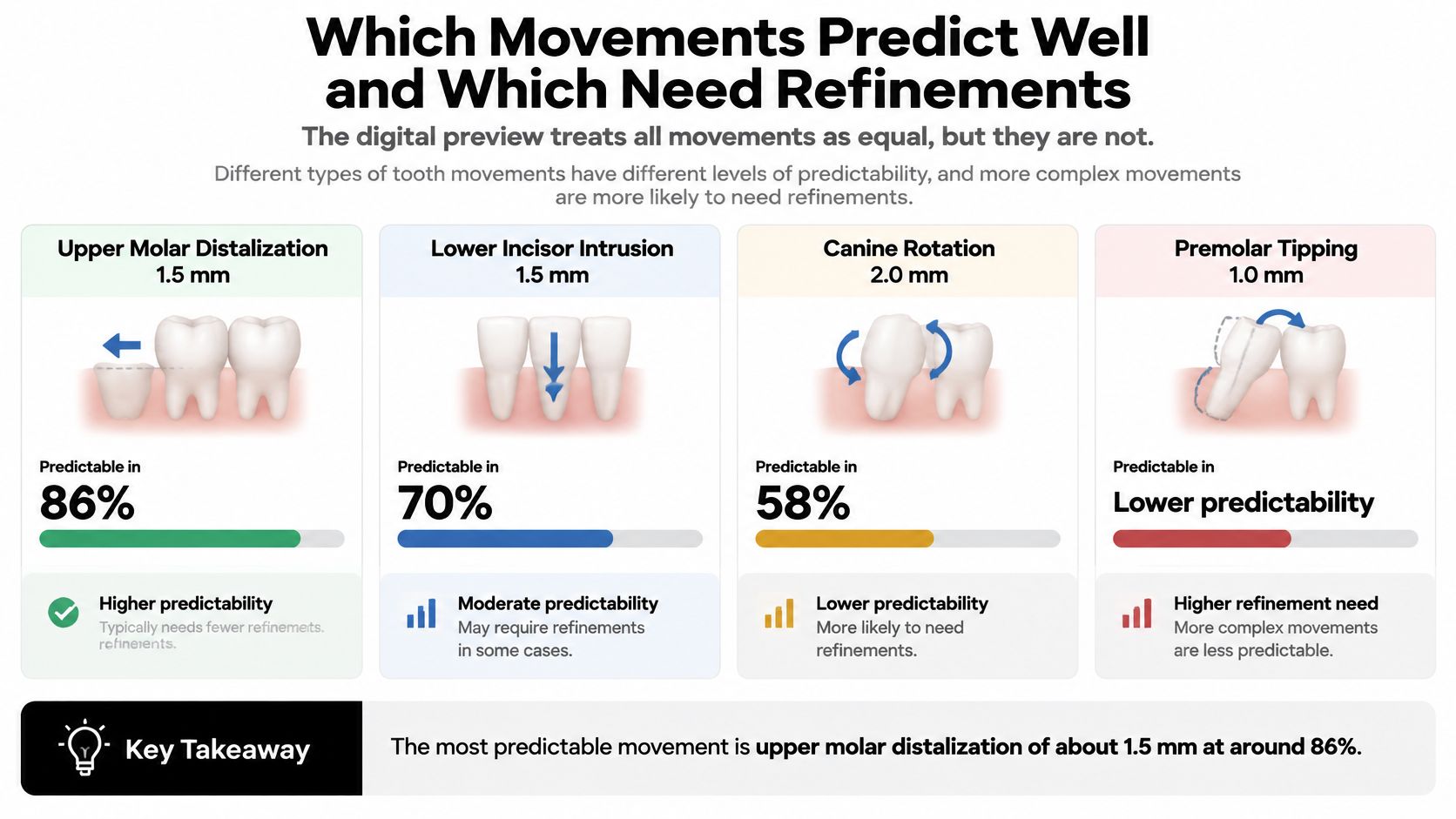
Different tooth movements have different levels of predictability, even when they look equally smooth in an animation. Moving a molar backward isn't mechanically equivalent to pulling a front tooth downward or controlling the angle of its root.
The chart illustrates why clinicians evaluate movements individually rather than judging the entire plan by its final frame.
What the reported benchmarks mean
A systematic review of clear-aligner movement control reported approximately 88% predictability for upper-molar bodily distalization of about 1.5 mm, compared with approximately 30% accuracy for extrusion. These measurements describe how closely achieved movement matched planned movement, not the percentage of patients who were satisfied or successfully treated.
A clinical consensus overview on aligner precision describes approximately 86% success for molar distalization, 80% for expansion, and 52% for torque control. Torque means controlling tooth inclination, including the root position, rather than merely tipping the visible crown.
A systematic review comparing predicted and achieved positions reported horizontal incisor discrepancies of approximately 0.20 to 0.25 mm, while upper-central-incisor intrusion had a median discrepancy of approximately 1.5 mm. Those findings explain why apparently tidy front teeth don't necessarily confirm successful vertical correction.
Reported predictability by tooth movement
| Movement | Reported accuracy or discrepancy | What the plan should do |
|---|---|---|
| Upper molar distalization, about 1.5 mm | About 86 to 88 percent in the cited reviews | Usually stage with greater confidence |
| Arch expansion | About 80 percent in the cited consensus overview | Track progress at each check-in |
| Torque control | About 52 percent in the cited consensus overview | Plan attachments and a refinement strategy |
| Anterior extrusion | About 30 percent in the cited movement review | Anticipate possible extra trays or auxiliaries |
| Rotation of rounded teeth | Less predictable; no single universal percentage | Use attachments and a refinement strategy |
| Horizontal incisor movement | Discrepancy within about 0.20 to 0.25 mm in the cited position review | Confirm achieved positions at check-ins |
| Upper central incisor intrusion | Median discrepancy about 1.5 mm in the cited position review | Verify vertical control clinically |
These are benchmarks from differing studies, not directly interchangeable scores or guarantees. Study quality, patient selection, movement size, and treatment methods affect how useful a benchmark is for an individual case.
Turning uncertainty into a practical plan
Extrusion moves a tooth farther out of the gum; intrusion moves it farther into the supporting tissues. Both can matter when the goal involves gum display, incisor height, or a deep bite.
For a cosmetic patient, a smile can appear finished while those relationships remain incomplete. The clinician should assess actual overbite, gum display, tooth contacts, and tray seating rather than relying on the animation.
An explanation of Invisalign attachments and their role can help patients understand why extra grip may be necessary. Depending on the movement, the clinician may also consider elastics or carefully planned enamel reduction between teeth.
The accompanying video provides another visual reference for the treatment discussion.
A useful plan identifies the difficult movements before treatment starts and specifies how the clinician will respond if they fall behind.
The consultation should establish which movements are hardest, which supporting components are planned, and what findings would prompt refinement or a different approach.
How Long Treatment Takes and Why Estimates Vary
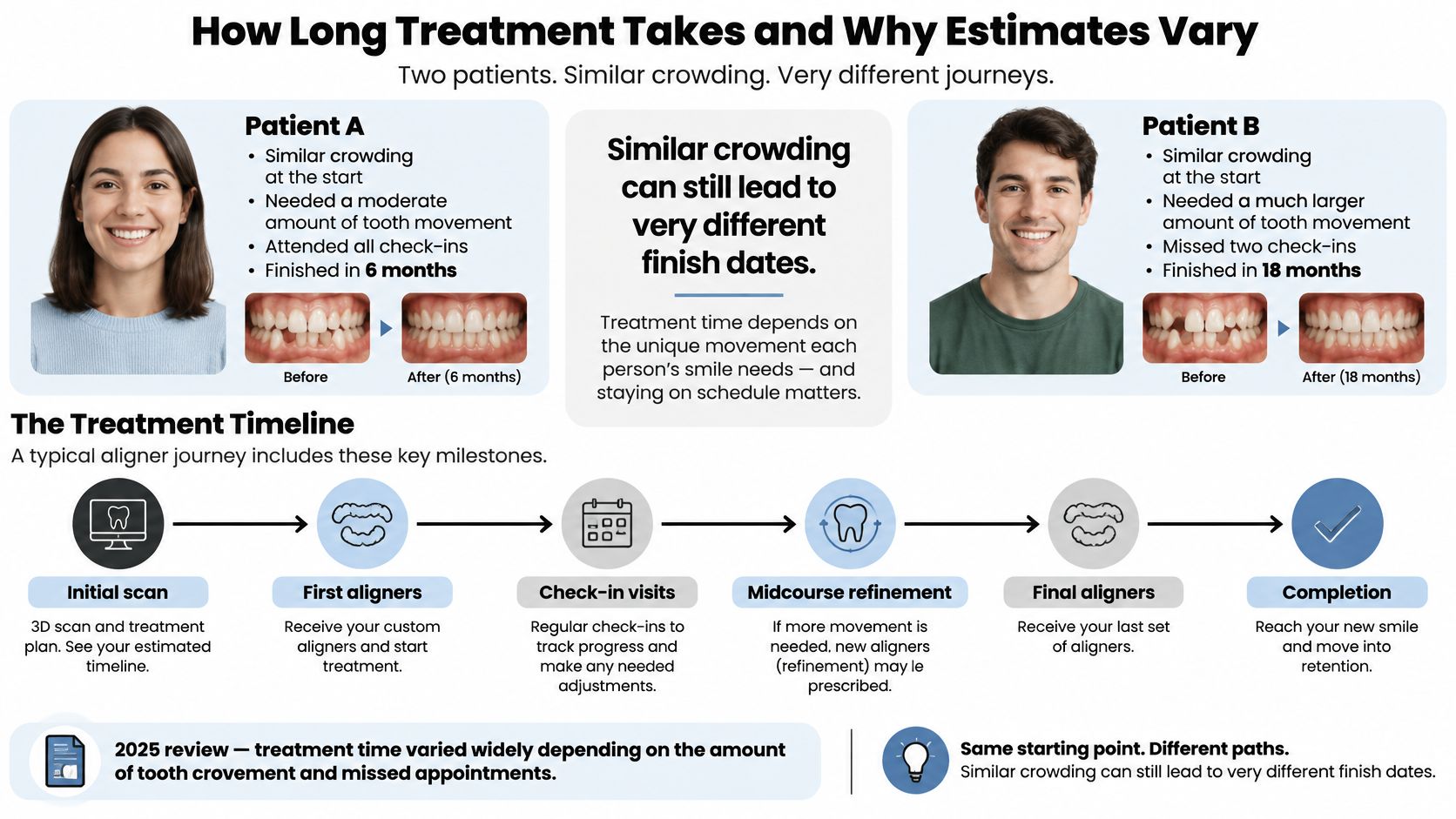
Consider an illustrative situation involving patients with similarly crowded front teeth. One needs mostly local alignment; the other also needs substantial bite correction and misses scheduled monitoring visits. Their starting photographs may look alike, but their completion dates can be very different.
A 2025 review of clear-aligner therapy reported treatment periods of approximately six to 18 months across the reviewed literature and discussed other clinical research with a broader range of six to 46 months. Neither range is a personalized promise.
The infographic shows how similar starting appearances can lead to different treatment paths.
Milestones worth requesting
The amount and type of movement matter more than a simple label such as mild crowding. Complex bite concerns, interruptions in wear, missed monitoring, and additional correction can all change the original estimate.
A milestone schedule makes those possibilities easier to understand:
- Assessment and simulation: Records are completed, dental health concerns are identified, and the proposed route is reviewed before approval.
- First trays and early tracking: The clinician confirms initial seating and checks that the patient can manage insertion, removal, and daily care.
- Mid-treatment review: Actual tooth positions and bite changes are compared with the intended stage.
- Refinement when needed: Updated records guide additional correction, with a revised estimate rather than an assumed original finish date.
- Finishing trays: The dentist evaluates remaining alignment details and functional contacts before ending active movement.
- Retention: The patient receives appliances and maintenance instructions to protect the completed result.
Milestones should describe observable progress. A statement such as reviewing whether a rotated tooth has reached its planned position is more useful than labeling a visit routine.
Comparing aligners with braces fairly
The fastest advertised option isn't necessarily the most appropriate one. A treatment method that offers better control for a difficult movement may be preferable even when another proposal displays an earlier estimated finish.
Patients comparing Invisalign with fixed braces should consider the suitability of each method, the monitoring requirements, and what happens if progress stalls. An estimate that openly includes uncertainty is more informative than an exact date with no explanation.
Planning insight: A completion estimate becomes useful when the clinician explains which milestones must be met to reach it.
For busy Miami professionals and families, appointment planning should begin before treatment starts. Work travel, school commitments, and likely interruptions belong in the scheduling discussion, not only in conversations after a missed visit.
How Wear Time and Check-Ups Keep Your Plan on Track
Daily adherence is often the hardest part of removable treatment. A review addressing clear-aligner adherence describes commonly prescribed wear of approximately 20 to 22 hours daily, while a cited cohort found that only about 36% achieved full compliance at 22 or more hours per day.
That gap doesn't mean patients are careless. Frequent meals, long shifts, travel, and forgotten reinsertion can make removable treatment less convenient than it first appears.
Building a routine that survives a busy day
Repeatedly falling short can leave teeth behind their intended positions. The dentist may need to extend a stage, obtain updated records, or revise difficult movements rather than continue the original schedule unchanged.
A workable routine includes:
- Meals and cleaning: Remove trays for eating, brush before reinsertion, and maintain flossing rather than trapping food against the teeth.
- Travel and social events: Carry a protective case, with a spare available when away from home. Napkins are easy to discard accidentally.
- Daily reminders: Use a phone reminder or wear log to identify interruptions before they become a pattern.
- Early communication: Report inconsistent wear or poor fit promptly rather than advancing trays to catch up.
Clear aligners don't replace cleaning and exams. Pain, bleeding gums, or new sensitivity should receive assessment instead of being dismissed as normal orthodontic pressure; severe pain or swelling warrants prompt dental advice, not merely a tray adjustment.
For broader context on preventive habits, patients can explore the mouth-body health connection through Healtsy. That resource complements, rather than replaces, individual dental advice.
Monitoring and maintenance without blame
A transparent plan should explain adherence coaching, what the dentist checks at visits, the criteria for changing the schedule, and whether additional refinement carries an extra charge. Patients shouldn't have to guess whether a missed milestone changes the clinical or financial commitment.
Shift work and dental anxiety deserve practical discussion. At Ultra Smile DentalSpa, time for questions and a calming environment can support that conversation; appointment planning should account for work and family demands.
After active movement, retainers need their own routine. They should be worn as directed, cleaned daily, kept away from hot water and pets, and brought to review visits.
A loose, painful, cracked, or lost retainer should be reported early rather than forced into place. Patients should establish how retention will be reviewed during the first year and which office contact handles replacement concerns.
The most useful adherence question is how the dental team will help maintain progress when the patient's schedule changes.
Book Your Invisalign Consultation in Miami
The cost of an Invisalign plan reflects more than a tray count. Movement complexity, attachments, likely refinement stages, monitoring, and retention appliances can affect the proposed fee, so a written estimate should clarify what is included.
Ultra Smile DentalSpa accepts insurance, and its website provides the full list of accepted plans. Coverage for orthodontic treatment can differ from general dental benefits, so patients should confirm their particular benefits before proceeding; those without coverage can discuss available options during the consultation.
Preparing for a planning appointment
A consultation with a dentist in Miami, FL should connect smile goals with clinical findings. The assessment reviews symptoms, oral health, and the bite, with scans, appropriate X-rays, and photographs informing the proposed approach.
Patients should bring:
- Available records: Recent dental X-rays and relevant treatment history.
- Health information: A current medication list and important medical updates.
- Treatment priorities: Specific smile and bite concerns, plus questions about difficult movements, refinements, and retention.
Ultra Smile DentalSpa serves Miami and nearby communities, including Downtown Miami, Midtown Miami, and Hallandale Beach. Patients can discuss check-in arrangements around work and family schedules without assuming that monitoring can be skipped.
For anyone evaluating online appointment information, clear forms and service explanations matter. Baikou's resource on website development for healthcare practices offers background on that digital experience, although a website itself cannot determine treatment suitability.
The next step is a clinical assessment, not an obligation to approve the animated result. Patients can request a consultation through the practice website or call the office to schedule an Invisalign assessment.
Ultra Smile DentalSpa offers invisible braces and personalized treatment discussions that address planned movements, monitoring, and retention. Its website has a free consultation request form, and completing it secures a 30% discount on dental treatments. Visit Ultra Smile DentalSpa to request an Invisalign consultation and discuss the proposed approach, available options, and offer details.