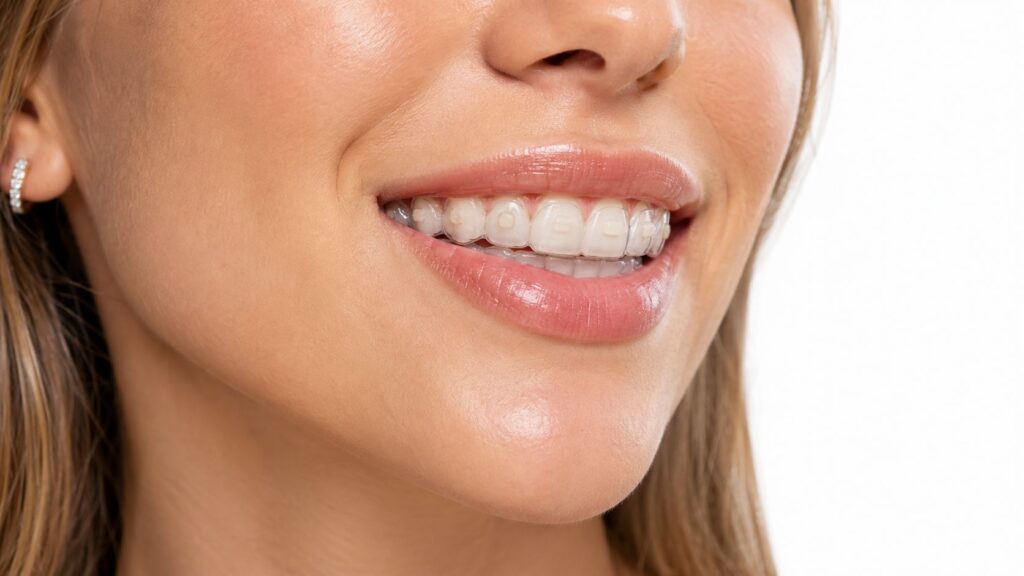
Optimized Invisalign attachments can improve movement, but they don't guarantee a perfect match to the digital plan: pooled canine-derotation accuracy was 61.2% with conventional attachments and 71.5% with optimized attachments, while anterior-extrusion accuracy was 57.5% and 62.4%, respectively (2025 pooled analysis). Invisalign attachments are small, tooth-colored bumps bonded to specific teeth so clear aligners can grip and guide them more effectively.
A Miami professional may arrive for a clear-aligner consultation expecting nearly invisible trays and then notice small shapes on the treatment preview. That moment can raise practical questions: Will the bumps show in photographs? Will speaking feel different? Can they hurt, stain, or fall off? These are reasonable concerns, especially for adults comparing Invisalign with traditional braces or searching for a dentist in Miami, FL who can explain every step before treatment begins.
Attachments aren't decorative add-ons. They're carefully placed composite shapes that help an aligner deliver force to a particular tooth. The right design can support a complex movement, but the result still depends on tooth anatomy, aligner fit, wear, biology, and follow-up care.
Table of Contents
- Understanding Invisalign Attachments in Miami
- How Attachments Improve Aligner Movement
- Conventional Versus Optimized Attachment Designs
- Realistic Expectations for Treatment Outcomes
- Comfort, Speech Adaptation, and Daily Life
- Aftercare and Troubleshooting Guidance
- Next Steps for Miami Patients Considering Attachments
Understanding Invisalign Attachments in Miami
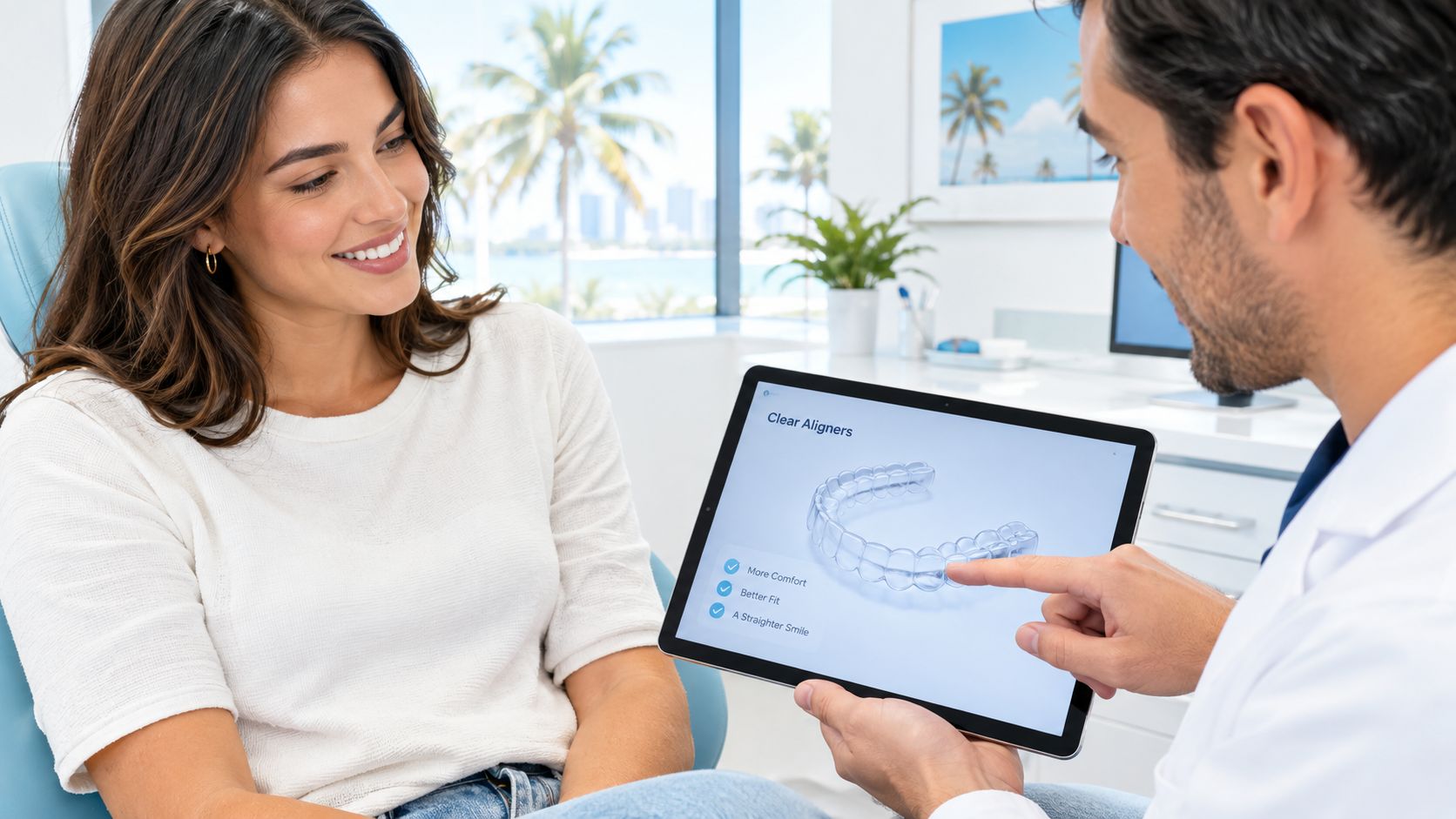
A patient sitting in a Miami dental office may see a clear aligner on a tablet and wonder why the teeth in the simulation have small bumps. The answer is straightforward. Invisalign attachments are bonded composite shapes that change how the aligner transfers force to a tooth, giving the plastic a more useful surface to push against and grip.
Their purpose becomes easier to understand with a simple example. A clear tray may guide a tooth forward or backward fairly well, but rotating a rounded tooth, controlling its root, or moving it vertically requires more targeted force. Attachments can help with rotation, extrusion, intrusion, root torque, mesio-distal angulation, and posterior anchorage, according to a systematic review in Materials.
What patients usually notice
The composite is selected to blend with the tooth, so attachments are generally discreet. They can still be visible on close inspection, particularly when the aligners are removed, but they don't resemble the metal brackets and wires associated with conventional braces. Their visibility is a practical compromise for patients who want invisible braces in Miami while accepting that clear-aligner treatment may involve bonded aids.
Not every tooth needs one. Placement depends on the tooth's shape, the movement planned, and the amount of control required. One tooth may receive an attachment to help with rotation, while another receives a different shape for root control or vertical movement.
Practical rule: An attachment plan should answer a specific movement problem. It isn't a random collection of bumps.
The evidence is reassuring but not absolute. The review found that attachments generally improved anterior root torque, rotation, and mesio-distal movement, while evidence for extrusion and intrusion was more limited or inconsistent. That distinction helps Miami patients understand why a consultation matters. A dentist examines the teeth, reviews the digital plan, and explains where attachments may help, where refinement might be needed, and how the plan fits the patient's broader cosmetic and oral-health goals.
How Attachments Improve Aligner Movement
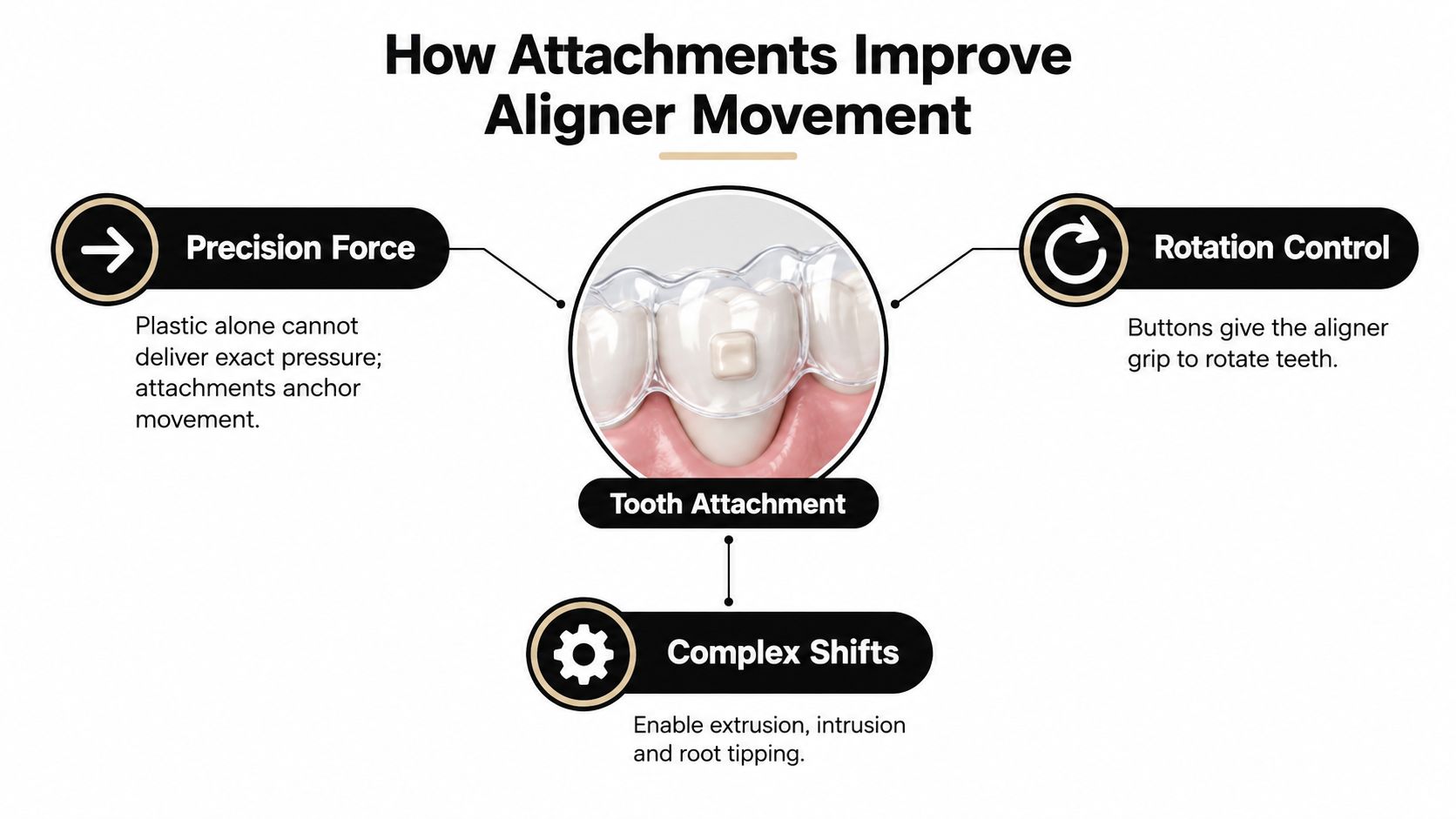
Clear aligners work by applying planned pressure through a sequence of trays. Plastic alone, however, doesn't always have a sufficiently precise surface to control a tooth. A bonded attachment acts like a small handle. The aligner fits around it and uses that contact to direct force more intentionally.
A door handle offers a useful analogy. Pushing against a smooth door can be awkward, but a handle gives the hand a reliable point of contact. An attachment gives the aligner a comparable point of contact on the tooth. The result isn't a guarantee of movement, but it can make the planned force more controlled.
Three reasons a dentist may prescribe them
Precision force. A composite shape can provide a defined surface where the aligner applies pressure. This matters when a tooth needs more than broad tipping.
Rotation control. Round or tapered teeth can be difficult for a tray to turn because the plastic may slip. An attachment gives the tray more purchase.
Complex shifts. Vertical movement, root torque, angulation, and anchorage require careful force management. The attachment helps the aligner engage the tooth, while staging and wear determine how consistently the force is expressed.
The design can vary from tooth to tooth. Research involving 95 patients found significant relationships between attachment type and the accuracy of lateral-incisor rotation, mesio-distal angulation, and buccolingual inclination (clinical attachment study). Optimized attachments were more accurate for lateral-incisor rotation, while conventional vertical attachments performed better for mesio-distal angulation and horizontal attachments performed better for buccolingual inclination.
That finding is important because “optimized doesn't mean universally superior. The shape should match the movement. A Miami dentist may therefore prescribe different attachments within one treatment plan rather than choosing one design for every tooth.
Conventional Versus Optimized Attachment Designs
A patient may see “optimized attachments in a treatment plan and expect them to outperform every other design. The evidence supports a narrower conclusion. Optimized shapes can help with particular movements, but their benefit varies by tooth and the type of correction planned.
A 2025 pooled analysis of 526 patients reported canine-derotation accuracy of 61.2% with conventional attachments and 71.5% with optimized attachments. For anterior extrusion, accuracy was 57.5% with conventional attachments and 62.4% with optimized attachments (pooled attachment analysis). The results suggest an advantage in selected cases, while showing no statistically significant difference between designs for several other movements.
| Movement Type | Conventional Attachments | Optimized Attachments |
|---|---|---|
| Canine derotation | 61.2% | 71.5% |
| Anterior extrusion | 57.5% | 62.4% |
Why the choice is individualized
Your dentist may consider several factors:
- Tooth anatomy: Narrow, rounded, or rotated teeth may need a different contact shape than broad front teeth.
- Movement demands: Rotation, angulation, torque, and extrusion ask the aligner to work in different ways.
- Treatment staging: Breaking a difficult correction into smaller steps can make each aligner's job more manageable.
- Clinical judgment: A 2025 review of attachment designs found no significant difference between conventional and optimized designs across nearly all assessed movement types.
In practical terms, the attachment acts like a small handle for the aligner. Its shape and position should match the movement your tooth needs, not a general promise that one design is always better.
Ask, “What movement is each attachment intended to help? A clear answer connects the design to your teeth and sets more realistic expectations about predictability, comfort, speech, and visibility.
Realistic Expectations for Treatment Outcomes
A digital ClinCheck simulation is a treatment plan, not a guarantee of exactly where every tooth will finish. Attachments can improve force delivery and tracking, but teeth respond through living tissue, and biological movement doesn't always follow the computer-generated path precisely.
A retrospective analysis of 382 teeth reported an overall mean movement accuracy of 57.2%, with rotation averaging 63.2% and extrusion averaging 47.6% (retrospective attachment analysis). The difference between planned and achieved extrusion averaged 0.40 millimeters with optimized attachments and 0.62 millimeters with conventional attachments, according to the same analysis.
What those results mean in practice
The more difficult the movement, the more carefully a dentist may monitor it. Canine and premolar rotations, anterior extrusion, and root control often deserve particular attention because the achieved result may lag behind the digital projection.
A refinement series isn't automatically a sign that treatment failed. It can be a normal response to tracking differences. The dentist may take a new scan, adjust attachment geometry, change staging, or prescribe additional aligners so the next phase responds to the tooth's actual position.
A well-designed plan includes monitoring and adjustment, not just the first set of trays.
Patients can help by wearing aligners as directed, seating each tray fully, and reporting a tray that no longer fits closely. The provider then has better information for deciding whether the issue is a temporary fit concern, a missing attachment, a biological response, or a need to revise the plan. This same attention to detail benefits patients who are also exploring cosmetic dentistry, restorative dentistry, or a broader smile makeover.
Comfort, Speech Adaptation, and Daily Life
Bonding day can feel more noticeable than the finished result. A patient may leave a Miami appointment aware of cheek rubbing, pressure, or a new texture against the lips. In a 2025 clinical study, bonding day produced the greatest cheek-adaptation discomfort, averaging 7.52 on a 0 to 10 scale, while comfort and quality of life improved after 15 days (clinical patient-experience study).

What adaptation may feel like
Early discomfort doesn't affect every patient in the same way. Attachment location and quantity matter. More posterior attachments were associated with greater lip discomfort across follow-up visits, while psychological discomfort improved significantly by approximately 45 days, based on the same study.
Speech changes usually relate more to the aligner itself than to the composite bumps. The tongue may notice the tray's edge or thickness, and certain sounds can feel unfamiliar during the first part of wear. Reading aloud, speaking at a normal pace, and wearing the aligner according to the treatment plan can help the mouth adjust.
Visibility also varies. Attachments on front teeth may be easier to see up close, while their tooth-colored material remains far less conspicuous than metal brackets. More attachments don't automatically mean a poor experience. The study found no overall deterioration in quality of life attributable to attachments.
Daily routines can continue with planning. Patients can review eating with Invisalign before treatment, remove trays for meals when instructed, and clean the teeth before replacing them. A small amount of cheek irritation may improve as the tissues adapt, but persistent rubbing, sharp edges, or significant pain should be reported rather than ignored.
The following video offers a visual overview of the patient experience and aligner use:
Aftercare and Troubleshooting Guidance
Attachments are bonded to teeth, but they still need ordinary care. Clean teeth and a well-fitting aligner help the treatment plan work as intended and reduce the chance that plaque collects around the composite.
A simple daily routine
- Brush carefully: Use a soft toothbrush and clean around the attachment edges instead of scrubbing aggressively across them.
- Floss consistently: Slide floss between teeth and gently guide it around contact areas where food and plaque can collect.
- Clean the aligners: Follow the provider's cleaning instructions and avoid exposing trays to heat that can distort their shape.
- Remove trays evenly: Lift from the back teeth and work around both sides rather than pulling sharply from one front corner.
- Protect the bonding: Avoid chewing ice, pens, hard objects, and sticky foods that can stress the composite.
A missing attachment may show up as a rough spot on the tooth, a piece inside the aligner, or a tray that suddenly feels loose. The patient shouldn't try to glue the piece back. Dental bonding requires proper cleaning, isolation, shaping, and curing, and a do-it-yourself repair can interfere with the tray fit.
If an attachment loosens: Keep the aligner in place unless the dental provider gives different instructions, save the piece if it was found, and contact the office promptly.
The dental team can decide whether the attachment needs replacement immediately or whether the patient can safely continue until a scheduled visit. The answer depends on the tooth involved and the movement planned. Patients can review the Invisalign attachment removal process to understand that removal and replacement are controlled dental procedures, not something to manage at home.
Prompt contact becomes especially important when the tray no longer seats, several attachments come off, a sharp edge causes injury, or significant pain develops. Early communication gives the provider a chance to protect tracking and adjust the plan before a small problem becomes a treatment delay.
Next Steps for Miami Patients Considering Attachments
Attachments are a practical part of many clear-aligner plans. They're discreet, tooth-colored aids that help direct force, but they don't make every movement predictable and they don't replace careful diagnosis. A sound plan matches attachment shape and location to the tooth, movement, staging, and expected monitoring needs.
Patients should also expect the plan to evolve when a tooth doesn't track exactly. Scans, attachment adjustments, and refinement aligners may be appropriate, particularly for rotation, extrusion, and root control. The aim isn't to force every case into a fixed digital sequence. The aim is to respond to the patient's actual tooth movement while protecting comfort, hygiene, appearance, and long-term stability.
Questions for a Miami consultation
A focused visit can include questions such as:
- Which teeth need attachments, and what movement is each one supporting?
- How noticeable will the attachments be when the aligners are removed?
- What sensations are common during the first days of wear?
- How will the office check whether the teeth are tracking?
- What happens if an attachment falls off or a refinement is needed?
- Could other care, such as cleaning and exams, dental X-rays, fillings, whitening, veneers, tooth extraction, or dental implants, affect the aligner plan?
Ultra Smile DentalSpa provides Invisalign and clear-aligner treatment in Miami, with attachment planning, patient education, and comfort-focused care included in the consultation process. The practice serves patients around Downtown Miami, Midtown Miami, and Hallandale Beach, and also provides general, cosmetic, restorative, and emergency dental services when a patient's smile plan includes more than alignment.
A consultation is particularly useful for adults who are comparing a cosmetic dentist near me with a general dental office, or who need to coordinate Invisalign with restorative work. A dentist can evaluate gum health, tooth condition, bite, existing restorations, and any urgent concern before recommending clear aligners. Patients with swelling, severe tooth pain, trauma, or a broken tooth should seek an emergency dentist promptly rather than waiting for an orthodontic consultation.
For Miami adults considering invisible orthodontics, the most helpful expectation is simple: attachments can expand what aligners attempt, but the treatment remains personalized and biologically responsive. Comfort usually improves as the mouth adapts, visibility is generally discreet, and follow-up care keeps the plan aligned with real progress.
Ultra Smile DentalSpa offers personalized Invisalign consultations, attachment planning, and broader cosmetic and restorative dental care for patients in Miami. Visit Ultra Smile DentalSpa to discuss whether clear aligners and Invisalign attachments fit the patient's smile goals, then schedule a consultation with the dental team.