
If you've been comparing Invisalign quotes in Miami and every office seems to talk about “low monthly payments without saying what the full bill looks like, you're not alone. That's the part many overlook, and it's usually the part that decides whether treatment feels manageable or frustrating. A smart Invisalign payment plan isn't just about the smallest number on the page, it's about the true out-of-pocket total, the timing of each charge, and whether insurance or tax-advantaged dollars can cut the balance before financing even starts.
Table of Contents
- Why Invisalign Payment Plans Matter for Miami Patients
- Understanding the True Cost of Invisalign Treatment
- Comparing Invisalign Financing Options Side by Side
- How Dental Insurance and Tax-Advantaged Accounts Reduce Your Cost
- Steps to Apply for Invisalign Financing in Miami
- Smart Strategies to Lower Your Out-of-Pocket Invisalign Costs
- Your Invisalign Journey at Ultra Smile DentalSpa in Miami
Why Invisalign Payment Plans Matter for Miami Patients
A young professional in Downtown Miami can fall in love with clear aligners in five minutes, then freeze when the quote lands. That reaction is normal. The sticker price for Invisalign is enough to make you think you need to pay everything upfront, even though modern treatment is usually built around staged billing and monthly financing.
Miami patients should think of Invisalign payment plans as the normal way adults make orthodontics fit real life. Align says U.S. dental insurance may cover up to $3,000 of orthodontic treatment, and its 2021 OrthoFi dataset of 112,243 insured patients found average orthodontic coverage of $1,772, with 92% qualifying for up to $3,000 and 77% qualifying for up to $2,000 in coverage Align Invisalign cost page. That kind of coverage changes the conversation fast, because it can lower the amount that has to be financed.
Practical rule: the right question is not “Can this be financed? The better question is “How much still has to be financed after insurance and pre-tax dollars are applied?
For a patient comparing cosmetic dentistry options in Miami, FL, that difference matters. Clear aligners, veneers, whitening, and other smile upgrades all sit in the same budgeting conversation, but Invisalign often gets funded over time because the treatment runs across several months and the quote can be split into milestones. Ultra Smile DentalSpa serves patients in Downtown Miami, Midtown Miami, and Hallandale Beach, so the financing discussion starts early, not after treatment is already underway.
The healthiest mindset is simple. Treat the payment plan as part of the treatment plan, not an afterthought. Patients who do that usually feel calmer, ask sharper questions, and choose the option that fits their monthly cash flow instead of just chasing the lowest advertised payment.
Understanding the True Cost of Invisalign Treatment
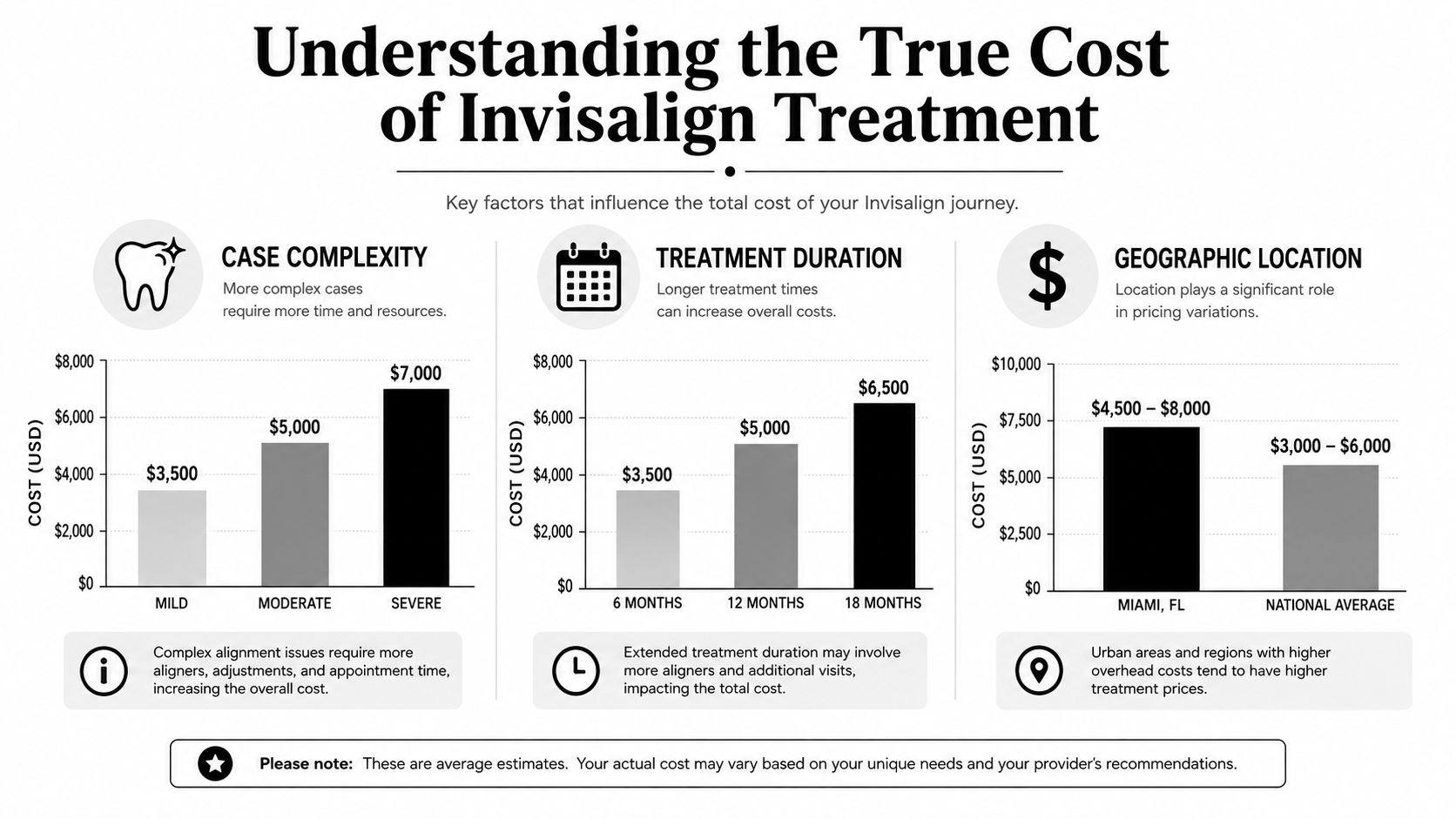
The biggest mistake with Invisalign pricing is focusing on the monthly number first. A low payment can hide a longer term, added finance charges, or a separate balance for retainers and refinements. The monthly bill matters, but the total repayment burden matters more.
What actually drives the price
Invisalign cost depends on the case, not just the brand name. A mild spacing issue, a more complex bite correction, and a full smile alignment case won't use the same number of aligners or the same amount of doctor time. That is why a quote should spell out what is included, not just hand over a payment amount and hope nobody asks follow-up questions.
The other variable is treatment length. A shorter plan can reduce the number of billing cycles, while a longer plan often spreads the payments out more thinly. Multiple Invisalign financing guides describe monthly payments ranging roughly from $100 to $400 per month, with some practices offering 0% interest for 6 to 24 months and longer repayment terms of 36 to 60 months or more Redent Klinik financing guide. That spread tells you everything. The advertised monthly number is only one piece of the price.
What to ask before saying yes
A patient should ask five direct questions before signing anything:
- Is this quote all-inclusive? Ask whether the number includes refinements, retainers, and follow-up visits.
- Who is holding the debt? In-office billing and third-party lending are not the same thing.
- Are there fees beyond interest? Origination fees, late fees, and prepayment penalties can change the final total.
- When does payment start? Some plans begin at assessment, others at aligner delivery.
- What happens if the treatment changes? A new plan can affect the monthly amount and the total owed.
The cheapest monthly payment is often the most expensive total plan.
A clean quote answers those questions in plain English. If a practice can't explain the difference between the headline payment and the final amount paid, that's a red flag. Patients in Miami should want a financing conversation that feels as clear as the aligners themselves.
Comparing Invisalign Financing Options Side by Side
A patient can have the right treatment plan and still make a poor money decision. The mistake is focusing on the monthly payment alone. The key question is how much cash leaves your pocket by the time the last bill is paid, and who is collecting it along the way.
In-office plans versus lender-managed plans
In-house payment plans usually keep the process close to the practice. The office sets the schedule, billing stays simple, and if the treatment timeline shifts a little, the plan often has more room to adjust. The trade-off is straightforward, you may need a stronger relationship with the practice and a larger first payment than you would with outside financing.
Third-party financing opens the door for more patients, but the true cost can be higher than the headline monthly number suggests. Align's financing page says HFD-backed Invisalign financing can offer guaranteed approval for $7,000 or more, no-to-low down payments for qualifying patients, and repayment terms up to 72 months, with some 0% interest options available Align financing page. Align also says HFD reports nearly 99% approval rates regardless of credit score Align HFD page. That makes a real difference for adults who assume financing will be out of reach, then find out the approval bar is much lower than they expected.
Where the total cost can drift
Credit cards and personal loans still deserve a look, but only if the math works. A credit card can be fine for a short balance that gets paid down quickly. For a longer orthodontic plan, revolving interest can turn a manageable monthly payment into a much more expensive total.
Personal loans are more structured. You get a fixed schedule, which helps with budgeting, but you also take on the full risk if rates, fees, or timing do not line up neatly with treatment milestones.
The practical question is simple. Who controls the payment schedule, and who benefits if the term stretches out? If a patient wants billing to stay close to the office and the conversation to stay simple, an in-office plan is the cleaner fit. If approval access matters more, third-party financing can get the treatment moving faster.
Invisalign Payment Options Compared
| Payment Method | Typical Interest | Repayment Term | Approval Rate | Best For |
|---|---|---|---|---|
| In-office installment plan | Often low or none, depending on the practice | Usually tied to treatment timeline | Practice-based | Patients who want direct office billing and simpler communication |
| HFD-backed third-party financing | Some 0% interest options available | Up to 72 months | Nearly 99% regardless of credit score | Patients who need broader approval access and longer terms |
| Traditional credit card | Varies by cardholder terms | Flexible, but usually revolving | Depends on credit limit | Short balances that can be paid off quickly |
| Personal loan | Varies by lender | Fixed schedule | Depends on lender underwriting | Patients who want a set monthly payment outside the dental office |
Ultra Smile DentalSpa's financing page also outlines payment plans for dental care, which helps patients compare whether the balance stays in the office or shifts to a lender. That choice changes the out-of-pocket burden more than many people expect.
How Dental Insurance and Tax-Advantaged Accounts Reduce Your Cost
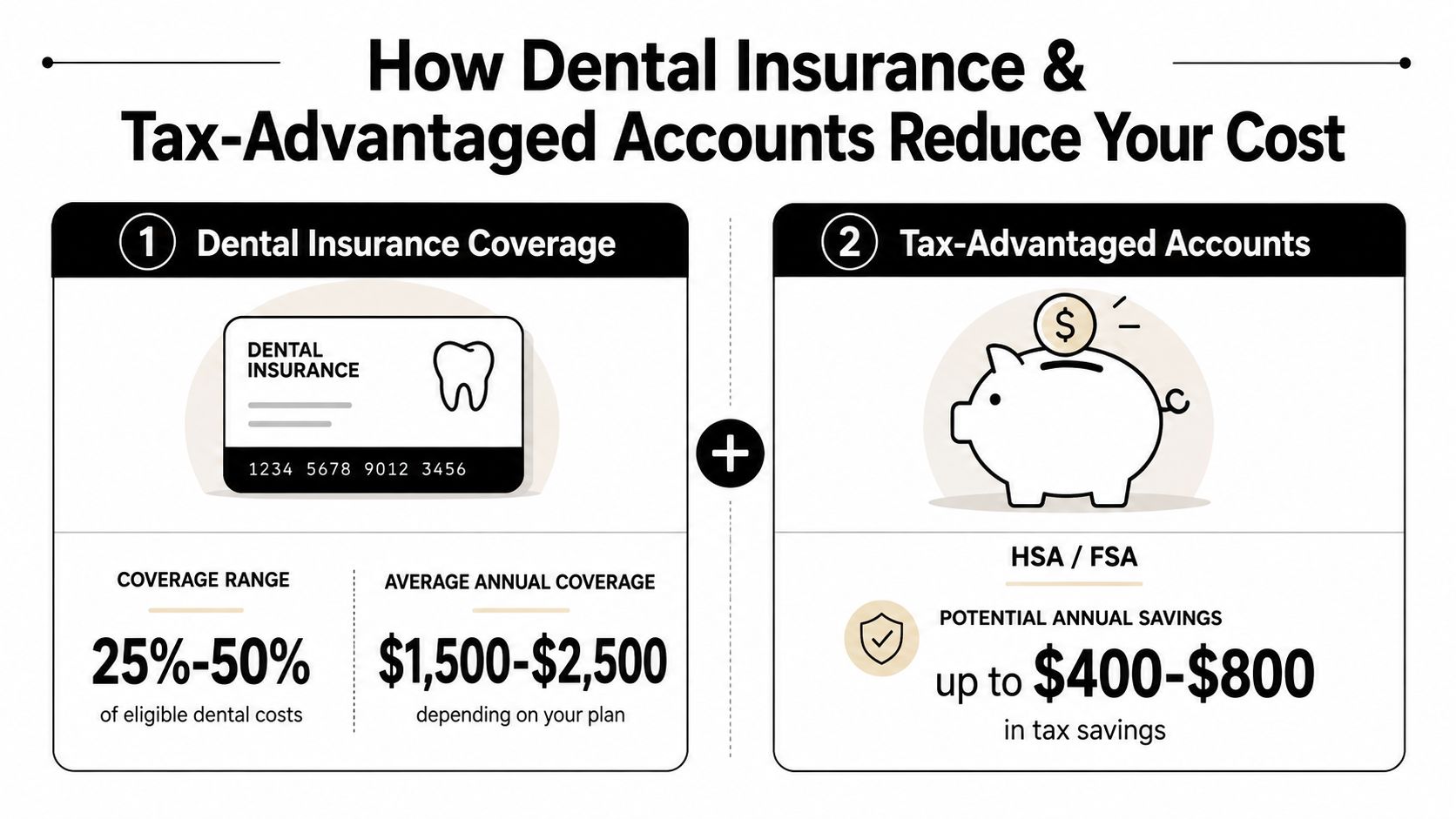
Check insurance before you get fixated on monthly financing. A lot of patients treat orthodontic coverage like a side benefit, but it can be the first thing that lowers the total bill. The smarter move is to verify benefits early, because a smaller amount financed is usually better than stretching a bigger balance over a longer term.
The order that saves the most money
Start with orthodontic coverage and any lifetime maximum. Align Technology says U.S. dental insurance may cover up to $3,000 of orthodontic treatment, and its 2021 OrthoFi dataset of 112,243 insured patients found average orthodontic coverage of $1,772, with 92% qualifying for up to $3,000 and 77% qualifying for up to $2,000 in coverage Align Invisalign cost page. Many patients have more coverage available than they assume.
Use HSA or FSA dollars next if they are available. Align notes that patients can use tax-free HSA or FSA dollars to offset costs. Those pre-tax funds cut the burden before financing enters the picture.
The sequence that makes the quote cleaner
Handle the process in this order:
- Get the consultation quote. Ask for the full treatment fee, not just a monthly number.
- Check insurance first. The office can confirm orthodontic benefits and submit pre-authorization.
- Apply pre-tax funds next. HSA or FSA dollars should be lined up before monthly billing starts.
- Finance the remainder. Only the leftover amount should go to a payment plan.
- Confirm the timing. Make sure monthly payments do not begin before insurance and HSA or FSA money are applied.
That order keeps patients from financing money they could have paid with pre-tax or covered dollars. It also makes the monthly number cleaner, and that is the number that matters once treatment begins.
Steps to Apply for Invisalign Financing in Miami
A financing plan should make the bill easier to read, not obscure the cost. In Miami, the smartest offices sort out scans, treatment planning, insurance, and payment setup before the first aligner is ordered. That sequence keeps the patient from agreeing to monthly payments before the full treatment fee is clear.
What happens first
The first stop is the consultation. A digital scan is usually taken, then the treatment plan is built and reviewed. A published Invisalign price list from HQ Dental shows how payment plans can be structured around a ClinCheck digital treatment-plan appointment, with one example requiring £300 at assessment and then a second payment when the patient is happy with ClinCheck before the rest is spread out HQ Dental price list.
That staged structure matters because the patient is not locked into the full cost before seeing the plan. The approval moment comes after the digital setup, not before the doctor can show the case.

A clean application flow
Start with the consultation, where the office evaluates the teeth, bite, and treatment needs. From there, the clinic reviews the digital simulation and the total cost, then checks orthodontic coverage and pre-authorization before the financing application is sent in. The patient can then choose an in-house plan or a third-party lender, and the payment terms are finalized before aligners are ordered.
Practical rule: do not let the financial application happen before the treatment plan is real. The estimate should be tied to a specific case, not a guess.
Some practices make the terms easier to follow than others. HQ Dental's example includes 12 months at 0% interest, 2 years at 9.9% interest, and 5 years at 9.9% interest. That kind of staged billing is what patients should expect when the office is transparent.
Smart Strategies to Lower Your Out-of-Pocket Invisalign Costs
The lowest monthly payment is not always the smartest deal. Miami patients do better when they focus on the whole package, because a quote that looks slightly higher can still cost less if it includes the right extras and fewer surprises.
Pay attention to what's included
A good plan should clearly state whether refinements and retainers are part of the quote. If they are not, the final spend can move in a direction nobody wanted. That's why the patient should ask what happens after the last aligner, not just what happens at month one.
The other lever is timing. Patients with an HSA or FSA should align the treatment start with the period when those funds are available, so the account pays part of the bill before financing has to absorb it. That is the cleanest way to reduce the financed balance without changing the treatment itself.
Choose value, not just the lowest monthly number
A Miami patient comparing options should look at the whole value stack. That includes:
- Included follow-up care, because revisions can affect the final bill.
- Retention coverage, because keeping the new smile stable matters.
- Office communication, because billing questions are easier when the team explains them clearly.
- Added patient perks, because value can extend beyond the aligners themselves.
Ultra Smile DentalSpa's model includes a spa-like setting, transparent treatment planning, and comfort-focused visits, which is where the money discussion becomes easier to handle. For patients who want the orthodontic side of treatment presented clearly, that matters more than a glossy headline payment. A financing plan should feel like part of a coordinated care experience, not a separate sales pitch.
The simple rule is this. Don't choose the plan that looks cheapest in isolation. Choose the one that gives the clearest total cost and the fewest unpleasant surprises later.
Your Invisalign Journey at Ultra Smile DentalSpa in Miami
A patient choosing Invisalign in Miami usually wants two things at once, straighter teeth and a calm experience. Ultra Smile DentalSpa, led by Dr. Neda Bahmadi, DMD, serves Downtown Miami, Midtown Miami, and Hallandale Beach with transparent treatment planning and a spa-like setting that keeps the process approachable.
The practice also connects Invisalign with the rest of the smile plan, including teeth straightening Invisalign, whitening, veneers, restorative dentistry, and other services patients often consider alongside aligner treatment. That matters because the financial conversation is rarely about one service alone. Patients are usually balancing function, appearance, and budget in the same appointment.
The experience is designed to feel steady from the first scan to the final aligner. Patients are welcomed with refreshments, custom aromatherapy, and a calm atmosphere, then guided through digital planning and payment discussion without pressure. Bilingual staff support and accepted insurance help keep the logistics clear, which is exactly what patients searching for a dentist near me or a dentist in Miami, FL want when they're comparing treatment options.
If Invisalign has been sitting on your to-do list because the cost feels confusing, this is the time to get a straight answer. Schedule a consultation, ask for the full cost breakdown, and compare the monthly plan against your insurance and HSA or FSA options before making a decision.
Ultra Smile DentalSpa helps Miami patients compare Invisalign payment plans, insurance benefits, and monthly financing with clarity instead of guesswork. If you want a practical plan for straighter teeth, visit Ultra Smile DentalSpa and schedule a consultation to review your options in person.