If the mirror has been telling the same story for months, crowded front teeth, spaces that never bothered anyone in the past, or a bite that feels different after years of coffee, stress, and skipped retainers, the next question is usually practical, not cosmetic. Can teeth straightening Invisalign work for this mouth, this schedule, and this history, or is it just the nicer-looking option on the menu?
For many adults looking for a dentist in Miami, FL or a dentist near me, Invisalign becomes appealing for three reasons at once. It is discreet, removable, and planned digitally, which is why so many professionals and parents in Downtown Miami, Midtown Miami, and nearby Hallandale Beach ask about it before they ask about braces. At Ultra Smile DentalSpa, the conversation usually starts with those same questions, then moves into the part most marketing pages skip, candidacy, retention, and what life looks like after the last tray.
Table of Contents
- Why More Miami Adults Are Choosing Invisalign for Teeth Straightening
- How Invisalign Moves Your Teeth
- How Long Invisalign Treatment Really Takes
- Who Is Actually a Good Candidate for Invisalign
- Invisalign vs Braces vs Other Clear Aligners
- What Daily Life With Invisalign Looks Like
- What to Expect at Ultra Smile DentalSpa in Miami
- Book Your Invisalign Consultation in Miami
Why More Miami Adults Are Choosing Invisalign for Teeth Straightening
A lot of adults don't decide on Invisalign because they're chasing a perfect celebrity smile. They decide because they've reached the point where the crowding in the front teeth is harder to ignore, a spacing issue shows up in every photo, or a bite that used to feel fine now seems off when chewing. In a city like Miami, where people go from meetings to dinners to beach weekends without a lot of room for visible orthodontics, the appeal is easy to understand.
Invisalign fits the adult schedule better than many patients expect. The aligners are removable, which makes eating and brushing feel normal, and the treatment is designed through digital planning instead of guesswork. Align Technology describes the system as a digital, staged biomechanics system built from virtual modeling, rapid manufacturing, and mass customization, with SmartStage technology and SmartForce attachments supporting movement control Align Technology solutions.
That combination is why teeth straightening with Invisalign has become such a common topic in cosmetic dentistry conversations for patients searching for a cosmetic dentist near me or comparing options for restorative dentistry and smile improvement. The brand's own history also tells the story of a mature platform, not a novelty, with Align Technology founded in 1997, FDA approval in 1998, and sales beginning in 1999, followed by broad clinical uptake over the years Invisalign timeline and uptake.
Practical rule: if a patient wants straighter teeth without putting every meal, social event, or work presentation on hold, Invisalign is often the first serious option worth evaluating.
Why the adult question is usually different from the teen question
Adults usually care less about whether treatment exists and more about whether it fits their real life. They want to know whether they can still present at work, meet clients, or manage family routines without a mouth full of metal. They also tend to ask a sharper question than teens do, which is whether the treatment can work around old fillings, missing teeth, crowns, or past orthodontic work.
That is where a local Miami exam matters. The aligners may be clear, but the decision is never one-size-fits-all. The right candidate is not the person who wants treatment the most, it's the person whose mouth can finish it well.
How Invisalign Moves Your Teeth

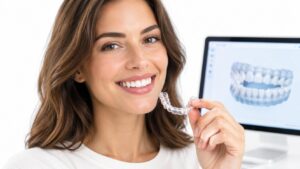
Invisalign moves teeth through a planned sequence, not a single push. A digital scan maps the bite, the treatment plan sets the order of movement, and each tray carries the teeth a little farther along that path. In the chair, I explain it as controlled pressure, not forceful movement. That distinction matters, because the teeth respond only when the tray stays in place long enough and the plan matches the bite in front of us.
The movement happens in tiny steps
Clinical literature describes clear aligner movement in micro-steps of about 0.25 to 0.3 mm per aligner, with many protocols changing trays every 1 to 2 weeks and expecting wear of about 20 to 22 hours per day micro-step and wear protocol data. That is why Invisalign can look simple from the outside and still demand real consistency from the patient. Each tray only does its job if it stays on long enough to keep applying the planned force.
The Invisalign FAQ gives the same wear-time guidance, stating that aligners need to be worn for about 22 hours per day Invisalign FAQ wear guidance. That leaves short windows for meals, drinks other than water, and oral hygiene. If patients keep slipping into long off-tray periods, the fit loosens and the sequence can fall behind.
Why SmartTrack and attachments matter
The system is not just soft plastic over teeth. Independent reviews note a 2013 product milestone with the introduction of SmartTrack material, which helped improve fit and force delivery in aligners SmartTrack milestone. Align Technology also says SmartForce attachments and SmartStage are used to improve control over movements like rotation, tipping, and vertical changes Align Technology solutions.
That part is easy to miss when someone only looks at the trays themselves. The plastic is one part of the treatment, but the full result depends on the attachments, the staging plan, and how well the trays are worn. If the wear time slips, the force delivery changes, and the teeth may not follow the intended path.
The aligner only works while it is on the teeth. Consistency turns the plan into a real smile.
How Long Invisalign Treatment Really Takes
Patients often sit down and ask for the shortest path, usually because they have heard a number like “as little as six months. That estimate can be true in limited cases, but it does not describe most adult treatment plans. The timeline depends on how far the teeth need to move, how involved the bite is, and how consistently the aligners stay in place.
What the evidence says about treatment length
A review of treatment duration in the orthodontic literature reported Invisalign treatment times of 13.4 months for mild crowding, 15.93 months for moderate crowding, and 17.92 months for severe crowding systematic review of treatment duration. In the same review, a case-control study found Invisalign treatment finished in 19.52 months versus 23.62 months for conventional fixed appliances.
Those figures do not lock every Miami patient into a single schedule. They do show a clear pattern, treatment length rises with case complexity, not with the marketing label on the aligner box. A mouth with light crowding usually needs less staged movement than one with multiple rotations, bite changes, and later refinement.
| Realistic Invisalign Treatment Timelines by Case Complexity | ||
|---|---|---|
| Case Complexity | Typical Duration | What It Usually Involves |
| Mild crowding | About 13 months in the cited review | Small alignment changes, limited space correction |
| Moderate crowding | About 16 months in the cited review | More visible overlap, more staged movement |
| Severe crowding | About 18 months in the cited review | More complex crowding, closer monitoring, possible refinements |
| Case compared with fixed braces | About 20 months for Invisalign in one cited study | Similar orthodontic goals, but different appliance mechanics |
For patients with crowded front teeth, the starting point matters. A case that looks minor from the outside may still need careful sequencing if the roots are twisted, the bite is uneven, or older dental work limits movement. For a more detailed look at that kind of case, see Invisalign for crowded teeth.
Why refinements matter
A lot of cases need a finishing phase. That can add weeks or months near the end, especially when one tooth needs more settling or the bite needs finer adjustment. That is part of normal orthodontic control, and it usually reflects attention to detail rather than a problem with the treatment.
The variable patients can control most is wear time. The tray schedule matters, but if the aligners are left out too often, the timeline stretches. The honest answer is not “How fast is Invisalign? It is, “How consistent can this patient be?
Who Is Actually a Good Candidate for Invisalign
The best candidate isn't the person with the prettiest smile goals. It's the patient whose teeth can move predictably and whose gums, restorations, and bite won't fight the process. Adults with mild to moderate crowding, spacing, or relapse after earlier orthodontic care often fit that profile well, especially when they're healthy enough to wear aligners the way the system requires.
The quiet reasons some mouths need a different plan
Some conditions make Invisalign harder or less predictable. Active gum disease, untreated cavities, severe orthodontic problems, and certain prior restorations can complicate treatment or rule it out, especially when teeth need movement that fixed anchor points won't allow candidacy limits and disqualifiers.
That is not a rejection list, it's a protection list. A patient with unhealthy gums or an untreated cavity should not start a cosmetic orthodontic plan before the foundation is stable. A patient with implants or bridges also needs careful planning, since those restorations do not move like natural teeth.
A Miami consultation should also look beyond alignment alone. The right question is not just whether the teeth are crooked, it's whether the mouth can support the plan. That is why a focused evaluation matters before anyone commits to trays.
Clinical insight: if the gums aren't healthy, straightening the teeth first can create a prettier problem, not a better one.
When aligners are part of a bigger cosmetic plan
Some patients want the smile straighter, but they also want old edge wear corrected, color improved, or tooth shape refined. In those cases, aligners may be combined with bonding, whitening, or other cosmetic work after tooth position is improved. The decision depends on the mouth, not the marketing.
For a deeper look at one common scenario, the practice's crowded-teeth guidance is available here. That kind of page matters because crowding is often the first reason adults ask whether Invisalign can help, and the answer depends on how much space, rotation, and bite correction are needed.

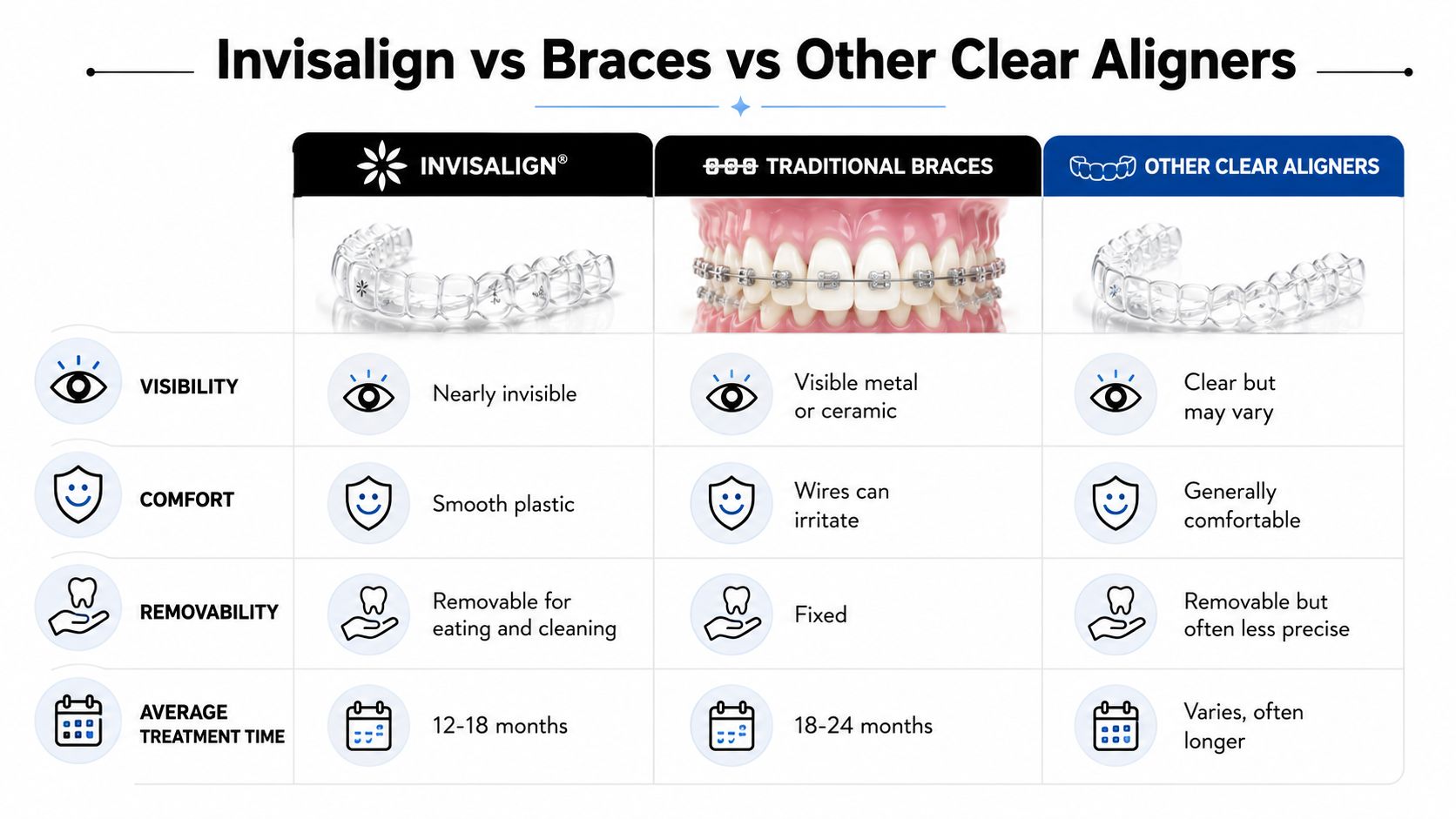
Invisalign vs Braces vs Other Clear Aligners
A patient sitting in my chair usually wants the same honest answer. Invisalign can be an excellent choice, but it is not the right tool for every bite, every history, or every finish line. The decision depends on how much tooth movement is needed, how much you care about visibility, and how closely the case needs to be watched as it progresses.
How the main options differ in real life
Traditional braces stay on the teeth, so treatment does not depend on daily wear time in the same way. That can help in cases where compliance is a concern or when the bite needs more controlled mechanics. The trade-off is obvious, they are visible, and the brackets and wires can rub the cheeks and lips.
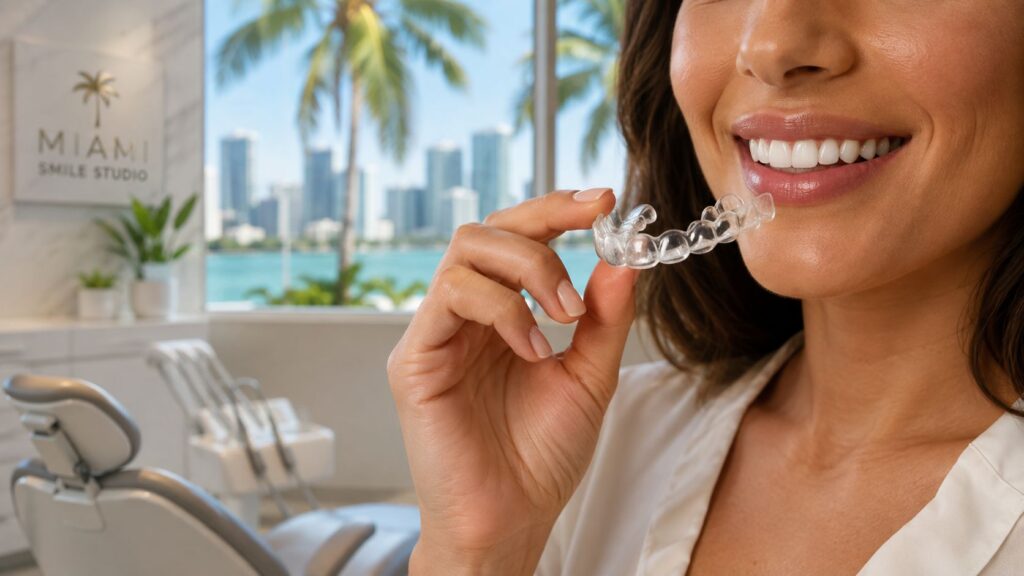
Invisalign is smooth, removable, and planned digitally, which is why many adults prefer it for work, travel, and everyday life. The trays are easier to clean around than fixed braces, but they only work well when the patient wears them as directed. If the trays are left out too often, the plan slows down.
Other clear aligners can work too, but the supervision model matters. A lower-cost option may look similar in a photo while offering less hands-on review once treatment starts. That difference matters more when the bite is complicated, when teeth need detailed rotation, or when there is prior dental work that changes how the teeth can move.
| Option | Visibility | Comfort | Removability | Monitoring |
|---|---|---|---|---|
| Invisalign | Nearly invisible | Smooth plastic, generally comfortable | Removable for eating and cleaning | Doctor-supervised |
| Traditional braces | Visible metal or ceramic | Wires can irritate | Fixed | Doctor-supervised |
| Other clear aligners | Clear but may vary | Generally comfortable | Removable, but often less precise | Varies by model |
Why clinical supervision changes the outcome
Aligner treatment is not just a stack of trays. It requires judgment about when to change trays, when to add attachments, when to adjust the plan, and when a simple cosmetic approach is not enough for the bite in front of you. That judgment is what keeps treatment realistic instead of optimistic.
The office also has to think about daily care, because aligners that are not cleaned properly can pick up odor and buildup. Patients who want a practical routine can review how to clean Invisalign aligners before treatment starts, since good maintenance supports both comfort and hygiene.
Invisalign uses SmartTrack, SmartForce attachments, and staged planning to guide movement, as described in its product materials. That does not make it the best choice in every case, but it does show why many clinicians treat it as a mature system rather than a simple cosmetic add-on.
What Daily Life With Invisalign Looks Like
The first week usually tells you the most about treatment, not because it is painful, but because it exposes habits. The aligners need to be in for about 22 hours a day Invisalign FAQ wear guidance, so meals, coffee, and casual snacking need more planning than usual.
The daily routine patients follow
Meals become straightforward once the habit sets in. The aligners come out, food happens, then the teeth get brushed or at least rinsed before the trays go back in. Coffee gets handled the same way, since leaving aligners in while drinking anything besides water is not the goal.
Oral hygiene needs to stay consistent. Patients who want a practical refresher can review how to clean Invisalign aligners before treatment starts, because clean trays are easier to wear and less likely to pick up odor or buildup. That routine usually fits into the same rhythm as brushing, rinsing, and putting the aligners back in on time.
Some patients notice a mild speech adjustment early on, especially in the first few days. That usually settles as the tongue adapts to the trays. If attachments or IPR, interproximal reduction, are part of the plan, the dentist explains them before they start so there are no surprises in the chair.
If a tray cracks or goes missing, the office needs to be contacted quickly. In many cases, the patient either goes back to the previous set or moves ahead only if the dentist says it is safe. The goal is to keep force delivery steady, not improvise.
What happens after the last tray
The final aligner does not mean the job is done. Some cases need refinements, which can add more trays before finishing. Then retention begins, and that phase is where many people get caught off guard.
The Invisalign overview guide makes the retention message clear, daily wear matters, and retainers are needed after treatment to help keep the result stable Invisalign overview guide. Many practitioners recommend nightly retainer wear after active treatment ends, because teeth can drift if retention is skipped.
Skipping retention is one of the fastest ways to turn a finished case into a partial relapse.
For patients asking about maintenance after alignment, it helps when the same practice also offers night guards and whitening as part of broader cosmetic and preventive care. Ultra Smile DentalSpa also notes complimentary yearly whitening, which can fit naturally into long-term smile maintenance when the orthodontic phase is done.
What to Expect at Ultra Smile DentalSpa in Miami
The first visit doesn't start with pressure. It starts with a welcome that feels calmer than most dental offices, refreshments, custom aromatherapy, streaming entertainment, and a hot towel finish are part of the experience, but they sit on top of rigorous clinical standards, not in place of them. That matters because Invisalign decisions still need diagnostic discipline.
The first appointment in practical terms
A new patient exam usually includes a full look at the bite, photos, and digital scans instead of old-fashioned goopy impressions. The goal is to see whether Invisalign is the right tool or whether another cosmetic or restorative option would do a better job. For some patients, that means aligners. For others, it may mean whitening, veneers, crowns, bridges, or another treatment path.
Treatment planning is presented transparently, including insurance and payment options, and there are paths for patients without coverage. The practice also serves patients with a bilingual team, which helps when details about wear time, retainer use, or follow-up care need to be understood clearly.
Why local convenience matters
Patients in Downtown Miami, Midtown Miami, and Hallandale Beach usually care about one thing more than branding, can they fit the office into real life? A clear-aligner plan only works if check-ins, scans, and maintenance feel manageable. That's why location and communication matter as much as the tray system itself.
For many readers searching for a dentist near me, the visit should feel predictable. The question is whether the bite can be improved, whether the patient is a good candidate, and whether the result can be maintained over time. That's the right kind of conversation for teeth straightening Invisalign, and it's the standard a Miami patient should expect.
Book Your Invisalign Consultation in Miami
A consultation at Ultra Smile DentalSpa is an information visit first, not a commitment. The dentist reviews the bite, dental history, and current concerns, then recommends Invisalign, another clear aligner approach, traditional orthodontics, or a cosmetic option like whitening or veneers if that will produce a better result. That's the right way to protect the patient's time and money.
If straightening has been on the back burner because the timing never felt right, now's a reasonable time to get a real answer. Patients in Downtown Miami, Midtown Miami, and Hallandale Beach can call the office or request a consultation online, then get a straight assessment of what will work and what won't.
The health part matters too. Straighter teeth can make cleaning easier, improve how the bite feels, and support a smile that's easier to maintain for the long run.
If you're ready to find out whether Invisalign is the right fit for your bite, your dental history, and your schedule, visit Ultra Smile DentalSpa to request a consultation. The team treats every smile plan like a long-term relationship, with the kind of careful, local follow-up Miami patients need to keep results stable.