A lot of adults in Miami already know something feels off about their smile before they can name it. Teeth overlap in photos. Floss catches in the same tight spots. One front tooth sits slightly forward, another twists behind it, and the whole smile can start to feel busier than it used to. For some people, it becomes a confidence issue at work or in social settings. For others, it’s the daily frustration of trying to keep crowded areas clean.
That’s often where questions about Invisalign for crowded teeth begin. Can clear aligners really create enough room? Will treatment look natural during the process? And is this only about appearance, or does it help oral health too?
For adults searching for a dentist in Miami, FL, a cosmetic dentist near me, or a more discreet alternative to braces, clear answers matter. Crowding can be treated, but the right plan depends on how the teeth fit together, how much space is available, and how consistently the aligners are worn. The process should feel understandable from the first visit, not overwhelming.
This guide walks through what crowding means, how Invisalign works, what treatment can involve, and what patients in Downtown Miami,and Midtown Miami, can expect when they’re ready to take the next step toward a more confident smile.
Table of Contents
- Your Guide to a Straighter Smile in Miami
- What is Dental Crowding and Why Treat It
- How Invisalign Technology Corrects Crowded Teeth
- Your Invisalign Journey at Ultra Smile DentalSpa
- Creating Space The Key to Fixing Crowded Teeth
- Invisalign vs Traditional Braces for Crowding
- Life After Invisalign Costs and FAQs
Your Guide to a Straighter Smile in Miami
Crowded teeth rarely show up all at once. A Miami patient may first notice them in a mirror under bright morning light, in a close-up photo, or while getting ready for an important meeting. The front teeth can seem slightly stacked, one canine may sit higher than expected, or the lower teeth may start to look uneven. Small shifts can create a big emotional reaction, especially when the smile no longer feels polished or easy to show.
For many adults, the concern isn’t vanity. It’s the feeling that their smile doesn’t match the way they want to present themselves. A person can be diligent about dental care, stay current with cleaning and exams, and still feel bothered by crowding that developed naturally over time or returned after earlier orthodontic treatment.
Why adults often look for a discreet option
Traditional braces still work well, but they aren’t always the first choice for a working adult, parent, or anyone who spends a lot of time face to face with other people. Clear aligners fit into daily life more easily. That matters to patients looking for a treatment option that feels modern, professional, and easier to manage.
In Miami, many patients also want a dental office experience that feels calm from the moment they walk in. Dental anxiety doesn’t disappear just because someone wants cosmetic dentistry. A setting that combines advanced technology with a more comfortable atmosphere can make it easier to move forward with treatment instead of postponing it.
Crowding can feel personal, but it’s also very treatable when the diagnosis is clear and the plan matches the patient’s bite, spacing, and goals.
A local path from uncertainty to action
Dr. Neda Bahmadi is known to patients looking for a cosmetic dentist near me or a dentist near me who can explain treatment in plain language. That matters because Invisalign for crowded teeth isn’t only about wearing clear trays. It starts with understanding what’s causing the overlap, how much space exists, and whether aligners alone can guide the teeth into healthier positions.
For patients in Downtown Miami, and Midtown Miami, the process often begins with one simple decision. Instead of continuing to wonder whether crowding can be corrected, they schedule a consultation and get a real answer. That first step often turns a vague concern into a clear treatment plan.
What is Dental Crowding and Why Treat It
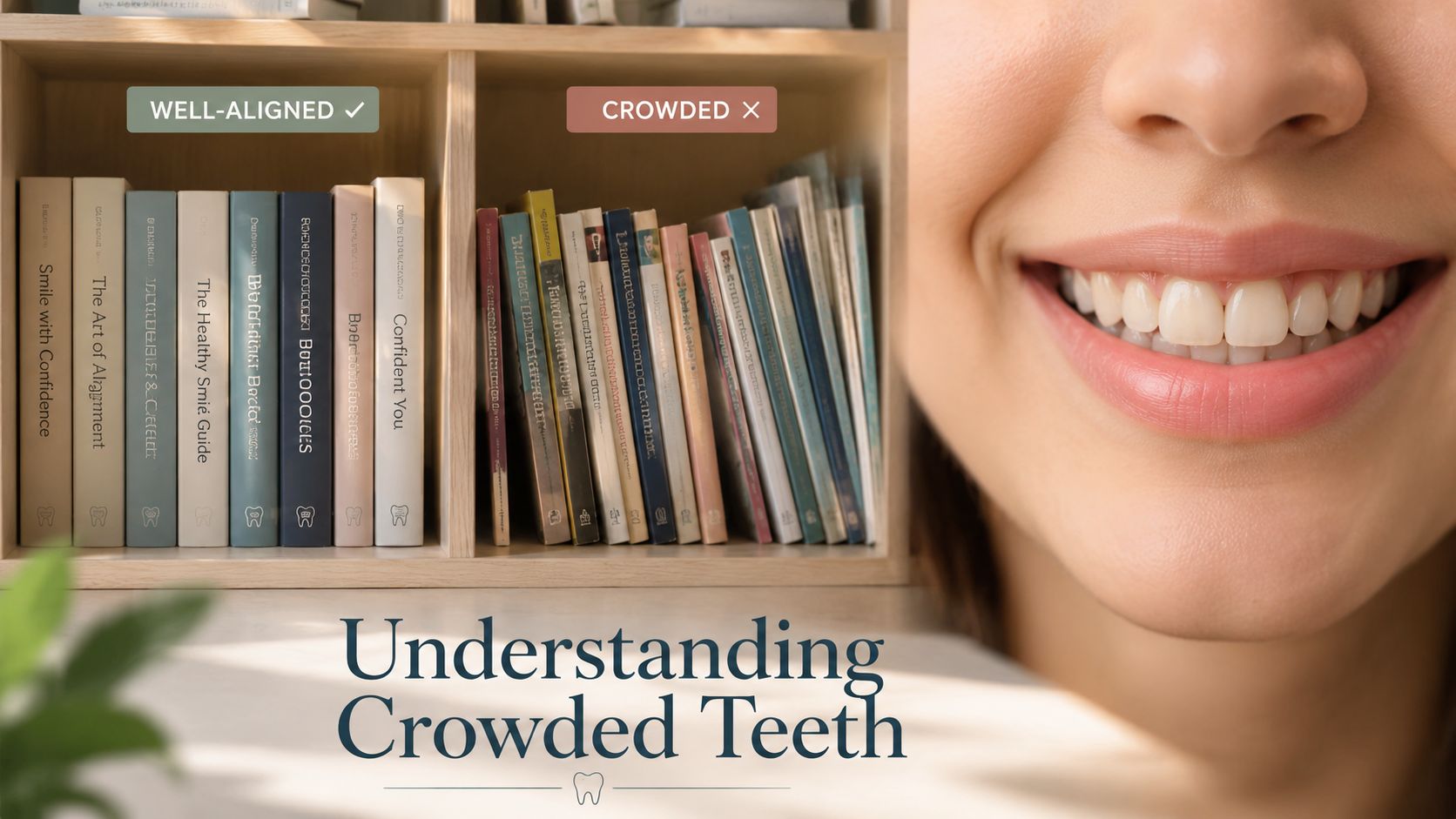
Dental crowding occurs when there is not enough room in the dental arch for all teeth to fit in proper alignment. As a result, teeth may overlap, twist, tilt, or sit slightly in front of or behind neighboring teeth. Invisalign’s crowded teeth overview explains that crowding often relates to limited jaw space, larger teeth, or inherited traits that affect how teeth and jaws develop.
How crowding starts
In Miami, many adults first notice crowding in a simple moment. A front tooth starts crossing over another in photos, or floss keeps catching in the same spot night after night. What looks like one crooked tooth is often a space problem affecting the whole arch.
Crowding can show up in several ways:
- Front teeth overlap: One tooth sits partly over another instead of lining up evenly.
- Teeth rotate: A tooth turns because it does not have enough room to settle into position.
- The smile looks narrow: The arch can appear tight rather than full and balanced.
- Cleaning takes more effort: Brushing and flossing around overlapping contacts is harder.
Patients are often surprised that crowding is not always caused by one issue alone. Sometimes the jaw is a bit narrow. Sometimes the teeth are naturally wider. Sometimes early tooth movement, bite pressure, or the way adult teeth erupted contributes to the pattern. At Ultra Smile DentalSpa, this is why the first conversation is diagnostic before it is cosmetic. Dr. Neda Bahmadi looks at where the teeth sit, how the bite comes together, and whether the crowding is mild, moderate, or more advanced.
Why it matters beyond appearance
A crowded smile can absolutely affect confidence. That part is real for patients, especially in a city like Miami where people spend so much time socializing, working face to face, and being photographed. But crowding is also a health issue.
When teeth overlap, plaque and food debris collect in tighter spaces. Those areas are harder to clean well at home, even for patients with good brushing habits. Crowding can also create uneven contact between upper and lower teeth, which may lead to excess wear on certain teeth over time.
Some patients come in focused on one crooked front tooth and leave understanding that the underlying issue is crowding across the arch. That shift matters because treatment planning is more accurate when the whole bite is evaluated instead of one visible tooth.
A peer-reviewed study published in the Journal of Aligner Orthodontics reported high rates of crowding improvement with clear aligners in both the upper and lower arches (study summary on PubMed). For patients, that supports an important point. Crowding is common, and it is often treatable with a carefully planned aligner approach.
Practical rule: If your teeth are hard to floss because they overlap, trap debris, or create tight contact points, it is worth having the bite and spacing examined.
For patients looking for a dentist in Miami, FL, the next step is usually straightforward. A professional exam, along with digital imaging or x-rays when needed, shows how much space is available, whether the roots and gums are healthy, and what type of tooth movement is realistic. That clarity often turns uncertainty into relief, especially when the process is explained in a calm, spa-like setting where patients feel cared for from the start.
How Invisalign Technology Corrects Crowded Teeth
Invisalign technology uses a sequence of custom-made clear aligners to apply controlled force and gradually move teeth into healthier positions. For crowded teeth, that matters because each tooth may need a different kind of correction. One tooth may need to rotate, another may need to shift slightly outward, and another may need to move just enough to relieve pressure on a neighbor.
The process starts with precision. A digital scan shows the current position of the teeth, and treatment planning maps out the order of movement. That order is important. Crowding is rarely solved by pushing every tooth at once. A better comparison is traffic management. Cars do not all merge into one lane at the same moment. Movement has to happen in sequence, with space created where it is needed, so the whole arch can settle into a better arrangement.
Patients often ask whether clear aligners are a newer idea or a well-established treatment. Invisalign has been in use since 1998, and an Invisalign statistics overview from Orthodontics Limited notes that more than 13 million people have used it. For many Miami patients, that history helps reduce the fear of trying something unfamiliar.
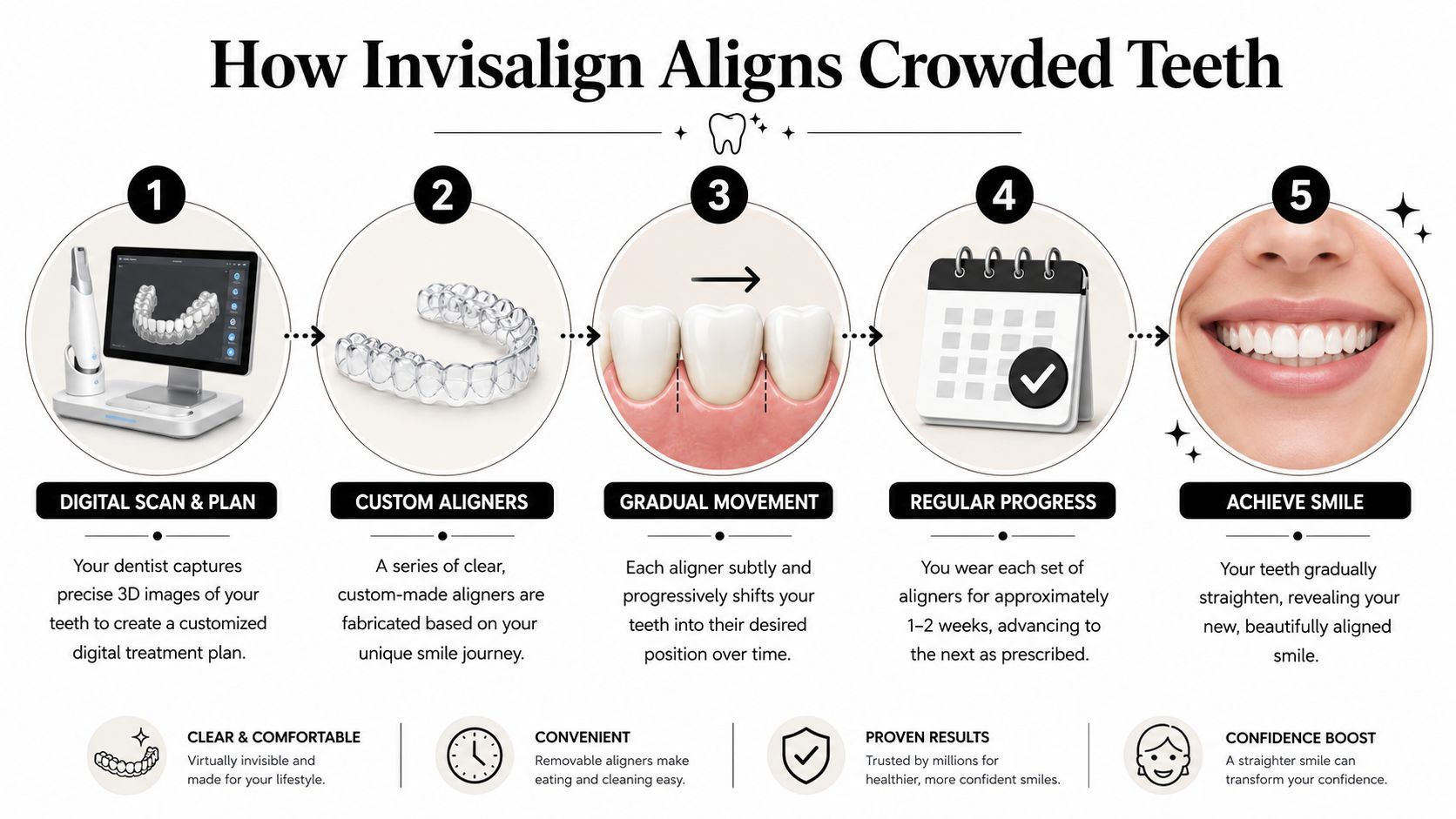
A staged system for controlled tooth movement
Each aligner is designed to continue the work of the previous one. That is why patients receive a series of trays instead of a single appliance. Small changes add up. Over time, those small changes can correct overlap, reduce rotations, and improve how the teeth fit together.
A typical sequence looks like this:
- Digital scan records the current tooth positions without messy impressions.
- Treatment planning sets the target positions and the order of movement.
- Custom aligners are fabricated for each stage of that sequence.
- Regular wear allows the trays to guide the teeth gradually.
- Refinement aligners can fine-tune areas that need more correction.
Patients who want a broader look at teeth straightening without braces often find it helpful to compare how clear aligner treatment fits into a cosmetic and functional smile plan.
This short video from Invisalign helps visualize how the aligners achieve that staged movement.
What makes the system work
The aligners only move teeth while they are being worn. Most patients are instructed to wear them for 20 to 22 hours a day and switch to a new set every one to two weeks, depending on the treatment plan. Treatment time can be shorter for mild crowding and longer for more complex cases, which is why the timeline is based on the individual bite rather than a fixed schedule.
This is a common point of confusion. Because the trays are removable, some patients assume missing a few hours here and there will not change much. In practice, teeth can fall behind the planned movement. When that happens, the next aligner may feel too tight or may not seat fully.
At Ultra Smile DentalSpa, this part is explained carefully because understanding the routine makes treatment feel much more manageable. Patients usually feel more confident once they know that Invisalign is not mysterious technology. It is a planned series of small, biologically guided movements, supported by consistent wear and regular monitoring.
| Treatment factor | What it means for the patient |
|---|---|
| Wear time | Aligners need to stay in most of the day |
| Tray changes | Each new set continues the movement |
| Monitoring | Check-ins help confirm the teeth are tracking |
| Complexity | Mild crowding moves faster than severe crowding |
For crowded teeth, Invisalign offers two things many adults want at the same time. It can be discreet in daily life, and it can be precise in how movement is planned. That combination is often what turns a long-standing concern about overlap into a clear, realistic path toward a straighter smile.
Your Invisalign Journey at Ultra Smile DentalSpa
The first visit usually feels more relaxed than many patients expect. Instead of starting with pressure, the appointment starts with observation and conversation. The team reviews what the patient sees in the mirror, where crowding is most noticeable, whether there are tight areas that trap food, and what kind of result the patient hopes to achieve.
The first consultation
Dr. Neda Bahmadi evaluates the teeth, bite, and smile balance as a whole. That’s important because crowding rarely exists in isolation. A front tooth may look like the only problem, but the underlying issue can involve arch form, tooth rotation, or limited space farther back.
Digital scanning helps patients understand their case without the mess of traditional impressions. Seeing the teeth on screen often makes everything click. A person who has spent months saying, “Something looks off, can suddenly see exactly where the lack of space is showing up.
Patients who want a closer look at clear aligner treatment can also review teeth straightening without braces to understand how removable orthodontic options fit into a broader cosmetic dentistry plan.
Some patients come in focused on one crooked front tooth and leave understanding that the real issue is crowding across the arch. That shift in understanding makes treatment decisions much easier.
What follow-up visits feel like
Once treatment begins, follow-up visits are usually shorter and more focused. The main question is whether the teeth are tracking as planned. If an aligner seats well and the teeth are responding correctly, the patient moves forward to the next set on schedule.
The office experience matters here more than people realize. Adults with busy work calendars don’t want unnecessary surprises. They want visits that are organized, comfortable, and clear. They also want a team that explains what’s happening in plain English.
At Ultra Smile DentalSpa, the patient environment is designed to reduce tension while maintaining a clinical standard of care. That combination matters for people who have avoided treatment because they dislike traditional dental settings. A calm visit can make it much easier to stay consistent with appointments, ask questions, and stay engaged throughout the full Invisalign journey.
Creating Space The Key to Fixing Crowded Teeth
One of the most common patient questions is simple and smart. If the teeth already look packed together, where does the space come from?
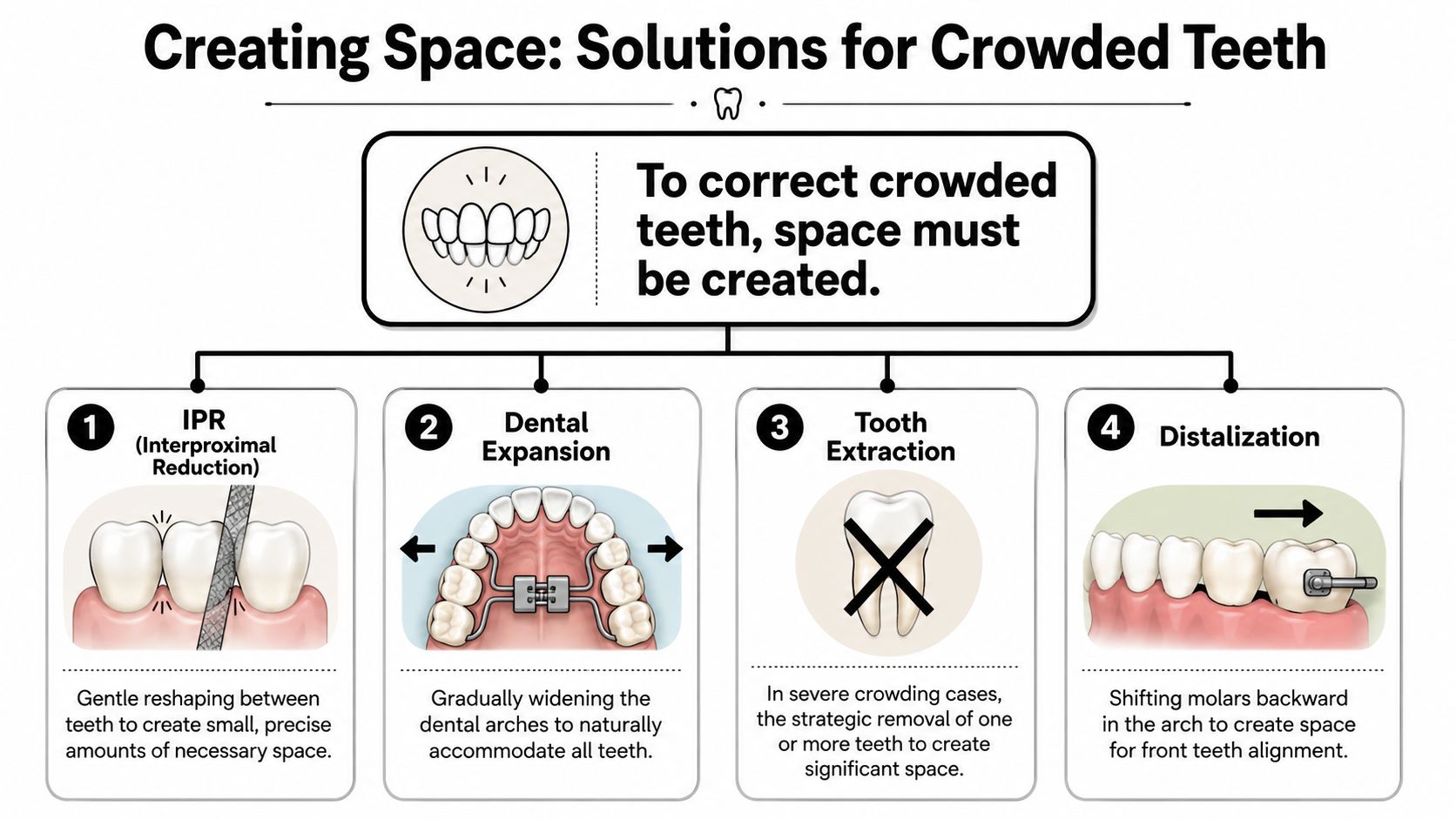
That question gets to the heart of successful crowding treatment. Teeth can’t straighten unless room is created for them to move. In aligner biomechanics, crowding resolution relies on space-gaining mechanics such as proclination, arch expansion, and interproximal reduction, as discussed in this peer-reviewed PMC study on clear aligner crowding resolution.
Where the room comes from
Different cases need different strategies. Some patients only need a small amount of space, while others need a more advanced plan.
Here are the main ways space may be created:
- Interproximal reduction or IPR: This involves polishing a very small amount of enamel between certain teeth to create precise space. Patients often worry this sounds aggressive, but in practice it’s a controlled, planned adjustment.
- Arch expansion: In selected cases, the arch can be developed so teeth have more room to align.
- Proclination: Some teeth can be guided slightly forward into a healthier alignment when the bite allows it.
- Extraction in severe cases: Invisalign notes that extreme crowding may require additional space creation through palatal expansion or tooth extraction. This is not the starting point for every case, but it can be part of treatment when crowding is significant.
Attachments also play an important role. These are small tooth-colored shapes bonded to certain teeth so the aligners can grip and direct movement more effectively. Patients sometimes think attachments mean something has gone wrong. In reality, they’re a normal part of many well-planned cases.
Why planning matters in complex cases
The same PMC study notes that aligners are less predictable for pure tooth translation in extraction space closure than conventional fixed appliances. That doesn’t mean aligners can’t treat crowding. It means severe cases require careful case selection and close follow-up.
Another useful point from the study is that digital planning alone was not a predictor of final tooth position. Clinically, that means the on-screen plan is valuable, but it doesn’t replace in-person monitoring, refinements, and judgment during treatment.
Good Invisalign planning for crowded teeth isn’t about forcing every case into aligners. It’s about choosing the right mechanics, in the right order, for the right patient.
For Miami patients, an experienced evaluation matters. A case that looks simple in a selfie can involve several types of tooth movement behind the scenes. Creating space is the key step that makes everything else possible.
Invisalign vs Traditional Braces for Crowding
Both Invisalign and traditional braces can correct crowded teeth. The better option depends on the patient’s crowding pattern, lifestyle, preferences, and how much control is needed over specific tooth movements. For many adults, the decision comes down to everyday practicality as much as clinical design.
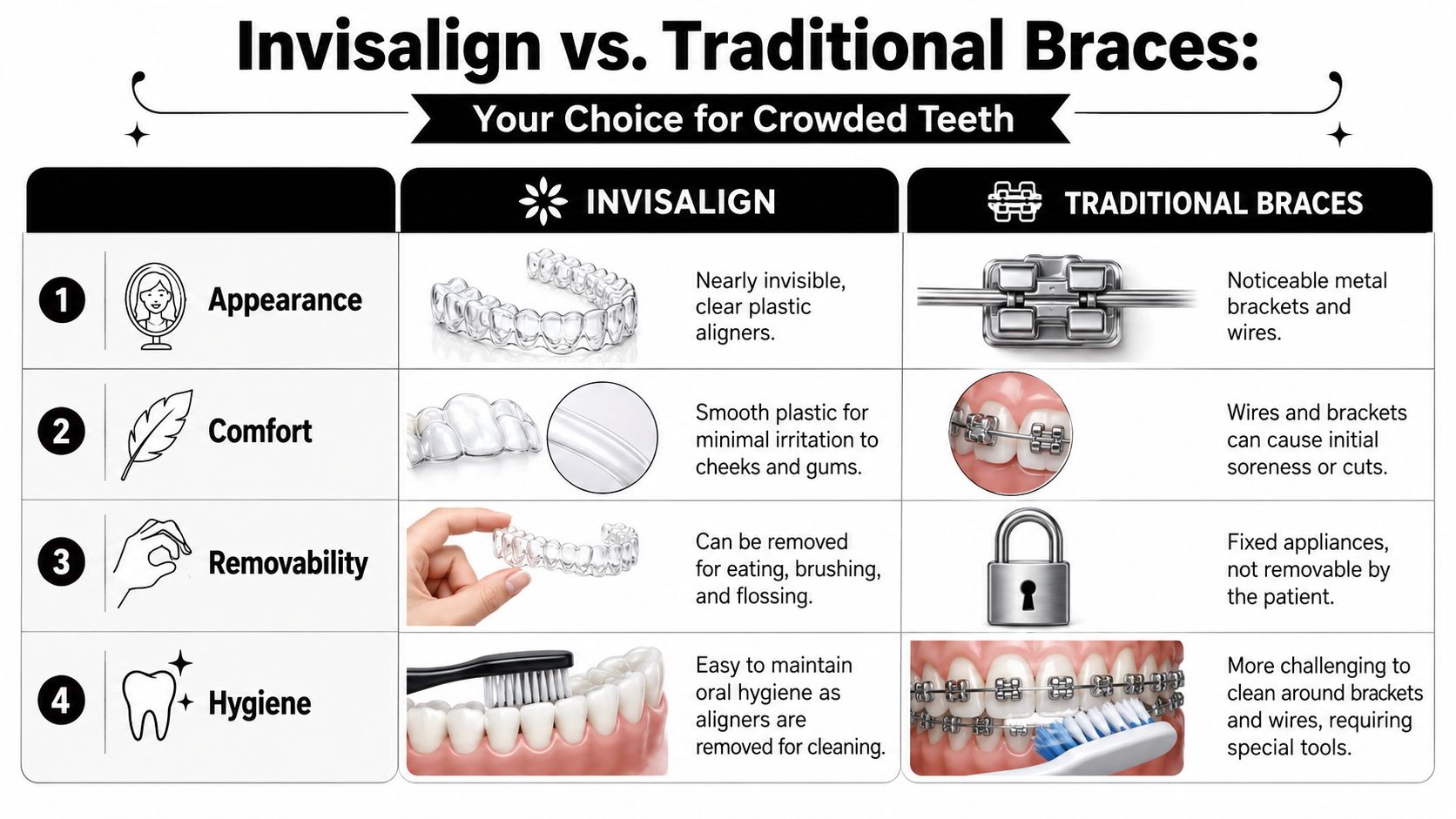
Lifestyle differences that matter
A busy professional in Miami often cares about how treatment fits into meetings, meals, travel, and social events. That’s where the day-to-day differences become more important than a simple list of features.
| Decision point | Invisalign | Traditional braces |
|---|---|---|
| Appearance | Clear and less noticeable | Metal brackets and wires are visible |
| Cleaning | Removed for brushing and flossing | Cleaning around hardware takes more effort |
| Eating | Removed for meals | Food restrictions are more common |
| Feel | Smooth plastic trays | Brackets and wires may irritate cheeks |
Invisalign often appeals to adults who want flexibility and a more discreet look. Braces may appeal to patients who prefer a fixed solution that stays in place all the time and doesn’t depend on remembering to reinsert trays after meals.
Patients comparing both options can review Invisalign vs braces to see how each treatment fits different orthodontic goals.
When each option makes sense
The honest answer is that neither option is automatically better for every crowded smile. Clear aligners are often an excellent fit for mild to moderate crowding and many adult cases. Traditional braces remain a strong option when movements are more demanding or when patient compliance with removable trays may be a concern.
A few practical examples help:
- A patient who wants discreet treatment at work may lean toward Invisalign.
- A patient who struggles with routines may benefit from the consistency of fixed braces.
- A patient with crowding plus cosmetic goals may like the way Invisalign fits into a broader cosmetic dentistry plan.
- A patient with very complex tooth movement may be advised that braces offer better control in certain areas.
For patients searching online for a cosmetic dentist near me, dentist near me, or even related services like teeth whitening, restorative dentistry, or dental implants near me, the broader point is this. Orthodontic treatment should fit the patient’s life and long-term oral health plan. Straightening crowded teeth is often one piece of a larger smile and function conversation.
Life After Invisalign Costs and FAQs
Finishing aligners doesn’t mean the work is over. The active movement phase ends, but the retention phase begins. Many patients are surprised by this. Teeth that have just been moved need ongoing support to stay in their new positions.
Retention protects the result
Long-term stability depends on retainers. A consumer-facing discussion of Invisalign crowding points out that relapse is a real concern and that success depends on compliance with a retention protocol, as explained in this discussion of crowded teeth, bite issues, and retention after Invisalign.
That means the question isn’t only “Will Invisalign straighten crowded teeth? It’s also “Will the result stay stable? The answer depends heavily on wearing retainers as directed after treatment.
A straight smile is built in two phases. First, teeth move. Then, retainers help keep them there.
Common questions from Miami patients
How much does Invisalign cost in Miami?
Cost depends on case complexity, treatment length, whether refinements are needed, and whether other procedures are part of the plan. A consultation is the right place to get an exact figure because crowded teeth can range from minor overlap to cases that need more involved space creation.
Does dental insurance cover Invisalign?
Some plans contribute to orthodontic treatment, while others don’t. Coverage varies. The practical next step is to have benefits reviewed before treatment starts so the patient understands what is covered and what remains out of pocket.
How long will treatment take?
Treatment time varies by complexity. Mild crowding may be relatively quick, while more advanced cases take longer. Wear time matters too. Patients who are consistent with aligners tend to stay closer to the planned schedule.
Does Invisalign hurt?
Most patients describe pressure rather than sharp pain, especially when switching to a new set of aligners. That pressure is a sign the trays are working. It usually feels more manageable than many people expect.
Can crowded teeth come back after treatment?
Yes, relapse can happen without retention. That’s why retainers are not optional. They protect the result the patient worked for.
For adults balancing work, family, and personal confidence, Invisalign for crowded teeth often becomes more than a cosmetic choice. It can improve daily hygiene, reduce frustration around overlapping teeth, and create a smile that feels easier to maintain.
Patients looking for a dentist in Miami, FL, a discreet solution for crowded teeth, or a more comfortable path through cosmetic dentistry can schedule a consultation with Ultra Smile DentalSpa. Dr. Neda Bahmadi and the team provide Invisalign evaluations, routine dental care, cosmetic dentistry, restorative dentistry, and guidance on related needs such as cleaning and exams, dental x-rays, tooth extraction, and smile enhancement planning.