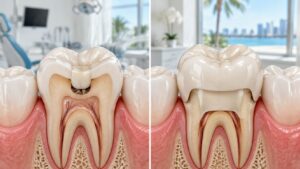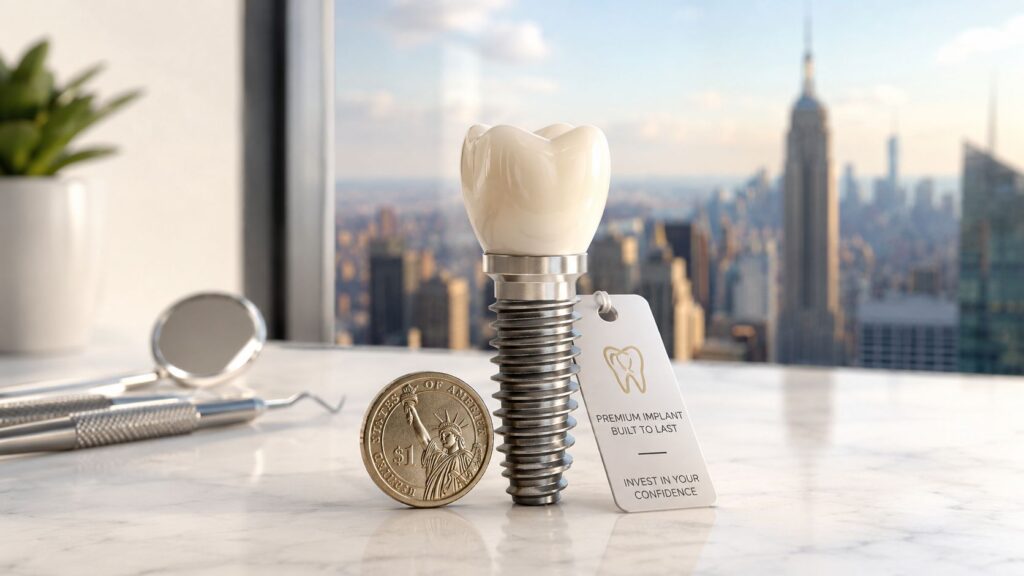
A single dental implant in NYC typically costs $3,000 to $6,000 per tooth. That's the number commonly seen first, but it's only the beginning of the story because the final total can change if the treatment also needs imaging, a custom crown, bone grafting, or other preparatory work.
Many patients start in the same place. A tooth cracks, an old crown fails, or a missing tooth that was ignored for years finally starts affecting chewing and confidence. Then the search begins for dental implants cost NYC, and the answers online often feel scattered, incomplete, or too simple to be useful.
What usually creates the most stress isn't only the price. It's the uncertainty around what that price includes. One office may describe a “single implant as the surgical post alone. Another may include the abutment and crown. A lower quote can look appealing until the add-ons appear later.
For patients comparing options in a major city, a clear all-in breakdown matters more than a headline number. That's where careful treatment planning helps. A thoughtful implant consultation should connect the clinical need to the financial picture, so patients know what works, what might be optional, and what can become expensive if it's skipped.
Table of Contents
- Your Guide to Dental Implant Costs in NYC
- Understanding Dental Implants and Their Benefits
- A Clear Breakdown of Dental Implant Costs in NYC
- Comparing Costs for Different Implant Solutions
- Key Factors That Influence Your Final Price
- How to Manage Implant Costs with Financing and Insurance
- Your Patient Checklist for an Implant Consultation
Your Guide to Dental Implant Costs in NYC
Cost conversations around implants can feel uncomfortable because they usually happen at the same time a patient is already dealing with pain, a visible gap, or a tooth that can't be saved. In New York City, that pressure is often amplified by the simple reality that complex dental care is expensive.
A useful way to think about implants is to treat the estimate like a treatment map, not a sticker. A patient replacing one back tooth has a very different path than someone who lost a front tooth years ago and now has bone loss. Both may search the same phrase, but they're not shopping for the same procedure.
What patients are usually trying to figure out
Patients often aren't only asking, “What does one implant cost? They're also asking:
- What's included in the quote
- Whether extra procedures are likely
- How long treatment takes
- Whether a less expensive option now could become a bigger problem later
That's why transparent planning matters.
Practical rule: A useful implant quote should match the patient's anatomy, missing-tooth pattern, and restoration plan. If it doesn't explain those pieces, it's incomplete.
For local patients comparing care, value is clarity. A straightforward consultation should explain whether the plan involves just one implant, a bridge supported by implants, or a full-arch solution, and it should separate required treatment from optional upgrades. That makes the cost easier to understand and much easier to budget for.
Understanding Dental Implants and Their Benefits
A dental implant replaces more than the visible part of a missing tooth. It replaces the support underneath it. That matters because a gap in the smile often leads to more than appearance concerns. Patients may start chewing on one side, nearby teeth can shift, and the area can become harder to clean.
The simplest explanation is this. A dental implant acts like a new tooth root placed into the jaw, and a replacement tooth is attached to it. Instead of resting on the gums like a removable appliance, it's designed to be anchored.
The three parts patients should know
Understanding the parts helps make the cost easier to follow later.
| Part | What it does |
|---|---|
| Implant post | Sits in the jawbone and serves as the artificial root |
| Abutment | Connects the implant post to the visible tooth |
| Crown | The custom-made tooth that shows when smiling and chewing |
Patients who worry about discomfort often find that the process sounds more intimidating than it feels once it's explained clearly. For a simple overview of the procedure experience, this guide on whether dental implants hurt can help answer common concerns in plain language.
Why implants are often worth considering
Implants are part of restorative dentistry, but they also affect day-to-day comfort and confidence.
- Chewing stability: They provide a fixed solution for eating more comfortably.
- Smile appearance: The final restoration is designed to blend with surrounding teeth.
- Jaw support: Because the implant is placed in bone, it supports a more complete reconstruction than a surface-level replacement.
- Neighboring teeth: Unlike some alternatives, treatment doesn't always rely on adjacent teeth for support.
A missing tooth is never just a cosmetic issue. It changes function, cleaning patterns, and often the way a patient uses the entire bite.
For some patients, an implant is the cleanest single-tooth solution. For others, especially when several teeth are involved, another implant-based design may make more sense. The right answer depends on what's missing, what bone is available, and what kind of long-term result the patient wants.
A Clear Breakdown of Dental Implant Costs in NYC
A patient comes in expecting a single number for “one implant, then finds out the quote does not include the extraction, CT scan, grafting, or the final crown. That is how implant costs become frustrating. A useful estimate in NYC should show the full treatment plan, line by line, so you can see what you are paying for and why, as outlined by this NYC dental implant cost breakdown.
The sticker price rarely tells the whole story.
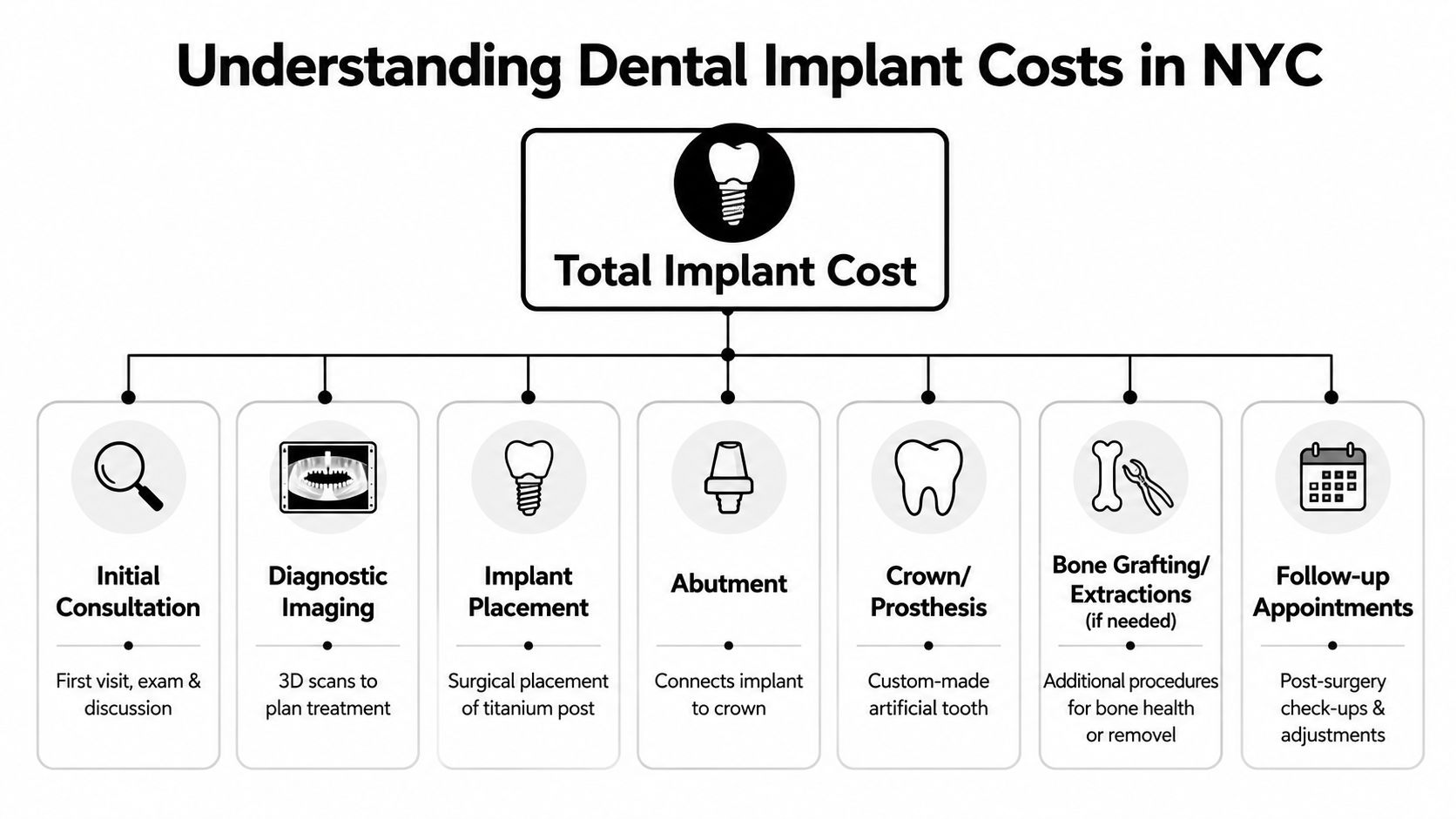
What an all-in implant estimate should show
Some offices quote only the surgical implant post. Others quote the post, abutment, and crown together. Patients need to know which version they are seeing. The American Academy of Implant Dentistry notes that fees can vary based on how many procedures are needed before and after placement, which is exactly why an itemized plan matters.
A complete implant proposal may include:
- Consultation and clinical exam: Review of the missing tooth, gum health, bite, and whether the site is ready now or needs preparation.
- 3D imaging or X-rays: Used to measure bone, locate nerves and sinuses, and plan the angle and depth of the implant.
- Extraction, if needed: A failing tooth may need to be removed before implant treatment can begin.
- Bone graft or sinus lift, if needed: Added when there is not enough bone to place the implant predictably.
- Implant placement surgery: The titanium post is placed in the bone.
- Healing phase and follow-up visits: Checks to confirm the implant is integrating properly.
- Abutment: The connector between the implant and the final tooth.
- Custom crown or larger prosthesis: The visible tooth or teeth that restore function and appearance.
That list encompasses the cost conversation. The phrase “per implant is only one part of it.
Later in the process, many patients also benefit from seeing a walk-through of the treatment steps. This overview video is a useful example.
Why two patients can get very different quotes
A straightforward single-tooth case usually costs less because the site may already have enough bone and gum support. A more involved case costs more because the treatment includes preparatory work, more appointments, and sometimes a more complex final restoration.
In practice, I tell patients to look at the estimate in layers:
- Base treatment: implant, abutment, and crown
- Site preparation: extraction, grafting, membrane, or sinus work
- Planning and delivery: imaging, surgical guides, temporary teeth, and post-op visits
That structure makes the trade-offs easier to understand. A lower starting quote can end up costing more once the missing pieces are added back in.
Why written estimates matter
Written estimates protect patients from vague pricing. They also make it easier to compare offices fairly. If one office includes the crown and follow-up care and another quotes only the implant post, the lower number is not a true comparison.
The most useful question in an implant consultation is: “What exactly is included in this fee, and what would add to it?
That question usually brings the full total into focus. It also helps patients separate a clean, all-in quote from a partial quote that leaves too much undefined.
Comparing Costs for Different Implant Solutions
A patient replacing one front tooth and a patient who needs a full arch may both search for "dental implants cost NYC," but they are not shopping for the same treatment. The question is the all-in cost for the solution that fits the mouth, not the lowest price attached to a single implant post.
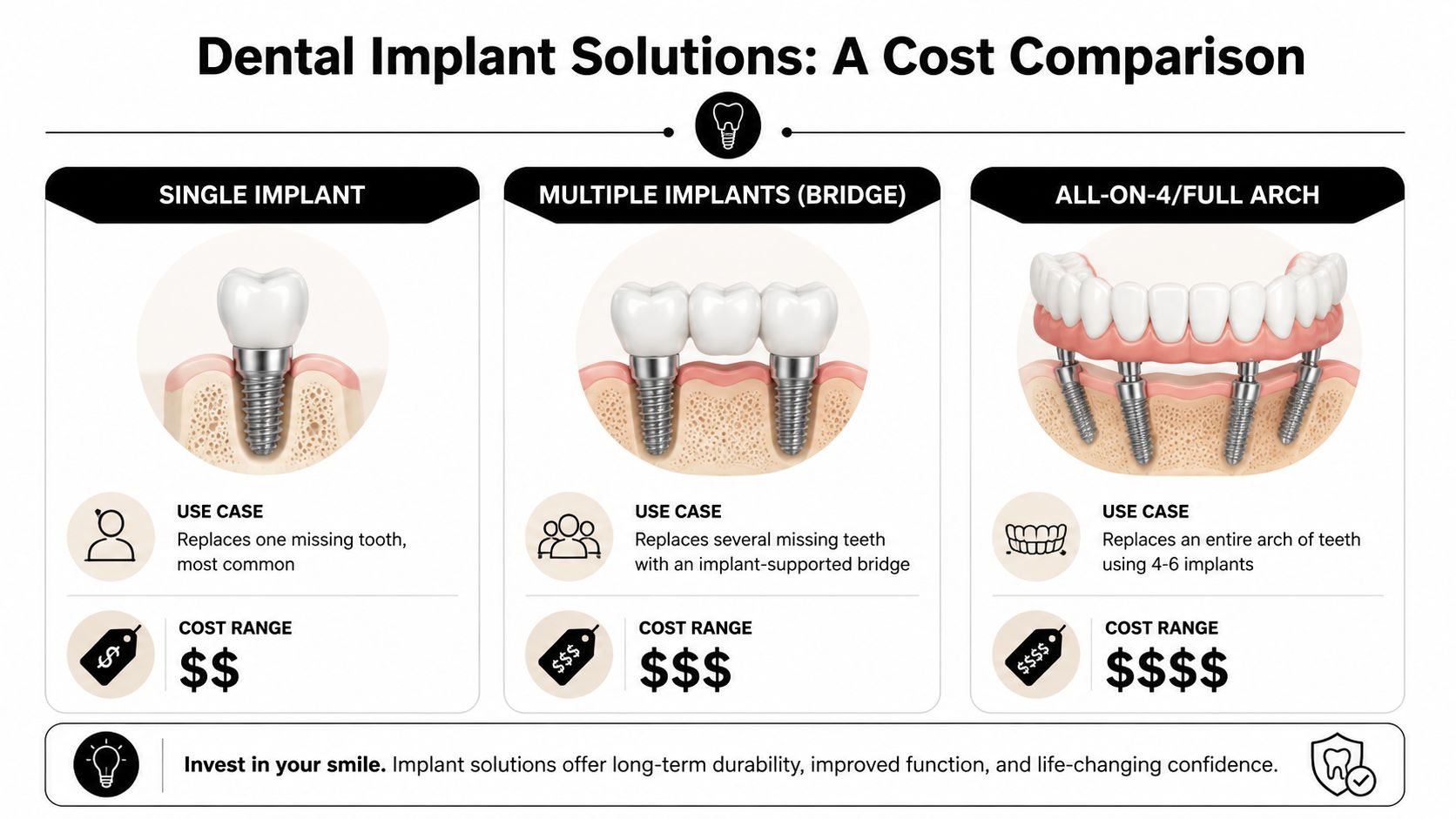
I advise patients to compare implant options by what they are trying to restore: one tooth, several teeth, or a whole arch. That keeps the conversation grounded in total treatment cost, final function, and long-term maintenance.
One missing tooth
A single-tooth implant is usually the simplest category, but even here, the final fee depends on more than the implant itself. The complete treatment often includes the exam, 3D imaging, implant placement, healing, the abutment, and the final crown. If the tooth has been missing for a while, site development may add cost before the implant can be placed predictably.
For a patient with healthy bone and gum tissue, a single implant is often the cleanest option because it replaces the tooth without preparing the neighboring teeth for a bridge. For a patient with bone loss, the fee rises because the treatment includes rebuilding the site first. Patients who want to understand why bone rebuilding changes the budget can review this guide to bone grafts before implant treatment.
Several missing teeth
This middle category is where online pricing gets especially confusing. Some patients do not need one implant for every missing tooth. In many cases, two implants can support a three-tooth bridge, which changes both the surgical cost and the prosthetic cost.
That approach can reduce the number of implants, but it also creates a different maintenance plan and a different load distribution. The right design depends on bite force, spacing, bone support, and whether the missing teeth are next to each other.
One full arch or full mouth
Full-arch treatment is a different financial category because the treatment is larger at every step. Planning is more involved. Surgery is more involved. The final prosthesis is more involved. A quote for a full arch may include extractions, temporary teeth, sedation, multi-implant placement, and a fixed prosthesis, or it may leave some of those items out.
This is why a "per implant" number can be misleading. A patient may hear that a full arch uses four or more implants, but the overall fee reflects the full reconstruction, not just the hardware.
The American Academy of Implant Dentistry explains that a single tooth implant restoration can cost several thousand dollars, while more extensive implant-supported prosthetics can increase significantly depending on the number of teeth replaced and the design of the restoration, as outlined in the AAID overview of implant treatment costs.
A practical side-by-side comparison looks like this:
| Patient situation | Typical treatment direction | What usually drives the total cost |
|---|---|---|
| One missing tooth | Single implant, abutment, and crown | Whether the site is ready now or needs grafting, plus crown material and esthetic demands |
| Several missing teeth | Multiple single implants or an implant-supported bridge | Number of implants, bridge design, and whether adjacent spaces can be restored together |
| One full arch | Implant-supported full-arch prosthesis | Number of implants, temporary teeth, extractions, sedation, and the type of final prosthesis |
| Full mouth | Both arches restored | Complexity across both jaws, bite design, staging, and long-term prosthetic planning |
The best cost comparison is the one that shows the entire treatment plan in writing. If two offices recommend different solutions, the lower quote is not automatically the better value. One plan may include the final teeth, temporaries, imaging, and follow-up visits. Another may quote only part of the case.
Key Factors That Influence Your Final Price
A patient may hear “one implant at two consultations and still get two very different total fees. In practice, the difference usually comes from what has to happen before the implant is placed, how the final tooth will be made, and how much treatment is included in the written plan.
The biggest mistake I see is focusing on the implant fixture alone. The final price is shaped by the condition of the site, the number of surgical steps, the type of restoration, and the follow-up care needed to get a stable result.
Bone support and surgical preparation
Implants need enough healthy bone to hold them in the right position. If the tooth has been missing for years, the ridge may have thinned. In the upper back jaw, the sinus can limit the available height for an implant.
That changes the treatment sequence. A site with good bone may be ready for implant placement with fewer steps. A site with bone loss may need grafting first, or grafting at the time of surgery. Some upper-jaw cases also need a sinus lift to create enough space for safe placement.
Patients who want a clearer explanation of how bone rebuilding affects timing, healing, and cost can review this guide to bone grafts and implant preparation.
These differences matter because they change the all-in price, not just the surgical fee.
- Healthy bone and favorable anatomy: Fewer preparatory procedures, shorter treatment timeline in some cases
- Bone loss at the implant site: Added grafting materials, added visits, and healing time before the final tooth
- Limited bone under the sinus: Possible sinus lift, more surgical planning, and a longer path to restoration
Design decisions that change treatment
The surgical part is only one part of the bill. The prosthetic plan often changes the final number just as much.
A front tooth usually takes more planning than a back tooth. Shade matching, gum symmetry, and the angle of the implant all affect how natural the result looks. In the back of the mouth, appearance may matter less, but bite forces matter more. That can influence material choice, lab work, and how the crown or bridge is designed.
Timing also affects price. Some patients qualify for immediate placement or a temporary tooth on the same day. Others need staged healing to lower risk and improve the long-term result. A faster plan can be convenient, but it is not the right choice for every site.
Other factors that often change the final estimate include:
- Number of teeth being replaced: One implant is different from a bridge or a full-arch case
- Type of final restoration: A single crown, implant bridge, overdenture, and fixed full-arch prosthesis all carry different lab and maintenance costs
- Material selection: The esthetic and strength goals may call for different crown or prosthesis materials
- Imaging and planning: 3D scans, surgical guides, and detailed bite planning can add cost up front but may reduce surprises later
- Extractions and temporary teeth: Some offices include these in the quote, while others list them separately
A low starting fee can look attractive and still leave out important parts of care. The better question is whether the estimate includes the full sequence, from diagnostics to the final restoration, and whether the treatment fits the actual condition of the mouth.
Clinical judgment matters here. The right plan reflects bone quality, bite forces, smile demands, healing risk, and what the patient is trying to solve.
How to Manage Implant Costs with Financing and Insurance
A common NYC scenario goes like this. A patient is comfortable with the treatment plan for one implant, then hesitates when they see that the total includes the exam, 3D imaging, surgery, parts, crown, and sometimes grafting or a temporary tooth. The way to handle that cost is to break it into pieces and decide which parts can be paid for, scheduled, or submitted to insurance in a practical order.
Insurance usually does not treat implants as one simple line item. Benefits may apply to the exam, imaging, extraction, bone graft, or final crown, while the implant post itself may be covered differently or not at all. Coverage depends on the plan, annual maximum, waiting periods, and whether the office is in network.
That is why I tell patients to focus on the all-in estimate, not just the advertised implant fee. A low per-implant number does not help much if the crown, abutment, sedation, or grafting sits outside the quote. For a single-tooth case, that distinction matters. For a full-arch case, it can change the budget by many thousands of dollars.
How patients usually handle the cost
The most workable payment plan often uses more than one source.
- Insurance benefits: These may reduce part of the bill, especially diagnostics, extractions, or the final restoration
- FSA or HSA funds: Pre-tax dollars can be useful for eligible dental expenses
- Third-party financing: Monthly payments can make larger cases more manageable
- Staged treatment: Some cases can be divided into surgical and restorative phases, with separate payments over time
Staging has limits. It can help with budgeting, but it still has to make clinical sense. In some mouths, delaying a needed step is reasonable. In others, waiting can create more wear, shifting, or added treatment later.
Ultra Smile DentalSpa offers implant treatment and related restorative services, so patients comparing options can ask that office, or any office they are considering, for a written explanation of financing arrangements, payment timing, and what the estimate includes.
What to confirm before you commit
Patients do not need to know insurance coding. They do need direct answers in plain language.
Ask these questions before treatment starts:
- What is the total fee for this case, from diagnostics through the final tooth or prosthesis?
- Which parts, if any, are being estimated for insurance reimbursement?
- Is the surgical phase billed separately from the abutment, crown, bridge, or full-arch prosthesis?
- If grafting, a temporary tooth, or another added procedure becomes necessary, how would that change the fee?
- What amount is due at each visit, and what can be financed or paid in phases?
Good financial planning lowers surprises. It also helps patients compare offices fairly, because they are comparing complete treatment rather than a partial number that leaves out major parts of the case.
Your Patient Checklist for an Implant Consultation
A good consultation should leave the patient with fewer questions, not more. The best way to make that happen is to arrive with a short list and ask for direct answers in writing.
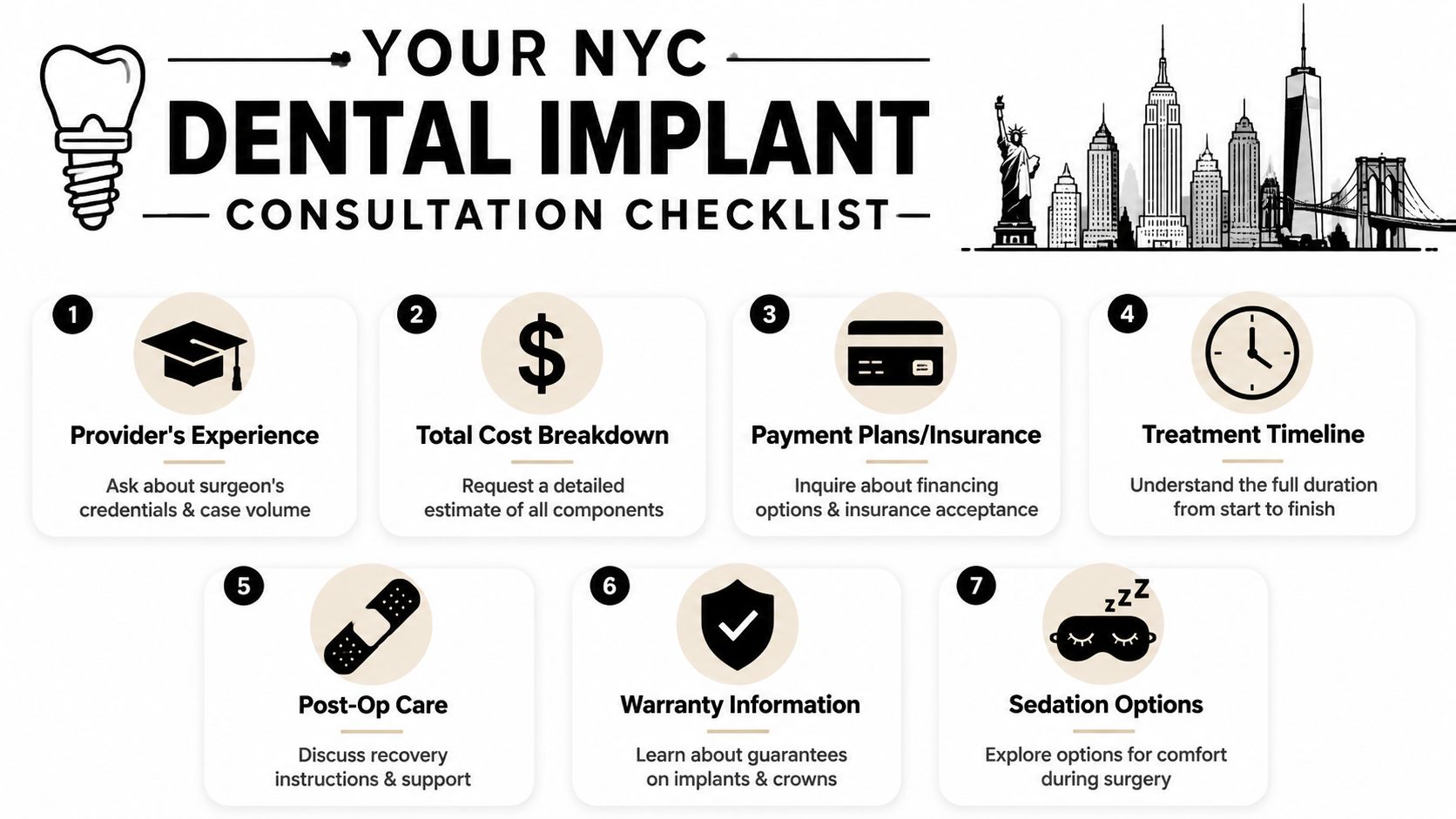
Bring this checklist to any implant visit:
- Ask what the quote includes: Is it only the implant post, or does it also include the abutment and final crown?
- Ask about additional procedures: Could this case require extraction, grafting, or sinus-related preparation?
- Ask about the restoration plan: Is this a single-tooth implant, a bridge-supported solution, or a full-arch design?
- Ask about the timeline: Will treatment happen in one main stage or over several healing phases?
- Ask who performs each step: One provider may handle everything, or the case may involve multiple doctors or labs.
- Ask about payment options: Find out whether insurance coordination, financing, or staged payments are available.
- Ask for the estimate in writing: A verbal quote is easy to misunderstand.
Clear implant planning should answer three things before treatment begins: what is being done, why it's needed, and what the full fee is likely to be.
For patients searching Dental Implants Cost NYC, that final written estimate is what turns a confusing online search into a decision based on facts.
If you're considering implants and want a clear, written breakdown before making any decisions, Ultra Smile DentalSpa provides consultations that review the clinical plan, likely add-ons, and available payment options in straightforward language. Patients in Miami who want to discuss single-tooth implants, bone grafting, or larger restorative treatment can schedule an appointment to get a personalized treatment plan and a transparent cost review.