Swallowing fluoride is not automatically bad, and for healthy adults the routine bit that comes from toothpaste residue or fluoridated tap water is not considered dangerous. The key question is dose and exposure duration, because that's what separates normal daily use from a problem.
A lot of people in Miami ask this after a brushing session, a mouthwash rinse, or a sip of coffee made with tap water. The answer is usually calmer than the internet makes it sound.
Table of Contents
- The Morning Scenario Most People Actually Have
- What Fluoride Is and Why Dentists Use It
- Acute vs Chronic Fluoride Exposure and the Numbers That Matter
- Everyday Scenarios Ranked by Actual Risk
- Recognizing Symptoms and Knowing When to Act
- Prevention Habits for Adults and Parents
- Putting It All Together With Your Dentist
The Morning Scenario Most People Actually Have
A typical Miami morning looks simple enough. Someone brushes with fluoride toothpaste, maybe swishes a little mouthwash, then heads out with coffee or water from the tap. That routine raises the same concern over and over, is it bad to swallow fluoride, or is the fear bigger than the actual risk?
What matters in the bathroom sink
The useful way to think about fluoride is not “swallow or don't swallow. It's whether the amount was tiny, accidental, and brief, or large enough to matter. The NIH says swallowing extremely large amounts can cause nausea, vomiting, abdominal pain, diarrhea, bone pain, and, in rare cases, death, while long-term excess intake can lead to skeletal fluorosis. It also lists adult upper limits of 10 mg/day, with much lower limits for young children, 1.3 mg/day for ages 1 to 3 and 2.2 mg/day for ages 4 to 8, which is why kids need closer supervision (NIH fluoride consumer factsheet).
Practical rule: accidental swallowing during normal brushing is usually a dose question, not a panic question.
This guide keeps that same practical lens. It's meant to help a patient in Downtown Miami, Midtown, or Hallandale Beach sort out the everyday stuff from the situations that really need action.
What the reader should walk away with
By the end, the risk tiers should feel clear. Routine incidental swallowing from toothpaste residue or fluoridated water falls in one category. Larger accidental ingestions, especially in young children, sit in another. True overdose belongs in an urgent category and should never be brushed off.
The goal here isn't to scare anyone away from fluoride. It's to show where it helps, where it stays low risk, and where a call matters more than waiting it out.
What Fluoride Is and Why Dentists Use It
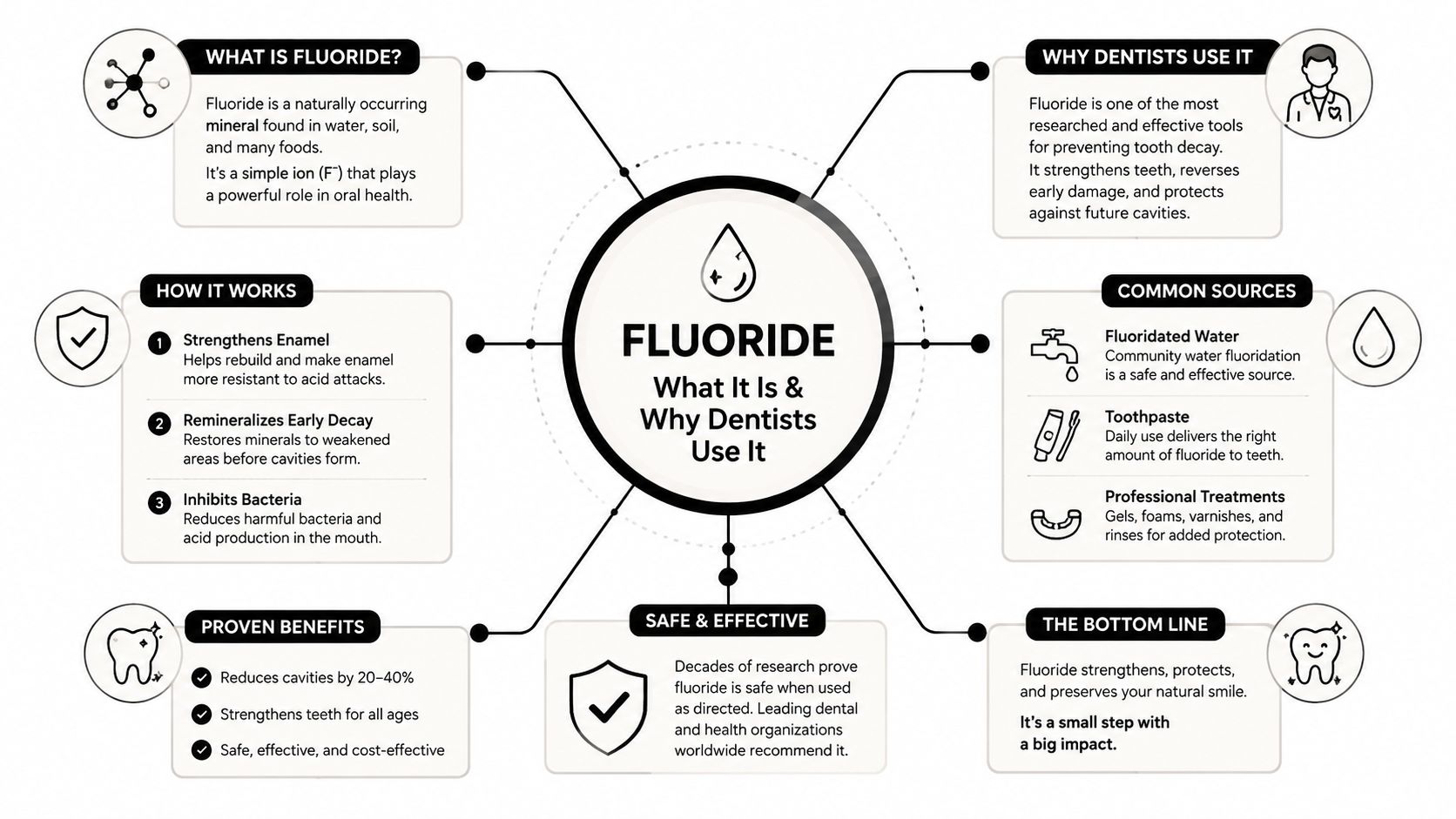
Fluoride is a naturally occurring mineral. In dentistry, it matters because it helps strengthen enamel when it touches the tooth surface, which is why it shows up in toothpaste, varnish, gels, and community water systems.
Topical use and swallowed use are not the same thing
Topical fluoride works on the outside of the teeth. That is the part that helps enamel stay stronger where cavities begin. Swallowed fluoride is different, because once it is in the body, the focus shifts from local enamel support to systemic exposure.
That distinction is why dentists pay so much attention to spitting after brushing and using the right amount, especially for children. It is also why water fluoridation has stayed a public-health issue for decades. The CDC and AAP report that community water fluoridation reduces tooth decay by about 25% (CDC and government review on fluoride).
Why the benefit matters before the fear does
A lot of families hear the word fluoride and go straight to risk. That misses the reason dentists still use it. It is one of the simplest tools for cavity prevention, and in a dental office it is usually part of a broader prevention plan that may also include cleaning, exams, x-rays, and home-care coaching.
The point is not that fluoride should be swallowed. The point is that it does useful work when it touches the teeth, and the benefit is strongest when the dose stays in the intended range. Public guidance keeps coming back to the same principle, topical benefit, careful intake.
A dental practice in Miami may also talk about fluoride in the context of preventive visits, especially when a patient is already dealing with enamel wear or a history of cavities. The product matters less than the pattern of use, and the pattern should always match age, risk, and brushing habits.
The technical details can sound abstract, but the practical message is simple. Fluoride is a tool, not a poison by default. Like any tool, it works best when it is used the right way and in the right amount.
Acute vs Chronic Fluoride Exposure and the Numbers That Matter
The clearest way to answer fluoride worries is to separate one-time acute exposure from chronic over-exposure. Those are different problems, and they do not behave the same way in the body.
The numbers that put risk in context
The NIH Health Professional Fact Sheet says serious systemic toxicity is usually associated with an acute dose around 5 mg/kg of body weight, and the same source notes a U.S. Public Health Service community water fluoridation recommendation of 0.7 mg/L (NIH Health Professional fluoride fact sheet). Toxicology guidance in the consumer factsheet explains that a 75 kg adult would reach that acute toxicity level at roughly 375 mg of fluoride, far above what comes from toothpaste residue or normal drinking water (NIH fluoride consumer factsheet).
That gap matters in a practical way. It shows why routine tap water exposure is not the same thing as swallowing a large quantity of toothpaste or a supplement by mistake. It also explains why public-health guidance can support fluoride use while still warning against misuse.
Age changes the picture too. The same NIH consumer factsheet lists an upper limit of 10 mg/day for adults and pregnant or breastfeeding women, compared with 1.3 mg/day for children ages 1 to 3 and 2.2 mg/day for children ages 4 to 8 (NIH fluoride consumer factsheet).
| Group | Upper Limit (mg/day) | Acute Toxicity Threshold | Real-World Equivalent |
|---|---|---|---|
| Adults and pregnant or breastfeeding women | 10 mg/day | About 5 mg/kg body weight for serious systemic toxicity | Routine toothpaste residue or fluoridated water stays far below poisoning levels |
| Children ages 1 to 3 | 1.3 mg/day | Lower body weight makes accidental swallowing matter sooner | A toddler swallowing toothpaste is the common concern |
| Children ages 4 to 8 | 2.2 mg/day | Still lower than adults because of size and tooth development | Supervised brushing matters more than for older kids |
Chronic exposure is a different issue
Long-term excess intake can cause skeletal fluorosis, which the NIH describes as a very rare condition marked by joint pain, stiffness, weak bones, muscle loss, and nerve problems (NIH fluoride consumer factsheet). In children under about 8 years, the other major concern is dental fluorosis, a developmental effect that can show up as white streaks or spots on teeth while they are forming (University of Rochester Medicine).
A separate government review notes that the U.S. Environmental Protection Agency's maximum allowed fluoride level in drinking water is 4.0 mg/L, while routine community fluoridation is typically about 0.7 mg/L. That spread is why normal municipal water is not treated like a poisoning exposure.
Everyday Scenarios Ranked by Actual Risk
The question for most households is which daily moments deserve concern. A child tasting toothpaste, a quick sip of tap water, or a fluoride varnish left on after a cleaning all sit in very different risk lanes.
How common situations compare
- Toothpaste swallowed by a child during brushing: Usually a mild concern if the amount is small. The common issue is stomach upset, not emergency toxicity, unless a large amount was eaten.
- A capful of fluoride mouthwash: Usually a mild concern if swallowed by accident, but it should not become a habit. The amount and the child's age matter.
- A sip of fluoridated Miami tap water: No concern in ordinary circumstances. Routine drinking water exposure is far below toxic levels and is part of normal public-health guidance.
- Fluoride varnish left on after a cleaning: No concern when it's applied by a dental professional as directed. It's meant to stay on the teeth, and it is one reason dentists talk about enamel protection in practical terms.
- A swallowed fluoride supplement tablet: Act now if the amount is uncertain, especially for a child. Supplements are the one scenario that can move from harmless to risky quickly.
Dental note: the common household mistake is not ordinary water, it's unsupervised swallowing of toothpaste or medicine-like fluoride products.
What that means in a Miami home
Miami families do not need to treat every fluoride product like a hazard. They do need to treat medicated products differently from tap water and standard toothpaste use. The practical line is simple, the more concentrated the product, the more careful the supervision should be.
That also changes how I talk with parents chairside. A toddler who swallows a dab of toothpaste is in a different category from a child who gets into a supplement bottle, and the response should match that difference. Tap water and dental varnish sit lower on the risk scale, while rinses, tablets, and swallowed toothpaste deserve more attention because dose and timing matter.
Routine dental visits help sort out those trade-offs. A dentist can match the product to the child's age, brushing skill, and cavity risk. For adults, the same conversation can clarify whether a mouthwash, rinse, or in-office preventive step fits the situation.
Recognizing Symptoms and Knowing When to Act
Small fluoride ingestions usually don't lead to dramatic symptoms. When they do cause problems, the early signs are often stomach-related, not mysterious.
Mild symptoms versus urgent symptoms
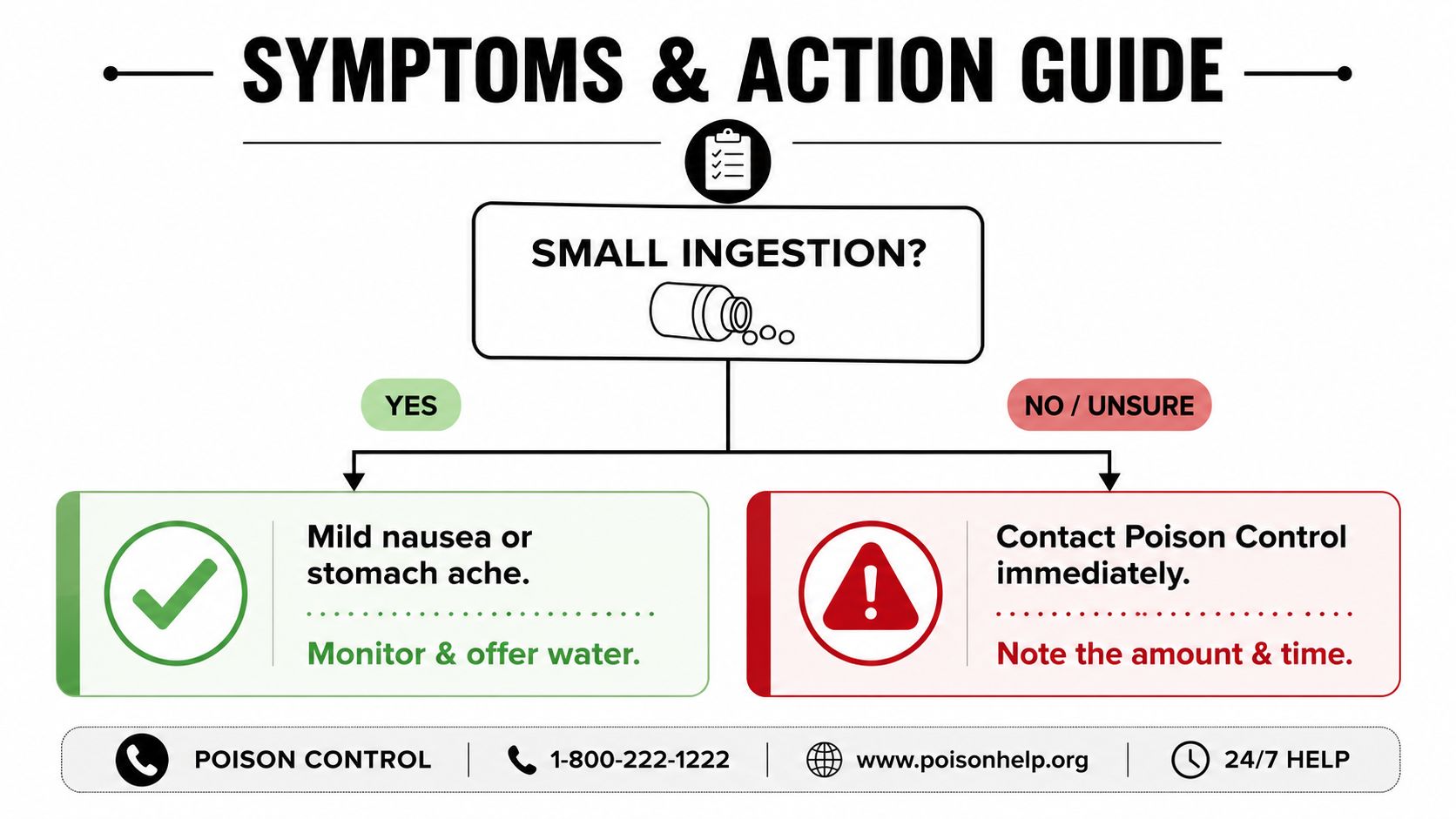
A small accidental swallow can lead to mild nausea or a mild stomach ache. That's the typical pattern families are warned about, and it often settles with observation and fluids if the person is awake and otherwise stable.
The red flags are different. Persistent vomiting, severe abdominal pain, drooling, seizures, or loss of consciousness deserve immediate medical attention. Those signs move the situation out of home monitoring and into emergency care.
If the amount is small and the person is conscious, offering milk or a calcium-containing food can help slow absorption while guidance is being sought. Calcium binds fluoride, which is why this simple step is often recommended during minor incidents.
Who to call and when
- Poison Control, 1-800-222-1222 in the U.S., for any large, uncertain, or concerning ingestion.
- The emergency room if severe symptoms, repeated vomiting, seizures, drooling, or unconsciousness are present.
- The family dentist if the issue is more about repeated brushing mistakes, toothpaste swallowing, or choosing the right fluoride product for a child.
The internal checkpoint for parents is simple. If the child only had a small taste or a tiny swallow and feels fine, watchful waiting is often enough. If the amount is unclear, the product is concentrated, or symptoms start, call right away.
For families worried about enamel wear or product choice, a separate prevention plan can help reduce the chance of these mishaps. This overview of enamel erosion can help connect fluoride use with broader tooth protection habits.
Prevention Habits for Adults and Parents
The safest fluoride routine is usually the simplest one. Adults need a few guardrails, and kids need supervision long enough to make those guardrails automatic.
Daily habits that keep the dose where it belongs
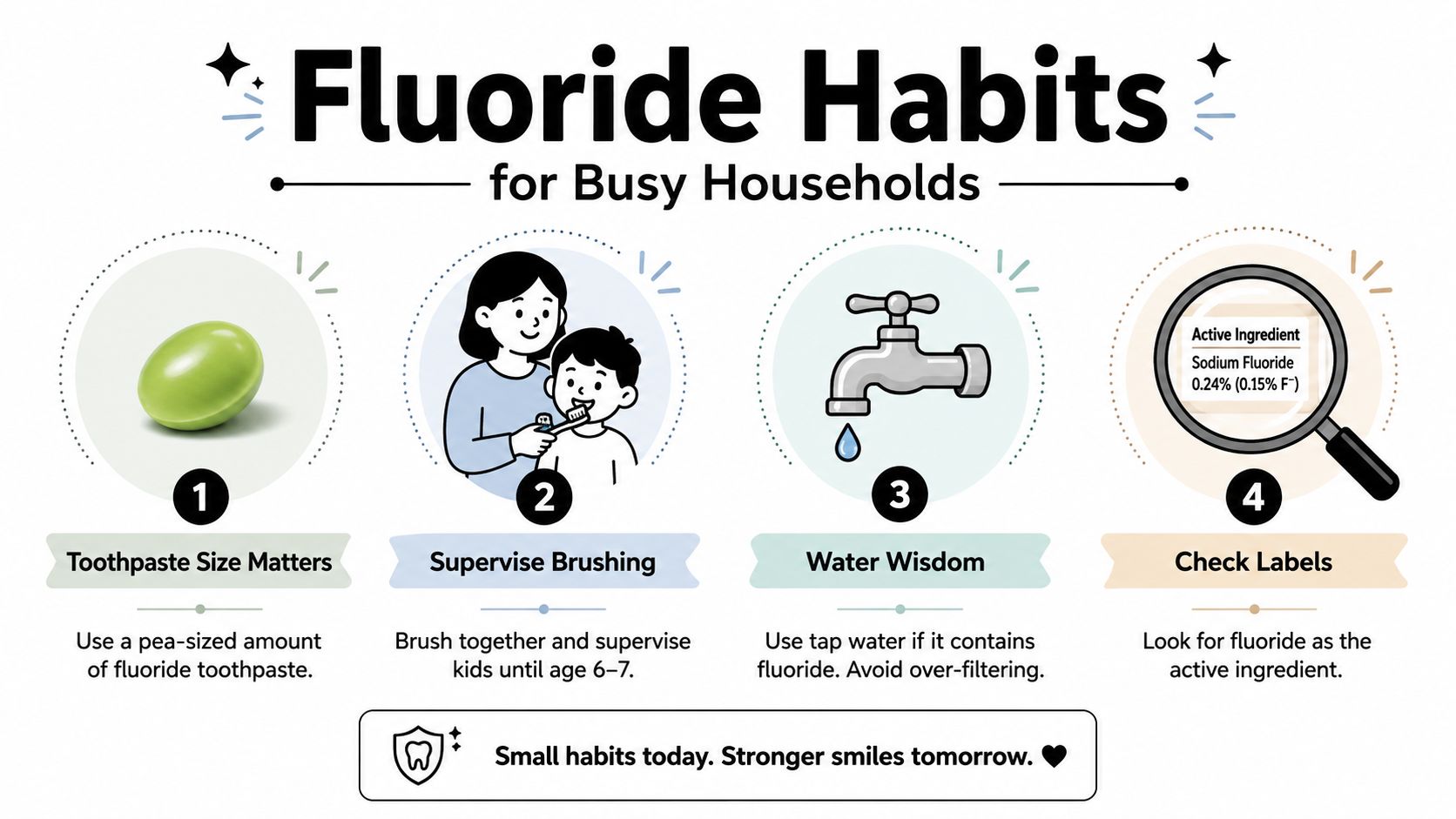
- Use the right amount of toothpaste: For young children, a smear is appropriate under age 3, and a pea-sized amount is the practical target for older children.
- Supervise brushing until at least age 6: Kids often swallow before they reliably spit, so an adult's eyes matter more than the product label.
- Store toothpaste out of reach: Curious toddlers treat tubes like snacks, and that's where most avoidable problems start.
- Choose age-appropriate fluoride products: Mouthwash and supplements belong in a different category from ordinary toothpaste, especially for children.
- Keep water habits ordinary: Tap water, when fluoridated according to public guidance, is part of routine daily intake, not a reason for worry (CDC-linked government review).
Adults need a quieter version of the same discipline
For adults, the main issue is not panic, it's consistency. Swishing and swallowing mouthwash isn't a habit worth keeping, and supplement use should always be intentional, not casual. Bottled water versus tap water matters less than the total pattern of intake, especially when the water supply sits near the recommended 0.7 mg/L community level (NIH Health Professional fluoride fact sheet).
Children under 8 deserve the most caution because fluoride exposure during tooth formation can produce dental fluorosis, usually a cosmetic issue but sometimes permanent (University of Rochester Medicine). That's a prevention issue, not a reason to fear every brush.
For families trying to build a cleaner daily routine around cavity prevention, this guide to preventing cavities fits naturally with supervised brushing and age-appropriate fluoride use.
When those small habits are in place, most households are already doing enough. The rest is just staying consistent.
Putting It All Together With Your Dentist
Fluoride is a tool, and like any tool, the dose and the user matter. Routine exposure, accidental swallowing, and true overdose are not the same thing, and the first two are usually fine when they stay small and occasional.
That's the framework a calm dental visit should reinforce. A patient in Downtown Miami may come in worried about toothpaste swallowing, a child's brushing habits, or whether tap water is safe, and those are exactly the kinds of questions that deserve a straight answer. Dr. Neda Bahmadi and the team at Ultra Smile DentalSpa in Downtown Miami can walk through those concerns during a preventive visit, alongside cleaning and exam planning, without making it feel rushed.
The same conversation often opens the door to better home care, better cavity prevention, and fewer panic moments at the bathroom sink. If a question still feels unresolved, it usually helps to bring the product bottle, the child's age, and the routine to the next appointment.
Ultra Smile DentalSpa helps Miami patients sort out fluoride questions during preventive care visits, and the office can also discuss cleanings, whitening, and other general dental concerns in a calm setting. If you want a clearer plan for your family, visit Ultra Smile DentalSpa and schedule a visit for personalized guidance.