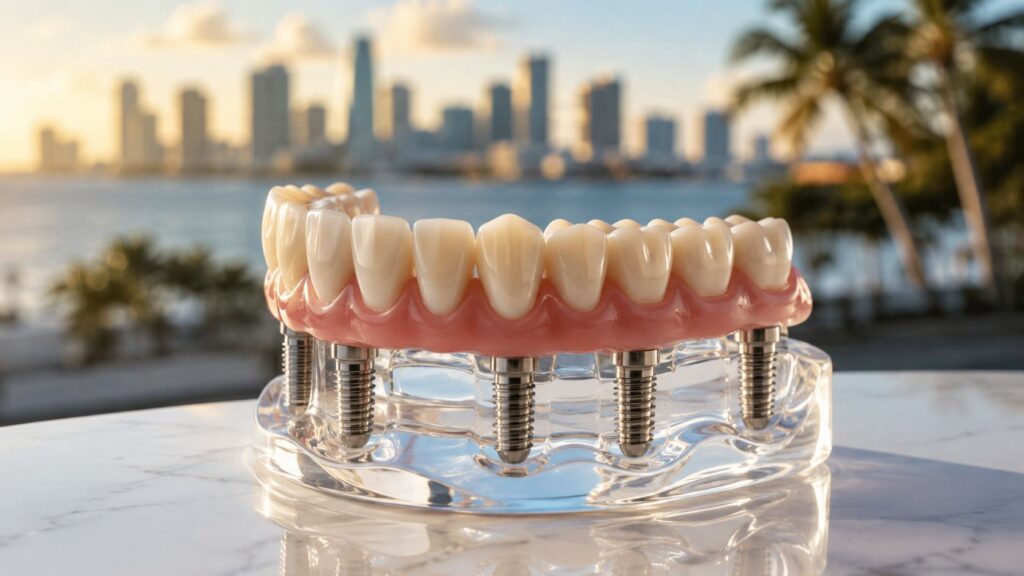
A loose denture can make even an ordinary Miami lunch feel stressful. A person starts soft, then skips the stone crab, then avoids speaking up at dinner because the lower denture keeps shifting, and that frustration turns into a daily habit.
Implant-supported dentures change that experience by anchoring replacement teeth to implants in the jaw instead of relying on gum suction or paste alone. For patients looking for a dentist in Miami, FL or searching dentist near me, the appeal is simple, better stability, better confidence, and a treatment plan that feels more secure for the long run.
Table of Contents
- Why Miami Patients Are Choosing Implant-Supported Dentures
- What Are Implant-Supported Dentures and How Do They Work
- Types of Implant-Supported Dentures Available in Miami
- Are You a Candidate for Implant-Supported Dentures
- Your Step-by-Step Treatment Journey at Ultra Smile DentalSpa
- Benefits and Realistic Expectations for Implant-Supported Dentures
- Understanding Costs and Financing Options in Miami
- Long-Term Care and Your Next Steps with Ultra Smile DentalSpa
Why Miami Patients Are Choosing Implant-Supported Dentures
A lot of patients do not start with implants. They start with a bad day. A denture slips while talking to family in Brickell, a bite feels weak at dinner in Midtown, or the lower plate starts rubbing sore spots before the afternoon is over. That's usually when the conversation shifts from “Can this be adjusted? to “What can make this stop?
The problem most people are trying to solve
Traditional dentures can sit loosely, especially when the lower arch has less natural suction. That movement makes eating slower, speech less predictable, and social moments more tiring than they should be. For people who are already tired of adhesives, reline appointments, and the fear of a denture shifting at the wrong time, implant support is a practical next step.
Practical rule: if the main complaint is slipping, rocking, or having to plan meals around the denture, implant support is worth a serious consult.
Ultra Smile DentalSpa in Miami approaches that discussion as restorative dentistry, not just tooth replacement. Patients get a treatment plan shaped around function, comfort, and appearance, with the added benefit of a calmer setting that suits people who feel anxious about dental work. That matters in a city where many patients want a cosmetic dentist near me experience that still respects the mechanics of chewing and speaking.
Why the conversation feels different in Miami
Miami patients often want a smile that looks natural in photos, but they also want to eat normally at home and out with friends. Those goals line up well with implant-supported treatment because the appliance is built for stability, not just appearance. The result is less about managing a denture and more about living with one that feels anchored.
For patients comparing a tooth extraction plan, emergency dentist options, or broader restorative dentistry care, this treatment often becomes part of a larger oral health reset. It's also one reason many people searching dental implants near me start asking whether a supported denture might solve more than a removable one ever could.
What Are Implant-Supported Dentures and How Do They Work
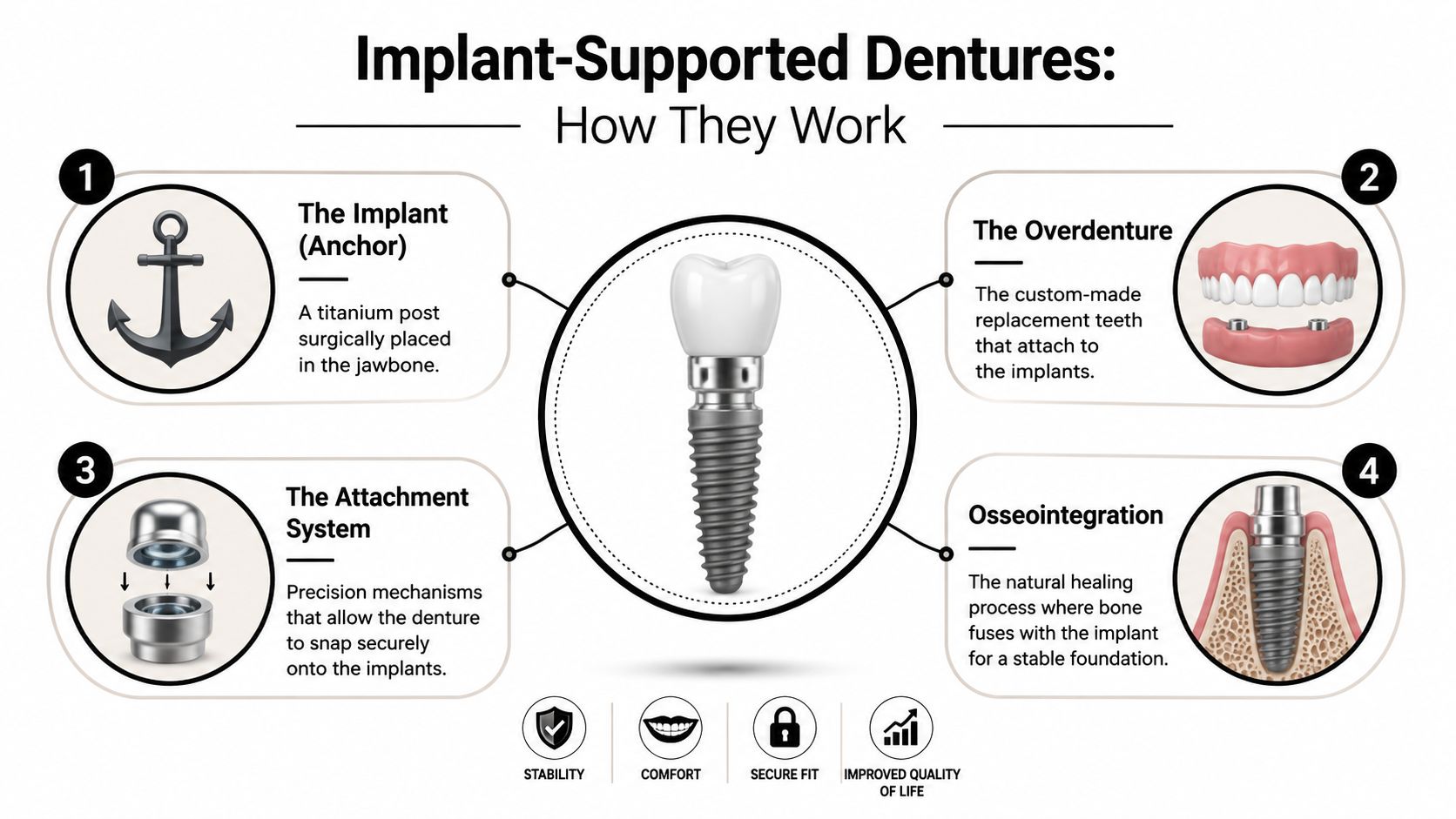
Think of a traditional denture as something that rests on the surface. An implant-supported denture works more like a docked boat, held steady by anchors in the harbor. The difference is the anchor, and in this case that anchor is a titanium implant placed in the jawbone.
The core mechanics
A dental implant is surgically placed into the bone, then the bone heals around it through osseointegration, which creates a stable base. The denture is then connected through attachments or a fixed framework, depending on the design. That's why these dentures feel more secure when a patient bites, speaks, or laughs.
The Cleveland Clinic explains that implant-supported dentures are attached to implants in the jaw and are designed to be more stable than traditional dentures during eating, speaking, and chewing (Cleveland Clinic). That stability is the main reason patients who hate movement tend to prefer them.
Supported, retained, and fixed
The labels matter because they describe how much of the load comes from the implants versus the gums. A true implant-supported overdenture is considered fully supported when four or more implants carry the load without mucosal contribution, and expert reviews often recommend at least four well-spaced implants in the maxilla, with six implants when bone quality is compromised (PMC review). That's a different setup from a partially implant-retained design, where soft tissue still plays a role.
A fixed version is closer to a permanent bridge, while a removable overdenture still comes out for cleaning. Both can work well. The right choice depends on space, bone, cleaning ability, and whether the person wants something that stays in place all day or something easier to remove at home.
Why the support system matters
The attachment style isn't just a detail. It affects speech, cleaning, repair needs, and how the denture handles bite force. Patients who want maximum stability usually lean fixed, while patients who want easier hygiene and simpler maintenance often choose a removable design. That decision becomes even more important once the mouth's available vertical space is measured.
Types of Implant-Supported Dentures Available in Miami
Different mouths need different support. A patient who wants the least removable option, a patient with limited space, and a patient who wants easier at-home cleaning may all end up with different prostheses. That's normal, and it's one reason a good consultation matters more than a one-size-fits-all promise.
Comparing the main options
The biggest practical differences come down to how the denture attaches, how many implants are used, and how much maintenance the design will need over time. Vertical restorative space is a real technical limit here. Reported minimum interarch space is about 8.5 mm for Locator attachments, 10–12 mm for free-standing attachments, and 13–14 mm for bar-retained designs (British Dental Journal review). In shorter space, lower-profile attachments often make more sense.
| Type | Implants Needed | Removable | Best For |
|---|---|---|---|
| Overdenture with attachment | Often 2 to 4 in the lower jaw | Yes | Patients who want stability with easier cleaning |
| Fixed hybrid denture | Often 4 or more | No | Patients who want the least movement and a more permanent feel |
| Bar-retained design | Often 4 or more | Usually yes | Cases where a bar can distribute force well |
| Ball-retained or stud-attachment design | Often 2 to 4 | Yes | Lower-profile, simpler removable option |
What each style means in daily life
A bar-retained denture can feel very secure because multiple implants are joined by a bar, but it needs enough vertical room to fit properly. A ball-retained or stud design is usually simpler, with the denture snapping onto individual attachments. That can be a good fit when the mouth doesn't have the space for a bar or when the goal is to keep the system more compact.
Fixed hybrids are the least removable option, but they also ask more of the patient in daily hygiene. Removable overdentures are easier to clean, yet they may not feel as locked in as a fixed design. The right choice depends on bone, bite, dexterity, and how much convenience matters at home.
A short consultation with imaging usually clarifies more than weeks of online research. The jaw has a say in the final design.
Are You a Candidate for Implant-Supported Dentures
Candidacy starts with anatomy, but it does not end there. A person can want implants badly and still need more bone, healthier gums, or a medical review before treatment is safe. That's why the evaluation is detailed and why it should never be guessed from a mirror or a photo.
What the exam looks for
The main questions are straightforward. Is there enough bone to hold implants? Are the gums healthy enough to heal well around them? Is the patient medically stable, and can daily cleaning be done consistently?
That's where dental x-rays, 3D imaging, and a full exam come in. Imaging shows bone height, bone width, sinus position, and the spacing available for the prosthesis. A patient who has lost teeth for years may have more shrinkage in the jaw, which can change the plan entirely.
Bone loss and medical factors
Bone loss doesn't automatically end the conversation. It often means the treatment needs an added step, such as grafting, before implants can be placed. Some people with diabetes still qualify if their condition is controlled, but healing risk has to be considered carefully. Smokers need especially honest counseling because smoking can interfere with healing and long-term success.
For readers comparing alternatives, Ultra Smile DentalSpa's overview of dental implants versus dentures can help frame the broader decision before the exam. The point isn't to push one answer. It's to match the mouth to the treatment that fits.
Who usually does well
Good candidates tend to be people who want more stability than conventional dentures offer and who are willing to keep up with follow-up care. They don't have to be perfect. They do need enough support, realistic expectations, and a commitment to oral hygiene after treatment. That combination matters more than age alone.
Your Step-by-Step Treatment Journey at Ultra Smile DentalSpa
The treatment process is structured, but it doesn't have to feel intimidating. At Ultra Smile DentalSpa, the experience is designed to stay calm and organized while the clinical work moves in a careful sequence. Patients who are nervous often relax once they know what happens next.
Consultation first, surgery second
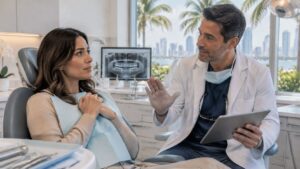
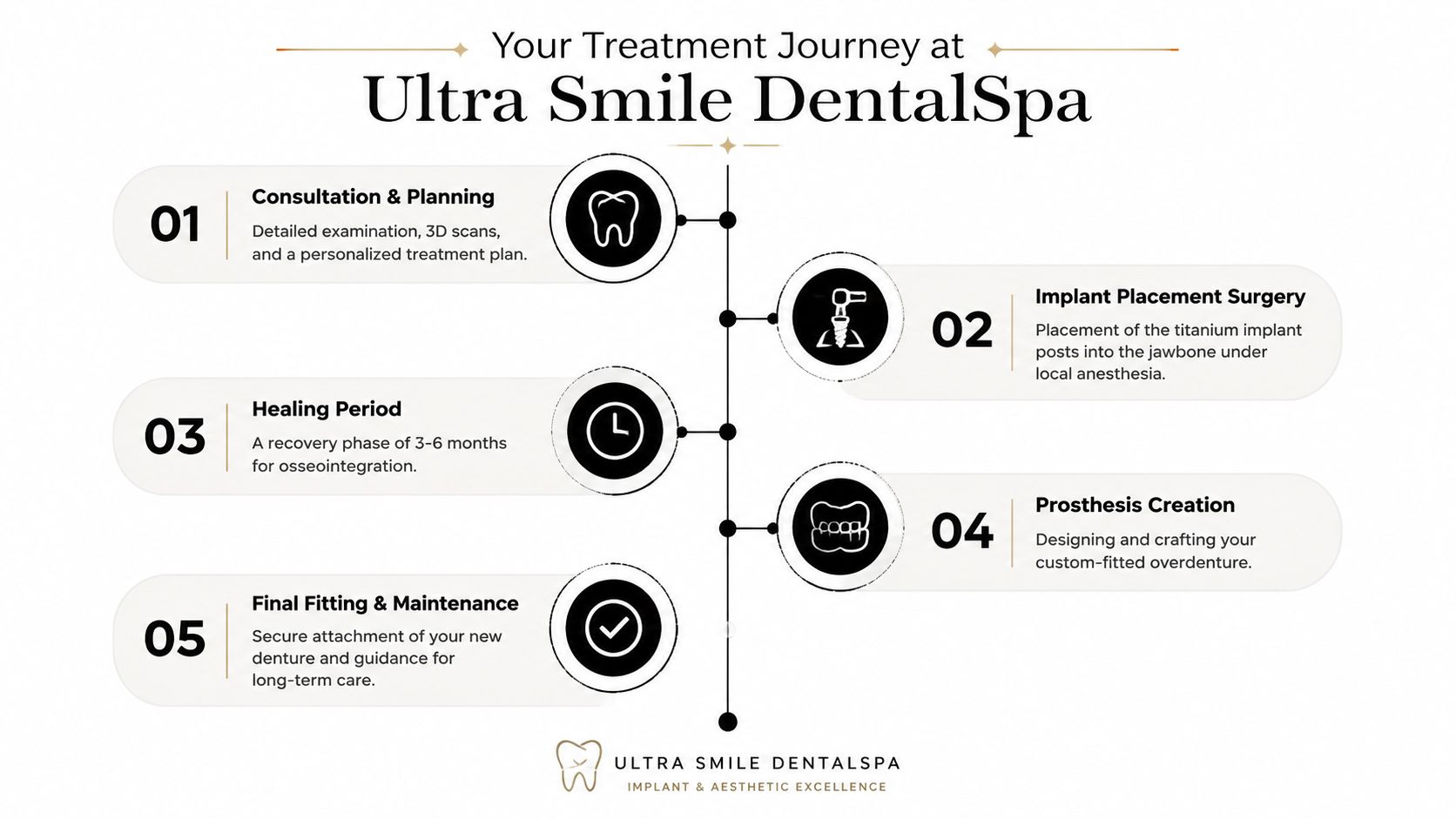
The first visit usually focuses on records, imaging, and treatment planning. That's where the team decides whether extractions, grafting, or a staged approach is needed. If surgery is appropriate, the implants are placed into the jaw, then the mouth is given time to heal.
The healing phase is where osseointegration happens. For many patients, that period is the part that requires the most patience, because the implants need time to fuse securely with the bone. Ultra Smile DentalSpa's own implant healing timeline gives patients a useful framework for what that recovery phase can look like.
What patients notice at each visit
The office experience matters here, especially for people who dislike clinical settings. Ultra Smile DentalSpa adds custom aromatherapy, streaming entertainment, and a hot towel finish, which helps turn a surgical workflow into something more comfortable and predictable. That comfort doesn't change the biology, but it does change how the day feels.
The step-by-step flow is usually easy to follow:
- Consultation and planning, with scans and a custom treatment path.
- Implant placement, where the posts are surgically positioned.
- Healing, so the bone can integrate around the implants.
- Abutment and prosthesis work, where the connector pieces and denture are created.
- Final fitting, with bite adjustments and care instructions.
The role of the temporary phase
Some patients wear a temporary restoration while healing happens. That interim phase helps keep the smile functional while the final denture is being prepared. It's not the end product, but it does bridge the gap in a practical way.
Benefits and Realistic Expectations for Implant-Supported Dentures
A patient sits in the chair after years of worrying about loose dentures, and the first thing they usually want to know is simple, will this stay put when they talk or eat. Stability is the biggest benefit of implant-supported dentures. Patients stop treating their dentures as something that might move at the wrong moment, and that can change how they eat, speak, and feel in social settings. The question is where implants make the biggest difference, and where marketing can go too far.
What improves most
For full-arch lower cases, implant support tends to improve function and patient satisfaction in a meaningful way. A systematic review and meta-analysis found implant-supported removable partial dentures had a significant quality-of-life difference, with a mean difference of 30.5 ± 1.8 and a 95% confidence interval of 24.9 to 36.1, along with a significant patient-satisfaction difference of −20.8 ± 0.2 (95% CI −23.7 to −17.8), both favoring implant-supported treatment (review and meta-analysis). Another review of randomized controlled trials reported that general satisfaction was more positive with implant overdentures than with conventional dentures, with an effect size of 0.80 across six RCTs (review and meta-analysis).
Clinical takeaway: the biggest gains are usually stability, confidence, and easier day-to-day use, not dramatic improvements on every chewing test for every patient.
Long-term durability data support the approach. A 20-year follow-up in frail elderly patients reported a 92.5% implant survival rate, with 8 of 106 implants lost over two decades (long-term clinical follow-up). That kind of result matters because it shows the implants themselves can hold up well over time, even when the patient population is medically complex. The prosthesis still needs planning, fit checks, and routine attention.
What needs a reality check
Partial-denture cases deserve more careful expectations. A PubMed review found that high-level evidence for improved masticatory performance over conventional dentures remains limited, and benefit in fixed implant-supported partial dentures for Kennedy Class I/II mandibles was not significant in experimental studies (PubMed review). That does not make implants a poor choice. It means the chewing gain may be smaller than some patients hope, especially when they compare partial-denture options and expect a complete change in bite force.
Maintenance also matters. Implant-supported removable prostheses can still develop mechanical or biological issues, including loosening, mucositis, and retention wear, so they are not set-and-forget devices (systematic review). Patients do best when they treat maintenance as part of the treatment, not something to deal with later if a problem shows up.
For the patient in a Miami practice, the honest message is straightforward. Implant-supported dentures can give you a steadier bite, a calmer daily routine, and a cleaner fit than many people have had for years. They do not guarantee full chewing power in every partial-denture case, and they still ask for upkeep, hygiene, and periodic checks. That trade-off is usually worthwhile when the goal is a restoration that feels secure, looks natural, and fits real life.
Understanding Costs and Financing Options in Miami
Cost is usually the hardest part of the conversation because there isn't a single number that fits every case. The price changes with the number of implants, whether the denture is fixed or removable, whether extractions are needed, and whether grafting has to be done first. That's why comparing implant-supported dentures to conventional dentures only on sticker price can be misleading.
What drives the investment
A full-arch case with more implants, more planning, and a fixed design will generally require a larger investment than a simpler removable attachment setup. Bone grafting, extraction work, and temporary prostheses can also affect the total. The most honest way to think about it is that the treatment includes surgery, hardware, laboratory design, and follow-up, not just a set of replacement teeth.
Why the value is different
Conventional dentures can look less expensive up front, but they often need relines, adjustments, adhesive, and eventual replacement. Implant-supported dentures spread their value across function, comfort, and durability. The long-term question is not only “What does it cost today? but also “What keeps this patient from having to start over again later?
A patient comparing options should ask what the restoration is likely to require over time, not just what the first appointment costs.
For Miami patients, financing may include dental insurance benefits where applicable, payment plans, or third-party financing. Ultra Smile DentalSpa also works with patients who need a more manageable path to treatment, which matters for people balancing family, work, and oral health decisions at the same time. That kind of flexibility can make a big treatment feel less overwhelming.
The cleanest next step is usually a consult with records, because a treatment plan built on the actual mouth is the only way to get a serious estimate.
Long-Term Care and Your Next Steps with Ultra Smile DentalSpa
The patients who do best with implant-supported dentures are the ones who keep them clean and show up for follow-up visits. Daily care is direct, but it matters. Food debris, plaque, and inflammation around the implants can create trouble if they are ignored, even when the restoration itself feels solid.
What maintenance looks like
Removable designs should be cleaned carefully every day, along with the surrounding gums and implant attachments. Fixed designs need brushing and cleaning under and around the prosthesis, plus professional checks to make sure the bite and the hardware stay stable. If you notice loosening, gum inflammation, or a change in fit, report it early rather than waiting.
The long-term data are encouraging, but they do not replace maintenance. Clinical reports show strong implant survival over extended follow-up, including the 92.5% figure from the 20-year mandibular follow-up and the ITI survival figures noted earlier, as noted in the long-term data above. That level of durability is real, and it still depends on care.
What makes the Miami visit feel different
Ultra Smile DentalSpa combines implant planning with a spa-like environment, bilingual communication, and a team led by Dr. Neda Bahmadi. Patients who feel tense about oral surgery often respond well to a setting that stays calm without losing clinical precision. For many people, that makes the first consultation easier to handle.
The practical goal is simple, a stable smile, a treatment plan that fits the mouth, and follow-up that keeps the result working. Implant-supported dentures can do a great job improving retention, stability, and comfort. They do not solve every chewing problem a partial denture can create, especially in complex bite situations, so the treatment plan should be discussed from the start. For patients searching emergency dentist, tooth extraction, dental implants near me, or a cosmetic dentist near me in Miami, the most useful next step is a consultation with imaging and a direct conversation about options.
If slipping dentures, sore gums, or chewing trouble have been wearing on daily life, Ultra Smile DentalSpa can help map out a steadier solution with implants, extractions, bone grafting, and custom restorative planning. Schedule a consultation at Ultra Smile DentalSpa to review candidacy, discuss options, and take the first step toward a steadier smile in Miami.