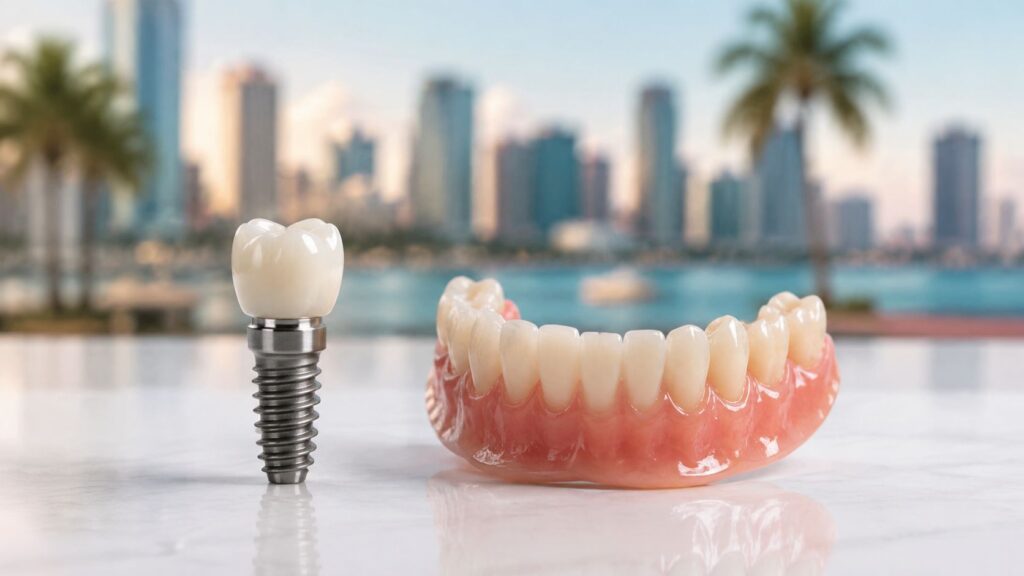
Missing teeth change daily life fast. Meals feel harder to enjoy, speech can feel less steady, and smiling in photos can start to feel like work. For many people looking for a dentist in Miami, FL, the primary question isn't just how to replace teeth, it's how to do it in a way that still feels natural years from now.
At Ultra Smile DentalSpa, patients often ask about dental implants vs dentures because they want a solution that fits both their health and their lifestyle. Some want a fixed option that feels secure at dinner in Brickell or Coconut Grove. Others want a simpler, lower-upfront path that still restores appearance and function. The right answer depends on bone health, maintenance, comfort, and what kind of long-term commitment makes sense for the patient.
| Feature | Dental Implants | Dentures |
|---|---|---|
| How they stay in place | Fixed in the jaw | Removable |
| Eating and speaking | More stable | Can shift or need adjustment |
| Bone support | Helps maintain jawbone | Does not replace the tooth root |
| Upfront cost | Higher | Lower |
| Long-term value | Often stronger over time | Often needs replacement and upkeep |
For many Miami patients, the decision comes down to lifestyle as much as dentistry. A solution that looks good but feels loose at brunch, needs frequent repairs, or causes embarrassment during conversations can wear on confidence. A solution that supports the jaw and stays steady can feel more like getting life back, not just teeth.
Table of Contents
- Your Guide to a Complete Smile in Miami FL
- Understanding Your Tooth Replacement Options
- The Core Differences Functional and Lifestyle Impact
- Candidacy and Procedure What to Expect in Miami
- Long-Term Care and Total Cost of Ownership
- Your Experience at Ultra Smile DentalSpa
- Making the Right Choice for Your Health and Smile
- Frequently Asked Questions About Implants and Dentures
Your Guide to a Complete Smile in Miami FL
Missing teeth affect more than appearance. They can change the way food breaks down, alter how the jaw feels when chewing, and make simple social moments feel more stressful than they should. In a city where work lunches, family dinners, and active weekends are part of everyday life, the difference between a removable appliance and a fixed restoration can show up in very ordinary moments.
Dental implants and dentures both replace missing teeth, but they solve the problem in different ways. An implant is designed to function like a new root, while a denture sits above the gums and replaces visible teeth without anchoring to the jaw in the same way. That basic difference shapes almost everything else, from comfort to maintenance.
At Ultra Smile DentalSpa, the conversation starts with the patient's goals. Some people want the most natural-feeling replacement possible. Others need a quicker, less invasive approach, or they're comparing options after an extraction, broken tooth, or long period with missing teeth. The right recommendation depends on what the mouth can support today and what the patient wants life to feel like next year, not just next week.
Practical rule: A good tooth replacement plan should improve chewing, confidence, and day-to-day ease, not just fill space in a smile.
For patients searching for a cosmetic dentist near me or asking about restorative dentistry, this choice often sits at the center of the treatment plan. Some cases may also involve tooth extraction, bone grafting, or even emergency care first, especially when a tooth is badly damaged. The sooner the issue is evaluated, the more options usually stay on the table.
Understanding Your Tooth Replacement Options
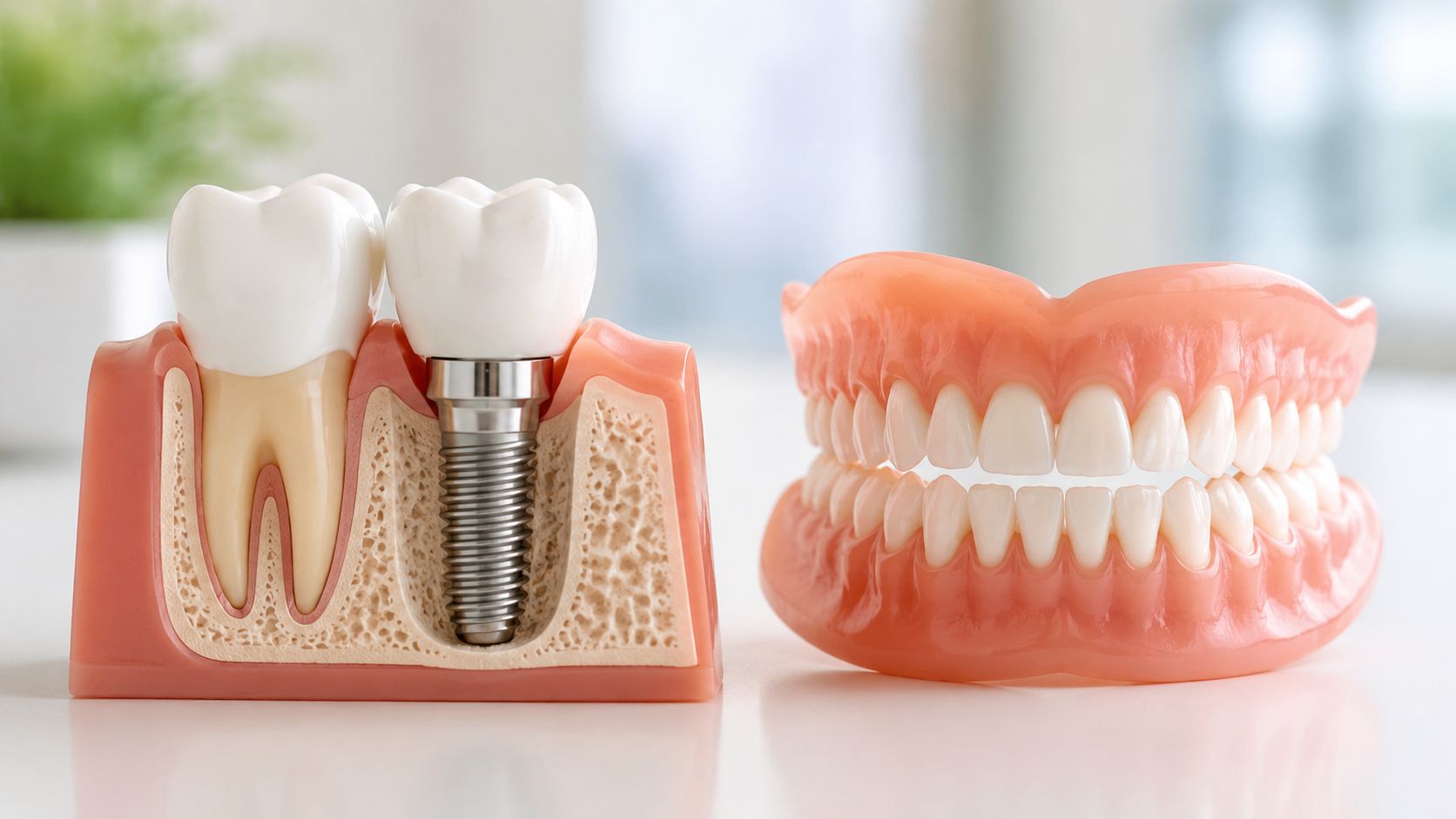
A dental implant is a small post placed into the jawbone, where it serves as an artificial tooth root. After healing, it can support a crown, bridge, or full-arch restoration. The most important thing to understand is that the implant is meant to anchor the replacement to the bone, which is why it tends to feel more stable once everything has healed.
A denture is different. It is a removable prosthetic that rests on the gums and holds artificial teeth in place. Some dentures replace all teeth in an arch, while partial dentures fill a section where a few teeth are missing. Because they're removable, they can be easier to start with, but they also require the patient to live around the device in a more active way.
Full, partial, single, and multiple options
The category matters. A single missing tooth may be replaced with a single implant, while several missing teeth can sometimes be restored with a bridge supported by implants. Dentures can be made for one arch or both, and some patients move into implant-retained overdentures when they want more stability than a traditional removable prosthesis provides.
The choice isn't only about how many teeth are missing. It's also about bone support, gum health, and how much wear the patient expects from the restoration. Someone who eats out often in Miami and wants fewer daily compromises may lean one way. Someone who needs a simpler start may lean the other.
A prosthetic that matches the patient's habits will usually age better than one chosen only because it was cheaper on day one.
When the mouth is evaluated carefully, the decision becomes less confusing. That's the point of a structured consultation, photos, digital imaging, and a plan built around the patient's actual anatomy, not a generic solution.
The Core Differences Functional and Lifestyle Impact

For most patients, the biggest difference is not how the teeth look in a mirror. It's how they behave during the day. Dental implants stay fixed, so chewing and speaking usually feel more natural once healing is complete. Dentures can restore appearance well, but they may require the patient to adapt to movement, adhesives, or more cautious eating.
Eating and speaking
A stable bite changes what people feel comfortable ordering at a restaurant, especially when foods are firmer or require more chewing. Implants generally give a more secure base for the bite, while dentures can shift or feel less dependable under pressure. That matters when the goal is to eat without thinking about whether the teeth might move.
Speaking is similar. Clear speech depends on predictable positioning, and a restoration that stays put tends to feel easier day after day. Dentures can take a period of adjustment, and some wearers become very good at adapting, but that learning curve is real.
Comfort, confidence, and the jawbone
Comfort goes beyond pressure points. A fixed option often feels more like part of the mouth, while a removable one may feel bulkier or more present. The emotional side matters too, because many patients don't want to worry about slipping, clicking, or removing teeth in public.
A major clinical difference is jawbone support. A review summarized in the provided evidence found 95.1% success for single-implant restorations at 60 months, compared with 84.0% for fixed partial dentures over the same period, and long-term observational data showed mean implant survival of 94.6% after 13.4 years of follow-up, with success at 89.7% (systematic review and long-term implant data). That kind of durability is one reason implants are often viewed as a long-term restorative choice rather than a cosmetic patch.
The same broad comparison often includes a standard workflow. A patient first completes an exam, then imaging and candidacy assessment, then treatment planning, followed by placement or impression work depending on the restoration. That process is built to reduce guesswork and to match the chosen option to the amount of bone and support available.
Candidacy and Procedure What to Expect in Miami
The first question is usually whether the mouth can support the plan the patient wants. Dental implants depend on enough jawbone and healthy tissues to heal well, while dentures depend more on the shape of the gums and how well the prosthesis can be made to fit. If a patient has waited a long time after tooth loss, the anatomy may have changed enough to alter the treatment path.
At a Miami consultation, the exam usually starts with a review of symptoms, medical history, and a look at the current bite. Digital X-rays or 3D imaging help show where bone is available and where additional treatment might be needed. For implant candidates, that imaging matters because placement has to respect both function and anatomy.
How the pathway usually differs
Implant treatment typically includes planning, surgical placement, healing, and then restoration. Denture treatment usually focuses on impressions, bite records, fitting, and adjustments until the appliance sits as comfortably as possible. Both require follow-up, but the type of follow-up is different.
A key point is that this choice can change over time. Patients who begin with dentures may later face issues as bone and gum shapes shift, sometimes requiring relines, future bone grafting, or a switch to implant-retained options if bone volume becomes inadequate (Oral-B on implants vs dentures). That's why a current exam matters more than an old recommendation copied from years ago.
For patients exploring dental implants near me, this is also where recovery planning comes in. Healing time, oral hygiene, and the timing of final restoration all shape the experience. A patient who wants to understand healing milestones in more detail can review the implant healing timeline as part of the treatment conversation.
Good planning prevents a lot of frustration later. When the bone, gums, and bite are assessed up front, the final result is usually easier to live with.
Long-Term Care and Total Cost of Ownership

The lowest quote on paper is not always the least expensive path over time. A single implant is often cited at roughly $3,000 to $6,000 upfront, while dentures are commonly $1,500 to $4,000 for a full set, but dentures typically need replacement every 5 to 7 years and annual adjustments or repairs can add cost (tooth replacement statistics). That's why the real comparison is the total cost of ownership, not the first bill.
What maintenance actually looks like
A patient with dentures usually has to plan for relines, adhesives, and periodic fit checks. A patient with implants still needs maintenance, but the daily routine is closer to caring for natural teeth. That difference affects not just money, but time, convenience, and how many extra appointments show up on the calendar.
For a helpful denture-specific resource, Your ultimate denture care guide offers practical cleaning context that pairs well with a maintenance discussion. Patients considering removable prosthetics also benefit from reading how to care for your partials and dentures so they understand the day-to-day commitment before they choose.
Why lifetime value matters in Miami
Busy adults rarely want a treatment that becomes a recurring project. They want to know what will still make sense after a few summers, a few travel seasons, and a few changes in the mouth. That's where implants often stand out, because properly maintained implants are commonly reported to last far longer than dentures, which face replacement cycles and fit changes over time.
The best way to think about this is simple. Dentures may cost less today. Implants may cost less over the years when maintenance, replacement, and hassle are counted together.
Your Experience at Ultra Smile DentalSpa
A lot of patients don't need more information, they need a setting that makes treatment feel manageable. At Ultra Smile DentalSpa, the appointment experience is built around comfort, privacy, and precise planning, so patients can focus on the decision instead of the anxiety around it. That matters for anyone who has delayed care because the idea of a dental visit felt overwhelming.
The environment is designed to feel calmer than a typical office visit. Patients are welcomed with refreshments, custom aromatherapy, streaming entertainment during procedures, and a soothing hot towel finish. Those details won't change the biology of implants or dentures, but they can change how a patient feels about showing up, asking questions, and completing treatment.
The clinical side still leads the way. Dr. Neda Bahmadi's approach centers on personalized treatment planning, modern technology, and careful attention to fit, function, and aesthetics. For patients comparing dental implants vs dentures, that combination matters because the same restoration can feel very different depending on how well it's designed and delivered.
The practical takeaway is straightforward. A patient who wants maximum stability, bone support, and a more natural day-to-day feel may be leaning toward implants. A patient who wants a less invasive start or lower upfront cost may be better served by dentures or an implant-retained option. The best choice is the one that matches the mouth, the budget, and the lifestyle, not the option that sounds nicest in theory.
For patients in Downtown Miami, Midtown Miami, or Hallandale Beach, that local conversation can be the difference between a short-term fix and a solution that feels right for years.
Making the Right Choice for Your Health and Smile
There's no single answer that fits every patient. Implant-retained overdentures can improve quality of life and satisfaction compared with conventional dentures, which is useful for patients who want more stability but still prefer a removable solution (implant-retained overdenture outcomes). Traditional dentures can still make sense when the priority is a simpler start, fewer surgical steps, or a lower upfront commitment.
The decision gets easier when it's framed around daily life. If the top concerns are chewing confidence, long-term bone support, and a fixed feel, implants usually deserve serious consideration. If the immediate goal is to replace missing teeth quickly and keep the early investment lower, dentures may be the more practical starting point.
A helpful way to narrow the choice is to ask three direct questions:
- How important is fixed stability? If slipping, adhesives, or removal would be frustrating, implants or implant-retained options often fit better.
- What can the jaw support today? Bone volume and gum health shape the treatment path, and those factors can change over time.
- What does maintenance look like in real life? Some patients want a solution that blends into daily routines, while others are comfortable with more regular upkeep.
For readers interested in the bigger picture, how oral health affects systemic health is a useful reminder that the mouth doesn't operate in isolation. Oral function, comfort, and hygiene all feed into overall well-being.
If missing teeth are making it harder to eat, smile, or speak with confidence, the next step is a personalized exam at Ultra Smile DentalSpa in Miami. A careful evaluation can show whether implants, dentures, or a hybrid approach makes the most sense for your goals and your health.
Frequently Asked Questions About Implants and Dentures
Do dentures or implants last longer?
Implants generally last longer with proper care, while dentures usually need replacement over time. The practical issue is not only longevity, but how much maintenance each option demands along the way.
Can someone switch from dentures to implants later?
Sometimes, yes. That depends on bone volume, gum health, and whether additional procedures such as bone grafting are needed. Waiting too long can make the transition more complex, which is why an exam matters early.
Are implants always the better choice?
No. Implants are often the stronger long-term solution, but dentures can still be appropriate when surgery, bone support, or budget are the main constraints. A good recommendation should match the person, not just the technology.
What if daily upkeep is a concern?
That's a fair concern. Dentures require ongoing cleaning, relines, and adhesives, while implants have a reported ~5% to 10% failure rate, so the better option depends on which maintenance burden fits the patient's lifestyle (maintenance burden comparison).
If missing teeth are affecting your comfort or confidence, schedule a consultation with Ultra Smile DentalSpa in Miami and get a treatment plan that fits your bite, your budget, and your long-term goals.