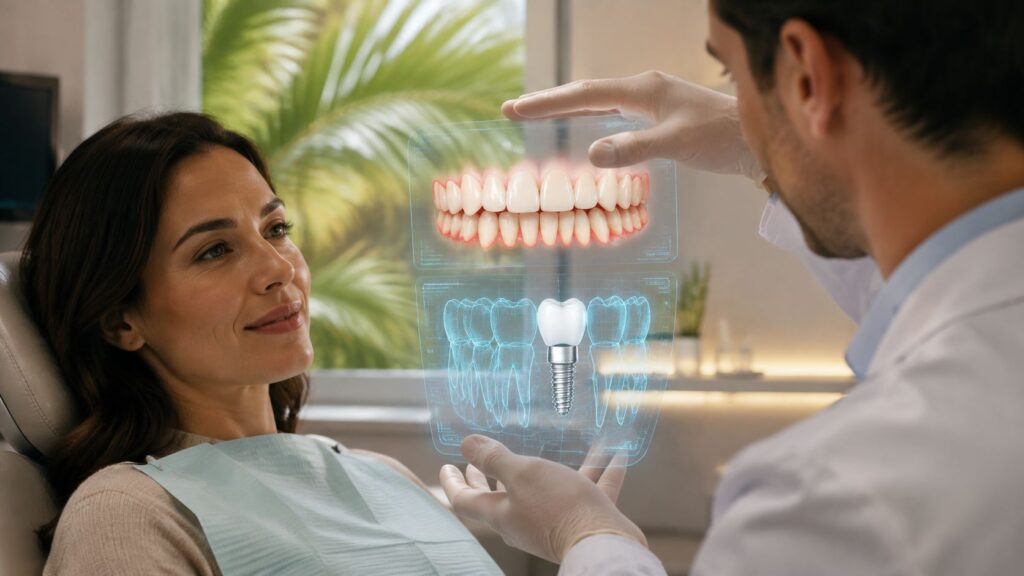
If teeth have been patched one by one for years, the problems can start to feel unrelated. A crown breaks, a filling wears down, a tooth goes missing, the bite shifts, and suddenly chewing feels different, the jaw feels tired, and smiling takes more effort than it should. For many adults looking for a dentist in Miami, FL, that is exactly when full mouth rehabilitation stops being a phrase and starts being the next practical step.
In a calm, spa-like office, this kind of care is not about chasing a prettier smile with random fixes. It is about rebuilding how the teeth, gums, jaw joints, and bite work together so the result feels stable in daily life. For patients searching for a dentist near me, cosmetic dentist near me, dental implants near me, or even help after a tooth extraction, the difference matters because the plan has to solve the whole pattern, not just the most visible tooth.
Table of Contents
- When One Tooth Is No Longer the Whole Problem
- What Full Mouth Rehabilitation Actually Means
- How the Diagnosis and Treatment Plan Come Together
- The Treatments Usually Combined in a Full-Arch Plan
- Realistic Timelines, Sedation Options, and What Recovery Feels Like
- Cost Factors, Insurance Realities, and Your First Visit in Miami
- Why Patients Choose Ultra Smile DentalSpa for This Level of Care
- Frequently Asked Questions About Full Mouth Rehabilitation
When One Tooth Is No Longer the Whole Problem
A lot of people arrive thinking they need one more repair. Then the exam shows a different story. The bite has changed, the front teeth are wearing faster, the back teeth aren't supporting the jaw evenly, and the old work no longer matches the rest of the mouth.
That's where full mouth rehabilitation earns its place. It treats the mouth as one connected system, not a list of unrelated fixes. For Miami adults dealing with worn enamel, missing teeth, jaw discomfort, or repeated dental emergencies, that bigger view often makes more sense than another isolated filling or crown.

Why the problem feels bigger than the damaged tooth
Teeth don't wear out in a vacuum. A high spot on one crown, a missing molar, or a hidden bite imbalance can push stress into other teeth and into the muscles that guide chewing. Over time, people notice they're avoiding certain foods, clenching more, or covering their smile because the wear has become obvious.
Practical rule: when several teeth look “individually fixable but the bite keeps changing, the right question isn't which tooth fails next. It's what pattern is driving the failures.
That is why adults in Miami often end up asking not just for restorative dentistry, but for a plan that also considers dental implants, same-day crowns, veneers, and sometimes emergency dentist care for the breakdown that finally brought them in. A coordinated approach can be far more predictable than piecemeal dentistry, especially when the issue is long-term wear, missing teeth, or old work that's started to fail.
For patients who feel like they've been “fixing the same mouth for years, this is usually the first time the whole picture gets addressed at once.
What Full Mouth Rehabilitation Actually Means
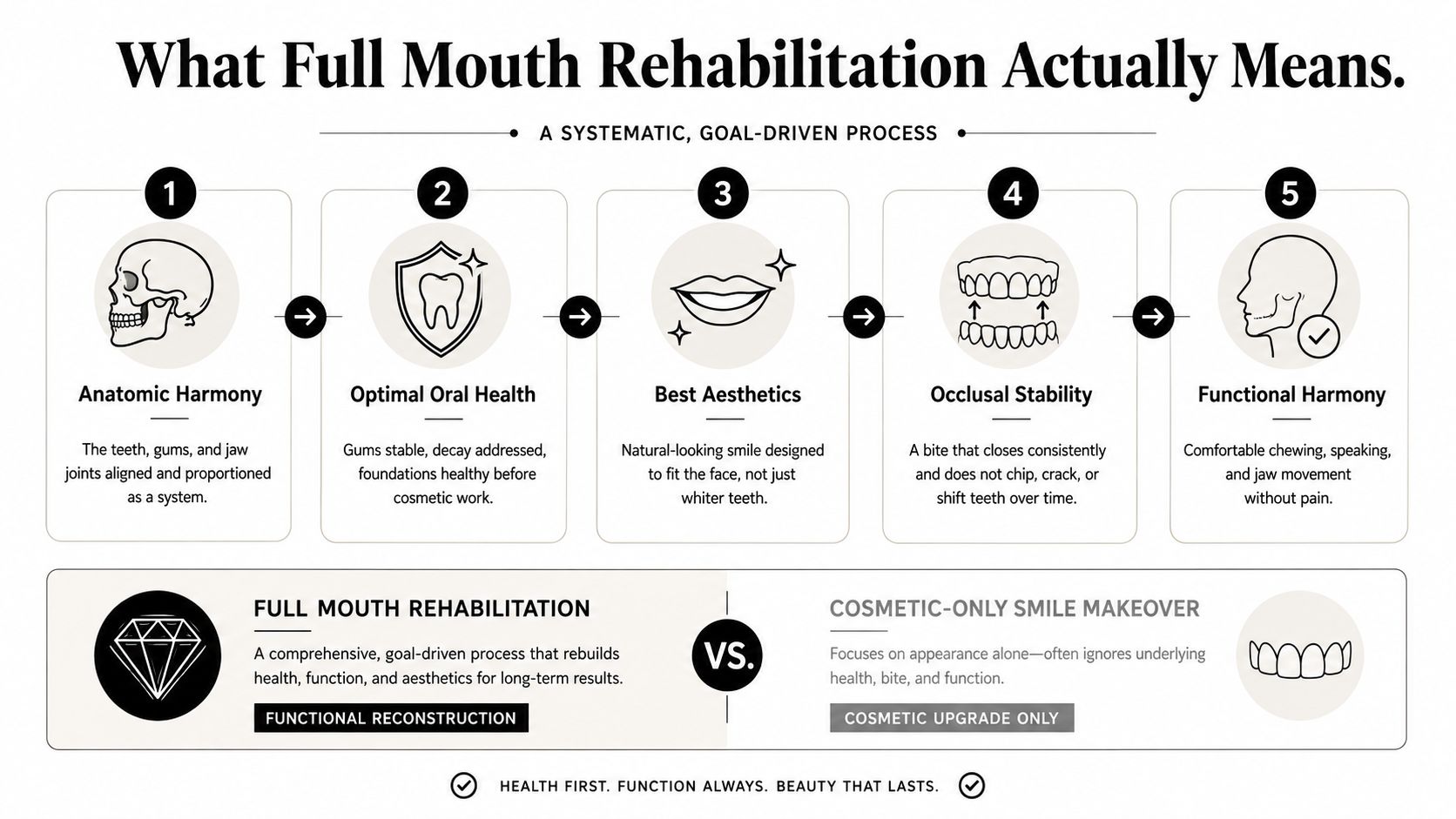
In plain English, full mouth rehabilitation is a planned reconstruction of the whole chewing system. It includes the teeth, gums, jaw joints, and bite, and it's designed to make those parts work together comfortably and predictably. That's very different from a simple cosmetic upgrade.
A smile makeover might focus on appearance, for example, whitening or veneers on selected front teeth. Full mouth rehabilitation goes further because it has to solve function first. The treatment has to be stable enough for eating, speaking, and long-term wear, not just photogenic for a day.
The five goals that make the definition real
The implant literature describes five goals that capture what this kind of care is meant to do, anatomic harmony, optimal oral health, best aesthetics, occlusal stability, and functional harmony. Those terms sound formal, but the patient version is straightforward.
- Anatomic harmony means the teeth, gums, and jaw joints fit together as a balanced system, not as isolated repairs.
- Optimal oral health means the gums are stable and the foundation is healthy before major rebuilding starts.
- Best aesthetics means the smile looks natural in the face, not just whiter in a mirror.
- Occlusal stability means the bite closes the same way over and over, without random chipping or shifting.
- Functional harmony means chewing, speaking, and jaw movement feel comfortable, not forced.
The goal is not to make every tooth look identical. The goal is to make the mouth work well enough that the smile can last.
That's why full mouth rehabilitation is usually multidisciplinary. A case may involve restorative dentistry, implant placement, periodontal therapy, orthodontic movement, or even root canals before the final restorations are placed. The plan has to be evidence-based, because the bite is the structure that carries everything else.
For adults exploring cosmetic dentistry in Miami, that distinction is important. Veneers alone can beautify healthy teeth. Full mouth rehabilitation rebuilds the system when the system itself has been worn down.
How the Diagnosis and Treatment Plan Come Together
The diagnostic visit is where predictable treatment starts. A clinician can't rebuild a bite without understanding how that bite is failing, so the records usually come first, then the plan, then the changes. Skipping that order is where patchwork dentistry tends to show up later.
The records that matter before anything is touched
A thorough evaluation typically includes periodontal charting, digital x-rays, intraoral photos, models or digital scans, and a facebow-mounted bite analysis. Each record answers a different question. The gum chart shows what the foundation can support, the images show what's hidden, and the scans or models help the team see the mouth in three dimensions.
The key bite question is often the relationship between centric relation and maximum intercuspation. In patient terms, that means comparing the jaw's repeatable closing position with the way the teeth currently meet, then measuring any slide between them. If that slide is ignored, later restorations can inherit the same instability that caused the wear in the first place.
Clinical takeaway: the bite has to be mapped before it gets changed. Otherwise, the new work can copy the old problem.
Mounted casts, a diagnostic wax-up, and provisional restorations let the team test the proposed jaw position before final crowns or prosthetics are made. That trial phase matters because it turns a guess into a controlled rehearsal. It also gives the patient a chance to judge comfort, speech, and appearance before anything becomes permanent.
For readers comparing treatment approaches, this is also where a decision about dental implants versus dentures becomes much clearer. A detailed comparison of implants and dentures helps show why the plan has to start with the bite, not just the missing tooth.
Why this phase protects the final result
A mouth that's been worn for years often needs sequencing. Gums may need to be stabilized, decayed teeth may need treatment, and the future restoration shape has to be planned before a crown is prepared or an implant is placed. That order is what separates a true rehabilitation from a series of disconnected repairs.
Ultra Smile DentalSpa performs this planning in-house with modern digital and analog records, which helps keep the sequence consistent from diagnosis to final restorations.
The Treatments Usually Combined in a Full-Arch Plan
A full-arch plan rarely relies on one procedure alone. Most cases combine several treatments, chosen in a specific order so each step supports the next one. That sequencing is what keeps the final bite stable instead of forcing one restoration to compensate for another.
Common treatments and why they're sequenced
Crowns and bridges are often the backbone of the final reconstruction, especially when teeth are cracked, heavily restored, or worn. Same-day crowns can sometimes speed up that phase, but only when the tooth and bite are ready for it. Veneers are usually reserved for the front teeth when the goal includes refining shape and color without over-treating healthy structure.
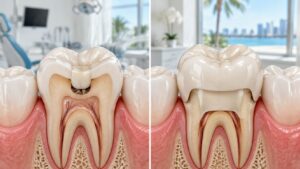
Missing teeth change the plan more dramatically. Dental implants may be used to replace absent roots, and bone grafts can be needed when the jawbone needs support before an implant can be placed. Teeth with active infection or severe nerve damage may need root canals first so the rest of the reconstruction isn't built on pain and inflammation.
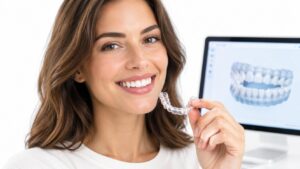
Orthodontic movement can also play a role. Clear aligners or limited tooth movement may be used to reposition teeth before the final restorations are made, especially when the bite has collapsed or the front teeth have drifted. Gum health comes first, though, because periodontal therapy has to stabilize the tissue before crowns, veneers, or implants can be finalized.
Why one office can make a long plan easier to live with
When all of these services are coordinated instead of handed off randomly, the patient doesn't have to retell the same story at every office. That matters in a long plan, because the final bite has to be built around one shared diagnostic vision.
Ultra Smile DentalSpa provides many of these services in-house across Downtown Miami, Midtown Miami, and Hallandale Beach, including general dentistry, cosmetic work, implant placement, Invisalign, wisdom teeth extraction, root canals, and injectables. For patients who want fewer handoffs during a complex case, that kind of coordination can simplify the whole process.
The logic behind the order
- Stabilize first: treat decay, infection, and gum disease before building on top of them.
- Reposition if needed: move teeth into a more workable bite before the final restorations.
- Replace missing support: place implants or bridges where the mouth has lost structure.
- Refine last: use veneers, crowns, and polishing steps to complete the appearance once function is steady.
That order is what makes the result feel like one plan instead of a collection of fixes.
Realistic Timelines, Sedation Options, and What Recovery Feels Like
Full mouth rehabilitation is not a same-week transformation in most cases. The timeline often stretches over several months or longer when implants, provisional testing, or tissue healing are part of the plan. That's not a delay, it's the treatment doing what it has to do.
What affects the timeline
Implants need time to integrate with the bone, provisional restorations need time to prove the new bite, and soft tissue needs time to settle around the final shapes. In full-mouth cases, that staging is one reason outcomes can stay durable rather than feeling rushed. The five-year prosthesis data showing 92% overall survival in a fixed dental prosthesis cohort, plus 15% technical complications and 12% biological complications, make that trade-off easy to understand, careful planning helps, but no complex reconstruction is completely free of maintenance issues. The same long-term study also reported 95% survival for zirconia-based prostheses and 88% for metal-ceramic prostheses, which is one reason material choice matters in longer cases.
Comfort during the process
Comfort options usually include local anesthesia, oral sedation, and IV sedation for longer surgical visits. The right choice depends on the number of procedures, anxiety level, and how much time the visit is expected to take. For patients who dread dental work, that planning can be as important as the restorations themselves.
Ultra Smile DentalSpa also uses a comfort-first setting, with refreshments on arrival, custom aromatherapy, streaming entertainment during procedures, and a soothing hot towel at the end of the visit. Those details don't replace clinical skill, but they can make long visits easier to tolerate.
What recovery typically feels like
A surgical visit can leave the area tender for a few days. Implant phases usually require a soft diet during healing, and provisional restorations can take a short adjustment period as the bite is fine-tuned. That adjustment is normal, because the whole point of the temporary phase is to test how the mouth responds before the final work is locked in.
This implant healing timeline resource is helpful for patients who want to see how those stages usually unfold. The important practical point is simple, long-term success depends on follow-up, not just the day the crowns go in.
Cost Factors, Insurance Realities, and Your First Visit in Miami
The cost of full mouth rehabilitation usually reflects how many parts of the mouth need rebuilding and how complex the sequence is. A single crown is one thing. A plan that includes implants, grafting, bite correction, and multiple final restorations is something else entirely.
What usually drives the cost
The main variables are straightforward. The number of teeth treated matters, as does the mix of implants versus natural-tooth restorations. Material choice also matters, especially when a case compares zirconia, metal-ceramic, or other restorative options, because the final plan has to balance strength, esthetics, and the bite.
Surgical support can add complexity too. Bone grafts, sinus lift planning, and sedation all affect the structure of the case. That is why two patients can both hear “full mouth rehabilitation and still receive very different financial estimates.
Insurance usually does not cover a full rehabilitation in full. Some portions may be accepted depending on the plan, but phased treatment and financing often make the larger plan more realistic. Ultra Smile DentalSpa accepts insurance and offers options for patients without coverage, which can help patients move forward without trying to solve everything at once.
What the first visit feels like
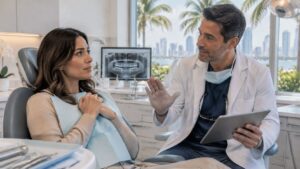
The first appointment is usually calm and structured rather than rushed. Paperwork comes first, then a detailed new patient exam with x-rays and photos, followed by a conversation about symptoms, goals, and timing. The clinical team then outlines a phased plan so the patient can see what comes first, what can wait, and how the bite will be rebuilt step by step.
Bilingual staff help make that conversation easier for Miami's diverse community, and complimentary yearly whitening is part of the new patient experience. Patients coming from Downtown Miami, Midtown Miami, and Hallandale Beach can expect the same planning process, with transparent discussion before treatment begins.
For someone comparing emergency dentist care, cleaning and exams, teeth whitening, and larger restorative treatment, that first visit is often where the path becomes clear.
Why Patients Choose Ultra Smile DentalSpa for This Level of Care
Full mouth rehabilitation demands current knowledge of occlusion, implants, and restorative materials. That's one reason Dr. Neda Bahmadi, DMD, matters in this conversation. Her ongoing education and active memberships in the ADA, FDA, SFDA, AACD, and AAFE support the kind of judgment these cases require.
What the practice brings to a complex case
The clinical side has to be precise, but the experience has to be tolerable too. Ultra Smile DentalSpa blends advanced dentistry with a spa-like environment that lowers the stress many adults feel when they know their treatment will take more than one visit. That combination can make it easier to commit to a long plan and complete it.
The convenience piece is just as important. Cleanings and exams, implants, Invisalign, veneers, same-day crowns, root canals, wisdom teeth extraction, and injectables like Botox can all be coordinated in one practice across three Miami locations. For patients who don't want to bounce between offices while managing a major restorative case, that coordination saves a lot of friction.
A complex bite plan goes better when the same team handles the records, the sequence, and the follow-up.
Miami patients also tend to value access. Bilingual staff, premium materials, modern technology, and a calm setting all help make a serious treatment plan feel less intimidating and more manageable. That matters when the goal isn't just a nicer smile, but a mouth that works better every day.
If a patient is looking for a local dentist in Miami, FL who can manage both the functional and cosmetic sides of reconstruction, this is the kind of practice to evaluate closely.
Frequently Asked Questions About Full Mouth Rehabilitation
Many patients ask whether they're even a candidate. The short answer is that people with widespread wear, missing teeth, repeated failures, bite changes, or jaw discomfort are often the ones who benefit most. Tooth wear becomes more common with age, and one review reported a rise from 3% at age 20 to 17% at age 70 in tooth wear prevalence, which helps explain why older adults often need more than isolated repairs. That epidemiologic review supports what many clinicians see in the chair every week.
Pain is another common concern. Most patients don't experience the treatment the way they fear it will feel, because local anesthesia, sedation options, and a gentle pace can make a big difference. Recovery still includes some tenderness after surgery and some adjustment with provisionals, but that's expected, not a sign that something went wrong.
Durability is where maintenance matters. The five-year FDP study showed 92% overall survival, with complications still possible, which is why night guards, hygiene, and regular follow-up remain part of the plan after the final restorations are placed. The implant literature also supports highly predictable outcomes over time, including up to 99% implant survival and up to 95% prosthetic survival after 10 years in All-on-Four protocols, but those numbers don't replace maintenance.
Patients also ask whether the treatment is cosmetic or functional. The honest answer is that it's both, but function comes first. A stable bite, comfortable chewing, and healthier support tissues are what let the smile look natural and last.
Insurance rarely covers the whole plan as a single line item, so phased treatment and financing usually matter. For someone who wants to know where a case falls on the spectrum between repair and full reconstruction, the next step is a consultation, not guesswork.
Ultra Smile DentalSpa in Miami combines diagnostic planning, restorative dentistry, implants, cosmetic care, and comfort-focused visits under one roof. If worn teeth, missing teeth, or bite discomfort have started to run your day, schedule a consultation at Ultra Smile DentalSpa and get a personalized plan built around your bite, your goals, and your timeline.