A lot of Miami patients start in the same place. They notice their smile in photos, on video calls, or during a night out in Brickell, and they know they want straighter teeth. What stops them isn't a lack of interest. It's the choice. Invisalign or braces sounds simple until real life gets involved.
For adults balancing work, social plans, travel, and comfort, the decision usually comes down to fit. Some people want the most discreet option possible. Others want something they don't have to remember to wear. Many want to know whether the cost gap is significant, or whether that assumption is outdated.
That's where a careful consultation matters. Patients looking for a dentist in Miami, FL, a cosmetic dentist near me, or even a practice for broader care like cleaning and exams, teeth whitening, restorative dentistry, or an emergency dentist visit often want one office that can look at the whole picture. A straighter smile is cosmetic, but it also affects cleaning, bite function, and long-term dental care.
Table of Contents
- Your Guide to a Straighter Smile in Miami
- How Braces and Invisalign Work to Transform Your Smile
- A Detailed Comparison of Invisalign vs Braces
- The True Cost of Orthodontic Treatment in Miami
- A Checklist for Choosing Your Best Option
- Your Orthodontic Journey at Ultra Smile DentalSpa Miami
- Frequently Asked Questions About Braces and Invisalign
Your Guide to a Straighter Smile in Miami
Miami patients rarely ask only one question. They're usually asking several at once. Will aligners be noticeable at work? Will braces feel uncomfortable during a busy week? Will treatment interfere with dinners out, meetings, or travel? Those concerns are valid, and they shape the right treatment choice just as much as the alignment issue itself.
A patient may feel confident in every area of life except when smiling. Another may have already had orthodontic treatment years ago and noticed shifting over time. Someone else may be planning cosmetic dentistry and realizes that straightening teeth first can improve the final result. The common thread is uncertainty about which system fits daily life.
Why the decision is more personal than it seems
Invisalign vs. braces isn't only a clinical question. It's also a lifestyle question.
A busy professional in Downtown Miami may care most about appearance during presentations and events. A patient with a packed schedule may prefer a system that doesn't rely on constant self-management. A person who values convenience with brushing and flossing may lean one way, while a person who wants the strongest control over difficult tooth movement may lean the other.
The right orthodontic plan should match both the bite and the person wearing it.
How smile goals connect to overall dental health
Straight teeth often make daily care easier. That matters because plaque tends to collect more easily around crowded or overlapping teeth. Better alignment can support long-term dental care, including new patient exams, dental x-rays, cosmetic planning, and restorative work.
For many adults searching for a dentist near me or a cosmetic dentist near me, orthodontic treatment also sits alongside other priorities, such as:
- Smile appearance: Straighter teeth can improve the final look of teeth whitening, bonding, or veneers.
- Cleaning access: Better alignment can make home care simpler.
- Future treatment planning: Orthodontics may support other care, including crowns, implants, or restorative dentistry.
In Miami, where appearance, confidence, and comfort often matter at the same time, patients usually do best when they get a treatment recommendation based on how they live their daily lives, not just on a generic list of pros and cons.
How Braces and Invisalign Work to Transform Your Smile
Braces and Invisalign both move teeth by applying steady pressure over time. The difference is how that pressure is delivered, and how much of the process depends on the appliance versus the patient.
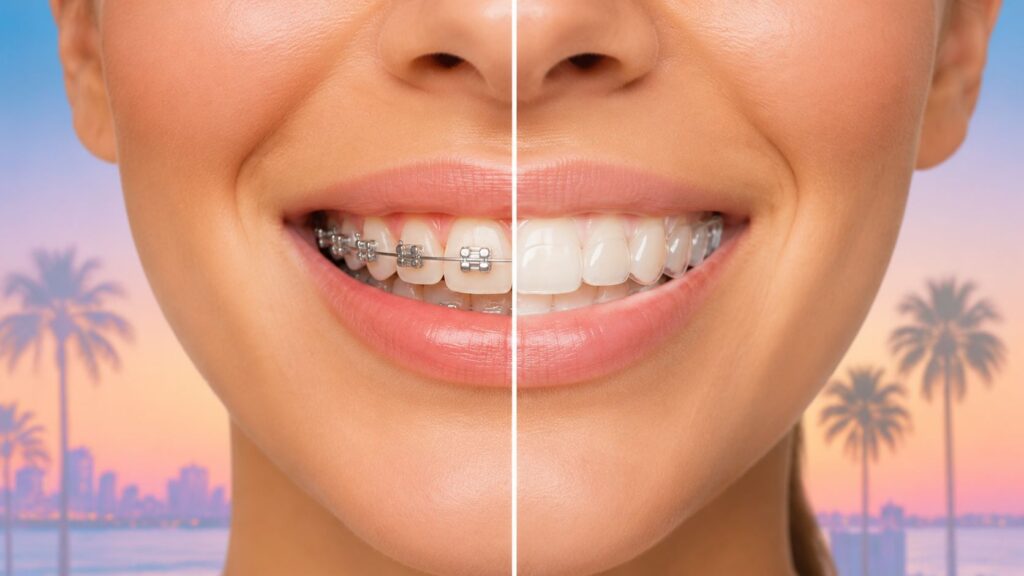
Traditional braces use brackets attached to the teeth and connected by wires. Those wires are adjusted to guide teeth into better positions. Because the system stays in place all day and all night, it keeps working whether the patient is at work, asleep, or out to dinner.
How braces move teeth
Braces act like a built-in guidance system. The brackets and wires work together to deliver continuous force, which is one reason braces remain a strong option for complex tooth movement and bite correction, as explained in this braces vs. Invisalign overview from Triad Orthodontics.
That fixed design has practical consequences:
- They don't rely on memory: The appliance is already on the teeth.
- They provide constant control: This helps with movements that need precision.
- They require office adjustments: The dentist or orthodontic provider changes the wire system as treatment progresses.
How Invisalign moves teeth
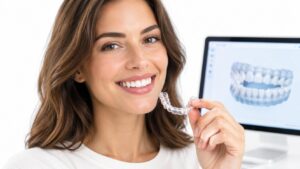
Invisalign uses a sequence of custom clear trays. Each tray is shaped to move teeth a little further than the one before it. Patients switch through the series as directed, and the teeth gradually shift.
The simplest way to think about aligners is this. Braces are like tracks fixed onto the teeth. Invisalign is like a series of custom-fitted guides, each one nudging the teeth forward in stages.
For patients interested in teeth straightening without braces, clear aligners can be appealing because they're removable and much less noticeable in day-to-day life.
Clinical reality: Invisalign can be very effective, but it works best when the treatment plan and the patient's habits are a good match.
Why understanding the mechanics matters
A patient who wants flexibility with meals and brushing may prefer clear aligners. A patient who wants a system that keeps working without daily decision-making may feel more comfortable with braces.
Neither option is automatically better. Each one solves a different kind of problem. The best recommendation depends on tooth movement, bite needs, appearance goals, and whether the patient wants freedom or structure during treatment.
A Detailed Comparison of Invisalign vs Braces
The practical differences show up fast once treatment starts. Appearance, convenience, comfort, cleaning, and scheduling all affect whether a patient feels good about the choice after the first week, not just on consultation day.
Quick Comparison Table
| Factor | Invisalign | Braces |
|---|---|---|
| Appearance | Clear and discreet | More visible |
| Removability | Removable for meals and brushing | Fixed on the teeth |
| Daily discipline | Requires consistent wear | Less dependent on patient habit |
| Comfort feel | Smooth trays | Brackets and wires can irritate cheeks early on |
| Oral hygiene | Easier to brush and floss normally | Cleaning takes more effort |
| Best fit | Often strong for mild to moderate cases | Often preferred for more complex control |

Aesthetics and Discretion
For many adults, this is the starting point. Invisalign is usually chosen because it blends into daily life more easily. In professional settings, social events, and photos, clear trays generally draw less attention than brackets and wires.
Braces are more visible. Some patients don't mind that at all, especially if they care more about reliability than appearance during treatment. Others know from the beginning that visibility will bother them, which makes aligners the more realistic fit.
Comfort and Daily Life
Invisalign trays are smooth, so they tend to avoid the rubbing sensation that brackets can cause inside the lips and cheeks. That said, aligners introduce a different kind of responsibility. They need to come out before meals and go back in afterward, which adds a routine to every day.
Braces remove that decision-making. They stay in place and keep working. The trade-off is that patients often need time to adjust to the feel of brackets and wires, especially in the early phase.
Aesthetics and comfort often point patients toward aligners. Control and consistency often point them toward braces.
Treatment Timeline and Appointments
A 2024 clinical analysis published in PMC found that Invisalign had a shorter mean treatment time than braces, 18 months versus 24 months, with similar high success rates of 88% for Invisalign and 90% for braces. That makes aligners especially appealing for mild-to-moderate cases where efficiency matters.
Still, shorter average treatment time doesn't mean every case will move faster in aligners. Some tooth movements respond more predictably to a fixed appliance. If a case needs detailed bite correction or stronger control, braces can still be the more dependable route.
Some patients choose speed. Others choose control. The right answer depends on which one their case actually allows.
Maintenance and Oral Hygiene
These advantages often sway many adults. Invisalign makes brushing and flossing much simpler because the trays come out. There are no wires to clean around, and meals don't come with the same food restrictions.
Braces require more effort. Home care is still manageable, but it takes patience and better technique to clean around brackets and wires thoroughly.
For patients already planning cosmetic dentistry, whitening, or broader dental care, oral hygiene during treatment matters. Treatment should improve a smile, not make daily maintenance harder than the patient can realistically manage.
The True Cost of Orthodontic Treatment in Miami
Cost matters, but it usually matters in a more nuanced way than patients expect. Many adults come in assuming clear aligners are dramatically more expensive. Current comparison data doesn't support that assumption.
What the current cost comparison actually shows
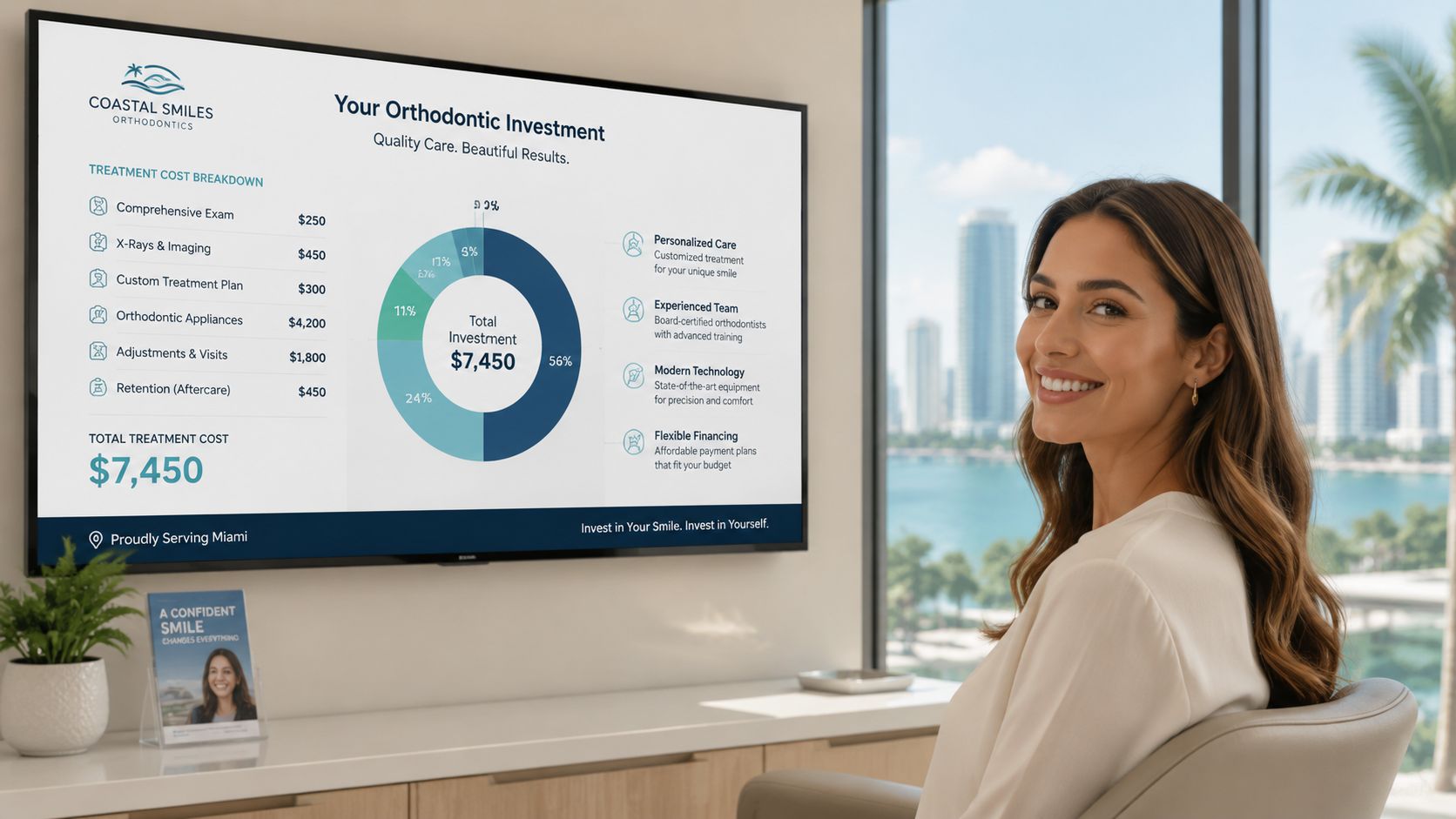
A recent comparison reported average costs of $6,121 for braces and $6,373 for Invisalign, a difference of $252, according to this cost and treatment comparison from Cruz Orthodontics. In that same dataset, braces averaged 24 months of treatment and Invisalign averaged 18 months.
That's an important shift in how patients should think about the decision. The gap isn't necessarily large enough to decide the issue by itself. For many Miami adults, the more meaningful question is whether they want the removability and appearance of aligners or the fixed consistency of braces.
What changes the final fee
The final treatment cost usually depends on the complexity of the case, not just the name of the system. A straightforward spacing issue may be handled very differently from a bite problem that needs more control.
Factors that commonly influence pricing include:
- Case complexity: More difficult tooth movement usually requires more planning and monitoring.
- Treatment length: Longer treatment can involve more visits and refinements.
- Combined dental needs: Some patients are also planning cosmetic or restorative work, which affects the overall treatment sequence.
What patients should ask before starting
A fee only makes sense when the patient understands what it covers. Before choosing between Invisalign and braces, patients should ask:
- What is included in the treatment plan
- Whether insurance applies
- How follow-up visits are handled
- What happens if the case needs additional adjustment
One practical option for patients comparing orthodontic care with other services is Ultra Smile DentalSpa, which provides Invisalign along with general, cosmetic, and restorative dental care in Miami. For patients who want to coordinate orthodontic treatment with cleanings and exams, whitening, crowns, implants, or future smile design, that broader scope can make planning simpler.
A Checklist for Choosing Your Best Option
Most indecision clears up once the choice is tied to daily behavior. The best appliance on paper won't feel like the best choice if it doesn't match the patient's schedule, habits, and priorities.
Choose Invisalign if these statements sound like you
A patient may lean toward Invisalign if appearance during treatment matters a lot. That's common for adults with client-facing work, frequent meetings, or an active social calendar in Miami.
A patient may also be a good fit if routines are already strong. Invisalign depends heavily on compliance. The trays need to be worn for 20 to 22 hours per day to stay effective, as explained in this orthodontic guidance on braces vs. Invisalign from Lee and Lee Orthodontics.
This option tends to make sense when several of these statements are true:
- Appearance matters daily: The patient wants a discreet treatment option for work or social life.
- Meals are predictable: The patient is comfortable removing trays before eating and putting them back in afterward.
- Home care is a priority: Brushing and flossing normally feels like a major advantage.
- Routine is reliable: The patient won't forget or delay wear time.
Practical rule: If someone doesn't want to think about the appliance all day, Invisalign may feel harder than expected.
For adults also dealing with spacing concerns, this guide on how to fix gaps between teeth can help frame whether aligners are part of the right solution.
Choose braces if these statements fit better
Braces often fit better when the patient wants less responsibility placed on daily discipline. They're also a strong option when the case needs stronger mechanical control.
A patient may be better suited for braces if any of these feel familiar:
- Consistency matters more than discretion: The patient wants treatment working at all times.
- Schedule is unpredictable: Meals, travel, or long workdays make aligner wear harder to maintain.
- Complex movement is expected: More demanding bite or tooth correction may need a fixed approach.
- Less self-management feels easier: The patient would rather not track wear time.
This isn't about willpower. It's about honesty. The right choice is the one a patient can realistically complete well.
Your Orthodontic Journey at Ultra Smile DentalSpa Miami
A consultation for Invisalign or braces shouldn't feel rushed or impersonal. For many adults, anxiety about the process is almost as important as anxiety about the smile itself. A calm setting changes that.

What the first visit feels like
Patients often arrive with a mix of cosmetic goals and practical concerns. They may want straighter teeth, but they also want to know how treatment affects comfort, speech, eating, work, and long-term dental care. A strong consultation addresses all of that, not just the alignment issue on a scan.
Dr. Neda Bahmadi and the team approach treatment planning with that broader view. The goal is to understand what the patient wants the smile to look like, how the bite functions now, and what daily life can realistically support.
How the process stays comfortable
The office environment matters more than many patients expect. A spa-like dental experience can reduce stress before treatment even begins.
Patients at the practice are welcomed with details designed to make care feel less clinical and more manageable, including:
- Custom aromatherapy: This helps create a calmer atmosphere from the start.
- Streaming entertainment: Patients can stay occupied during visits instead of focusing on the procedure.
- Hot towel finish: That final step helps the visit end on a more relaxed note.
Digital scanning also improves the experience. Instead of relying on messy traditional impressions, modern scans make planning cleaner and more comfortable.
Orthodontic treatment takes time. The visit experience should feel sustainable, not draining.
How treatment fits into broader dental care
Orthodontic care doesn't happen in isolation. Many patients also need preventive visits, cosmetic planning, or restorative treatment along the way. That can include dental care, whitening, crowns, implant planning, night guards, or even services such as tooth extraction when a larger treatment sequence calls for it.
That broader support matters for adults looking for a single dentist in Miami, FL who can coordinate both appearance and function. It also matters for patients who may need help outside orthodontics, whether that's an urgent visit with an emergency dentist or planning for future restorative work.
Frequently Asked Questions About Braces and Invisalign
Patients usually feel more confident once the smaller, practical questions are answered. Those questions often have less to do with marketing claims and more to do with what happens if treatment doesn't go exactly as planned.

Can someone switch from Invisalign to braces mid treatment
Yes, that can happen. A 2022 Scientific Reports study found that 17.2% of Invisalign patients switched to braces during treatment, and the average Invisalign case required 2.5 refinement scans. That doesn't mean Invisalign fails broadly. It means some cases need mid-course adjustment, especially when movement is more complex or wear habits are inconsistent.
That's one reason the initial evaluation matters. The more accurately a case is assessed at the start, the easier it is to choose the right system from day one.
What happens after treatment ends
Orthodontic treatment doesn't end the day the braces come off or the final aligner is finished. Teeth can shift after treatment, so retention matters. Patients should expect a plan to maintain the result.
The exact retention approach depends on the case and the provider's recommendation, but the key point is simple. Finishing active treatment is one milestone. Keeping the smile stable is the next one.
Is one option better for severe cases
In general, braces are often preferred when a case needs more continuous control or more difficult movement. Invisalign is often very attractive for mild to moderate alignment issues, especially when appearance and convenience matter.
That doesn't mean every severe case requires braces or every mild case should automatically use aligners. It means complexity changes what's predictable. A customized assessment is still the deciding factor.
Can adults still benefit from orthodontic treatment
Absolutely. Many adult patients seek care because they didn't have treatment earlier, lost a retainer years ago, or noticed shifting after previous dental work. Adult orthodontics is common, and the treatment choice often comes down to whether the patient wants discretion, structure, or a balance of both.
Adult patients usually do best when the plan respects real life. Work schedules, travel, confidence, and comfort all matter.
Patients comparing Invisalign and braces in Miami don't need a generic answer. They need a plan that fits their teeth, their schedule, and their comfort level. To explore orthodontic treatment with a calm, personalized approach, schedule a consultation with Ultra Smile DentalSpa.