A lot of adults in Miami reach the same point at the same time. They're doing video calls, meeting clients in Brickell, going out in Midtown, or attending events in Hallandale Beach, and they like almost everything about their smile except the way one or two details pull attention. A small gap. Front teeth that overlap. A bite that feels off in photos and even more obvious in person. They want change, but they don't want metal braces to become part of their work life or social life.
That's where teeth straightening without braces becomes a practical conversation, not just a cosmetic one. Some options move teeth, which changes alignment and bite. Other options change how teeth look, which can create the appearance of a straighter smile without repositioning anything. Knowing that difference early prevents disappointment later.
For adults, this isn't a fringe request anymore. More than 20% of orthodontic patients worldwide are over age 18, and more than 13 million people worldwide have used Invisalign according to this industry summary on Invisalign adoption and adult orthodontics. That level of adoption tells patients something important. Wanting a discreet solution is normal, and there are established ways to get there.
Table of Contents
- Your Introduction to a Straighter Smile in Miami
- Your Guide to Teeth Straightening Without Braces
- Comparing Your Non-Brace Options in Miami
- Are You a Candidate for Brace-Free Straightening
- The Dangers of DIY Aligners and Why a Dentist Matters
- Your Treatment Journey at Ultra Smile DentalSpa
- Benefits and Long-Term Success for Your Smile
Your Introduction to a Straighter Smile in Miami
For many adults looking for a cosmetic dentist near me or a dentist in Miami, FL, the question isn't whether straighter teeth would help. It's whether the process can fit daily life without becoming a constant hassle. Professionals often want improvement that looks polished, feels manageable, and doesn't interfere with meals, presentations, photos, or conversations.

Two different paths to a straighter-looking smile
There are two very different ways to approach teeth straightening without braces.
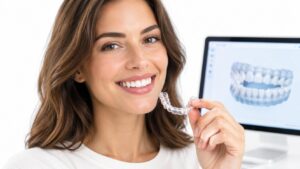
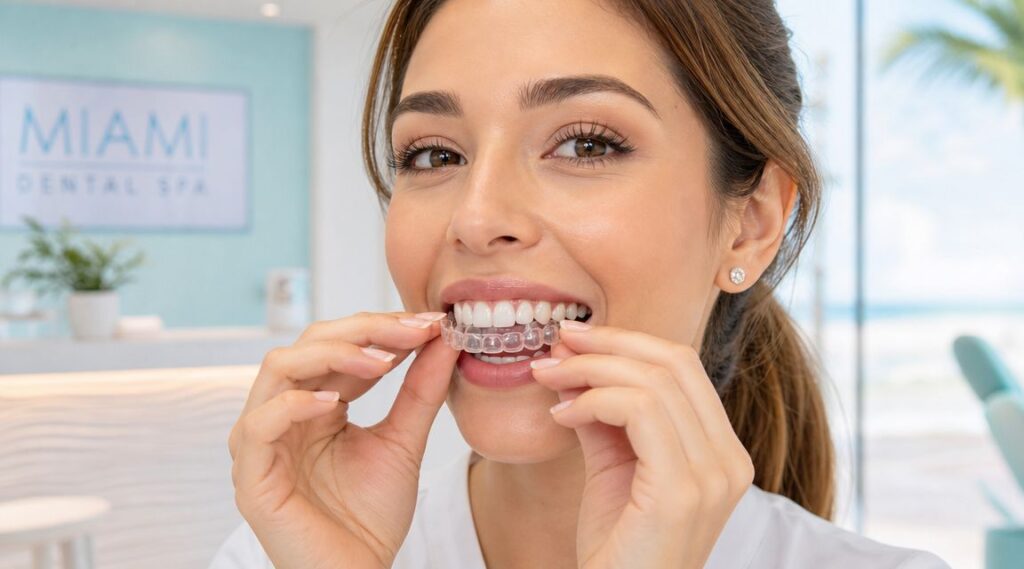
One path is orthodontic movement. This means using clear aligners to gradually reposition teeth. That approach changes alignment in a biologic way and can help with crowding, spacing, and some bite concerns.
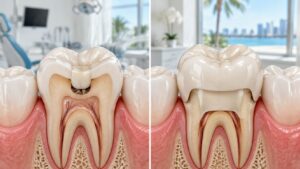
The other path is cosmetic masking. That includes treatments such as veneers or bonding. Those options can make teeth appear straighter by reshaping the visible surface, but they don't physically move teeth.
Practical rule: If the problem is mostly position and bite, the solution usually needs movement. If the problem is mostly shape, symmetry, or a tiny visible gap, a cosmetic solution may be enough.
Adults in Miami often come in thinking they need Invisalign when they may be better served by bonding or veneers. Others assume veneers can solve crowding when what they really need is controlled tooth movement first. That distinction matters because it affects comfort, timeline, maintenance, and the final result.
Why discreet treatment has become so common
Discreet smile correction isn't unusual anymore. As noted earlier, adults now make up a meaningful share of orthodontic patients, and aligners have been used by millions worldwide. That shift reflects how modern patients think. They want treatment that respects professional image, personal comfort, and social confidence.
In a market like Miami, where appearance and presentation matter, that lifestyle fit is often the deciding factor. A treatment can be clinically sound and still be the wrong choice if it doesn't match the patient's routine.
That's why a thoughtful consultation matters more than trends. Patients looking for dental care, cosmetic dentistry, cleaning and exams, or even related services like teeth whitening and restorative dentistry often need the same thing first. A clear answer about what will work, what won't, and what daily commitment the result will require.
Your Guide to Teeth Straightening Without Braces
The easiest way to understand non-brace options is to separate them by purpose. Some treatments are designed to straighten teeth. Others are designed to make teeth look straighter. Those aren't the same outcome.
Quick comparison at a glance
| Feature | Invisalign (Clear Aligners) | Porcelain Veneers | Dental Bonding |
|---|---|---|---|
| Main purpose | Moves teeth into better alignment | Improves the appearance of tooth shape and visible alignment | Reshapes teeth to improve appearance |
| Changes tooth position | Yes | No | No |
| Best for | Crowding, gaps, and some bite concerns | Cosmetic concerns, shape issues, minor visible unevenness | Small gaps, chips, mild shape asymmetry |
| Removable | Yes | No | No |
| Bite correction potential | Can help in appropriate cases | Limited | Limited |
What clear aligners actually do
Clear aligners work through biologic tooth movement. They apply controlled pressure over time to shift teeth and address both crown and root position. That's why they belong in the orthodontic category, even though they look simple from the outside.
By contrast, veneers and bonding don't move teeth at all. According to this explanation of aligners, veneers, and bonding for straighter-looking teeth, aligners create real tooth movement, while veneers and bonding reshape or cover the visible tooth surface to create the illusion of straightness. That makes veneers and bonding useful in the right case, but not interchangeable with orthodontic treatment.
What veneers and bonding do well
Veneers can be a strong option when a patient wants to improve multiple cosmetic details at once. Shape, color, proportion, and minor visual unevenness can all be addressed together. That's why veneers are often part of smile makeover planning in cosmetic dentistry.
Bonding is more conservative in many situations. It can close a small gap, improve symmetry, or soften a chipped or irregular edge. For patients searching for a dentist near me because one tooth bothers them every time they smile, bonding can be a simple answer.
A smile can look straighter without becoming orthodontically straighter. That's sometimes the right outcome, but only when function and bite are already stable.
The real decision point
The first question isn't, “Which treatment is better? It's, “What is the problem that needs solving?
If a patient has moderate crowding, visible overlap, or bite interference, cosmetic camouflage alone may leave the underlying issue untouched. If the concern is a small gap, one undersized tooth, or minor edge irregularity, full orthodontic treatment may be more than the case requires.
That's why the best treatment plans don't start with a product. They start with diagnosis, dental x-rays when needed, a bite evaluation, and a realistic conversation about goals.
Comparing Your Non-Brace Options in Miami
Patients usually choose between non-brace options based on two things. First, what their teeth clinically need. Second, what their lifestyle realistically allows. Those are not always aligned, and that's where careful planning matters.
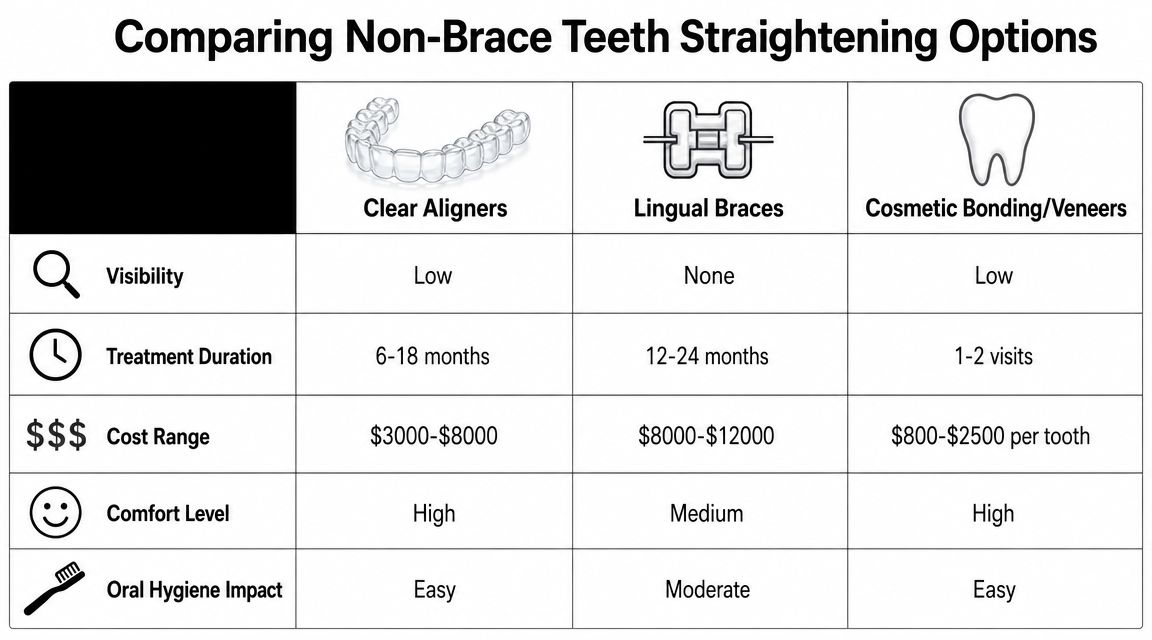
Comparing Teeth Straightening Options Without Braces
| Feature | Invisalign (Clear Aligners) | Porcelain Veneers | Dental Bonding |
|---|---|---|---|
| Core goal | True tooth movement | Cosmetic transformation of visible surfaces | Cosmetic reshaping for smaller concerns |
| Best match | Mild to moderate alignment and selected bite concerns | Patients who want shape and smile design changes | Patients with localized cosmetic concerns |
| Daily commitment | High, because trays must be worn consistently | Low after placement, with normal oral care | Low after placement, with attention to staining and wear |
| Reversibility | Generally more conservative than restorative masking | Irreversible enamel-altering procedure in many cases | Conservative in many cases, but material may need maintenance |
| Social visibility | Very discreet | Final result is immediate after treatment | Usually subtle and natural-looking |
| Hygiene considerations | Removed for brushing and flossing | Normal brushing, flossing, and maintenance visits | Normal brushing, flossing, and maintenance visits |
Clinical fit matters first
A patient with crowding, spacing, or certain bite issues may be a better fit for aligners because the problem is positional. The goal there isn't just a nicer photo. It's moving teeth into a healthier, more stable arrangement.
A patient with one small gap, a short tooth, or a visible shape mismatch may be a stronger candidate for bonding or veneers. In those cases, masking the issue can be efficient and appropriate because there may not be a true orthodontic problem to solve.
Candidacy becomes clearer when broken into categories:
- Position problems: crowding, spacing, overlap, and some bite concerns usually point toward aligners.
- Surface problems: chips, peg laterals, uneven edges, and minor visible asymmetry often point toward bonding or veneers.
- Mixed cases: some smiles need both. Teeth are aligned first, then cosmetic refinements complete the result.
Lifestyle fit matters just as much
Aligners appeal to busy adults because they're removable and discreet. That flexibility is helpful, but it also creates responsibility. If someone regularly snacks through the day, forgets appliances easily, or doesn't want to remove trays for coffee, dining, and cleaning, the convenience can become the main obstacle.
Veneers and bonding ask less of the patient day to day once treatment is complete. The trade-off is that they don't deliver true orthodontic correction. Veneers also involve a restorative decision that should be made carefully, especially when a patient's real issue is alignment rather than appearance alone.
The right choice is the one a patient can actually complete and maintain, not the one that sounds most appealing at the consultation.
A practical Miami decision guide
Many professionals in Downtown Miami and nearby neighborhoods care about visibility during treatment. In that respect, aligners often fit better than fixed appliances. Patients who want more context on timing for simpler cases can review how long clear aligners may take for mild cases.
At the same time, someone preparing for a major event, branding shoot, or public-facing role may prefer the immediate cosmetic change of veneers or selective bonding if the case allows it. That doesn't make one option more sophisticated than another. It means the treatment has to match the timeline, the biology, and the patient's real priorities.
Are You a Candidate for Brace-Free Straightening
A patient may look like a great aligner candidate in photos and still be a poor fit in real life. In Miami, that comes up often with professionals who are in meetings all day, attend business dinners, travel often, or want a treatment option that stays discreet without becoming another daily chore.
Candidacy starts with two questions. Can the teeth be moved predictably without braces, and will the patient follow the routine well enough to get the result?
The clinical side of candidacy
Clear aligners work well for many adults with mild to moderate crowding, spacing, and certain bite concerns. They can be an excellent option when the tooth movements are controlled and the bite can be corrected without the extra force or precision that fixed braces sometimes provide.
They are not the right answer for every case.
A patient with significant bite imbalance, complex rotations, limited bone support, active gum disease, or tooth positions that require more difficult movement may need braces or a staged plan that combines orthodontic and cosmetic treatment. That is why candidacy should never be based on a scan alone. It requires a full exam, a bite analysis, and a clear understanding of what the teeth and supporting structures can tolerate safely.
The lifestyle side of candidacy
Daily habits matter as much as tooth position. The American Association of Orthodontists explains in its patient guidance that aligners are typically changed about weekly and must be worn for most of the day, including about 22 hours daily, to stay on track, as described in its patient information on aligner wear and compliance.
For many patients, the question is not whether aligners look appealing. It is whether aligners fit the way they live.
Several patterns tend to predict success:
- Structured workdays: patients with set meal times and consistent routines often do well.
- Minimal all-day snacking: fewer interruptions usually mean better wear time.
- Comfort removing trays in public: that matters for client lunches, dates, events, and office settings.
- Good follow-through: the best cosmetic result still depends on consistent use.
Other patterns call for a more careful conversation:
- Frequent coffee, cocktail, or sparkling water sipping: trays come out often, and wear time drops.
- Constant travel or unpredictable schedules: missed hours add up quickly.
- Public-facing roles with nonstop speaking or dining: some patients do not want the interruption, even if the trays are discreet.
In practice, lifestyle and treatment planning meet. A young attorney, realtor, founder, or media professional may care less about the technology itself and more about whether treatment will interfere with networking, presentations, dining out, or an upcoming event calendar. That is a valid concern. The best option is the one that works clinically and fits daily life well enough to be completed.
When caution matters most
Borderline cases need more judgment, not less. If aligners are only a partial fit for the bite or the patient's habits are inconsistent from the start, the margin for error gets smaller.
Health still comes first. Gum condition, bone support, existing dental work, tooth shape, and bite contacts all affect whether brace-free straightening is appropriate and whether the result will hold up.
Patients searching for a cosmetic dentist near me or a dentist in Miami, FL often begin with appearance. That is understandable. A good plan still has to respect biology, function, and the realities of daily wear. If those pieces line up, brace-free straightening can be a polished, low-visibility solution that suits both the smile and the life around it.
The Dangers of DIY Aligners and Why a Dentist Matters
A patient decides to skip the office visit because the remote option looks easier. No scheduling around work. No in-person records. No detailed bite check. Just impressions or scans, trays in the mail, and the promise of a straighter smile with less effort.
That convenience is exactly where the risk begins.
What can be missed without an exam
The American Association of Orthodontists has warned that remote orthodontic treatment can miss important health issues. A peer-reviewed study also found that direct-to-consumer aligners were associated with adverse events including pain and bite problems, which is why the AAO warning and related discussion on remote orthodontic risks emphasize in-person diagnostics such as X-rays and a full bite evaluation.
A tray can move teeth. It can't diagnose gum disease, root position, bone support, or hidden problems that affect whether movement should happen at all.
Why supervision changes the outcome
A properly supervised case starts with more than a scan. It includes a close look at dental health, existing restorations, gum condition, bite relationship, and the direction each tooth needs to move. During treatment, follow-up visits matter because teeth don't always behave exactly as planned on a screen.
That's especially important when a patient is also considering other services such as restorative dentistry, crowns, veneers, or even treatment for an emergency dentist concern that may need to be resolved first. Straightening should happen inside a full diagnosis, not beside it.
Remote convenience can feel efficient at the start. Fixing a damaged bite later is rarely efficient.
What a safer visit looks like
In a Miami dental office, the appointment is usually calm and straightforward. The patient checks in, reviews goals, gets examined, and has imaging taken if needed. The dentist studies whether the concern is alignment, cosmetic shape, or a combination of both.
That process doesn't just protect teeth. It protects expectations. Some patients learn they're excellent aligner candidates. Others find out that bonding, veneers, or another restorative approach will solve the concern more directly and with less burden.
Your Treatment Journey at Ultra Smile DentalSpa
Once a patient decides to pursue teeth straightening without braces, the process should feel organized and easy to follow. The treatment itself may be advanced, but the experience shouldn't feel confusing.
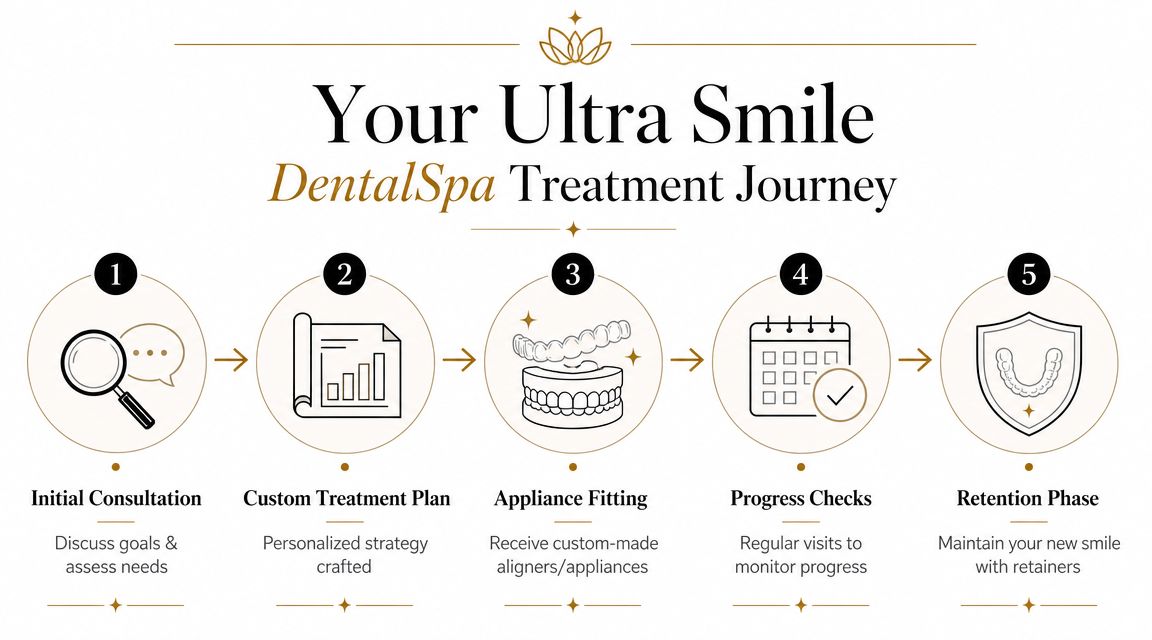
Step one begins with diagnosis
The first visit focuses on what the patient wants to change and what the mouth can support safely. That usually includes a conversation about smile goals, an exam, and records such as scans or dental x-rays when needed. For some patients, the answer is aligners. For others, cosmetic dentistry or restorative dentistry may be the more sensible choice.
At this stage, one practical option in Miami is Ultra Smile DentalSpa's invisible braces care, which centers on removable aligners for adults who want orthodontic movement without traditional brackets.
The plan should fit the patient, not just the teeth
A good treatment plan accounts for more than crowding or spacing. It also considers work demands, travel frequency, eating habits, and how disciplined the patient can be with removable trays. A plan that looks elegant clinically but clashes with daily life tends to unravel.
This is also the point where related needs are identified. Some patients need cleaning and exams before cosmetic work. Others may need restorative dentistry first, especially if there are damaged teeth, old restorations, or active issues that should be stabilized before movement begins.
Progress is usually simple to maintain
Once aligners or another selected treatment begins, follow-up visits help confirm that everything is tracking correctly. Those visits are where small corrections happen before they become larger setbacks. They also give the patient a chance to ask about comfort, wear habits, and cleaning routines.
A typical journey often includes:
- Consultation and records to assess goals, bite, and oral health.
- Custom planning based on movement needs or cosmetic targets.
- Delivery of treatment with clear instructions for use and care.
- Periodic reviews to make sure progress matches the plan.
- Retention to protect the result after active treatment ends.
The final result isn't created on the day treatment starts. It's created by the combination of diagnosis, consistent follow-up, and retention after the teeth look good.
Long-term thinking starts early
The strongest plans connect immediate appearance with long-term maintenance. Straightening can make oral hygiene easier because crowded areas are often harder to clean. A more balanced bite may also make the smile feel more natural, not just look more polished.
That's why the end of treatment isn't really the end. It's the start of protecting the result with retainers, routine dental care, and regular monitoring.
Benefits and Long-Term Success for Your Smile
You finish a work presentation in Brickell, smile for a quick photo afterward, and do not think about your teeth at all. For many adults, that kind of ease is the ultimate payoff of straightening. The result is not only a better-looking smile. It is more comfort in conversation, more confidence in social settings, and fewer areas where crowded teeth make brushing and flossing frustrating.

Why patients often prefer aligners
For many Miami professionals, clear aligners fit daily life better than brackets and wires. They are discreet in meetings, removable for dinners and events, and usually easier to manage if appearance is part of your work. That lifestyle advantage matters, but candidacy still comes first. Aligners tend to work best when the tooth movement needed matches what removable trays can control predictably and when the patient is willing to wear them as directed.
Clinical research also supports their appeal. In this comparative study of clear aligners and conventional braces, both approaches produced meaningful improvement, while aligner patients reported higher satisfaction, less discomfort, and slightly shorter treatment times. In practice, that often translates into a treatment experience adults are more willing to stick with.
The trade-off is simple. Aligners offer convenience only if they are worn consistently.
Protecting the result after treatment
Long-term success depends on what happens after the teeth are straight. Teeth can shift back if retention is inconsistent, especially in the first phase after active treatment. Patients who keep their results usually do a few basic things well and do them regularly:
- Wear retainers as instructed: this keeps the teeth from drifting after treatment ends.
- Stay current with cleanings and exams: regular visits help us monitor stability, gum health, and areas that are harder to maintain.
- Get dental x-rays when needed: imaging helps evaluate changes that are not visible in a mirror.
- Plan cosmetic finishing at the right time: whitening, bonding, or other refinements often look better once the teeth have fully settled.
For patients considering what a finished cosmetic result can look like, this short American Academy of Cosmetic Dentistry video gives a visual overview of smile enhancement goals and the kind of natural-looking improvement many adults want.
A straighter smile should still feel like your smile
The best result fits your face, your bite, and your routine. In my experience, adults are happiest when their smile looks refreshed without looking treated. That is especially true for patients with public-facing careers, frequent social commitments, or cosmetic goals that overlap with restorative needs.
For adults in Miami looking for a local dentist who can assess cosmetic concerns, restorative needs, and long-term options such as dental implants, the starting point is the same. The smile needs a precise diagnosis and a plan that respects both appearance and oral health.
If a smile feels close but not quite right, a personalized consultation can clarify whether aligners, bonding, veneers, or another approach makes the most sense. Patients considering teeth straightening without braces in Miami can explore treatment options and request an appointment through Ultra Smile DentalSpa.