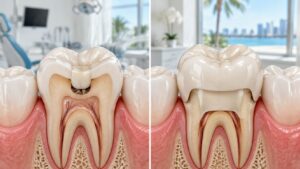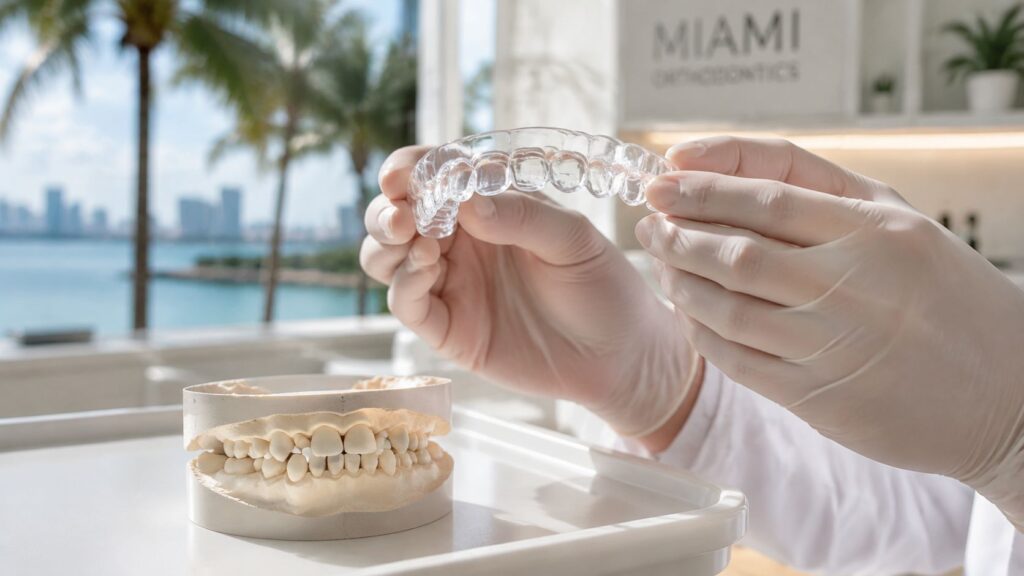
If crowded lower front teeth have started showing up in selfies, in an elevator mirror, or while brushing at night, that's usually the point when the question turns from “Can this be fixed? to “What works? In Miami, adults ask that all the time, and the honest answer is that crowded teeth are usually fixed by creating space, then moving teeth into that space with the right appliance, not by forcing a one-device solution.
For a dentist in Miami, FL, that means the first step is a measured diagnosis, not a sales pitch. The amount of missing arch space, the bite, the health of the gums, and the way the teeth fit together all shape whether a case is mild, moderate, or severe. In practice, that difference matters because a small space deficit may respond to interproximal reduction, while larger crowding can need expansion, braces, or tooth extraction to make the result stable.
Table of Contents
- What Crowded Teeth Look Like and Why It Matters
- How a Dentist in Miami Diagnoses Crowded Teeth
- Treatment Options That Match Your Level of Crowding
- Invisalign, Braces, Veneers, or Surgery Compared
- What to Expect at Ultra Smile DentalSpa in Miami
- Recovery, Retention, and Keeping Your Teeth Straight
- Common Questions Miami Patients Ask About Crowded Teeth
What Crowded Teeth Look Like and Why It Matters
A lot of Miami adults notice crowding in a very ordinary moment, standing in a Brickell elevator or looking at a photo and realizing the lower front teeth have started to overlap. It rarely starts as a dramatic problem. More often, it begins as one tooth turning slightly, then another following the path of least resistance until the front teeth look tighter and harder to clean.
Crowding is a space problem, not just a cosmetic one
Dentists define crowding by the amount of space the arch is missing, not by how “crooked the teeth look in a mirror. The evidence base commonly treats mild crowding as less than 4 mm, moderate as 4 to 8 mm, and severe as more than 8 mm (Cochrane review on crowded teeth). That matters because the treatment has to match the shortage of space, not just the visible overlap.
Crowded teeth can make brushing and flossing harder, especially around the lower front teeth where plaque likes to collect. They can also throw off bite balance, which is why some patients describe jaw soreness or a tired feeling when chewing. The problem is practical, not cosmetic only, and the more crowded the arch gets, the less forgiving it becomes.
Practical rule: If a toothbrush can't reach the tight contacts between teeth, the crowding is already affecting hygiene, not just appearance.
Why the pattern often worsens over time
Crowding can stay subtle for years, then become more obvious as teeth shift, retainers are lost, or the bite changes. Adults often assume the teeth will settle on their own, but that usually isn't how arch space works. Once teeth are packed tightly, the teeth don't create room by themselves.
The historical shift in orthodontics has been toward space-based planning, because the jaw has to be managed as a whole. That's why a good dentist near me search should lead to a provider who measures the arch, checks the bite, and discusses whether the case is manageable with aligners alone or needs a more structural plan. For patients seeking cosmetic dentistry or restorative dentistry, the primary goal is a mouth that's easier to clean, easier to maintain, and less likely to relapse.
How a Dentist in Miami Diagnoses Crowded Teeth
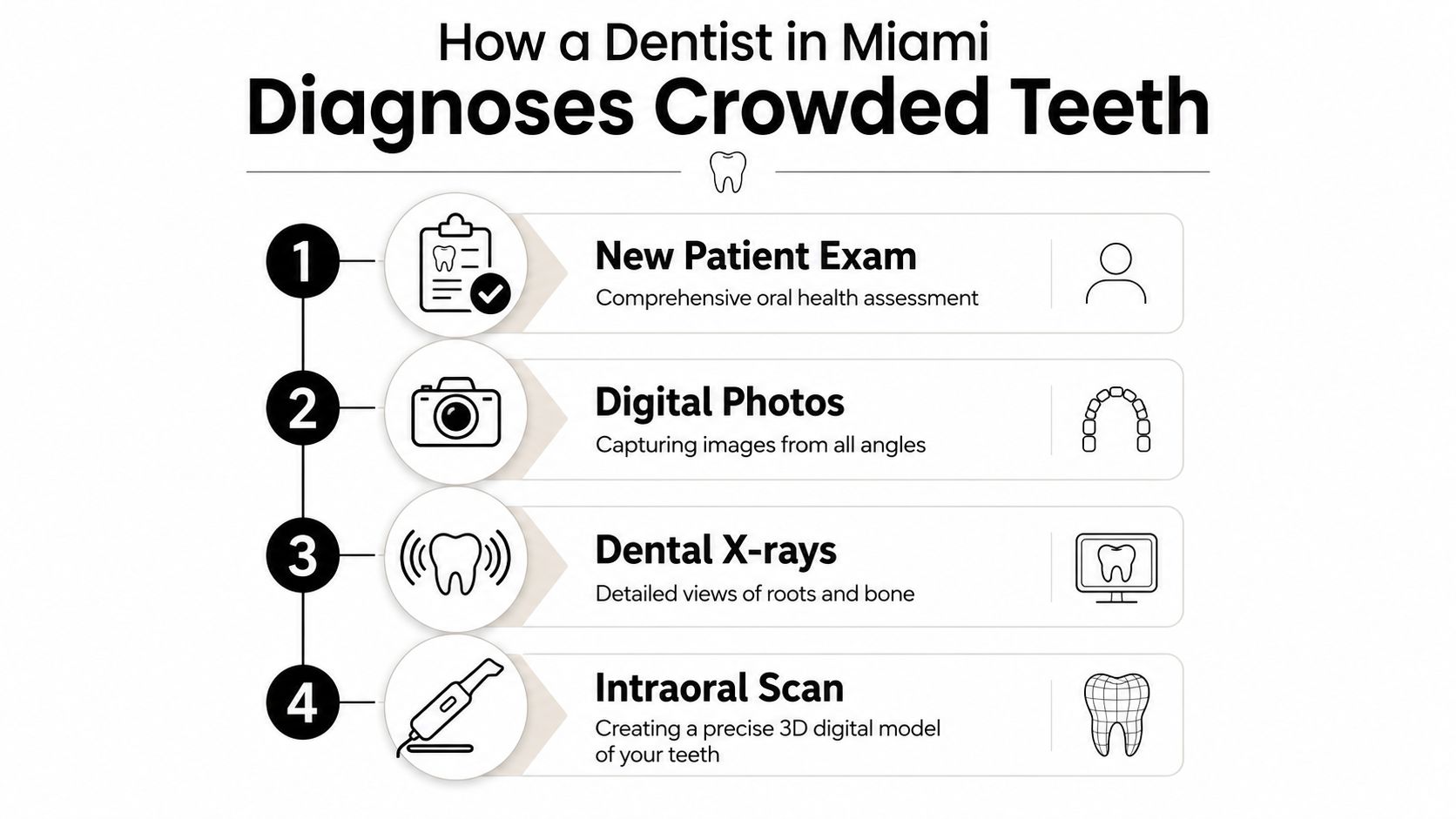
A solid diagnosis starts with records, not assumptions. In a new patient exam, the dentist checks the teeth, gums, bite, and any areas where plaque is collecting. Then the office usually adds digital photos, dental X-rays, and an intraoral scan so the arch can be measured rather than guessed at.
What the records show
The photos document the visible overlap, while the scan and X-rays show what's happening underneath. That includes root position, available arch length, and whether the teeth can be moved safely without creating new problems. In crowded cases, the diagnosis comes down to a millimeter-based space analysis, because treatment planning depends on the exact shortage of room.
That shortage is what guides the next step. Mild crowding may only need a small amount of space recovery, moderate crowding often needs more deliberate room-making, and severe crowding may require a plan that changes the arch more substantially. I see patients who arrive expecting aligners alone, then learn the arch does not have enough room for that approach without compromising stability. Others do well with conservative reshaping or slight expansion, but only if the bite and root positions support it.
The patient does not need to interpret every measurement, but it helps to know what the dentist is deciding between. One path creates a little space with enamel reduction or minor reshaping. Another opens room by expanding or moving the arch. The last path reduces tooth mass or tooth count through extraction.
A quick checklist for the appointment
A productive visit feels easier when the patient comes prepared.
- Bring your history: Prior orthodontic treatment, past extractions, and whether retainers were worn or lost.
- Share your goal: Some patients want the fastest cosmetic improvement, while others want the most stable bite correction.
- Ask about the space deficit: The key question is how many millimeters of crowding are present.
- Ask what would happen if treatment is delayed: That helps frame urgency without pressure.
- Ask whether the plan is cosmetic, orthodontic, or both: The answer usually changes the treatment path.
Good diagnosis is visible on the chart and translates to a clear treatment plan. When the records are complete, the plan becomes much clearer, and the patient can compare options with real confidence.
For adults searching for an emergency dentist because a tooth has shifted, or for families looking for a tooth extraction opinion tied to orthodontic planning, the conversation should start here. The right answer comes from the data gathered at the visit, not from a one-size-fits-all guess.
Treatment Options That Match Your Level of Crowding
A crowded smile does not start with a treatment menu. It starts with a space problem. In chairside planning, the question is simple, how much room is missing, and how far do we need to go to create it? Mild cases can often be managed with small space gains. Moderate cases usually need more active movement. Severe cases may need extraction-based planning or expansion that is carefully chosen for the bite and arch shape.

Mild crowding usually starts with space recovery
For mild crowding, the first step is often to make a small amount of room with interproximal reduction, or IPR, then align the teeth with braces or clear aligners. A recent peer-reviewed review describes mild cases as often treated with stripping, while moderate crowding may need stripping or selective extraction, and severe crowding may need extraction of one or more teeth (PMC review on crowding treatment). In teaching material, IPR is often done in very small increments, around 0.5 mm per tooth, while preserving roughly 0.6 mm of margin thickness where possible.
That small space can be enough to ease overlap in the front teeth without removing healthy teeth. I use that approach when the crowding is limited and the bite still has room to be organized predictably. Once the shortage becomes larger than enamel reduction can safely solve, the plan has to change.
Moderate to severe cases need bigger moves
For moderate to severe crowding, the sequence is usually to measure the space deficit, decide whether to increase arch perimeter or decrease tooth mass or count, then finish with alignment and retention. A scoping review lists the main space-recovery methods as arch perimeter increment, reduction in mesiodistal tooth width, and serial extractions (PMC review on crowding treatment). In practice, that can mean expansion, proclination, distalization, IPR, or extraction as part of one plan.
The trade-off is stability. Expansion can preserve teeth, but it has to fit the biology of the case. Extraction creates more space, but it is a bigger decision and it needs orthodontic planning from the start. When crowding is severe, braces often give the control needed to finish the case predictably. For patients comparing appliance choices, this overview of Invisalign versus braces helps explain why one case can work with aligners alone while another needs more control.
Wisdom teeth are not the fix people think they are
A common myth is that removing wisdom teeth will straighten crowded front teeth. The evidence does not support that. In the Cochrane review, wisdom-tooth extraction produced a mean difference of only -0.30 mm in crowding over 5 years, with a 95% confidence interval from -1.30 to 0.70, based on 77 participants (PubMed review of wisdom teeth and crowding). That does not show a meaningful crowding benefit from third-molar removal as a treatment for front-tooth overlap.
The practical takeaway is straightforward. If the problem is front-tooth crowding, the answer is usually a space-creation plan tied to orthodontics, not routine wisdom-tooth removal.
Invisalign, Braces, Veneers, or Surgery Compared
Adults usually compare the same four ideas, clear aligners, braces, veneers, and surgery or extraction-based planning. Each one solves a different problem, and only some of them move teeth. For a patient looking for dentist near me options in Miami, the right choice usually depends on whether the goal is cosmetic masking or true correction.
| Option | Best For | Typical Timeline | Visibility | Key Trade-off |
|---|---|---|---|---|
| Clear aligners | Mild to moderate crowding, patients who want a discreet option | Case-dependent, often staged over months | Low visibility | Needs consistent wear and enough space to work |
| Traditional braces | Moderate to severe crowding, more complex bite control | Case-dependent, often longer for tougher cases | Visible | More noticeable, but gives strong control |
| Veneers | Very mild cosmetic concerns | Fast once the teeth are ready | Low visibility | Masks crowding, does not move teeth |
| Extraction-based orthodontics | Severe crowding with limited arch space | Case-dependent, planned in phases | Depends on the appliance used | More invasive, but may be necessary for stability |
Clear aligners and braces treat the crowding
Clear aligners can work well when the crowding is limited and the patient will wear them consistently. They're best understood as a controlled way to move teeth, not a shortcut around diagnosis. Braces are still the more flexible tool for complex movement, especially when the bite has to be managed at the same time.
A practical comparison for Miami adults is also available in this Invisalign versus braces guide, which helps patients sort through visibility, comfort, and treatment complexity before a consultation.
Veneers can change the look, not the arch
Veneers can make front teeth appear straighter in select cosmetic cases, but they don't create space or move roots. That's fine when the concern is very minor shape irregularity and the bite is healthy. It's not a fix for meaningful crowding, because the underlying space problem remains.
Surgery and extraction planning belong in bigger cases
Severe crowding sometimes needs extraction-based orthodontics, and in some cases more advanced jaw-related planning. That's not a failure of treatment, it's the correct response when the arch is too short for all the teeth. The goal is a stable result that can be cleaned, maintained, and retained.
What to Expect at Ultra Smile DentalSpa in Miami
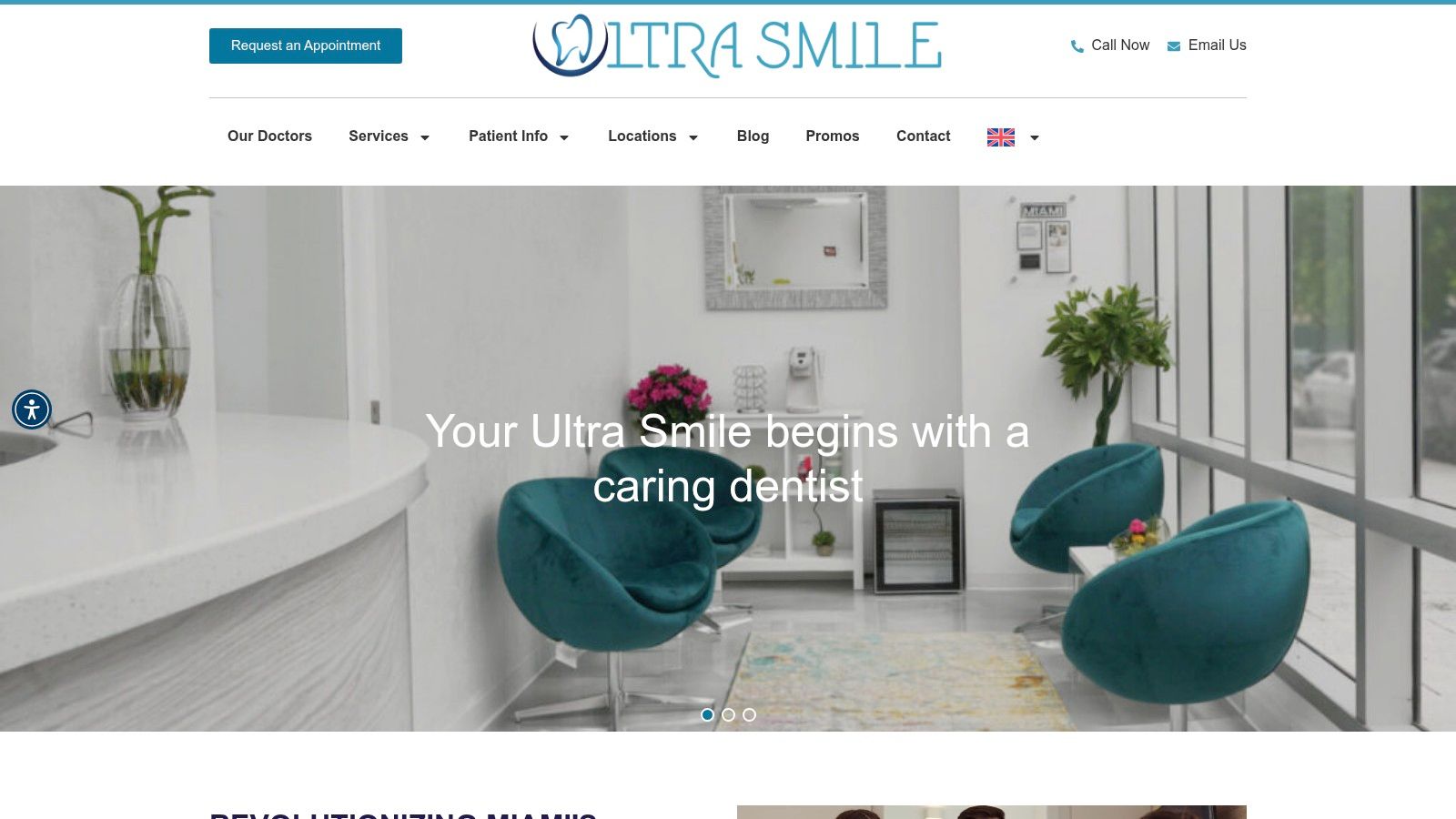
A crowded-teeth consultation at Ultra Smile DentalSpa usually starts like a normal dental visit, then moves into orthodontic planning once the records are complete. Patients are welcomed at the front desk in Downtown Miami, Midtown Miami, or Hallandale Beach, and the team typically begins with a new patient exam, photos, and a digital scan before discussing options. The setting is calmer than a typical office, with a spa-style feel, bilingual communication, and treatment planning built around comfort as well as function.
What the first visit usually covers
The visit should leave the patient with a written plan, not a vague estimate. That plan can include clear aligners, braces, veneers for limited cosmetic masking, or extraction-based coordination if space is tight. For patients who also need teeth whitening, cosmetic dentistry, restorative dentistry, dental implants, or an emergency dentist visit for a separate problem, those services can be discussed alongside the crowding plan rather than handled in isolation.
A crowded smile is rarely just a cosmetic issue in the treatment room. Once the spacing, bite, and gum health are measured together, the path forward is much easier to explain.
Cost, insurance, and financing questions to ask
Orthodontic costs vary because complexity and treatment length vary. Braces, aligners, veneers, and combined plans all land differently depending on how much space has to be created and how many visits are needed. Insurance may help with orthodontic care in some plans, but benefits depend on the policy, and many patients use FSA or HSA dollars to help cover eligible treatment.
Patients without coverage usually need to ask how the office structures payment options before starting. A clear financial discussion should include what's covered, what's not, and whether any part of the plan is staged so treatment can begin without delay. That conversation is especially important for adults balancing orthodontics with other dental needs like same-day crowns or tooth extraction.
The practical question for the first visit is simple. Does the case need a small space adjustment, a moderate orthodontic plan, or a more extensive approach? Once that answer is clear, the budget conversation gets much easier.
Recovery, Retention, and Keeping Your Teeth Straight
The first week after active orthodontic movement can feel tight or tender, especially if aligners were changed or brackets were adjusted. Soft foods, careful brushing, and good cleaning habits matter most during that short adjustment period. The bigger issue, though, is what happens after the teeth look straight.

Retainers are part of the treatment
Retention isn't optional. Expert orthodontic guidance emphasizes that retainers are the final step and that stopping retainer use is the most common reason teeth drift back. That's especially true in crowding cases, because the original problem was a lack of space in the first place.
Fixed retainers can hold the front teeth in place continuously, while removable retainers depend on patient compliance. Neither one matters much if it sits in a drawer. The result lasts when the retainer plan is treated as part of the orthodontic plan, not an afterthought.
Maintenance protects the result
Teeth that were crowded before treatment often still need careful cleaning afterward, especially if there's any overlap near the gums. Regular cleanings and exams help catch new plaque traps early. Patients should also keep an eye on the bite, because bite changes can affect how stable the alignment remains over time.
For patients comparing timelines and follow-up needs, this Invisalign treatment timeline resource can help frame what the active phase and retention phase usually involve. The long-term investment only makes sense if the result is protected.
Common Questions Miami Patients Ask About Crowded Teeth
Can adults fix crowded teeth? Yes. Adult crowding is common, and treatment is still very effective when the plan matches the amount of missing space and the bite mechanics. Adults often need the same diagnosis-driven approach as younger patients, just with more attention to stability and retention.
How long do clear aligners take for mild cases? Mild cases can move faster than more complex ones, but the exact timeline depends on how much space has to be created and how consistently the aligners are worn. The important part is not the calendar alone, it's whether the case is mild enough for aligners to work predictably.
Do veneers work as a shortcut? Only for very mild cosmetic concerns. Veneers can improve the appearance of small irregularities, but they don't move teeth or correct a real space deficit.
Will the fix last? It can, if the treatment is planned correctly and the retainers are worn as directed. Without retention, crowded teeth often drift back toward their old positions.
For adults in Downtown Miami, Midtown Miami, and Hallandale Beach who are tired of wondering whether crowded teeth are “bad enough to treat, the next step is a consultation built around measurement, not guesswork. Ultra Smile DentalSpa can evaluate the space deficit, explain whether aligners, braces, IPR, expansion, or extraction makes sense, and map out a plan that fits the smile and the bite. Schedule a visit with Ultra Smile DentalSpa to get a clear diagnosis and a treatment path you can use.