You are often told to brush your implant and move on. That advice is incomplete. How to clean dental implants the right way means treating the implant as a long-term maintenance job, because plaque can irritate the tissue around it and, if it keeps building, contribute to bone loss. If the crown looks fine, that doesn't mean the foundation is healthy.
For anyone seeking a dentist near me, dentist in Miami, FL, or Dental implants near me, the question is not whether the implant gets brushed. The question is whether the implant is being cleaned well enough, often enough, and checked often enough to catch trouble before it turns into peri-implantitis. A useful patient resource on implant longevity is the dental implant lifespan guide from Delaware Center for Advanced Dentistry, and the same logic applies here, long-term success comes from long-term care. Ultra Smile DentalSpa also shares patient education on implant success and maintenance, because the routine matters just as much as the restoration.
Table of Contents
- Why Cleaning Dental Implants Is a Lifelong Program
- A Daily Home Routine That Protects Your Implant
- Choosing the Right Tools for Implant Cleaning
- What Professional Implant Maintenance Looks Like
- How Often to Schedule Implant Maintenance
- Warning Signs of Peri-Implant Disease
- Do's, Don'ts, and Your Next Miami Visit
Why Cleaning Dental Implants Is a Lifelong Program
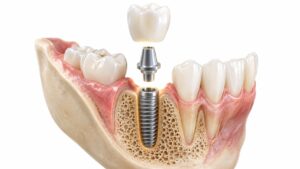
A clean implant affects more than appearance. The soft tissue seal around an implant is more fragile than many patients think, and inflammation can progress from peri-implant mucositis to peri-implantitis, where supporting bone is lost. Implant care works as an ongoing program that begins the day the crown is placed.
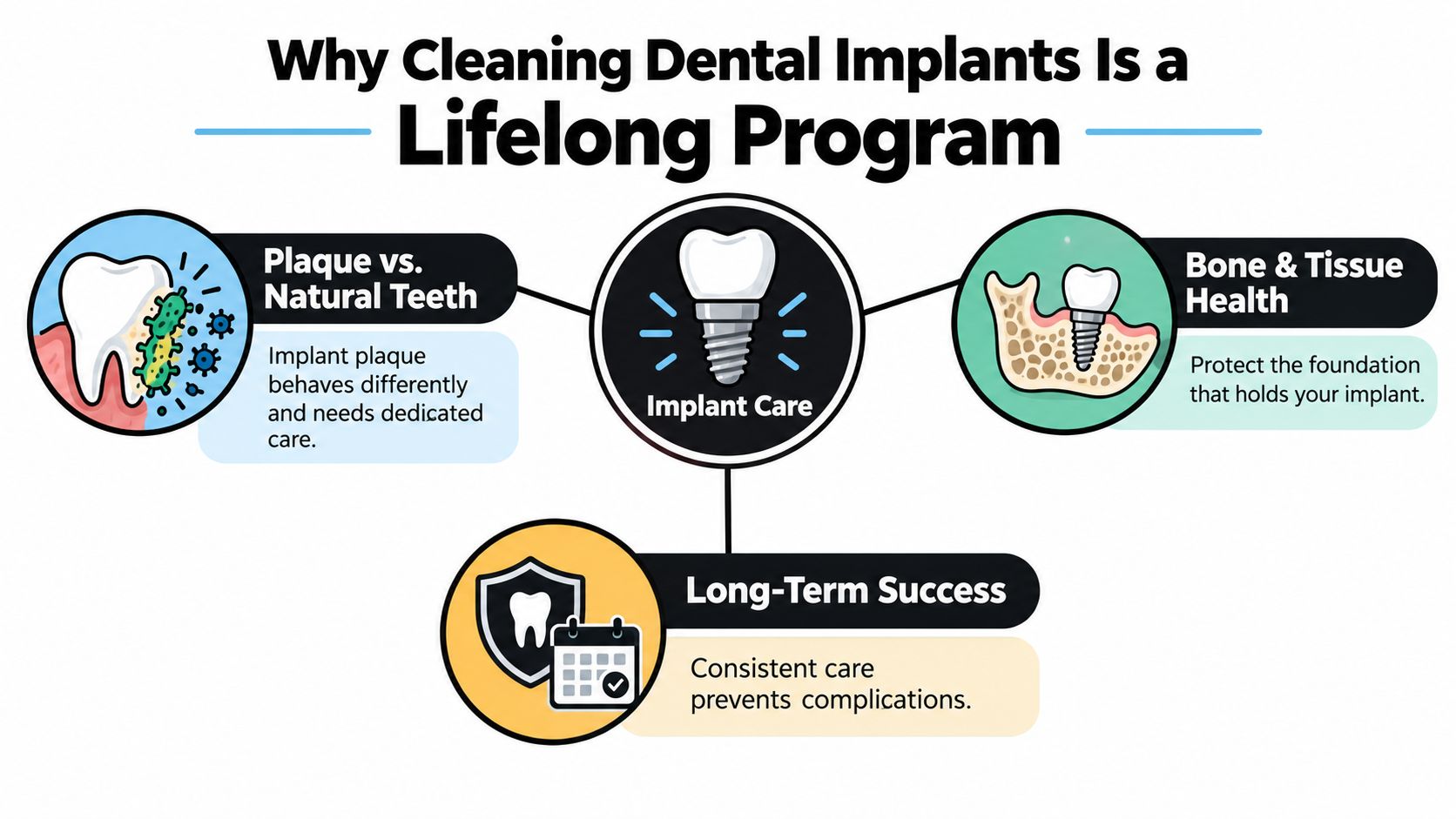
A recent PMC survey should change how patients judge home care. It found that 88.2% of patients reported daily cleaning, yet 70.4% still had peri-implant disease. Frequency alone does not guarantee effective plaque disruption. Diligent brushing can still miss the tight spaces around the implant crown, abutment, and neighboring teeth.
What that means for a Miami patient
A patient can brush morning and night and still run into trouble if the angle is wrong, the tool is too large, or the restoration creates hidden ledges. Cleaning has to match the shape of the restoration and the anatomy around it. Professional monitoring matters just as much, because bleeding, probing changes, and bone changes can appear before a patient feels pain.
Practical rule: If bleeding keeps showing up around an implant, treat it as a tissue warning that needs evaluation.
For patients comparing options at a cosmetic dentist near me or a dentist in Miami, FL, the mindset shift is simple. A dental implant needs disciplined upkeep, the same way patients commit to other high-value medical devices, except this one lives in the mouth and faces plaque every day. For more background on long-term implant outcomes, see this dental implant lifespan guide, and review implant success and maintenance for another patient-focused perspective.
A Daily Home Routine That Protects Your Implant
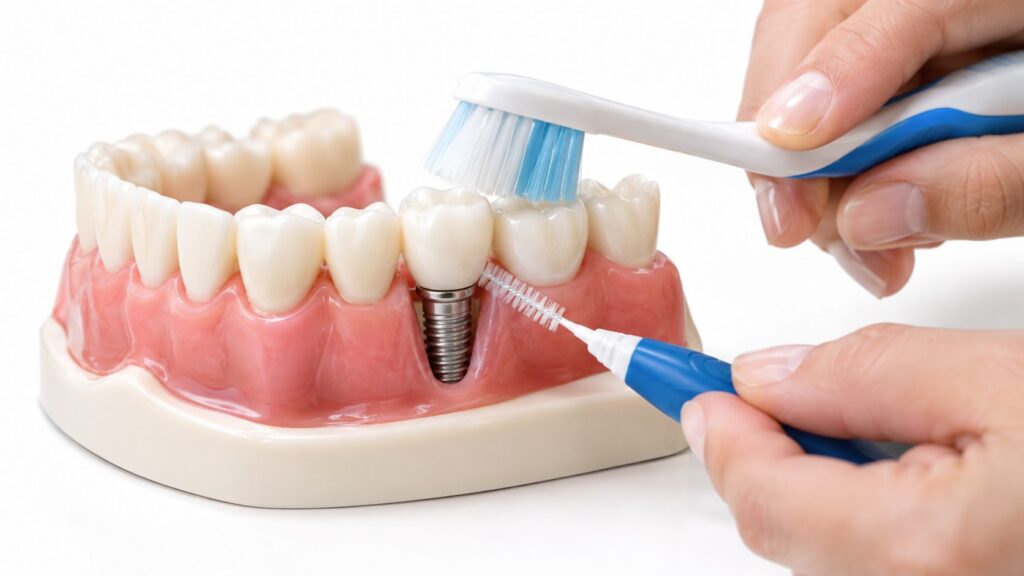
The home routine should be boring, repeatable, and gentle. Start with a soft-bristled toothbrush or an electric brush used lightly at the gumline, then clean the implant crown, the abutment, and the edges where the restoration meets tissue. That's where plaque likes to sit, and that's where a toothbrush alone often falls short.
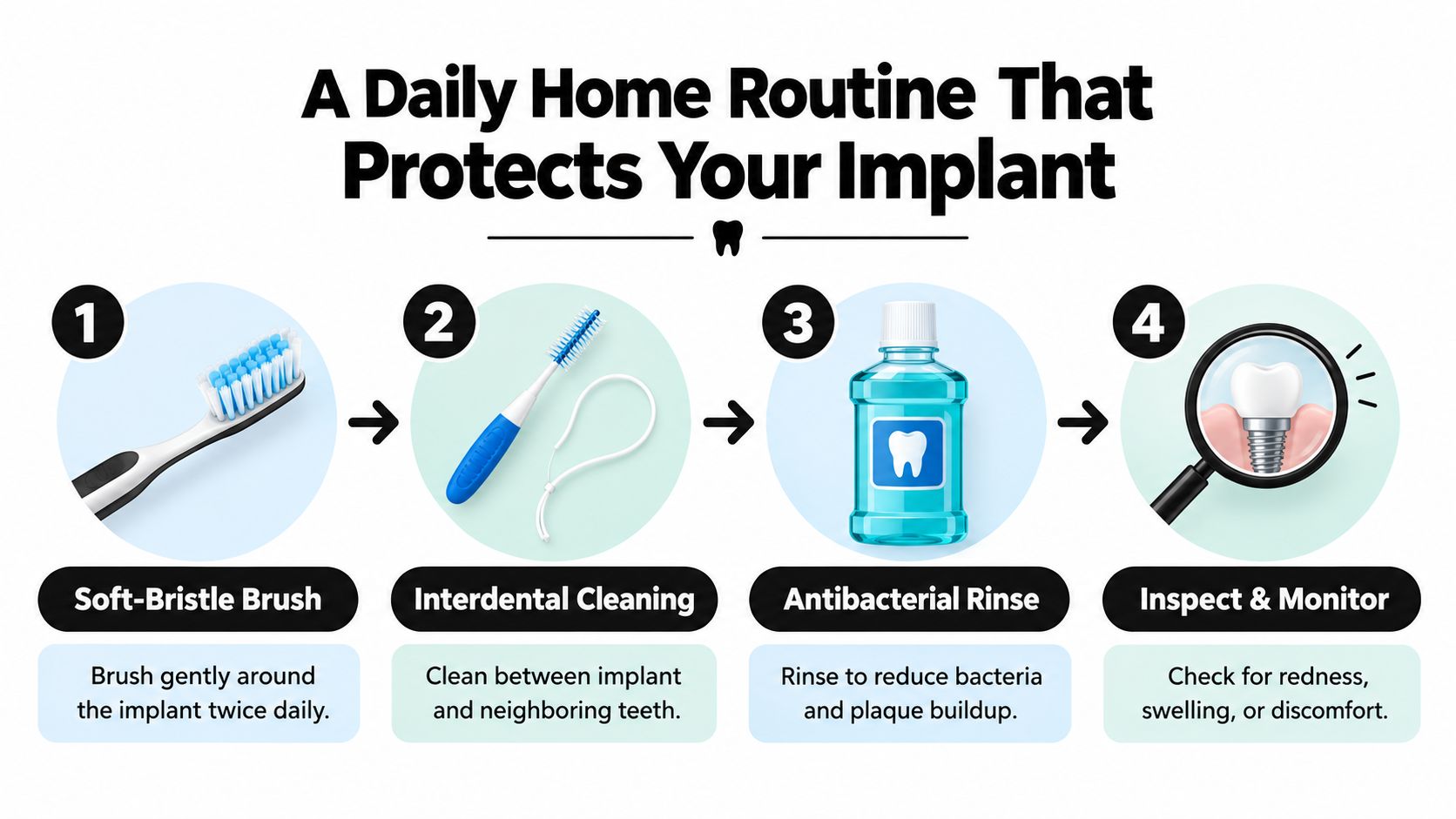
The American Academy of Periodontology recommends brushing twice daily, cleaning between teeth at least once daily, and receiving regular professional checkups that include a full periodontal evaluation at least annually (AAP implant procedures). That is the floor, not a luxury version of care. Interdental cleaning matters because the crown, abutment, and neighboring teeth create spaces a brush cannot fully reach.
What to do every day
- Brush twice daily: Use a soft brush and work around the gumline with gentle pressure, not a hard scrub.
- Clean between teeth once daily: Use an implant-safe floss, tape, interdental brush, water flosser, or a single-tuft brush, depending on the space.
- Check the tissue: Redness, swelling, odor, bleeding, or tenderness means the area needs attention, not more force.
- Keep the motion gentle: The goal is to remove biofilm, not polish the implant with pressure.
A helpful guide to implant maintenance from All Stars Dental makes the same practical point, the device has to fit the space. That's the difference between a routine that looks good and one that protects tissue.
Bleeding during cleaning is not a signal to scrub harder. It's a signal to examine the technique, the tools, and the implant contour.
Choosing the Right Tools for Implant Cleaning
There is no single tool that fits every implant. The right choice depends on the restoration shape, the space around it, and whether the case is a single crown, a bridge, or a full-arch restoration. The tool choice should come from an exam, not an ad.
The starting point is usually one of four options, and the clinician should match the tool to the anatomy during a hygiene visit. Ultra Smile DentalSpa provides implant cleanings with instruments designed to clean without scratching titanium or ceramic materials, which matters because the wrong instrument can damage implant surfaces.
| Implant Cleaning Tools at a Glance | ||
|---|---|---|
| Patient Situation | Recommended Starting Tool | Why It Helps |
| Tight contacts around a single crown | Implant-safe floss or tape | Reaches narrow spaces along the restoration edge |
| Open embrasures or bridge spaces | Correctly sized interdental brushes | Disrupts plaque where a brush head can't reach |
| Hard-to-reach contours or limited dexterity | Water flosser | Flushes debris without forcing a brush into tight angles |
| Around the underside of a crown or bridge | Single-tuft brush | Targets edges, corners, and emergence areas |
Research does not support one universal winner. A 2025 meta-analysis found some benefit with oral irrigators and interdental brushes, but the differences versus floss or brushing alone were not consistently statistically significant (PMC review). The point is simple, the best tool is the one that fits the mouth in front of you.
Match the tool to the restoration, not the trend
A single implant with generous spacing may do well with an interdental brush. A tight crown contact may need floss or tape. A bridge or a full-arch restoration often benefits from a water flosser plus a single-tuft brush for the margins. For patients comparing restorative dentistry, dental implants, or even emergency dentist options after irritation appears, the tool choice should come from an exam, not an ad.
Bring the tools to the next cleaning and have the hygienist demonstrate them in the mouth. That beats guessing every time.
What Professional Implant Maintenance Looks Like
A real implant maintenance visit is not just a quick polish. It starts with a structured look at the implant crown and prosthesis, especially any contours that catch plaque, then moves to bleeding, probing depths, mobility, and occlusion. The clinician compares those findings with the baseline, because change matters more than appearance.
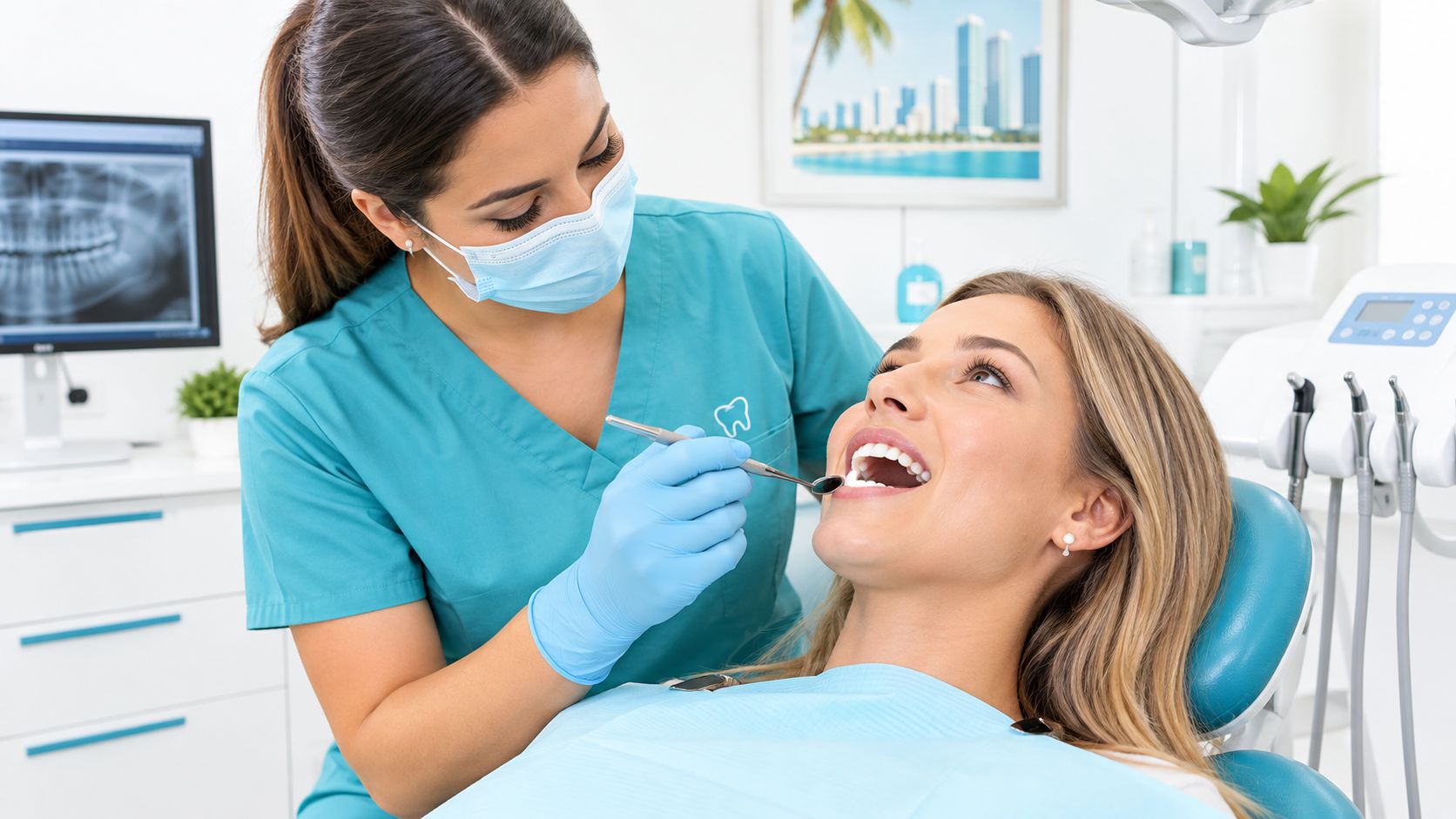
The debridement step should be implant-compatible. Air abrasion can clean machined, sand-blasted/acid-etched, and titanium-plasma-sprayed surfaces. Ultrasonic scalers with non-metal tips are supported for polished and structured surfaces, and rotating titanium brushes may be useful on sand-blasted/acid-etched titanium (PubMed review). Conventional non-metal curettes and rubber cups alone may be ineffective on established contamination.
After that, the clinician should polish accessible prosthetic surfaces, reinforce daily interdental cleaning, and review the patient's home technique. Bleeding isn't a cosmetic detail. It's a tissue-level finding that needs to be tracked, not ignored. For patients exploring missing tooth replacement solutions or comparing tooth extraction and replacement pathways, that maintenance appointment is part of the treatment, not an add-on.
A supportive maintenance visit also gives the team a chance to compare the implant with its baseline and catch subtle changes early. That matters for patients looking for dental cleanings, dental x-rays, or a new patient exam in Miami, because an implant can look acceptable while the supporting tissue is already changing.
How Often to Schedule Implant Maintenance
There is no honest one-size-fits-all interval. Stable, low-risk patients may do well at roughly 5 to 6 months, while patients with poor plaque control, smoking, uncontrolled diabetes, or previous peri-implantitis usually need visits every 3 to 4 months (CLINICAL review). After peri-implantitis treatment, an initial supportive-care visit at about 3 months is a common starting point.
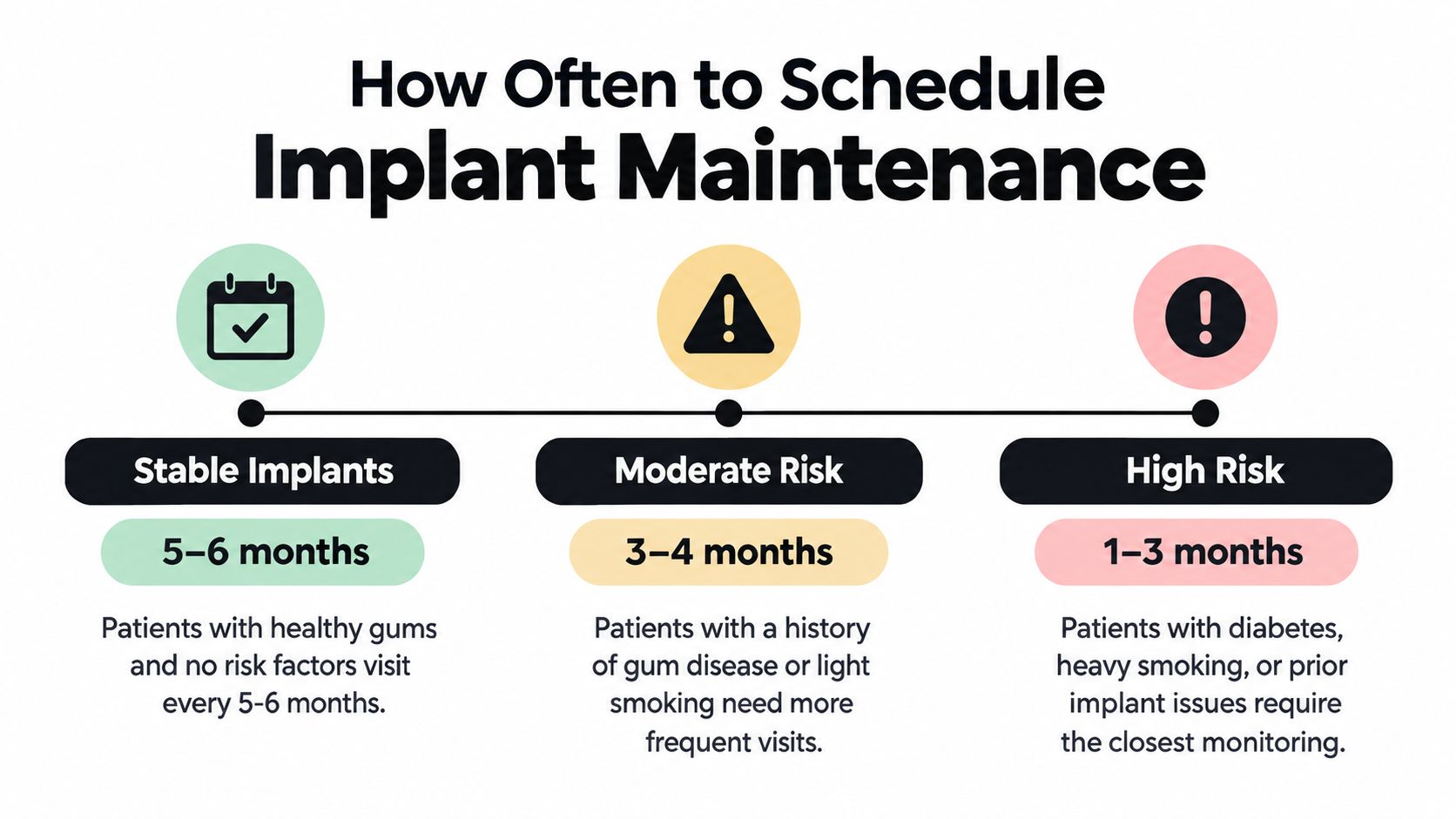
The reason for shorter recalls is plain. A review summarized in the Brazilian Oral Research literature reported a median peri-implantitis prevalence of 9.0% with preventive maintenance, compared with 18.8% without regular preventive maintenance. The same review also reported an estimated 25% reduction in peri-implantitis incidence among patients receiving maintenance (Brazilian Oral Research review). That is a clear case for keeping the schedule tight when risk is high.
Risk should drive the calendar
Patients with recurring inflammation, difficult-to-clean bridges, or a history of gum disease should not wait for an annual visit just because the implant “feels fine. A structured maintenance plan catches changes in probing, bleeding, and plaque retention sooner. That is especially important in a city like Miami, where busy schedules make it tempting to stretch recalls.
Straight answer: If an implant has shown bleeding before, the recall interval should get shorter, not longer.
For readers who want a practical timeline on recovery and follow-up, the dental implant healing timeline is a useful reference. But once healing is complete, the focus shifts to lifelong maintenance, and the patient's risk profile decides how often that maintenance happens.
Warning Signs of Peri-Implant Disease
Bleeding around an implant is not something to shrug off. Peri-implant mucositis means bleeding or suppuration on gentle probing, with or without a deeper pocket than before, but without bone loss beyond the normal early remodeling phase. Peri-implantitis adds progressive supporting-bone loss to the inflammation (Springer review).
That difference matters because the patient cannot diagnose it by appearance alone. A crown can look attractive and still sit over inflamed tissue. A dentist has to probe the area and, when indicated, compare dental x-rays to earlier images to see whether bone levels have changed.
Call promptly if any of these show up
- Persistent bleeding during cleaning: This is a tissue warning, not a sign of “doing it right.
- Swelling or tenderness: Inflamed tissue around an implant needs evaluation.
- Pus or bad taste: These are signs the area may be harboring active infection.
- Pain or looseness: Any change in how the restoration feels needs prompt review.
- A change in fit: A crown or bridge that suddenly feels different deserves a check.
Patients should not scrape implants with household tools or use abrasive products without guidance. That can damage the surface and make the problem worse. When bleeding starts, the right move is an exam, not a harder brush, and not a random pick from the medicine cabinet.
Do's, Don'ts, and Your Next Miami Visit
Do brush twice daily with a soft brush. Do clean between the implant and neighboring teeth once daily with a clinician-matched aid. Do keep the maintenance schedule risk-based, and do call when bleeding, swelling, pus, pain, or looseness shows up. Don't scrape the implant with metal tools, don't ignore bleeding because the crown looks fine, and don't push visits past six months without a clear reason.
Ultra Smile DentalSpa in Downtown Miami, Midtown Miami, and Hallandale Beach provides implant maintenance in a comfort-focused setting, with modern cleaning methods, transparent planning, and the kind of careful follow-up implant patients need. For anyone looking for a dentist near me, Emergency dentist, or a cosmetic dentist near me who also handles restorative work, that combination matters.
The single best question to ask at the next cleaning is simple: “What risk category is this implant in, and what should the recall interval be because of it?
If your implant has been bleeding, smelling off, or just hasn't been checked in a while, schedule a visit with Ultra Smile DentalSpa. The team can assess your implant, clean it with the right instruments, and set a maintenance schedule that matches your risk instead of guessing.