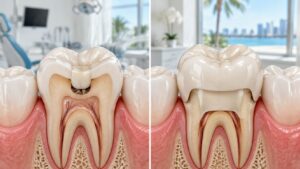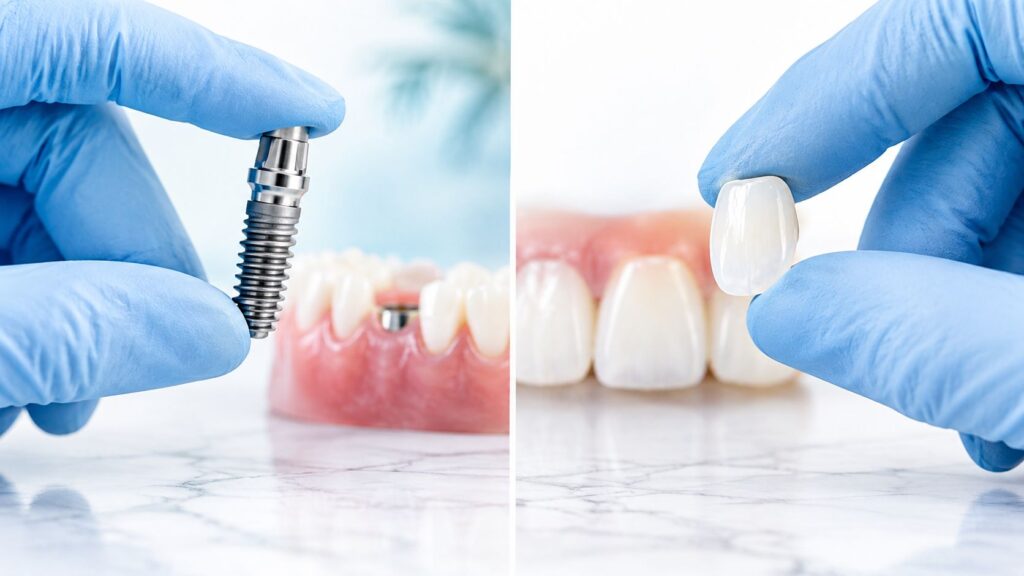
A chipped front tooth after a weekend on South Beach and a missing molar after years of postponed cleanings can both lead someone to search for a dentist near me. But dental implants or veneers aren't interchangeable treatments. One replaces a missing tooth from the root up. The other improves an existing tooth while preserving as much healthy structure as possible.
For patients looking for a dentist in Miami, FL, the right decision starts with biology, not a social-media smile preview. Bone volume, enamel, gum health, bite pressure, tooth damage, time, and budget all matter. The comparison below gives a quick orientation before the clinical details.
| Question | Dental implants | Veneers |
|---|---|---|
| Is the tooth missing? | Usually the correct category to evaluate | Not a replacement for a missing tooth |
| Is the existing tooth structurally sound? | May be unnecessary if the tooth can be predictably restored | Often appropriate for cosmetic changes |
| Main biological foundation | Jawbone integration through osseointegration | Adhesive bonding to remaining enamel |
| Common goals | Replace a missing tooth or tooth root | Improve color, shape, chips, gaps, or minor alignment |
| Typical treatment character | Surgical and staged | Conservative compared with extraction, but irreversible when enamel is prepared |
Table of Contents
- Two Smiles, Two Very Different Problems
- What Dental Implants and Veneers Actually Do
- Candidacy, Preparation, and Procedure Snapshot
- The Dental Implant Timeline From Consultation to Final Crown
- The Veneer Timeline From Smile Design to Bonding
- Longevity, Maintenance, and What Actually Fails
- Cost, Insurance, and Financing in Miami
- Which Option Fits Your Situation and Next Steps
Two Smiles, Two Very Different Problems
A 34-year-old Brickell professional chips a front tooth beside a pool. The tooth is still present, the root is healthy, and the main complaint is a sharp edge that shows whenever the patient smiles. A carefully designed porcelain veneer may mask the chip, refine the shape, and preserve the tooth's function without turning a cosmetic problem into an extraction case.
A 58-year-old Hialeah resident presents with a very different problem. A back molar is gone after years of skipped cleanings and worsening decay. No veneer can solve that. The evaluation needs to focus on the missing root, the condition of the surrounding gums, and whether the jawbone can support a titanium implant and crown.
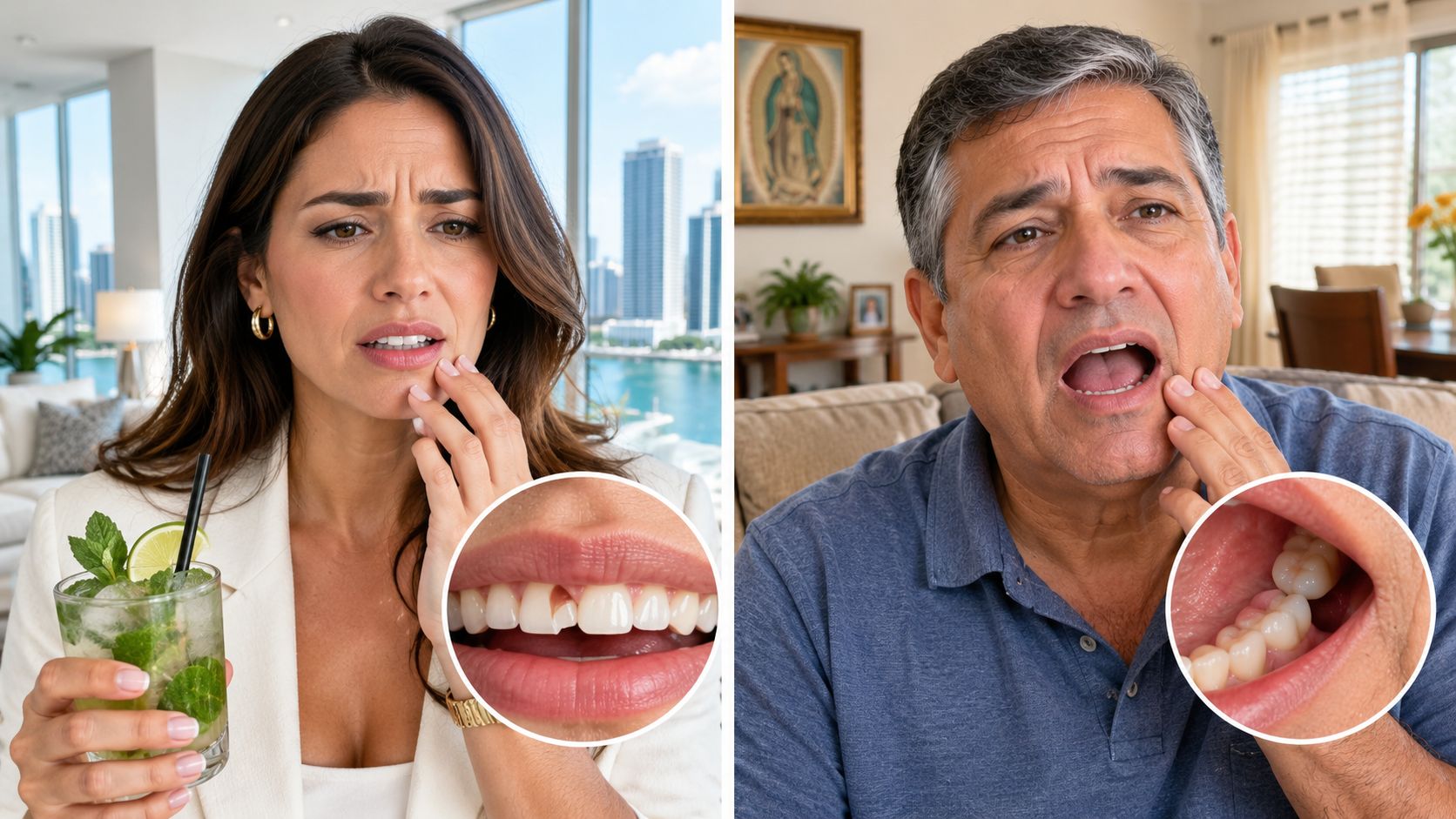
Miami patients also face daily habits that can challenge teeth and restorations. Sugary foods, acidic cocktails, long beach days with dehydration, and delayed dental cleaning can contribute to decay, staining, enamel wear, and gum problems. Those factors don't automatically make someone an implant or veneer candidate, but they do make prevention and maintenance part of the treatment decision.
The central tradeoff isn't appearance versus function. It's whether the existing tooth and supporting bone can be preserved, or whether the missing or failing structure must be replaced. A veneer depends on healthy tooth structure and a stable bite. An implant depends on bone healing, gum control, and long-term maintenance.
The sections ahead compare candidacy, preparation, timelines, maintenance, and cost. A scenario-based guide at the end helps a Miami patient identify the most sensible starting point before scheduling an evaluation.
What Dental Implants and Veneers Actually Do
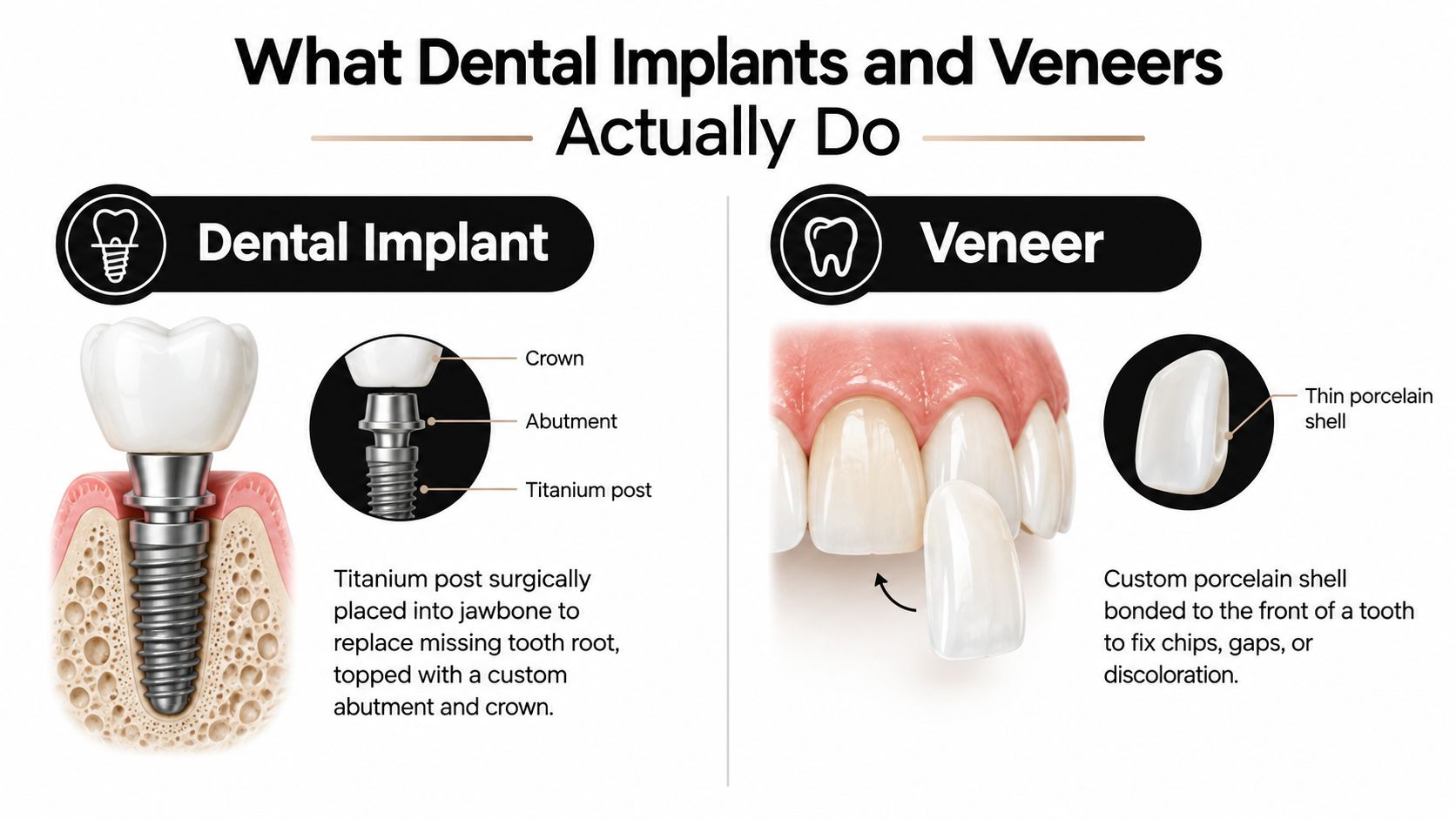
A dental implant replaces the part of a tooth that is missing below the gum. A titanium post sits in the jawbone, an abutment connects the post to the restoration, and a custom crown replaces the visible tooth. This design restores a missing root foundation instead of relying on neighboring teeth, as a bridge does, or resting on the gums like a removable denture.
The post must bond with healing bone before it can carry ordinary chewing forces. That process, called osseointegration, commonly takes about 3 to 6 months, so implant care often involves several appointments rather than same-day completion. Read the overview of osseointegration for a closer explanation.
A veneer preserves an existing tooth and changes its front surface. This thin shell, usually porcelain or composite resin, is bonded to the tooth to improve color, shape, length, small gaps, worn edges, minor alignment, or selected intrinsic stains. It cannot replace a missing tooth, repair a failing root, or rebuild lost bone.
Porcelain veneers generally require removal of about 0.3 to 0.7 millimeters of enamel from the facial surface, according to this clinical discussion of veneer preparation. That alteration makes treatment practically irreversible. Even a minimal-preparation case can require future bonding or another restoration because the tooth has entered a restorative cycle.
Problems implants are designed to solve
Implants are suited to situations such as:
- A missing tooth: The implant replaces the root, while the crown restores the visible portion.
- Severe root or below-gum damage: A tooth that cannot be predictably saved may need extraction and replacement planning.
- Loose dentures: Implant-supported overdentures can improve retention when conventional dentures move during chewing.
- A missing back tooth: An implant can restore chewing without reducing neighboring teeth for a traditional bridge.
Problems veneers may address
Veneers may fit patients with:
- Chipped or worn front teeth
- Persistent discoloration that whitening will not correct
- Small spaces between otherwise sound teeth
- Minor shape or alignment concerns
- Uneven edges or cosmetic proportions
A damaged front tooth may qualify for bonding, a veneer, a crown, or extraction followed by an implant. Choose the least invasive treatment that can predictably protect the tooth, preserve enamel and bone, and withstand the patient's bite and daily habits.
Candidacy, Preparation, and Procedure Snapshot
A Miami patient with one missing molar and healthy neighboring teeth has a different problem from someone with chipped, discolored front teeth. The right choice depends on biology first, then appearance and lifestyle. Implants require enough jawbone, controlled gum disease, and healing conditions that support surgery. Active periodontitis or an uncontrolled medical condition must be treated before implant placement.
Veneers require a sound tooth worth preserving. The tooth needs enough enamel for a dependable bond, stable gums, and a bite that will not overload the ceramic. A veneer cannot rescue a structurally failing tooth, untreated decay, or uncontrolled grinding. Patients who clench or grind may need bite protection before cosmetic treatment.
| Dimension | Dental implants | Veneers |
|---|---|---|
| Candidacy | Missing or non-restorable tooth, sufficient bone, stable gums, suitable healing conditions | Existing tooth with adequate enamel, healthy gums, and a manageable bite |
| Tooth preparation | The missing tooth site is prepared; neighboring teeth typically aren't reduced for the implant itself | A small amount of facial enamel may be removed, depending on the design and preparation approach |
| Procedure length | Often staged over months, especially when extraction or grafting is involved | Usually completed through several visits over a shorter treatment period |
| Anesthesia | Local anesthesia, with sedation available when appropriate, plus minor oral surgery | Local anesthesia when needed, and sometimes none for selected minimal-preparation cases |
| Reversibility | Intended as a permanent replacement once integrated; removal can affect supporting bone | The bonding material can be replaced, but prepared enamel is permanently altered |
| Main biological dependency | Bone healing and long-term peri-implant tissue health | Enamel bonding, gum stability, ceramic thickness, and bite control |
Preparation differs in one important way. Implant planning centers on the missing-tooth site, bone volume, and nearby anatomy, while veneer planning centers on enamel preservation, tooth proportions, and bite load. In selected cases, veneer preparation may remove roughly 0.3 to 0.7 mm of facial enamel, so “cosmetic does not mean reversible.
The first consultation should replace guesswork with evidence. Implant planning may include dental x-rays and a CBCT scan to assess bone height, width, and surrounding anatomy. Veneer planning may use photographs, digital impressions, and a digital smile design mock-up. Review the proposed tooth length, shape, and proportions before any enamel is prepared.
If a tooth can be restored predictably and conservatively, preserve it. Extraction should not be the default route to a cosmetic result, especially when enamel, bone, and a stable bite can still be maintained.
The Dental Implant Timeline From Consultation to Final Crown
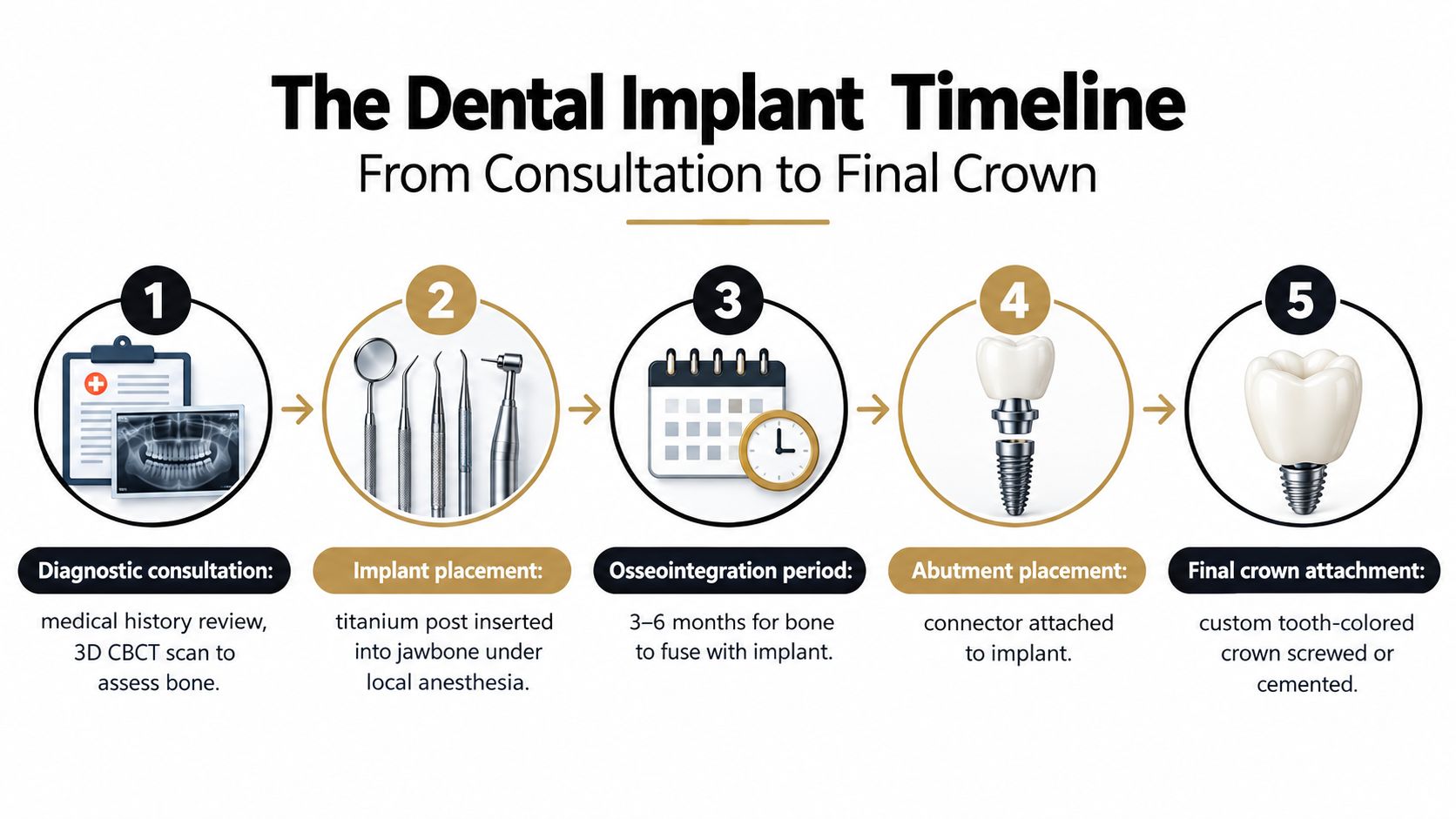
For a Miami patient with one failing tooth, the timeline depends less on the calendar than on bone, infection, gum health, and bite load. Implant treatment is a sequence of decisions, beginning with medical history, a clinical examination, dental x-rays, digital impressions, and a three-dimensional CBCT scan. The scan shows bone height and width, and the planned implant's relationship to nearby anatomy, including the upper-jaw sinus.
Your written plan should state whether tooth extraction is needed, whether bone grafting or a sinus lift may be required, which temporary restoration will protect your smile, and how those choices affect treatment time and cost.
Stage one and site preparation
If a tooth cannot be restored predictably, extraction may come first. A socket or jaw with insufficient volume may require grafting before implant placement. Grafted bone often needs a healing period that can extend several months, depending on the site and the patient's biology.
Some patients qualify for immediate or earlier placement. The decision rests on infection control, remaining bone, gum condition, and primary stability. A faster schedule is appropriate only when those conditions support it.
Stage two and implant placement
During placement, the dentist uses local anesthesia, with sedation considered for appropriate patients. A small incision exposes the jawbone, the titanium post is inserted, and the site receives either a healing abutment or a cover screw.
The implant then enters osseointegration, the phase in which bone integrates with the implant surface before the final crown carries normal biting forces. The commonly cited healing window is 3 to 6 months. Patients can review the stages in this dental implant healing timeline. Soft foods, careful cleaning, and scheduled follow-ups protect the healing site.
Stage three and final restoration
After integration, the dentist attaches the abutment if it was not placed earlier, takes an impression or digital scan, and checks the crown's shade, contour, contacts, and bite. The final crown is then screwed or cemented into place.
For the first 72 hours, follow prescribed medication directions, eat softer foods, avoid direct pressure on the surgical site, and clean the area as instructed. Contact the office if swelling, bleeding, or pain becomes concerning. Your dentist's individualized instructions take priority.
The Veneer Timeline From Smile Design to Bonding
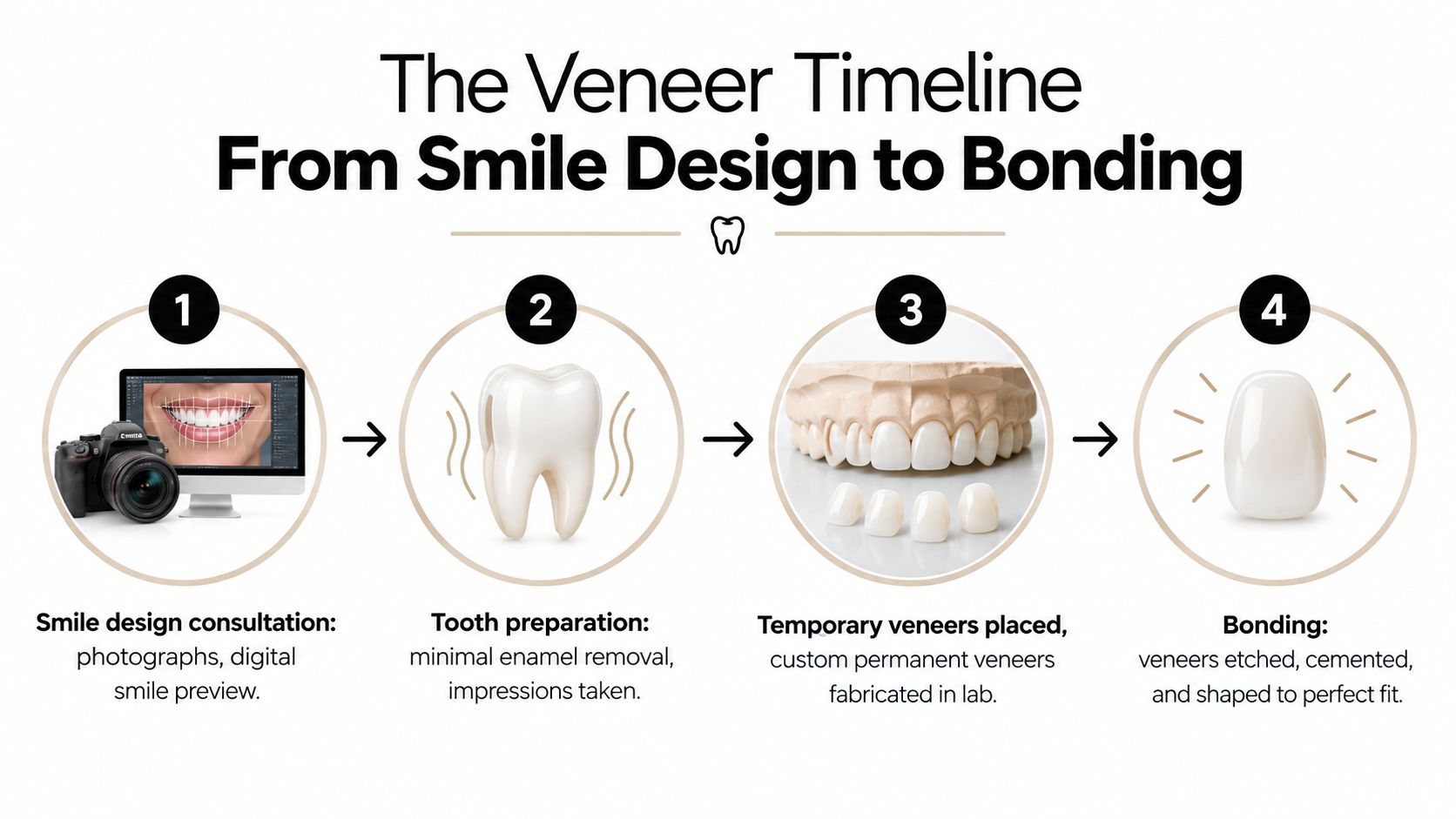
Veneer treatment should begin with design, not drilling. During the consultation, the dentist evaluates facial proportions, gum display, tooth position, enamel thickness, bite pressure, and the patient's goals. Photographs, shade mapping, digital scans, and a smile preview can help determine whether one tooth or a broader group should be treated.
A smile makeover may involve several upper front teeth when color and symmetry need to match. The number should be based on the patient's smile line and the transition between treated and untreated teeth, not on a standard package.
Design and preparation
At the preparation appointment, the dentist removes approximately 0.3 to 0.7 millimeters of enamel from the facial surface when porcelain preparation is indicated. Final impressions or digital scans then capture the prepared teeth, and temporary acrylic veneers may protect them while the laboratory fabricates the definitive restorations.
Temporary veneers also give the patient a chance to assess speech, tooth length, smile fullness, and comfort. If the proposed design feels too long or bulky, adjustments should happen before final porcelain is bonded.
Laboratory work and bonding
The laboratory phase allows a ceramist to create the chosen color, translucency, surface texture, and edge design. At the bonding visit, the dentist tries in each veneer, checks contacts and bite, makes minor chairside adjustments, and then uses resin bonding agents to secure the ceramic.
The final steps include an occlusal check and home-care guidance. Patients should understand that veneers aren't indestructible covers. A patient who clenches, bites pens, opens packages with teeth, or regularly chews hard objects may need bite protection or a different restorative plan.
Longevity, Maintenance, and What Actually Fails
Long-term performance depends on more than the material label. Implant survival is strong in major clinical datasets, but results vary with patient population, loading protocol, bone volume, smoking history, bruxism, gum health, and maintenance.
A ten-year systematic review reported a pooled implant survival rate of 96.4%, with a 95% confidence interval of 95.2% to 97.5%. Its sensitivity estimate was 93.2%, with a wide prediction interval that signals meaningful variation between studies and patients, as reported in this systematic review of implant survival. A separate 20-year meta-analysis reported a mean survival rate of 92% in three prospective studies, 78% after imputation, and 88% in five retrospective studies, detailed in this long-term implant analysis.
Those figures support a clear conclusion. Implants are generally high-success restorations, but they're not biologically neutral and they aren't maintenance-free.
| Factor | Dental implant, single tooth | Porcelain veneer |
|---|---|---|
| Expected performance | Strong long-term survival in major clinical datasets, with outcomes varying by case and maintenance | Ceramic veneer longevity depends heavily on enamel bonding, bite load, margins, and hygiene |
| Common failure concerns | Bone loss around the implant, peri-implant inflammation, screw loosening, and porcelain chipping | Marginal adaptation problems, gingival inflammation, marginal discoloration, debonding, and cleaning difficulty |
| Daily care | Brush and clean between teeth, with professional monitoring of gums and supporting bone | Use non-abrasive toothpaste, clean carefully around margins, and consider a nightguard for grinding |
| Lifestyle responsibility | Avoid smoking where possible, follow healing instructions, and maintain regular examinations | Don't bite hard objects, manage clenching, and protect the ceramic from excessive load |
| Repair reality | Components may sometimes be repaired or replaced, but biological complications need prompt attention | A veneer may be repaired or replaced, but the prepared tooth remains part of a permanent restorative cycle |
For veneers, a 2025 long-term review found that common complications included marginal adaptation, gingival inflammation, and marginal discoloration. Patients reported dissatisfaction with function, food impaction, and cleaning difficulty, which means appearance alone isn't a sufficient measure of success. The review is summarized in this ceramic veneer complications analysis.
A veneer plan should therefore answer a practical question: can the patient keep the margins clean and tolerate the bite? Guidance on daily care is available in this veneer maintenance guide.
Cost, Insurance, and Financing in Miami
Treatment fees in Miami depend on the tooth, the restoration, the laboratory, imaging, sedation, grafting, extraction, and the complexity of the bite. Patients should compare complete treatment plans, not isolated advertised prices.
For planning purposes, a single implant including surgery, abutment, and crown may commonly fall around $3,500 to $6,500 per tooth. Full-arch All-on-4 treatment may start near $20,000 per arch. Porcelain veneers may range around $1,500 to $2,800 per tooth, while composite veneers may fall around $800 to $1,500 per tooth. These are the Miami planning ranges specified for this treatment comparison, not a quote for an individual case.
| Item | Implants | Veneers |
|---|---|---|
| Common treatment scope | Surgery, implant post, abutment, crown, and possible grafting | Cosmetic consultation, preparation, laboratory veneer, bonding, and follow-up |
| Insurance pattern | Some PPO plans may provide partial coverage for the crown portion, depending on policy and reason for treatment | Usually classified as cosmetic and excluded |
| Main fee variables | Bone grafting, extraction, sedation, imaging, temporary teeth, and final crown | Number of teeth, porcelain type, preparation design, laboratory work, and bite management |
| Payment planning | May be staged around surgery, healing, and restoration milestones | May be staged around design, preparation, laboratory delivery, and bonding |
Out-of-pocket patients at Ultra Smile DentalSpa can ask about an in-house membership plan, 0% short-term financing for qualifying cases, third-party lenders such as CareCredit and Cherry, and staged payments tied to treatment milestones. Availability and qualification depend on the specific plan and financial review.
Before committing, request a written, itemized estimate. It should identify diagnostics, anesthesia, extraction, grafting, temporary restorations, laboratory fees, abutments, crowns, revisions, and follow-up care. A lower initial number can become misleading when those items appear later.
Which Option Fits Your Situation and Next Steps
A fast decision framework can narrow the conversation, but it can't replace an examination.
- One missing molar: Start with an implant evaluation. The question is whether the bone and gums can support replacement from the root up, or whether a bridge or other restorative option makes more sense.
- Chipped or worn front teeth with healthy enamel: Veneers may be appropriate when the tooth remains structurally sound and the bite is controlled. Bonding may be even more conservative for a small chip.
- Dark tetracycline staining: Whitening may not provide the desired change. Veneers or crowns may offer better coverage, with the choice depending on how much tooth structure remains and how much protection the tooth needs.
- Denture fatigue: Ask about implant-supported overdentures or All-on-4 treatment. The evaluation should include bone anatomy, gum health, hygiene ability, and the patient's tolerance for staged care.
- Gaps between otherwise sound teeth: Veneers can close selected spaces, while orthodontics or Invisalign may move the natural teeth without adding ceramic. The safest choice depends on tooth position, enamel, bite, and the desired speed of treatment.
- Pain, swelling, trauma, or a broken tooth: Contact an Emergency dentist promptly. An urgent exam may involve dental x-rays, a root canal, tooth extraction, or temporary stabilization before any cosmetic decision.
The right treatment isn't the one that changes the smile fastest. It's the one that respects the remaining enamel, supporting bone, and bite.
Miami patients should bring current x-rays if available and ask for both appropriate options in writing. A consultation should explain bone health, enamel quality, bite load, maintenance, timeline, and total cost in plain language. Patients searching for a Cosmetic dentist near me, Dental implants near me, or related restorative care deserve a plan based on those findings, not a generic package.
Ultra Smile DentalSpa offers complimentary cosmetic and implant consultations, with care for veneers, implants, bone grafting, restorative dentistry, emergency dental services, cleanings and exams, and tooth extraction in Miami. Visit Ultra Smile DentalSpa to request an appointment and discuss whether a veneer, implant, or more conservative option fits the teeth and goals.