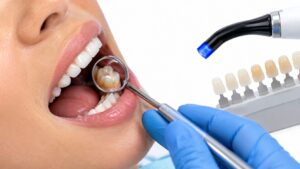
Most patients report no to mild discomfort during dental implant surgery, and the roughest soreness is usually short-lived. In the data set most relevant here, 78.7% reported no to mild intraoperative pain, 57.7% reported no pain during surgery, and discomfort dropped from 57.7% on day 1 to 36.1% by day 3 and 17.5% by day 7 after surgery (BMJ Open).
For the patient sitting in a Miami dental chair and wondering if this is going to hurt, the more useful question is a little sharper, how much will it hurt for someone like you, and what can the dentist do about it before, during, and after surgery? The honest answer is that many people feel pressure more than pain once they're numb, but a meaningful minority do feel stronger soreness, especially when anxiety, surgical complexity, or nerve irritation enter the picture.
Table of Contents
- What Dental Implant Surgery Pain Really Feels Like in Miami
- How the Implant Procedure Works and Where the Discomfort Comes From
- Your Day-by-Day Recovery Timeline After Implant Surgery
- Who Is More Likely to Feel Stronger Pain After Implants
- Managing Implant Surgery Pain With Medications and Home Care
- Warning Signs After Implant Surgery and When to Call the Dentist
- How Ultra Smile DentalSpa in Miami Makes Implant Recovery Easier
- Book Your Implant Consultation in Miami Today
What Dental Implant Surgery Pain Really Feels Like in Miami
A nervous Miami patient walks in, gets settled into a calm room, and hears the same thing many implant patients need to hear first, the numbing step should make the procedure feel manageable. Once local anesthesia is working, patients describe implant placement as pressure, vibration, and sound, not sharp pain. That's the point where the experience becomes less about “can I tolerate this? and more about staying relaxed while the team works methodically.
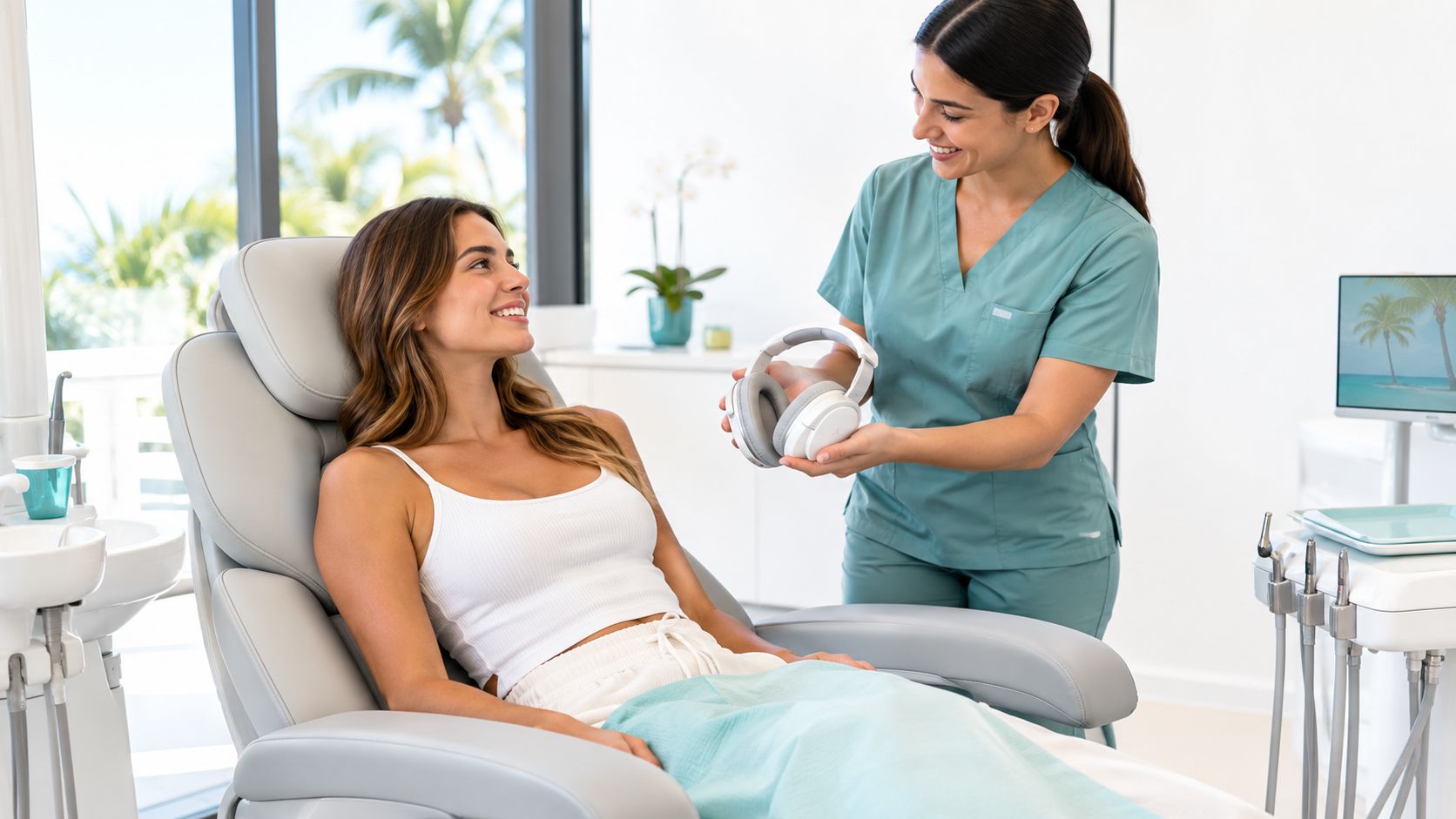
Practical rule: once the area is numb, the sound of the handpiece can bother people more than the tissue itself.
That said, the average doesn't tell the whole story. A real subgroup experiences moderate to severe soreness after surgery, and that's where good planning matters. Pain isn't just about the implant, it's shaped by anxiety level, surgical complexity, prior dental experiences, and the body's own inflammatory response. A calm, well-prepared team can reduce the fear that amplifies pain before the first incision is even made.
Miami patients often want specifics, not vague reassurance. The strongest comfort plans start before surgery, continue through the procedure, and carry into the first few days at home. That's how a busy patient in Brickell, Coral Gables, or Kendall gets from uncertainty to a recovery plan that actually makes sense.
How the Implant Procedure Works and Where the Discomfort Comes From
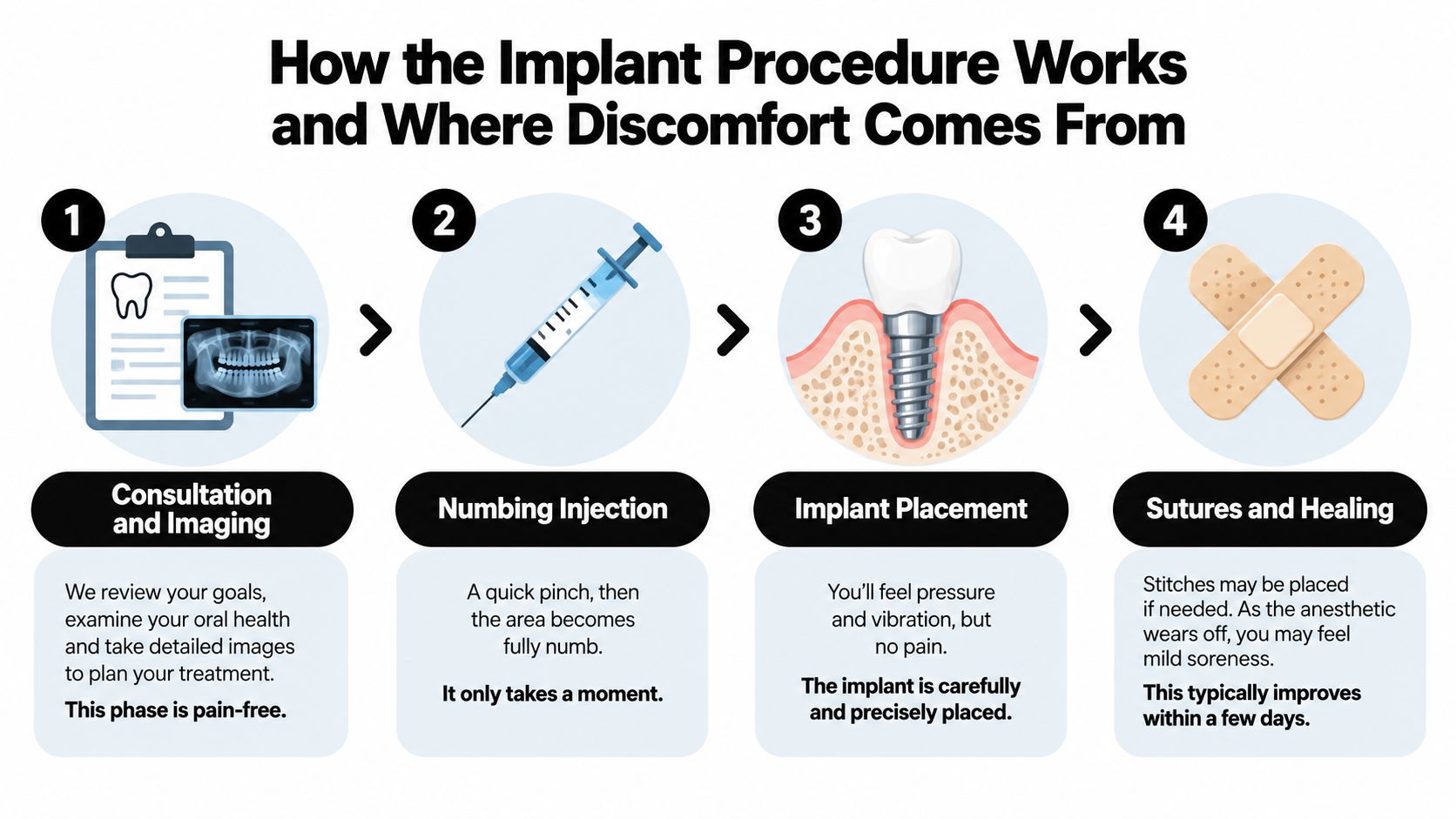
The consultation phase should feel easy, because it's usually just planning. Imaging, exam findings, and treatment discussion don't hurt. They're there to show whether the bone, gum tissue, and bite can support an implant cleanly and safely.
What the mouth feels during placement
The numbing process usually starts with a topical gel, then an injection. Most patients feel a brief pinch, then the area goes quiet. After that, the gum is opened with a small incision or punch, and the handpiece creates vibration and pressure while the osteotomy is prepared for the post.
That drilling sound is often the most memorable part, not because it's painful, but because it's unfamiliar. The sensation comes from controlled mechanical work in bone, not from the implant “cutting through healthy tissue in a rough way. If the site is fully numb, the patient should notice movement, pressure, and maybe a sense of heaviness, not a sharp jab.
Why soreness shows up later
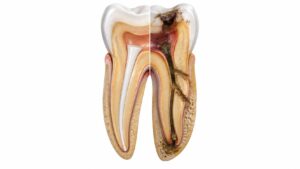
Post-op soreness usually comes from tissue reflection, bone remodeling, and inflammation around the surgical site. That's why the pain often shows up after the numbness fades, not during placement. The body is reacting to a clean surgical injury, and that response can feel more noticeable once the anesthetic wears off.
The most useful clue is timing. Pain that tracks with the first few days of healing is expected, pain that escalates instead of settling down needs attention.
For patients preparing for surgery, good preparation lowers stress before a single tool is used. A practical pre-op checklist is laid out in this oral surgery preparation guide, and it helps patients arrive calmer and better organized.
Your Day-by-Day Recovery Timeline After Implant Surgery
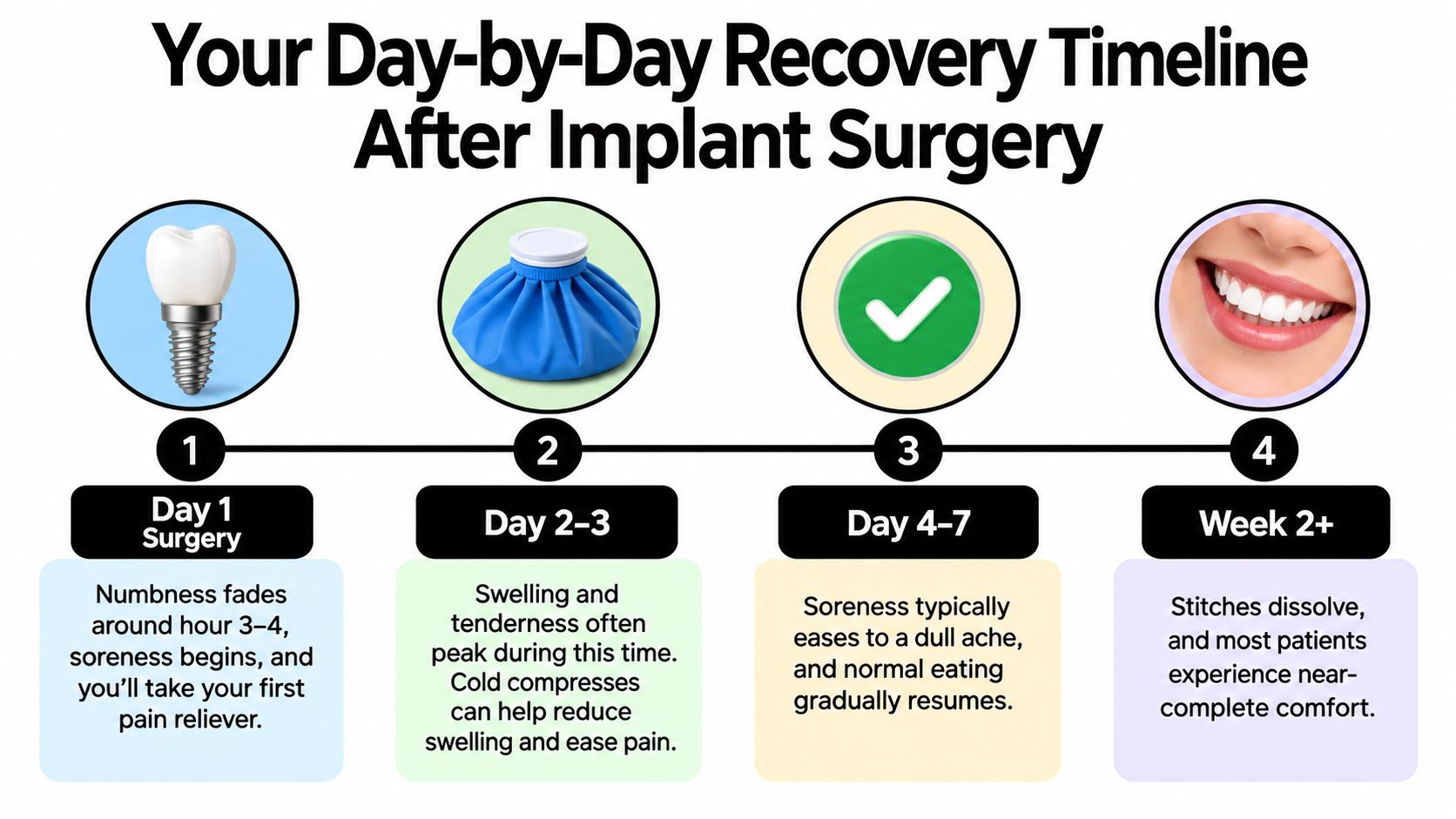
The recovery pattern is usually more predictable than patients expect. The first day is mostly about anesthesia wearing off, staying ahead of discomfort, and keeping the surgical area undisturbed. In a peer-reviewed recovery study, the median time for maximal pain was about 3 days, the median time for analgesic use was 2.5 days, and swelling generally took 4 to 5 days to reach minimal levels (PMC).
What the first week usually looks like
Day 1 tends to be the hardest mentally. The numbness fades, soreness starts, and the first pain medication should already be on board before the anesthetic fully disappears. That approach matters more than waiting until the pain is loud.
Days 2 to 3 are commonly the peak of swelling and tenderness. This is the window where patients often feel the site most when talking, eating, or sleeping on one side. For many people, the pain is still controllable, but it's the phase that feels most “present.
Day 4 through 7 usually brings a noticeable drop in discomfort. Soft chewing starts to feel easier, and the pain often changes from active soreness to a dull ache. By this stage, most patients are less focused on the surgical site throughout the day.
What happens after the first week
Healing keeps going even when the outside feels normal. Cleveland Clinic notes that the first round of healing takes about one week, while deeper bone fusion can take three to nine months (Cleveland Clinic). That's why the mouth can feel settled long before the implant is fully integrated underneath.
For a practical patient timeline of pain and swelling, this recovery article is a useful reference point. It helps set expectations without promising an unrealistically smooth ride.
Who Is More Likely to Feel Stronger Pain After Implants
Not every implant patient has the same pain curve. Some sail through with mild soreness, while others feel a harder recovery because the surgery itself, or the body's response to it, is more intense. That difference is exactly why “does it hurt? is the wrong question for a careful treatment plan.
The factors that tend to push pain higher
Anxiety matters because the brain turns tension into amplified sensation. When a patient is already bracing for pain, the body often feels every step more strongly. Surgical factors matter too, especially when the case requires more tissue handling, longer chair time, or additional bone work.
| Risk Factor | Why It Increases Pain |
|---|---|
| High anxiety or catastrophizing | Raises tension, makes sensations feel sharper, and can intensify pain perception |
| Flap surgery | Involves more tissue reflection, which usually means more soreness afterward |
| Bone grafting or sinus lift | Adds surgical sites and more healing demand |
| Longer operative time | Keeps tissues exposed and inflamed for longer |
| Multiple implants in one visit | Creates more cumulative trauma in one appointment |
| Clenching or bruxism | Can irritate the site and increase postoperative tenderness |
| Poorly controlled diabetes or smoking | Can slow healing and make inflammation harder to settle |
| History of difficult extractions | Often signals a more reactive healing pattern |
The 2026 observational research noted in the brief also points to a meaningful subgroup with stronger pain tied to flap surgery, surgical templates, and the interaction of anxiety state, pain sensitivity, and pain expectation (Wiley). That doesn't mean the procedure should be avoided. It means the comfort plan should be customized.
Some patients also report that prior bad dental experiences make them brace harder, even before treatment starts. A skilled implant team can work with that directly by adjusting sedation, pacing, communication, and follow-up instructions.
Managing Implant Surgery Pain With Medications and Home Care
The best recovery plans don't rely on one trick. They combine medication, ice, rest, food choices, and a predictable routine so the painful window closes faster. The strongest evidence in the brief supports short-term NSAID therapy for reducing postoperative pain and rescue-analgesic use versus placebo (Springer), and a review of implant surgery pain found NSAIDs such as ibuprofen, piroxicam, dexketoprofen trometamol, dexamethasone, and lornoxicam outperformed placebo for postoperative pain control.
What patients usually do at home
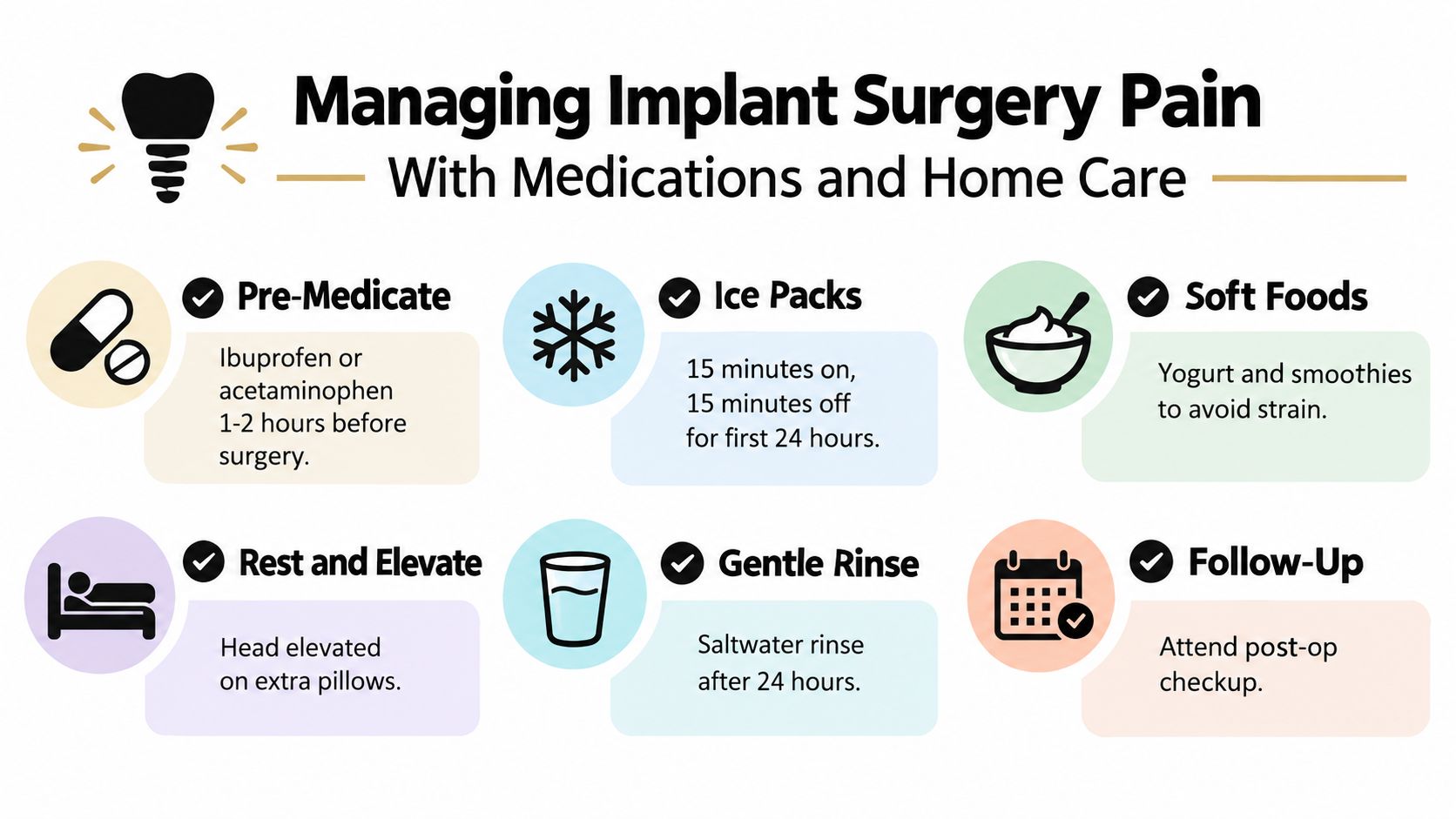
A dentist may recommend taking pain medicine before the numbness fully fades, then staying on schedule for the first few days. That early timing matters because once pain has broken through, it's harder to settle back down.
- Pre-medicate early: take the recommended pain reliever before the anesthetic wears off.
- Use cold compresses: keep them on and off in short intervals during the first day or two.
- Sleep with your head raised: extra pillows help reduce facial pressure overnight.
- Choose soft foods: yogurt, smoothies, eggs, and lukewarm soups keep chewing stress low.
- Skip straws and carbonation: suction and pressure can irritate the area.
- Avoid aspirin and alcohol rinses: both can complicate healing.
- Keep hydration steady: dry tissues heal less comfortably.
What helps more than people expect
Gentle hygiene matters, but so does not overdoing it. A calm rinse after the first day, careful brushing away from the site, and no smoking all support a quieter recovery. Patients who try to “test the area too soon often make the soreness last longer than it needs to.
A useful comfort philosophy is simple. Medication takes down the pain signal, cold therapy lowers swelling, rest protects the site, and food choices reduce mechanical irritation. Together, those steps do more than any single remedy alone.
Warning Signs After Implant Surgery and When to Call the Dentist
Normal soreness should be dull, localized, and gradually improving after the first few days. It should not keep getting louder. When the pain shifts from predictable healing to something more aggressive, the reason may be infection, nerve irritation, or another early complication.
What should raise concern
Pain that throbs, spreads, or intensifies after day three deserves a closer look. So does swelling that keeps growing instead of settling, a foul taste, pus, fever, or a loose-feeling implant. Mayo Clinic's patient guidance also notes that worsening soreness in the days after surgery should prompt contact with the surgeon, and that pain by itself is not a reliable sign of early implant failure (Mayo Clinic).
A few warning signs deserve special attention:
- Fever or expanding swelling, call the same day.
- Persistent throbbing pain, contact the office within 24 hours.
- Numbness that does not resolve, report it promptly, especially if it continues after the anesthetic should be gone.
- Loose implant sensation, don't wait for the next visit.
- Pus or foul taste, these can signal infection at the surgical site.
If the pain is improving day by day, that's reassuring. If it's getting more intense after the third day, the team should hear about it.
Persistent or atypical pain can also point toward nerve injury rather than ordinary surgical soreness. Implant-related trigeminal nerve damage can happen from drilling, implant placement, compression by bone debris, edema, or thermal injury during drilling (PMC). That's why early communication matters, even when the symptom seems small at first.
How Ultra Smile DentalSpa in Miami Makes Implant Recovery Easier
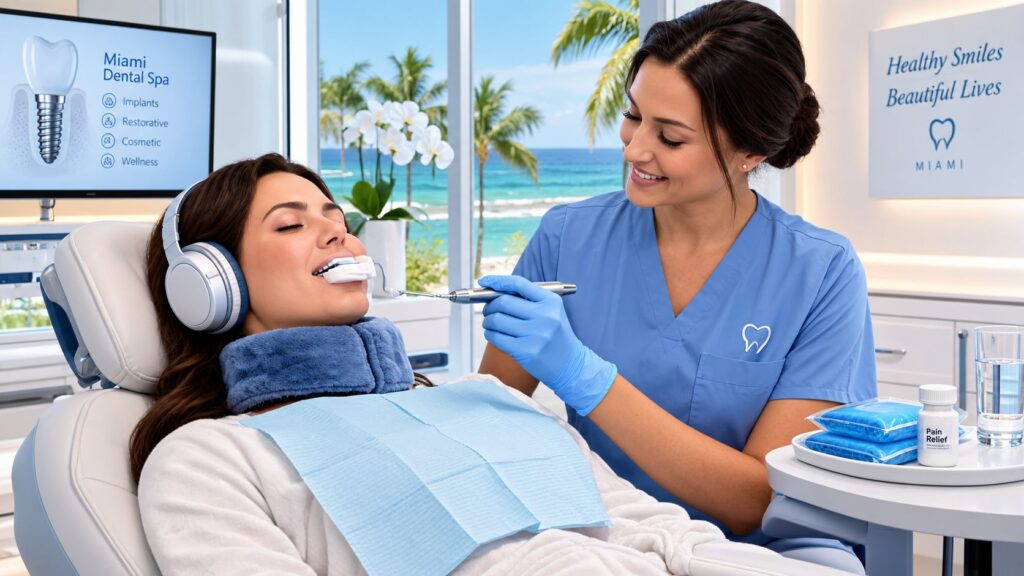
The comfort difference starts before the first instrument comes out. A spa-integrated setting, with softer lighting, noise-canceling headphones, and warm neck wraps, can lower the anxiety that makes pain feel sharper. For many patients, that atmosphere changes the whole emotional tone of the visit.
Clear communication matters just as much. A bilingual team can explain each step in plain language, which helps patients stay calmer and more cooperative during treatment. When people know what's happening and what comes next, they usually feel less trapped by the procedure.
Guided implant planning can also reduce unnecessary chair time, and same-day provisional options can keep the treatment sequence more efficient. For patients who need more support, on-site IV sedation is another comfort tool the team may use to reduce awareness and stress during surgery.
Practical convenience counts in Miami too. Easy parking near US-1, flexible scheduling for working professionals, and a direct after-hours line staffed by the clinical team help patients get answers without guessing whether a sore spot is normal. Ultra Smile DentalSpa also uses sedation options for implant surgery and local anesthesia for placement, which fits the broader goal of making the visit feel controlled instead of intimidating.
The point is simple. Comfort features are not decoration. They lower stress, and lower stress helps lower pain perception.
Book Your Implant Consultation in Miami Today
The uncertainty around dental implant surgery pain usually fades fast once a real plan is on paper. A first visit should include imaging, a one-on-one review of medical history and anxiety triggers, a written outline of likely soreness for the specific case, and a transparent estimate with timing.
Consultations in English and Spanish make it easier for Miami patients to ask direct questions, and morning or early-evening appointments can help fit the schedules of people coming from Brickell, Coral Gables, or Kendall. Bringing a list of current medications and any past dental experiences helps the team plan pain control more accurately.
For personalized care, call Ultra Smile DentalSpa in Miami, visit their office, or schedule online through their website. The goal isn't to guess how much the surgery will hurt. It's to build a comfort plan before the implant is placed, so the recovery feels manageable from the start.
If you're weighing dental implant surgery and want a calmer, more personalized experience in Miami, Ultra Smile DentalSpa can help you plan the procedure, pain control, and recovery in one visit. Learn more or book your consultation at Ultra Smile DentalSpa, then get a clear treatment plan built around your comfort, your schedule, and your goals.