In Miami, teeth straightening cost in 2026 usually falls between $3,500 and over $9,000, depending on whether a patient chooses braces or clear aligners and how complex the case is. Traditional metal braces commonly range from $3,000 to $7,000, while clear aligners in major U.S. markets usually run $3,000 to $8,000 and can go beyond $10,000 for complex treatment that needs more trays and longer supervision (Invisalign cost guide).
Many adults start in the same place. They notice crowding in photos, spacing that shows more than it used to, or a bite that feels off when chewing, but they hesitate to take the next step because the financial side feels vague. That uncertainty keeps people stuck far longer than the treatment itself.
Patients looking for a dentist in Miami, FL, or searching for a cosmetic dentist near me, usually don't just want a broad online estimate. They want to know what they'd pay, what might get added later, and whether a lower-cost option is worth the risk. They also want care that fits real life, especially in busy areas like Downtown Miami, Midtown Miami, and Hallandale Beach.
Teeth straightening isn't only about appearance. Better alignment can make daily cleaning easier, reduce wear from an uneven bite, and support long-term restorative or cosmetic work such as veneers, crowns, implants, or whitening. For some patients, a consultation also uncovers other needs first, such as cleaning and exams, dental x-rays, a new patient exam, or even a tooth extraction before movement begins.
Table of Contents
- Your Guide to Teeth Straightening Costs in Miami
- Comparing Teeth Straightening Options and 2026 Costs
- What Determines the Final Price of Your Treatment
- Beyond the Sticker Price What Else to Budget For
- Making Your New Smile Affordable with Insurance and Financing
- What to Expect During Your Consultation in Miami
- Your Teeth Straightening Questions Answered
Your Guide to Teeth Straightening Costs in Miami
A Miami patient often comes in expecting one number and leaves realizing there are two. There is the advertised price, and there is the full cost of finishing treatment properly.
That difference matters. A low quote can leave out records, refinement trays, retainers, follow-up visits, or the cost of fixing problems that started with poorly supervised mail-order treatment. A higher quote may include those items from the beginning, along with more attentive scheduling, clearer communication, and a setting that feels calmer for adults who are fitting treatment around work and family life.
The starting point is simple. Teeth straightening is priced case by case. The fee depends on the type of appliance, how much movement is needed, how closely the bite needs to be corrected, and how much supervision the case will require over time. As noted earlier, national pricing can vary widely, and Invisalign's teeth straightening cost overview shows how treatment complexity can push totals higher.
Why online estimates feel inconsistent
Many online calculators show only the appliance fee. They often leave out diagnostic images, consultation fees, mid-course refinements, replacement trays, and retention after treatment ends.
That is where confusion starts.
A meaningful estimate should tell a patient what is included, what could raise the fee later, and what happens if teeth do not track as planned. For adults comparing teeth straightening without braces, that level of detail is often more useful than a broad price range on a national website.
Why local care matters in Miami
Miami patients are not only comparing bracket types or tray systems. They are also weighing appointment convenience, time away from work, appearance in social settings, and whether they want treatment in a more private, spa-like environment instead of a high-volume office.
That local context changes value.
A consultation in Miami should answer practical questions. Is the quote all-inclusive or only a base fee. Are retainers covered. Are emergencies, refinements, and progress checks built into the plan. If the office offers a more comfortable experience, the patient should know what that adds and whether that added comfort is worth it for their schedule and stress level.
Cheaper options can work in the right case, but lower pricing sometimes comes with less supervision and fewer safeguards. For some patients, that trade-off is acceptable. For others, especially adults with bite concerns or busy professional lives, paying for clearer planning and closer follow-up is money well spent.
A local exam gives an answer the internet cannot. It shows what your teeth need, what your budget should realistically cover, and whether the quote in front of you reflects the full process from consultation to retainer.
Comparing Teeth Straightening Options and 2026 Costs
Different teeth straightening methods solve different problems. The right choice depends on how visible the appliance can be, how much discipline the patient wants in daily wear, and how much control the dentist needs over the movement.

Braces vs clear aligners in daily life
Traditional metal braces stay on the teeth all day, so they work continuously without depending on patient compliance in the same way removable trays do. They're often a strong fit when crowding or bite correction is more involved.
Clear aligners appeal to adults who want a subtle look and the ability to remove the trays for meals and photos. That flexibility is real, but so is the responsibility. If they aren't worn as directed, treatment can slow down or become less predictable.
A quick comparison helps:
| Option | Best known for | Lifestyle trade-off | Typical price context |
|---|---|---|---|
| Metal braces | Reliable control for more involved movement | More visible, fixed on teeth | Often $3,000 to $7,000 in major markets |
| Clear aligners | Discreet, removable design | Requires consistent wear and tray changes | Often $3,000 to $8,000, with complex cases higher |
What the Miami numbers look like
South Florida pricing gives patients a more local benchmark. In Miami-Dade County, Invisalign costs range from $4,500 to $9,000, while in-house clear aligners range from $3,200 to $5,500. Traditional metal braces remain in the $3,000 to $7,000 range. That local spread shows the premium many patients pay for aesthetics and removability.
Patients who are considering a more discreet approach can also review teeth straightening without braces to understand how invisible options fit different goals.
Some adults don't mind visible braces. Others care a lot about meetings, events, and photos. That preference is legitimate, and it affects value even when the clinical result may be similar.
A few patients ask about cosmetic alternatives for minor imperfections. In very selective cases, veneers may improve the appearance of slightly uneven front teeth, but veneers don't move teeth or correct the bite. They belong in cosmetic dentistry, not true orthodontic correction.
When the goal is actual tooth movement, the comparison is usually braces versus aligners. The better option isn't the one with the lower sticker price. It's the one that fits the case and can realistically get the desired result without cutting corners.
What Determines the Final Price of Your Treatment
The final fee works more like a custom-built plan than an off-the-shelf purchase. Two patients can both want straighter teeth and still receive very different recommendations.
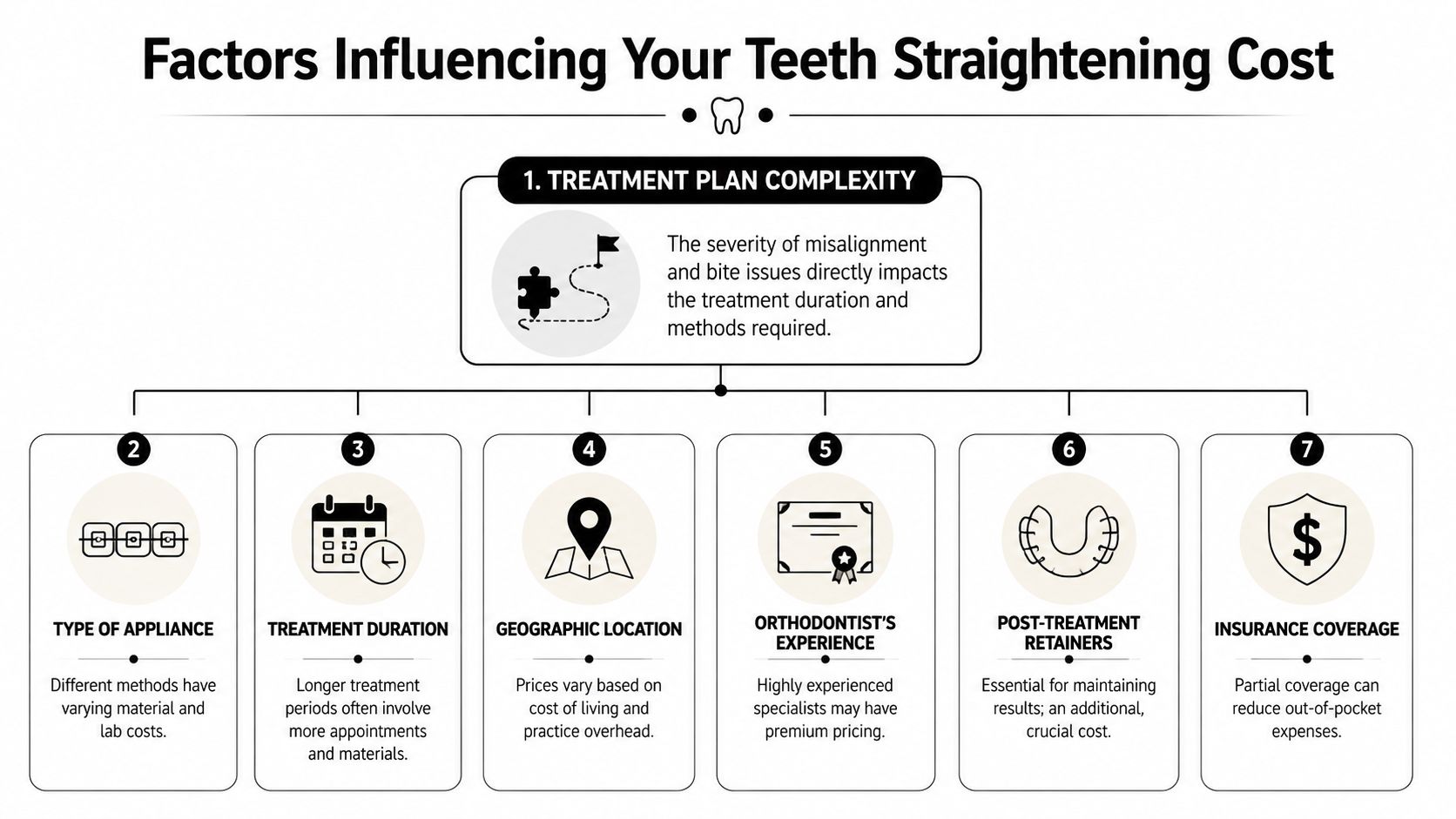
Complexity changes everything
Clear aligner pricing shows this clearly. The actual range can span from $1,800 for minor crowding to over $9,500 for complex bite issues. Mild alignment issues typically cost $1,800 to $3,500, moderate cases usually range from $3,500 to $5,500, and complex cases can exceed $5,500, often costing 3 to 5 times more than minor adjustments.
That spread exists because complexity changes nearly every part of treatment. More difficult cases often need more trays, more supervision, more refinement, and a longer timeline.
Why two patients rarely get the same quote
Several factors push a case toward the low or high end:
- Severity of crowding or spacing. A few rotated front teeth are different from full-arch crowding.
- Bite correction needs. When the upper and lower teeth don't meet correctly, the treatment plan gets more involved.
- Length of treatment. More time usually means more visits, more monitoring, and more opportunity for refinements.
- Technology and lab work. Digital scans, planning software, and custom appliance fabrication all affect the overall fee.
- Provider supervision. A plan with regular in-person assessment isn't the same as one built around remote check-ins only.
A patient may come in thinking the concern is cosmetic, but the exam may show wear patterns, gum concerns, or bite instability that change the treatment recommendation. That doesn't mean the case is “worse than expected. It means the diagnosis is becoming more accurate.
Treatment price usually follows treatment difficulty. When a quote goes up, it's often because the plan is addressing more than what shows in the mirror.
Miami also adds a local reality. Patients often want efficient scheduling, advanced imaging, and a polished experience that respects their time. Those details don't replace clinical outcomes, but they do affect how treatment is delivered and how predictable the process feels.
Beyond the Sticker Price What Else to Budget For
A patient in Miami may see one quote online, another from a mail-order aligner company, and a higher number from a dental office, then wonder why the gap is so wide. The answer is usually simple. The sticker price rarely shows the full cost of getting teeth straight, keeping them straight, and being monitored safely along the way.

Some costs show up before treatment starts. Others appear after the last tray or bracket comes off.
Costs that patients often overlook
Before active treatment begins, some patients need records and baseline care. That can include a consultation, dental x-rays, a new patient exam, or a cleaning so tooth movement starts in a healthy mouth. If there is decay, gum inflammation, or a tooth that does not have enough room, those issues may need to be handled first.
The sequence matters. Straightening often affects later cosmetic or restorative work, including whitening, veneers, crowns, and implant planning. A lower quote can stop looking low if it leaves out the care needed to make treatment safe and stable.
Patients should ask for a clear breakdown of:
- What the quoted treatment fee includes
- Whether adjustment or monitoring visits are bundled
- Whether refinement trays or mid-course corrections cost extra
- Whether the final retainer is included
- What happens if a tray, aligner, or retainer is lost
Why Retention Belongs in the Budget
Retention should be part of the financial plan from day one. Teeth can shift after braces or aligners, especially in the first months after active treatment. If retainers are not discussed clearly, patients may finish treatment with a smile they like but no clear plan to protect it.
Costs vary by material and design, so offices should explain their own fees in writing. If a patient loses or breaks a retainer later, replacement is usually an additional expense. Fixed retainers can also carry a separate fee for placement or repair. The exact amount depends on the office, the type of retainer, and whether one arch or both need coverage.
That is why I tell patients to budget for the result, not only for the movement.
Patients in Miami often care about more than the lowest possible price. They want clear communication, convenient scheduling, digital scans instead of messy impressions when possible, and an environment that feels calm rather than rushed. A spa-like dental experience does not change biology, but it can make a long treatment process easier to stay on track with, especially for busy adults balancing work, family, and appearances.
There is a trade-off here. A cheaper option may cost less upfront, but it may also offer limited supervision, less help if teeth stop tracking, and less clarity about what happens after treatment ends. Office-based care usually costs more because it includes diagnosis, follow-up, retention planning, and a place to go if something does not look right.
For patients comparing quotes, the better question is not "What is the cheapest way to straighten my teeth?" It is "What will I likely spend in total to finish treatment well and keep the result?" Reviewing monthly payment options for dental care in Miami can help make that total cost easier to plan for without cutting corners on supervision or follow-up.
Making Your New Smile Affordable with Insurance and Financing
A Miami patient might feel comfortable with the treatment fee, then hesitate once the practical question comes up. How will this fit into the monthly budget?
That conversation should happen early. Clear financial planning reduces surprises and helps patients choose a treatment they can finish, including the follow-up care that protects the result.
How to use insurance wisely
Orthodontic insurance can lower the out-of-pocket cost, but the details vary widely by plan. Some policies include adult orthodontic benefits. Some cover braces but place limits on clear aligners. Others have a lifetime maximum, waiting period, or preauthorization requirement that changes the timing of treatment.
I tell patients to verify the terms before they commit. A quick call to the insurer can save a lot of confusion later, especially if the patient is comparing two treatment options with different fees and different coverage rules.
These are the questions worth asking:
- Does the plan include orthodontic benefits for adults
- Is there a lifetime orthodontic maximum
- Does coverage apply to clear aligners as well as braces
- Is preauthorization required
- Are there in-network or out-of-network differences
Bringing the insurance card and benefit details to the consultation helps the office estimate the patient portion more accurately. It also makes it easier to discuss the all-in cost, rather than only the headline fee.
How financing can make treatment manageable
Financing is often what turns a good plan into a realistic one. Many adults in Miami prefer to spread the cost over time instead of paying everything upfront, particularly if they are also budgeting for retainers, routine dental care, or other restorative work.
Monthly payment amounts depend on the total fee, the down payment, the repayment term, and whether any insurance benefit is applied first. That is why I recommend reviewing the full terms instead of focusing on a single advertised number. For patients who want to see how office-based financing may work, these monthly payment options for dental care in Miami give a useful starting point.
A practical comparison comes down to three figures:
- The full treatment fee
- The estimated insurance contribution
- The remaining monthly payment
That approach keeps the decision grounded in what the patient will spend to complete treatment and maintain the result. In my experience, that is a much better way to compare options than chasing the lowest sticker price and finding out later that key parts of care were not included.
What to Expect During Your Consultation in Miami
A consultation should answer two questions at the same time. What does the patient need, and what will it realistically cost?

The first visit and treatment review
The visit usually begins with conversation, not pressure. The patient explains what bothers them most, whether that's visible crowding, a gap, an uneven bite, or concern that a smile makeover won't look right until the teeth are aligned first.
From there, the clinical team gathers the information needed to plan carefully. That may include an exam, digital imaging, and a review of whether there are any issues that should be treated before tooth movement starts. If someone has delayed care because of fear or discomfort, the atmosphere matters more than many people expect.
At this stage, the discussion usually becomes specific. The patient learns whether the case looks mild, moderate, or more involved, which options are appropriate, and what may be included in the full fee.
For readers who want a closer look at the office setting, this short video gives helpful context:
Why the setting matters to many adults
Adults often want more than technical competence. They want care that feels organized, calm, and respectful of their time. That's especially true for patients with dental anxiety or for busy professionals trying to fit appointments into a packed Miami schedule.
Ultra Smile DentalSpa is one Miami option that combines digital treatment planning with a spa-like environment, along with broader services such as cosmetic dentistry, implants, same-day crowns, whitening, and emergency dental care. For a patient whose straightening plan may connect to future veneers, restorative work, or a missing tooth replacement, that kind of integrated approach can simplify decision-making.
A consultation should leave the patient with clear next steps, not a vague sales pitch. If the plan is appropriate, the office should be able to explain what's included, what isn't, what may need to happen first, and how the financial side can be structured.
Your Teeth Straightening Questions Answered
How long does teeth straightening usually take
It depends on the complexity of the case and the method chosen. Mild cosmetic cases are usually simpler than bite-related cases that need more control and closer supervision. The consultation is where that timeline becomes specific.
Is teeth straightening painful
Most patients notice pressure rather than sharp pain, especially after starting treatment or moving to a new aligner stage. That pressure is expected because the teeth are shifting. If something feels excessive, the office should evaluate it.
Can teeth be whitened during treatment
Whitening timing depends on the appliance and the overall smile plan. Many adults get the best cosmetic result when whitening is planned with the dentist rather than started randomly during treatment. If veneers or bonding are being considered later, shade planning matters.
Why choose a dentist in Miami instead of a cheaper at-home aligner kit
Because lower price doesn't always mean lower risk. Independent expert commentary warns that at-home aligners can miss underlying bite or jaw issues without an in-person assessment, increasing the risk of gum recession, loose teeth, bite problems, and potentially expensive irreversible damage, as discussed in this expert video on risks of unsupervised at-home aligners.
That doesn't mean every mild case needs the same level of treatment. It does mean a patient should know what problem is being treated before choosing the cheapest path. Professional evaluation helps separate a simple cosmetic alignment issue from a case that could become more expensive if handled without proper diagnosis.
If a straighter smile has been on the back burner because the numbers felt unclear, a consultation can turn that uncertainty into a real plan. Ultra Smile DentalSpa provides teeth straightening evaluations for patients in Miami, FL, including Downtown Miami, Midtown Miami, and Hallandale Beach, with guidance on treatment options, full cost considerations, and ways to fit care into a realistic budget.