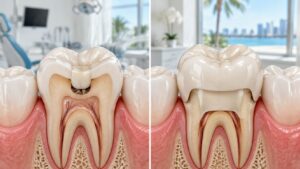
A root canal is usually worth it when the tooth can be restored, with modern success rates around 88.6% to 94% in the studies most patients need to hear about. The question in Miami is not “root canal or nothing, it's whether saving the tooth beats extraction now plus the cost, time, and hassle of replacing it later.
When someone is sitting in a chair in Miami, FL with a throbbing molar, the decision feels bigger than a procedure. It's about whether the tooth can still chew, whether the pain will stop, and whether a calm dentist near me can solve the problem without turning the rest of the month into a chain of extra appointments.
Table of Contents
- Why You're Asking Whether a Root Canal Is Worth It
- What a Root Canal Does to Save a Tooth
- The Signs That Point Toward Needing a Root Canal
- What Success and Survival Numbers Mean for You
- Root Canal vs Extraction and Replacement in Miami
- What a Gentle Root Canal Visit Feels Like in Miami
- How Anxiety and Comfort Change the Outcome
- A Simple Way to Decide and Book Your Visit
Why You're Asking Whether a Root Canal Is Worth It
The search usually starts with a real event, not a theory. A tooth starts throbbing at 2 a.m., a cracked molar hurts after Cuban coffee, or a quote arrives that feels steeper than expected. In that moment, the question is usually about time, cost, and comfort over the long run.
That is the right way to judge it. A root canal is a decision about keeping a natural tooth in place or choosing extraction and the treatment that follows. In Miami, where patients can go from emergency dentist care to full restorative dentistry and dental implants near me, the cheapest first move is not always the smartest lifetime choice.
The decision is longer than one appointment
A lot of people ask whether the procedure hurts. That matters, but it is only part of the picture. The bigger issue is whether saving the tooth protects chewing, keeps neighboring teeth stable, and avoids the chain reaction that can follow a missing molar.
Practical rule: If the tooth can still be restored, keeping it usually makes more sense than pulling it.
That is especially true for patients who want a steady bite and want to avoid jumping straight into replacement work. If the choice is between a tooth that can be saved and a socket that will need more treatment later, the worth-it answer becomes much clearer.
What a Root Canal Does to Save a Tooth
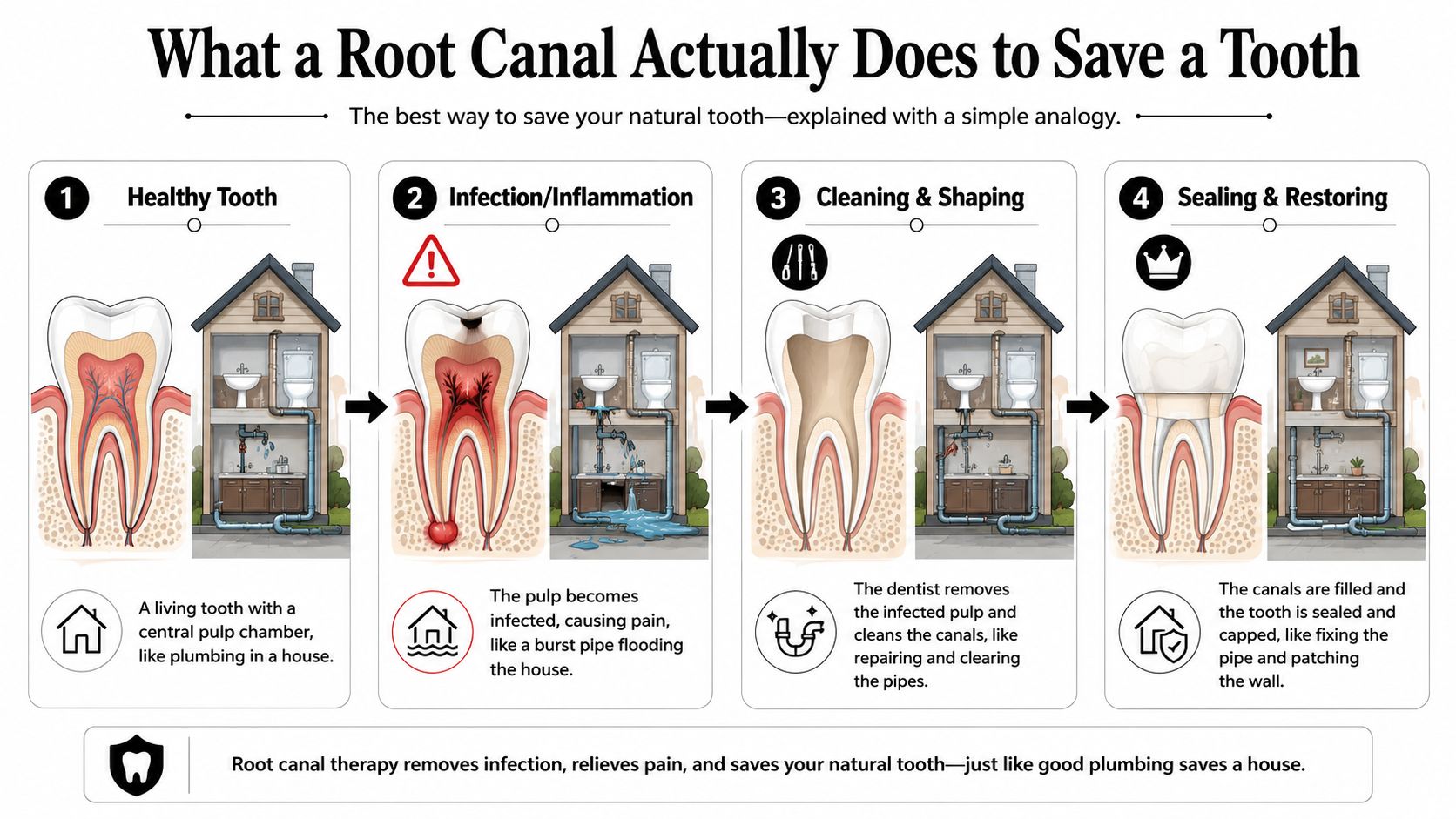
A good way to understand endodontic treatment is to see the tooth as a small house with plumbing running through the middle. The pulp is the living tissue inside that structure. When deep decay, trauma, or a crack inflames or infects it, the damaged tissue has to be removed so the tooth can stay in place.
The procedure is direct. The dentist numbs the tooth, opens a small access point, removes the infected tissue, disinfects the canals, fills them with a biocompatible material, and seals the tooth so it can later be rebuilt with a crown. The goal is simple: stop pain, clear infection, and keep the natural tooth instead of extracting it.
Fear makes people think the tooth is gone once the nerve is removed. That is not how it works. The tooth stays in the mouth, supported by the surrounding bone and ligament, and it can still do its job in the bite after proper restoration. Natural enamel and root structure are hard to replace well with any artificial option.
Why saving the tooth still matters
Extraction clears the problem, but it also removes the root. After that, the patient has to deal with healing, replacement, and bite changes. A root canal keeps the original tooth working, which is usually the smarter choice when the tooth can still be repaired.
The best candidates are teeth that are structurally restorable. In those cases, root canal therapy is a practical way to keep a useful part of the mouth functioning, and it often avoids a bigger replacement plan later. In a calm Miami setting, where anxious patients do better when the visit is comfortable and the follow-through is easy, that long-term value matters even more.
The Signs That Point Toward Needing a Root Canal
Pain is the loudest clue, but it's not the only one. A tooth that needs endodontic care can show up as lingering hot or cold sensitivity, throbbing pain that wakes someone up, tenderness when biting, or swelling in the cheek or jaw. A small draining pimple on the gum and a tooth that starts darkening are also classic warning signs.
Some symptoms need faster attention than others. Facial swelling and fever are urgent. Lingering sensitivity or pain when chewing still deserves a same-week visit, because waiting usually makes treatment more complicated and less comfortable.
What patients in Miami should watch for
- Pain that lingers: Heat, cold, or sweetness doesn't just zing and stop. It hangs around longer than it should.
- Biting tenderness: Pressure hurts when chewing or tapping the tooth.
- Gum drainage: A small bump or pimple on the gum can signal a chronic infection.
- Color change: A darkening tooth can mean the pulp is damaged.
- Swelling: Cheek or jaw swelling is a sign the problem is moving beyond simple irritation.
| Common Signs That Suggest a Root Canal May Be Needed | ||
|---|---|---|
| Symptom | What It Suggests | Urgency Level |
| Lingering sensitivity | Inflamed or infected pulp | Same-week visit |
| Throbbing pain | Advanced nerve irritation or infection | Same-week visit |
| Gum pimple or drainage | Ongoing infection | Prompt evaluation |
| Swelling in face or jaw | Infection spreading beyond the tooth | Urgent |
| Tooth darkening | Internal damage or nerve death | Prompt evaluation |
Sometimes the tooth barely hurts at all. It can look almost normal and still need treatment after trauma or deep decay, which is why a recent exam and dental x-rays matter more than online guessing. The smartest move is to match the symptom pattern to the tooth, not to a forum thread.
What Success and Survival Numbers Mean for You
The numbers behind root canal treatment are strong enough to matter in a real decision. A 2022 systematic review reported pooled success rates of 92.6% under loose criteria and 82.0% under strict criteria, and a prospective cohort of 816 teeth found 88.6% overall success at the tooth level and 90.3% at the root-canal level (PMC cohort data). Those figures are not a promise, but they do show that saving a tooth with a restorable structure is usually a smart move.
The starting condition changes the outlook. In that cohort, teeth treated with vital pulp therapy succeeded in 91.5% of cases, while necrotic teeth without detectable periapical bone lesions succeeded in 89.5%. Once apical periodontitis was present, success fell to 82.7%, and larger lesions of at least 5 mm fell to 78.2% (PMC cohort data).
Success is not the same thing as survival
A tooth can heal well and still need solid follow-up to keep doing its job. A U.S. National Library of Medicine summary reported root canal treatment plus restoration survival of 94% at 2 to 4 years, 94% at 4 to 6 years, and 97% after more than 6 years (NLM review). That is why the crown matters so much. The procedure itself is only part of the value.
| Root Canal Success vs Survival at a Glance | ||
|---|---|---|
| Metric | Typical Range | What It Really Means |
| Procedure success | 82.0% to 92.6% | The tooth is likely to heal and stay functional |
| Tooth-level success in a large cohort | 88.6% | Real-world outcomes stay strong when the tooth can be restored |
| Survival after restoration | 94% to 97% | The tooth can remain durable for years |
Bottom line: A restorable tooth usually deserves serious consideration before extraction.
Three questions turn those percentages into a personal call. Is the infection limited or already advanced? Can the tooth be crowned soon after treatment? Is the tooth strong enough to stay in service? In Miami, where a calm visit and good follow-through can make treatment much easier to finish, those questions matter as much as the numbers.
Root Canal vs Extraction and Replacement in Miami
The first bill never tells the whole story. A root canal plus crown usually costs more up front than an extraction, but extraction can start a longer and pricier replacement path. The review evidence cited earlier shows that treated teeth can stay functional for years, and implant-supported single crowns are also durable. Both routes can work. They solve different problems.
Short-term cost often favors extraction. A recent cost-effectiveness analysis found mean costs around $280 for extraction and $689 for root canal treatment, but that picture changes once you add the likely cost of replacing the tooth with an implant, bridge, or partial denture (cost-effectiveness evidence). That is the part many “is a root canal worth it articles leave out.
| Option | Upfront Logic | Long-Term Tradeoff |
|---|---|---|
| Root canal plus crown | Higher initial investment | Keeps the natural root and usually preserves the bite |
| Extraction plus implant | Lower immediate pain from removal, higher replacement burden later | Can be durable, but requires more steps and healing time |
| Extraction plus bridge | Uses neighboring teeth for support | Can affect healthy teeth |
| Extraction plus partial | Least invasive at first | More maintenance and less natural feel |
For many Miami patients, the hidden costs matter more than the first invoice. Extraction can mean bone changes, healing time, and future restoration work. A bridge or partial fills the gap, but it does not feel the same as keeping the natural tooth. If you want a plain comparison before deciding, this root canal vs extraction guide is the right next read.
What a Gentle Root Canal Visit Feels Like in Miami

Most patients expect the worst and feel less than they feared. After numbing, the tooth is isolated with a dental dam, the infected tissue is removed, and the canals are cleaned with modern rotary or single-file systems that help shorten chair time. What patients usually feel is pressure, vibration, and maybe brief sensitivity, not the sharp pain they were bracing for.
A single-root tooth is often handled in about 60 to 90 minutes in a focused visit, though the exact timing depends on the tooth and the level of infection. Some teeth are finished in one appointment, others need two visits if the tooth needs extra cleaning or medication between stages. The point is not to drag the process out, it's to get the tooth sealed and protected.
The comfort details matter more than people think. Noise-canceling headphones, warm blankets, aromatherapy, ceiling TVs, and oral or IV sedation can make the appointment feel much more manageable for anxious patients. A spa-style office doesn't change the biology of the tooth, but it can change whether the patient can sit through the treatment calmly.
Here's the video walkthrough of the appointment flow.
What comfortable care changes
In a calm Miami setting, the visit feels less like a crisis and more like a controlled repair. That matters because the patient leaves less tense, more willing to finish the crown, and less likely to delay the next step. The best technical work still depends on the patient showing up and staying engaged.
How Anxiety and Comfort Change the Outcome
Dental anxiety changes outcomes in ways many people ignore. Prior negative dental experiences are linked to higher anxiety during root canal treatment, and higher anxiety is tied to greater physiological stress in the chair. Another study found lower success rates among high-anxiety patients, 65% versus 85%, along with lower satisfaction (anxiety and outcome research).
The problem is not fear alone, it's what fear causes. Patients delay the visit, miss the follow-up, or never complete the crown. That is where a tooth that might have been saved starts to fail in real life.
Comfort is not a luxury add-on. It is part of adherence.
A calm environment, noise-canceling headphones, blankets, sedation when appropriate, and a clear restoration plan all support completion. That matters in a spa-like practice setting such as Ultra Smile DentalSpa, where comfort is built into the visit instead of treated as an afterthought. When a patient feels safe, the plan is more likely to get finished on time.
| Comfortable Care | Unmanaged Anxiety |
|---|---|
| Reduces pain perception | Leads to delayed or avoided care |
| Encourages timely follow-up | Increases likelihood of missed appointments |
| Helps patients finish the crown and restoration | Raises the risk of incomplete treatment |
The patient who postponed for two years usually pays more later. The patient who finally relaxes enough to complete treatment in one visit often walks out with a clearer path and less stress. The patient who returns for the crown because the office feels safe is the one who gives the tooth its best chance.
For patients who need extra support, this dental anxiety resource can help frame the visit in practical terms before the appointment.
A Simple Way to Decide and Book Your Visit
Three questions usually settle the debate fast. First, is the tooth restorable? If the answer is no because the crack runs too deep or there's not enough structure left, extraction may be the cleaner choice. If the answer is yes, saving the tooth deserves serious weight.
Second, is the bone and gum support healthy enough for the tooth to last after restoration? A root canal without a solid foundation is not a good bargain. Third, can the crown or final restoration be completed soon enough to protect the tooth long term? Waiting too long can undermine an otherwise good procedure.
A quick decision framework for Miami patients
- Restorable tooth: Root canal usually stays on the table.
- Not restorable: Tooth extraction becomes the more realistic option.
- Comfort concerns: Ask about sedation, headphones, and a calm visit style before treatment starts.
- Follow-up commitment: Make sure the crown plan is clear before leaving.
At the consultation, bring your insurance details, a list of medications, and any questions about crown timing, comfort options, and financing. A good dental office should verify benefits early, explain the sequence of care, and tell you whether the tooth needs a root canal, extraction, crown, or another restorative step. That is the point where the worth-it calculation stops being abstract.
The right environment often makes the decision clearer than expected. A patient who walks in unsure usually leaves with a practical answer once the tooth is examined, the costs are laid out, and the comfort plan is set.
Ultra Smile DentalSpa offers root canals, crowns, extractions, implants, and anxiety-aware dental care in a calm Miami setting. If the question is whether saving your tooth is worth it, schedule a visit with Ultra Smile DentalSpa and get a clear, comfortable plan before the problem gets bigger.