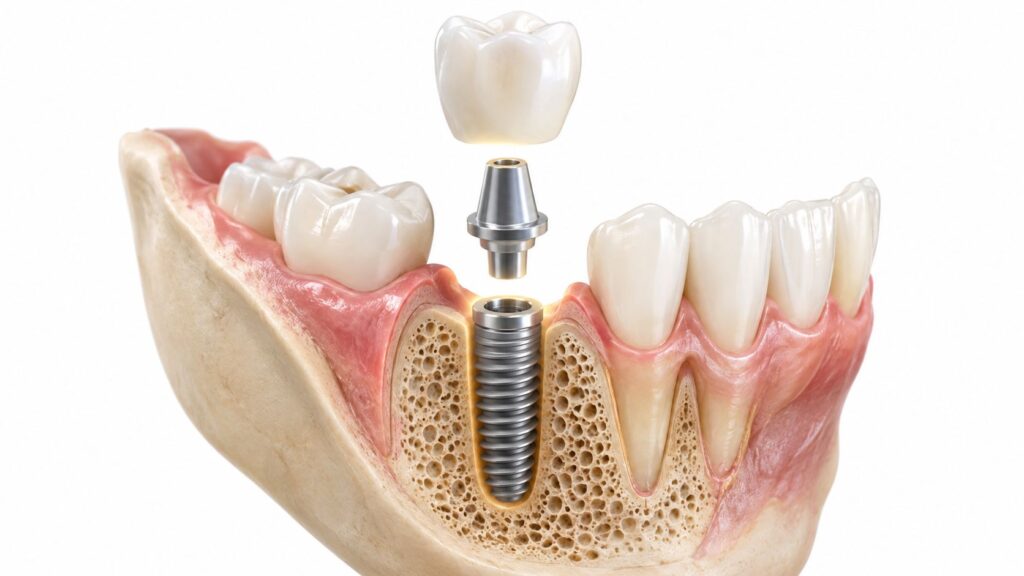
A missing tooth can make ordinary moments feel unexpectedly complicated. A Miami resident may chew on one side, avoid crunchy foods, or feel self-conscious during a conversation at a restaurant in Downtown Miami. Even a back tooth that no one sees can affect comfort, confidence, and the way the rest of the mouth carries biting forces.
Dental implants offer a way to replace more than the visible part of a tooth. They replace the tooth root, support a custom restoration, and give the jawbone a stable structure around which it can heal. For someone searching for dental implants near me, a dentist in Miami, FL, or a calm alternative to a rushed surgical experience, understanding the biology matters as much as understanding the procedure.
Table of Contents
- Restoring Your Smile in Miami
- The Three Parts of a Dental Implant
- Osseointegration and the Healing Timeline
- Long-Term Maintenance and Biological Health
- Digital Planning and Same-Day Options
- Your Spa-Like Experience at Ultra Smile DentalSpa
- Schedule Your Implant Consultation in Miami
Restoring Your Smile in Miami
A missing tooth often starts as a small inconvenience. A person may postpone a tooth replacement after an extraction, thinking the gap can wait. Over time, chewing can feel less balanced, smiling can feel less relaxed, and the surrounding teeth may no longer share everyday forces in the same way. The jawbone also depends on stimulation from tooth roots, so a missing root changes the biological environment beneath the gum.
Dental implants address that deeper problem by placing a root substitute in the jawbone and adding a carefully designed replacement tooth above it. The result isn't just a cosmetic cover over an empty space. It's a coordinated restoration intended to support chewing, appearance, and the health of the surrounding tissues.
A missing tooth affects more than a smile. Treatment planning should consider the jawbone, gums, bite, overall health, and the patient's comfort with each stage of care.
For a Miami patient, the decision may begin with a simple question: should the missing tooth be replaced with an implant, a bridge, or another restoration? The answer depends on bone volume, gum health, the location of the tooth, bite forces, medical history, and long-term goals. A new patient exam, dental X-rays, and a careful discussion can clarify whether implant treatment is appropriate.
Implants may also follow tooth extraction when a tooth can't be restored. Other patients first need treatment for gum disease, a bone graft, or a damaged neighboring tooth. A cosmetic dentist near me may focus on shade, shape, and smile design, while a restorative dental evaluation also considers the structure supporting the final crown.
Patients in Downtown Miami, Midtown Miami, and nearby communities often want both clinical clarity and a comfortable setting. A consultation should leave the patient understanding what will happen, why healing takes time, and how daily care will protect the result. That calm, personalized approach helps transform a frightening gap into a manageable plan.
The Three Parts of a Dental Implant
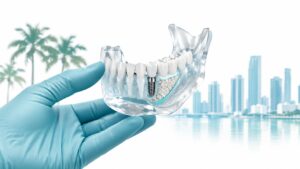
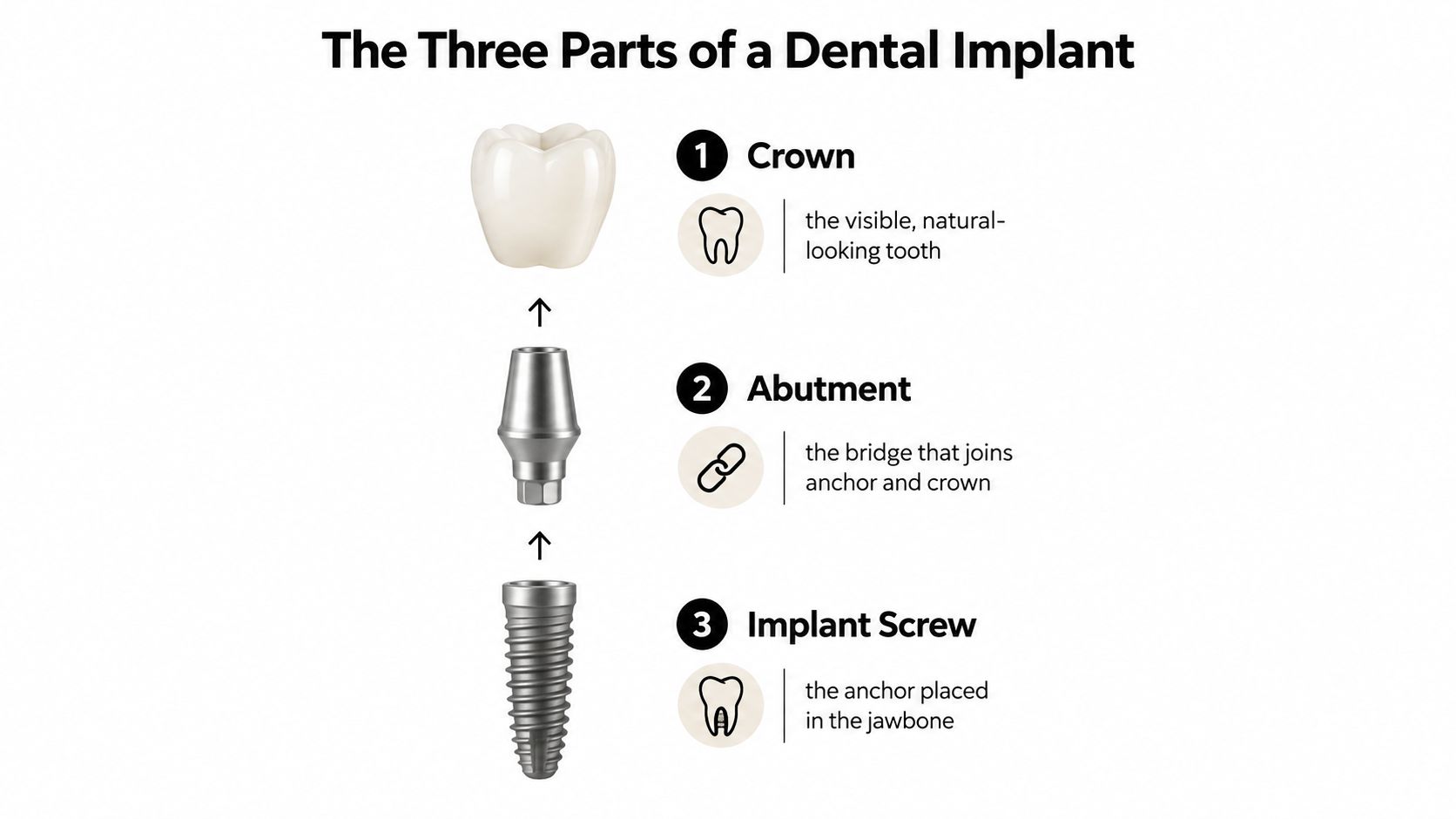
Many patients use the word “implant to describe the entire replacement tooth. Clinically, an implant restoration has three connected components, much like a building with a foundation, a connector, and the visible structure above ground.
The fixture anchors the restoration
The implant fixture is the portion placed inside the jawbone. It functions as an artificial tooth root and is usually made from titanium or zirconium oxide, materials selected for their established safety and biocompatibility. The FDA describes a dental implant system as including components that may remain in permanent contact with bone and tissue, so manufacturers evaluate potential biological effects such as irritation and allergic reactions through the device review process (FDA guidance on dental implants).
The abutment connects the parts
The abutment is the connector secured to the fixture after the foundation has healed, or incorporated into the restoration plan depending on the system. It joins the implant below the gum with the crown above it. A dentist evaluates the position, gum contours, bite, and planned crown shape so the connection supports both function and a natural appearance.
The crown restores the visible tooth
The crown is the part patients see. It's custom-made to replace the missing tooth and can be shaped and shaded to coordinate with neighboring teeth. The crown isn't the implant itself. The fixture anchors, the abutment connects, and the crown restores the visible chewing surface.
Patients comparing titanium and zirconia options can review the practice's information about zirconia dental implants during treatment planning. Patients also benefit from choosing a dental practice with clear communication and a strong local presence. Resources such as Leaping Lemur Media for dentists can help dental practices explain services clearly online, but the treatment decision still belongs in a personalized clinical consultation.
Osseointegration and the Healing Timeline
A dental implant begins its work long before the crown is attached. After placement, the jawbone starts forming direct contact with the implant surface, and that process is called osseointegration. Under the microscope, the bone gradually locks to the fixture so chewing forces can move from the crown, through the abutment and implant, into the surrounding bone.
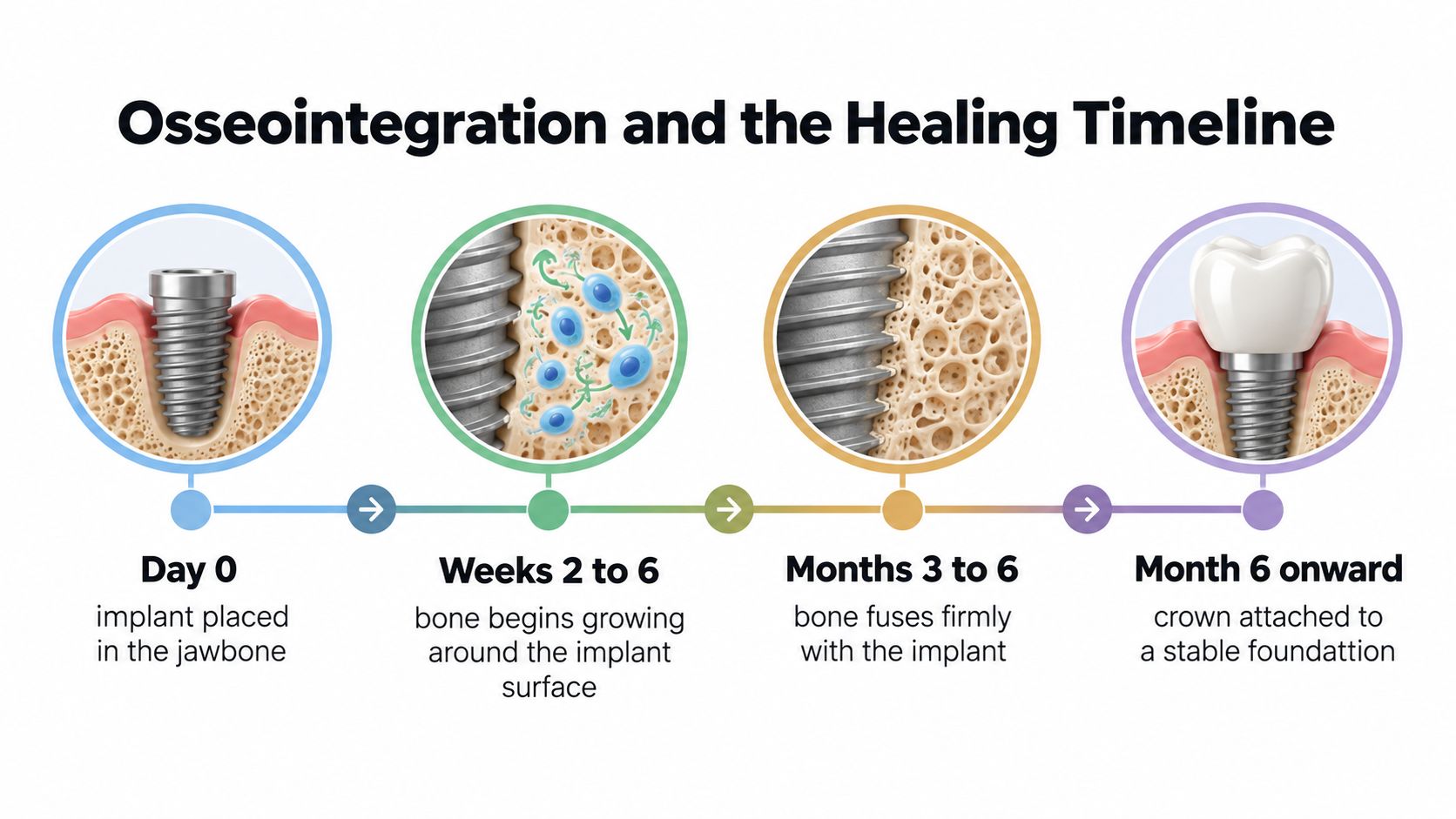
At the start, stability is mainly mechanical. Implant shape, bone density, insertion stability, dimensions, and how much bone contact exists all affect how firmly the fixture sits right after placement. As healing continues, the body remodels the surgical interface and replaces it with mineralized bone, so stability becomes biological.
That is why the healing phase cannot be rushed. Too much movement during this period can lead to fibrous tissue instead of solid bone attachment. The implant may look settled from the outside while the foundation below is still maturing.
Why location and bone quality matter
Traditional protocols allowed at least three months of submerged healing in the lower jaw and six months in the upper jaw before loading, according to a review of implant healing protocols (review of dental implant osseointegration). Published reviews also report healing periods of approximately three to six months for some implant surfaces in the right clinical setting (review of dental implant osseointegration).
The timeline still depends on bone quality, implant location, primary stability, occlusion, smoking, systemic health, parafunctional habits, and whether grafting is needed. A patient with limited bone may need a graft before or during implant treatment. For a plain-language explanation of that step, see whether dental bone grafts are necessary, although only an examination and imaging can show whether it applies in a given case.
Healing is not ruled by the calendar alone. A dentist chooses immediate, early, or conventional loading based on anatomy and stability, not just on how many weeks have passed.
Long-Term Maintenance and Biological Health
An implant can restore chewing and confidence, yet its long-term health depends on living gum and bone. The crown cannot develop cavities like a natural tooth, while the tissues around it still respond to plaque, bacteria, biting forces, smoking, diabetes, and daily hygiene.
Peri-implant mucositis means inflammation around an implant without the progressive supporting-bone loss associated with peri-implantitis. It can generally improve when its cause is addressed. Peri-implantitis is more serious. Ongoing inflammation may destroy supporting bone, weaken osseointegration, and place the implant at risk.
A clinical review of peri-implant diseases estimates peri-implantitis at approximately 10% of implants and 20% of patients. The figures vary with case definitions and follow-up. The same review supports structured maintenance, with quarterly visits may be appropriate when a patient's individual risk warrants that schedule (clinical review of peri-implant diseases). Previous periodontitis, poor plaque control, smoking, uncontrolled diabetes, excessive biting forces, and missed care can increase risk.
What daily protection looks like
Follow the home-care plan prepared by your dental team. Depending on the restoration and gum contours, it may include careful brushing, cleaning between teeth, and targeted tools for reaching around the implant crown and abutment.
Professional visits reveal changes that a mirror cannot show. The dental team may check the tissues with periodontal probing, look for bleeding or swelling, assess the bite, and take radiographs when appropriate. The visit schedule should reflect your healing, medical history, home care, and signs of inflammation.
Implant success is a partnership, not a finish line. You manage daily plaque removal, while the dental team monitors the tissues, bite forces, and early changes.
Contact your dentist about swelling, persistent bleeding, a bad taste, drainage, looseness, or discomfort. A resource on spotting infection after root canal offers broader guidance about oral infection signs. Implant symptoms still need direct evaluation because several conditions can look alike. In a calm Miami practice, regular maintenance helps protect the biological foundation behind the smile.
Digital Planning and Same-Day Options
A digital implant plan can make a complex treatment easier to understand before surgery begins. Three-dimensional imaging helps the dentist assess available bone, nearby anatomy, and the planned relationship between the implant fixture and final crown. Guided planning also gives the patient, dentist, laboratory, and surgical team a shared view of the proposed result.
“Same-day describes timing, not completed healing. An implant may be placed during an extraction visit, a temporary tooth may be fitted quickly, or a digital scan may support rapid fabrication. These options involve different clinical decisions, and none means the implant has already completed osseointegration.
What technology can and can't promise
A review of digital and implant technologies describes hydrophilic and nanostructured surfaces, zirconia and titanium-zirconium materials, CBCT-based planning, CAD/CAM, and 3D printing as important areas of development. It also discusses a clinical study in which fully digital and conventional workflows showed comparable impression accuracy, framework adaptation, and aesthetics, while digital fabrication reduced production time. The review notes that much of the supporting evidence remains preclinical or short-term.
Technology supports diagnosis, planning, communication, and production. It does not guarantee faster bone healing, remove the possibility of complications, or make immediate loading suitable for every patient.
The practical choices are easier to compare:
- Digital planning improves visualization and coordination, but healing still depends on the patient's biology.
- Immediate loading may work in carefully selected cases with adequate stability. Movement during early healing can interfere with integration.
- Conventional loading takes more time, but may offer a more cautious route when bone quality, implant stability, or grafting calls for patience.
Ask whether the proposed workflow changes healing time, comfort, grafting needs, or future maintenance. The answer rests on anatomy and health, not just on the technology's name. A carefully planned digital process can support a calm experience in the treatment room, while long-term success still depends on protecting the living tissues around the implant.
Your Spa-Like Experience at Ultra Smile DentalSpa
An implant consultation should feel structured, not rushed. At Ultra Smile DentalSpa, Dr. Neda Bahmadi and the team evaluate the missing tooth, neighboring teeth, gums, jawbone, bite, medical history, and desired outcome. Digital imaging and individualized treatment planning help organize the clinical information before the patient commits to a procedure.

The visit can also address related needs. Some patients require a tooth extraction first. Others may need a bone graft, a crown, treatment for gum disease, or a temporary restoration while the implant heals. Patients seeking a cosmetic dentist near me may also want to coordinate implant treatment with veneers, teeth whitening, composite fillings, or other smile services so the final result looks balanced.
A calmer approach to dental care
Dental anxiety can make a complex treatment plan feel even more intimidating. A hospitality-focused environment gives patients room to ask questions and understand each decision before treatment begins. Ultra Smile DentalSpa offers refreshments, custom aromatherapy, streaming entertainment during procedures, and a soothing hot towel finish as part of its patient experience.
The practice serves patients in Downtown Miami, Midtown Miami, and Hallandale Beach, with bilingual staff, transparent treatment planning, accepted insurance, and options for patients without coverage. That practical support matters because a long-term implant plan includes appointments, home care, professional maintenance, and decisions about related restorative services.
Patients don't need to arrive knowing whether immediate loading, grafting, titanium, or zirconia is right for them. A careful evaluation can explain the available choices in plain language, including the benefits, limitations, healing demands, and maintenance responsibilities connected with each path.
Schedule Your Implant Consultation in Miami
Dental implants can restore a missing tooth's visible appearance and provide a stable foundation for chewing. They may also support the jawbone environment more effectively than a restoration that replaces only the crown. The right plan still depends on gum health, bone volume, bite forces, medical history, smoking, diabetes control, and the patient's ability to maintain the area over time.
A consultation at an implant dentist in Miami, FL should answer practical questions:
- Treatment sequence: Whether tooth extraction, grafting, implant placement, temporary restoration, and final crown placement are needed.
- Healing expectations: Which loading approach fits the available stability and bone quality.
- Maintenance requirements: How the patient should clean around the restoration and how often professional monitoring is appropriate.
- Financial planning: What the complete treatment includes, which insurance benefits may apply, and what options exist for patients without coverage.
Patients with sudden dental pain, swelling, trauma, or a broken tooth shouldn't wait for a routine implant consultation. An emergency dentist can first address the urgent problem, then discuss tooth replacement when the mouth is stable. Patients who are unsure whether a damaged tooth needs a root canal, extraction, crown, or implant can begin with a thorough exam and dental X-rays.
For Miami adults searching for dental implants near me, scheduling the first evaluation is the clearest next step. A calm conversation can replace uncertainty with a personalized path toward a healthier, more complete smile.
Ultra Smile DentalSpa provides personalized implant consultations, digital treatment planning, restorative care, and comfort-focused dentistry for patients in Miami, including Downtown Miami and Midtown Miami. Visit Ultra Smile DentalSpa to request an appointment and discuss a long-term tooth replacement plan with the dental team.