High pressure water teeth cleaning means two different things, a home water flosser and the professional ultrasonic scaler used during a dental cleaning. The home device can help with daily gumline care, but it does not replace the professional cleaning that removes hardened tartar.
If a Miami patient has been hearing about a “water tool at the dentist and seeing countertop irrigators all over social media, the confusion is understandable. The term sounds like one simple thing, but in practice it covers different tools with different jobs, and only one of them is designed to clear calculus safely during a visit with a high pressure water teeth cleaning dentist.
Table of Contents
- What High Pressure Water Teeth Cleaning Actually Means
- The Three Clinical Techniques Behind the Term
- Home Water Flossing vs Professional Ultrasonic Cleaning
- What the Research Says About Real Outcomes
- Who Benefits Most and Who Should Adjust
- What to Expect Before, During, and After Your Visit
- Cost, Insurance, and Choosing the Right Miami Dentist
- Schedule Your Water-Assisted Cleaning in Miami
What High Pressure Water Teeth Cleaning Actually Means
A patient sitting in a Miami dental chair may hear the hygienist mention the water tool and assume it's the same device that sits on a bathroom counter at home. It isn't. The phrase is a shortcut for a group of water-based cleaning methods, and the setting determines whether the water is being used for gentle interdental cleaning or for professional scaling during a visit.
Two different tools, two different jobs
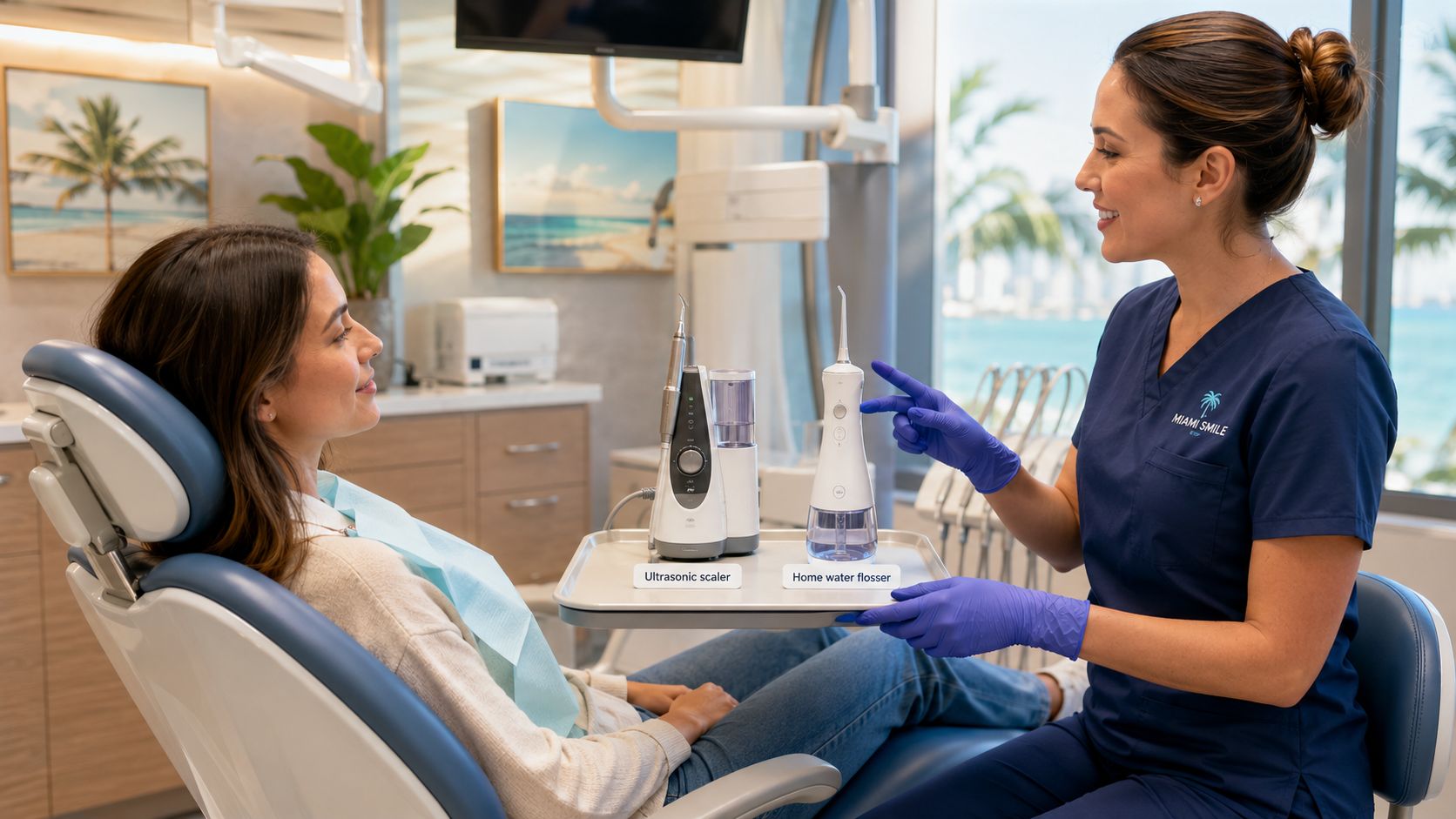
The home version is an oral irrigator, also called a water flosser. It sends a pulsating stream of water between teeth and along the gumline to help remove loose biofilm and rinse hard-to-reach areas. That makes it useful between professional visits, especially for people with braces, bridges, implants, or tight contacts where string floss can be awkward.
The office version is the ultrasonic scaler used during a dental cleaning. It combines ultrasonic tip vibration with a continuous water spray to disrupt hardened plaque and tartar while cooling the tip and washing debris away, with tip oscillation around 25,000–50,000 vibrations per second according to a clinical description from Aspen Dental (Aspen Dental on ultrasonic scaler cleaning).
The practical split is simple, the home tool helps manage soft buildup, the in-office tool removes the hardened buildup that brushing and rinsing leave behind.
That distinction matters before anyone books an appointment. Miami patients often want gentler care, and a water-based cleaning can feel more comfortable than old-fashioned scraping in many cases, but the visit still has to end with professional removal of tartar if calculus is present.
The Three Clinical Techniques Behind the Term
A single appointment usually involves a sequence of water-based tools working together. Patients hear one phrase, but in the chair they experience separate steps, each with a different job. That is the part marketing often blurs into “water cleaning.
What the patient experiences
First is the home water flosser concept, even if the patient does not bring the device into the office. Its role is familiar, a pulsating stream aimed between the teeth and along the gumline to manage daily biofilm. For many patients, that means easier cleanup around orthodontic brackets, implant parts, bridgework, or the back molars that are hard to reach with string floss.
Second is the ultrasonic scaler, the device that does the heavy lifting in a cleaning visit. It uses vibration and water together to loosen hardened deposits that cling to enamel and root surfaces. The water is not only there for comfort, it also cools the tip and flushes away debris so the hygienist can keep moving efficiently.
Third is air-water polishing or stain removal, which many hygienists use to finish the visit. This step addresses surface stain and smoothing, not tartar removal. It often leaves teeth feeling cleaner because the remaining film and discoloration are treated after scaling is done.
A useful way to separate the tools is by texture. Soft film can be rinsed and disturbed at home, hardened calculus needs professional instrumentation, and stain often needs a finishing step after the tartar is gone.
Practical rule: if a deposit feels hard against the tooth, it belongs in the dental chair, not at the sink at home.
A Miami dental visit may use more than one water-based tool in one sitting because each one handles a different layer of the problem. The hygienist matches the instrument to the job instead of asking one device to do everything.
Home Water Flossing vs Professional Ultrasonic Cleaning
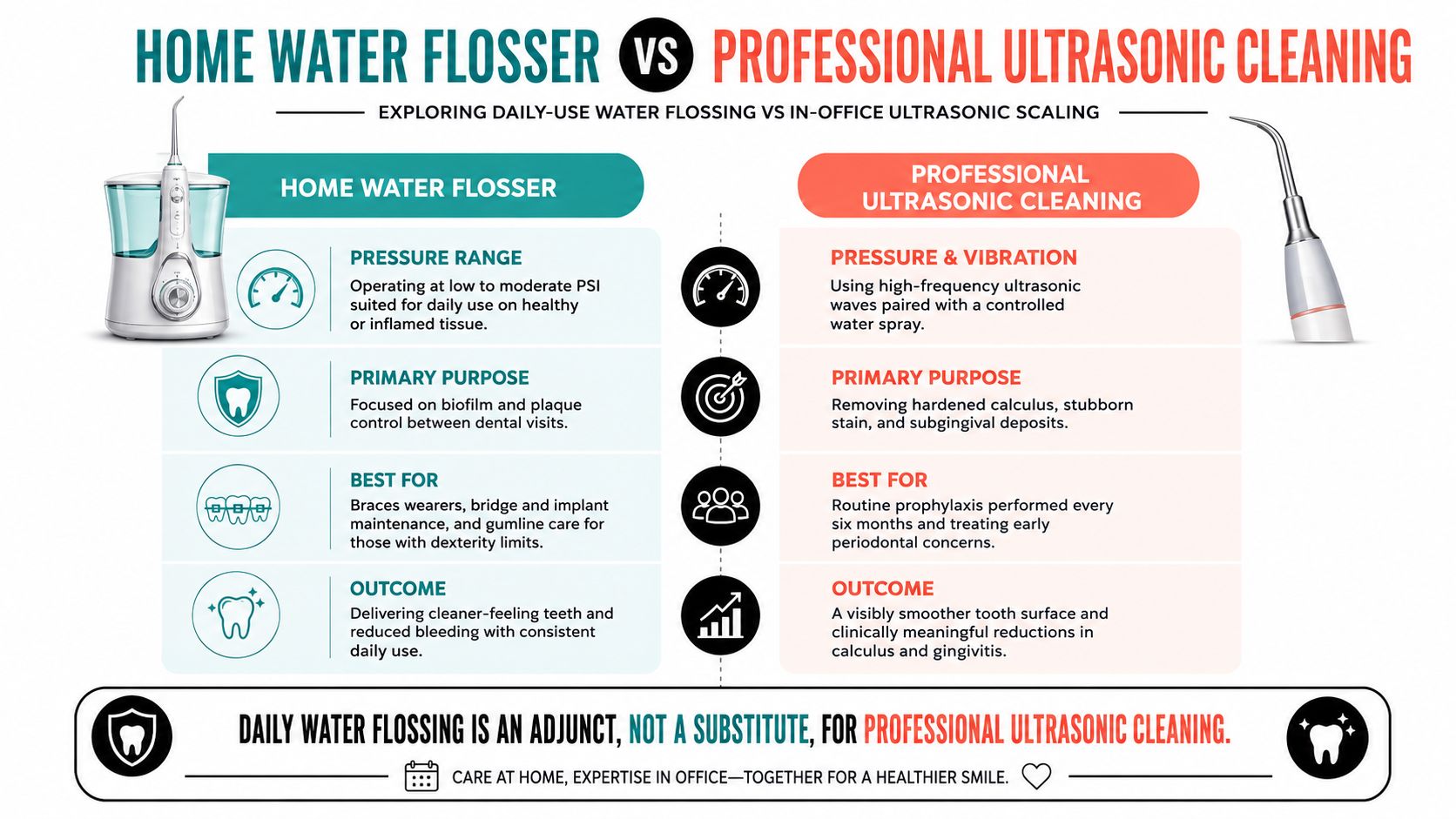
A lot of patient confusion disappears once the two approaches are placed side by side. Home irrigation is about daily maintenance, while professional ultrasonic cleaning is about removing what has already hardened and can't be rinsed away.
| Feature | Home Water Flosser | Professional Ultrasonic Cleaning |
|---|---|---|
| Main role | Daily biofilm control between visits | Removal of hardened calculus and debris during cleaning |
| What it feels like | Pulsating water stream | Vibrating tip with water spray |
| Best use cases | Braces, bridges, implants, gumline care, dexterity limits | Routine prophylaxis and areas with tartar buildup |
| What it can't do well | Remove hardened tartar | Replace daily home care |
| Tissue setting | Gentler settings for inflamed or sensitive areas | Controlled clinical use, adjusted by the hygienist |
| Practical takeaway | Helpful adjunct | Necessary when calculus is present |
Home water flossers are usually described in terms of comfort and control. Research and patent literature describe pulsating water streams that can operate around 50–70 psi for inflamed or ulcerated tissue, with up to 90 psi reported as acceptable on undamaged oral tissue (CDE World on dental water jet product details). Those ranges help explain why many patients find them easier to tolerate than string floss, especially when the gums are tender.
Professional ultrasonic cleaning is different because the goal is harder and more specific. The hygienist is removing calculus, stain, and subgingival deposits that home irrigation can't reliably clear. That's why a counter machine can be an excellent daily adjunct, but it doesn't erase the need for routine prophylaxis.
For patients in Miami, the practical rule is straightforward. Use the water flosser at home to improve daily plaque control, then let the dental team remove the deposits that have turned into tartar. One tool supports the other, but they are not interchangeable.
What the Research Says About Real Outcomes
Patients often ask a simple question in the chair, does this kind of water cleaning change gum health, or does it just feel cleaner? The research shows there is a real effect, but it is measured and modest, which is the right way to think about high pressure water teeth cleaning dentist care. One of the earliest documented uses appeared in 1969, when an early study reported reductions of 50% in calculus and 52% in gingivitis without injuring uninstructed users, and a later historical review framed those findings as the start of a long research path for water-jet cleaning (Historical review of the dental water jet).
What the modern studies add
Modern evidence does not turn a water flosser into a cure-all, and that restraint is part of why the findings are useful in practice. A 2025 systematic review of 18 randomized controlled trials found a slight improvement in bleeding index and gingival index versus flossing or toothbrush-only routines in some settings, including a pooled bleeding index change of −0.18 and another analysis of 197 participants showing a 0.12 lower bleeding index score at 4 to 6 weeks (2025 systematic review and meta-analysis).
The same evidence base is especially relevant for orthodontic patients. In that group, adding a dental water jet to manual brushing improved plaque and bleeding scores compared with brushing alone, with a plaque index mean difference of −0.75 and a bleeding score mean difference of −0.17. That matters because braces, wires, and attachments create more places for biofilm to hide, and the same review is the basis for that orthodontic finding (2025 systematic review and meta-analysis).
Water jets do not replace brushing, and they do not remove hardened tartar. They can make daily cleaning more workable when the mouth has hardware in the way, which is why they fit well as a home tool alongside professional care.
The practical takeaway is straightforward. Water-based cleaning has real evidence behind it, but the gains are modest and measurable, not magical. Its strongest role is as an adjunct to brushing and professional treatment, especially when daily access around teeth is difficult.
Who Benefits Most and Who Should Adjust
Some patients see the biggest practical value from a water-based routine. Adults with bleeding gums, people in orthodontic treatment, patients with implants or bridges, and anyone who struggles with string floss because of dexterity or sensitivity often find the approach easier to maintain day after day.
Good candidates and situations that need caution
A water flosser is often a strong fit when the goal is easier access and better consistency. It can help with gumline cleaning, reduce the friction of daily home care, and support areas around appliances where regular floss can snag or feel cumbersome.
But not every mouth should start at the same pressure or use the same technique. Sensitive recession areas need a gentler setting, and recent oral surgery or active periodontal infection may require clinician guidance before any high-pressure irrigation. The same caution applies when gums are already inflamed, because the patient may need a lower setting first rather than assuming more force equals more cleaning.
Patients often ask whether the device can worsen bleeding at the beginning. It can reveal inflammation that was already there, and that's not the same as causing damage. A careful start, with lower pressure and a slow learning curve, usually makes more sense than trying to blast every area clean on day one.
- Braces and aligners: Helpful for reaching around attachments and hard-to-see edges.
- Implants and bridges: Useful for rinsing around restorations where flossing can be awkward.
- Recession and sensitivity: Better handled with softer pressure and clinician instruction.
- Active infection or recent surgery: Needs personalized advice before use.
Clinical judgment matters more than force. A gentler setting used correctly is usually more valuable than a high setting used carelessly.
The best question for a dentist is not “How hard can this go? It's “What setting matches this mouth right now? That's the conversation that keeps a water flosser useful instead of irritating.
What to Expect Before, During, and After Your Visit
A dental cleaning in Miami should feel organized from the start. The visit usually begins with a health-history review, a look at the gums and teeth, and any imaging the dentist thinks is needed. That preparation helps the team decide whether the appointment needs a routine cleaning, more focused gum care, or a broader treatment plan.
At a spa-style practice, the atmosphere can be noticeably calmer than patients expect. Comfort touches matter, and many patients appreciate the quieter environment before the cleaning even starts.
During the cleaning
The sequence typically moves from examination to scaling, then polishing and a final floss check. The ultrasonic scaler removes the hardened buildup, and the polishing step smooths the surface afterward so stain and residue don't linger.
The process described on the practice's patient education page is worth reviewing ahead of time, especially for first-time visitors at Ultra Smile DentalSpa, which explains the flow of a dental cleaning visit in more detail at its dental cleaning process page. That kind of overview helps patients know what's happening before they sit down.
After the visit, mild sensitivity or a little bleeding can happen, especially if the gums were inflamed at the start. The hygienist usually gives home-care guidance that may include a softer brush, a gentler water-flossing setting, and a consistent routine until the tissue settles.
The appointment can also connect to broader care when needed. Whitening, veneers, and clear aligners are common conversations after a cleaning because a healthy surface is easier to evaluate for cosmetic planning. A clean mouth also gives the dentist a better look at areas that might need restorative attention later.
Cost, Insurance, and Choosing the Right Miami Dentist
The practical questions usually come after the patient understands the cleaning itself. Routine prophylaxis is often covered by insurance as preventive care, while more advanced polishing, deeper periodontal treatment, or additional services may involve partial coverage or out-of-pocket cost. Patients should ask for a clear estimate before treatment so there are no surprises.
Miami patients also have a lot of options, and not all practices feel the same. A good fit usually combines transparent treatment planning, accepted insurance, and staff who can explain the difference between a routine cleaning and a more involved periodontal visit without making the conversation feel rushed.
A strong local dental office should also feel comfortable to walk into. Bilingual communication, modern technology, same-day crown capability, and a clinician who keeps up with continuing education all make the experience smoother for busy families and professionals.
For patients comparing practices, the right questions are practical ones. Does the office explain what the cleaning will do and what it won't do? Are comfort options available? Can the team discuss restorative services like crowns, implants, and tooth extraction if the exam shows a larger problem?
Ultra Smile DentalSpa is one Miami practice that offers dental cleaning alongside broader general, cosmetic, and restorative services, and patients can review how to choose a dentist on this practice guide. That kind of context helps patients understand whether they're looking at a true long-term dental home or just a quick appointment slot.
Schedule Your Water-Assisted Cleaning in Miami
A professional ultrasonic cleaning paired with daily home water flossing is the most complete approach for healthier gums and a brighter smile. The home device helps with routine control, but the dental visit still does the work of removing hardened tartar and polishing the tooth surfaces properly.
Ultra Smile DentalSpa, led by Dr. Neda Bahmadi, DMD, serves patients in Downtown Miami, Midtown Miami, and Hallandale Beach with cleanings, whitening, implants, Invisalign, and other restorative and cosmetic services. The practice pairs modern dentistry with a spa-like setting, so patients who want a gentler experience can still get thorough care.
For a dentist near me or a dentist in Miami, FL, the next step is simple. Request an appointment, ask about cleaning options, and get a plan that fits the mouth in front of you instead of a generic one-size-fits-all routine.
If you're ready for a more comfortable cleaning and a clearer answer about what water-based dentistry can do for your smile, visit Ultra Smile DentalSpa and schedule a visit in Miami today. The team can help with routine cleanings, gum health, whitening, implants, and other care in one local place.