A missing tooth rarely feels like a simple cosmetic problem. It changes how a person chews, how food collects around the gap, and how confidently they smile in a work meeting or restaurant. For a busy patient searching for a dentist in Miami, FL, the question usually isn't only, “Which option costs less today? It's, “Which choice will create fewer problems over the years?
For patients comparing dental implants vs bridges, the answer depends on the bone, the neighboring teeth, the desired timeline, oral health, and tolerance for future replacement work. A bridge can restore a smile quickly and without surgery. An implant takes longer, but it stands independently in the jaw. The right treatment plan should account for the patient's whole timeline, not just the next appointment.
Table of Contents
- When a Missing Tooth Starts Driving the Decision
- What Implants and Bridges Actually Are
- Comparing Implants and Bridges Across the Criteria That Matter
- The Lifetime Cost Picture Most Patients Never See
- Candidacy, Bone Requirements, and the Treatment Timeline
- Real Scenarios That Change the Right Answer
- Choosing With Confidence at Ultra Smile DentalSpa
When a Missing Tooth Starts Driving the Decision
Daniela had a full weekday in Brickell planned around property tours, a lunch meeting, and a presentation before the end of the quarter. Instead, the 34-year-old commercial real-estate broker was sitting in a dental operatory with a panoramic X-ray in her hands.
Her lower molar had cracked below the gumline. The tooth was extracted the week before, and the empty space already felt noticeable when she chewed. The proposed choices sounded straightforward. A three-unit bridge could be completed before quarter-end. A single implant would require healing and wouldn't be restored for four to six months.
The faster choice appealed to Daniela's schedule. The implant appealed to the version of Daniela imagining her mouth decades later. She wasn't choosing between a tooth and no tooth. She was choosing between a restoration supported by two neighboring teeth and one supported by the jawbone.
The practical question: Is the priority a faster repair now, or a standalone replacement designed around long-term function?
That tension shows up often among patients seeking dental implants near me, a cosmetic dentist near me, or restorative care in Miami. A bridge may make sense when the adjacent teeth already need substantial crowns, when surgery isn't appropriate, or when the patient needs a non-surgical solution quickly. An implant may be the stronger recommendation when the neighboring teeth are healthy and preserving them matters.
The decision also raises questions that a price quote can't answer. Does the extraction site have enough bone? Are the gums stable? Can the patient clean beneath a bridge consistently? Would a future replacement damage or weaken the supporting teeth? How much healing time can the patient accept?
Daniela's situation illustrates the central point of this guide. Dental implants vs bridges is a lifetime decision, not a same-week repair. A consultation should examine the mouth as it exists today and consider how each restoration may behave through future cleanings, exams, repairs, and replacement cycles.
What Implants and Bridges Actually Are
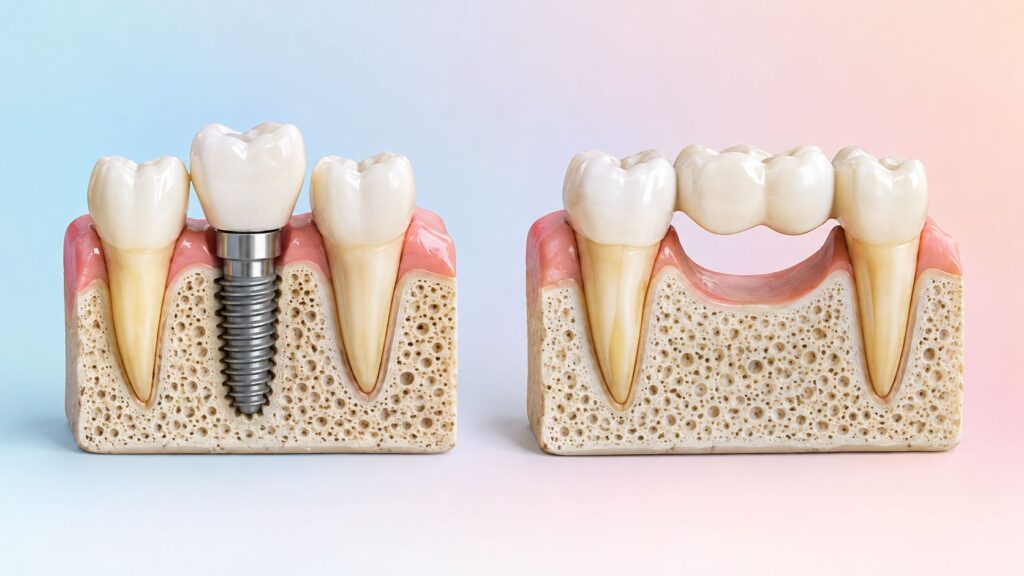
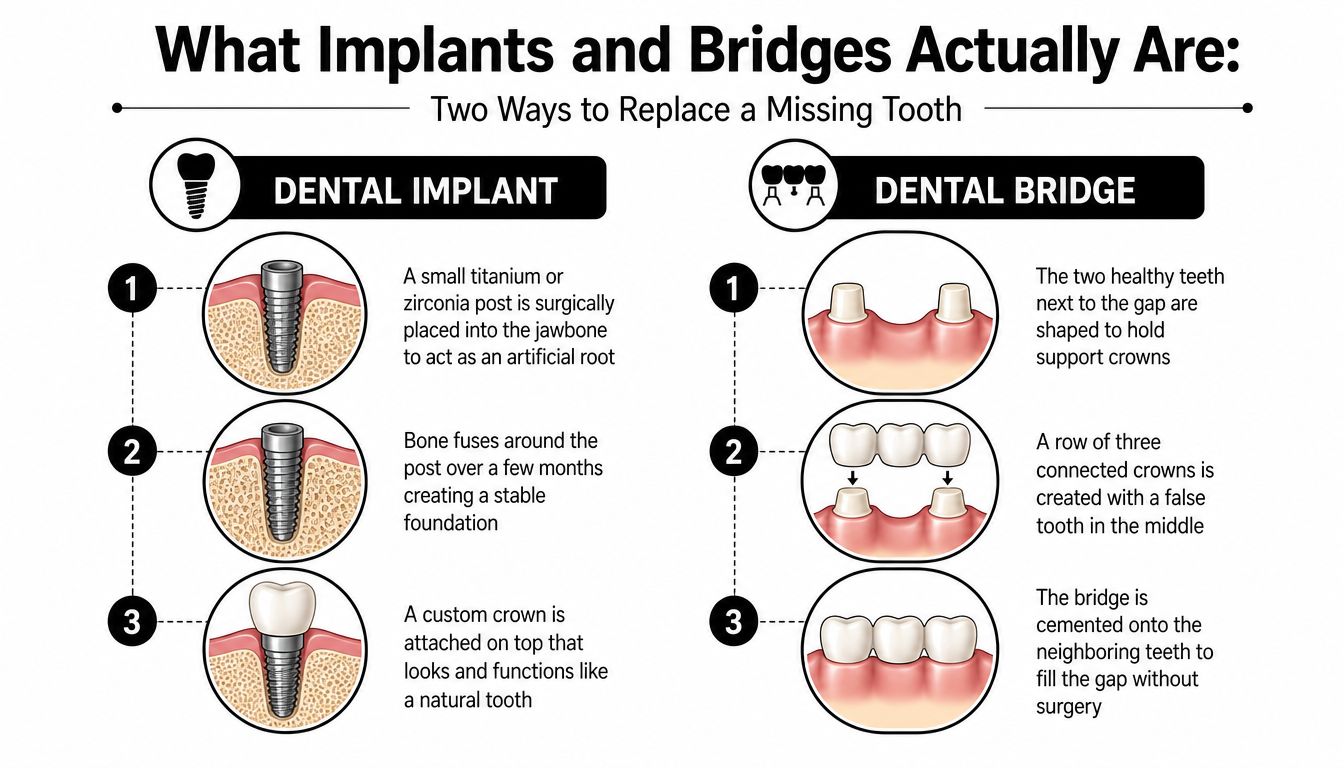
A dental implant replaces a missing tooth from the root upward. A small titanium or zirconia post is surgically placed into the jawbone where the natural root used to be. After healing, an abutment connects the post to a custom crown.
The implant stands alone. It doesn't require the teeth beside the gap to be filed down or used as supports. As bone grows around the implant surface over weeks to months, the post becomes a stable foundation for the final crown.
A traditional dental bridge replaces the visible tooth without replacing its root. The false tooth, called a pontic, sits between crowns that are cemented onto the teeth on either side of the gap. In a typical three-unit bridge, the two neighboring teeth become abutments and the three crowns function as one connected chewing unit.
How an implant is completed
An implant case usually begins with a consultation, medical history review, gum assessment, and three-dimensional CBCT imaging. The dentist uses the scan to evaluate bone volume and plan the implant position. Guided placement may then be used to place the post accurately.
Healing follows placement. The bone gradually stabilizes around the implant, and a temporary tooth may be used when appearance or chewing requires it. Once integration is confirmed, digital impressions help create the abutment and crown, which are then fitted and adjusted.
How a bridge is completed
Bridge treatment usually begins by preparing the neighboring abutment teeth. The dentist reshapes them so the supporting crowns can fit over them. Digital scans are sent for fabrication, and a temporary bridge may protect the prepared teeth while the final restoration is made.
At the try-in appointment, the dentist checks the bridge's fit, bite, shade, and contacts. Once the restoration is approved, it's cemented onto the abutment teeth. The process is generally faster because it doesn't require implant surgery or a bone-healing phase.
A resin-bonded Maryland bridge is another option for selected front-tooth cases. It uses wings bonded to the back of neighboring teeth and may preserve more tooth structure, but it isn't suitable for every location or bite.
Once seated, both restorations can look natural. An implant crown feels like an independent tooth, while a bridge feels like a connected span. Daily hygiene and the condition of the supporting structures determine whether either option remains comfortable and attractive.
Comparing Implants and Bridges Across the Criteria That Matter
The evidence doesn't support a simplistic rule that one restoration always wins. For short-span restorations, a systematic review found broadly comparable annualized performance. Supporting abutments survived at 99% versus 98.7% per year, and prostheses survived at 96.4% versus 97.4% per year for implant-supported and tooth-supported designs, respectively, as reported in the systematic review of three-unit fixed dental prostheses.
The more useful question is how each option affects the rest of the mouth and the patient's future treatment choices.
| Criterion | Dental Implant | Dental Bridge |
|---|---|---|
| Support | Stands independently in the jawbone | Relies on neighboring abutment teeth |
| Neighboring teeth | Healthy adjacent teeth can remain untouched | Abutment teeth must be prepared for crowns |
| Bone response | Replaces the root-like support at the missing-tooth site | Replaces the visible tooth but doesn't provide root stimulation |
| Timeline | Requires surgery and healing before final restoration | Usually completed faster without implant healing |
| Hygiene | Crown can be cleaned like an individual tooth, with professional guidance | Requires careful cleaning beneath and around the connected span |
| Upfront burden | More surgical planning and staged treatment | Lower initial complexity in many cases |
| Long-term concern | Implant maintenance and possible crown replacement | Abutment decay, fracture, retreatment, and bridge replacement |
Longevity depends on design and support
A large evidence synthesis found that, after five years, implant-supported single crowns had 96.8% survival, while implant-supported crowns overall and implant-supported fixed dental prostheses each had 94.5% survival. Conventional tooth-supported fixed dental prostheses had estimated survival of 93.8% at five years and 89.2% at ten years, while resin-bonded bridges declined to 87.7% at five years and 65% at ten years, according to the evidence synthesis on fixed dental prostheses.
Another systematic review and meta-analysis reported five-year survival of 96.363% for implant-supported single crowns and 94.525% for fixed partial dentures, with cumulative failure rates per 100 prosthesis-years of 0.684 and 0.881, respectively, in the published meta-analysis.
Longer follow-up adds important nuance. A 25-year analysis estimated survival at 84% for tooth-supported crowns, 63% for tooth-supported fixed partial dentures, 87% for implant-supported single crowns, and 64% for implant-supported fixed partial dentures. The same analysis noted that implant-supported reconstructions had at least 86% survival after 20 years, as reported in the long-term comparative analysis.
Bone, appearance, and cleaning
An implant replaces the missing root's structural role at the site. A bridge fills the visible gap, but the ridge beneath the pontic can change over time. That change may affect the gum contour and the appearance of the space, especially in visible areas.
A bridge can also be harder to clean because food and plaque may collect beneath the false tooth. Patients need an individualized routine that may include floss threaders, interdental brushes, and professional dental care. Guidance on daily maintenance is available in this guide to cleaning a dental bridge.
Bridges win on speed and simplicity. Implants win when preserving healthy neighbors and maintaining a standalone replacement are the priorities. Comfort during healing, bite forces, gum symmetry, and access for hygiene should be discussed before treatment begins, not after the restoration is already committed.
The Lifetime Cost Picture Most Patients Never See
The cheapest option at the first appointment isn't always the least expensive option over a patient's adult life. A bridge may carry a lower upfront price because it avoids surgery, but it also places the restoration on two neighboring teeth and may require future retreatment.
The NIH and NCBI Bookshelf review of dental bridges estimated survival at about 94% at three years, 89% to 91% at five years, and 79% to 82% at ten years across studies with follow-up up to ten years. Those figures don't predict exactly what will happen in one patient, but they show why replacement and maintenance belong in the financial discussion.
A separate long-term comparison summarized by Healthline's discussion of implants versus bridges describes bridges as generally cheaper at the start, while noting that they often need replacement after roughly 10 to 15 years. The same source explains why a single implant may become the lower-cost option over a 20-year horizon when bridge replacement is included.
What creates the hidden cost
A bridge may need a new set of crowns if the restoration wears out, loosens, fractures, or develops decay around an abutment. If a supporting tooth needs additional treatment, the patient may face more appointments before another replacement can be made.
An implant has a different cost pattern. The initial plan may include surgical placement, healing, the abutment, and the final crown. Bone grafting can add another stage when the extraction site lacks adequate support. The implant itself and the crown on top should be discussed separately because maintenance needs can differ.
The most honest financial comparison isn't a universal dollar estimate. It's a written plan that identifies the initial treatment, likely maintenance, possible replacement of the prosthetic tooth, and risks involving neighboring teeth.
For Miami patients planning decades ahead, an implant often deserves serious consideration when bone, gums, and medical history support it. A bridge can still be sensible when speed, budget, anatomy, or the condition of the abutment teeth makes it the more responsible choice. The best decision is the one that accounts for total treatment burden, not just the first invoice.
Candidacy, Bone Requirements, and the Treatment Timeline
A responsible implant consultation begins with diagnosis, not a sales pitch. At Ultra Smile DentalSpa, the planning process can include CBCT imaging, periodontal charting, a medical history review, and a close evaluation of the teeth beside the missing space.
The clinical questions that decide candidacy
Bone volume and density matter because an implant needs a stable foundation. Gum disease must also be managed because inflamed or unsupported tissues can threaten either an implant or a bridge.
The condition of the adjacent teeth often changes the recommendation. Healthy teeth are valuable structures that shouldn't be prepared casually. Teeth with extensive restorations, cracks, or poor long-term outlook may be more logical abutments for a bridge if they already need crowns.
A patient's medical history also matters. The dentist should review diabetes control, smoking, medications, bruxism, healing history, and prior radiation therapy. These factors don't automatically rule out implants, but they can change timing, risk management, or the preferred restoration.
Bone grafting or a sinus lift may be recommended when the site lacks sufficient support, including situations involving a thin ridge or an upper molar area affected by sinus anatomy. The treatment plan should explain whether grafting is needed, what healing involves, and how it affects the final schedule. Patients with questions about implants and reduced bone support can review this resource on dental implants with bone loss.
The two timelines
| Treatment Phase | Dental Bridge | Dental Implant |
|---|---|---|
| Examination and planning | Evaluation, scans, and shade planning | Evaluation, CBCT imaging, and surgical planning |
| Preparation | Abutment teeth shaped and scanned | Implant placed into the jawbone |
| Healing | No implant healing phase | Bone healing and stabilization before final loading |
| Temporary option | Temporary bridge may protect prepared teeth | Temporary tooth may support appearance during healing |
| Final restoration | Try-in and cementation | Abutment, digital impressions, and crown delivery |
| Overall pace | Faster completion for patients who need a prompt restoration | Longer staged process, with some cases eligible for early loading when bone quality permits |
A bridge may be completed in two to three weeks, while an implant case may require three to six months when healing is included. Bone grafting can add three to six months of healing before implant placement, depending on the site and clinical plan. These timelines come from the treatment planning parameters provided by the practice and should be confirmed for the individual case.
Real Scenarios That Change the Right Answer
No universal winner exists in every mouth. The following scenarios show how the recommendation changes when the patient's age, anatomy, priorities, and supporting teeth change.
A healthy single molar site
A 28-year-old Brickell professional has lost a lower first molar, and the teeth beside the gap are healthy. An implant is the stronger option if the patient can accommodate the healing period and the site has suitable bone. Leaving the neighboring teeth untouched protects their natural structure and keeps the restoration independent.
A failing bridge with bone loss
A 67-year-old Hallandale Beach retiree has a failing bridge that has been present for 12 years and moderate bone loss at the site. The options may include another bridge or an implant combined with grafting. The dentist must weigh the condition of the abutment teeth, medical history, medications, healing capacity, and the patient's willingness to accept staged treatment.
A visible front tooth
A 32-year-old actress missing a front tooth may prioritize gum-line symmetry and the way light reflects through the restoration. An implant with careful soft-tissue shaping may provide the most independent foundation, but the dentist must evaluate the bone and gum contour before promising an aesthetic result.
Several adjacent missing teeth
A 58-year-old patient has already lost three teeth next to one another. A traditional bridge may place too much demand on the remaining abutments. An implant-supported bridge or partial restoration may distribute support more appropriately, depending on bone, bite, gum health, and the number of teeth that can be predictably retained.
These examples also explain why an emergency dentist, a restorative dentist, and a cosmetic dentist may approach the same missing-tooth problem differently. A painful fracture may require tooth extraction first, while the definitive replacement decision can wait until the tissues and diagnosis are clear.
Choosing With Confidence at Ultra Smile DentalSpa
Patients usually fall into one of three practical groups. Someone who needs a fast, budget-conscious, non-surgical solution may lean toward a bridge, especially when the neighboring teeth already need crowns. Someone planning for decades of function may favor an implant when bone and medical history support surgery. Someone replacing a front tooth may prioritize the implant option when preserving adjacent teeth and shaping the gum line are central concerns.
Ultra Smile DentalSpa offers both bridges and implants, including same-day CEREC crowns for selected bridge cases, guided implant placement, CBCT-based planning, bone grafting, and sinus lifts when anatomy requires additional support. The practice serves patients through locations in Downtown Miami, Midtown Miami, and Hallandale Beach, with treatment planning based on the individual mouth rather than a blanket preference.
Financing discussions can include 0% APR plans, extended terms through CareCredit, and in-house membership savings for uninsured patients. Patients should ask for the full treatment sequence, expected maintenance, possible replacement needs, and the effect on neighboring teeth before deciding.
The practical next step is a consultation that includes an examination and appropriate imaging. Patients searching for a dentist near me, dental implants near me, or an emergency dentist in Miami can call the office or book online to discuss the missing tooth, treatment timeline, bone support, adjacent teeth, and budget before committing to either restoration.
Ultra Smile DentalSpa provides implant planning, dental bridges, restorative dentistry, and related care for patients in Downtown Miami, Midtown Miami, and Hallandale Beach. Schedule a consultation or visit Ultra Smile DentalSpa to compare dental implants and bridges with a plan built around the patient's mouth and long-term priorities.