Yes, dental implants can still work with bone loss. Modern implant dentistry has treated compromised jawbone since 1965, and long-term reports have documented implant loss as low as 0.3% in the first year and 4.1% over the first 10 years for ITI implants when sites are properly prepared and monitored (Brånemark milestone and clinical evidence).
A missing tooth, loose denture, or past gum disease can make the question feel urgent, especially when another dentist has said there isn't enough bone. The practical answer depends on two separate issues: how much bone remains and what reconstruction is needed to create a stable foundation. A 3D evaluation can show whether the next step is an implant, a graft, a sinus lift, or another restorative option.
Table of Contents
- Can You Get Dental Implants With Bone Loss in Miami?
- Understanding Jawbone Loss and Why It Happens
- Treatment Options for Patients With Bone Loss
- How Dentists Evaluate and Plan Your Implant
- Success Rates and Risks With Augmented Bone
- Costs, Insurance, and Related Services in Miami
- What to Expect at Ultra Smile DentalSpa and Next Steps
Can You Get Dental Implants With Bone Loss in Miami?
The short answer for many Miami patients is yes. The modern concept of osseointegration, the direct structural and functional contact between living bone and an implant surface without intervening fibrous tissue, was established when Per-Ingvar Brånemark placed the first osseointegrated dental implants in 1965 in a patient with a severely atrophic mandible (historical implant milestone). That development changed the clinical question from “Is bone loss an automatic disqualifier? to “Can the site be prepared well enough for stable integration?
Patients from Brickell, Coral Gables, Hialeah, Downtown Miami, Midtown Miami, and the beaches may arrive with different versions of the same problem. Some have periodontal disease that gradually reduced the bone around their teeth. Others lost molars years ago, wore dentures for a long time, or had an extraction without preserving the socket. The appearance of the gum may not reveal how much support remains underneath.
The two questions that matter
A dentist evaluating dental implants near me won't rely on a quick visual inspection. The assessment must determine:
- How much bone is present: Bone height, width, density, and the location of the sinus or nerve all influence implant planning.
- What reconstruction is required: A small defect may need limited grafting, while a larger upper-jaw defect may call for a sinus lift or a different implant design.
Research also shows that bone remodeling can occur after implant placement without making stable function impossible. A broader review reported average radiographic bone loss of 0.05 mm at 2 to 3 years and 0.21 mm at 8 years, while smokers lost about 0.26 mm more bone than nonsmokers over 4 years (2024 review of bone levels around implants). Those averages don't describe every patient, so regular examinations and maintenance remain important.
Ultra Smile DentalSpa's planning process uses 3D cone-beam imaging to assess the available anatomy and discuss potential paths, including grafting, sinus lifts, short or angled implants, and full-arch treatment. The key takeaway is reassuring but specific: bone loss changes the plan more often than it eliminates the possibility of implants. Understanding why the bone disappeared helps identify the safest reconstruction route.
Understanding Jawbone Loss and Why It Happens
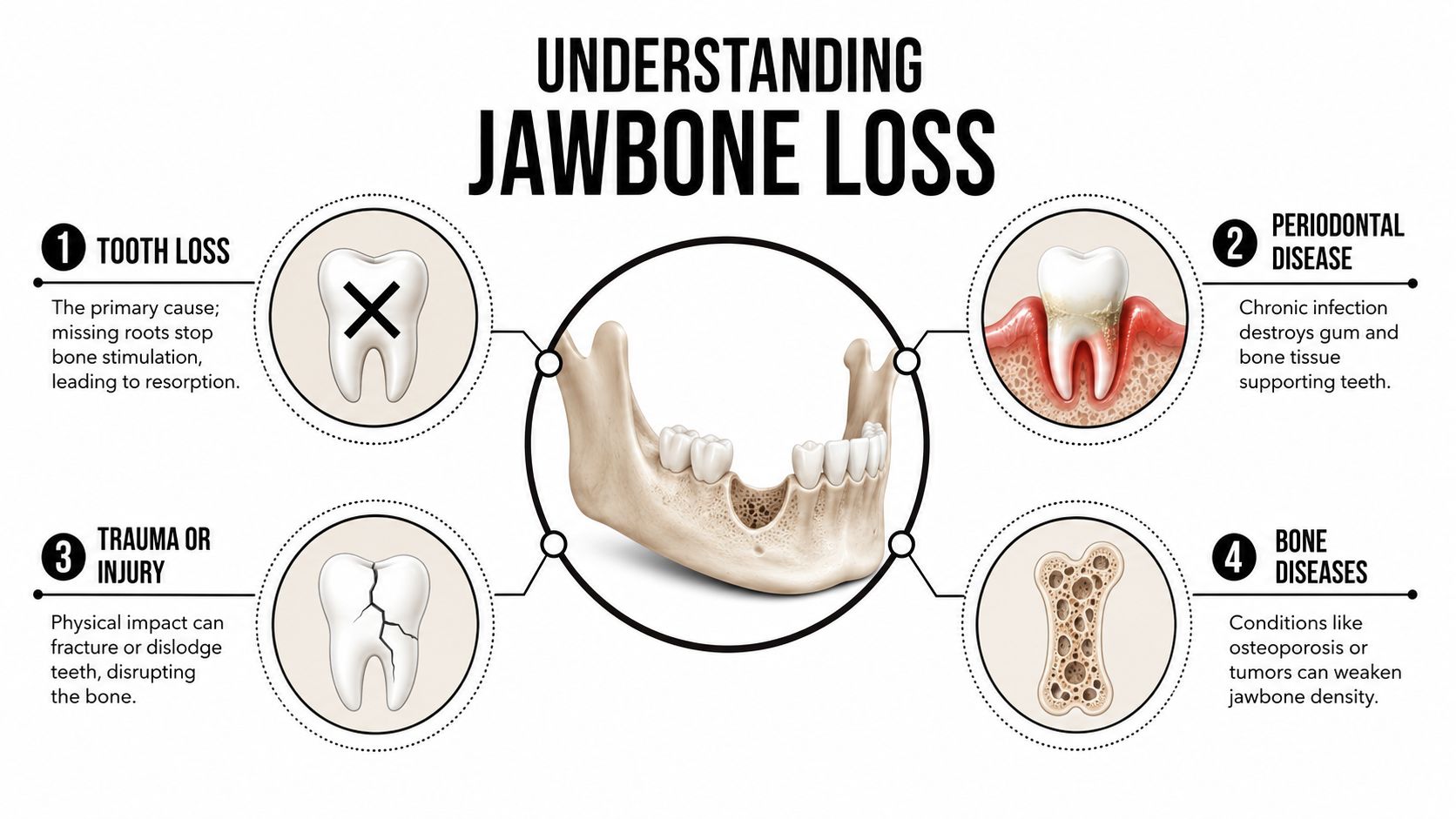
Jawbone is living tissue. Natural tooth roots stimulate the surrounding bone during chewing, so when a tooth disappears, the bone no longer receives the same functional signal and can gradually shrink. Gum infection can cause a different type of damage by destroying the tissues that hold teeth in place.
Four causes appear frequently in dental evaluations:
- Tooth extraction: A socket can lose support after the tooth is removed, especially when the area isn't preserved for a future implant.
- Periodontal disease: Long-standing inflammation can damage the bone around several teeth, not just one missing-tooth site.
- Long-term denture wear: Dentures rest on the gums and don't provide the same root-like stimulation as a natural tooth.
- Trauma or failed root canals: A fracture, injury, or persistent infection can create a localized defect.
How Miami dentists measure the foundation
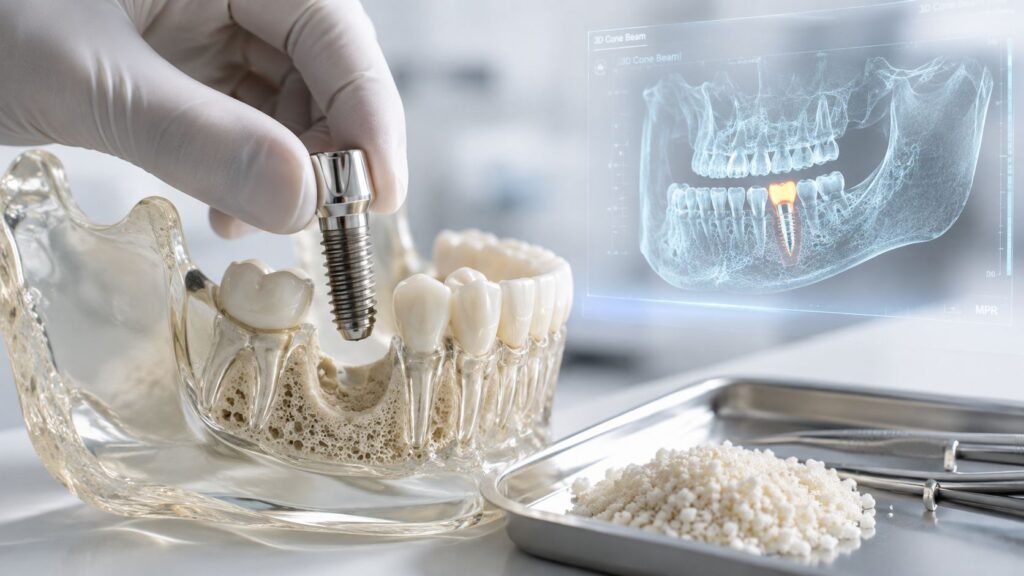
A panoramic X-ray provides a broad view of the jaws, while a cone-beam CT scan gives a three-dimensional picture of bone height, width, density, and nearby anatomy. The scan also helps identify the maxillary sinus in the upper jaw and the nerve pathway in the lower jaw, both of which affect implant positioning.
Some patient-facing explanations use general bone requirements such as 6 to 7 mm of height and 5 mm of width, but the actual measurement depends on the implant design, location, and safety margins. A clinician must read the scan rather than apply a single universal threshold.
Consider a 58-year-old Hialeah resident who lost several molars eight years ago. The ridge may now be narrower than it was immediately after extraction, and the upper back jaw may have less vertical space because the sinus has expanded downward as the supporting bone resorbed. The patient might need a ridge graft, a sinus lift, or an implant design that uses another area of available bone.
Practical rule: “Not enough bone today describes the current site. It doesn't automatically describe the final treatment possibility.
The cause and measurement guide the next decision. Active gum disease, uncontrolled health issues, or smoking may need attention before surgery, while a localized defect may be rebuilt with a focused procedure.
Treatment Options for Patients With Bone Loss
Treatment isn't selected from a checklist. A dentist compares the defect's location, size, density, gum condition, bite, and proximity to vital structures before recommending a path.
Bone grafting and ridge reconstruction
A socket-preservation graft can protect the shape of a ridge after tooth extraction. For an older defect, guided bone regeneration or ridge augmentation adds graft material and may use a barrier membrane to keep soft tissue from occupying the space needed for bone. Graft materials may include autogenous bone, processed donor material, animal-derived material, or synthetic particulate.
A systematic review found that, for immediate implants, bone grafting preserved horizontal ridge dimension and buccal plate thickness better than leaving the defect ungrafted. A barrier membrane alone also reduced buccal plate resorption and residual defects, while the strongest included approach combined cortical autogenous bone with synthetic particulate (systematic review of grafting around immediate implants). Patients considering this route can review Ultra Smile DentalSpa's guide to bone grafts in Miami.
Sinus lifts and implant-specific approaches
A sinus lift is used when the upper jaw lacks enough bone beneath the maxillary sinus, usually around the premolars and molars. The sinus membrane is raised, and graft material is placed in the new space to create an implant foundation (sinus lift explanation). A lateral-window approach creates access through the side of the jaw, while a crestal approach uses the implant site itself and is generally considered for more limited vertical deficiencies.
Some patients may qualify for implant designs that reduce or avoid grafting. Short implants can suit certain moderate-loss sites, while narrow or mini implants may fit a thin ridge when the forces and restoration are appropriate. Severe upper-jaw atrophy may require zygomatic implants, which anchor in the cheekbone, or a full-arch plan such as All-on-4 or All-on-6 with tilted implants that use stronger areas of remaining bone.
| Reconstruction option by severity of bone loss | Best for | Healing time | Relative cost |
|---|---|---|---|
| Socket preservation or limited graft | Recent extraction or small defect | Several months may be needed before placement | Lower |
| Ridge augmentation | Narrow or vertically deficient ridge | Often several months | Moderate |
| Sinus lift | Limited upper back-jaw height | Several months, depending on the approach | Moderate to higher |
| Short, narrow, or tilted implants | Selected moderate-loss sites | May avoid separate graft healing | Moderate |
| Zygomatic or full-arch treatment | Severe upper-jaw atrophy or extensive tooth loss | Case-specific | Higher |
A useful decision rule is simple: minor loss often needs limited grafting, moderate loss may allow short or tilted implants, and severe upper loss may require zygomatic or full-arch protocols. A CBCT scan determines which category fits the individual site.
How Dentists Evaluate and Plan Your Implant
A careful consultation turns an alarming phrase, “there isn't enough bone, into a sequence of decisions. At Ultra Smile DentalSpa, the workflow begins with the patient's medical history, dental records, current medications, smoking status, and any conditions that may affect healing.
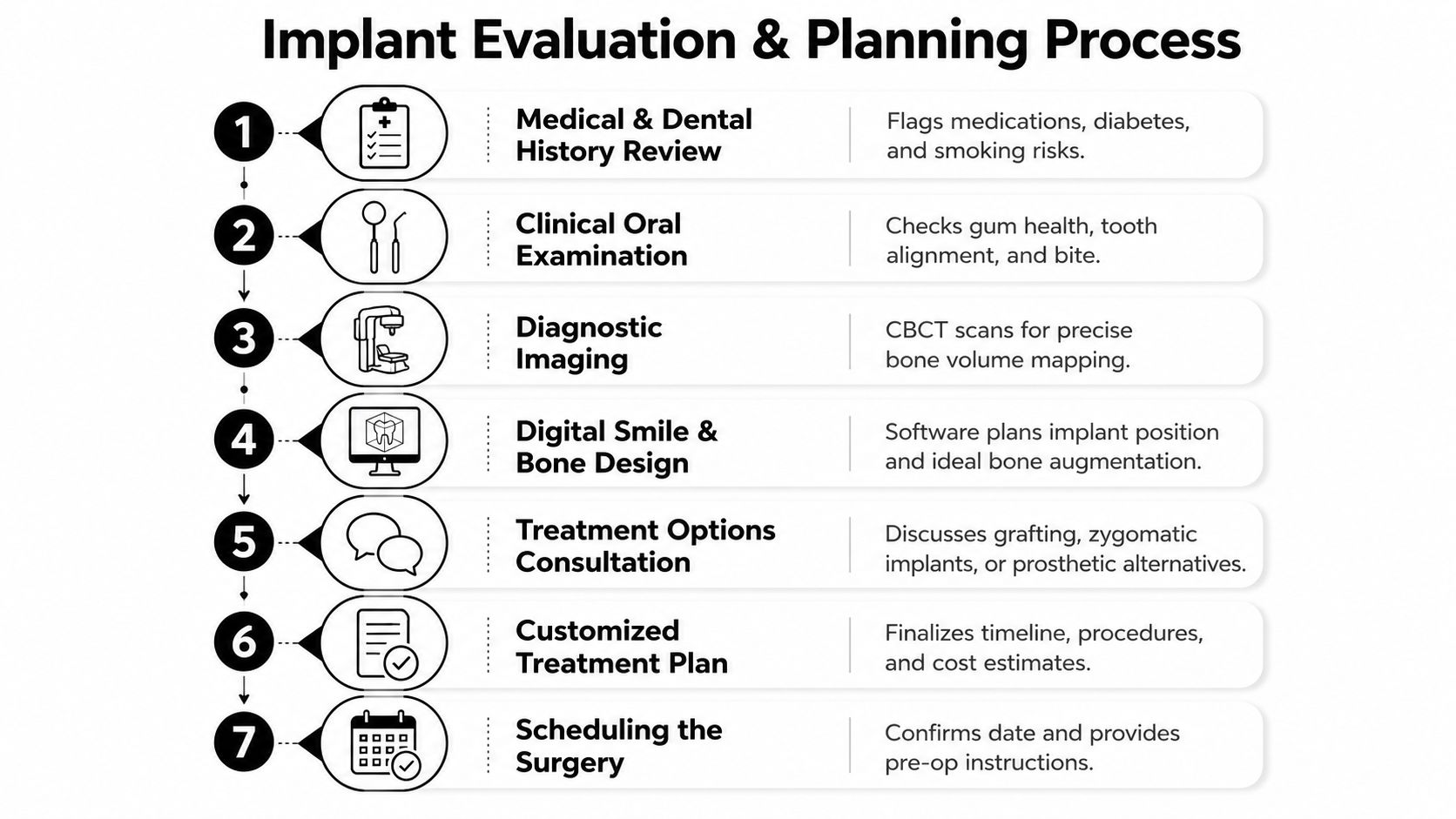
Seven planning steps
- Medical and dental history review: The team identifies medications, diabetes-related concerns, smoking, previous surgeries, and the reason teeth or bone were lost.
- Clinical oral examination: The dentist checks gum inflammation, remaining teeth, bite, tooth alignment, and the health of the proposed implant area.
- CBCT imaging: A three-dimensional scan maps bone width, height, and density while showing the relationship to the sinus and nerve.
- Digital implant planning: Planning software places the virtual implant before surgery, allowing the restoration and available bone to guide the position.
- Treatment consultation: The patient discusses grafting, sinus lift options, sedation, short or angled implants, and prosthetic alternatives.
- Written treatment plan: The office provides a timeline, procedure sequence, expected visits, and cost estimate.
- Medical clearance when needed: The dentist may request communication with the patient's physician before proceeding.
What a sample timeline can look like
A patient might have the consultation and CBCT during the first month, complete periodontal treatment or extraction next, undergo grafting soon afterward, and return for healing checks. If the graft needs a separate healing phase, implant placement follows after the site is ready. The final crown or bridge is made after integration and soft-tissue healing, so the complete sequence may span several months.
A sample 9-month timeline could include initial records, extraction or grafting, healing visits, implant placement, integration checks, and final restoration. The exact order varies because some implants can be placed with the graft, while others require the site to mature first.
Patients should bring recent dental X-rays, medical information, medication lists, and details about previous gum treatment. A video overview can also help nervous patients understand the planning sequence:
The important question at the first visit isn't only whether implants are possible. It's what sequence will protect the bone, gums, bite, and final restoration.
Success Rates and Risks With Augmented Bone
Bone grafting can make implant treatment possible, but rebuilt bone isn't identical to untouched bone. A 2025 systematic review reported mean five-year marginal bone loss of 1.90 mm in augmented sites versus 0.79 mm in pristine sites, with substantial variation between studies (2025 review of augmented and pristine sites). That difference doesn't mean grafted implants are destined to fail. It means the maintenance burden and long-term variability can be greater.
A long-term cohort found five-year survival of 92% in grafted bone versus 90% in native bone, and ten-year survival of 87% versus 79%, with no statistically significant overall survival difference. The same study found that professional maintenance reduced failure risk by 80%, while tobacco use increased failure risk 2.6-fold (long-term cohort on grafted and native bone).
| Implant survival by bone condition and time | Five-year survival | Ten-year survival | Key risk factor |
|---|---|---|---|
| Grafted bone | 92% | 87% | Maintenance and tobacco exposure |
| Native bone | 90% | 79% | Maintenance and tobacco exposure |
Risks patients should understand
Potential complications include graft loss, infection, sinus membrane perforation, nerve irritation, and loss of supporting bone around an implant. The likelihood and seriousness depend on the defect, surgical technique, medical history, oral hygiene, and follow-up.
Smoking deserves a direct conversation because it affects healing and long-term implant stability. Active periodontal disease also needs treatment before implant placement because the bacteria and inflammation that damaged natural teeth can threaten the tissues around an implant.
A review of immediate implants reported an annual failure rate of 0.82% and a two-year survival rate of 98.4% (review of immediate implant outcomes). Those figures apply to appropriately selected and planned cases, not to every patient with advanced bone loss.
The main difference between augmented and pristine cases often appears after surgery. Consistent maintenance, smoking cessation, and prompt treatment of inflammation protect the result.
Costs, Insurance, and Related Services in Miami
Implant pricing in Miami varies with the number of teeth, the type of restoration, imaging, sedation, grafting, sinus treatment, and whether the case involves a full arch. A written estimate should separate the surgical phase from the crown, bridge, or denture that sits on the implant.
The figures below reflect the ranges specified for common Miami procedures:
| Typical Miami costs for implant and bone procedures | Low estimate | High estimate | Typical insurance coverage |
|---|---|---|---|
| Single implant and crown | $3,500 | $6,000 | Implant body often excluded, crown may be partly covered |
| Bone grafting per site | $400 | $1,200 | Plan-dependent and often limited |
| Sinus lift | $1,500 | $3,000 | Plan-dependent and frequently limited |
| Zygomatic implants | Higher than standard implant treatment | Varies by specialist fees | Usually requires detailed benefit review |
Many dental plans exclude the implant body while offering some coverage for the crown or the extraction that precedes treatment. Benefits differ by policy, so patients should ask for a pre-treatment estimate rather than assume the entire procedure is covered.
Ways patients organize payment
Flexible spending accounts and health savings accounts may help eligible patients use pre-tax funds for qualifying care. Third-party financing such as CareCredit can divide the expense into scheduled payments, subject to approval and the terms offered at the time of application.
Implant treatment may also include related services. A patient might first need a tooth extraction, periodontal therapy, bone grafting, sedation for anxiety, or a same-day CEREC crown for another tooth. Coordinating those services through one treatment plan can reduce confusion and make the sequence easier to follow.
Patients searching for a dentist near me, an emergency dentist, or a cosmetic dentist near me may be dealing with more than one dental concern. Cleaning and exams, dental X-rays, restorative dentistry, teeth whitening, and cosmetic dentistry can be planned around implant care when appropriate.
What to Expect at Ultra Smile DentalSpa and Next Steps
A first visit for dental implants in Miami should feel organized, not rushed. Patients can expect a review of their concerns, a medical and dental history discussion, and diagnostic imaging when implant planning is appropriate. The team should explain whether the missing bone is localized, related to gum disease, affected by the sinus, or part of a broader pattern.
Ultra Smile DentalSpa provides a spa-style reception and a bilingual English-Spanish team. The practice's broader services include cleanings and exams, restorative dentistry, tooth extraction, bone grafting, root canals, wisdom teeth extraction, crowns and bridges, same-day crowns, veneers, teeth whitening, Invisalign, and dental implants. Comfort options include refreshments, aromatherapy, streaming entertainment during procedures, and a hot towel finish.
A consultation built around clarity
A CBCT scan can map the height and width of the jawbone. The dentist can then discuss whether the patient needs ridge augmentation, socket preservation, a sinus lift, short or angled implants, a zygomatic approach, or a non-implant alternative.
The written plan should show:
- Treatment sequence: Which procedure comes first and whether healing is required before the next stage.
- Expected timeline: How the surgical, healing, and restoration phases fit together.
- Phased costs: What each part of care costs and what insurance may contribute.
- Financing choices: Whether CareCredit or available in-house payment arrangements fit the patient's budget.
- Follow-up needs: How maintenance visits, dental cleanings, and periodontal monitoring protect the result.
Digital imaging and guided implant surgery can make planning more precise, while same-day crowns may reduce visits for selected restorative cases. Those tools don't replace clinical judgment. They support a plan based on the patient's anatomy and health.
If another provider has said implants aren't possible, a second opinion can clarify whether the issue is permanent or requires reconstruction. Patients in Brickell, Downtown Miami, Midtown Miami, Coral Gables, Hialeah, and nearby areas can call the Brickell-area office, request a consultation online, or stop in to discuss their imaging. The goal is a realistic written plan, not pressure.
Ultra Smile DentalSpa offers CBCT-based implant consultations, bone grafting, restorative care, and treatment planning for Miami patients with limited jawbone support. Visit Ultra Smile DentalSpa to request a consultation and learn what reconstruction, timing, and maintenance your dental implant case may require.