A dentist points to a tooth on an X-ray and says it needs a large dental filling. The tooth may not hurt, but the recommendation can still raise immediate questions: Can it be filled again? Will treatment be uncomfortable? Would a crown protect it better? And what happens if the decision is put off?
For adults looking for a dentist in Miami, FL, the answer depends less on a label like “large and more on how much healthy tooth remains, how many surfaces are involved, and how the tooth handles biting pressure. A careful exam can help distinguish a tooth that can be repaired conservatively from one that needs broader protection. The aim is to make a sound decision before a manageable problem becomes an emergency.
| Treatment option | Main advantage | Main trade-off | Often considered when |
|---|---|---|---|
| Direct filling | Preserves more natural tooth structure | Depends on the remaining tooth for support | The surrounding walls and cusps remain strong |
| Inlay | Replaces damaged tooth structure with a fitted restoration | Requires an indirect restoration process | Damage is too extensive for a straightforward filling, but cusps remain sound |
| Onlay | Covers one or more weakened cusps | Covers more tooth than an inlay | A cusp needs protection without covering the entire tooth |
| Crown | Covers the visible part of the tooth | Requires reshaping the tooth | Remaining walls or cusps are compromised |
| Extraction and implant | Replaces a tooth that can't be predictably restored | Removes the natural tooth and involves replacement treatment | The tooth is no longer restorable |
Table of Contents
- The Moment Your Dentist Says It Is a Large Filling
- What Counts as a Large Filling in Clinical Terms
- Why Large Fillings Fail and What That Means for You
- Large Filling vs Inlay, Onlay, Crown, and Implant
- Material Choices for a Large Filling in Miami
- How to Decide What Your Tooth Actually Needs
- What to Expect at Your Miami Consultation and Next Steps
The Moment Your Dentist Says It Is a Large Filling
A patient hears “large cavity, sees a shadow on the X-ray, and starts weighing choices before leaving the chair. Maybe the tooth only feels slightly sensitive. Maybe it feels normal. Either way, the recommendation can sound like a bigger decision than expected: repair the tooth with another filling, protect it with a crown, or consider something more involved.
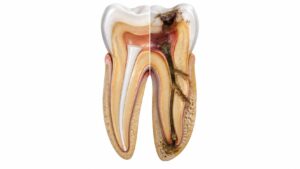
Those questions are reasonable. A large dental filling isn't automatically a warning that the tooth is about to break, and it doesn't automatically mean a crown is required. But a heavily damaged tooth has less natural structure to help it withstand everyday chewing, so the dentist needs to look beyond the cavity itself.
Questions worth asking before deciding
Patients commonly want to know whether treatment will hurt, how long the restoration might last, and what it will cost. Those answers depend on the condition of the tooth, the treatment selected, and the patient's coverage. A consultation should clarify the options and trade-offs rather than promise a fixed lifespan or a particular outcome.
The plan also depends on why the tooth needs attention. A new cavity and an older filling with decay around its edges can leave different amounts of healthy tooth behind. If the dentist finds a crack or a weakened cusp, replacing the existing filling may not provide the protection the tooth needs.
A patient who has no pain may still need a timely assessment. Pain is not a reliable measure of structural strength: a tooth can have compromised walls or a crack without causing constant discomfort. Waiting until sharp pain or a broken edge appears can narrow the treatment choices.
Practical rule: The best option is the least extensive restoration that can reliably protect the remaining tooth.
For a Miami adult comparing repair with replacement, the useful next step is to ask what the dentist sees, how much healthy structure remains, and why the recommendation fits that specific tooth. A second opinion can also help when the tooth is stable and the choices aren't clear. A thoughtful plan is more useful than either rushing into treatment or waiting for a painful surprise.
What Counts as a Large Filling in Clinical Terms
“Large isn't a measurement on a ruler. In a dental exam, it describes how much of the tooth has been lost or replaced, and how much healthy structure remains to support a restoration.
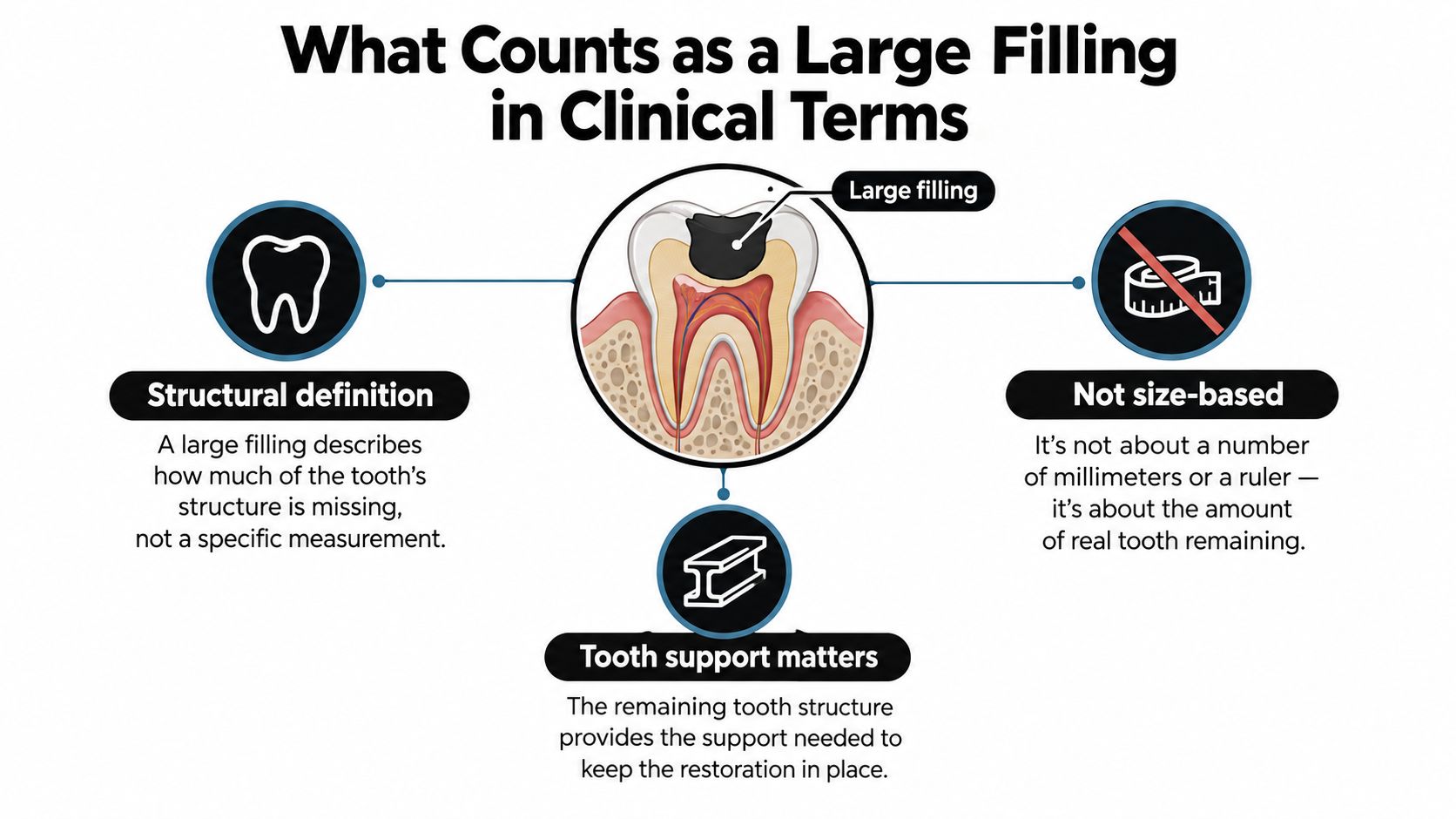
The details behind the word “large
Dentists consider the tooth's surfaces. A restoration limited to one surface leaves more of the natural tooth intact than one that extends across several surfaces. A filling that reaches between teeth, including the contact area where they meet, can also affect how the tooth supports chewing and how well the restoration maintains a clean, functional contact.
They'll also check the cusps, the raised parts of back teeth that take on biting pressure. If a cusp is thin, cracked, or unsupported, a filling may not be enough to protect it. The thickness and condition of the remaining tooth walls matter for the same reason: the restoration needs strong tooth structure around it.
Think of the filling as a patch and the tooth as a wall. A patch can close a hole, but it can't make weakened supports strong again. If the surrounding structure is compromised, the dentist may recommend covering the vulnerable area instead of filling the space alone.
Why two “large fillings may call for different plans
One patient might have a multi-surface composite filling in a premolar with solid walls and no cracks. Another might have a molar where decay or an older restoration has left little support around the cusps. Both restorations may be called large, but the second tooth may face a greater risk of fracture.
The reason the tooth needs work matters, too. Decay that has spread through a tooth can leave less healthy structure than a filling that needs replacement because its margins have deteriorated. In either case, the dentist must assess the tooth after damaged tissue is accounted for. The treatment choice should follow the structure that remains, not the word “large.
Why Large Fillings Fail and What That Means for You
Large fillings can fail through recurrent decay around the restoration or through a fracture of the filling or the tooth. The risks aren't identical for every material. In the reviewed evidence, secondary caries was the most common cause of composite failure, while fracture was the primary reason for amalgam replacement. A guideline summary also reported higher secondary-caries rates for composite than amalgam in the cited evidence, though material performance varies by situation and techniques continue to develop. (AAPD restorative dentistry guideline summary)
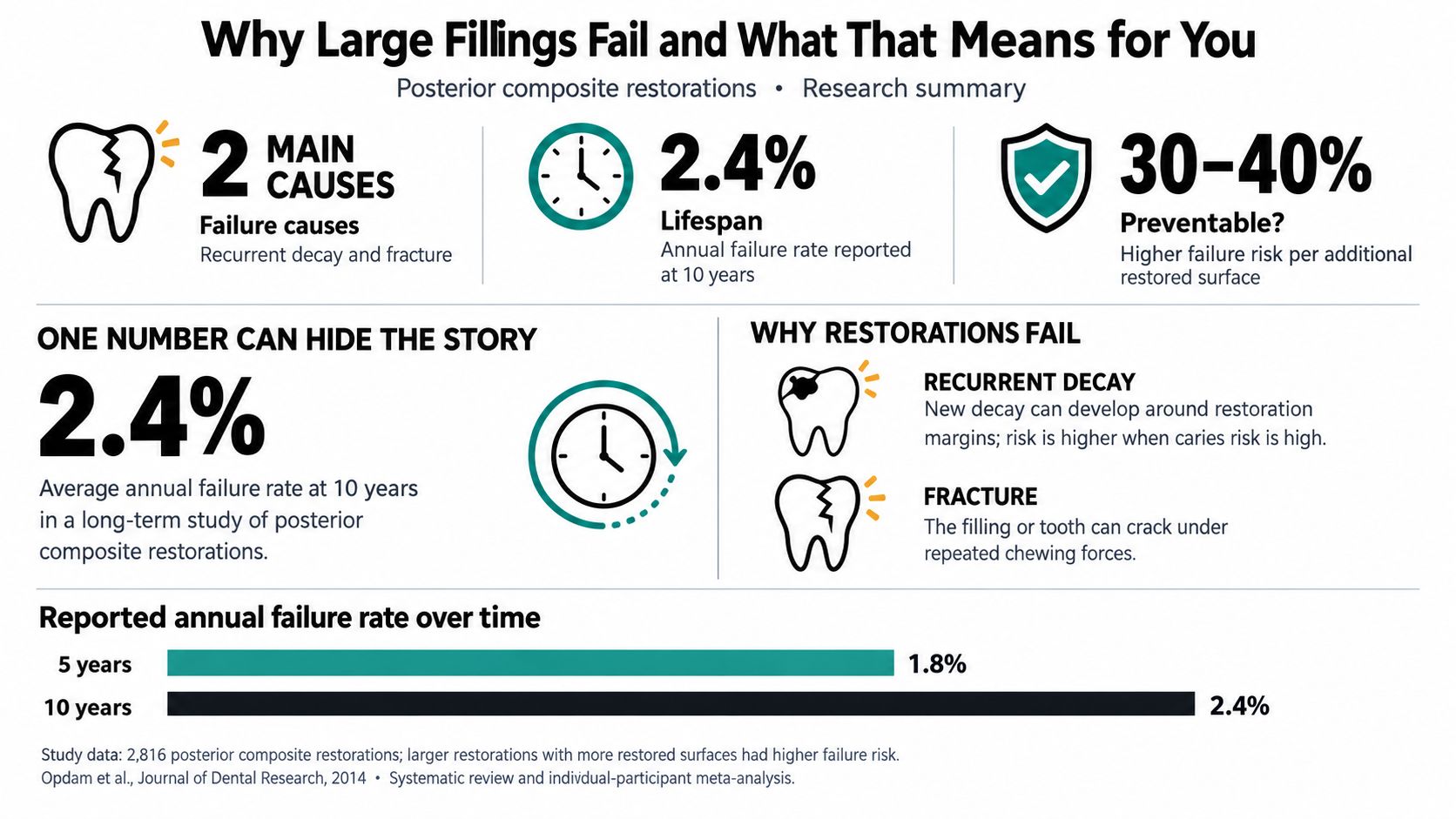
What population estimates can and can't tell you
The American Dental Association reports an estimated annual failure rate of 2.19% for large posterior composite restorations. An evidence summary reports about 90% composite success at 10 years when enamel etching and rubber-dam isolation are used. Reported cumulative survival for posterior composites is approximately 91.7% at 6 years, 81.6% at 12 years, and 71.4% at 29 years. These are population estimates, not a forecast for an individual tooth. (ADA information on materials for direct restorations)
The tooth's condition and the way treatment is carried out both affect the result. A systematic review found that outcomes beyond five years were influenced by technique, the operator's skill and knowledge, tooth type, how many surfaces were restored, and oral hygiene, not just the material. One cited study reported five-year survival of about 91.7% for composite restorations and 89.6% for amalgam, a reminder that study results vary by treatment setting. (Systematic review of posterior restorations)
Signs that deserve an examination
Fracture and recurrent decay are the practical concerns to watch for. Moisture control during placement, incremental curing, good proximal contacts, an accurate bite adjustment, and ongoing caries-risk management all matter. Bruxism, diet, oral hygiene, the amount of tooth left, and the restoration's size can also change the outlook.
No pain doesn't prove the tooth is structurally safe. Arrange a dental evaluation for pain when biting, lingering sensitivity to temperature, a fractured or rough edge, food trapping, or a visible crack. These signs don't establish a diagnosis, but they warrant an exam rather than a wait-and-see approach. Early assessment may leave more options available.
A short video about large fillings can offer background, but it can't determine what a specific tooth needs. A dentist must examine the tooth and assess the restoration directly.
Large Filling vs Inlay, Onlay, Crown, and Implant
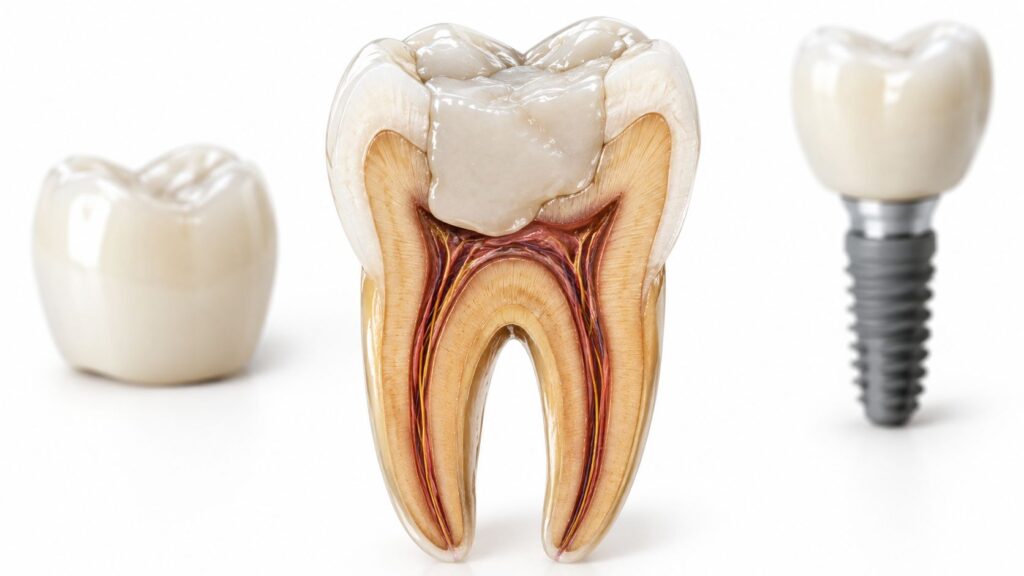
The right restoration depends on what needs protection and how much healthy tooth remains. A direct filling is the most conservative option when the remaining tooth can support it. If the tooth has weakened cusps or walls, an indirect restoration may offer protection that a filling can't provide.
| Option | Tooth Preservation | Typical Durability | Best For |
|---|---|---|---|
| Large filling | Preserves the most tooth when the remaining walls are sound | Varies with tooth structure, technique, bite, and oral health | A tooth with enough strong structure to support a direct restoration |
| Inlay | Retains more outer tooth than a crown, but replaces a shaped internal area | Depends on the tooth, restoration, and care | Damage that needs a fitted restoration while cusps remain intact |
| Onlay | Preserves tooth outside the covered cusp areas | Depends on the tooth, restoration, and care | A weakened cusp or a larger defect that doesn't require full coverage |
| Crown | Covers the visible tooth and protects more of its outer structure | Depends on fit, material, bite, and care | A tooth with compromised walls, cracks, or extensive prior restoration |
| Extraction and implant | Does not preserve the natural tooth | Depends on the implant and individual treatment factors | A tooth that cannot be predictably restored |
Choosing coverage without over-treating
A large composite filling can make sense when the tooth has sturdy walls, the pulp is healthy, and the bite can be managed. An inlay may suit a defect that needs a carefully fitted restoration but leaves the cusps intact. An onlay covers one or more cusps, offering protection while keeping more of the tooth than a full crown.
A crown may be more appropriate when cracks, thin walls, or extensive previous restoration make a direct filling a poor structural choice. It covers the visible portion of the tooth, but preparing for one requires removing some tooth structure. That trade-off matters: stronger coverage can reduce risk to a weakened tooth, but it isn't automatically the best choice for every large filling.
For a plain-language look at crown materials, this Katy dental crown materials guide can help patients understand common options. The treatment itself still needs to be selected for the tooth being examined.
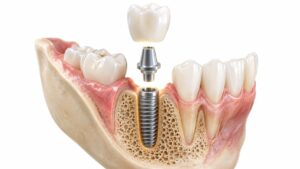
Extraction with a dental implant is a different decision, not an upgrade from a filling or crown. It may be considered when decay, a fracture, or other damage leaves the tooth beyond predictable repair. A dentist should explain why saving the tooth isn't a sound option before discussing extraction and implant treatment. For details about available crown care in Miami, see crowns and bridges at Ultra Smile DentalSpa.
Material Choices for a Large Filling in Miami
Patients often ask which material lasts longest or looks most natural. Those questions matter, but the first question should be whether a direct filling is suitable for the tooth at all. Material can't compensate for walls that are too weak or cusps that need coverage.
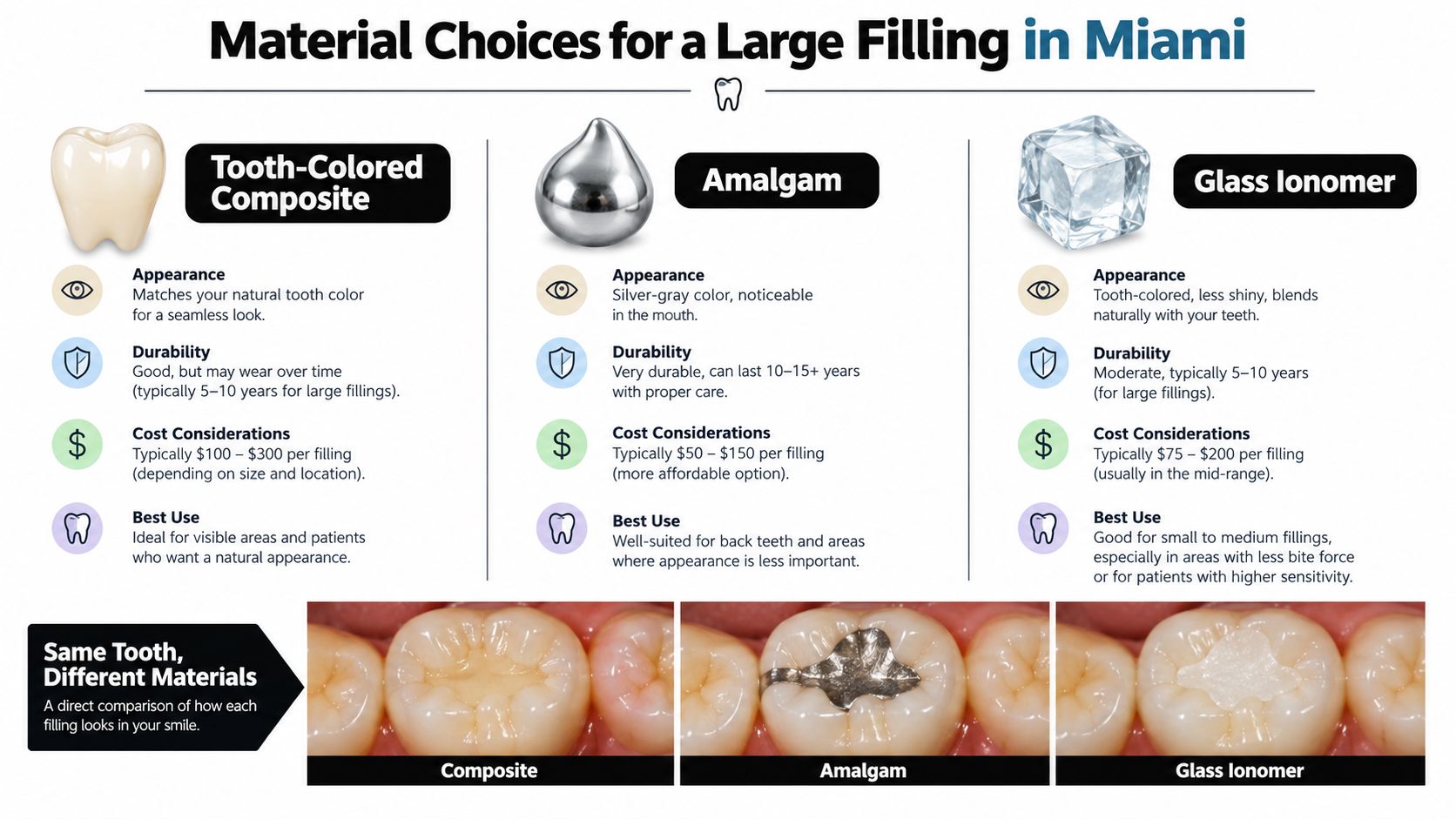
Direct filling materials
Composite resin is tooth-colored and can be shaped to blend with the surrounding tooth. Its success depends on careful bonding and moisture control, especially for a large restoration. Patients considering this option can review what composite fillings are made of, then ask the dentist how the material fits the tooth's location and remaining structure.
Amalgam is metallic and doesn't match a natural tooth's color. The reviewed evidence identifies fracture as its primary replacement issue, while material performance still depends on the clinical circumstances. A dentist can explain whether an existing amalgam restoration is intact, needs repair, or should be replaced.
Glass ionomer is another tooth-colored material, but the dentist needs to decide whether its properties suit the location and load the tooth will take. It may be considered for particular clinical needs rather than chosen because it looks different from metal.
Materials for indirect restorations
For an inlay or onlay, a dentist may discuss porcelain. A crown may use zirconia or porcelain-fused-to-metal, depending on the tooth, bite, and aesthetic priorities. These options can differ in appearance and how they fit a particular treatment plan, so patients should ask what the material is intended to address.
In Miami, appearance may weigh heavily for teeth visible when smiling, while back teeth must withstand substantial chewing. Temperature sensitivity also deserves discussion if hot coffee or cold drinks trigger discomfort, although that symptom alone doesn't identify a material problem. Ask whether the sensitivity points to decay, a crack, or another concern that needs evaluation.
The material follows the diagnosis. The dentist should first identify how much tooth remains and what protection it needs, then explain which material suits that job.
How to Decide What Your Tooth Actually Needs
A clear recommendation should account for the tooth's structure, symptoms, bite, and decay risk. A dentist can use the answers to those questions to explain whether a filling is reasonable, whether a cusp needs coverage, or whether the tooth may not be restorable.
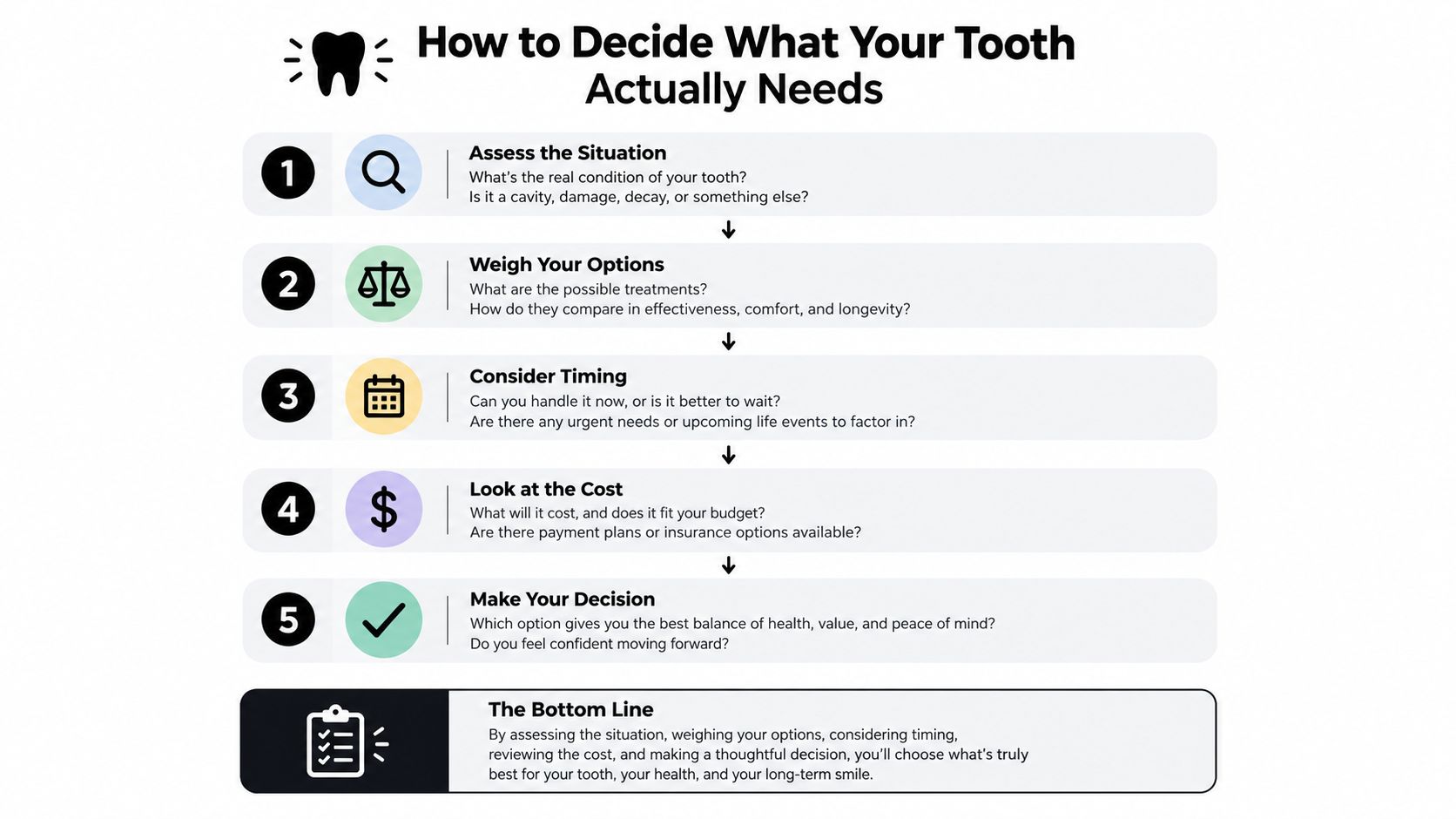
The questions that guide the plan
- How much support remains? The dentist checks the number and strength of the remaining walls and whether the cusps are intact. Strong support may leave room for a direct filling; thin or unsupported areas can point toward an onlay or crown.
- Is there a crack? A crack can change the plan because filling a cavity doesn't necessarily protect a weakened cusp or hold a cracked tooth together.
- How heavy is the bite? Grinding and clenching add stress. The dentist may discuss bite management or a night guard alongside restorative care.
- Has decay reached the pulp? If the tooth's inner tissue is involved, the treatment plan may need to address that before the final restoration.
- What is the decay risk? Oral hygiene, active decay, and the condition of other restorations help determine how the tooth should be protected and monitored.
The same logic applies across different patients. A tooth with a single damaged cusp but healthy surrounding walls may call for an onlay. Recurrent decay beneath an older, extensive filling may leave too little sound structure for another direct filling. A back tooth with a root canal often needs a dentist to assess whether the remaining walls and cusps require additional protection. And when a tooth can't be predictably restored, extraction followed by implant treatment may be the honest option.
No pain doesn't establish structural safety. Ask the dentist to point out the remaining walls, explain any visible crack, and describe why the proposed restoration fits the tooth. If a crown is recommended, it's fair to ask whether an onlay could preserve more tooth and still protect the vulnerable area. If a filling is proposed, ask what changes would make a stronger restoration necessary.
What to Expect at Your Miami Consultation and Next Steps
At Ultra Smile DentalSpa, a consultation for a large filling begins with an assessment of the tooth, not a preset treatment choice. The dentist can review remaining structure, take dental X-rays when needed, evaluate the bite, and discuss signs of decay or grinding. A written treatment plan should set out the options and explain why each one may or may not fit.
Patients can ask what the dentist sees on the X-ray, whether the tooth has cracks, and how much healthy structure is expected to remain after treatment. They can also discuss comfort needs before the appointment. Ultra Smile DentalSpa offers refreshments, aromatherapy, streaming entertainment during procedures, and a hot towel finish, details that may help patients who feel anxious about dental care.
A plan built around the tooth
The practice offers composite fillings, crowns and bridges, and same-day crowns. If a tooth can't be saved, a dentist can also discuss tooth extraction and dental implants. Cosmetic services, including veneers and teeth whitening, may be relevant when appearance is part of the broader care plan, but they don't replace the need to first address decay or structural weakness.
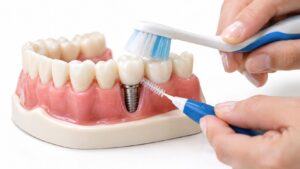
Regular cleaning and exams help dentists monitor restorations and identify changes that may need attention. Patients looking for a dentist near me, an emergency dentist, or a cosmetic dentist near me can ask which service fits their immediate concern. A large filling with new pain, a fractured edge, or lingering sensitivity should be assessed promptly rather than treated as a routine cosmetic question.
Patients in Downtown Miami, Midtown Miami, or Hallandale Beach can book a consultation, request a second opinion on a filling they've been told to watch, or contact the practice with questions before scheduling. A same-week assessment can help clarify whether the tooth can be repaired, needs stronger coverage, or requires a different plan.
Ultra Smile DentalSpa provides exams, X-rays, composite fillings, crowns, and restorative consultations for patients weighing treatment for a large dental filling. Visit Ultra Smile DentalSpa to request an appointment in Miami and discuss the options for your tooth.