Dental implants feel close to natural teeth during everyday chewing, speaking, and smiling, but they're biologically different because they lack the periodontal ligament, so very fine pressure feedback is duller than with a real tooth. Patient satisfaction remains consistently high, with more than 90% of patients in one 10-year prospective study completely satisfied with implant function and appearance, while tactile thresholds can be 4 to 20 times higher than for natural teeth (PubMed).
A missing tooth can make an ordinary meal feel surprisingly stressful. Someone in Miami may order a Cuban sandwich at a café, choose a stone crab platter in Midtown, or smile across a family dinner, then wonder whether a new implant will feel secure or somehow artificial. That concern is reasonable, especially for patients already comparing a dentist near me, dental implants near me, or a dentist in Miami, FL.
The most honest answer has two layers. The first is practical: a well-planned, healed implant can feel stable and natural enough for daily life. The second is biological: an implant doesn't have the same nerve-connected support system as a natural tooth, so it won't provide identical feedback when pressure changes subtly. Understanding both layers helps patients set realistic expectations and decide whether restorative dentistry, a bridge, or an implant consultation fits their needs.
Table of Contents
- The First Bite After an Implant in Miami
- Why Implants Feel Tooth-Like in the First Place
- What an Implant Feels Like Over Time
- Stability, Feedback, and Daily Function Across Replacement Options
- Factors That Quietly Change How an Implant Feels
- Adapting to a New Implant in Downtown Miami
- Common Myths About How Implants Actually Feel
The First Bite After an Implant in Miami
A patient may take the first careful bite of a Cuban sandwich and notice something reassuring before noticing anything unusual: the replacement tooth stays still. It doesn't wobble like a removable denture, and it doesn't feel as though neighboring teeth are carrying the entire load. The crown meets the opposing tooth, the bite feels organized, and chewing becomes a normal activity again.
That stable feeling comes from the implant's connection with the jawbone. Dental implants fuse with bone through osseointegration, creating a firm foundation rather than relying on a removable appliance. The implant still doesn't transmit sensation exactly like a natural tooth, but the everyday experience can feel remarkably close because patients commonly regain confidence with chewing, speech, and smiling. A 10-year follow-up study reported that 87.4% of patients were strongly satisfied overall, while another survey found that 144 of 196 patients, about 73.5%, rated overall satisfaction above 80% (PubMed).
Practical rule: Stability is usually the first noticeable benefit. Fine pressure awareness is the difference patients may recognize later.
What the patient may notice
The first bite may feel unfamiliar because the crown has a new shape, the gum tissue is healing, and the brain hasn't yet learned how to interpret signals from the implant area. A patient may chew more slowly, test softer foods, or favor the opposite side. That doesn't automatically mean the implant is failing.
The restoration also shouldn't feel painful, loose, or increasingly uncomfortable after healing. Persistent soreness, swelling, an altered bite, or movement deserves prompt evaluation by a dentist. Patients reviewing an implant healing timeline should remember that healing and sensory adaptation are related but not identical processes.
Why a layered answer matters
A natural tooth gives the brain detailed information about pressure and contact. An implant provides a different type of feedback through bone and surrounding tissues, so it can support confident chewing without reproducing every subtle signal. That distinction explains why a patient may enjoy a normal meal while still noticing that the implant feels slightly more rigid or less precisely localized.
The following sections separate the biology, the adjustment period, the practical differences between replacement options, and the treatment variables that shape the final result. That approach gives Miami patients a clearer basis for a consultation than a simple yes or no.
Why Implants Feel Tooth-Like in the First Place
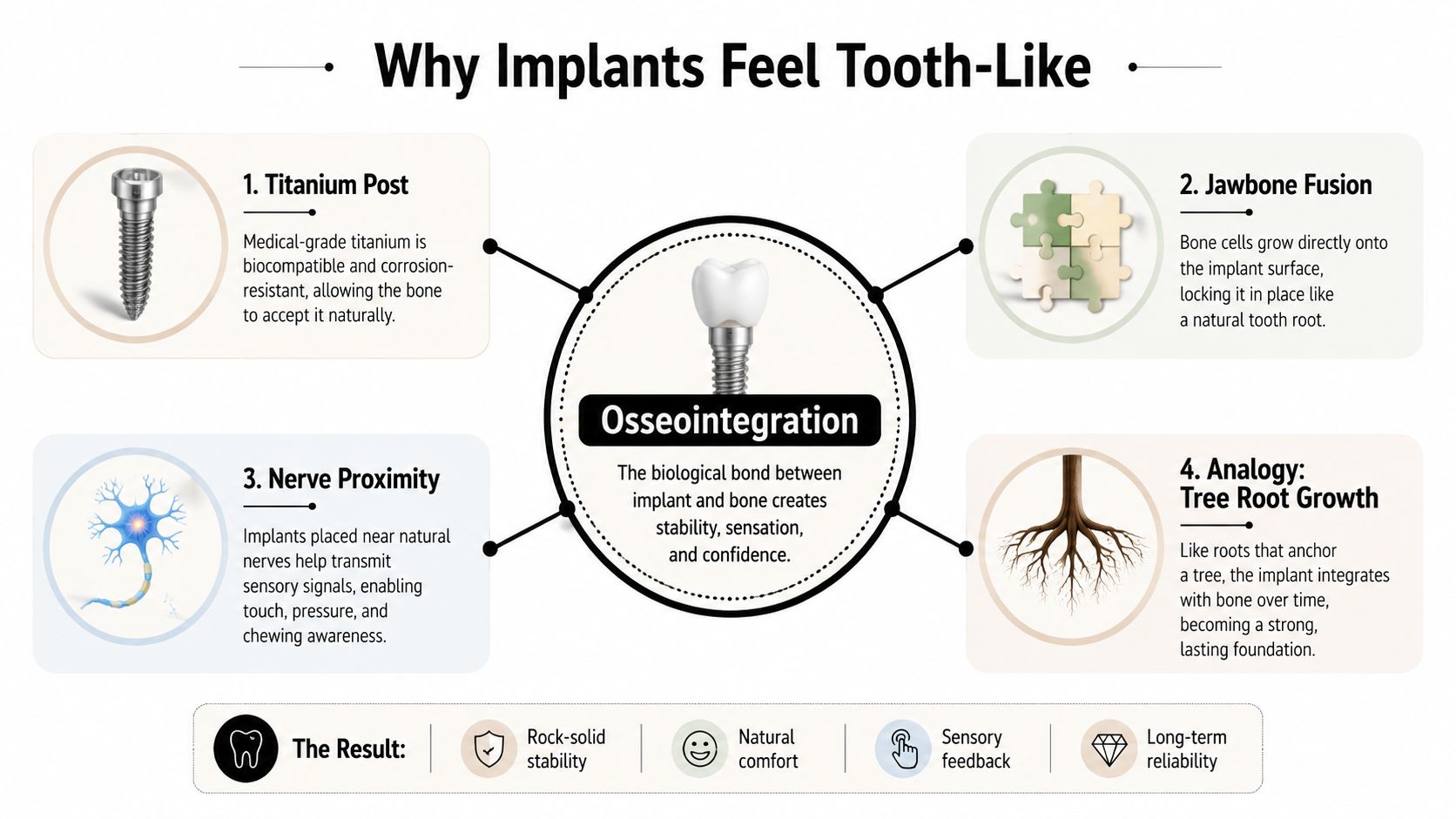
For a Miami patient, the tooth-like feeling begins with stability. A dental implant becomes part of the jaw's load-bearing structure through osseointegration, the process in which the implant connects directly with surrounding bone. In 1965, Per-Ingvar Brånemark placed the first osseointegrated dental implants in a human patient, Gösta Larsson. That case remained functional for more than 40 years until Larsson's death, helping establish the foundation of modern implant dentistry (Brånemark milestone).
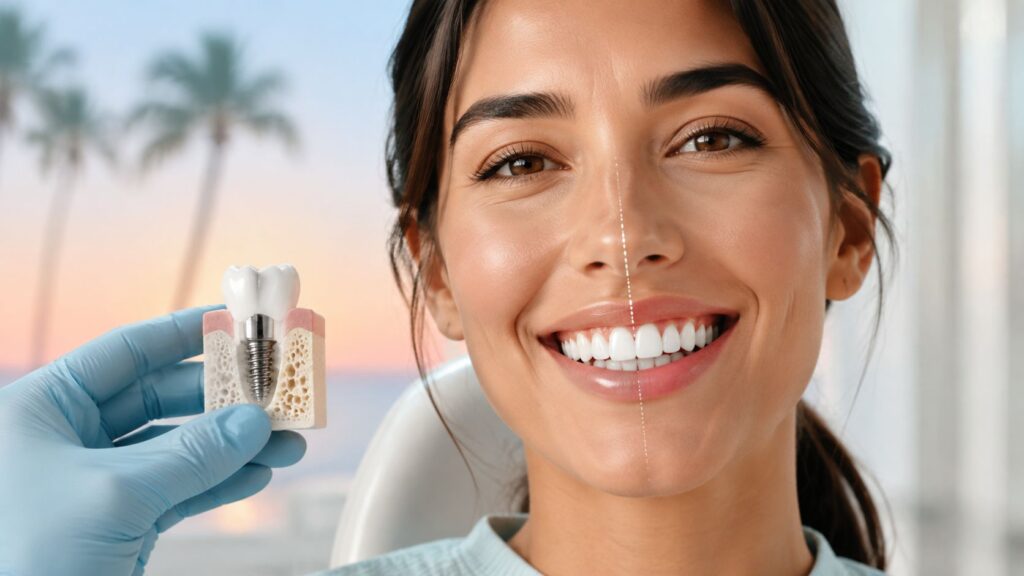
The structure works much like a house on a foundation. A denture rests on soft tissue and may shift slightly as you speak or chew. An implant post sits inside the jawbone, like support secured below the surface. The crown is the visible tooth, while the post and abutment form the foundation that helps it handle ordinary biting. That firm base is why eating and speaking can feel close to normal once the restoration is established.
The missing periodontal ligament
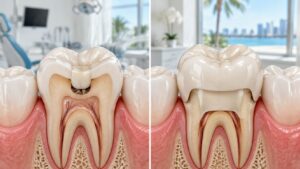
A natural tooth has a thin layer called the periodontal ligament between its root and the surrounding jawbone. This tissue contains receptors that detect pressure, contact, and movement. It works somewhat like a suspension system, allowing the tooth to respond to changing forces with fine sensitivity.
An implant connects to bone more rigidly. You can still feel biting and loading, but the feedback carries less detail. A systematic review reported active tactile thresholds about 5 times higher for implants than for natural teeth and passive thresholds about 50 times higher (Journal of Oral Rehabilitation). During a meal, a natural tooth may notice a tiny contact change sooner. An implant may need a stronger signal before you recognize the difference.
Macro-feel and micro-feel
The sensation becomes clearer when separated into two layers:
- Macro-feel: The implant feels fixed, firm, and dependable while you chew and speak.
- Micro-feel: Information about tiny changes in force, texture, or contact location is less precise.
This explains the practical answer for daily life. An implant can feel close to a natural tooth during ordinary meals, conversation, and routine biting, while its fine tactile feedback remains biologically different. Long-term daily-practice data found that more than 99% of patients rated their restoration as excellent or good after five years of function, with mean crestal bone loss of -0.28 mm. Strong function and satisfaction can coexist with a subtly different sensory experience.
What an Implant Feels Like Over Time
An implant does not feel finished on the day it is placed. The surgical site, gum tissue, bite, and nervous system need time to settle, so early sensations often reflect healing rather than the restoration's long-term feel.
The early period
During the first days, tenderness, swelling, or temporary numbness can change how the area feels. If a temporary crown is used, it may be shaped mainly to protect the site, not to provide the final chewing surface. Soft foods limit pressure while the tissues recover, and your Miami dentist's instructions take priority over any general timeline.
As healing progresses, stability usually becomes easier to notice. The implant may feel firmer than expected, while the crown still seems unfamiliar because your tongue and cheeks are learning its contours. A bite that feels high or uncomfortable should be reported instead of tolerated, since a small adjustment may improve comfort.
Learning to interpret new signals
The brain can adapt to signals carried through bone and nearby tissues. Dentists commonly call this process osseoperception. Clinical research has measured implant active tactile sensibility in the 10 to 100 µm range, while natural teeth are typically below 10 to 50 µm. A split-mouth randomized clinical trial reported average active tactile sensibility of 21.4 ± 6.55 µm for natural teeth and 30.0 ± 7.55 µm for implants, a statistically significant but relatively small difference (PubMed).
For daily life, that difference is usually subtle. A well-integrated implant can support comfortable chewing and clear speech, yet may feel slightly less precise when you judge very small changes in pressure. Neuroplastic adaptation may occur faster when implants are immediately loaded and contact natural opposing teeth, although the appropriate approach depends on the individual case.
Sensory adaptation is a process, not an event. Healing changes the physical conditions first, then repeated chewing and speaking help the brain interpret the new signals more naturally.
Over time, many patients describe the implant by what it lets them do: eat comfortably, speak clearly, and smile without protecting the missing-tooth area. In a Miami restaurant or during a normal workday, that practical confidence often matters more than matching every sensation of a natural tooth. The implant can feel tooth-like in function while remaining biologically different in fine feedback.
Stability, Feedback, and Daily Function Across Replacement Options
A Miami patient comparing a dental implant with a denture or bridge usually wants practical answers. Will it stay in place during lunch? Could it affect speech? Will it feel noticeable during a normal workday, or require a different cleaning routine?
Implants generally offer the most root-like stability because the post is secured in the jawbone. Dentures can restore appearance and basic function, yet movement against soft tissue may make chewing or speaking less predictable. Implant-retained overdentures can improve chewing efficiency compared with conventional dentures. One peer-reviewed study reported that patients needed 40 chewing strokes with implant-supported overdentures versus 69 strokes with conventional dentures to reach the same mean particle size (PMC study).
Bridges occupy a middle position. They are fixed in the mouth and may feel comfortable, but they rely on neighboring teeth for support. The appropriate choice depends on the condition of those teeth, available bone, the number of missing teeth, oral hygiene, treatment preferences, and budget.
How each replacement option behaves during the day
| Option | Stability | Fine Pressure Feedback | Chewing Comfort | Speech Clarity |
|---|---|---|---|---|
| Natural teeth | Naturally stable with slight physiological movement | Most precise | Familiar and responsive | Familiar |
| Dental implant | Firm and fixed after integration | Less detailed than a natural tooth | Typically close to natural daily function | Usually stable and clear |
| Denture | Can move against soft tissue | Limited and different from natural teeth | May require adaptation | May change if movement occurs |
| Bridge | Fixed when supporting teeth are healthy | Depends on the supporting teeth | Often comfortable | Usually stable |
The main tradeoff is sensory detail. Natural teeth include a periodontal ligament, a thin tissue layer that helps detect subtle pressure and movement. An implant does not recreate that layer, so its fine feedback differs, even though its everyday stability and chewing function can feel close to a natural tooth.
Patients reviewing the practical differences between dental implants versus dentures should also discuss whether a tooth extraction, bone graft, bridge, or implant-supported restoration fits their oral condition. A fixed implant may feel more direct and dependable than a denture, while a bridge can provide comfortable function when its supporting teeth are healthy. That tradeoff is often acceptable to patients who value a fixed tooth replacement and dependable daily use.
Factors That Quietly Change How an Implant Feels
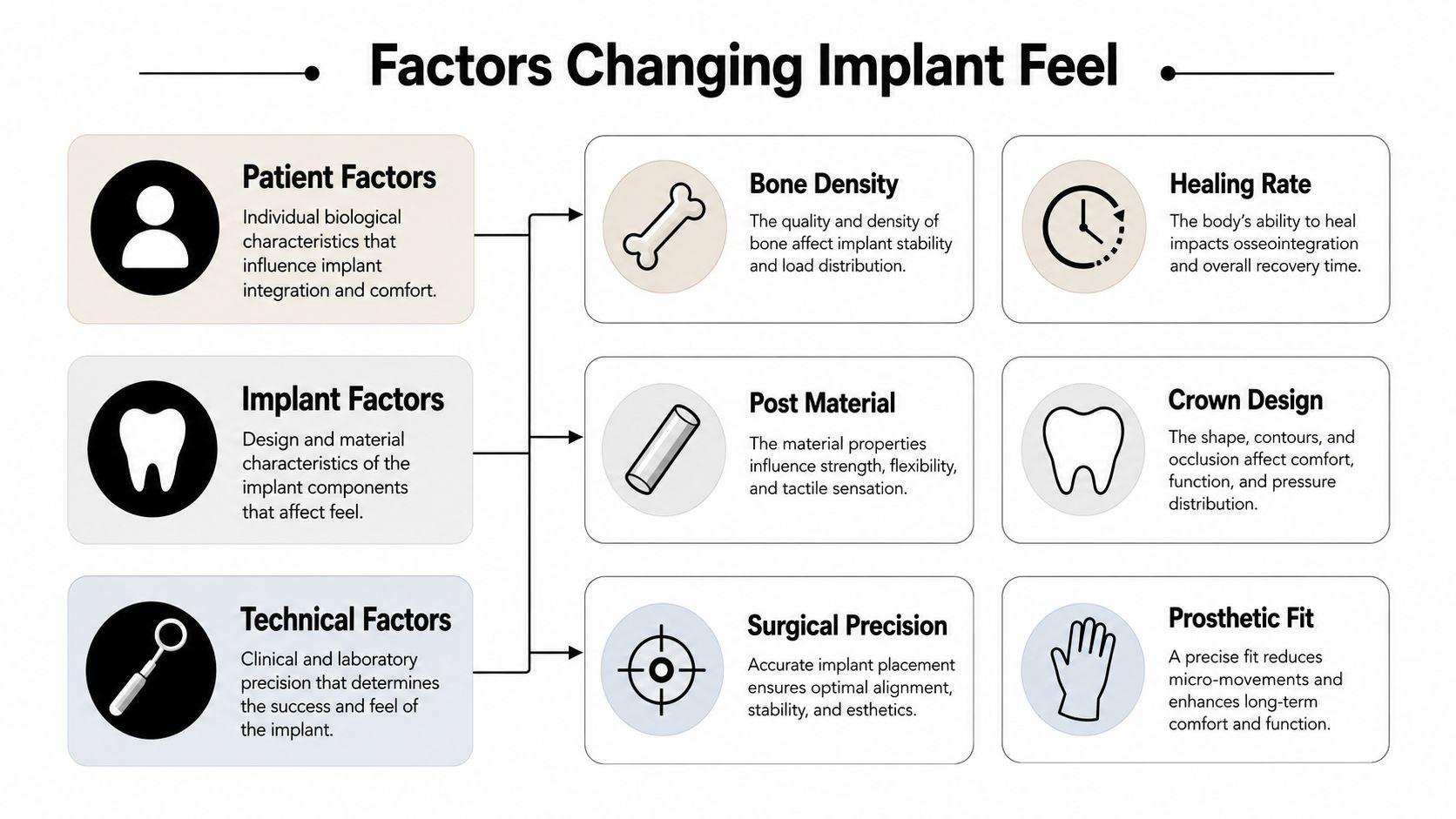
Two implants can both be successful yet feel somewhat different to their patients. The final perception depends on the foundation, the position, the restoration, the healing response, and the way the upper and lower teeth meet.
The foundation comes first
Bone density and volume affect how securely the implant can be supported. If the jaw needs a bone graft, treatment may include a separate preparation phase before implant placement. A graft doesn't mean the eventual result will feel unnatural, but it can influence the healing plan and the time required before normal loading.
Implant positioning matters because the post needs to sit where chewing forces can be distributed appropriately. A restoration placed too close to neighboring roots, shaped poorly, or positioned outside the ideal biting path may feel awkward even when the implant itself is integrated. Surgical planning and digital imaging help the dentist evaluate available bone, neighboring structures, and the intended crown position.
The crown shapes the everyday experience
The implant post provides support, but the crown is the part that contacts food and opposing teeth. Its contours influence how the tongue perceives the surface, how food breaks apart, and whether the bite feels balanced.
Materials can also affect the experience. Zirconia, porcelain-fused-to-metal, and acrylic restorations have different physical and cosmetic characteristics. The dentist may recommend a material based on location, strength requirements, appearance, available space, and the patient's bite. Material alone doesn't determine whether an implant feels natural, because fit and contour remain central.
Healing and nerve response
The surrounding gum and bone change during recovery. Nearby nerves can also make the early experience feel numb, tender, or unusually sensitive before settling. Patients with different anatomy and healing responses may notice different timelines, even when the surgical and restorative plan is similar.
Ultra Smile DentalSpa coordinates bone evaluation, implant placement planning, and crown design as related decisions. That approach lets a patient discuss bone grafting, restoration materials, bite adjustment, and comfort preferences in one treatment conversation rather than treating each variable separately.
Adapting to a New Implant in Downtown Miami
The first weeks are easier when patients treat chewing as a gradual return rather than a test of strength. The surgical team's instructions always come first, particularly when bone grafting, a temporary restoration, or other procedures are part of the plan.
A practical eating routine
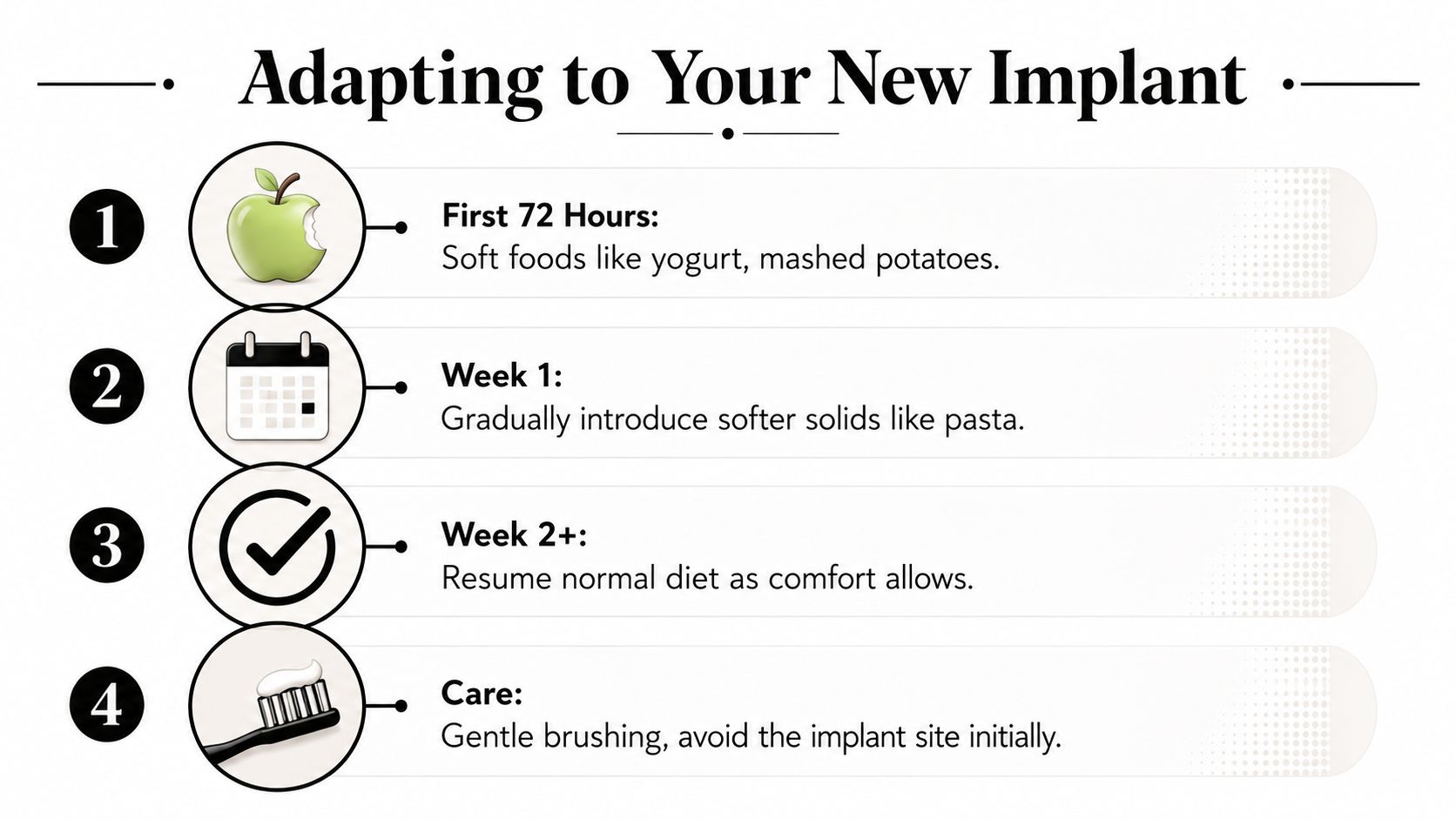
During the first 72 hours, soft foods such as yogurt and mashed potatoes can limit pressure on the healing area. Patients can then introduce softer solids, such as pasta, as comfort improves. Normal foods should return gradually, and the implant side shouldn't be forced if chewing still feels tender.
Chewing on the non-implant side early on can make meals more comfortable. Patients should also avoid testing the implant with unusually hard or sticky foods to see whether it holds. Comfort, bite balance, and healing signs offer better guidance than a single challenging bite.
Protecting the healing site
Gentle oral hygiene helps keep the surrounding tissues clean, but the implant site may need special handling immediately after surgery. A dentist may recommend a specific toothbrush, rinsing approach, interdental cleaner, or temporary restriction around the area. Patients shouldn't scrub directly over a fresh surgical site unless the dental team has approved that step.
Pain that worsens, swelling that persists, drainage, fever, or implant movement should prompt a call to the practice. Someone searching for an emergency dentist in Miami should treat those symptoms as reasons for timely evaluation rather than waiting for a routine cleaning and exam.
A consultation at Ultra Smile DentalSpa can address practical questions such as:
- Crown material: Which option suits the implant location, bite, appearance goals, and chewing habits?
- Bone support: Is a bone graft needed before or during implant placement?
- Healing expectations: What will the temporary and final restoration feel like at each stage?
- Comfort planning: Which comfort and anxiety-support options are available during treatment?
Patients in Downtown Miami, Midtown Miami, and Hallandale Beach can also ask how dental X-rays, new patient exams, restorative dentistry, cosmetic dentistry, and related services fit into the broader plan.
The practice provides a spa-style environment with refreshments, custom aromatherapy, streaming entertainment during procedures, and a hot towel finish. A video can also help patients visualize the recovery and care process:
Common Myths About How Implants Actually Feel
Myth: An implant feels identical to a natural tooth on day one.
Reality: Early tenderness, temporary numbness, a new crown shape, and an unfamiliar bite can make the first days feel different. Sensory adaptation develops with healing and use, so the final experience shouldn't be judged immediately after placement.
Myth: An implant feels artificial or permanently numb.
Reality: Implants don't contain the periodontal ligament, but patients can still detect loading through bone and surrounding tissues. Research found that patients distinguished loads applied to implants versus natural teeth 100% of the time, while retaining proprioceptive awareness of implant loading (PubMed). The signals differ, but they aren't absent.
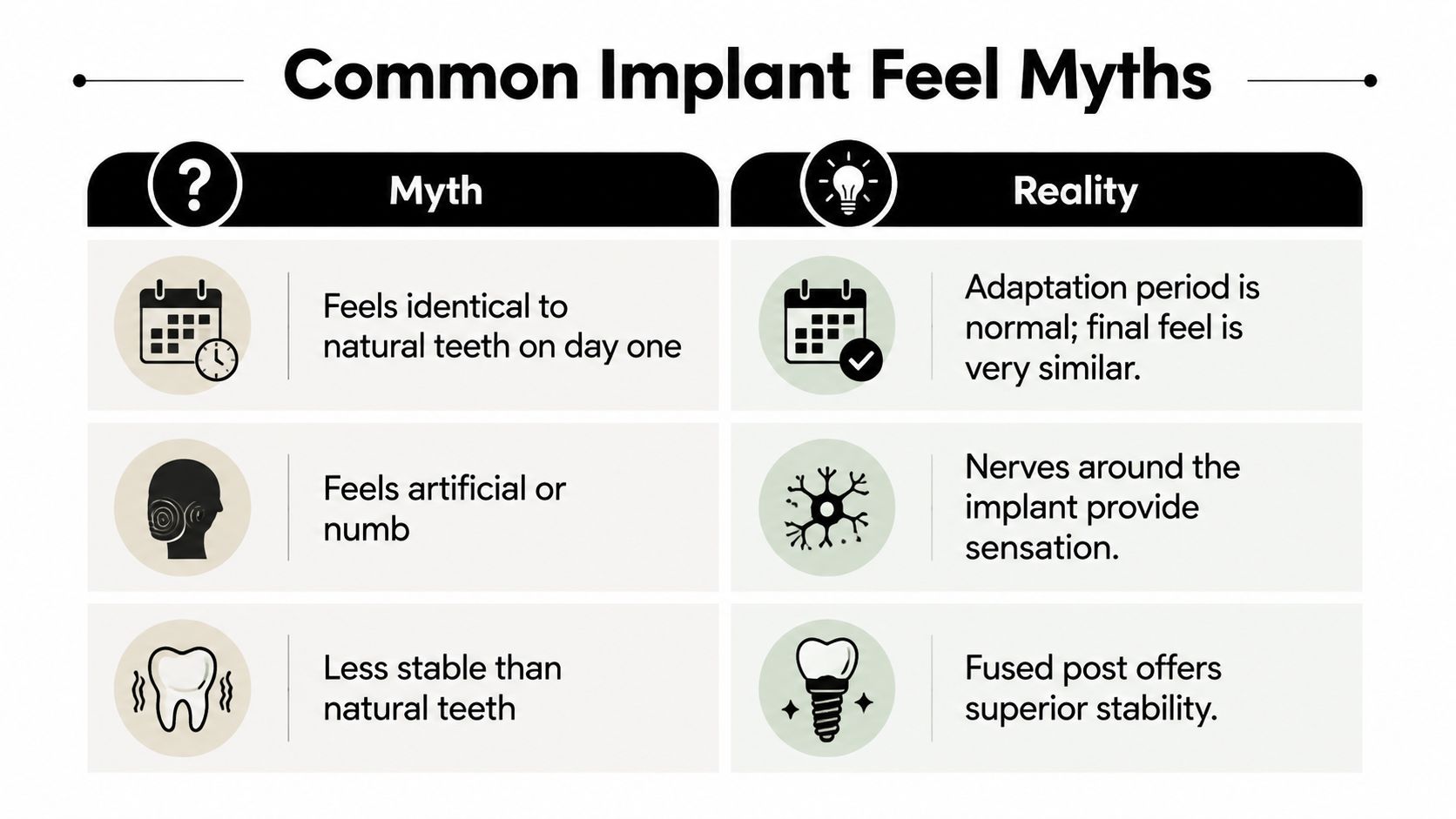
Myth: An implant is less stable than a natural tooth.
Reality: Once osseointegration is complete, the implant's post is directly connected with the jawbone. That rigid support is one reason implants often feel more secure than removable dentures.
Myth: An implant will look fake or feel like a metal filling.
Reality: The visible crown is custom designed for the smile. The implant post sits below the gum, while the crown's shape, shade, and bite contact determine what patients see and feel during meals. Patients should discuss appearance, material, and fit during a consultation rather than assume every restoration feels the same.
For patients seeking a cosmetic dentist near me, dental implants near me, or care after a tooth extraction, an evaluation can clarify whether an implant is suitable. Ultra Smile DentalSpa offers implant planning, bone grafting, restorative care, cosmetic dentistry, and comfort-focused visits for patients meeting Dr. Neda Bahmadi and the team in Miami.
Patients considering dental implants can visit Ultra Smile DentalSpa to request a consultation about implant stability, crown materials, bone support, and expected sensation. The team serves patients near Downtown Miami, Midtown Miami, and Hallandale Beach with personalized implant planning and a calm, spa-style dental experience.