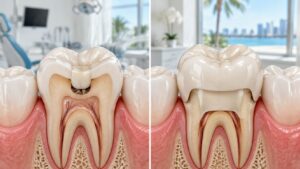
If the mirror, phone camera, or a video call keeps drawing attention to one chipped, darkened, or uneven front tooth, the thought usually follows fast. Would 4 front teeth veneers fix this without turning treatment into a full smile makeover?
For many adults in Miami, that's the right question. The front four teeth sit at the center of the smile, so small flaws there can feel bigger than they are. The challenge is that veneers on only four teeth can look beautiful when they're planned carefully, and look obvious when they're not. That's why the best cosmetic dentistry starts with restraint, not pressure.
Patients searching for a dentist near me, a cosmetic dentist near me, or a dentist in Miami, FL often want a clear answer, not a sales pitch. Veneers can help, but only when the teeth, bite, color, and long-term goals all line up. The sections below explain what works, what doesn't, and what to expect before committing.
Table of Contents
- Transform Your Smile with a Cosmetic Dentist in Miami
- Are Veneers on Your Four Front Teeth Right for You
- Porcelain vs Composite Veneers A Detailed Comparison
- Your Veneer Procedure Step-by-Step at Our Miami Dental Spa
- Understanding the Cost of 4 Front Teeth Veneers in Miami
- Long-Term Success What to Know Before Committing
- Your Questions Answered and Your Next Steps in Miami
Transform Your Smile with a Cosmetic Dentist in Miami
A common situation brings people into cosmetic dentistry. The teeth are healthy enough for daily function, but the smile doesn't feel polished. A small chip on one front tooth, spacing between the upper incisors, or discoloration that didn't respond to whitening can make someone smile with a closed mouth in photos and during conversations.
In those cases, veneers can be a focused solution rather than a full reconstruction. Dental veneers are custom-made, thin shells of either porcelain or composite resin that cover only the front surface of the tooth at approximately 1 mm thick, while crowns encase the entire tooth and are thicker at about 2 mm, according to this dental veneers procedure and safety overview. That distinction matters. Veneers are meant to improve appearance on teeth that still have a sound structure. Crowns usually belong in more heavily restored or weakened teeth.
Why the front four matter so much
The central and lateral incisors often dominate the smile. When they're uneven in length, shape, or color, people notice. When they're balanced well, the entire smile tends to look cleaner and brighter without much else changing.
The appeal of treating only four teeth is simple:
- Focused correction: It can address the teeth people notice first.
- Conservative scope: It avoids placing veneers on more teeth than necessary.
- Cosmetic precision: It works well for small gaps, minor asymmetry, and localized discoloration.
Practical rule: Veneers should improve the smile as a whole, not just make four teeth look whiter than everything around them.
When cosmetic treatment should stay conservative
Not every smile needs crowns, orthodontics, or extensive restorative dentistry. Sometimes the right answer is a limited cosmetic plan. Sometimes it isn't. A responsible dentist in Miami, FL also has to consider related care such as cleaning and exams, dental x-rays, new patient exams, teeth whitening, and restorative options before recommending veneers.
That broader view matters for patients who also search for dental implants near me, tooth extraction, or an emergency dentist. Cosmetic care should never ignore oral health. If a tooth is structurally compromised, painful, or infected, the treatment path may shift toward restorative dentistry first, then cosmetic finishing later.
Are Veneers on Your Four Front Teeth Right for You
A common consultation goes like this. A patient likes the shape of most of the smile, but the four upper front teeth look chipped, uneven, or darker than the rest. In the right case, treating only those four teeth can create a clean, natural improvement. In the wrong case, it can make the center of the smile look too bright, too flat, or disconnected from the teeth beside it.
That decision takes more than spotting a cosmetic flaw. Four veneers make sense when the concern is limited to the upper central and lateral incisors, the bite is stable, and the neighboring teeth already support the look we want. They are less forgiving when the canines show prominently in the smile or when the surrounding teeth have strong color character that porcelain cannot blend around easily.
Good reasons to consider four veneers
This approach can work well for patients with:
- Small gaps between the front teeth
- Minor chips or edge wear that change tooth length
- Localized discoloration that whitening will not fix evenly
- Mild shape differences such as narrow or slightly undersized incisors
- Small alignment issues that are visible but do not reflect a bigger bite problem
In my experience, the best four-veneer cases are the ones where the smile already has good balance and only the front center needs refinement.
A conservative plan also needs honest discussion about enamel. Veneers are not a temporary styling choice. Even with minimal-prep veneer techniques, some enamel reshaping is often required to control thickness, contour, and the final path of insertion. Once that enamel is removed, the tooth will always need some form of coverage.
Where patients get surprised later
The overlooked risk is not usually the procedure itself. It is the long-term blend.
If only four teeth are veneered, the dentist has to match color, translucency, brightness, and surface texture to the teeth next to them. That sounds straightforward, but natural teeth change over time. A patient may whiten the untreated teeth later, or the canines may remain warmer and more saturated than the veneers, which can draw attention to the transition. Four veneers can look beautiful for years, but only if the smile design accounts for what the neighboring teeth will look like in real life, not just on delivery day.
When four veneers are not the best answer
A careful cosmetic exam should pause this plan when there is significant crowding, active decay, inflamed gums, or a bite that overloads the front teeth.
Some cases need a different starting point:
| Concern | Better first step |
|---|---|
| Severe crowding or rotation | Invisalign or invisible braces |
| Heavy grinding or clenching | Night guards and bite management |
| Large existing fillings or weak tooth structure | Restorative dentistry or crowns |
| Infection, pain, or fractured tooth | Emergency dental care |
| Missing tooth in the smile line | Dental implants |
This is also why a patient searching for a cosmetic dentist may need someone who can handle restorative dentistry, implant planning, and urgent problems before cosmetic treatment begins.
Veneers succeed when the teeth underneath are healthy, stable, and strong enough to hold them for years.
A practical self-check before booking
Four front veneers are more likely to be a good fit if these statements are true:
- The concern is cosmetic, not pain or damage.
- The issue is mostly limited to the four upper front teeth.
- The surrounding teeth already look close enough in color and shape to blend well.
- The bite feels stable, with no history of frequent chipping.
- Grinding, nail biting, or chewing ice is not part of daily routine.
- You understand that enamel removal is permanent, even in conservative cases.
If several of those points do not fit, another treatment plan often gives a better result and a longer service life. Good veneer planning protects both appearance and tooth structure.
Porcelain vs Composite Veneers A Detailed Comparison
A patient may only want the four front teeth corrected, but the material choice affects far more than the day the veneers are bonded. It affects how those four teeth will match the neighboring teeth next year, how they will hold polish under Miami sun and bright indoor lighting, and how much maintenance the smile will need to stay balanced.
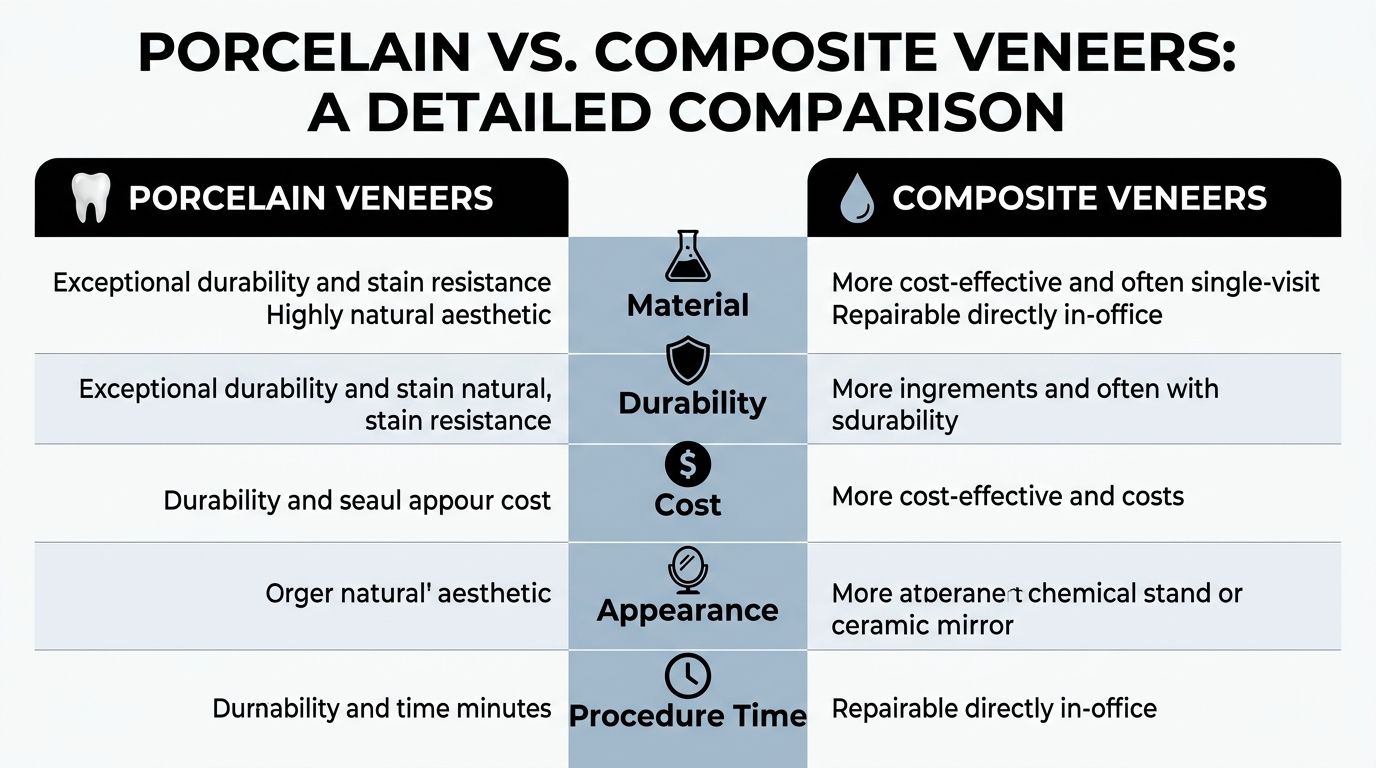
How the two materials differ in daily life
Porcelain is usually the stronger aesthetic choice for the smile zone. It is fabricated with more control over shape, surface texture, translucency, and edge detail, then bonded after the teeth are prepared. Composite is placed directly on the teeth or made indirectly, and it can look very good in the right case, but it is more dependent on maintenance and more limited in how long it keeps that fresh, polished look.
For four front veneers, the biggest practical issue is blending. If the adjacent teeth already have strong character, visible translucency, or a different shade, porcelain usually gives me more control. Composite can still work well for smaller corrections, especially when the patient wants a conservative starting point and understands that periodic polishing, repair, or replacement is more likely.
| Factor | Porcelain veneers | Composite veneers |
|---|---|---|
| Appearance | More precise surface detail and more natural light reflection | Good for simpler cosmetic improvements and minor shape changes |
| Stain behavior | Holds color better over time | More likely to pick up stain and lose surface luster |
| Longevity | Often chosen for longer-term cosmetic stability | Usually considered a shorter-term option with more maintenance |
| Repairability | Strong once bonded, but damage often means replacement | Easier to repair directly in the office |
| Enamel trade-off | Usually involves irreversible tooth preparation, even if conservative | May allow a more additive approach in selected cases, but not always |
Patients who are exploring a more conservative approach often benefit from reading about minimal prep veneer options for selected cosmetic cases before the consultation.
Satisfaction and appearance over time
Patients rarely regret choosing the material that matches their long-term standard. They regret choosing a quick fix that no longer matches the rest of the smile a few years later.
According to this review of veneer durability and patient satisfaction, patient satisfaction rates with porcelain veneers range from 80% to 100%, with porcelain receiving the best response at 93% compared with indirect composite veneers at 82% and direct composite veneers at 67%. That lines up with what many cosmetic dentists see clinically. Porcelain tends to hold its finish, contour, and color more predictably in high-visibility teeth.
That does not make composite a poor choice. It makes composite a different commitment.
Which one fits which patient
Composite often makes sense when:
- The correction is modest: Small chips, worn edges, or minor contour changes can respond well.
- The patient wants a lower upfront cost: It is usually the more accessible entry point.
- Future changes are likely: Younger patients or patients still refining their bite or orthodontic plan may prefer a less permanent first step.
Porcelain tends to fit better when:
- The smile line is prominent: Small differences in symmetry and translucency show easily on the front four teeth.
- Color matching has to stay stable: This matters even more when only four teeth are being veneered.
- The patient wants a longer-lasting cosmetic result: Fewer refinishing appointments and less staining are common advantages.
One caution matters here. If only four veneers are placed, the surrounding teeth still age, darken, and wear at their own pace. A very bright or very opaque choice can look excellent at delivery and less natural later if the nearby teeth change. Careful shade selection helps, but it cannot stop natural teeth from evolving over time.
Four veneers can look beautiful, but they succeed best when the material, color, and tooth preparation are planned for how the smile will age, not just how it will photograph on day one.
Your Veneer Procedure Step-by-Step at Our Miami Dental Spa
A patient often comes in with the same question. If we only veneer the four front teeth, will the result blend or will those teeth start to stand out later? The procedure answers that question in stages, because good veneer work depends as much on planning and restraint as it does on the final bonding appointment.
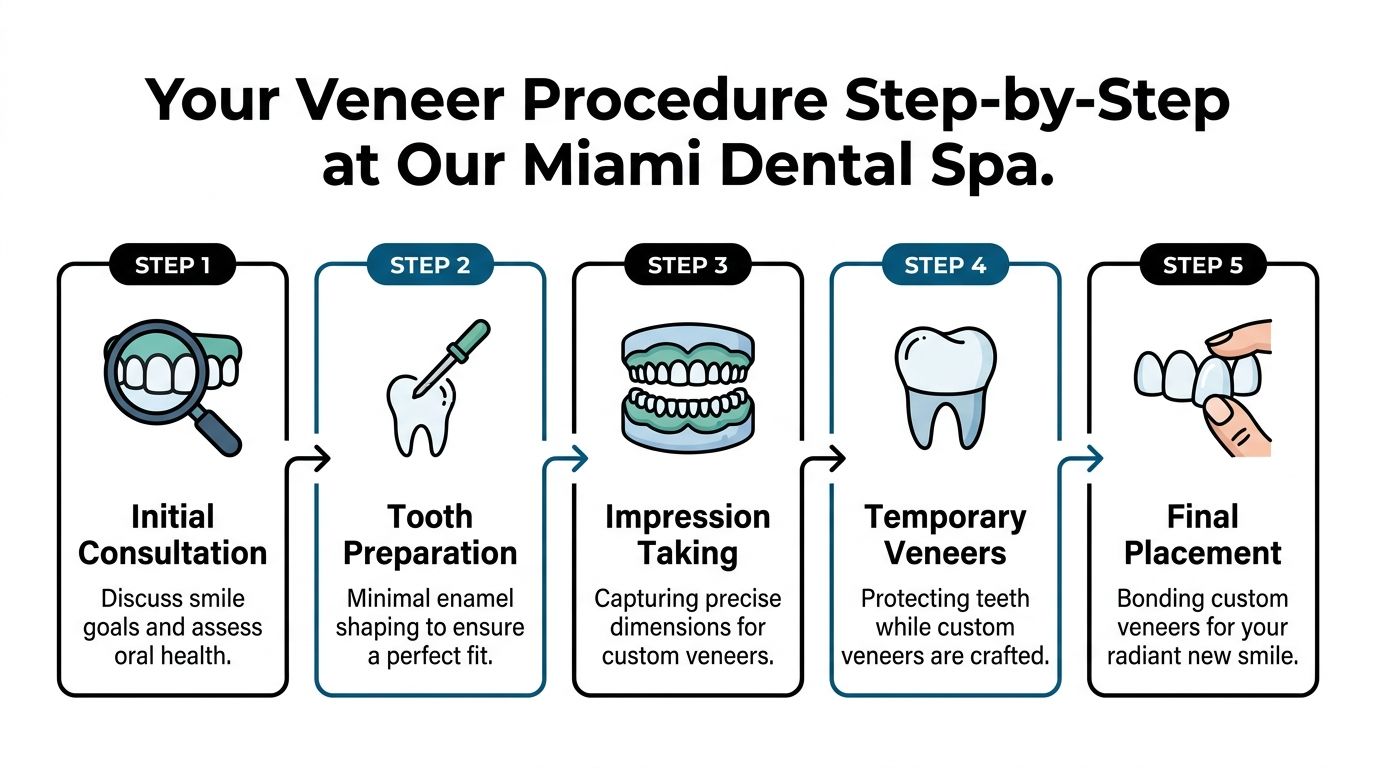
For most cases, treatment is spread across a few visits rather than done in a single sitting. That pace gives time to evaluate the bite, refine the design, and review temporary changes before the final porcelain is bonded. Patients who want a clearer sense of fees before treatment can review our guide to veneers cost in Miami.
Consultation and smile planning
The first visit is diagnostic. I examine the teeth, gums, bite, lip position, and smile line, then compare that clinical picture with what the patient wants to change. If old bonding, uneven wear, gum inflammation, or hidden decay is present, that has to be addressed before veneer design starts.
Only four veneers can look excellent, but only if the surrounding teeth are part of the plan. I check whether the adjacent teeth are likely to match the new shade, whether whitening should happen first, and whether the length and edge position of the front four will still look balanced in speech and at rest. This is also the right time to discuss a hard truth. If enamel reduction is needed, the decision is permanent.
Records matter here. Photos, digital scans, x-rays, and a full exam help us decide whether veneers are the right treatment or whether orthodontics, whitening, or bonding would protect more tooth structure.
Conservative preparation and records
Preparation should stay as conservative as the case allows. For four front teeth, bonding to enamel gives the most predictable long-term adhesion, and conservative facial reduction often supports that goal, according to this clinical paper on veneer preparation design. Over-preparation creates problems that are hard to reverse, especially in a case where only a small group of teeth is being restored.
A typical sequence looks like this:
- The teeth are photographed and evaluated for shape, proportion, and shade.
- A small amount of enamel is adjusted where the design requires space.
- Digital scans or impressions are taken for the lab.
- Temporary veneers may be placed so the patient can preview length and contour.
Temporaries are more than a placeholder. They let us test speech, edge position, and how the veneers relate to the lower lip. If a patient feels that one central incisor looks slightly longer, or the smile feels too bright against the nearby teeth, it is better to catch that before the final ceramics are bonded.
Comfort should be straightforward and well managed. In a spa-style setting, details such as aromatherapy, streaming entertainment, and a warm towel can make a cosmetic visit feel easier, but the clinical goal stays the same. Careful preparation, precise records, and a design that will still look natural after the novelty wears off.
A short visual explanation can help patients who prefer to see the flow before booking.
Final try-in and bonding
When the veneers return from the lab, I check fit, contour, surface texture, edge position, and color before anything is bonded permanently. This try-in matters. Four veneers can look too opaque, too bright, or slightly flat if they are judged only under operatory lighting and not against the neighboring natural teeth.
The smile should work in motion. I want to see the veneers during speech, in a relaxed smile, and from angles other than the straight-on photo view patients often focus on.
Clinical focus: The best veneer appointment ends with teeth that look balanced with the face, the lips, and the untreated teeth nearby.
Bonding is usually efficient, but it should never feel rushed. Once the veneers are placed, final bite adjustments and polishing shape how comfortable they feel and how naturally they catch light. Those details have a direct effect on long-term success, especially when only four teeth are being changed.
Understanding the Cost of 4 Front Teeth Veneers in Miami
A patient often comes in asking for “just four veneers because the front of the smile is what shows in photos. The budget sounds simpler at first. In practice, the fee reflects more than four pieces of porcelain or composite. It reflects how much planning it takes to make those four teeth look balanced next to the untreated teeth beside them.
In Miami, four front veneers are usually priced as premium cosmetic work because matching shape, brightness, translucency, and edge position across a highly visible area takes time and precision. Porcelain usually carries the higher fee. Composite is usually less expensive up front, but it can involve more maintenance, more polishing, and earlier replacement depending on the case.
What changes the price
The number of veneers is only one part of the estimate. I tell patients to look at what is included before comparing fees between offices.
- Material choice: Porcelain costs more because it involves laboratory fabrication, custom layering, and a more stable finish over time. Composite is completed more directly and usually costs less at the start.
- How difficult the match is: Four veneers can be harder to make look natural than a full upper smile because the neighboring teeth stay visible. If the canines are darker, rotated, or heavily characterized, the design work becomes more demanding.
- Amount of preparation needed: Minor contour changes are simpler than cases that require significant reshaping, bite adjustment, or management of old bonding.
- Records and smile design: Digital photos, mock-ups, temporaries, and detailed shade communication with the lab add value because they reduce surprises.
- What is bundled into treatment: Whitening, retainers, a night guard, or follow-up contouring may be included in one office and billed separately in another.
That last point matters more than patients expect.
A lower quote can become less attractive if it excludes diagnostics, provisional veneers, or protective appliances after bonding. A higher quote may be reasonable if it includes the planning needed to avoid one of the biggest problems with four veneers: a result that looks bright in the center and disconnected from the rest of the smile. Patients who want a fuller breakdown can review this guide to veneer pricing and what affects the total fee before the consultation.
Cost should be weighed against longevity and limitations
The least expensive option is not always the most conservative one long term. If a patient chooses four veneers to save money but the neighboring teeth are likely to need whitening, bonding, or future cosmetic work to keep up visually, the total investment can spread out over several stages.
That is especially true with partial smile treatment. Four veneers can look excellent, but only if the surrounding teeth support the result. If they do not, the patient may end up paying twice. First for the veneers, then for the correction of the mismatch around them.
When another treatment may make more sense
Some concerns do not justify veneer treatment on four front teeth. A good consultation should separate what is cosmetic preference from what needs structural coverage.
| If the concern is mainly this | Another option to discuss |
|---|---|
| One small chip | Cosmetic bonding |
| General yellowing | Teeth whitening |
| A heavily damaged front tooth | Crown |
| Missing tooth | Dental implant |
| Crooked alignment across several teeth | Invisalign |
A cosmetic exam should point the patient toward the treatment that fits the problem, not force every case into veneers. Someone searching for a smile upgrade may do better with whitening and bonding, or with orthodontic alignment before any porcelain is considered.
Making the investment easier to manage
Many Miami practices offer payment plans or phased treatment. Ask direct questions. Does the quoted fee include records, temporaries, final cementation, adjustments, and a night guard if clenching is part of the picture?
A clear consultation should end with a written fee and a clear rationale for the plan. Patients should know what they are paying for, what is permanent, and what future maintenance may still be needed if only four teeth are being changed.
Long-Term Success What to Know Before Committing
The part many veneer articles skip is the part patients remember later. Four veneers can look stunning at first and still create problems over time if planning was too narrow.

The color mismatch issue most people don't anticipate
A key concern with partial veneer treatment is the risk that the veneered teeth stay bright while the surrounding natural teeth gradually darken. According to this Cleveland Clinic overview of dental veneers, a key risk of partial veneers is long-term color discrepancy; porcelain is stain-resistant, while natural teeth darken over time, which can disrupt smile aesthetics and lead to patient dissatisfaction.
That's the “tooth-colored island problem. The four treated teeth may remain crisp and stable while the canines or nearby teeth age differently. This is one reason a dentist may recommend whitening first, or advise that four veneers won't create the most harmonious result.
The commitment is structural, not just cosmetic
Traditional veneers also involve permanent enamel modification. That doesn't mean treatment is a bad idea. It means it should never be treated casually. Once enamel has been removed, the patient is entering a long-term restorative path, even if the result looks natural and conservative.
Good maintenance improves the odds of long-term success:
- Brush and floss consistently: Veneers still depend on healthy gums and healthy margins.
- Keep recall visits on schedule: Cleanings and exams help catch edge wear, bonding changes, and bite issues early.
- Avoid force habits: Ice chewing, pen biting, and opening packaging with the front teeth shorten the life of cosmetic work.
- Use a night guard if needed: Patients who clench or grind need protection.
Four veneers should be planned as part of the future smile, not just the current selfie.
This is also why well-rounded dental care matters. Patients looking for a dentist in Miami, FL should think beyond the placement day. Long-term success depends on maintenance, bite monitoring, and good preventive care just as much as the cosmetic design.
Your Questions Answered and Your Next Steps in Miami
Two questions come up almost every time.
Will getting veneers hurt
Most patients tolerate the process well, especially when the case is planned conservatively and the teeth are healthy. The preparation is controlled, the appointments are organized, and comfort measures make a big difference. For anxious patients, a calm environment often matters as much as the dentistry itself.
Can veneers be reversed later
No. Once enamel is removed for traditional veneers, the tooth can't be restored to its original state, which makes treatment a permanent commitment, according to this dental veneers FAQ on reversibility. That answer shouldn't scare patients away, but it should slow the decision down enough to make it thoughtfully.
What should a patient expect at the first visit
The first appointment should feel more like planning than pressure. The team should review smile goals, oral health, bite, and whether veneers are the best option. In some cases, whitening, bonding, Invisalign, restorative treatment, or even an emergency dentist visit comes first.
Patients also want to know what the office feels like before they arrive.

In a well-run Miami cosmetic practice, the difference is often in the details. A warm welcome, bilingual communication, clear financial conversations, and a dentist who explains trade-offs plainly can make the choice feel much easier. That matters for patients in Downtown Miami, Midtown Miami, and Hallandale Beach who want both aesthetic quality and a comfortable experience.
Patients ready to explore 4 front teeth veneers, whitening, restorative dentistry, or a full smile consultation can contact Ultra Smile DentalSpa to schedule an appointment. The practice serves Downtown Miami, Midtown Miami, and Hallandale Beach with gentle, modern dental care for patients searching for a trusted dentist near me, cosmetic dentist near me, dental implants near me, tooth extraction, and emergency dentist support.