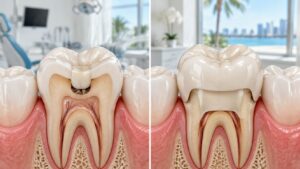
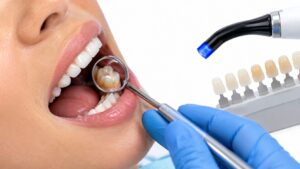
Laser teeth whitening is a professional, in-office cosmetic dental procedure that uses a concentrated whitening gel activated by a specific wavelength of light to rapidly brighten teeth by several shades in a single visit. In most offices, treatment takes 30 to 60 minutes, uses 25 to 40% hydrogen peroxide, and can produce roughly 3 to 8 shade units of whitening in one session.
A lot of people looking for a cosmetic dentist near me in Miami are in the same position. Their teeth are healthy, but the smile in photos doesn't match how vibrant they feel. Coffee, tea, red wine, age, and everyday staining can leave teeth looking dull, and store-bought products often feel slow, inconsistent, or too irritating.
That's why laser whitening gets so much attention in a city like Miami, FL. When someone wants visible improvement before a wedding, work event, vacation, or because they're ready to invest in themselves, speed matters. So does comfort. The best laser whitening experience isn't just about how bright teeth look the day of treatment. It's also about how carefully sensitivity is managed and how well results are maintained afterward.
Table of Contents
- Your Trusted Cosmetic Dentist for Laser Whitening in Miami
- How Laser Teeth Whitening Works Its Magic
- Your Laser Whitening Experience at Ultra Smile DentalSpa
- Laser Whitening Compared to Other Whitening Methods
- Is Laser Teeth Whitening Safe and Right for You
- Results Longevity and Cost of Laser Whitening in Miami
- Frequently Asked Questions About Laser Teeth Whitening
Your Trusted Cosmetic Dentist for Laser Whitening in Miami
In Miami, a smile carries a lot of social weight. People notice it in meetings, at dinners, on video calls, and in photos under bright South Florida sun. Many patients who search for a dentist near me or a dentist in Miami, FL aren't dealing with pain at all. They're dealing with hesitation. They smile with lips closed, avoid close-up photos, or keep postponing cosmetic care because they're unsure what works.
Laser whitening appeals to that patient for one reason first. It's fast. Light-activated whitening became popular in the early 2000s and has been marketed to deliver 5 to 8 shades of improvement in a single 30 to 60-minute appointment, which helped it earn a premium place in cosmetic dentistry according to this overview of whitening trends and in-office light systems.
Why this matters in a busy Miami lifestyle
Someone in Downtown Miami may want brighter teeth before an investor presentation. Someone in Midtown may be comparing teeth whitening options after trying strips with limited change. Someone in Hallandale Beach may be looking for a more polished smile but still wants care that feels calm, not rushed.
That's where patient experience matters as much as the whitening itself. A strong cosmetic result is only part of the treatment decision. Many people also want to know:
- Will it feel intense if teeth are already a little sensitive
- Will the appointment be predictable or uncomfortable
- Will the result last long enough to justify the investment
The right whitening plan starts with the person, not the light.
A trusted cosmetic approach also means knowing when whitening is and isn't the best fit. If discoloration comes mostly from coffee, tea, wine, or surface staining, laser whitening can be a very attractive option. If the issue involves old restorations, deeper intrinsic discoloration, or uneven tooth shape, another cosmetic solution may create a more natural result.
A brighter smile should fit into complete dental care
Patients often start with whitening, then discover other services that improve the final outcome even more. A fresh exam, cleaning and exams, updated dental x-rays, or a new patient exam can reveal whether a simple whitening treatment is enough or whether cosmetic bonding, veneers, or restorative work would better support the smile.
That's also why a modern cosmetic practice shouldn't feel disconnected from overall oral health. If someone also needs a filling, crown, tooth extraction, or even replacement planning such as dental implants near me, the whitening conversation should fit into a larger treatment plan that protects the mouth, not just brightens teeth for one day.
How Laser Teeth Whitening Works Its Magic
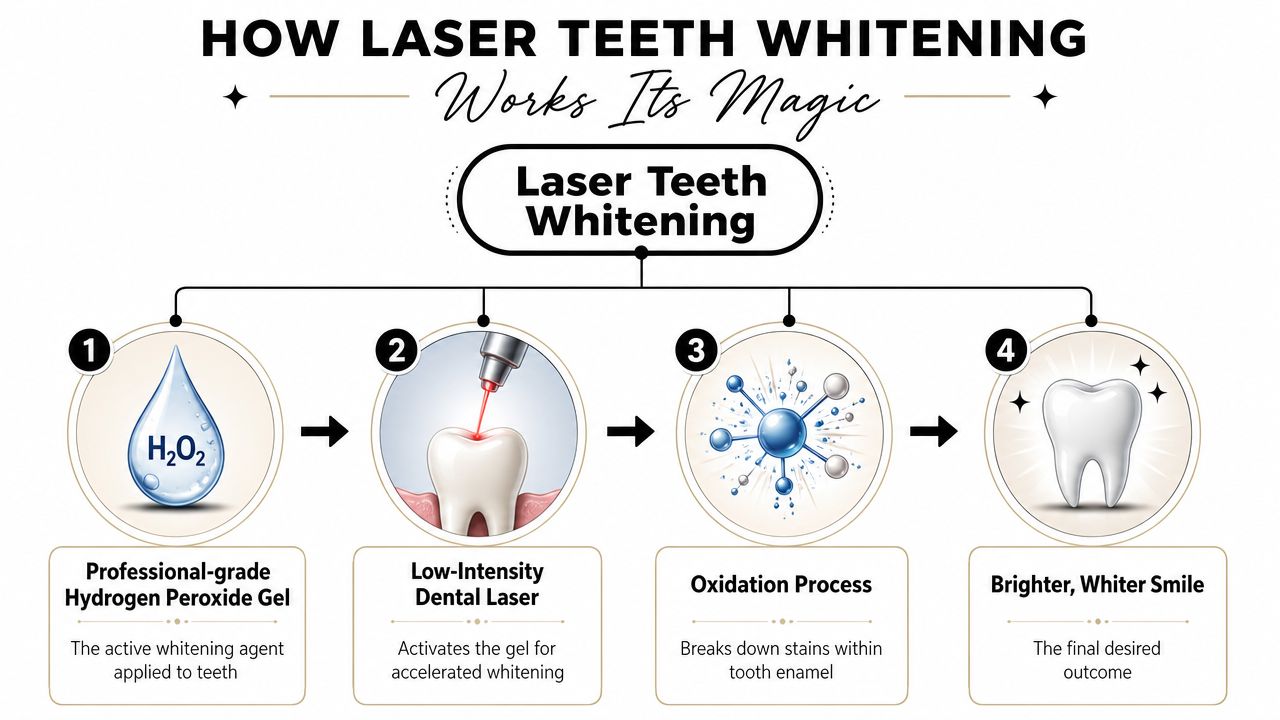
Laser whitening sounds high-tech, but the basic idea is straightforward. A dentist places a strong whitening gel on the teeth, then uses a laser or high-intensity light to activate that gel so stain molecules break apart faster.
The chemistry behind the brightness
The procedure uses a hydrogen peroxide gel at concentrations of 25 to 40%, and when light activates it, the peroxide forms reactive oxygen species that break large stain molecules into smaller, colorless ones. That process can create a whitening effect of roughly 3 to 8 shade units in a single session, as described in this clinical explanation of laser teeth whitening chemistry.
A simple way to think about it is this. The gel does the whitening. The laser acts like a controlled accelerator. It helps the whitening reaction move faster during the appointment.
Why professional whitening feels different from a kit
At-home strips and trays can help with mild staining, but they use a different model. The concentration is lower, the contact time is spread out over many days, and there's no in-office control over exposure, isolation, or immediate adjustment.
Laser whitening is different because the dentist controls several variables at once:
- Gel placement keeps the whitening material where it should be and away from soft tissue
- Light activation speeds the reaction during a single appointment
- Shade planning helps the result look brighter without pushing beyond what the teeth can reasonably deliver
- Safety controls allow the team to monitor comfort throughout treatment
Not every “laser treatment is a true laser in the strict technical sense. Some systems use other intense light sources. For patients, the practical issue isn't the label. It's whether the system is used thoughtfully, with the right gel, the right exposure, and the right protection.
Practical rule: Whitening works best when the stain type, tooth condition, and treatment intensity match. Stronger isn't always better if comfort and enamel health are ignored.
The core answer to what is laser teeth whitening is that it's supervised chemical whitening enhanced by light energy. That combination is what makes it appealing for people who want a faster, single-visit cosmetic result.
Your Laser Whitening Experience at Ultra Smile DentalSpa
For many patients, the biggest stress isn't the treatment itself. It's not knowing what will happen once they're in the chair. A clear step-by-step experience usually lowers anxiety more than any marketing promise.
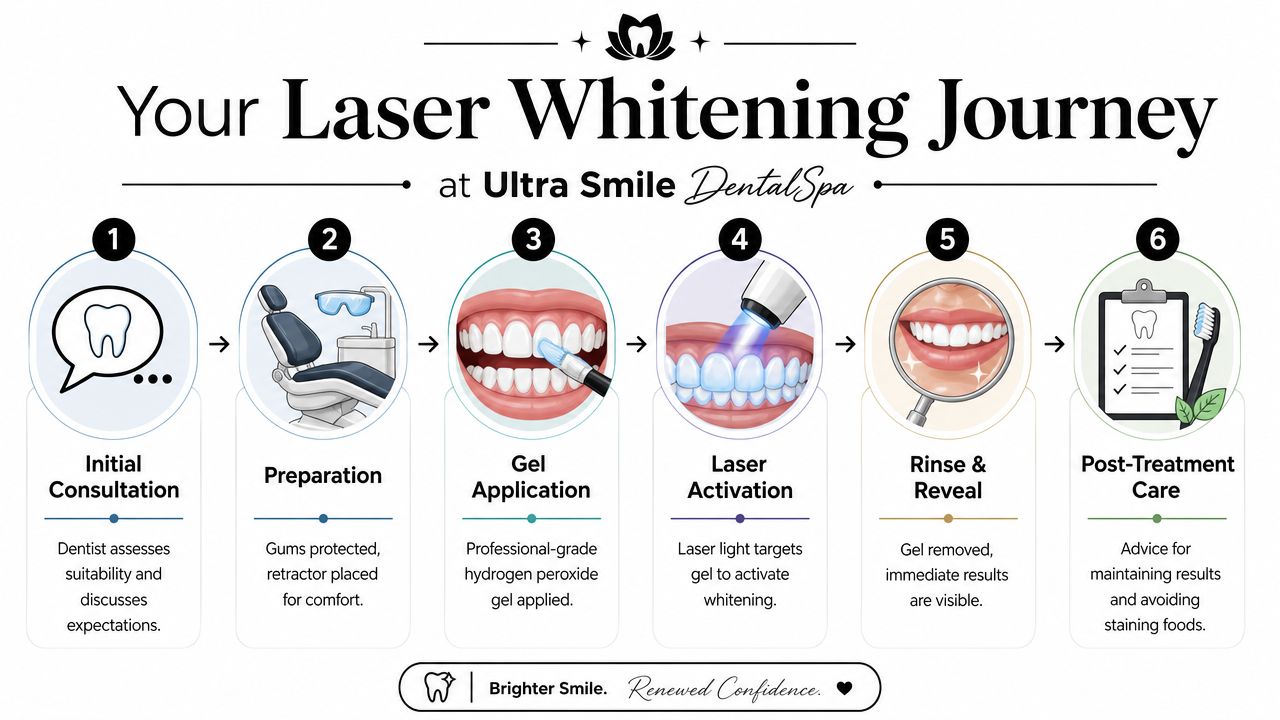
A visual walkthrough helps make the process feel familiar before the appointment even begins.
Before treatment begins
The appointment starts with an evaluation, not with whitening gel. Teeth and gums need to be healthy enough for cosmetic whitening. If there's active decay, gum inflammation, or another issue that needs attention first, it's better to address that before moving into cosmetic treatment. That same visit may also include discussion of related care such as restorative dentistry, same-day crowns, Invisalign, or even urgent concerns if someone originally came in searching for an emergency dentist.
Once a patient is cleared for whitening, the team prepares the mouth carefully. The lips and cheeks are gently retracted, and a protective barrier is placed to shield the gums. This step matters because the gel is strong and should stay on enamel, not soft tissue.
What happens during the appointment
Most laser whitening treatments last 30 to 60 minutes, and they usually involve two to three cycles in which the gel is applied and illuminated for about 15 to 20 minutes at a time to speed stain breakdown, as outlined in this step-by-step description of an in-office laser whitening visit.
That rhythm is one reason many patients find the process manageable. It isn't one long uninterrupted exposure. It's a series of controlled intervals, with opportunities to check comfort and monitor progress as the appointment continues.
This overview gives patients a helpful visual sense of the pace and setup involved.
A spa-like environment also changes how the appointment feels. When the room is calm, communication is clear, and comfort details are built into the visit, cosmetic dentistry becomes much easier for anxious patients to tolerate. Features like refreshments, aromatherapy, entertainment during treatment, and a warm towel finish don't change the chemistry of whitening, but they do change the patient's physical experience of the visit.
Right after the final rinse
When the gel and barriers come off, the smile usually looks brighter immediately. The dentist then checks the shade, reviews what the patient is seeing, and explains the next steps for the first day or two after whitening.
Those aftercare instructions matter. Freshly whitened teeth can be more vulnerable to picking up color from dark foods and drinks right away. Patients usually do best when they treat the first stretch after whitening as a protection phase, not as the end of treatment.
A good whitening visit should feel polished from start to finish. It should also feel personalized. Some patients want the brightest result possible in one sitting. Others want a more conservative change with extra focus on comfort. Both are valid goals.
Laser Whitening Compared to Other Whitening Methods
Whitening isn't one category. It's a set of very different options that solve different problems. The best choice depends on whether the priority is speed, cost, sensitivity management, or the type of discoloration involved.

When speed is the top priority
Laser whitening sits at the premium end because it's designed for visible change in one office visit. Professional in-office whitening without laser enhancement can also produce strong results, but laser-assisted treatment is usually chosen by patients who value immediate impact and are comfortable paying more for it.
At-home strips, trays, and LED kits work on a different timeline. They may be reasonable for mild staining and lower budgets, but they ask the patient to trade speed for convenience. Store options also rely heavily on daily compliance, which is where many whitening attempts lose momentum.
A simple comparison helps clarify the trade-offs:
| Method | Best for | Main advantage | Main trade-off |
|---|---|---|---|
| Laser whitening | Fast cosmetic improvement | Single-visit visible change | Higher cost |
| General in-office bleaching | Professional oversight without laser premium | Strong supervised whitening | May feel less “instant to some patients |
| At-home strips or trays | Mild staining and budget-conscious care | Lower upfront cost | Slower and less controlled |
| Veneers | Shape, color, and symmetry concerns together | Broader smile redesign | Different procedure entirely |
Patients who want a broader overview of options can compare different types of teeth whitening treatments before deciding which path fits their goals.
When another cosmetic option may make more sense
Whitening only changes natural tooth color. It doesn't reshape teeth, repair chips, close spaces, or change the color of crowns and veneers. If someone dislikes the smile for multiple reasons, whitening may be helpful but incomplete.
Some smiles don't need a brighter version of the same problem. They need a different cosmetic solution.
That's where cosmetic dentistry becomes more individualized. Veneers may be the better answer for stubborn intrinsic discoloration, visible shape issues, or older restorations in the smile line. Restorative dentistry may come first if there are damaged teeth, leakage around fillings, or bite problems affecting appearance.
Laser whitening also isn't automatically “better just because it uses light. Evidence-based reviews note that peroxide whitening is generally safe when protocols are followed, but light activation doesn't appear to meaningfully improve the final whitening outcome, the duration of effect, or the risk of sensitivity compared with gel alone according to this peer-reviewed review of tooth-whitening methods. In practical terms, that means the strongest reason to choose laser whitening is often the speed and experience of the appointment, not guaranteed superior long-term whitening.
That's an important distinction. Patients deserve the actual trade-off, not a sales line.
Is Laser Teeth Whitening Safe and Right for You
The short answer is yes, laser whitening is generally considered safe when it's done by a dental professional on the right patient, with the right protections in place. The more useful question is whether it's the right treatment for a specific mouth.
Who tends to be a strong candidate
A good candidate usually has healthy teeth and gums and wants to lighten natural enamel that has darkened from common external stains. Coffee, tea, wine, tobacco, and age-related yellowing are common reasons people seek treatment.
Someone may need a different plan first if any of these apply:
- Active dental problems such as cavities, gum inflammation, or untreated pain need treatment before cosmetic whitening
- Visible restorations like crowns, veneers, or tooth-colored fillings won't whiten the way natural teeth do
- Deep internal discoloration may respond less predictably and sometimes points toward veneers or other cosmetic options
- Complex smile concerns involving alignment, wear, or broken teeth may call for broader cosmetic or restorative care
That's why a proper consultation matters. A cosmetic treatment should never bypass basic diagnosis.
Sensitivity concerns and how they're managed
Sensitivity is the issue many people worry about most, especially those who've had a bad reaction to strips or trays. The encouraging part is that comfort can be planned for. Certain laser systems can be tuned for lower heat and controlled exposure, which may reduce pulpal stress and improve comfort compared with other intense-light systems, especially when paired with desensitizing protocols, according to this review discussing laser wavelength, heat control, and patient comfort.
That doesn't mean nobody feels sensitivity. It means good technique matters. A careful whitening appointment usually includes thoughtful isolation, controlled exposure time, and aftercare suited to a patient's history.
Patients who are especially concerned about post-whitening discomfort can also review how long sensitive teeth can last after whitening to understand what's normal and what deserves a call to the office.
Whitening should be elective, not something a patient has to “push through.
For anxious patients in Miami who want a cosmetic dentist near me, that comfort discussion is often the deciding factor. A safe whitening visit should feel supervised, measured, and adaptable. If the plan doesn't account for sensitivity from the start, it isn't a complete plan.
Results Longevity and Cost of Laser Whitening in Miami
The most practical questions are usually the most important ones. How white will teeth get, how long will it last, and what does it cost?
A visual summary can help frame those decisions before getting into the details.

What kind of result to expect
Results vary because teeth don't all start from the same shade, and stains don't all behave the same way. Some patients see a dramatic shift right away. Others see a cleaner, brighter, more natural improvement rather than an extreme white.
The key is realistic planning. Teeth can become noticeably brighter in one visit, but whitening has limits set by enamel structure, dentin color, and the kind of discoloration present. Strong cosmetic dentistry respects those limits instead of overpromising.
Why maintenance matters more than marketing
A lot of whitening ads treat treatment like a one-time event. That's not how long-lasting results usually work. The better model is maintenance.
Habits matter. Dark beverages, smoking, acidic diets, and inconsistent hygiene all shorten the life of whitening. So does overdoing bleaching too often. A review discussed in this patient-focused article on laser teeth whitening and whitening aftercare notes concern that frequent in-office bleaching more often than every 6 to 12 months can increase enamel microhardness loss and hypersensitivity, especially with high-concentration hydrogen peroxide.
That's why a maintenance plan should be personalized, not generic.
- Diet guidance helps patients limit the foods and drinks most likely to re-stain teeth
- Regular professional care keeps plaque and surface stain from building back quickly
- Touch-up timing should be based on enamel condition, sensitivity history, and actual stain return
- Home support products can make maintenance gentler and more predictable
The whitening session creates the result. Daily habits protect it.
What laser whitening costs in Miami
Laser whitening is one of the more expensive whitening options available. In the United States, professional whitening averages around $500 to $700 per session, while laser-enhanced procedures often cost about $1,500 per session in urban markets according to this pricing overview of whitening effectiveness, utilization, and sensitivity. That premium pricing reflects equipment costs, professional oversight, and the perception of a higher-end cosmetic service.
For many patients, the value calculation comes down to three things:
| Question | Why it matters |
|---|---|
| How fast are results needed | Laser whitening is often chosen for single-visit convenience |
| How important is supervision | Professional monitoring can improve consistency and comfort |
| Is this part of a larger smile plan | Whitening may be one step within broader cosmetic or restorative care |
Insurance usually treats whitening as cosmetic, so patients should expect it to be an out-of-pocket investment. Even so, many people choose it because confidence has real day-to-day value. When the plan is thoughtful and maintenance is built in, the investment tends to feel more worthwhile.
Frequently Asked Questions About Laser Teeth Whitening
Can laser whitening damage enamel
When whitening is performed professionally and according to manufacturer protocols, peroxide-based whitening is generally considered safe. The biggest mistakes usually happen when someone whitens teeth that aren't healthy enough for treatment yet, or repeats treatment too aggressively without enough evaluation in between.
Will crowns fillings or veneers whiten too
No. Whitening changes natural tooth structure, not the color of restorations. If a crown, veneer, or filling is visible when someone smiles, the dentist should talk through the possibility of a color mismatch before treatment begins.
How should someone prepare for the appointment
Come in with clean teeth if possible, and be ready to discuss sensitivity history, previous whitening attempts, and any dental work in the front of the mouth. If there's gum irritation, tooth pain, or a broken tooth, those issues should be addressed before cosmetic whitening. That's also why people sometimes start with routine dental care, restorative treatment, or even urgent care before moving into cosmetic treatment.
Is laser whitening a substitute for other dental care
No. Whitening improves color, but it doesn't treat decay, gum disease, bite problems, infection, or missing teeth. Someone searching for a dentist near me, emergency dentist, tooth extraction, or dental implants near me may still benefit from whitening later, but first the mouth needs to be healthy and stable.
For the right patient, though, laser whitening can be a very satisfying treatment. It's fast, professional, and well-suited to adults who want a brighter smile without weeks of at-home trial and error. The best outcomes usually come from two things working together: careful sensitivity management on the day of treatment, and a realistic maintenance plan afterward.
If you're looking for a calm, high-comfort approach to cosmetic dentistry in Miami, Ultra Smile DentalSpa offers laser whitening within a broader plan for long-term smile health. Patients in Downtown Miami, Midtown Miami, and Hallandale Beach can schedule a consultation to discuss whitening, cleanings and exams, veneers, restorative dentistry, dental implants, or urgent dental concerns and get a treatment plan that fits both comfort and cosmetic goals.