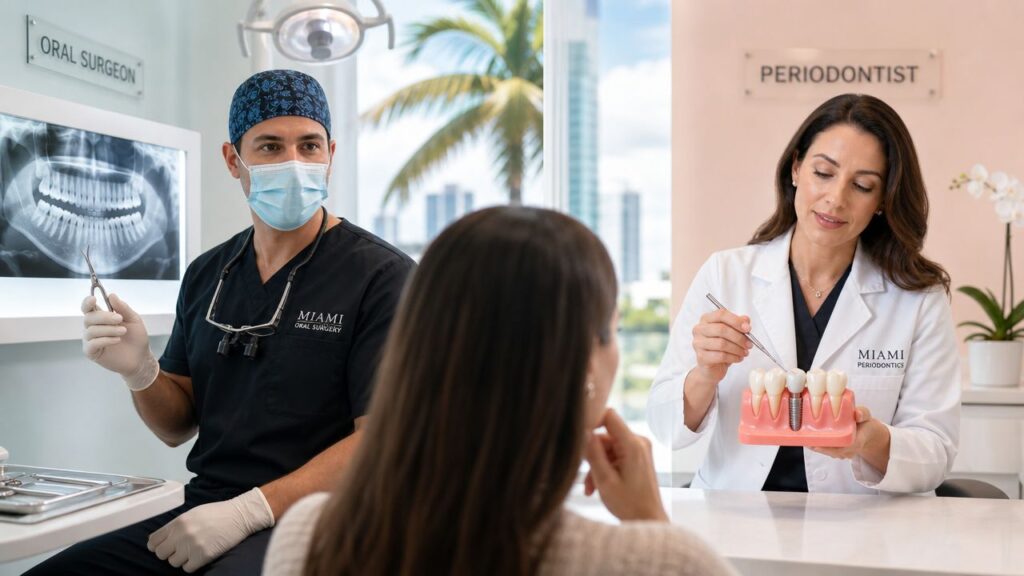
A lot of Miami patients arrive at this question in the same way. A general dentist has said a tooth may not be savable, gum disease has started to affect support around the teeth, or an implant case has become more involved than expected. Then two unfamiliar titles appear at once: oral surgeon and periodontist.
That's where the confusion starts. Both specialists work in the mouth. Both may be involved with implants. Both may be recommended for surgical care. But they don't solve the same problem in the same way, and the right choice depends less on the title alone and more on what's happening with the gums, bone, teeth, and jaw.
For patients searching for a dentist in Miami, FL, dental implants near me, tooth extraction, or even an emergency dentist, the most useful answer is practical. The goal isn't to memorize specialties. The goal is to understand who should handle your case, who should coordinate treatment, and how to protect both function and appearance.
Table of Contents
- Navigating Your Dental Care in Miami
- Training and Focus The Key Differences
- Comparing Roles in Common Dental Procedures
- When to See a Periodontist vs an Oral Surgeon
- Collaborative Care for the Best Results
- Your Consultation at Ultra Smile DentalSpa Miami
- Frequently Asked Questions About Dental Specialists
Navigating Your Dental Care in Miami
A patient may come in expecting a routine exam and leave hearing words like bone loss, recession, extraction, grafting, or implant. That's usually the moment when stress rises. It's not only concern about pain or appearance. It's also uncertainty about who should treat the problem.
In Miami, that uncertainty shows up often in cases involving front teeth, advanced gum inflammation, failing dental work, and teeth that have broken below the gumline. One patient may need help preserving soft tissue before a cosmetic implant. Another may need a surgical extraction because the roots or surrounding bone make the case less straightforward. Those are very different problems, even if both involve a single tooth.
A specialist recommendation should reduce confusion, not create more of it.
For many people searching dentist near me or dental care in Downtown Miami, Midtown Miami, or Hallandale Beach, the first helpful step is a clear diagnosis from a practice that can look at the full picture. That includes symptoms, X-rays, gum condition, bite forces, smile line, and whether treatment needs to be phased.
A quick comparison
| Specialist | Primary Focus | Often Chosen For | Best Fit When |
|---|---|---|---|
| Periodontist | Gums and tooth-supporting tissues | Gum disease care, gum grafting, crown lengthening, implant support | The main issue involves soft tissue, recession, support around teeth, or implant maintenance |
| Oral surgeon | Surgery of the mouth, jaw, and face | Complex extractions, jaw surgery, trauma care, broader surgical access | The case involves impacted teeth, significant surgical access, or a problem extending beyond the tooth-support system |
Patients don't usually need to sort this out alone. They need a dental team that can tell them whether the priority is preserving gum architecture, removing a tooth safely, rebuilding bone support, or sequencing treatment so cosmetic and restorative work lasts.
Training and Focus The Key Differences
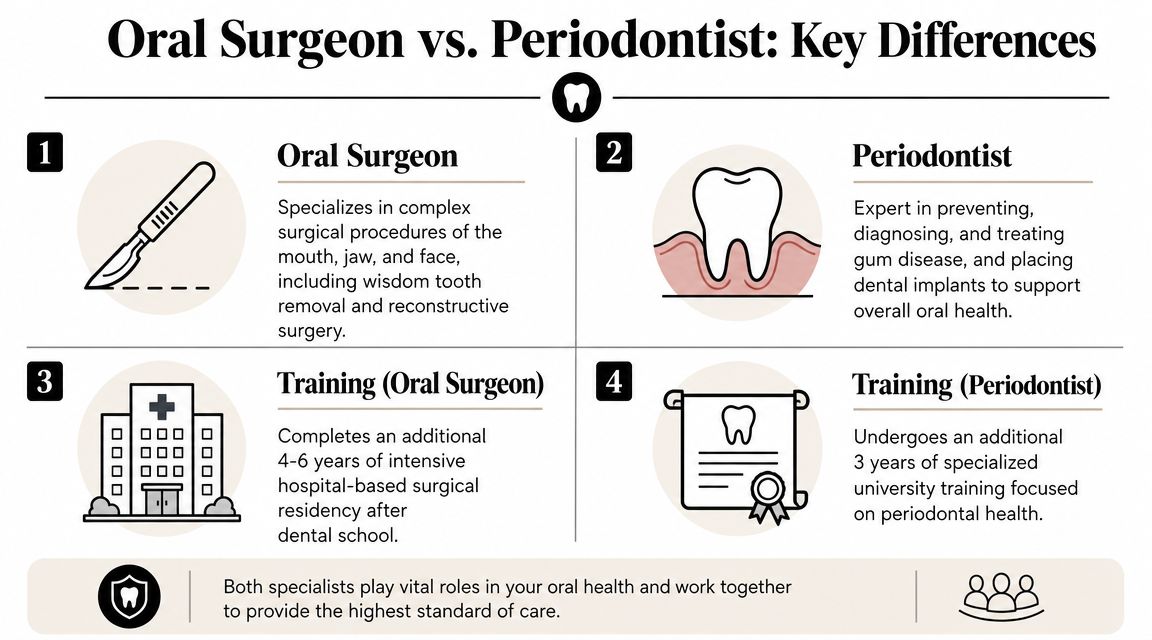
The simplest way to understand the oral surgeon vs periodontist question is this. A periodontist is centered on the tissues that support teeth. An oral surgeon is trained for broader surgery involving the mouth, jaw, and face.
A quick comparison
After dental school, periodontists complete about three years of specialty training focused on periodontal tissues and implant therapy, while oral and maxillofacial surgeons complete roughly 4 to 6 years of hospital-based surgical training and are trained for broader head-and-neck surgery and anesthesia, according to this oral surgery training overview.
That difference shapes what each specialist sees all day.
- Periodontists spend their training and clinical work concentrating on gums, ligament support, bone around teeth, gum disease therapy, soft-tissue correction, and implant-site health.
- Oral surgeons train in a wider surgical environment that includes extractions, jaw procedures, facial structures, pathology, and anesthesia.
Why the training path matters
A useful analogy is foundation work versus structural access. If the problem is primarily about the tissue and bone that support a tooth or implant, a periodontist is often the more focused expert. If the problem requires broader surgical management across the jaw or face, an oral surgeon is often the more natural fit.
That doesn't mean one specialist is “higher level for every situation. It means the training path points them toward different strengths.
Clinical takeaway: The better specialist is the one whose daily work matches the main problem in front of them.
In real patient care, that distinction becomes important quickly. A person with gum recession around a visible front tooth needs someone thinking carefully about tissue contour and stability. A person with impacted wisdom teeth, facial swelling, or a jaw-related issue needs a surgeon whose scope is built around surgical access and the broader maxillofacial area.
For patients considering restorative dentistry, cosmetic dentistry, or implants in Miami, this difference also affects long-term planning. A beautiful crown or veneer won't stay attractive if the gums are unstable. A well-designed implant won't help if an extraction or grafting procedure isn't handled properly at the start.
Comparing Roles in Common Dental Procedures
The overlap creates the most confusion. Many patients searching dental implants near me assume there's one specialist who clearly “owns implant care. In reality, several procedures can involve either specialty, depending on the case.
Implants and implant planning
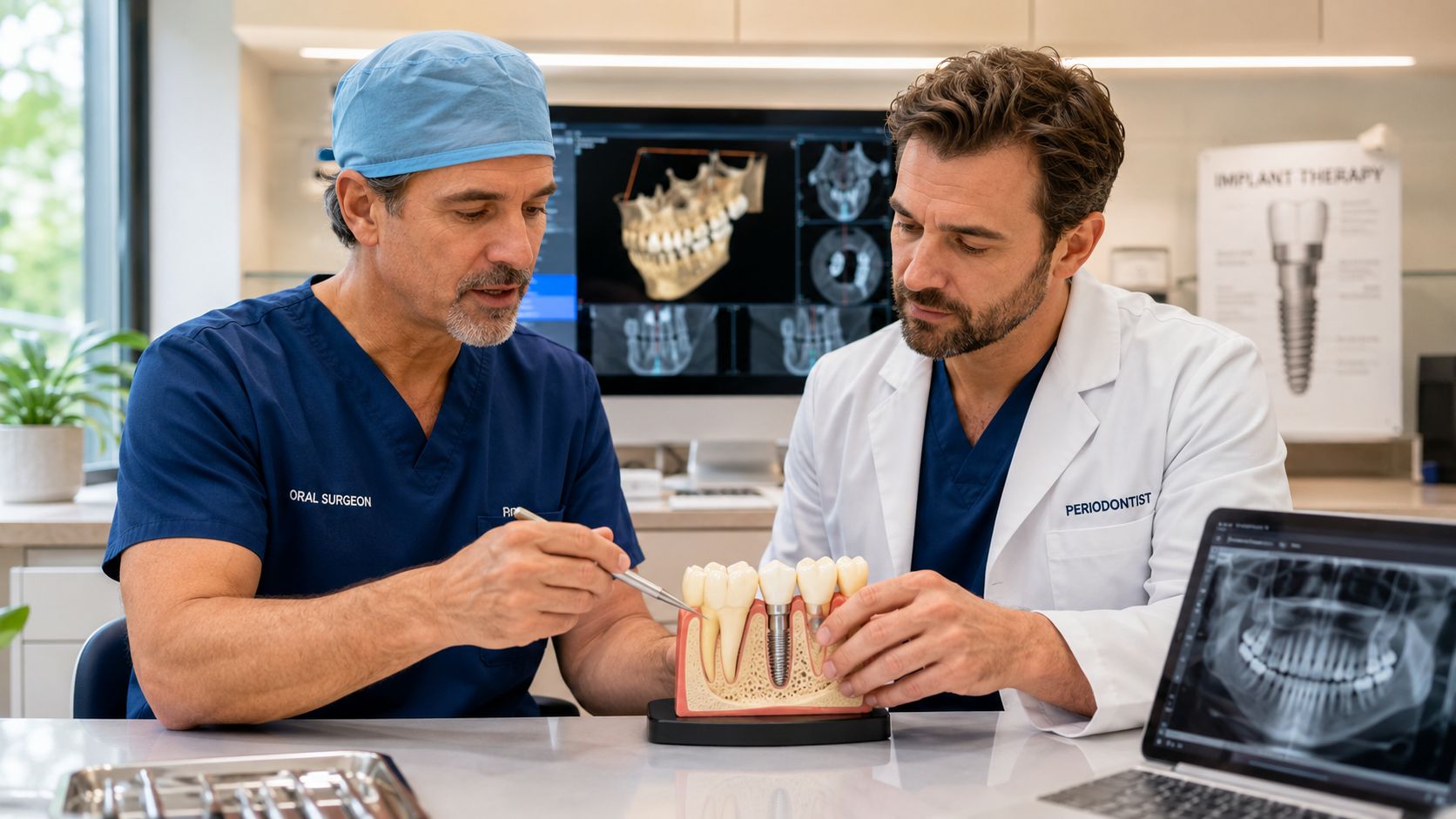
Both specialists can place dental implants. A peer-reviewed analysis of implant placements performed during specialty training found an early implant failure rate of 1.3% for periodontists and 1.7% for oral surgeons, and that difference was not statistically significant. The same analysis reported implant survival of 94.2% for third-year residents, 89.38% for second-year residents, and 88.6% for first-year residents, showing that training level and procedural experience matter in both specialties, as detailed in this peer-reviewed implant training analysis.
That's an important point. It shifts the conversation away from title alone and toward case selection, experience, and planning.
For implant-related care, oral surgeons are often preferred when significant bone grafting or sinus lift procedures are needed, while periodontists are often selected when the priority is long-term soft-tissue and periodontal support around the implant, as explained in this implant specialist comparison.
Extractions grafting and gum surgery
A straightforward extraction may be handled differently than a difficult one. If a tooth is impacted, fractured in a challenging way, or tied to a larger surgical issue, the oral surgeon's broader surgical scope often makes sense. That's especially true for wisdom teeth, deeper impactions, and cases where anesthesia planning matters.
When the focus turns to the gumline and support around teeth, a periodontist often becomes the more natural choice. That includes gum grafting, recession correction, crown lengthening, and maintaining healthy tissue around implants. In highly visible areas of the smile, those details affect not only health but symmetry and appearance.
Bone grafting can sit in the middle. Some grafting procedures are primarily about preparing the support around a tooth or implant site. Others are more surgically involved. Patients often benefit from having the case reviewed as part of a broader plan rather than booking a specialist first and asking questions later. For readers considering grafting before implants, this guide to bone grafts in Miami gives a helpful starting point.
- Dental implants: Both may place them. The deciding factor is often whether the priority is surgical access or soft-tissue stability.
- Tooth extraction: Oral surgeons are more often involved when the extraction is complex or extends beyond routine removal.
- Bone grafts: Either specialty may be involved, depending on whether the case is site development or broader surgery.
- Gum surgery: Periodontists are more closely aligned with procedures focused on periodontal health and tissue architecture.
If a procedure touches both hard tissue and soft-tissue esthetics, the question isn't who can do it. The question is who should lead it.
When to See a Periodontist vs an Oral Surgeon
The most practical answer comes from identifying the main problem. A periodontist should generally be prioritized when the primary issue is the tooth-support system, including gingiva, periodontal ligament, and alveolar bone. Oral and maxillofacial surgeons are generally the better fit when the surgical problem extends to the broader maxillofacial complex, such as impacted wisdom teeth or jaw surgery, based on this case-selection benchmark for dental specialists.
Choose a periodontist if
The symptoms and goals below usually point toward periodontal care:
- Gum recession is the main concern. This matters when roots are exposed, sensitivity is increasing, or the gumline looks uneven.
- A tooth is being affected by gum disease. Saving support around the tooth is often the central issue.
- An implant is planned in the aesthetic zone. Tissue contour around the implant can matter as much as the implant itself.
- Long-term implant maintenance is a concern. Healthy surrounding tissue plays a major role in how an implant looks and functions over time.
- The problem is centered on support, not access. If the question is about gum, ligament, or local supporting bone, periodontal treatment is usually more aligned.
Choose an oral surgeon if
These situations usually lean more clearly toward oral surgery:
- The tooth is impacted or difficult to access.
- A wisdom tooth extraction is needed. Patients comparing options can review this resource on wisdom teeth extraction in Miami.
- The case involves the jaw, facial structures, or a broader surgical issue.
- There's concern about surgical complexity or anesthesia planning.
- The diagnosis extends beyond the tooth-support system.
Here's the quick-reference version many patients want.
Quick Guide Who to See for Your Condition
| Condition or Goal | Primary Specialist | Reasoning |
|---|---|---|
| Gum recession around teeth | Periodontist | The issue centers on soft tissue and tooth support |
| Advanced gum disease affecting stability | Periodontist | Treatment focuses on preserving and managing periodontal structures |
| Implant in a visible smile area | Periodontist | Tissue contour and long-term support often guide planning |
| Impacted wisdom tooth | Oral surgeon | The procedure usually requires broader surgical access |
| Jaw-related surgical problem | Oral surgeon | The condition extends beyond the gums and supporting tissues |
| Complex extraction with wider surgical concerns | Oral surgeon | The scope fits advanced surgical management |
Patients often assume they must choose before they can even book an appointment. In reality, many people are better served by starting with a complete evaluation and letting the diagnosis determine the referral path.
Collaborative Care for the Best Results
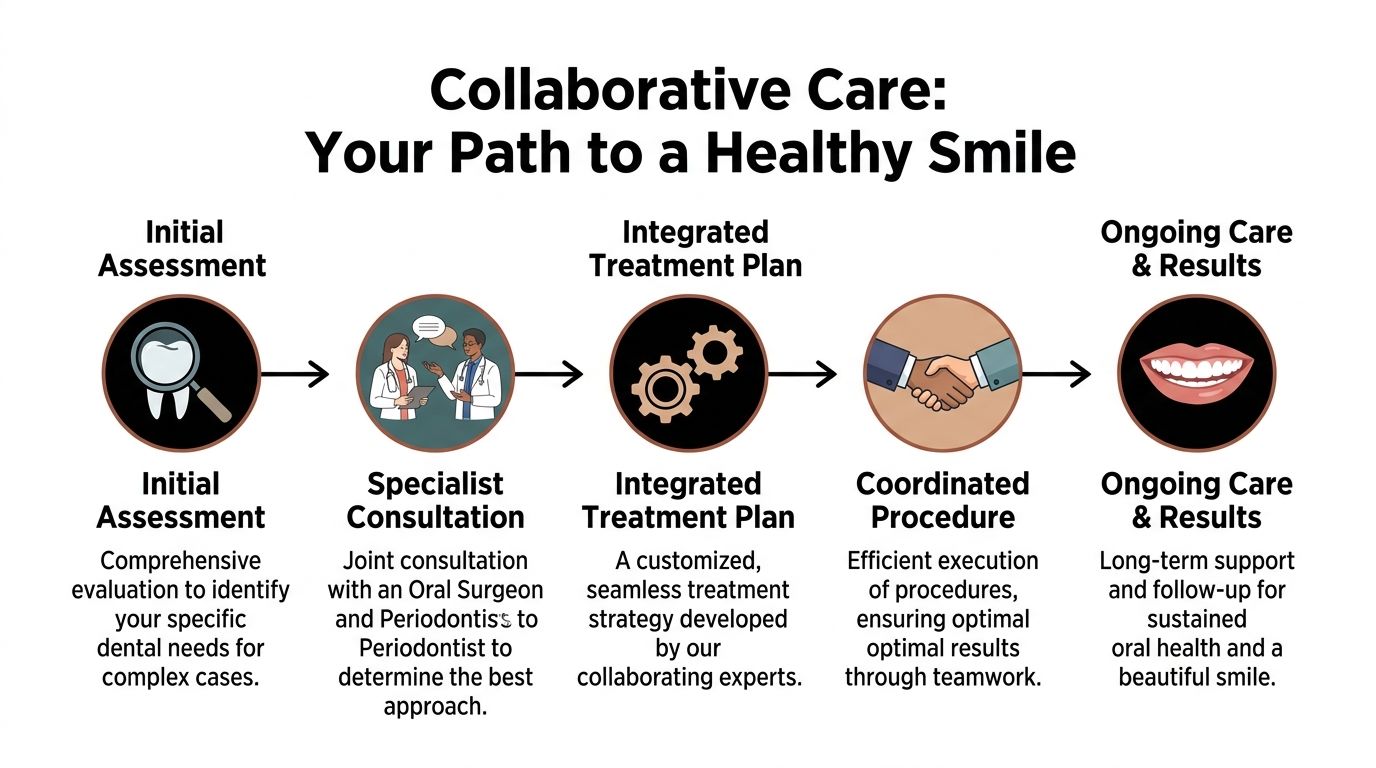
A patient may come in expecting a simple extraction and leave needing a plan that also protects the gums, preserves bone, and supports a natural-looking final tooth. In cases like that, the right question is not which title sounds more advanced. The right question is who is directing the full sequence of care from diagnosis to healing to restoration.
At least one clinical review notes that studies have not consistently shown one specialty to outperform the other for implant outcomes, as noted in this review of implant specialist decision-making. In practice, the quality of planning, communication, and follow-through often shapes the patient experience as much as the specialty itself.
Why coordination matters
Problems tend to show up between appointments, not during them. One office removes the tooth. Another recommends grafting. A restorative dentist later sees that the tissue shape or bone contour will compromise the final result. That sequence creates delays, mixed messages, and extra stress for the patient.
A coordinated approach keeps the records, images, healing timeline, and cosmetic goals aligned from the start. That is especially important in the front of the mouth, where millimeters of gum position and tissue thickness can change the appearance of the smile.
The strongest treatment plans are built backward from the final result.
What coordinated care looks like
Good coordination means the patient does not have to act as the messenger between offices. The treating team decides who should handle the extraction, whether grafting is needed, when implant placement makes sense, and how the final restoration will be supported. The sequence is clear. The handoff is clear. The patient knows what happens next.
In Miami, many patients want two things at once. They want a healthy outcome and a polished cosmetic result. Those goals often overlap, but they are not always handled in the same appointment or by the same specialist. A difficult extraction can affect future implant positioning. A gum defect can change how natural the crown will look. Those trade-offs need to be addressed early.
At Ultra Smile DentalSpa, that process is managed in one place whenever appropriate, or coordinated carefully with the right specialist when a case calls for referral-based care. The benefit for the patient is simple. There is one diagnostic starting point, one treatment roadmap, and less guesswork about whether a periodontist, an oral surgeon, or a multidisciplinary plan is the better fit.
Your Consultation at Ultra Smile DentalSpa Miami
The first visit should answer the patient's real questions quickly. Is the tooth savable. Is extraction necessary. Is gum disease changing the plan. Is this a case for implant therapy, restorative work, or a specialist referral. Good consultations don't overload patients with jargon. They organize the problem.

What happens at the first visit
In a thorough consultation, the doctor reviews symptoms, dental history, and the reason the patient came in. That might be pain, swelling, a loose tooth, bleeding gums, a broken tooth, or concern about appearance. Dental X-rays and a clinical exam help clarify whether the issue is primarily restorative, periodontal, surgical, or a combination.
That matters for patients searching emergency dentist, tooth extraction, or cosmetic dentist near me because those terms often describe urgency, not the actual diagnosis. A person may think the need is cosmetic when the underlying issue is hidden bone loss. Another may assume extraction is the only answer when the tooth can still be stabilized.
What patients can expect in the office
Comfort also changes how patients move through treatment. A calm setting, clear explanations, and a predictable sequence can make specialized dental care feel manageable, even for patients with dental anxiety. At a Miami practice with a spa-like environment, that may include amenities such as refreshments, aromatherapy, entertainment during care, and a more relaxed visit flow.
A strong consultation should also produce a treatment roadmap the patient can understand:
- What the diagnosis is
- Whether the case needs a periodontist, an oral surgeon, or coordinated care
- Which steps are urgent and which can be phased
- How the final result will be restored and maintained
For busy professionals and families in Downtown Miami, Midtown Miami, and Hallandale Beach, that clarity matters almost as much as the treatment itself. Patients want to know what comes next, how long healing may affect daily life, and what choices protect the appearance of their smile.
Frequently Asked Questions About Dental Specialists
Do patients need a referral
Not always. Many patients can schedule directly for an evaluation. In practice, starting with a thorough dental exam is often the easiest route because the diagnosis determines whether periodontal care, oral surgery, restorative treatment, or a combination makes the most sense.
Which specialist handles dental emergencies
It depends on the emergency. Swelling, severe pain, trauma, or a difficult extraction may point toward oral surgery. Bleeding gums, sudden recession concerns, or implant tissue problems may point toward periodontics. The first priority is getting examined quickly so the problem is identified correctly.
Is one specialist better for dental implants
There isn't a universal answer. Both specialties can place implants. The stronger question is whether the case depends more on broader surgery, bone access, and anesthesia considerations, or on gum health, tissue stability, and long-term implant support.
Are costs different between an oral surgeon and a periodontist
Costs vary by procedure, complexity, imaging, anesthesia, grafting needs, and restoration plan. The title alone doesn't tell a patient what treatment will cost. A clear exam and written treatment plan are more useful than trying to compare specialties in the abstract.
What if the patient is anxious and doesn't want to choose wrong
That concern is common. The safest approach is to start with a practice that evaluates the full case, explains the findings clearly, and directs the patient to the right specialist when needed. That removes a lot of unnecessary guesswork.
Patients in Miami who are deciding between a periodontist and an oral surgeon usually don't need more internet debate. They need a clear diagnosis, a practical plan, and a team that can guide the next step with confidence. To discuss implants, gum concerns, extractions, cosmetic goals, or urgent dental symptoms, patients can schedule a consultation with Ultra Smile DentalSpa.