Missing teeth can change daily life surprisingly quickly. Meals become selective. Certain words feel awkward. Smiling in photos starts to feel like a decision instead of a reflex. For many adults in Miami, that’s the moment the search begins for a dentist near me, a cosmetic dentist near me, or a dentist in Miami, FL who can restore comfort as well as appearance.
Making a denture isn’t just a lab procedure. It’s a carefully planned process that restores chewing, speech, facial support, and confidence. At a comfort-focused dental spa, that process should feel calm, personal, and clear from the first conversation through the final adjustment. Patients who also need related care such as a tooth extraction, implant planning, or broader restorative dentistry often benefit from having the whole treatment mapped out in one place.
Table of Contents
- Your Journey to a Confident Smile with Dentures in Miami
- Choosing the Right Type of Denture for Your Needs
- How We Craft Your Custom Denture at Our Miami Practice
- Your Denture Delivery and Adjustment Appointments
- Denture Costs Timelines and Long-Term Care
- Experience the Difference at Ultra Smile DentalSpa
Your Journey to a Confident Smile with Dentures in Miami
A patient may arrive embarrassed by loose older dentures, worn-down teeth, or spaces that make conversation feel self-conscious. Another may have been postponing treatment because the idea of impressions, multiple appointments, or a clinical setting feels overwhelming. In both situations, the concern usually sounds simple on the surface. They want to eat comfortably again. They want speech to feel natural. They want their face and smile to feel like themselves.
That need is ancient. Early dentures date to 700 BCE, when the Etruscans used gold bands to bind human or animal teeth, a reminder that replacing missing teeth has been a concern for centuries according to this history of dentures. What has changed is the patient experience. Modern dentures are custom prosthetics made with far better materials, more precise records, and better methods for refining fit and appearance.
Why this process feels emotional as well as physical
Tooth loss affects more than the mouth. People often change what they order at restaurants, avoid laughing freely, or cover their smile during meetings and family gatherings. Some also deal with anxiety before treatment, especially if they’ve had uncomfortable dental visits in the past or need added services such as dental x-rays, new patient exams, or an emergency dentist evaluation before treatment starts.
A good denture doesn’t only replace teeth. It restores routine, confidence, and ease.
In Miami, where appearance and social confidence matter, patients often want a result that feels polished without looking artificial. That means the denture has to do more than fill a space. It has to support speech, lip position, bite comfort, and facial balance.
What comfort-focused care should feel like
A spa-like setting matters because denture treatment isn’t a one-visit transaction. It’s a relationship over several appointments. Calm surroundings, clear explanations, and unhurried adjustments can make a major difference for someone who’s nervous about treatment or frustrated by a denture that never felt right elsewhere.
Patients searching for a dentist in Miami, FL or a cosmetic dentist near me usually aren’t looking for technical language. They’re looking for reassurance that the process will be thoughtful, individualized, and gentle. That’s exactly how making a denture should be handled.
Choosing the Right Type of Denture for Your Needs
Some patients need to replace all teeth in an arch. Others still have healthy natural teeth and only need to fill several gaps. Others want the security of a prosthesis anchored to implants because movement has been the biggest problem. The right answer depends on anatomy, goals, budget, and whether other treatments such as extractions or implants are part of the plan.
Three common paths
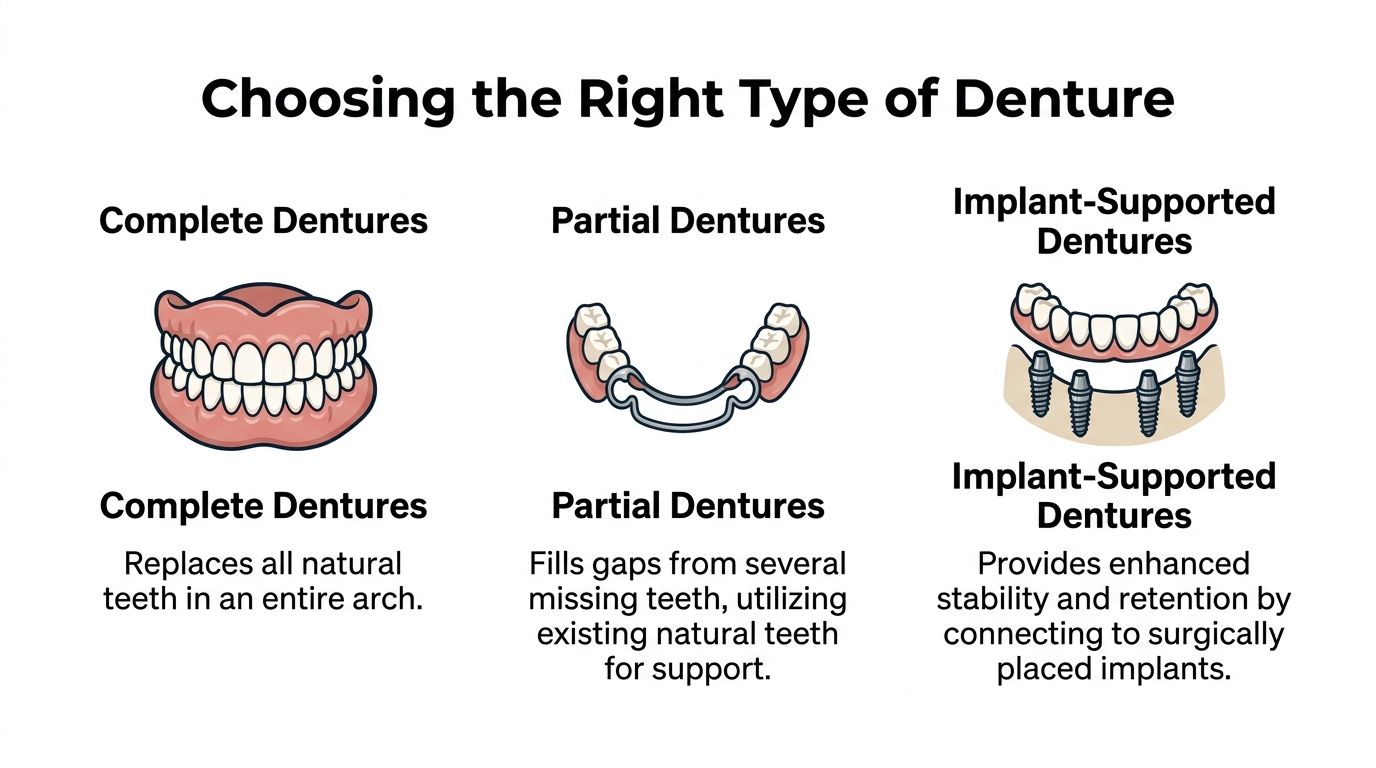
Complete dentures replace all natural teeth in the upper arch, lower arch, or both. They’re often chosen when an arch no longer has teeth that can predictably support crowns, bridges, or partials. They can restore appearance and function well, but lower complete dentures usually demand more adaptation because they have less natural surface area and more tongue movement to work around.
Partial dentures fill in spaces while preserving remaining healthy teeth. They use the existing teeth for support and can be an excellent option when a patient wants a removable restoration without replacing every tooth in the arch. Patients comparing these options may find this guide on partials vs full dentures helpful before a consultation.
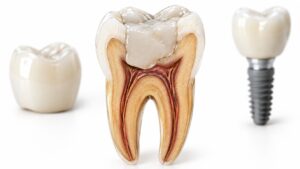
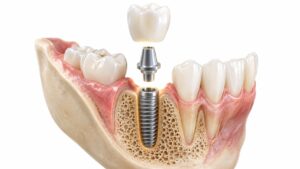
Implant-supported dentures connect to dental implants for stronger retention. For people searching dental implants near me, this option often stands out because it can reduce slipping and improve confidence while chewing and speaking. It also requires a different treatment sequence, and it isn’t right for every patient at every stage.
Practical rule: The best denture isn’t the fanciest one. It’s the one that matches the patient’s bone support, bite, expectations, and ability to maintain it.
Comparing Your Denture Options at a Glance
| Denture Type | Best For | Key Feature |
|---|---|---|
| Complete denture | Patients missing all teeth in an upper or lower arch | Replaces a full arch with a removable prosthesis |
| Partial denture | Patients with several missing teeth and healthy remaining teeth | Uses existing teeth for support |
| Implant-supported denture | Patients seeking more retention and stability | Connects to dental implants for a more secure fit |
A common mistake is choosing based on appearance alone. A denture can look attractive on the bench and still fail in daily life if the support, bite, or retention plan isn’t realistic. Another mistake is assuming implants automatically eliminate every adjustment or maintenance issue. They improve stability, but the prosthesis still needs careful design and follow-up.
Patients who come in for restorative dentistry often benefit from discussing several possibilities at once. In some cases, a removable denture is the most practical solution. In others, a partial or implant-supported plan offers a better balance of comfort and function.
How We Craft Your Custom Denture at Our Miami Practice
A patient often arrives worried about two things at once. Will the denture look natural, and will it feel comfortable enough to wear with confidence? Our process is built to answer both questions before the final prosthesis is ever delivered.
The first visit and the records that matter
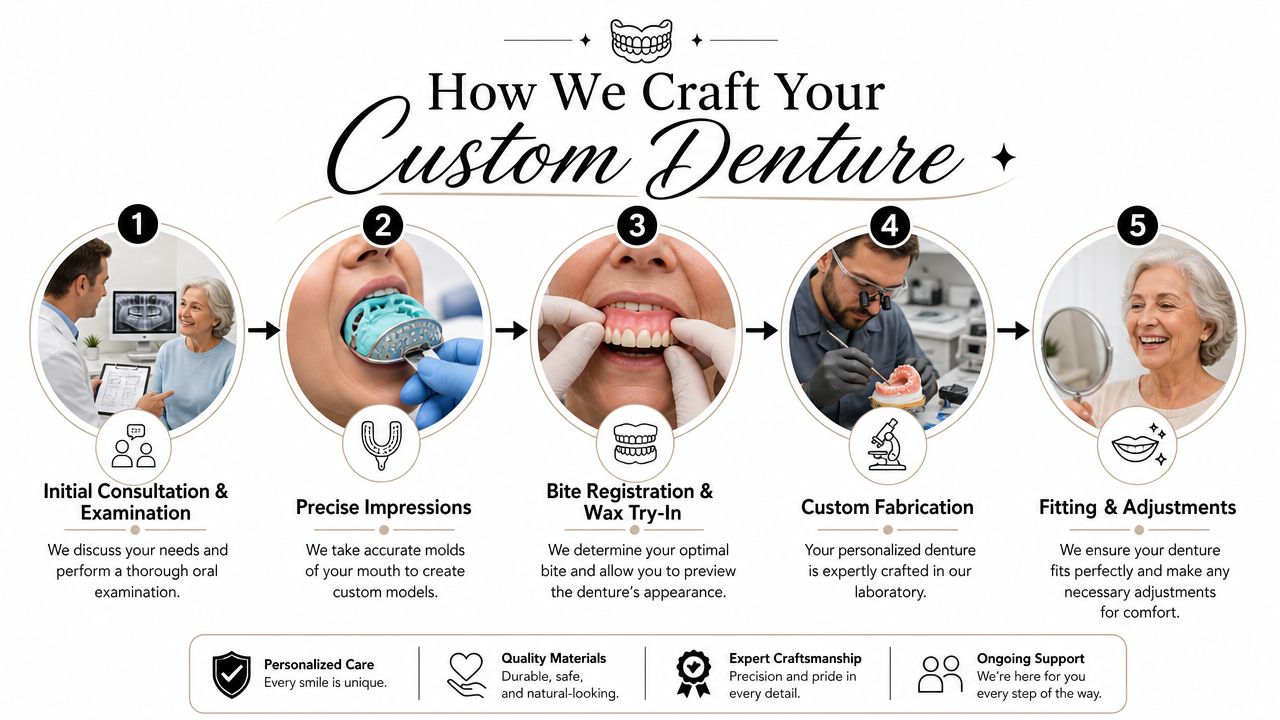
The first appointment is a planning visit, not a quick impression and guesswork. We evaluate the gums, bone ridges, facial support, bite pattern, old dentures if you have them, and any treatment that should happen before fabrication, such as periodontal care, extractions, or imaging. For some patients, this visit overlaps with routine dental care, cleaning and exams, and updated dental x-rays so the full picture is clear.
The clinical and lab stages typically include preliminary impressions, final impressions using a custom tray, recording jaw relations to ensure a proper bite, a wax try-in for aesthetic approval, and final processing, as outlined by this denture fabrication overview. Those terms can sound technical, but each one has a clear purpose. Impressions capture the tissue shape and borders. Jaw relation records help position the teeth where the bite can function comfortably. The try-in lets us verify appearance and speech before the denture is finished.
Bite registration deserves special attention. If the vertical dimension or jaw position is slightly off, a denture may look attractive in photos and still feel tiring, loose, or awkward in daily use. That is one of the trade-offs patients do not always see. Saving time early often creates more adjustment problems later.
The smile preview before final processing
The wax try-in is usually the most reassuring visit. Teeth are set in wax so you can preview the smile, lip support, tooth display, and general feel before the denture is processed in its final material.
This appointment gives room to refine details that strongly affect the result. If the smile looks too full, too flat, too short, or out of balance with the face, we adjust it here, while changes are still straightforward. In a Miami cosmetic setting, that step matters to many patients as much as the fit itself. A good denture should restore function, but it should also suit the face, support the lips properly, and look like it belongs there.
When a denture feels wrong, the cause is often found in the records, border shape, or bite position long before the final material is processed.
Where digital tools help and where judgment still matters
Digital workflows can make parts of treatment more comfortable and efficient. In some cases, scanners, CAD design, CAM milling, and printed try-ins can replace parts of the traditional stone-and-wax process. Digital methods still need careful oversight.
Recent peer-reviewed evidence found that the build angle significantly influences the surface characteristics, accuracy, and dimensional stability of 3D-printed denture bases, and that a 0-degree build angle performed best in one study. The same study found maxillary bases were more precise and stable than mandibular bases, according to this peer-reviewed review of 3D-printed denture accuracy. The distinction is important because lower dentures are often the ones patients struggle with most.
The strongest workflow combines technology with experienced clinical judgment. Digital tools can improve record capture and lab efficiency, but they do not choose the right border extension, confirm a stable bite, or decide how much tooth should show when a patient smiles. At Ultra Smile DentalSpa, denture treatment is often planned alongside cosmetic and restorative needs, which helps when a patient also needs extractions, implant discussion, or guidance on facial aesthetics before the prosthesis is made.
A high-quality denture depends on anatomy, engineering, and artistry working together. If one is overlooked, patients usually feel it right away.
Your Denture Delivery and Adjustment Appointments
Delivery day is exciting, but it’s rarely the very end of treatment. A new denture changes how the lips, cheeks, tongue, and bite work together. Even when the fabrication has been careful, the mouth still needs time to adapt.
What delivery day usually feels like
At the delivery appointment, the denture is inserted, pressure areas are checked, borders are reviewed, and the bite is refined. Patients are shown how to place and remove the prosthesis, how to clean it, and what to expect during the first days of wear. Speech may feel different at first. Certain sounds may need practice. Chewing usually improves with time and technique.
That early adaptation can be frustrating if nobody prepares the patient for it. A well-made denture can still feel bulky, unfamiliar, or slightly sore in spots during the first phase. That doesn’t mean the denture has failed. It means the final fine-tuning has begun.
Why follow-up visits are part of good care
U.S. public dental guidance notes that denture delivery is often followed by multiple adjustment visits because tissues continue to change, especially after extractions, and these visits help relieve pressure spots while improving speech and chewing according to this denture appointment guide. In practical terms, those follow-ups are how a denture becomes wearable in daily life.
Common reasons for adjustment include:
- Pressure spots: Small sore areas can develop where the denture presses too firmly on tissue.
- Border issues: Edges may need refinement if they’re too long, too short, or rubbing during movement.
- Occlusion changes: The bite may need selective adjustment so chewing feels more even and controlled.
- Speech concerns: Tooth position, thickness, or tongue space sometimes need evaluation if words still feel difficult.
Patients shouldn’t judge a new denture by the first few hours alone. The better measure is how it responds to careful adjustment over follow-up visits.
If soreness persists, clinicians may need to revisit the border extension, posterior seal, pressure points, or bite. Occasionally, a larger correction is needed. That possibility is exactly why close follow-up matters. Good care doesn’t stop when the denture is handed over.
Denture Costs Timelines and Long-Term Care
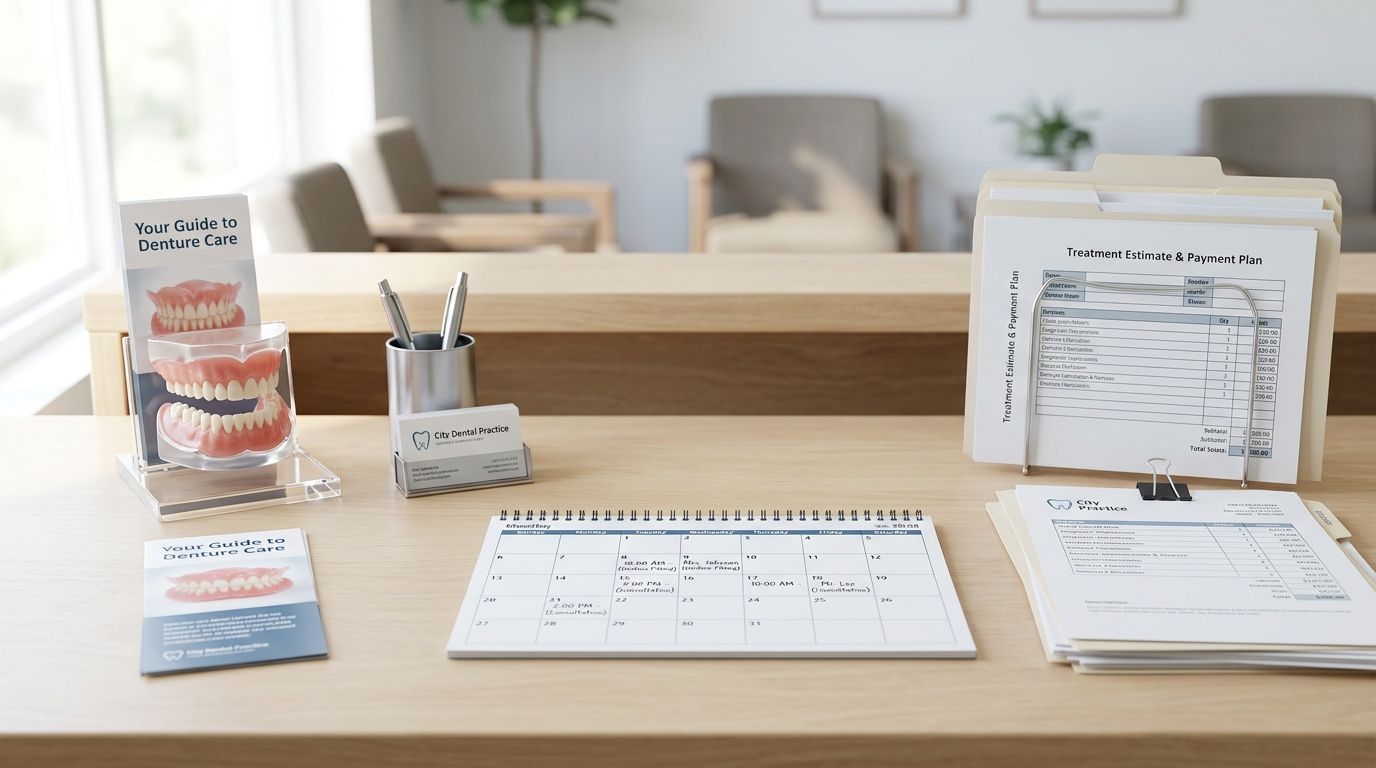
Cost matters because making a denture involves materials, lab work, clinical records, try-ins, finishing, and follow-up. Price differences usually reflect how customized the process is, what materials are used, whether extra treatment is needed first, and how much time is spent refining the final result.
What affects the price
Denture fees vary widely. A typical low-cost denture can start at about $300 to $500 per denture or $600 to $1,000 for a full upper-and-lower set, while mid-priced heat-cured dentures often run $500 to $1,500 per denture. Premium custom dentures can reach $2,000 to $4,000 per denture or $4,000 to $8,000+ per set, based on this denture cost overview. The same source notes that more than 35 million Americans are edentulous and about 90% of that group wears dentures, which helps explain why this remains such an important restorative service.
The premium end of the range usually reflects more detailed records, higher customization, aesthetic refinement, and additional chair time. That doesn’t mean every patient needs the most expensive option. It does mean that a bargain denture can become costly if the fit, bite, or appearance leads to repeated frustration and remakes.
How long making a denture usually takes
The timeline depends on the treatment plan. A straightforward case can move through consultation, impressions, jaw records, try-in, and delivery in a staged sequence over several visits. If healing is needed after a tooth extraction, or if implants are part of the plan, the schedule becomes more individualized.
Patients often expect a denture to be made in one quick step. In reality, the timeline exists for a reason. Each appointment verifies something different, and skipping checkpoints usually increases the chance of bite problems, sore areas, or dissatisfaction with the look.
Daily habits that protect the fit
Long-term success depends on care at home and periodic professional review. This is especially important because the mouth can change over time even if the denture itself is well made.
Helpful habits include:
- Clean it consistently: Daily cleaning helps control buildup and keeps the denture looking and smelling fresher.
- Handle it carefully: Acrylic can crack or chip if dropped on a hard surface.
- Store it properly: Follow the instructions provided for when it should be worn and how it should be stored when out of the mouth.
- Report sore areas early: Small pressure spots are easier to correct before they turn into persistent irritation.
- Keep recall visits: Denture wearers still benefit from routine oral exams to monitor tissues, fit, and any remaining teeth.
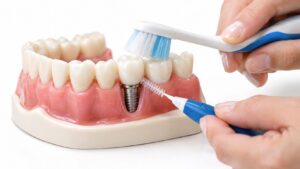
Patients who want more home-care guidance can review how to care for your partials and dentures.
Experience the Difference at Ultra Smile DentalSpa
Patients looking for a dentist near me for dentures usually want more than a replacement appliance. They want clear communication, calm visits, and a result that feels personal. That’s especially true for adults who also want access to cosmetic dentistry, teeth whitening, implant planning, or an emergency dentist when a broken tooth or failing restoration changes the treatment plan.
A comfort-centered Miami practice can make that process easier. A soothing environment, thoughtful pacing, and modern diagnostic tools help reduce the stress many patients associate with removable prosthetics. For anxious patients, those details matter just as much as the final polish on the denture itself.
Dr. Bahmadi and the team serve patients in Downtown Miami, and Midtown Miami, with a blend of restorative planning and aesthetic attention. That combination matters in denture care because function and appearance are tied together. The smile has to look natural, but it also has to work at lunch, in conversation, and during everyday life.
Someone considering dentures, partials, extractions, or dental implants near me doesn’t need guesswork. They need a careful exam, a realistic plan, and enough time to get the details right.
If missing teeth, loose dentures, or an uncomfortable bite have been affecting daily life, schedule a consultation with Ultra Smile DentalSpa. Patients in Miami, FL, Downtown Miami, Midtown Miami, and Hallandale Beach can get a personalized evaluation, a clear treatment plan, and compassionate care designed to restore comfort, confidence, and a healthy smile.