In Miami, patients usually see inlays and onlays quoted at about $900 to $1,900 per tooth, with porcelain often landing toward the higher end and insurance sometimes reducing the final out-of-pocket amount substantially. If a dentist has told you that a tooth needs more than a filling but doesn't need a full crown, the main question usually isn't just the sticker price. It's what drives that price, what's included, and whether the result is worth it.
That situation is common. A patient comes in with a cracked cusp, an old filling that has failed, or decay that's too large for a simple composite repair. They want something strong, natural-looking, and conservative. They also want a straight answer about cost. In Miami, that matters even more because material quality, lab work, and the level of technology used during treatment can noticeably affect both the experience and the final estimate.
Table of Contents
- Your Guide to Inlays and Onlays in Miami
- What Are Dental Inlays and Onlays
- Understanding the Inlays and Onlays Cost in Miami for 2026
- Comparing Costs Inlays Onlays vs Fillings and Crowns
- The Inlay and Onlay Procedure at Ultra Smile DentalSpa
- Using Dental Insurance and Financing for Your Restoration
- Frequently Asked Questions About Inlays and Onlays
Your Guide to Inlays and Onlays in Miami
A typical Miami patient doesn't start by asking for an inlay or an onlay. They usually come in because a tooth hurts when chewing, a corner of a molar broke, or a previous filling no longer feels secure. Then they hear a phrase that sits in the middle of two familiar options: not a small filling, not a full crown.
That middle ground is where inlays and onlays often make sense. They restore a damaged tooth with more strength and precision than a standard filling, while preserving more natural tooth structure than a crown. For many adults in Downtown Miami, Midtown Miami, and Hallandale Beach, that's the balance they're looking for.
Practical rule: If a tooth is too damaged for a predictable filling but still has enough healthy structure to avoid full coverage, an inlay or onlay is often the most sensible restorative step.
Cost still drives the conversation. Patients searching for a dentist in Miami, FL, a cosmetic dentist near me, or even an emergency dentist after a crack or lost filling want clarity before they commit. They don't want a vague national average. They want to know what affects the estimate for their specific tooth.
Why Miami patients ask about value, not just price
The strongest treatment choice isn't always the cheapest line item. A restoration has to fit the bite, seal the tooth well, and hold up under daily chewing. In a city where patients often want both durability and aesthetics, material selection matters as much as the base procedure.
That is why a careful consultation matters. The final recommendation depends on where the tooth sits, how much enamel remains, how visible the tooth is when smiling, and whether the tooth has already had extensive dental care such as root canal treatment or repeated fillings.
Who usually benefits from this option
Patients are often good candidates when they have:
- A failed large filling that no longer supports the tooth well
- Moderate tooth damage that doesn't yet require a full crown
- A cracked or weakened chewing surface on a premolar or molar
- Aesthetic concerns with older metal restorations
- A need for conservative restorative dentistry that preserves healthy enamel
For patients comparing providers after searching dentist near me or reviewing options for restorative and cosmetic dentistry in Miami, transparency helps more than hard selling. The best starting point is a precise exam, digital imaging when needed, and a written treatment plan that separates the restoration fee from any additional care.
What Are Dental Inlays and Onlays
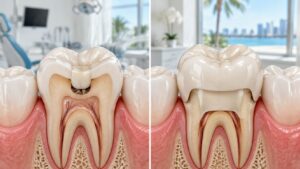
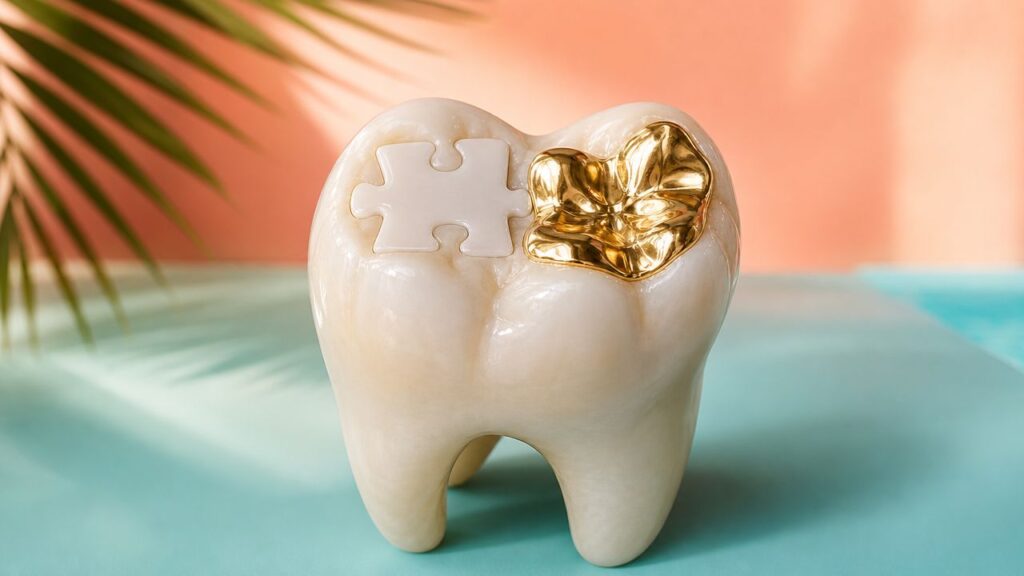
An inlay or onlay is a custom restoration that fits into a damaged tooth like a carefully made puzzle piece. Instead of placing soft filling material directly into the tooth and shaping it by hand, the dentist prepares the area and uses a restoration that's fabricated to match the tooth's contours more precisely.
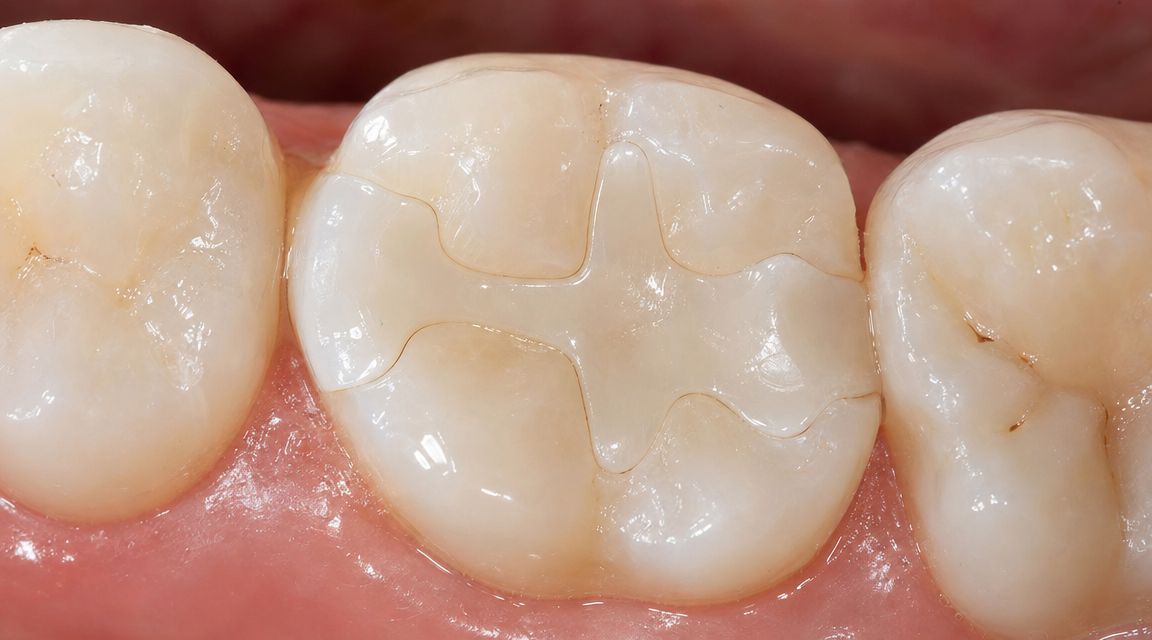
This treatment is often used when a cavity or fracture is too extensive for a routine filling but the tooth doesn't need to be reduced all the way around for a crown. That makes it one of the most conservative options in restorative dentistry for moderate damage.
How they differ from a filling
A filling is placed directly into the tooth during the appointment and shaped there. That's often the right choice for small cavities. But as the damaged area gets larger, the limits of a filling become more important. The tooth may need more structural support, stronger margins, and a restoration that distributes chewing pressure more predictably.
An inlay or onlay is designed for that situation. Because it is custom-made, it can provide a more exact fit than a large direct filling in the right case.
A good restoration doesn't just fill space. It helps the remaining tooth carry force safely every time the patient bites down.
When an inlay becomes an onlay
The difference is simple:
- Inlay fits within the grooves of the tooth and stays inside the cusps
- Onlay extends over one or more cusps when more coverage is needed
If the top ridges of the tooth are still strong, an inlay may be enough. If one or more cusps are weakened, cracked, or missing, an onlay may be the better choice because it protects those areas from further fracture.
Why patients often choose them
For the right tooth, inlays and onlays can offer a strong mix of benefits:
- Conservative treatment because more healthy tooth structure can stay in place compared with a crown
- Natural appearance especially with tooth-colored materials
- Precise fit that supports function and comfort
- Versatility for back teeth that need both strength and aesthetics
Patients looking for a dentist in Miami, FL often compare this option with composite fillings, crowns, and other restorative services. The best match depends on damage level, bite pressure, and appearance goals, not just on whether the tooth has a cavity.
Understanding the Inlays and Onlays Cost in Miami for 2026
A patient in Miami often sits down expecting one price and leaves with a range. That happens because an inlay or onlay is never priced by material alone. The final fee depends on how much tooth is left, whether the restoration stays inside the cusps or covers them, how the bite loads that tooth, and whether any supporting treatment is needed first.
Miami fees also do not always track with broad national estimates. Lab work, digital scanning, material choice, and office technology all affect the quote. At Ultra Smile DentalSpa, the goal is not to produce the lowest number on paper. The goal is to deliver a restoration that fits precisely, looks natural, and holds up well under daily chewing forces, with a more comfortable experience from start to finish.
What patients in Miami are usually paying for
A written estimate for an inlay or onlay usually includes more than the restoration itself. It reflects the clinical time to prepare the tooth properly, the records needed to fabricate a custom piece, the material selected, and the level of detail involved in bonding and bite adjustment.
A simpler porcelain inlay on a premolar generally costs less than a larger onlay on a heavily used molar. The reason is practical. Larger restorations take more design work, more finishing, and more attention to force distribution so the tooth functions safely after treatment.
| Material | Estimated Cost Per Tooth |
|---|---|
| Composite resin | Usually at the lower end of the fee range when the case is appropriate |
| Gold | Often priced higher because of material and laboratory factors |
| Porcelain | Commonly falls in the mid to upper range because patients want strength and a natural appearance |
Porcelain remains the most common choice in Miami for one simple reason. Patients want a restoration that disappears when they smile but still performs well on back teeth. Gold still has real advantages in durability, but esthetics matter to many patients. Composite can reduce the fee in selected cases, though I am careful about where I recommend it because heavy bite pressure can change the long-term value.
Why one office quote can be higher than another
Price differences usually come from how the case is planned and how the restoration is made.
An office using digital scanning, high-quality ceramics, careful shade matching, and a strong bonding protocol may charge more than a basic fee schedule suggests. That higher fee can also reflect a better fit, fewer remakes, and a more predictable result over time. In a city like Miami, where patients care about both appearance and longevity, that trade-off matters.
Comfort matters too. Many patients factor in more than the tooth alone. They want efficient visits, a clear explanation of fees, and an experience that feels calm rather than rushed. That is part of value, even if it does not show up as a separate line item.
Costs that may be added before the final restoration
The restoration fee is sometimes only one part of the total treatment cost. If the tooth has deep decay, a crack near the nerve, old leaking dental work, or inflamed gum tissue around the area, those issues must be handled first. A temporary restoration may also be needed while the final piece is being fabricated.
That is why two patients who both need an onlay can receive very different estimates.
Patients comparing this option with a large direct restoration can also review the difference between indirect treatment and composite fillings and amalgam fillings. In practice, the least expensive option at the first visit is not always the one that preserves the tooth best over time.
A useful estimate should separate the restoration fee from any supporting treatment. That level of detail helps patients in Miami understand what they are paying for, why it costs what it costs, and whether the proposed plan matches the condition of the tooth.
Comparing Costs Inlays Onlays vs Fillings and Crowns
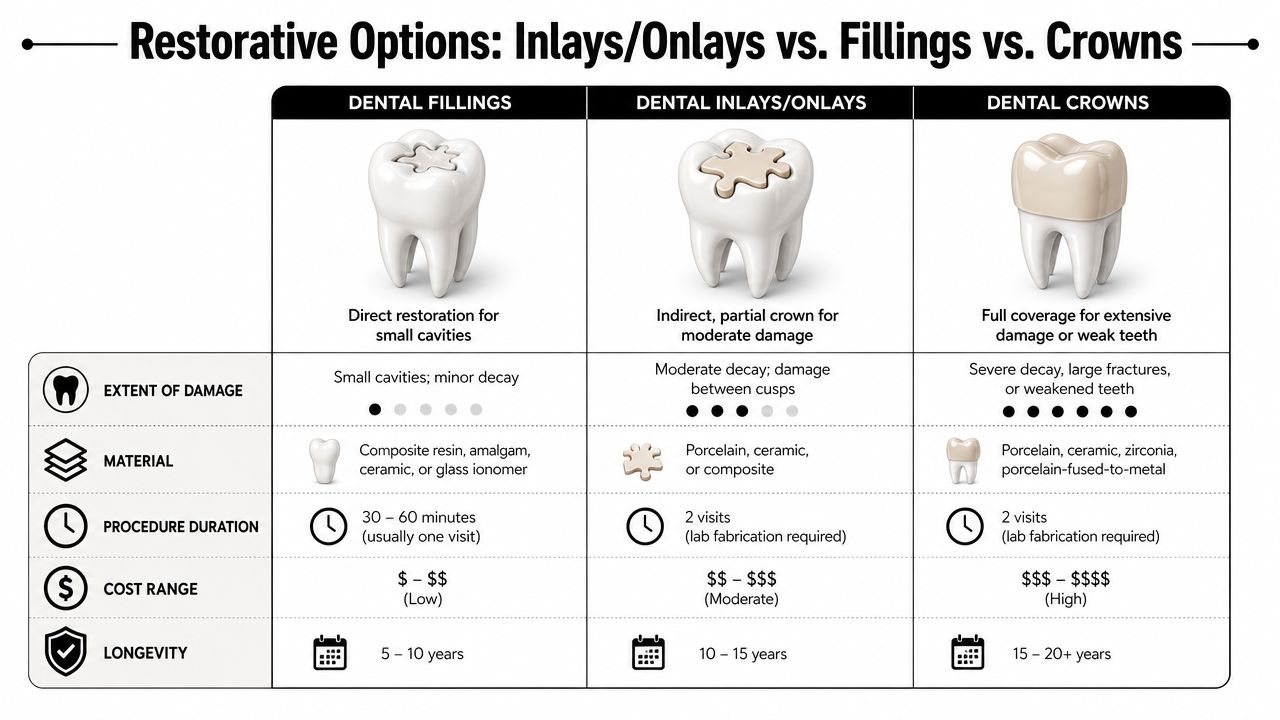
Most patients don't compare inlays and onlays in isolation. They compare them to the options they've already heard about: a filling or a crown. The right choice depends on how much of the tooth is compromised and how much healthy structure can still be preserved.
When a filling is enough
A filling works well for smaller areas of decay or damage. It is direct, efficient, and usually the most conservative first step when the tooth still has strong surrounding walls.
What doesn't work well is trying to stretch a filling beyond what the remaining tooth can support. As the restoration gets larger, the risk shifts from "repairing a cavity" to "holding together a weakened tooth." At that point, a custom indirect restoration may provide a better long-term result.
When an inlay or onlay offers better value
An inlay or onlay often makes sense when the damage is moderate. The tooth needs more support than a filling can offer, but enough sound structure remains to avoid covering the entire tooth.
That middle-ground value matters. These restorations preserve more natural tooth structure than crowns while offering more precision and reinforcement than large direct fillings.
A practical comparison looks like this:
- Fillings are best for smaller defects
- Inlays and onlays fit moderate damage where conservation and strength both matter
- Crowns are often used when the tooth is extensively weakened or requires full coverage
Clinical judgment matters most: The best option is the one that protects the tooth without removing more healthy structure than necessary.
When a crown makes more sense
A crown covers the full visible portion of the tooth above the gumline. That can be the right answer when the tooth is badly broken down, has very little remaining enamel, or has already undergone extensive repair.
The trade-off is that a crown usually requires more reduction of the natural tooth. For patients trying to decide between partial and full coverage, this guide on dental crown cost in Miami helps put the options into context.
How patients should think about the choice
Instead of asking which treatment is "best" in the abstract, it helps to ask four direct questions:
- How much healthy tooth is left
- How much force does this tooth take when chewing
- How visible is the tooth when smiling
- Is the goal a short-term repair or a more durable restoration
Patients who also need related restorative care, such as a tooth extraction, dental implants near me, or cosmetic improvements after previous damage, often benefit from evaluating the whole treatment plan rather than one tooth in isolation.
The Inlay and Onlay Procedure at Ultra Smile DentalSpa
For many patients, the procedure is easier than they expect. The process is methodical, comfortable, and focused on preserving as much healthy tooth structure as possible while restoring strength and function.
What the appointment process usually looks like
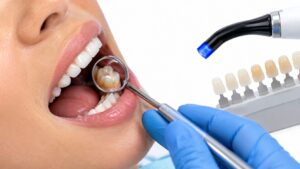
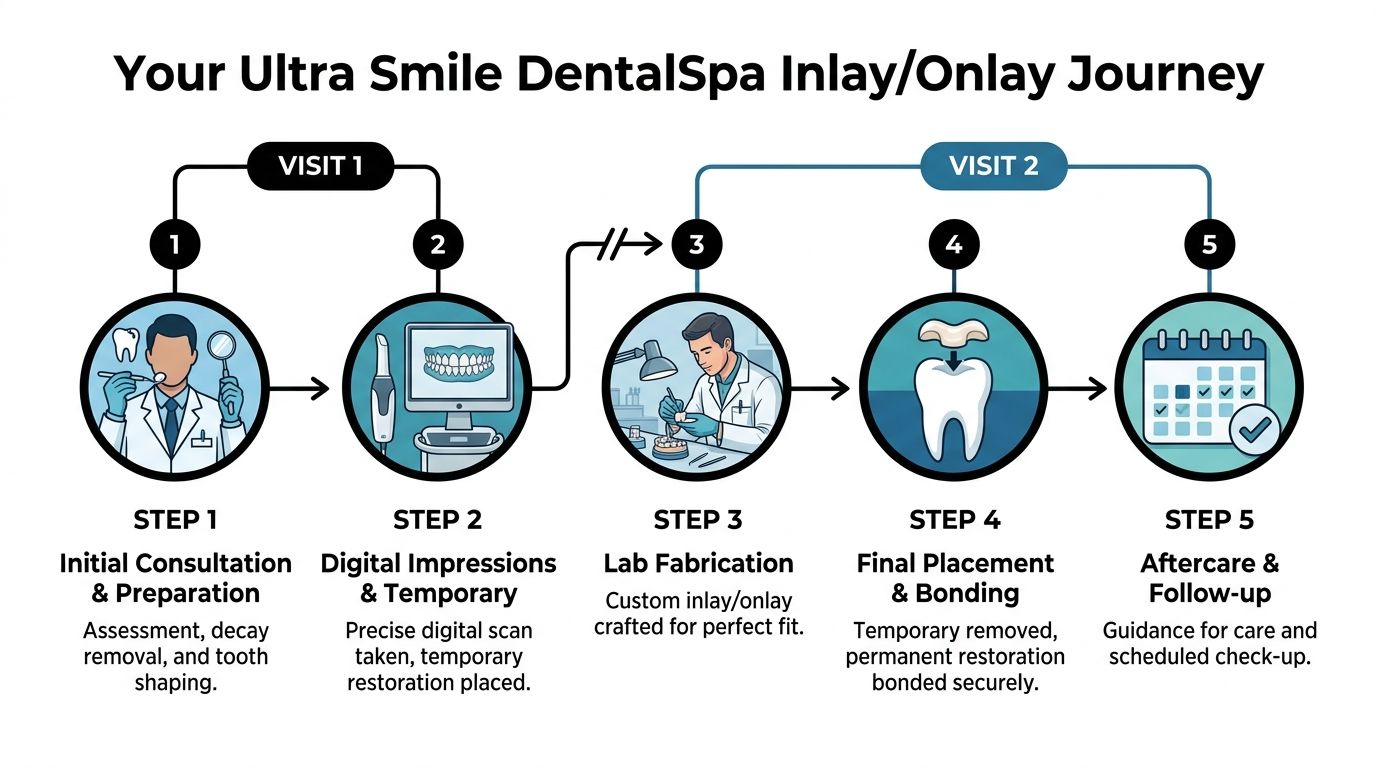
The first visit starts with a close examination of the tooth. If the damage is suitable for an inlay or onlay, the dentist removes decay or weakened material and shapes the tooth so the restoration can seat properly.
Digital scanning can replace the old impression experience in many offices. That improves precision and helps the lab fabricate a restoration that matches the prepared tooth more accurately. If the case isn't completed the same day, a temporary restoration may be placed while the final one is being made.
At the second visit, the temporary is removed, the fit is checked, and the final inlay or onlay is bonded into place. The bite is adjusted so chewing feels even and natural.
Why comfort matters during restorative care
Patients with dental anxiety often delay treatment until a cracked or decayed tooth becomes more serious. A calmer setting can make a real difference in whether they move forward early, when the tooth is still a candidate for conservative treatment instead of a crown or extraction.
A practice that uses digital tools, careful anesthetic technique, and a patient-centered approach usually creates a smoother visit than one that treats the process like a rushed repair.
A comfortable appointment isn't a luxury feature. It helps patients accept needed treatment sooner, before the tooth deteriorates further.
What helps the restoration last
After placement, the restoration still depends on daily habits and follow-up care. Patients usually do best when they:
- Brush and floss consistently to protect the margins around the restoration
- Avoid chewing hard objects such as ice or pens
- Wear a night guard if recommended when clenching or grinding is an issue
- Keep regular cleanings and exams so small bite or margin problems can be caught early
- Address pain promptly instead of waiting for an emergency dentist visit
For busy professionals and families in Miami, good restorative dentistry should feel predictable from the first exam through follow-up, not confusing or rushed.
Using Dental Insurance and Financing for Your Restoration
A common Miami scenario is simple. A patient is ready to save a cracked tooth with an inlay or onlay, then pauses when the front desk mentions insurance estimates, deductibles, and annual maximums.
The good news is that many dental plans contribute toward this kind of restoration. The exact amount depends on how your carrier classifies the procedure and how much of your yearly benefit is still available. In my experience, patients feel much more comfortable scheduling treatment once they see a written breakdown instead of a vague verbal estimate.
How insurance often applies
Insurance does not process every inlay or onlay the same way. Some plans place it under basic restorative care. Others place it under major services, which can change the percentage paid and the out-of-pocket cost.
Three details usually determine what you will owe:
- How the plan classifies the restoration
- Whether your deductible has already been met
- How much of your annual maximum remains
This is why benefit verification matters. A careful office team can confirm the details before treatment and give you a more realistic estimate, especially if you are also planning other care during the same benefit year.
Why a written estimate matters
A written estimate should separate the fee for the inlay or onlay from any related treatment. That may include imaging, a build-up, a temporary restoration, or other work needed to restore the tooth properly. Patients deserve that level of clarity.
At Ultra Smile DentalSpa, value is not just the lab bill or the material itself. The fee also reflects the precision of the fit, the quality of the ceramic or porcelain used, the digital technology involved, and the comfort of the experience. In a city like Miami, where patients often compare prices online, that distinction matters. A lower quote can leave out steps that improve longevity, comfort, and appearance.
Financing can help when a patient wants the stronger, more conservative option now rather than postponing care and risking a larger repair later. Monthly payments are often easier to manage than one larger expense at the time of treatment.
This short video helps explain how many patients think through dental financing and payment planning:
If you are comparing dentists in Miami because a tooth has started to crack, hurt, or trap food, ask three direct questions: Has my insurance been verified, what exactly is included in the quote, and are financing options available if I want to start soon? Those answers usually tell you more than a broad online price range ever will.
Frequently Asked Questions About Inlays and Onlays
Are inlays and onlays painful
Most patients do well with this treatment.
During the procedure, the tooth is numb, so patients usually feel vibration or pressure rather than pain. Afterward, mild sensitivity with chewing or cold foods can happen for a few days. If the bite is adjusted precisely, that tenderness usually settles quickly.
Comfort also depends on how the appointment is handled. In my experience, patients feel less anxious when they know what is happening, how long each step takes, and what to expect once the numbness wears off.
How do patients choose between a large filling and an inlay
The choice depends on the size of the damaged area, the condition of the remaining tooth, and the pressure that tooth handles every day. A filling is often reasonable for a smaller repair. An inlay or onlay makes more sense when a tooth needs more strength, better edge support, and a restoration that is made to fit more precisely.
Bite force matters more than many patients realize. A back tooth that absorbs heavy chewing pressure can break down faster with a large filling, especially if the cusps are already weakened. In that situation, paying more upfront for an inlay or onlay can reduce the chance of another repair later.
Why can the final fee be different from the original online range
Online ranges are broad by design. They usually describe the restoration itself, not every step required to restore the tooth properly.
The final fee may change if the tooth needs updated imaging, old decay removed, a build-up, a temporary restoration, bite adjustment, or treatment for a deeper crack that only becomes clear after the old filling is removed. That is why a written treatment plan matters more than a national price estimate.
In Miami, this difference is even more noticeable because offices vary widely in materials, lab quality, digital technology, and how much is included in the quoted fee.
Why do many Miami patients choose this type of restoration
Many patients want to keep as much healthy tooth structure as possible without settling for a large filling that may not hold up well. That is where inlays and onlays fit. They can offer a conservative repair with a more refined fit, strong ceramics, and a natural appearance.
At Ultra Smile DentalSpa, the value is not only in the restoration itself. It comes from careful planning, high-quality materials, digital precision, and a calmer treatment experience. For Miami patients comparing costs, that combination often makes the fee easier to understand because it is tied to comfort, appearance, and long-term performance.
If a tooth has been diagnosed as needing more than a filling, scheduling a consultation with Ultra Smile DentalSpa is the best way to get a clear, Miami-specific treatment plan. Patients in Downtown Miami, Midtown Miami, and Hallandale Beach can get a personalized exam, a transparent written estimate, and guidance on whether an inlay, onlay, crown, or another restorative option makes the most sense for long-term comfort and function.