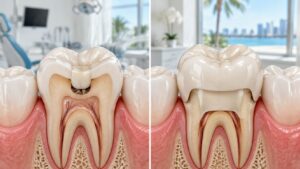
A lot of people in Miami land on this page the same way. There's a dull pressure behind the last molar, gum swelling that comes and goes, or a recent exam where a dentist pointed to a dental x-ray and said the wisdom teeth may need attention. Others aren't in pain at all. They're trying to figure out whether impacted wisdom teeth surgery is necessary, what the procedure feels like, and whether recovery will derail work, school, or family routines.
That uncertainty is normal. Wisdom teeth can stay quiet for a while, then flare up quickly, especially when they're trapped under gum or bone, angled into the next tooth, or partly erupted and hard to clean. For patients searching for a dentist near me, an emergency dentist, or a dentist in Miami, FL, the need is usually simple: clear answers, a calm plan, and treatment that respects comfort as much as clinical precision.
Table of Contents
- A Miami Dentist's Guide to Wisdom Tooth Pain
- Understanding Impacted Wisdom Teeth
- Signs You Need Wisdom Tooth Extraction
- The Surgical Procedure A Step-by-Step Overview
- Your Recovery Timeline and Essential Aftercare Tips
- Cost of Wisdom Teeth Surgery and Insurance in Miami
- Experience a Gentle Extraction at Ultra Smile DentalSpa
A Miami Dentist's Guide to Wisdom Tooth Pain
A common pattern starts subtly. A patient in Downtown Miami notices soreness behind the last lower molar while chewing. A few weeks later, the gum feels puffy. Then the discomfort spreads into the jaw, makes brushing the back teeth annoying, and turns one normal workday into an urgent search for a tooth extraction provider or an emergency dentist.
That story is familiar because impacted wisdom teeth are common. About 90% of people have at least one impacted wisdom tooth, and in the United States that contributes to 10 million wisdom teeth being extracted from 5 million people each year, according to Cleveland Clinic's overview of impacted wisdom teeth. The procedure is routine in dentistry, but that doesn't mean the decision feels routine to the person dealing with it.
Why wisdom tooth pain feels confusing
Wisdom tooth symptoms don't always announce themselves clearly. Some people feel pressure more than pain. Others notice swelling, trapped food, or a bad taste near the back of the mouth. Some only find the problem during cleaning and exams or new patient exams, when a dental x-ray shows a tooth stuck under the gum or pressing against a neighboring molar.
Practical rule: Pain in the far back of the jaw that keeps returning deserves an exam, even if it fades between flare-ups.
Patients also bring understandable anxiety to these visits. Online descriptions of oral surgery often sound cold and mechanical. That tone can make a manageable treatment feel much more intimidating than it is.
A local approach that starts with clarity
For patients looking for a dentist in Miami, FL, the first step isn't committing to surgery. It's getting a careful evaluation, clear imaging, and a direct explanation of what's happening. Sometimes the answer is removal. Sometimes the better answer is observation and follow-up.
That distinction matters. Good dental care doesn't start with selling treatment. It starts with diagnosing the source of pain, explaining the trade-offs, and deciding whether wisdom tooth removal, monitoring, or a broader plan involving restorative dentistry makes the most sense. In a city like Miami, where patients often balance work, appearance, and convenience, that practical approach matters just as much as technical skill.
Understanding Impacted Wisdom Teeth
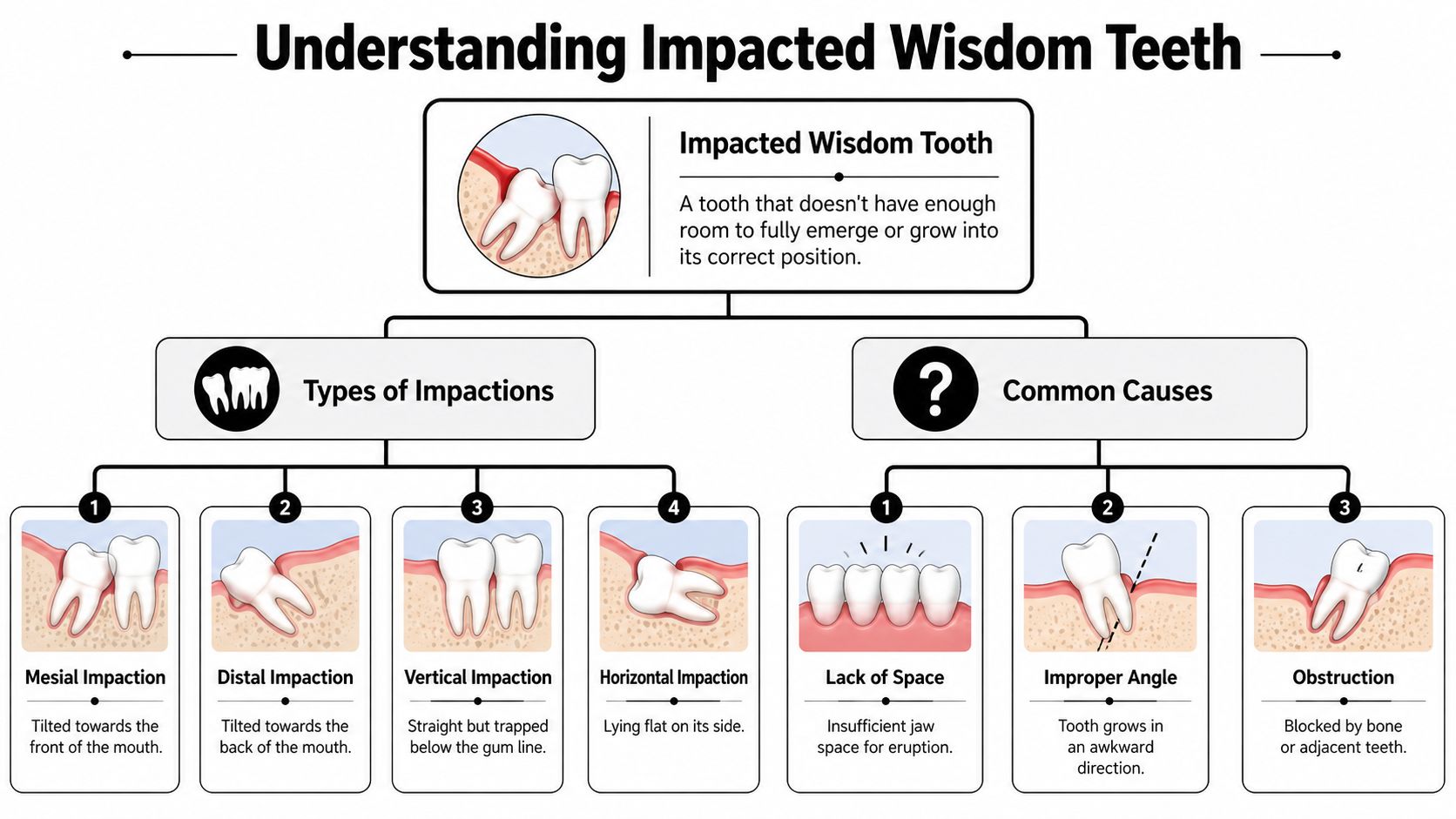
An impacted wisdom tooth is a third molar that cannot come in normally because space is limited, the angle is off, or bone and gum tissue block its path. In practice, that means the tooth is trapped under the gums, lodged in the jawbone, or pressing into the molar in front of it.
What impaction means
Patients often expect a wisdom tooth to behave like any other erupting tooth. Impacted teeth do not. They stop short, drift sideways, or remain buried, and that position can create pressure, trap bacteria, or place the neighboring molar in a harder-to-clean area.
Some impacted teeth are partially erupted. Part of the crown is visible, but gum tissue still covers the rest. This is a common setup for irritation because food and bacteria collect under that gum flap, especially in the very back of the mouth where brushing and flossing are harder.
Other impacted teeth stay much deeper. A fully bony impaction means the tooth remains enclosed in the jawbone. These cases usually require a more technical surgery, often with a small opening in the gum, careful removal of some surrounding bone, and, at times, dividing the tooth into sections so it can be removed gently. Lower wisdom teeth also deserve close planning because important nerve structures can be nearby. Good imaging and careful technique matter more than speed.
The angle of the tooth matters too. On x-rays, dentists usually describe impacted wisdom teeth by the direction they lean.
- Mesial impaction means the tooth tilts forward toward the second molar.
- Distal impaction means it tilts backward.
- Vertical impaction means it is upright but still trapped.
- Horizontal impaction means it lies sideways and may press directly into the tooth in front of it.
Each pattern creates a different set of concerns. A partially erupted tooth may flare up again and again because the gum stays inflamed. A horizontal impaction may threaten the neighboring molar. A deep lower impaction may not hurt much day to day, yet still require a more precise surgical plan.
This is one reason online explanations can feel more intimidating than helpful. The condition sounds dramatic, but modern evaluation is usually straightforward. With clear x-rays, local anesthesia, and sedation options when appropriate, impacted wisdom tooth surgery is typically planned in a calm, controlled way focused on comfort.
For patients already visiting for dental care, dental x-rays, or cosmetic goals like teeth whitening or cosmetic dentistry, wisdom teeth often become part of the bigger conversation about protecting the rest of the smile.
Signs You Need Wisdom Tooth Extraction
Not every impacted wisdom tooth needs to come out immediately. Some do. The challenge is separating the teeth that are likely to keep causing trouble from the ones that can be watched safely.
Clear reasons to remove a wisdom tooth
Certain findings usually push the decision toward tooth extraction. Recurrent pain in the back of the jaw is one. Repeated swelling around a partially erupted tooth is another. If food keeps packing around the area, cleaning is difficult, and the gum becomes irritated over and over, monitoring often stops being practical.
Other reasons are visible on the exam or x-ray rather than felt day to day. A wisdom tooth may press against the second molar, create a space that's hard to keep clean, or show a position that makes future damage more likely. In those situations, surgery can be preventive in the sensible sense of the word. It addresses a defined risk rather than removing a tooth solely because it exists.
A patient may also need faster treatment if the area is acutely painful, swollen, or interfering with eating and sleeping. That's when people often search for an emergency dentist in Miami instead of waiting for a routine visit.
What if it doesn't hurt
Honest dentistry is especially vital. Many dentists recommend preventative removal, but recent guidance also states that if an impacted tooth is healthy and has a low risk of future problems, the best approach can be “no treatment but kept under review, as explained by the British Association of Oral and Maxillofacial Surgeons guidance on removal of impacted wisdom teeth.
That means “doesn't hurt isn't enough by itself to justify surgery, and it also isn't enough to rule surgery out. The better questions are more specific:
- Is the tooth healthy right now
- Can the patient clean the area predictably
- Is the position stable or risky
- Is it affecting the adjacent tooth
- Would waiting likely make surgery more complex later
A quiet wisdom tooth isn't always a safe wisdom tooth, but a quiet wisdom tooth also isn't automatically a surgical case.
This balanced approach tends to build trust because it avoids extremes. Patients looking for a new dentist near me often want exactly that. Not pressure. Not delay. Just a realistic recommendation based on symptoms, x-rays, anatomy, and long-term oral health.
When removal is recommended, it should be easy to explain why. When monitoring is reasonable, that should be said clearly too.
The Surgical Procedure A Step-by-Step Overview
A common Miami scenario goes like this: a patient arrives expecting a tense, highly medical experience, then realizes wisdom tooth surgery is usually much calmer and more controlled than the internet makes it sound. When the plan is explained clearly and comfort is handled well, the day feels predictable.
Before the procedure
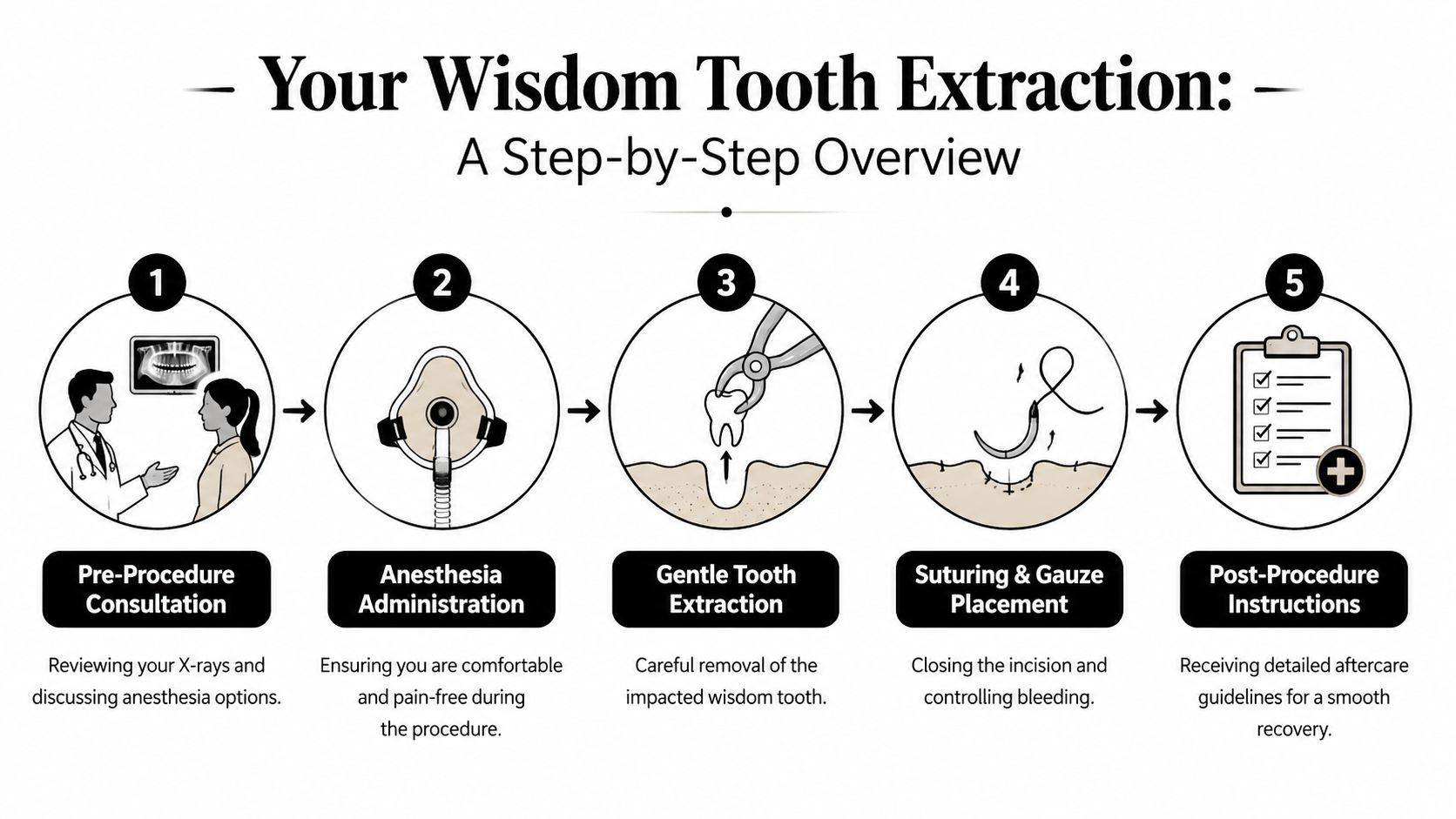
Surgery starts with a focused review of the x-rays, the tooth position, the nearby roots, and the amount of gum or bone covering the tooth. That tells the surgeon whether the extraction is likely to be straightforward or more technical.
Comfort planning happens before anything begins. Some patients do very well with local anesthetic alone. Others prefer help relaxing, especially if the tooth is impacted or several teeth are coming out at once. A clear review of sedation options for wisdom teeth extraction helps patients choose what fits their anxiety level, health history, and ride-home logistics.
In a modern Miami practice, the goal is not just to remove the tooth. The goal is to make the experience feel calm, gentle, and well controlled from the first few minutes.
What happens during surgery
Once the area is fully numb and the patient is comfortable, the surgeon opens the gum enough to reach the tooth. If bone is blocking access, a small amount is removed. If the tooth is locked in place, it may be divided into smaller sections so each piece can be lifted out with less pressure on the surrounding area.
That sounds technical because it is. It is also often the gentler approach.
Trying to force out a tightly impacted tooth in one piece can place more stress on the jaw, gum tissue, and neighboring tooth. Careful sectioning usually gives the surgeon better control and makes the extraction smoother. After the tooth is removed, the area is cleaned and sutures are placed if they will help the tissue heal in a stable position. Many of those sutures dissolve on their own.
The appointment length depends on the anatomy. A partially erupted tooth can be relatively quick. A full bony impaction near important structures takes more time and precision. Patients usually feel pressure and movement, not sharp pain, because numbness is the priority before any surgical step begins.
A short video can make the sequence feel more familiar.
What happens right after
Gauze is placed over the site so a blood clot can form and early bleeding stays controlled. Patients rest briefly, then go home with written instructions and a clear plan for medication, food, and activity.
A little preparation helps a lot. If sedation was used, a ride home is usually needed. Soft foods should already be in the kitchen. Gym sessions, heavy lifting, and late nights are better postponed for a short period so the body can focus on healing.
Good surgical technique matters. Clear instructions, good numbness, thoughtful sedation, and realistic planning are what usually make the whole experience feel easier than expected.
Your Recovery Timeline and Essential Aftercare Tips
Most patients want the same answer after surgery. How long will this last, and what helps the most? Recovery after impacted wisdom teeth surgery usually improves in stages rather than all at once. The first days matter most because they set the tone for healing.
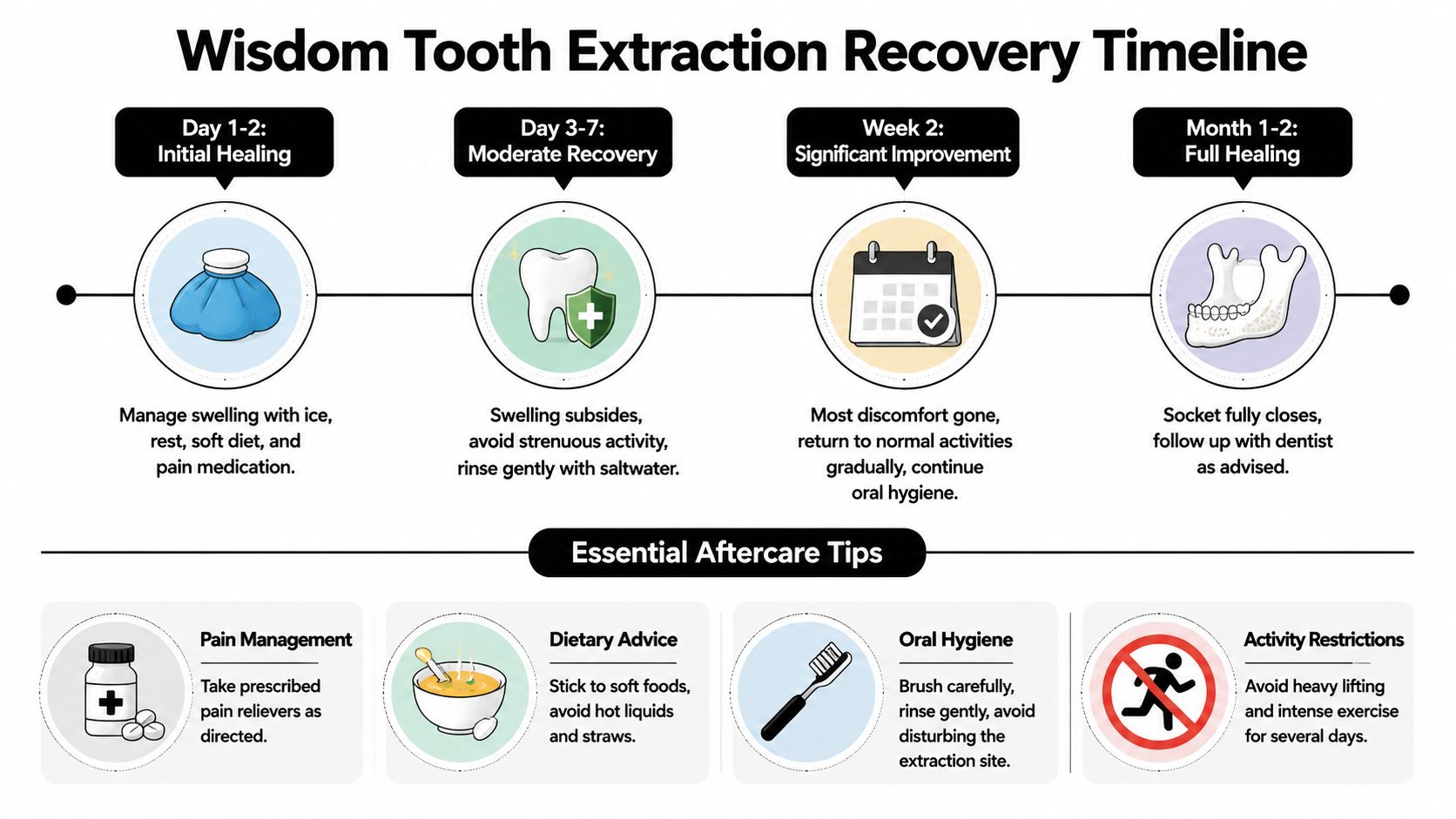
This timeline graphic gives a quick overview before the practical details.
The first two days
Swelling, soreness, and mild bleeding are most noticeable early. Post-operative care is essential: use ice packs for 48 hours, avoid straws for at least 5 days, stick to a soft-food diet, and begin warm salt water rinses after the first day to facilitate healing and prevent food from getting trapped in the socket, according to post-op wisdom teeth removal instructions from Amarillo Oral Surgery.
That advice works because it protects the blood clot and keeps pressure off the surgical site. Straws and smoking create suction. Crunchy foods leave debris. Aggressive rinsing can disturb healing tissue before it has stabilized.
A few practical food choices usually go over well: yogurt, smoothies eaten with a spoon, mashed potatoes, soup once it's cooled, scrambled eggs, oatmeal, and applesauce. Seeds, rice, nuts, and popcorn are better avoided because they can lodge in the extraction area.
The next stage of healing
By the next few days, most patients can feel the shift from acute soreness to gradual improvement. Rest still matters. So does limiting strenuous exercise for a short period. Gentle oral hygiene becomes more important as the mouth starts to feel more normal.
One useful reference for patients is healing after wisdom teeth extraction, especially for questions about eating, cleaning, and when routine activities can resume.
The site may still look uneven or feel tender even when recovery is going well. That's expected. Healing bone and gum tissue takes longer than the first drop in pain.
Don't judge recovery by one rough afternoon. Judge it by the day-to-day trend. Most healthy healing follows a steady pattern of less swelling, easier eating, and better comfort.
Typical Wisdom Tooth Surgery Recovery Timeline
| Timeframe | What to Expect | Key Actions |
|---|---|---|
| Day 1 to 2 | Swelling, soreness, light bleeding, and limited chewing | Use ice packs, rest, take medications as directed, eat soft foods |
| Day 3 to 7 | Swelling usually starts settling, mouth opening improves, tenderness remains | Continue gentle cleaning, start warm salt water rinses after the first day, avoid straws and smoking |
| Week 2 | Most daily activities feel easier, gums are closing, mild sensitivity may persist | Return to normal activity gradually, keep the area clean, follow office instructions |
| Month 1 to 2 | Deeper tissue and socket healing continue | Attend follow-up if advised and maintain routine dental care |
A few signs deserve a prompt call to the office: worsening pain after early improvement, bleeding that doesn't settle, foul taste with increasing swelling, or numbness that feels unusual or persistent. Most recoveries are uneventful, but early communication is always better than guessing.
Cost of Wisdom Teeth Surgery and Insurance in Miami
Cost is a real part of the decision, and patients deserve direct answers. The final fee for impacted wisdom teeth surgery in Miami depends less on the city itself than on the details of the case.
What affects the final fee
The national average cost for surgically removing one impacted wisdom tooth is $363, with prices ranging from $281 to $702 depending on location, the anesthetic used, and the complexity of the extraction, according to CareCredit's review of impacted wisdom tooth removal costs.
That range makes sense in practice because not all wisdom teeth are alike. A partially erupted upper tooth is different from a completely embedded lower tooth near the nerve. A single extraction differs from removing several teeth in one visit. Sedation choices also affect the total.
Common cost drivers include:
- Depth of impaction. Teeth trapped in bone usually require a more involved surgical approach.
- Number of teeth removed. The total changes if one tooth is urgent versus several teeth being addressed together.
- Anesthesia and monitoring. Comfort options can change both the experience and the fee.
- Imaging and follow-up needs. The treatment plan may include diagnostic imaging and post-op visits.
How insurance usually fits in
Many dental plans provide some level of coverage for surgical extraction, but the exact patient portion depends on the policy. Deductibles, annual maximums, waiting periods, and co-insurance all shape what the patient pays.
The most useful move is verifying benefits before treatment, not after. Patients should ask whether surgical extraction is covered, whether sedation has separate coverage rules, and whether the treating office is in network or out of network. That conversation often removes more stress than any online estimate can.
For patients without coverage, financing or staged payment options can make care more manageable. Transparency matters here. A good treatment coordinator should explain the estimate clearly, separate what is known from what depends on insurance processing, and help the patient avoid surprises.
Experience a Gentle Extraction at Ultra Smile DentalSpa
Many people still picture wisdom tooth surgery as a cold, rushed experience under harsh lights. That expectation is outdated. Modern dentistry can make this procedure feel calmer, more organized, and far less intimidating than older descriptions suggest.

Why modern surgery feels different
Technique matters. Environment matters too. Patients with dental anxiety usually don't need hype. They need a team that communicates clearly, moves efficiently, and reduces unnecessary stress before, during, and after treatment.
That's one reason newer approaches are worth discussing. Emerging incision-simplification techniques can significantly reduce post-surgical pain and surgery time, allowing for faster wound healing, as described in a PMC report on simplified upper impacted wisdom tooth extraction techniques. Not every case qualifies for the same method, but the direction is clear. Wisdom tooth surgery doesn't have to feel as disruptive as many patients assume.
What patients in Miami can expect
For adults seeking a dentist near me, cosmetic dentist near me, dental implants near me, or surgical care in the same office, comfort often comes down to consistency. The same practice that provides cleaning and exams, restorative dentistry, cosmetic dentistry, and dental implants should also be able to explain oral surgery in plain language and support recovery without drama.
Ultra Smile DentalSpa serves patients in Downtown Miami, Midtown Miami, and Hallandale Beach with a model built around both clinical standards and patient comfort. The setting includes details that help anxious patients settle in, such as refreshments, custom aromatherapy, streaming entertainment during procedures, and a warm towel finish. The office is led by Dr. Neda Bahmadi, DMD, and supported by a bilingual team, which can make treatment planning and aftercare easier for many Miami families.
Patients usually notice the difference in small moments. Questions are answered directly. The treatment plan is explained before the appointment starts. The surgery is approached with a gentle, structured process rather than a rushed, impersonal tone.
Comfort in oral surgery isn't about pretending the procedure is nothing. It's about removing confusion, controlling pain well, and helping patients know exactly what to expect.
For someone dealing with back-jaw pain, swelling, or a troubling x-ray, that combination of calm communication and precise care can make the next step feel much more manageable.
If wisdom tooth pain is disrupting eating, sleep, or peace of mind, the next move is a clear evaluation. Ultra Smile DentalSpa provides wisdom teeth consultations and treatment planning for patients in Miami, FL, including Downtown Miami, Midtown Miami, and Hallandale Beach. Schedule an appointment to review your x-rays, discuss whether monitoring or extraction makes more sense, and get a practical plan for comfortable care.