Dental Implants vs. Bridges: Which Tooth Replacement Option Lasts Longer?
Losing a tooth can affect much more than the appearance of your smile. The open space may change how you chew, make certain words more difficult to pronounce, and allow neighboring teeth to shift out of position. Over time, a missing tooth can also influence the way your upper and lower teeth come together.
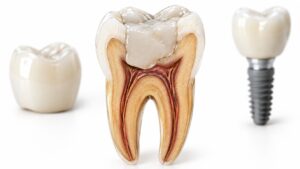
Two of the most common fixed tooth replacement options are dental implants and dental bridges. Both can restore the visible part of a missing tooth, but they work in very different ways. A bridge relies on neighboring teeth for support, while an implant is anchored in the jawbone and functions more like an artificial tooth root.
When patients ask which option lasts longer, dental implants generally have the advantage. However, longevity is only one part of the decision. Your bone health, neighboring teeth, medical history, treatment timeline, oral hygiene, and personal preferences all matter.
At Ultra Smile DentalSpa, we offer both dental implants and customized bridges. Our team evaluates the complete mouth before recommending a treatment because the best option is not necessarily the same for every patient.
How Does a Dental Bridge Replace a Missing Tooth?
A traditional dental bridge fills the space left by a missing tooth with an artificial tooth called a pontic. The pontic is attached to crowns placed over the natural teeth on either side of the gap.
To create the bridge, the supporting teeth must usually be reshaped so the crowns can fit over them. The completed restoration forms one connected unit that is permanently cemented in place.
A bridge can restore the appearance of the smile, improve chewing, and help prevent nearby teeth from moving into the open space. It may be an appropriate choice when the teeth beside the gap already need crowns because of large fillings, fractures, wear, or other structural concerns.
At Ultra Smile DentalSpa, we provide customized crowns and bridges designed to restore both function and appearance. We also use CEREC technology for qualifying restorations, allowing certain customized crowns and bridges to be designed, fabricated, and fitted efficiently.
How Does a Dental Implant Work?
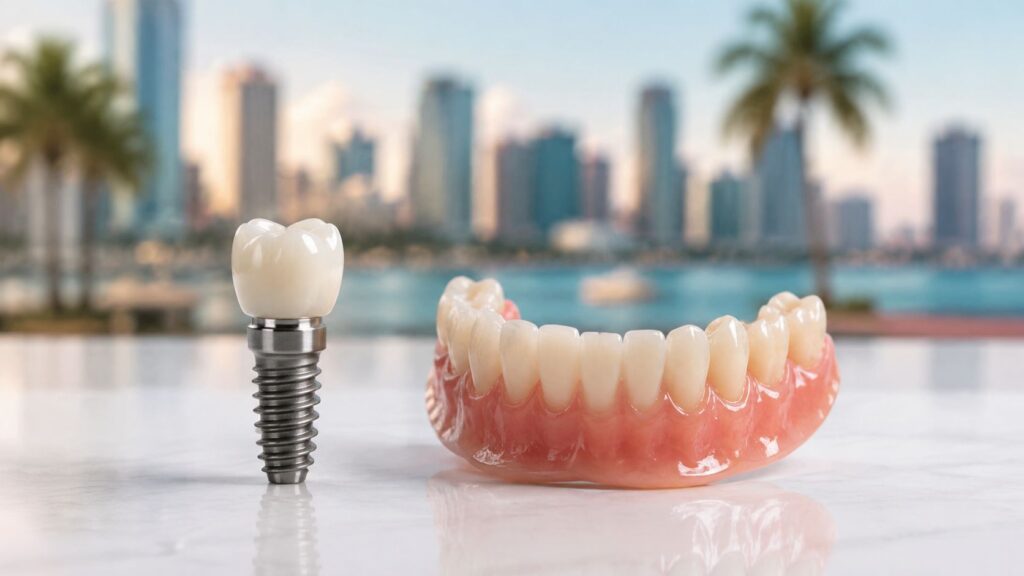
A dental implant replaces more than the visible tooth. It also replaces the missing root.
The implant itself is a medical-grade titanium fixture placed in the jawbone. During healing, the surrounding bone integrates with the implant, creating a stable foundation. An abutment and customized dental crown are then attached to complete the visible restoration.
Because the implant stands independently, the neighboring teeth generally do not need to be reshaped simply to support the replacement tooth. This can be a major advantage when the teeth beside the gap are healthy and have not previously required crowns.
At our practice, CBCT imaging provides three-dimensional views of the jaw, teeth, and surrounding anatomy. This technology helps us assess available bone and plan the position of the implant more precisely. Bone grafting is also available when a patient does not have enough bone volume to support predictable implant placement.
Which Option Usually Lasts Longer?
In general, dental implants tend to offer greater long-term durability than traditional tooth-supported bridges.
A systematic review of long-term implant outcomes estimated a 10-year implant survival rate of approximately 96.4%. Another major review estimated that conventional tooth-supported fixed dental prostheses had a survival rate of about 89.2% after 10 years. These figures come from separate groups of studies, so they should not be interpreted as a guarantee or a perfect head-to-head comparison. They do, however, help explain why implants are often viewed as the longer-lasting solution.
It is also important to separate the implant fixture from the restoration placed on top of it. The titanium implant may remain integrated for many years, while the crown may eventually need repair or replacement because of normal wear, bite forces, chipping, or changes in the surrounding tissues.
A bridge may also serve a patient successfully for many years. Its longevity depends heavily on the health of the supporting teeth. If one of those teeth develops decay, fractures, or experiences gum and bone loss, the entire connected bridge may be affected.
Why Implants Often Have a Longevity Advantage
Dental implants usually last longer because they do not depend on adjacent teeth for support. Each implant functions as an independent foundation for the replacement tooth.
With a conventional bridge, two neighboring teeth may support one missing tooth. Those teeth must handle their own chewing forces as well as some of the pressure transferred through the bridge. If either supporting tooth develops a serious problem, the bridge may need to be removed or replaced.
An implant transfers chewing pressure into the jawbone more like a natural tooth root. It also avoids the need to prepare healthy neighboring teeth solely to anchor the restoration.
However, an implant is not immune to complications. Gum inflammation, bone loss around the fixture, smoking, uncontrolled medical conditions, grinding, poor oral hygiene, and skipped maintenance appointments can all reduce its long-term success.
A well-planned bridge may outlast a poorly maintained implant. Longevity depends on the quality of the treatment, the patient’s health, and the care the restoration receives afterward.
When a Bridge May Be the Better Choice
Even though implants often last longer, a dental bridge may still be the more appropriate treatment in certain situations.
A bridge does not require implant surgery or a period of waiting for the fixture to integrate with the bone. This may appeal to patients who want a fixed replacement but cannot undergo surgery, prefer not to have an implant placed, or want to complete treatment within a shorter period.
The condition of the neighboring teeth also matters. When the teeth beside the gap already have large fillings, fractures, extensive wear, or older crowns that need replacement, using them as bridge supports may restore several concerns at once.
A bridge may also be considered when the patient has limited bone and does not want bone grafting. While a graft may make implant treatment possible, it can add another stage to the process.
The decision should be based on an examination rather than a general rule. A bridge can be a reliable restoration when the supporting teeth are strong, the bite is properly managed, and the patient maintains good oral hygiene.

When an Implant May Be the Better Choice
An implant is often especially attractive when one tooth is missing and the adjacent teeth are healthy. Instead of removing tooth structure from those teeth, the implant replaces the missing tooth independently.
Implants may also be recommended when preserving the jawbone is a priority. After a tooth is lost, the bone that once surrounded the root no longer receives the same stimulation. An implant placed in the bone can help maintain support in that area, although individual bone changes vary.
Patients should be prepared for a longer treatment process. Implant care may involve extraction, healing, bone grafting, implant placement, integration, and fabrication of the final crown. Not every patient needs every stage, but the process is usually less immediate than receiving a bridge.
At Ultra Smile DentalSpa, we use CBCT imaging to study the patient’s anatomy and develop an implant plan based on the available bone, bite, tooth position, and nearby structures. We believe this individualized planning is essential because implant treatment should never follow a one-size-fits-all approach.
How Maintenance Differs
Both options require daily brushing, professional dental care, and attention to the gum tissue around the restoration.
An implant crown can usually be brushed much like a natural tooth. Flossing or another dentist-recommended cleaning aid is needed around the sides of the implant to remove plaque near the gumline.
A bridge requires cleaning underneath the artificial tooth because standard floss cannot pass directly through the connected restoration. Floss threaders, interdental brushes, or water flossing devices may be recommended to clean beneath the bridge and around the supporting teeth.
This maintenance is not optional. Decay cannot form in an artificial bridge tooth, but it can develop in the natural teeth underneath the supporting crowns. Gum disease can also compromise both bridges and implants.
Regular examinations allow us to check the restoration, gums, bite, supporting teeth, and surrounding bone. Small concerns are generally easier to manage when they are identified early.
What Happens If the Restoration Needs Repair?
Neither option should be described as indestructible.
With an implant, the crown, abutment, or small connecting components may sometimes need repair even when the implant fixture remains stable. This means part of the restoration can potentially be replaced without removing the implant from the jawbone.
When a bridge develops a problem, treatment depends on the cause. A small cosmetic chip may sometimes be repaired, but decay beneath a supporting crown or a fracture in an anchor tooth may require removal of the entire bridge.
The connected design that makes a bridge functional can also make repairs more complicated. A problem affecting one part may influence the complete restoration.
Grinding and clenching can shorten the life of either option. Patients who place excessive force on their teeth may benefit from a custom night guard to help protect implants, bridges, crowns, and natural enamel.
How We Help Patients Compare Their Options
Choosing between a bridge and an implant requires more than looking at the empty space. We also evaluate:
- The health of the neighboring teeth
- The amount and quality of available bone
- Gum health
- Bite forces and signs of grinding
- The number and location of missing teeth
- Existing crowns or large fillings
- Medical conditions that may affect healing
- The patient’s treatment preferences and timeline
At Ultra Smile DentalSpa, our goal is to recommend the most appropriate long-term solution rather than automatically promoting one procedure. In some cases, protecting healthy neighboring teeth makes an implant the better option. In others, a bridge may efficiently restore a missing tooth while also strengthening adjacent teeth that already need crowns.
Our Downtown Miami, Midtown Miami, and Hallandale Beach locations provide access to dental implants, bone grafting, crowns, bridges, dentures, and other restorative options.
The Bottom Line on Dental Implants vs. Bridges
Dental implants generally last longer than traditional bridges and have the advantage of replacing the missing root without relying on adjacent teeth. For a healthy candidate with adequate bone and good oral hygiene, an implant may offer the strongest long-term solution.
That does not make a bridge an inferior treatment. Bridges remain an effective, fixed tooth replacement option, particularly when the neighboring teeth already need restoration or when implant surgery is not desired or appropriate.
The right choice depends on your mouth, not simply on which treatment has the highest average survival rate. A thorough examination and imaging can help determine which option offers the best combination of longevity, appearance, function, comfort, and maintainability for your smile.
At Ultra Smile DentalSpa, we can evaluate your missing tooth, explain both options clearly, and create a personalized plan designed around your oral health and long-term goals.
Ultra Smile DentaSpa
https://maps.app.goo.gl/aZyhKAnrJbTXqQFv8
(305) 676-5330
111 NE 32nd St, Miami, FL 33137, United States
https://www.ultrasmilemiami.com/