Most patients comparing dental implants cost in NJ can expect a complete single-tooth treatment to fall between $3,000 and $5,500 when the implant, abutment, and crown are included. That's the number that usually matters most, because the lowest advertised fee often isn't the full treatment price a patient will pay.
For many people in New Jersey, the process starts the same way. A tooth has failed, a gap is getting harder to ignore, or a dentist has recommended extraction and replacement. The first search is usually about price, and the first reaction is often concern that the answer seems to be all over the place.
That confusion is understandable. Some offices quote the implant fixture alone. Others quote the full restoration. Some treatment plans also need imaging, bone support, or preparatory care before the implant can be placed. A realistic cost discussion has to focus on the total case, not just the screw.
This guide breaks down what changes the final number, what should appear in a quote, and how patients in New Jersey can compare options without getting tripped up by incomplete pricing.
Table of Contents
- Understanding the Cost of Dental Implants in New Jersey
- Average Dental Implant Cost in NJ by Treatment Type
- Key Factors That Determine Your Final Implant Cost
- What Should Be Included in Your Dental Implant Quote
- Using Insurance and Financing for Implants in NJ
- The Dental Implant Timeline from Consultation to Crown
- NJ Dental Implant Cost FAQs
Understanding the Cost of Dental Implants in New Jersey
A common New Jersey scenario goes like this. A patient sees an implant price online, comes in expecting one number, and then learns the final treatment may also involve a CBCT scan, a surgical guide, an abutment, a crown, and sometimes a bone graft before the implant can be placed.
That gap is where confusion starts.
For patients searching dental implants cost NJ, the biggest mistake is focusing on the implant screw alone. The fixture is only one part of the bill. The total cost is the cost of getting from a missing tooth to a finished, functioning tooth that looks right, bites well, and lasts.
In practice, offices often present pricing in different ways. One office may advertise the surgical placement only. Another may quote the full single-tooth case. A third may leave diagnostics or grafting out of the first estimate until records are reviewed. Those are very different quotes, even if each office uses the phrase “implant cost.
Practical rule: Ask whether the fee covers the implant fixture, the abutment, and the final crown, or only the surgical portion.
Complete pricing matters because hidden add-ons are not unusual. If the bone is too thin or too soft, grafting may be needed. If the case is close to the sinus or a nerve, 3D imaging may be needed before surgery. If a tooth has to come out first, extraction and temporary replacement can affect the total as well. Patients comparing implants with removable options often also look at the long-term tradeoffs in dental implants vs traditional dentures, especially when stability and maintenance are part of the decision.
A useful implant quote should answer a few basic questions clearly:
- What is included now: exam, imaging, implant placement, abutment, and crown
- What may be added later: bone graft, sinus lift, extraction, sedation, temporaries, or tissue shaping
- What could change the fee: bone quality, healing time, implant brand, lab work, and case complexity
That level of detail helps patients compare offices fairly.
It also reduces the stress that comes from a low advertised price that grows once treatment is underway. In a well-prepared consultation, the goal is simple. Show the likely total, explain what could change it, and give the patient a treatment plan they can budget for with confidence.
Average Dental Implant Cost in NJ by Treatment Type
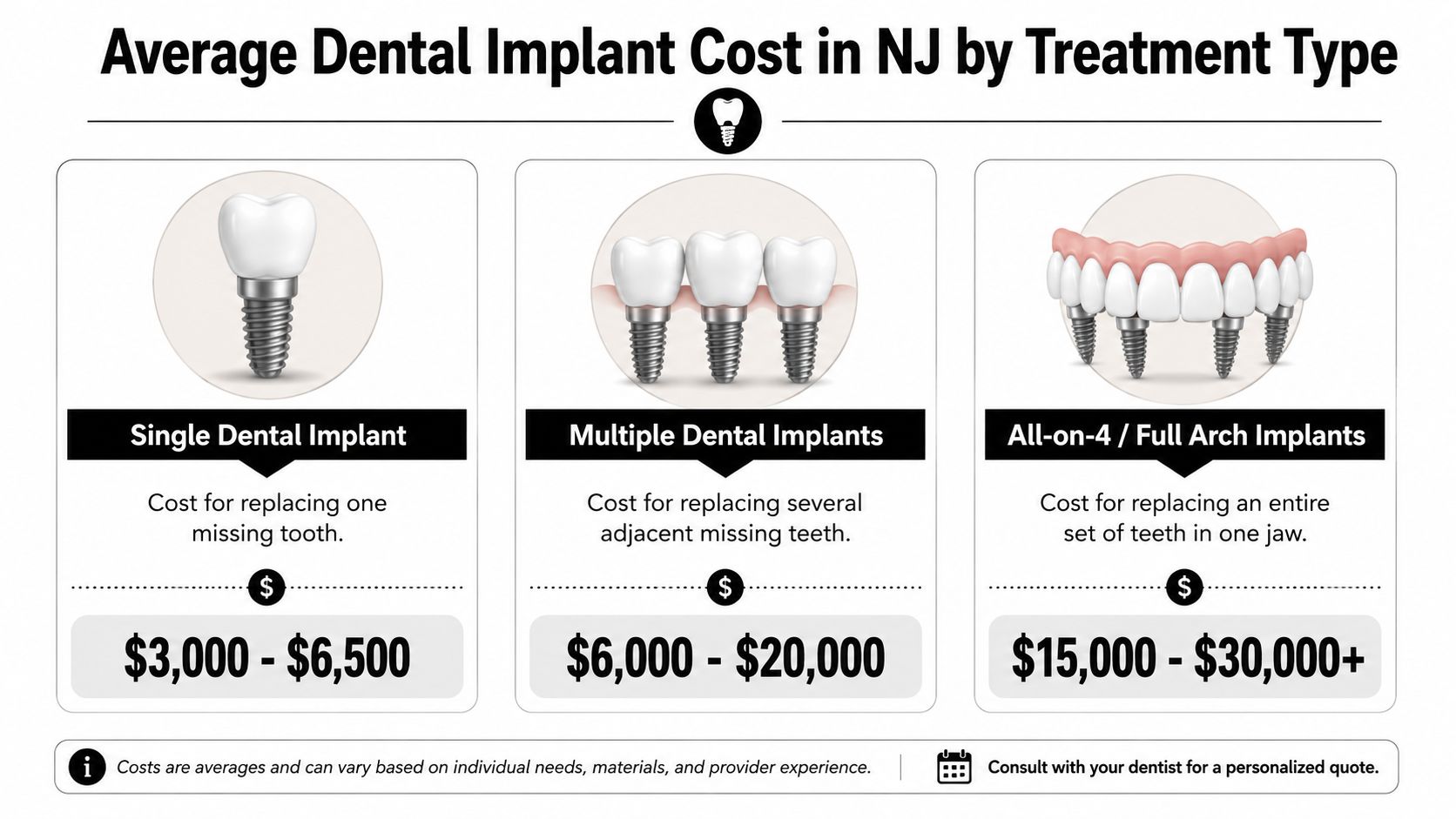
A patient may come in expecting one implant fee, then learn the final plan includes imaging, a custom abutment, the crown, and sometimes site preparation before the implant can even be placed. That is why treatment type matters so much. The total cost changes based on what is being replaced and how much dentistry is needed to finish the case properly.
Single tooth replacement
For one missing tooth, patients in New Jersey often see completed treatment quoted in the $3,000 to $5,500 range. In practical terms, that usually means the implant post, the connector piece, and the final crown. In some offices, the lower advertised figure reflects only the surgical placement fee, not the full tooth replacement.
For a straightforward case, this is usually the clearest category to compare. It replaces one tooth with a fixed solution and avoids involving neighboring teeth the way a traditional bridge does.
A useful way to read these numbers is to separate a true finished cost from a starting price.
| Treatment Type | Typical Price Range |
|---|---|
| Single dental implant | $3,000 to $5,500 |
| 4-tooth implant-supported bridge | $10,000 to $15,000 |
| Full-arch All-on-4 | $20,000 to $35,000 per jaw |
Replacing several teeth
When multiple teeth are missing in the same area, an implant-supported bridge can be more cost-efficient than placing an implant for every tooth. A common range for a 4-tooth implant bridge is $10,000 to $15,000. The exact number depends on how many implants support the bridge, the materials used for the final restoration, and whether the area needs grafting first.
This option sits between a single implant and a full-arch case in both cost and complexity. It can also be a better long-term fit for patients who want a fixed restoration instead of something removable. For patients comparing fixed teeth with removable options, this guide on dental implants vs traditional dentures can help frame the trade-offs.
A short video can help patients visualize how these treatment categories differ in real life.
Full-arch implant treatment
For patients replacing all teeth in the upper or lower jaw, a full-arch All-on-4 or similar implant solution often falls between $20,000 and $35,000 per jaw. That larger range reflects real differences in the case. Temporary teeth, the design of the final prosthesis, sedation, extractions, grafting, and the amount of digital planning can all affect the fee.
A full-arch case is not a mere bigger version of one implant. It involves more surgery, more lab work, more appointments, and a larger prosthetic restoration.
That is why I tell patients to look past the phrase “implant cost and ask what treatment they are pricing. A single implant, an implant bridge, and a full-arch rebuild are three very different services, and the total bill in New Jersey usually reflects that difference far more than the implant screw itself.
Key Factors That Determine Your Final Implant Cost
A patient may come in expecting to pay for one implant and leave with a treatment plan that includes imaging, a graft, a temporary, and a final crown. That gap between the advertised number and the actual total is where most of the confusion starts.
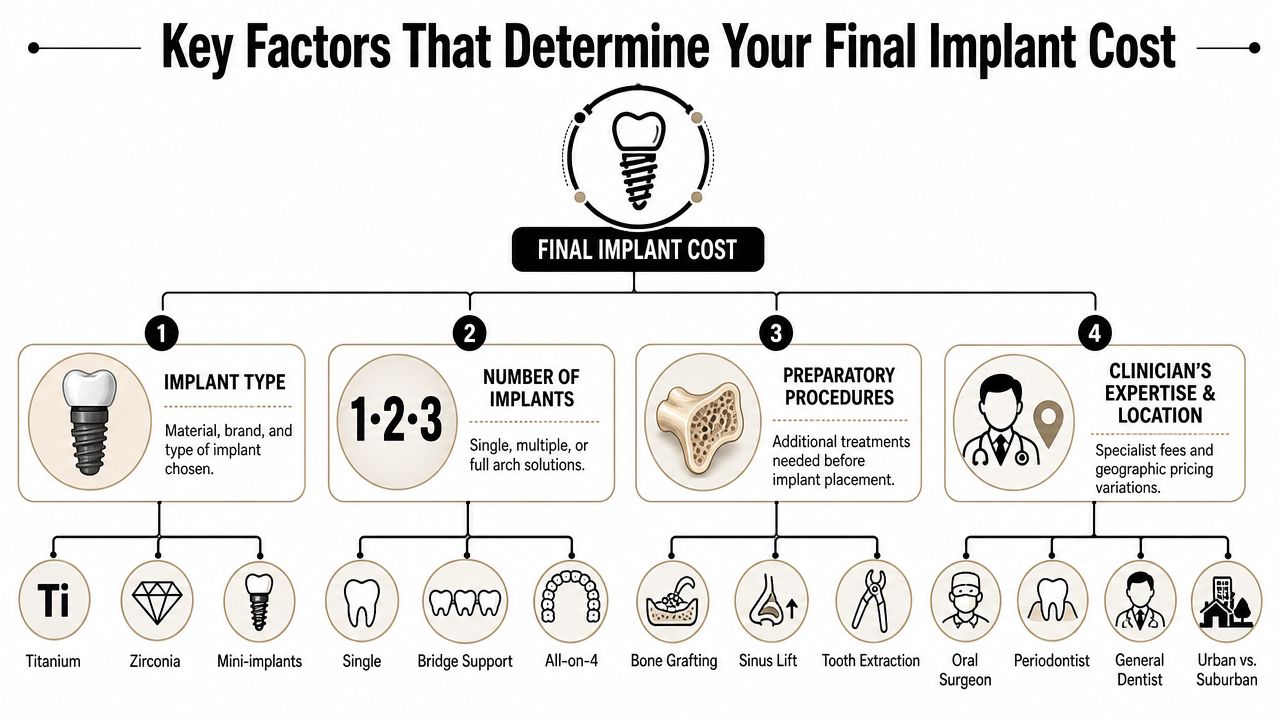
Why one implant quote looks lower than another
In practice, the implant screw is only one part of the bill. The final cost depends on what has to happen before the implant is placed, what materials are used to restore it, and which steps the office includes in the quote versus bills separately later.
That is why two offices can give very different numbers for what sounds like the same treatment.
Several factors commonly change the final number:
- What the quote covers: Some estimates list only the surgical placement of the implant. Others include the abutment, the custom crown, follow-up visits, and post-op imaging.
- Cone beam CT scans and planning: A 3D scan and digital surgical planning add cost, but they also help identify bone limitations, sinus position, nerve location, and angulation before surgery. In many cases, that planning reduces surprises.
- Bone grafting or site development: If there is not enough bone to support the implant well, the site may need grafting first or at the time of placement. Patients who may need that step can review this guide on dental implants and bone grafts healing.
- Extractions and timing: Replacing a tooth that is already missing is different from removing a failing tooth, preserving the socket, and deciding whether immediate placement is appropriate.
- Implant location and cosmetic demands: A back tooth usually has different bite forces and visibility concerns than a front tooth. Matching the gumline and smile esthetics in the front can require more planning and more custom lab work.
- Sedation and surgical difficulty: Some patients only need local anesthetic. Others choose IV sedation or need a more involved surgical appointment because of anatomy, access, or medical history.
- Temporary restorations: A temporary tooth or healing appliance may be part of the plan, especially in visible areas. Some offices include that step, and some do not.
One of the most common reasons patients feel blindsided is that hidden costs are often not really hidden. They were just never broken out clearly. A low headline price can leave out the scan, graft, connector, or crown, which means the total rises as the case moves along.
The number that matters is the total cost to get from diagnosis to a working final tooth.
Questions worth asking before saying yes
Ask for a written estimate that shows each major phase of care.
A strong implant consultation should answer a few practical questions clearly:
- Does this fee cover the finished tooth or only the implant placement?
- Is the CT scan included, or billed separately?
- If I need a bone graft, extraction, or sinus-related treatment, where will that appear in the estimate?
- Are sedation, temporaries, and follow-up visits included?
- If healing takes place in stages, what will I pay at each stage?
Patients do not need to know every clinical term. They do need a treatment plan that shows the actual sequence of care and the actual financial trade-offs before they commit.
What Should Be Included in Your Dental Implant Quote
A good implant quote should read more like a treatment map than a promotional flyer. If the estimate doesn't identify the major components, it becomes hard to compare one office with another.
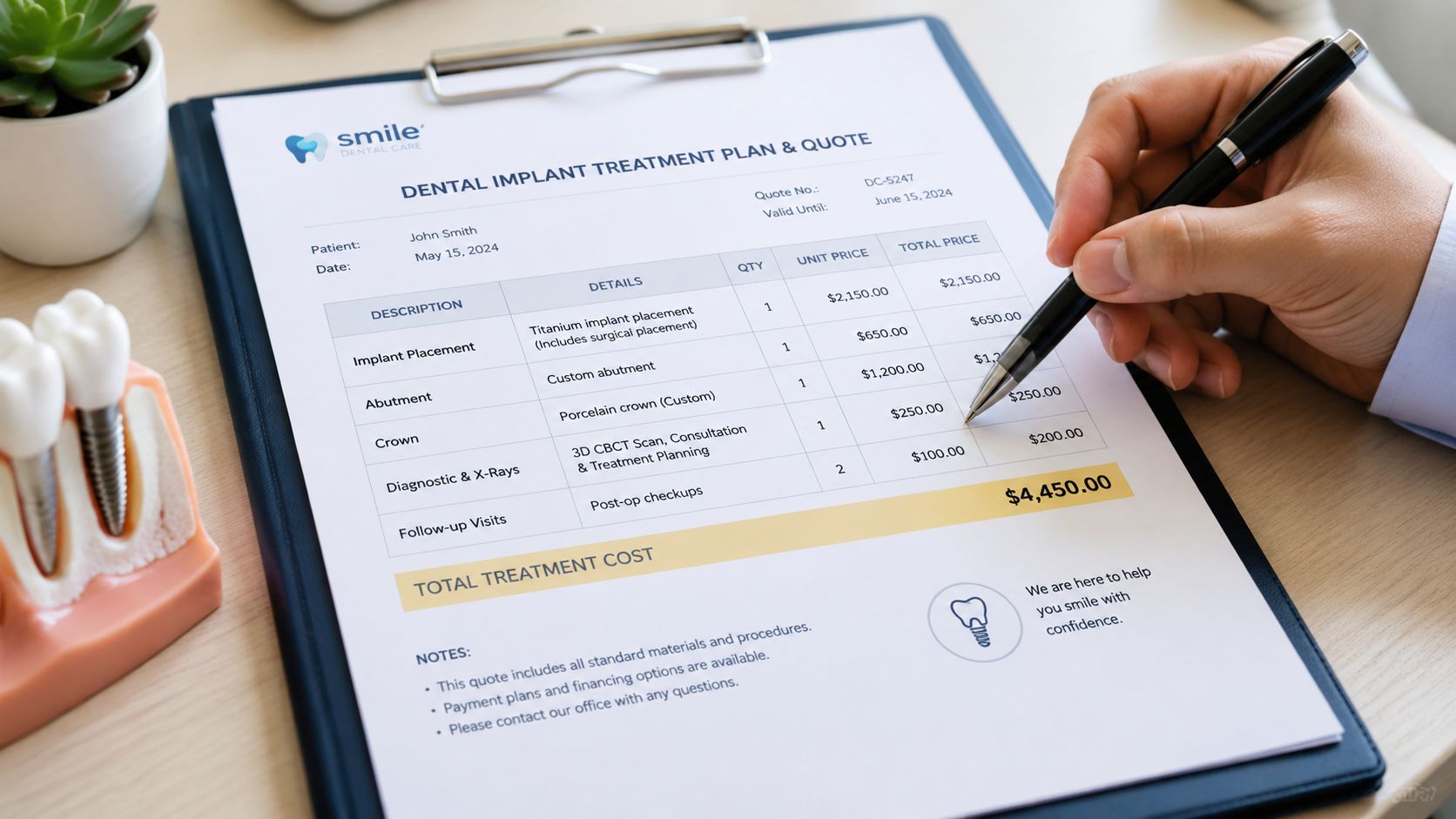
The three core parts of a complete quote
A full single-tooth implant cost in New Jersey is typically broken into three parts: the implant fixture, the abutment, and the final crown. A complete quote around $3,500 to $4,000 per tooth usually includes all three components, while lower advertised prices may only cover the fixture, as explained in Lindenwold Dental's implant cost breakdown.
Each piece serves a different purpose:
- Implant fixture: This is the portion placed in the jawbone. Patients often think of it as the screw.
- Abutment: This is the connector that joins the implant to the visible replacement tooth.
- Crown: This is the final custom tooth that shows when a patient smiles and chews.
If one of those pieces is missing from the quote, the patient is not looking at the full treatment fee.
How to compare quotes fairly
The cleanest way to compare offices is to ask for an itemized estimate and then read it line by line. That doesn't mean every office must structure pricing the same way. It means the components should be visible enough to compare.
A helpful checklist includes:
- Core components listed: fixture, abutment, and crown
- Planning identified: exams, imaging, or surgical design if applicable
- Extra procedures separated: grafting, extraction, sedation, or temporary teeth when needed
A fair comparison is never “Which quote is lower? It's “Which quote covers the full treatment being discussed?
That approach protects patients from surprise charges and makes the conversation about value, not just sticker shock.
Using Insurance and Financing for Implants in NJ
After the treatment plan is clear, the next concern is usually how to pay for it in a way that feels manageable. That part matters just as much as the clinical discussion.
What insurance may and may not do
Insurance can help in some cases, but patients shouldn't assume it will cover the entire implant process. Coverage often depends on the specific plan, how the procedure is categorized, and whether different parts of care are considered surgical, restorative, or elective.
The practical takeaway is simple. Patients should ask for a benefits review before treatment starts and request a written estimate that shows expected insurance involvement, if any. That won't remove every variable, but it helps prevent confusion later.
Ways patients manage the cost
When insurance leaves a gap, many patients use one or more of these options:
- Monthly financing: Third-party healthcare financing can spread treatment into smaller payments rather than one large upfront fee.
- Phased treatment: Some patients complete preparatory care first and move into the restorative phase after healing.
- In-house payment arrangements: Some offices offer structured payment options for approved cases.
- Pre-tax funds: Health-related spending accounts may be worth discussing with the patient's benefits provider.
A clear quote becomes particularly useful. When the treatment plan is itemized, patients can see whether they're paying for diagnostics, surgery, restoration, or additional support procedures and can plan accordingly.
For patients who feel anxious about cost, the most productive next step is usually not delaying the consultation. It's getting a written roadmap. Once the case is defined, payment options become much easier to discuss.
The Dental Implant Timeline from Consultation to Crown
An implant fee also reflects the fact that treatment happens in stages. Patients aren't paying for one short visit. They're paying for planning, surgery, healing, restoration, and follow-up.
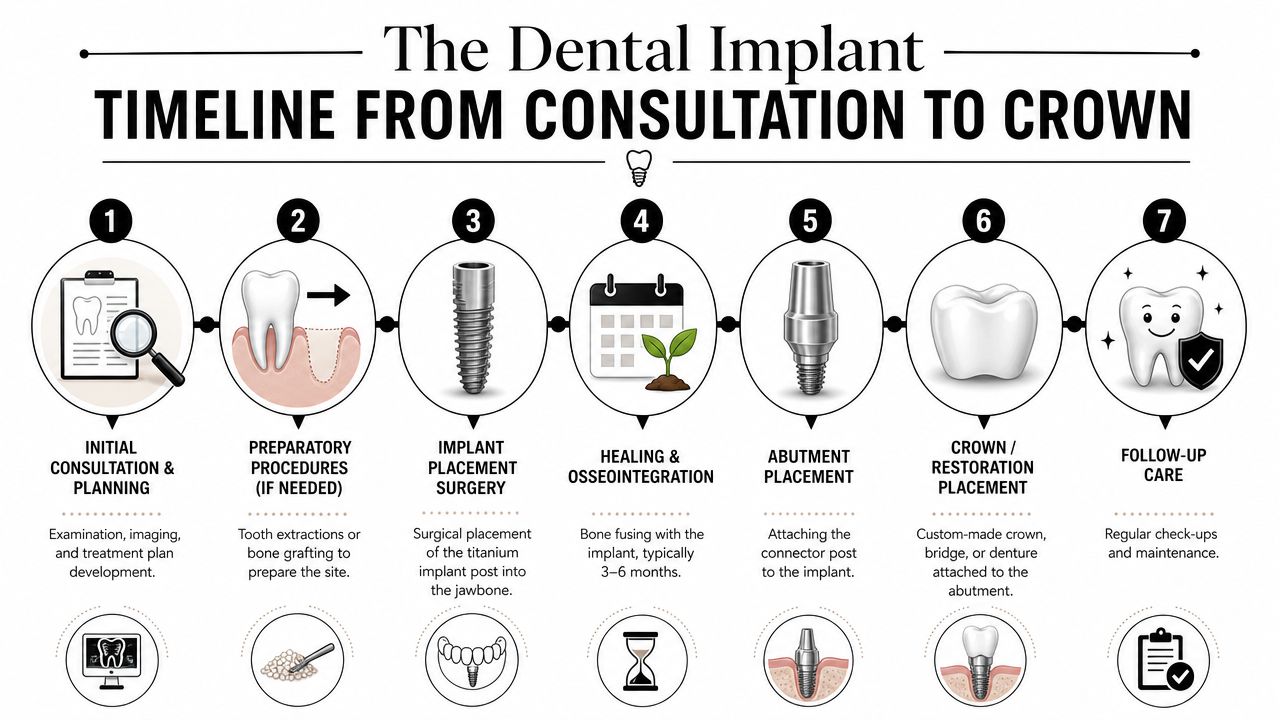
The main phases of treatment
Many implant cases unfold over roughly 4 to 6 months, though some take longer when preparatory procedures are needed. The typical sequence looks like this:
Consultation and planning
The dentist examines the site, reviews health history, and determines whether the area is ready for an implant.Preparatory care if needed
Some cases need extraction or bone support before placement can happen.Implant surgery
The implant fixture is placed in the jaw.Healing and integration
The bone bonds with the implant over time. This is one of the most important stages for long-term stability.Abutment and crown phase
Once healing is adequate, the connector and final restoration are completed.
Why the timeline affects value
Implants are not a same-day shortcut in most cases. They're a carefully sequenced treatment designed to replace a missing tooth with a stable, functional result.
Patients often feel better about the cost once they understand they're paying for a process, not just a product.
That process includes decision-making, lab work, surgical precision, healing supervision, and the final restoration that must fit the bite and blend with nearby teeth. When patients evaluate the fee through that lens, the number usually makes more sense.
NJ Dental Implant Cost FAQs
Are cheap dental implants safe?
A low advertised fee can be safe, but it often reflects limited pricing rather than the full treatment cost.
In many NJ offices, the number used in an ad applies only to the implant post. The CT scan, extraction, bone graft, abutment, temporary, and final crown may all be billed separately. That is why the better question is not, "How cheap is the implant?" It is, "What will I pay to finish this tooth properly?"
A lower starting price is only a good value if the office is clear about what is included and what could raise the fee after the exam and imaging.
Why does the cost vary so much between offices in New Jersey?
Offices build quotes differently. One practice may include the surgical placement, follow-up visits, custom abutment, and crown. Another may quote only the fixture and leave the rest for later.
Training, materials, lab choices, and case complexity also affect cost. A front tooth in the smile zone usually requires more planning and cosmetic detail than a back molar. If the site has been missing a tooth for years, added bone support may be needed before the implant is stable enough to restore.
Is a bone graft always needed?
No.
A bone graft is recommended only when the existing bone is too thin or too soft to support the implant predictably. I often see this when a tooth has been missing for a while or after an infection has damaged the area. Some patients need no graft at all. Others need minor grafting at the time of extraction or implant placement, and that changes the final fee.
What should patients ask for in an implant estimate?
Ask for a written treatment quote that separates each phase of care. It should show whether the fee includes the exam, 3D imaging, extraction if needed, bone grafting if needed, implant placement, healing visits, abutment, and final crown.
That kind of breakdown makes comparison easier. It also helps patients avoid the common problem of choosing a low headline price and discovering later that several necessary pieces were never part of the original number.
What matters more than the lowest price?
The full treatment plan matters more.
A good implant quote should explain the expected total, the likely add-ons, and the conditions that could change the plan once imaging is reviewed. Patients usually feel more comfortable with the investment when the fees are specific and the office explains where the money goes.
Patients in Miami who want a clear, personalized implant consultation can contact Ultra Smile DentalSpa to review treatment options, discuss bone grafting or restorative needs, and get a transparent written plan built around comfort, function, and long-term value.