Supervised clear aligner treatment in the United States generally costs $1,800 to $8,100 before insurance, with a national average near $5,108, according to NewMouth's clear aligner cost guide. A Miami quote depends on what the fee includes, especially professional monitoring, additional trays and retainers.
The advertised starting price is only one part of the cost. What matters is the amount needed to reach a stable result, including any refinements and how predictable bite correction is for your case. A written treatment plan makes these details easier to compare.
Crowding, gaps and an uncomfortable bite can raise cosmetic or dental-health concerns. At Ultra Smile DentalSpa, patients can discuss those concerns, review treatment options and understand the financial commitment before starting.
Table of Contents
- Typical Clear Aligner Prices by Treatment Model
- What Sets Your Clear Aligner Price
- Invisalign vs At-Home Aligners Compared
- Hidden Costs Beyond the Quoted Fee
- Insurance and Financing for Clear Aligners
- Clear Aligner Timeline and What Affects It
- Book Your Miami Clear Aligner Consultation
Typical Clear Aligner Prices by Treatment Model
Office-based clear aligner prices depend on the case, rather than a standard menu. A 2023 cost study conducted for CareCredit, summarized in NewMouth's clear aligner cost guide, puts the national range at $1,800 to $8,100 before insurance, with an average of $5,108.
Limited cosmetic movement and full bite correction are different purchases. Treatment length, location, tray count, and included services can all affect the fee.
Clear aligner prices by treatment model
| Treatment model | Typical price before insurance | What it usually includes | Main limitation |
|---|---|---|---|
| Office-based, supervised aligners, national range | $1,800 to $8,100, average about $5,108 | Exam, records, scans, refinements, and retainers when included in the written quote | Greater complexity and treatment of both arches can increase cost |
| Office-based average from a 2024 orthodontic practice survey | $6,373 per case, according to the survey summarized by Brockway Orthodontics | Clinical services specified by the practice and case scope | A survey average is not an individual quote |
| Complete at-home program, 2025 market estimate | $1,500 to $3,000, according to DataIntelo's market report | Trays and remote monitoring under the program's terms | In-person examination and clinician-managed bite correction may be limited |
| Advertised at-home program, both arches | $699 to $1,395, as reported by NewMouth's aligner comparison | Trays and an online plan | Many in-person services are excluded; review the package terms |
These figures describe different kinds of pricing, not equivalent packages. A practice survey average reflects the cases and offices surveyed, while an advertised at-home fee may cover a narrower service than a complete program estimate.
The office-based range also does not guarantee that every listed service is bundled. Some written quotes include refinements and retainers; others charge separately. At-home plans may not include an in-person examination or enamel shaping to create space.
Practical rule: Compare what each written estimate includes, not just the brand name or advertised starting fee.
For Miami patients, these are national benchmarks, not established local fees. They do not establish a citywide average. A personal quote depends on an examination and written treatment plan that identifies records, scans, monitoring, refinements, and retainers. It should also clarify expected wear time and how reliably the proposed plan can address bite correction. The advertised price is only one part of the cost of reaching a stable result.
What Sets Your Clear Aligner Price
A patient with small spaces between front teeth may need a different plan from someone whose upper teeth overlap the lower teeth too much. Both may want a straighter smile, but the clinician must plan different movements.
The manufacturer's payment and insurance guidance explains that the treating doctor sets the fee according to case complexity and the number of aligners required. The trays are only part of what the patient purchases.
The clinical work behind the quote
- Complexity and treatment scope: Mild crowding, spacing, and bite correction require different planning. Treating upper and lower teeth together may be necessary even when the visible concern affects only the front teeth.
- Tray count and treatment length: More planned stages require additional custom appliances and professional review. A shorter cosmetic plan shouldn't be compared directly with full treatment.
- Attachments and space creation: Attachments are small tooth-colored shapes that help trays grip teeth. Interproximal reduction means carefully shaping a small amount of enamel between selected teeth to create space.
- Diagnostic records: Digital scans or impressions describe tooth position, while dental X-rays provide information that surface images alone can't supply.
- Finishing and retention: Refinement trays fine-tune movements that haven't finished as planned. Retainers maintain tooth position after active treatment.
- Monitoring and clinical resources: Scheduled checks, the clinician's experience, and the planning technology support decisions throughout care.
Consider a patient concerned about a visible gap. Closing that space may also require the clinician to consider how the teeth meet, rather than pulling the front teeth together.
Diagnosis matters before cosmetic treatment. Crowded teeth can make cleaning difficult, but aligners don't replace cleaning and exams, cavity treatment or gum care. Existing dental problems should be evaluated before tooth movement begins.
A dentist in Miami, FL can explain which services belong in the orthodontic plan and which are separate dental treatments. That distinction prevents a patient from assuming that every dental need is included in an aligner package.
The lowest appliance price isn't necessarily the lowest cost for a clinically appropriate treatment plan.
Invisalign vs At-Home Aligners Compared
A lower price often reflects less clinical oversight, not just cheaper plastic. The important comparison is who examines the patient, manages movement and responds when treatment doesn't proceed as expected.
This visual summarizes the differences in supervision.
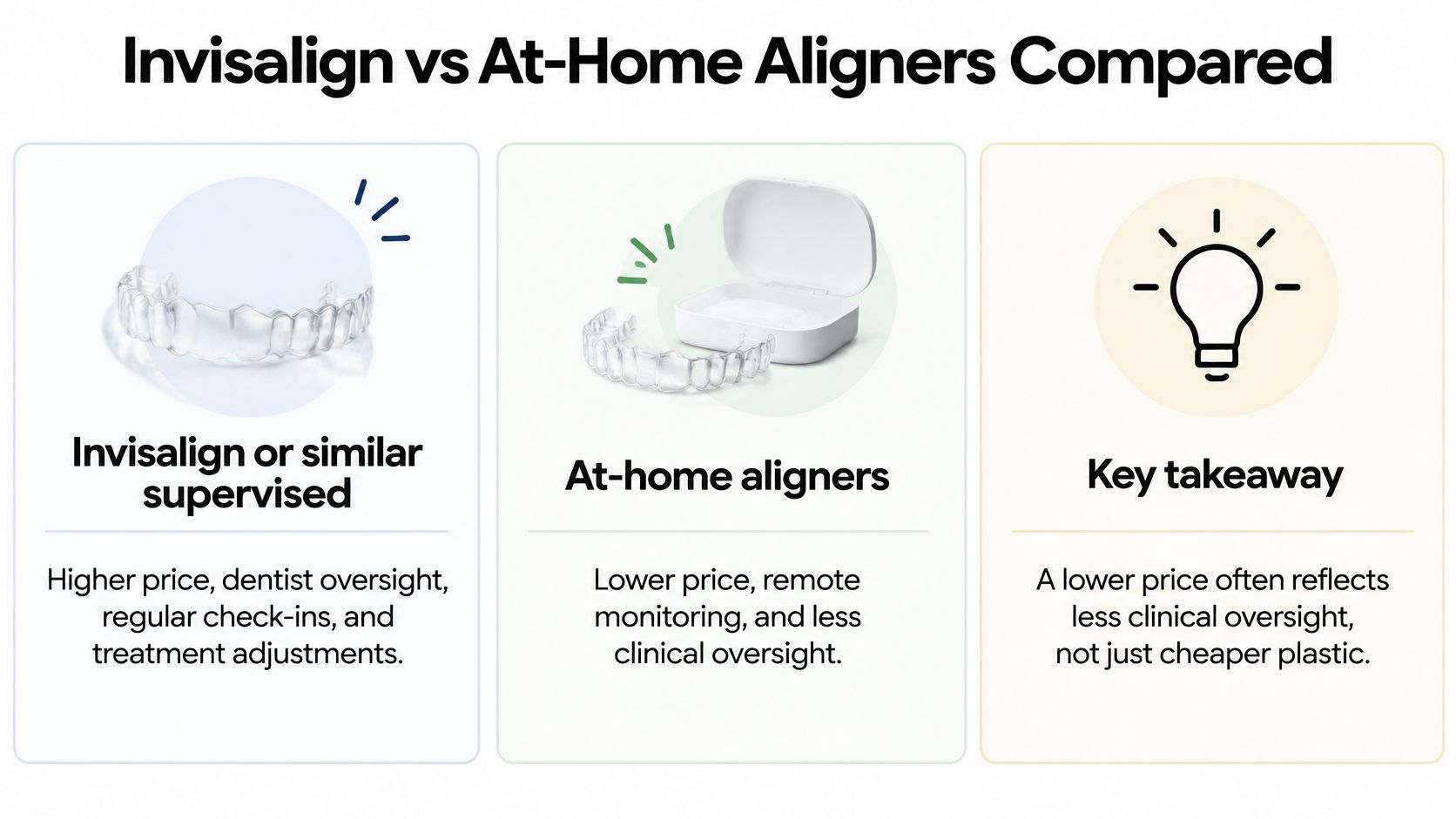
Supervised aligners, at-home aligners and braces compared
| Option | Typical price | Clinical oversight | Best fit |
|---|---|---|---|
| Invisalign or similar supervised aligners | Within the national office-based range presented above | In-person examination, scans, attachments and refinements as planned | Suitable mild cases and more involved movements requiring monitoring |
| Advertised at-home aligners, both arches | $699 to $1,395, as reported by NewMouth's aligner comparison | Mostly remote; in-person examination and enamel reduction may be excluded | Minor cosmetic movement, subject to professional assessment |
| Traditional metal braces | Written local quote required | Full orthodontic management | Cases where fixed appliances offer better control of the required movement |
Supervised aligners allow a clinician to assess fit and adjust treatment when needed. Ultra Smile provides invisible braces to all patients, with individual suitability determined through assessment. Its clear aligners and Invisalign comparison explains the terminology patients encounter when comparing options.
At-home treatment may appeal to adults seeking minor cosmetic changes. However, an online plan shouldn't be mistaken for confirmation that the gums, roots and bite are suitable for the proposed movement. The package should identify which assessments are included and who takes responsibility for clinical decisions.
Traditional braces remain worth discussing when a clinician needs more control over complex movement. A local braces quote makes the financial comparison meaningful rather than relying on assumptions about which appliance is cheaper.
The accompanying video provides another format for reviewing the treatment topic.
Aligners don't automatically cost more than braces. In a 2024–2025 survey of 333 U.S. orthodontists and general dentists, 53.5% reported Invisalign cases cost the same as or less than conventional braces, according to Align Technology's affordability guide, a manufacturer source.
Before choosing any program, the patient needs clear answers to three questions: Who diagnoses the case? Who monitors progress? Who decides whether refinements are necessary?
Hidden Costs Beyond the Quoted Fee
A clear aligner quote can cover the first set of trays without covering the cost of finishing treatment. The advertised fee is only useful for comparison when you know which steps it includes, what happens if teeth move differently than planned, and how long you are expected to wear the aligners.
Bite correction can be less predictable than straightening visible teeth. A 2025 systematic review of deep-bite treatment reported 0.4 to 3.8 mm of bite opening, with accuracy ranging from 33% to 48.88%. That finding applies to deep-bite treatment, not every aligner case, but it shows why a written plan should explain how bite changes will be assessed and whether extra trays could be needed.
Questions that belong in writing
- Refinement coverage: Does the fee include additional trays, repeat scans, attachments and bite ramps, which help manage tooth contact?
- Retainer charges: Which retainers are included, and what does replacement cost under the agreement?
- Alternative treatment: If aligners cannot achieve the planned movement, is switching to fixed braces included or charged separately?
- Poor tray fit: If teeth stop following the plan, who reassesses the case, and what additional charges might apply?
- Additional office fees: Are administrative, payment-processing or unplanned-visit fees disclosed before treatment begins?
Ask for an estimate that lists the expected refinements, retainers, treatment duration and approach to bite correction. Those details make it easier to compare the cost of the finished result, rather than just the initial appliance fee. For Miami patients, the written treatment plan should also clarify how consistently the trays need to be worn and what happens if the result takes longer than expected.
Transparency matters for charges beyond orthodontics, too. The Midtown dentist's fluoride upcharge controversy illustrates why patients may want optional treatments and payment-related fees explained in advance.
A written policy for unfinished treatment is more useful than a verbal promise that everything will work out.
Needing refinements does not automatically mean treatment has failed. The important financial question is whether the agreement anticipates additional work and clearly states what the patient may have to pay.
Insurance and Financing for Clear Aligners
Insurance can lower the bill, but patients often pay part of the treatment fee themselves. CareCredit's Invisalign financing guide describes lifetime orthodontic maximums commonly around $1,000 to $2,500. A $5,000 case can therefore leave a substantial balance, depending on the patient's policy and remaining benefits.
Plan maximums vary widely. The exact limit, eligibility rules and remaining benefits on a patient's policy determine how much insurance may contribute.
Benefit details to confirm before treatment
- Coverage percentage: What share of eligible orthodontic treatment does the plan pay?
- Lifetime maximum: How much remains after any previous orthodontic claims?
- Age restrictions: Does the policy include adult orthodontic treatment?
- Waiting period: Must coverage remain active for a period before benefits apply?
- Network rules: Does the treating office's network status affect reimbursement?
For general policy comparisons, My Policy Quote's dental insurance picks can help patients identify questions to ask. The insurer's benefit documents determine whether clear aligners are covered and how much the plan will pay.
Payment arrangements are separate from insurance benefits. An office installment plan divides the patient's balance into scheduled payments. Third-party healthcare financing uses a separate lender agreement, which may involve interest, credit approval requirements or promotional terms.
Compare the total amount repayable, not just the monthly payment. Check what happens if a promotional financing period ends before the balance is paid.
Ultra Smile DentalSpa accepts insurance, and its website provides a full list of accepted plans. The practice also offers insurance prices to patients without coverage. Its Invisalign payment-plan information can help patients begin a discussion about payment options.
Before treatment starts, ask for a written total that explains which services are included and how insurance or financing affects the balance. Bringing policy documents and financing questions to the consultation can help clarify the expected insurance contribution and the patient's remaining responsibility. A written estimate also makes it easier to compare the advertised aligner price with the cost of completing treatment.
Clear Aligner Timeline and What Affects It
A treatment timeline depends on the patient's clinical plan. A concern that looks minor can require extra tooth movements to maintain a suitable bite. Appearance alone cannot predict when treatment will finish, and the advertised aligner price does not necessarily cover the finished result.
Factors that determine clear aligner treatment length
| Factor | How it can affect treatment |
|---|---|
| Type and complexity of tooth movement | Minor crowding, small gaps or slight rotation may involve a simpler course than complex corrections or bite changes. |
| Treatment planning and movement sequence | The planned order of tooth movements affects the course, and reassessment may be needed as treatment progresses. |
| Prescribed wear and monitoring | Consistent wear and following clinician-approved tray changes help keep treatment on track. |
| Refinements or a change in appliance | Additional trays, bite correction or a switch to fixed appliances can extend the course. |
The stages below show a general treatment pathway, not a guaranteed schedule for an individual patient.
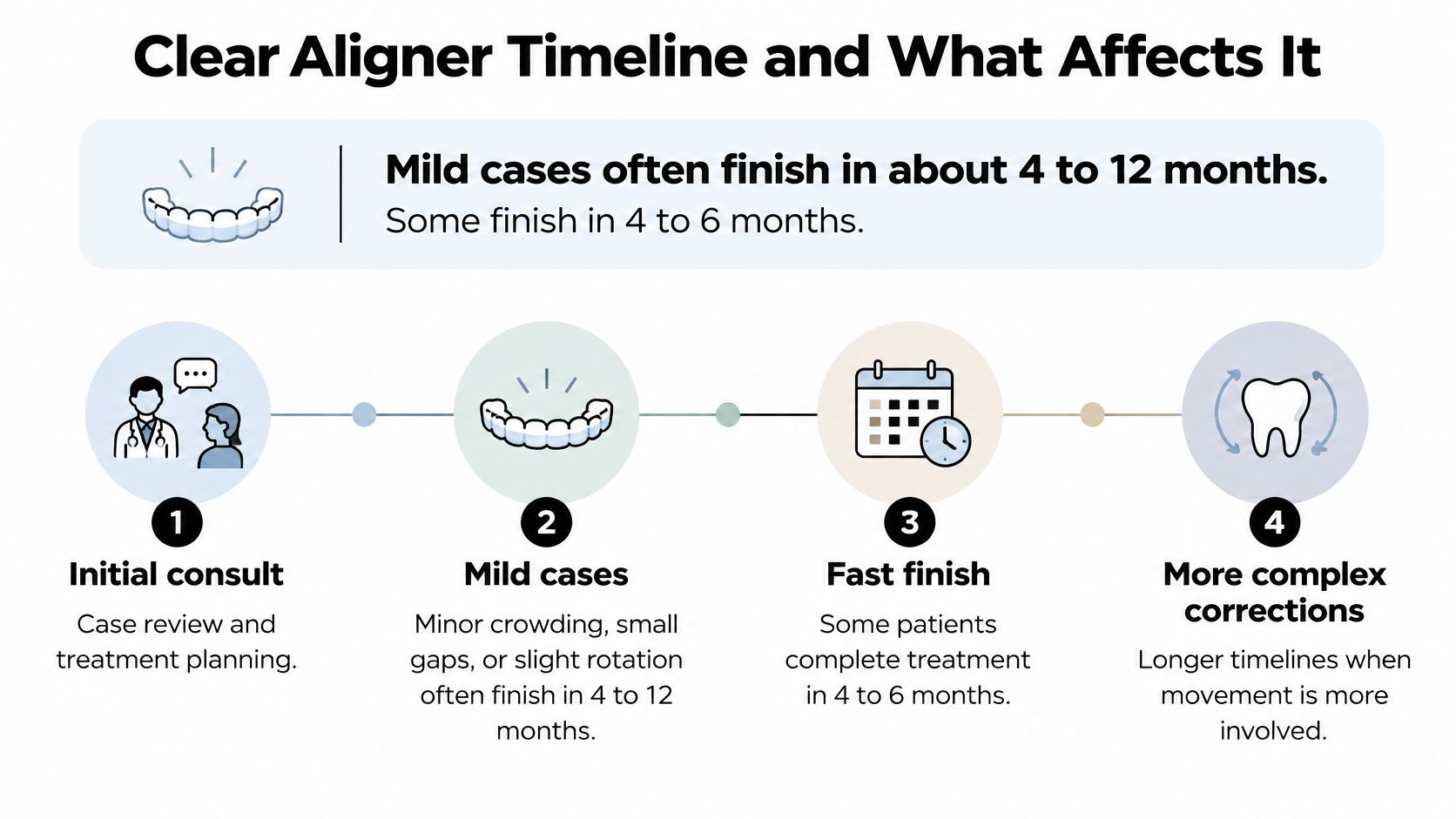
A 2025 systematic review discussing aligner success identified patient compliance, treatment planning and case complexity as major factors in treatment outcomes. The studies varied, and compliance was often self-reported, so wear habits alone cannot predict the result precisely.
Wear consistency has a financial consequence
Follow the clinician's prescribed daily wear schedule and tray-change instructions. Missed wear can mean extra appointments, replacement trays or refinements, so removable aligners are not automatically the least costly choice for every lifestyle.
Work travel, childcare, dental anxiety and irregular schedules can all affect whether wearing trays consistently is practical. Discuss these constraints before treatment, including how progress will be monitored and whether another appliance may be more suitable.
Compare written estimates that explain what is included, such as refinements and retainers, and ask how predictable bite correction is for the proposed plan. The final quote depends on that written treatment plan. It should distinguish active tooth movement from ongoing retention, because finishing the last active tray does not end the need to maintain tooth position.
Book Your Miami Clear Aligner Consultation
A clear aligner quote is only useful if it describes the finished treatment, not just the first set of trays. During a consultation, ask how the written estimate accounts for refinements, retainers, expected wear time, and how predictable bite correction is for your case. The right plan depends on an assessment, so the final cost should be confirmed in writing before you decide.
Patients in Downtown Miami, Midtown Miami, and Hallandale Beach can discuss their goals and oral health with Ultra Smile DentalSpa. A dental assessment helps clarify whether aligners suit the changes you want or whether another type of care is more appropriate.
What patients can expect
- Request a free consultation. Ultra Smile DentalSpa provides a consultation request form on its treatment pages. Completing the form can secure a 30% discount on dental treatments. Ask how the offer applies to the care in your proposed plan.
- Review oral health and your bite. The assessment may include digital X-rays, with scans or impressions taken as needed. Existing fillings, gum health, and discomfort should also be discussed because they can affect treatment planning.
- Discuss your options with Dr. Neda Bahmadi, DMD. Ask which changes aligners are intended to make, what alternatives may fit, and how long treatment is expected to take. The practice also offers smile design and conservative, noninvasive restorations using Curodont.
- Read the written estimate. Check whether it includes monitoring, refinements, retainers, and replacement policies. Review insurance with the team, and ask for clarification on any amount or service you do not understand.
- Decide after reviewing the plan. Once you understand the clinical recommendation and costs, discuss a start date and how retention will be handled.
The booking steps are shown below.
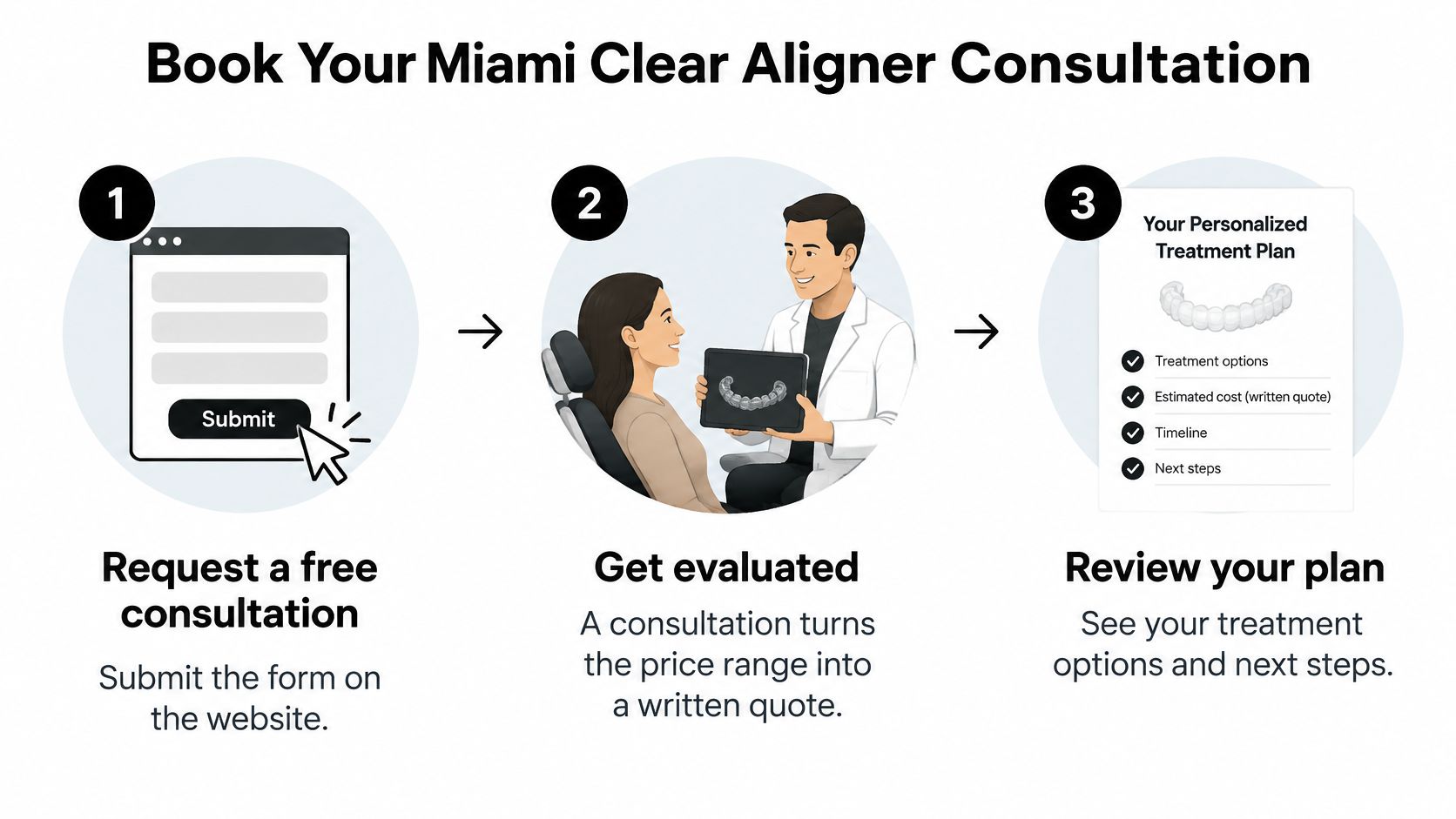
A comfortable visit with clear priorities
The practice offers refreshments, custom aromatherapy, and streaming entertainment as part of its spa-style setting. If dental visits make you anxious, mention your concerns when requesting an appointment.
Searches for dental implants near me, tooth extraction, or an emergency dentist point to needs that differ from elective alignment. Pain, swelling, or a damaged tooth calls for assessment rather than an assumption that straightening will help. Services such as implants, root canals, and wisdom teeth extraction may require separate planning.
Online visibility alone cannot show whether a provider or treatment is clinically suitable. A local search guide for contractors concerns another industry, so search rankings should not be treated as evidence of dental credentials or a good fit.
Request a consultation through the website or call the Miami office. Bring your insurance details and questions, and ask for a written estimate that makes clear what is included through active treatment and retention.
Ultra Smile DentalSpa offers invisible braces and digital X-rays, with personalized treatment planning in Miami. Visit Ultra Smile DentalSpa to request a free consultation and discuss a written plan for treatment, refinements, and retention.