Invisalign can fix many overbite cases, especially mild to moderate dental overbites, but real-world correction is often less than the digital plan predicts. Severe skeletal overbites may need braces, functional appliances, or jaw-focused treatment instead of aligners alone.
A Miami professional may notice the issue while checking a smile in the mirror, or a parent may see the upper front teeth covering too much of the lower teeth in family photos. The next search is usually practical: can Invisalign fix overbite without visible braces, lengthy appointments, or an uncertain result?
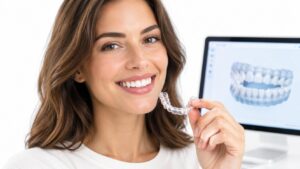
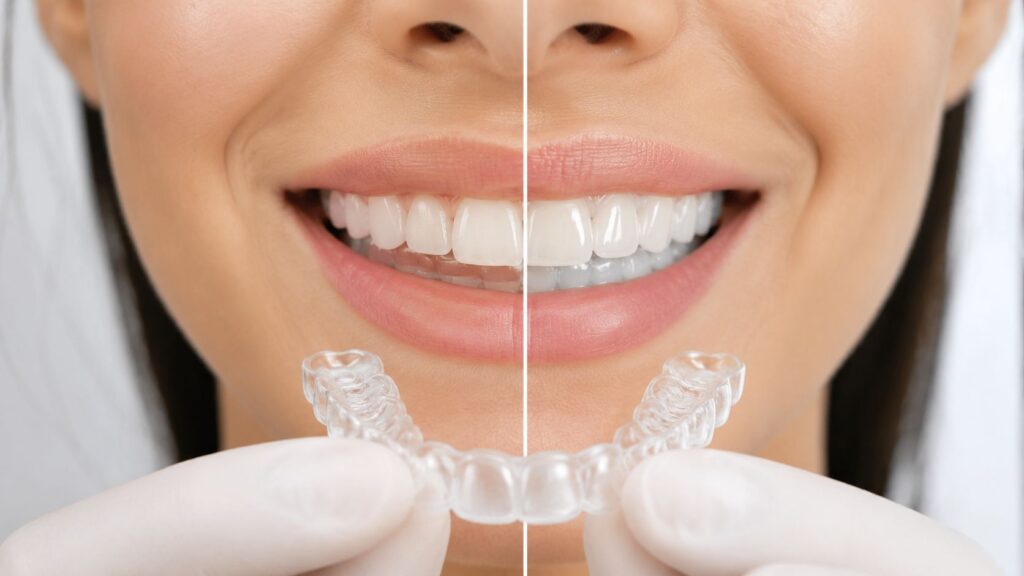
The honest answer is yes for many carefully selected patients. The outcome depends on whether the overbite comes mainly from tooth position or jaw structure, how much vertical movement is needed, the patient's age, and whether the aligners are worn as directed. Digital before-and-after previews help explain a plan, but they aren't guarantees of the final bite.
Table of Contents
- Why Miami Patients Ask If Invisalign Can Fix Overbite
- Understanding Overbite Types and How They Affect Your Smile
- How Invisalign Moves Teeth to Reduce Deep Bites
- Who Is a Good Candidate for Invisalign Overbite Correction
- Realistic Timelines Costs and Long-Term Stability
- What to Expect at Ultra Smile DentalSpa in Miami
- Schedule Your Invisalign Overbite Consultation Today
Why Miami Patients Ask If Invisalign Can Fix Overbite
A patient may notice a deep bite while checking a smile in the mirror, reviewing family photos, or preparing for professional events around Miami. The upper teeth can cover too much of the lower teeth, while the lower teeth may contact the palate, wear unevenly, or contribute to jaw strain. These concerns make a discreet option appealing, especially for patients who want to avoid visible brackets.
Invisalign can correct many dental overbites, particularly when tooth position creates most of the overlap. Clear aligners can reposition the incisors, coordinate the relationship between the front and back teeth, and reduce the bite gradually. Their ability is more limited when jaw size or jaw position drives the problem. That distinction affects case selection, treatment expectations, and whether aligners should be used alone.
Marketing previews can make the planned result look precise. Clinical results depend on whether the teeth, supporting bone, bite, and daily habits allow the prescribed movement to occur. A 2023 systematic review found that deep-overbite reduction after clear-aligner treatment reached only about 33% to 40% of the amount orthodontists had planned. It also concluded that attachment type did not meaningfully change the outcome. The systematic review indexed by PubMed gives patients a more realistic reference than polished before-and-after images.
Practical rule: The digital plan outlines intended movement; a clinical evaluation then determines whether the patient's teeth, bone, bite, and habits can express that movement.
Age can affect certain vertical movements. A 2024 prospective study reported mandibular incisor intrusion of 1.7 mm in adolescents versus 0.9 mm in adults, with reported accuracies of 63.5% and 45.3%, respectively. The PubMed study suggests that younger patients may express these movements more predictably, while adults may need refinements or added mechanics.
An adult searching for a dentist in Miami, FL should not treat those limitations as a reason to reject Invisalign. The consultation should identify the overbite pattern, estimate the movement required, and explain how refinements or other mechanics would be handled if the first aligner series falls short. Retention also matters because teeth can drift after correction, even when the digital preview looked ideal.
Understanding Overbite Types and How They Affect Your Smile
An overbite describes the vertical overlap of the upper front teeth over the lower front teeth. A mild overlap can be functional and healthy. A deep overbite occurs when the upper teeth cover too much of the lower teeth or when the lower teeth contact gum tissue or the roof of the mouth.
A simple analogy helps. Think of the upper and lower front teeth as a door and threshold. The door should close into a controlled position. If it closes too far over the threshold, the contact becomes excessive and can damage the surrounding surfaces over time.
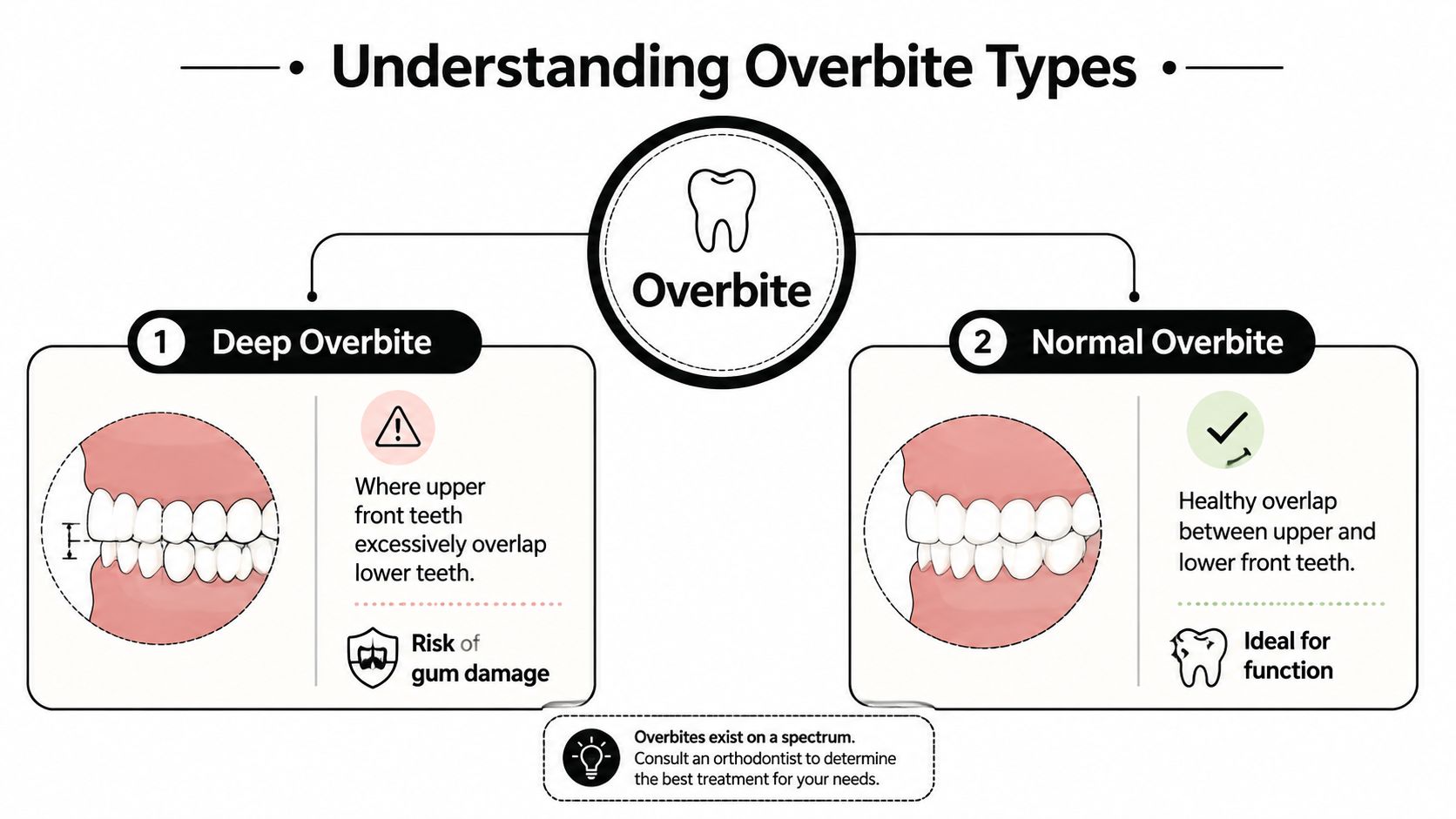
Dental and skeletal causes
A dental overbite develops mainly because the teeth are tipped, erupted, or positioned in a way that creates excessive overlap. This is the pattern most likely to respond to tooth-moving treatment such as Invisalign, provided the required movements are within predictable limits.
A skeletal overbite relates more to the relationship between the upper and lower jaws. Aligners can move teeth that compensate for some jaw relationships, but they generally don't reposition the jawbones in the way a growth-focused appliance or orthognathic treatment may.
Dentists describe overbite using measurements that help distinguish a minor issue from a more significant one:
- Millimeters describe the vertical distance or overlap between the upper and lower incisors.
- Percentages describe how much of the lower front teeth are covered by the uppers.
- Palatal contact matters because lower teeth that strike the palate may create tissue irritation or trauma.
Patients can't reliably diagnose the cause by looking in a mirror. A lower jaw that appears set back, a very deep overlap, or facial imbalance may suggest a skeletal contribution, but dental X-rays and bite records are needed to determine the treatment path.
Why the bite matters
An untreated deep bite may contribute to uneven tooth wear, jaw discomfort, chewing difficulty, or speech changes. The pattern can also make cleaning harder around crowded or overlapping teeth, which matters for long-term dental care, cleaning and exams, and gum health.
A consultation should assess more than the appearance of the smile. The dentist needs to examine tooth wear, gum position, jaw movement, incisor angles, and the way the teeth contact during chewing.
How Invisalign Moves Teeth to Reduce Deep Bites
Invisalign reduces a deep bite through several coordinated tooth movements. Each aligner applies controlled pressure to selected teeth, while attachments, bite ramps, or elastics guide movements that plastic alone may not express reliably. The aim is a healthier relationship between the front and back teeth, not a promise of jawbone repositioning.
Most correction comes from dentoalveolar movement, meaning movement of the teeth and their supporting dental structures. The 2026 systematic review and meta-analysis reported a pooled mean overbite reduction of 1.79 mm, with a 95% confidence interval of 1.03 to 2.54 mm and a prediction interval from -0.78 to 4.36 mm. The very high heterogeneity, I² = 96.3%, shows how widely results can vary by patient and treatment protocol. The 2026 review described most correction as mandibular incisor intrusion and limited lower-molar extrusion, with negligible skeletal change.
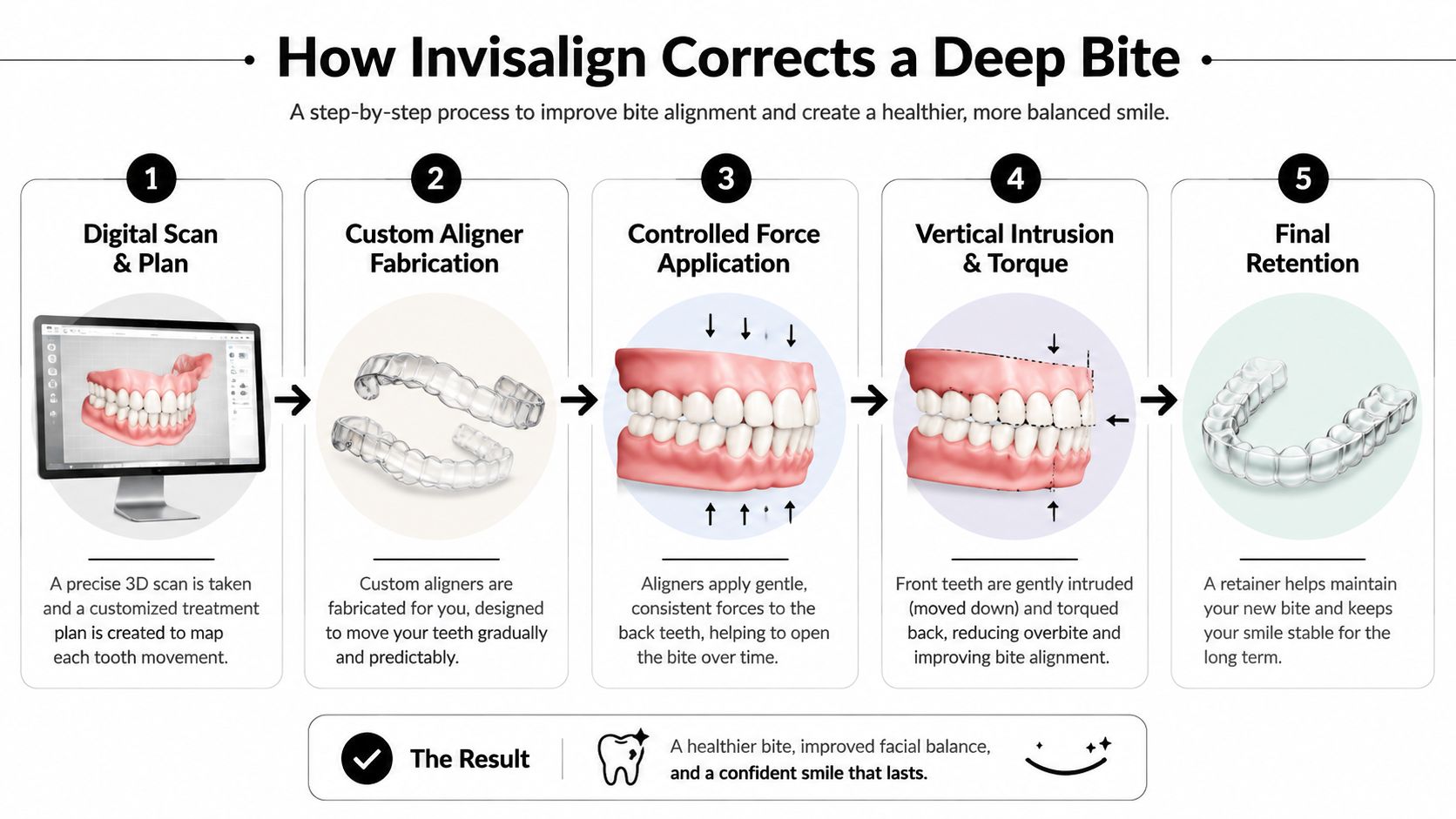
The movements that create improvement
A treatment plan may combine these movements:
- Incisor intrusion moves a front tooth slightly farther into its supporting bone. Expressing the full planned vertical intrusion can be difficult, particularly for adults.
- Incisor inclination control changes the angle of the upper or lower front teeth. This can reduce overlap, although excessive tipping may produce an unstable or unhealthy result.
- Molar extrusion changes the vertical relationship of the back teeth, helping open the front bite in selected cases.
- Attachments and bite ramps give the aligner more purchase and can reduce heavy front-to-front contact.
- Elastics add force between the upper and lower arches when tooth movement alone does not provide enough control.
In an adult retrospective study of 120 patients, the deep-bite group had a median overbite opening of 1.5 mm. Improvement came mainly from changes in incisor position, with minimal change in molar height or mandibular plane angle. The adult study on PubMed supports a practical conclusion: Invisalign is better suited to a primarily dental bite problem than to a case requiring major jaw repositioning.
Why ClinCheck can overpredict correction
The digital plan remains useful for sequencing movements, but planned movement and achieved movement are not identical. A deep-overbite study found mean correction of 33%, with about 1.15 mm of improvement after the first aligner series. Every assessed tooth also showed a statistically significant difference between planned and achieved vertical movement or inclination. The PubMed research on deep-overbite predictability explains why a dentist may include overcorrection and anticipate refinement aligners.
A separate analysis found that ClinCheck overestimated overbite reduction in 95.3% of patients, who achieved about 39.2% of the anticipated correction on average. The predictability analysis gives patients a practical question to ask: does the proposed plan include refinement aligners if the first series falls short?
For patients reviewing Invisalign teeth-straightening treatment, daily wear still affects the clinical result. Poor seating, missed wear time, or skipped elastics can leave the teeth behind the digital design, even when the original plan looked precise.
Who Is a Good Candidate for Invisalign Overbite Correction
A strong candidate usually has a dental rather than skeletal overbite, healthy teeth and gums, and the ability to follow the aligner schedule. The patient also needs realistic expectations. The goal isn't to reproduce a computer image at any cost. The goal is a stable, comfortable bite that respects tooth roots, bone, gums, and facial balance.
Adolescents may show more predictable intrusion than adults in some cases, as the comparative study cited earlier suggests. Adults can still respond well, but the plan may require more refinement stages or adjunctive mechanics when vertical correction is difficult.
Candidate profiles at a glance
| Patient Profile | Overbite Type | Invisalign Suitability | Expected Correction |
|---|---|---|---|
| Cooperative adolescent with a tooth-related deep bite | Mainly dental | Often favorable after full examination | Meaningful correction may be possible, but the final result still needs monitoring |
| Adult with mild or moderate incisor overlap | Mainly dental | Often suitable | Gradual dental correction, with possible refinement |
| Adult with a deep bite and significant incisor wear | Dental, possibly complex | Case-dependent | Correction may require intentional overcorrection and additional mechanics |
| Patient with a major jaw discrepancy | Skeletal | Limited with aligners alone | Braces, functional appliances, or jaw-focused treatment may be discussed |
| Patient unable to maintain prescribed wear | Any type | Poor fit for removable aligners | A fixed option may offer more consistent force |
The table offers a screening framework, not a diagnosis. A full new patient exam should include bite evaluation, dental X-rays, photographs, and a digital scan. These records help identify root position, bone limits, unerupted teeth, gum concerns, and the difference between a tooth compensation problem and a jaw relationship problem.
When braces or other mechanics may make more sense
Fixed braces may provide greater control for difficult vertical movements because the appliance stays in place. Functional appliances may be considered in selected growing patients when the jaw relationship contributes to the bite. In a small group of adults with a significant skeletal discrepancy, an oral and maxillofacial surgeon may need to evaluate jaw surgery.
Severe doesn't automatically mean Invisalign is impossible. In adults with severe deep overbite defined as more than 5 mm and more than 60% deep overbite, a study of 50 consecutive patients found both Invisalign and fixed appliances effective, with Invisalign potentially preferable in high-angle, deep-overbite cases. The severe adult case study still supports individualized planning rather than a blanket promise.
Realistic Timelines Costs and Long-Term Stability
Patients searching for a Cosmetic dentist near me often want three answers immediately: how long treatment will take, what it will cost, and whether the bite will stay corrected. The responsible answer is that complexity, planned movement, refinements, insurance, and retention all affect the final commitment.
Treatment length should be discussed as a range rather than a guaranteed finish date. Mild dental cases may be relatively straightforward, while moderate cases can require additional aligner series. Severe cases may take longer or need braces, elastics, attachments, or another treatment approach.
The initial digital plan may not express the full correction in the mouth. Because deep-bite movement can underperform the prediction, refinements aren't necessarily a sign that treatment failed. They may be part of responsible clinical management.
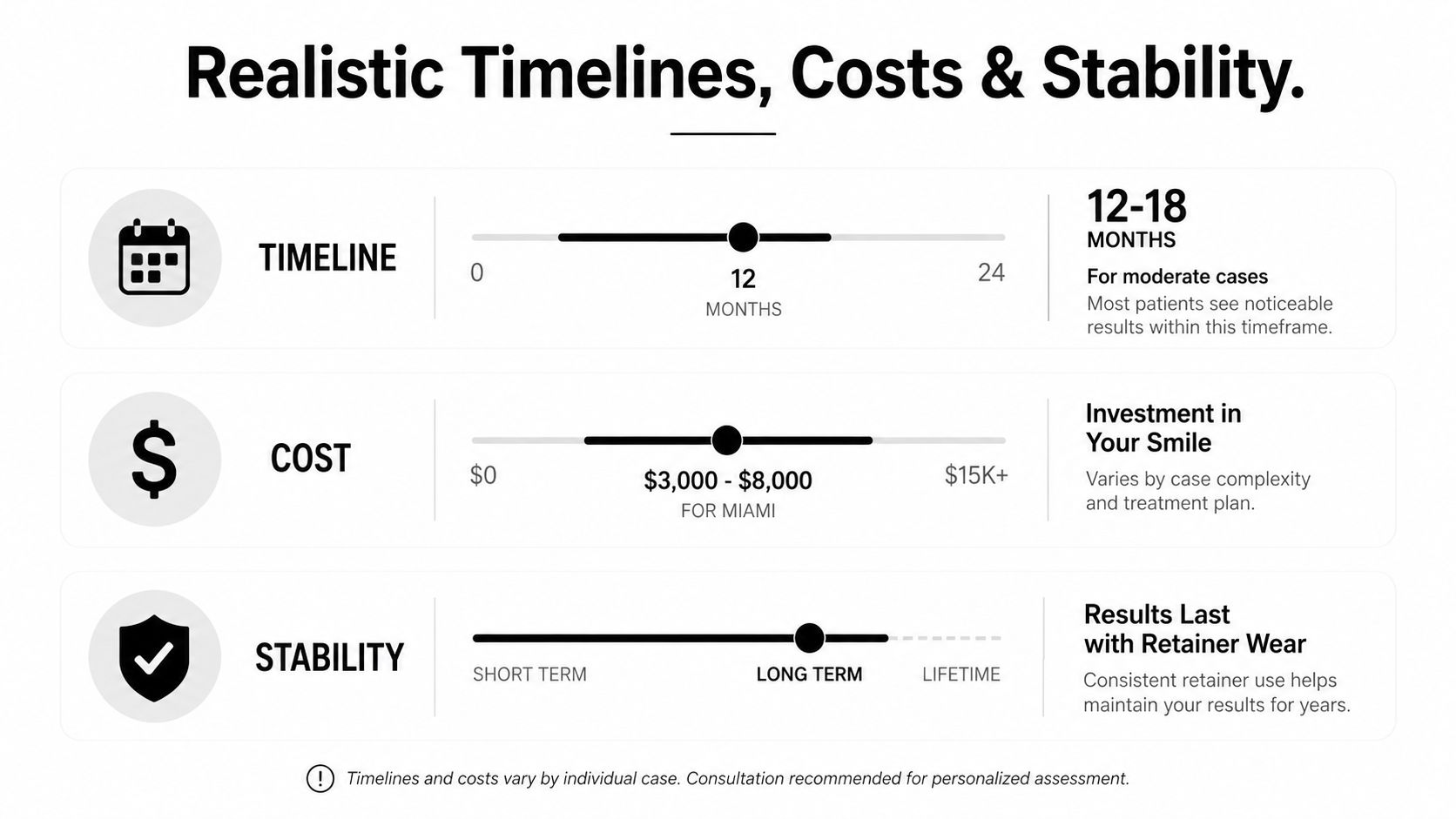
Budgeting for treatment in Miami
A Miami Invisalign estimate depends on the number of aligners, bite complexity, attachments, refinements, diagnostic records, and retention appliances. The provided clinical material doesn't establish a verified Miami price range, so a responsible practice should give a written case-specific estimate rather than advertise an unsupported universal fee.
Insurance may contribute to orthodontic treatment depending on the plan. Patients should ask whether benefits apply to adult care, whether the provider is in network, what exclusions exist, and whether refinements or retainers are included. Patients without coverage can ask about available payment arrangements before starting.
The Invisalign treatment timeline information can help patients prepare questions about aligner changes, progress visits, refinement stages, and the transition to retention.
The video below offers another visual explanation of treatment planning and patient expectations.
Retention is part of the treatment
Teeth can shift after active orthodontic treatment if retainers aren't worn according to the prescribed plan. Retention deserves the same attention as the aligners because a corrected bite still needs support after the teeth reach their planned positions.
A 2023 clinical study of anterior open-bite correction reported that overbite change during a mean 2.1-year retention period wasn't statistically significant, and only 6% of patients had relapse at least one year after treatment completion when retainers were used. The retention study concerns open-bite correction rather than every deep-bite pattern, so it shouldn't be treated as a universal relapse guarantee. It does reinforce the broader clinical point that retention protocols matter.
Long-term advice: A patient who wants stable correction should treat the retainer as part of the treatment plan, not as an optional accessory after the aligners end.
What to Expect at Ultra Smile DentalSpa in Miami
A consultation for overbite correction should begin with diagnosis, not with a promise. At Ultra Smile DentalSpa, Dr. Neda Bahmadi and the team can assess the bite using a clinical examination, digital scans, dental X-rays, photographs, and a discussion of the patient's goals. The evaluation helps determine whether Invisalign is appropriate or whether braces, restorative care, or another referral would better address the problem.
The team can explain whether the proposed correction depends on incisor intrusion, bite ramps, attachments, elastics, or a combination of movements. Patients should also receive a clear explanation of possible refinements, retention, expected limitations, and the relationship between bite correction and any future cosmetic dentistry.
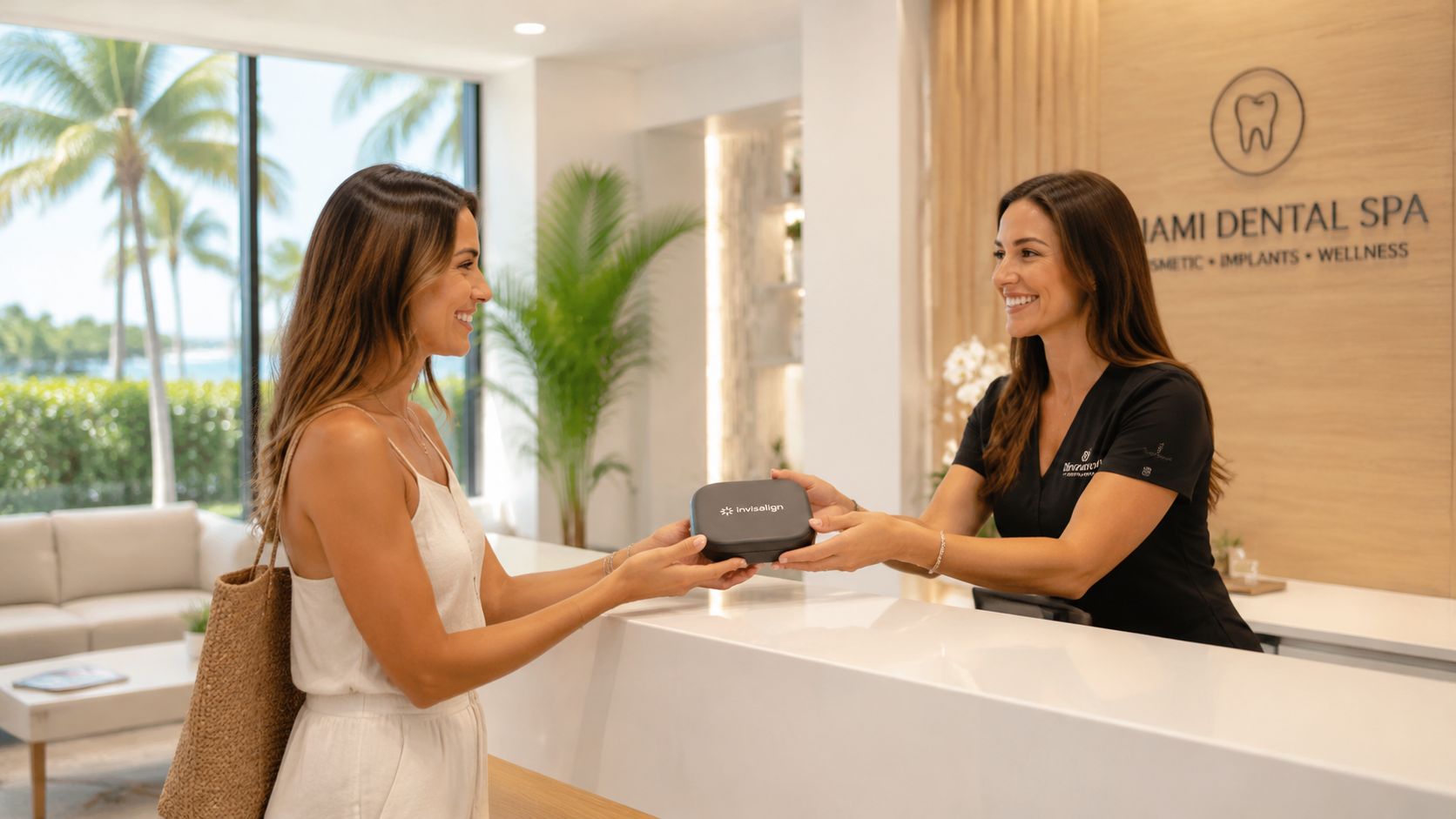
A calmer visit without sacrificing clinical detail
The practice combines thorough dental care with a spa-like setting. Patients may receive custom aromatherapy, streaming entertainment during procedures, refreshments, and a soothing hot towel finish. These details can make the visit more comfortable for patients with dental anxiety, while the clinical process remains focused on diagnosis, safety, modern technology, and durable treatment planning.
Dr. Bahmadi maintains ongoing professional education and membership in organizations including the ADA, FDA, SFDA, AACD, and AAFE. The practice also has bilingual staff and discusses treatment planning for patients with insurance and those without coverage.
Care beyond Invisalign
An overbite consultation may reveal other needs that affect treatment timing or oral health. A patient may need cleaning and exams, dental X-rays, a night guard, a filling, a crown, or periodontal care before aligners begin. Ultra Smile DentalSpa also provides cosmetic and restorative services such as teeth whitening, veneers, crowns and bridges, dental implants, bone grafts, root canals, and wisdom teeth extraction.
Patients with sudden swelling, severe tooth pain, trauma, or a broken tooth should ask about emergency dentist availability rather than waiting for a routine Invisalign consultation. A tooth extraction or other urgent service may need to happen before cosmetic or orthodontic planning.
Schedule Your Invisalign Overbite Consultation Today
A consultation is the only reliable way to determine whether Invisalign can correct a particular overbite. Patients should bring insurance information, a list of medications and health conditions, and any previous dental records or X-rays that may help the dentist understand changes over time.
During the visit, useful questions include:
- Treatment fit: Is the overbite mainly dental, or does the jaw relationship contribute?
- Movement plan: Will the correction depend on intrusion, molar movement, attachments, bite ramps, or elastics?
- Predictability: Which movements may underperform the digital plan?
- Refinements: Are additional aligner stages included in the proposed treatment?
- Retention: What retainer type and wear schedule will protect the result?
- Alternatives: Would braces, functional appliances, restorative dentistry, or a surgical opinion be more appropriate?
- Financial planning: What does the written estimate include, and how may insurance or payment options affect the balance?
Patients looking for a dentist near me, a dentist in Miami, FL, or a Cosmetic dentist near me should choose an office that evaluates the bite as carefully as the smile. The same principle applies to people searching for Dental implants near me or an Emergency dentist. A complete examination helps place each service in the correct order and prevents cosmetic goals from overshadowing oral health.
The most useful next step is to schedule an in-person evaluation, review the scans and X-rays, and ask for a treatment plan that explains both the expected correction and its limitations. Patients don't need to decide before they understand the diagnosis.
Ultra Smile DentalSpa offers Invisalign consultations, digital treatment planning, and complete dental care for Miami patients who want to understand whether clear aligners can correct an overbite. Visit Ultra Smile DentalSpa to request a consultation and discuss a realistic path toward a healthier, more balanced bite.