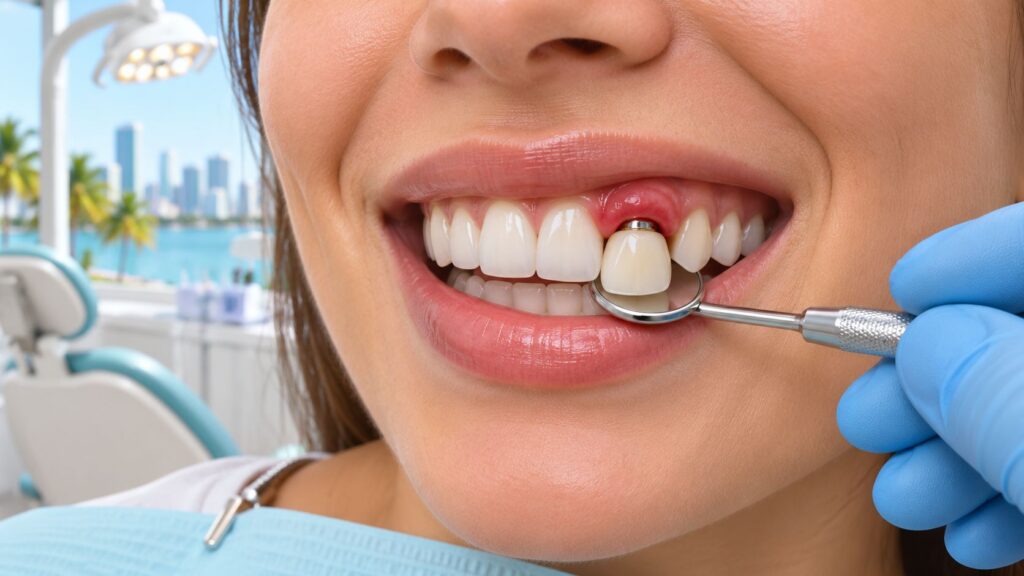
A small amount of bleeding may have a simple cause, such as brushing too firmly. If it keeps happening, or you notice recurring discharge, a metallic taste, or gum recession, contact a dentist for an assessment. The tissue's condition and how it changes over time matter more than pain by itself.
The rule that matters most: judge an implant by what you can see and taste, changes you notice over time, and what a dentist measures, not by whether it hurts.
Signs may include bleeding or tenderness, then discharge or recession. A loose implant needs prompt attention. Comparing these changes with the expected healing process can help you decide when to call a dentist in Miami, Florida. Ultra Smile DentalSpa offers implants and bone grafts to patients across Downtown Miami, Midtown Miami, and Hallandale Beach.
Table of Contents
- Warning Signs of Dental Implant Infection at a Glance
- How to Tell the Difference
- Why Implants Become Infected and Who Is at Higher Risk
- When to Contact a Dentist Urgently
- How Dentists Diagnose and Treat an Infected Implant
- Book an Implant Check at Ultra Smile DentalSpa in Miami
Warning Signs of Dental Implant Infection at a Glance
The question almost everyone brings to an implant exam is the same. Is this normal, or is it infected? Two clinical words do most of the work here, and neither one is pain.
Peri-implant mucositis means the soft tissue around the implant is inflamed without bone loss beyond the normal early remodeling. Peri-implantitis means that inflammation plus progressive loss of the supporting bone. Both are common. The 2025 AO/AAP systematic review and meta-analysis estimated patient-level prevalence at 46% for peri-implant mucositis and 21% for peri-implantitis, with 95% confidence intervals of 41 to 51% and 17 to 24%.
Common doesn't mean catastrophic. Plenty of early inflammation settles with a professional cleaning and a corrected home routine. The numbers matter because they explain why a small symptom deserves a look rather than a wait.
| Symptom | What It May Indicate | Typical Stage |
|---|---|---|
| Redness, swelling or tenderness around the implant | Soft-tissue inflammation, possibly mucositis | Early |
| Bleeding when brushing, flossing or gently probed | Inflamed gum tissue; a key sign a dentist checks | Early |
| Pus or other discharge | Active infection, possibly with bone involvement | Moderate to advanced |
| Persistent bad taste or odor | Bacteria building up around the implant | Moderate |
| Gum recession or a deeper pocket | Tissue loss that is progressing | Advanced |
| Loose implant or reduced chewing stability | Significant bone loss | Advanced |
| Little or no pain | Does not rule out infection | Any stage |
Read that list and a pattern appears. The early group is quiet: redness, puffiness, soreness on pressure, blood on the brush or floss. None of it stops you eating dinner. All of it says the gum is reacting to something that shouldn't be there.
The middle group starts announcing itself. Discharge, odor, or a bad taste that returns within hours of cleaning points to bacteria collecting somewhere a toothbrush can't reach. A bump that releases a bad taste when pressed belongs here too, and it helps to know how a painful bump beside a tooth behaves, because an implant site can mimic the look of a natural-tooth abscess.
The late group is structural: gum recession, a pocket that keeps deepening, an implant that wobbles, a crown that suddenly feels different against the opposite teeth. Those signs mean bone has already been lost around the post.
Little or no pain sits across every row, which is exactly why discomfort can't be the trigger for a call. Some people with confirmed peri-implantitis feel nothing at all.
Keep a short note on your phone of what you're seeing and when it started. Bring that list to your visit. Ultra Smile DentalSpa examines implants for patients across Downtown Miami, Midtown Miami and Hallandale Beach, and a dated list turns a vague worry into a measurable trend.
How to Tell the Difference
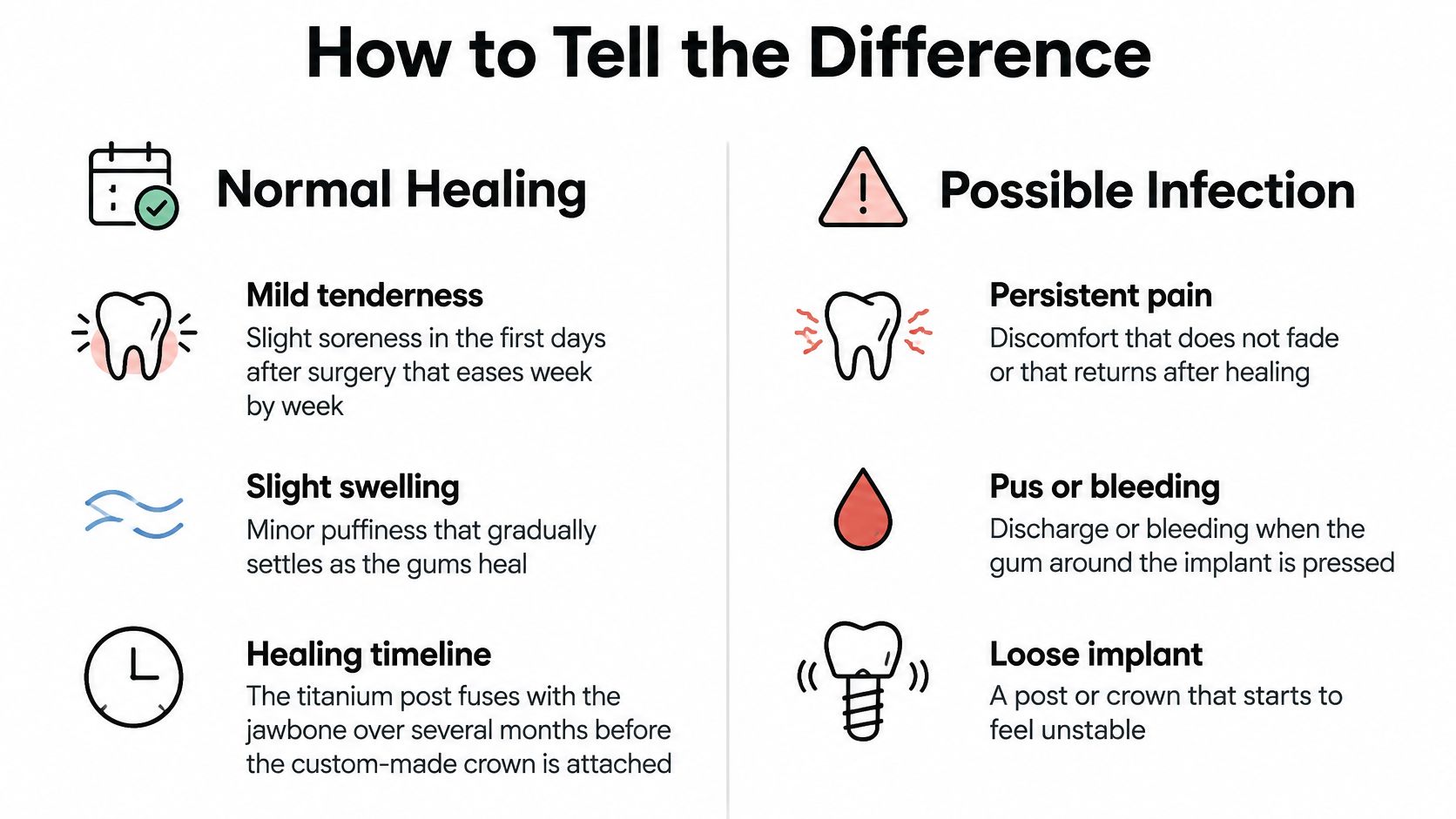
A dental implant begins with a titanium post placed in the jawbone, followed by a healing phase of several months, and then a custom-made crown attached to the post. That timeline explains why the first weeks feel the way they do. The bone is bonding to the post, the gum is closing over it, and some mild tenderness, slight swelling and minor bleeding are ordinary parts of surgery.
Normal healing has a direction. Soreness fades, swelling settles, and bleeding stops within the first few days. The dental implant healing timeline lays out those stages visit by visit, which makes it easier to spot the difference between a slow week and a wrong turn.
| Sign | Normal Healing | Possible Infection |
|---|---|---|
| Tenderness | Fades over the first days | Grows stronger or lasts beyond the first weeks |
| Bleeding | Stops after the first few days | Returns at brushing or flossing |
| Swelling | Settles week by week | Persists or spreads |
| Discharge or taste | None | Pus, drainage or a foul taste appears |
What Separates a Sore Week From a Problem
Say two patients had implants placed in the same month. The first has a gum that aches for three days and then goes calm, with no blood by the weekend. The second has a gum that bleeds a little more each week, then develops a bad taste about a month in. Same surgery, opposite trajectories, and the second one needs an exam.
The deciding factor is the trend. Improvement over two weeks is reassuring. Anything flat or worsening past the first week deserves attention, and that includes a symptom that vanished and then came back.
What a Dentist Checks That Home Observation Misses
Three measurements settle most of these questions. Gentle probing reveals bleeding or pus that you'd never see in a mirror. Probing depth compared with earlier visits shows whether the pocket is deepening. A dental X-ray shows the bone level around the implant.
The clinical research on peri-implant disease describes a consensus pattern dentists use when no earlier records exist: bleeding or suppuration on gentle probing, a probing depth of at least 6 mm, and bone level at least 3 mm below the most coronal part of the implant's intraosseous segment. That's what turns "it looks a bit puffy" into a clear diagnosis.
Note the date, the bleeding, any swelling, any taste, and any discharge. Four lines of notes give a dentist more than ten minutes of trying to remember.
One home habit prevents the most common mistake, which is quitting the area because it bleeds. Keep brushing gently with a soft brush, and keep cleaning around the implant the way you were taught.
Why Implants Become Infected and Who Is at Higher Risk
Bacteria don't need encouragement. They need a surface, and the seam where gum meets titanium is a surface they colonize easily.
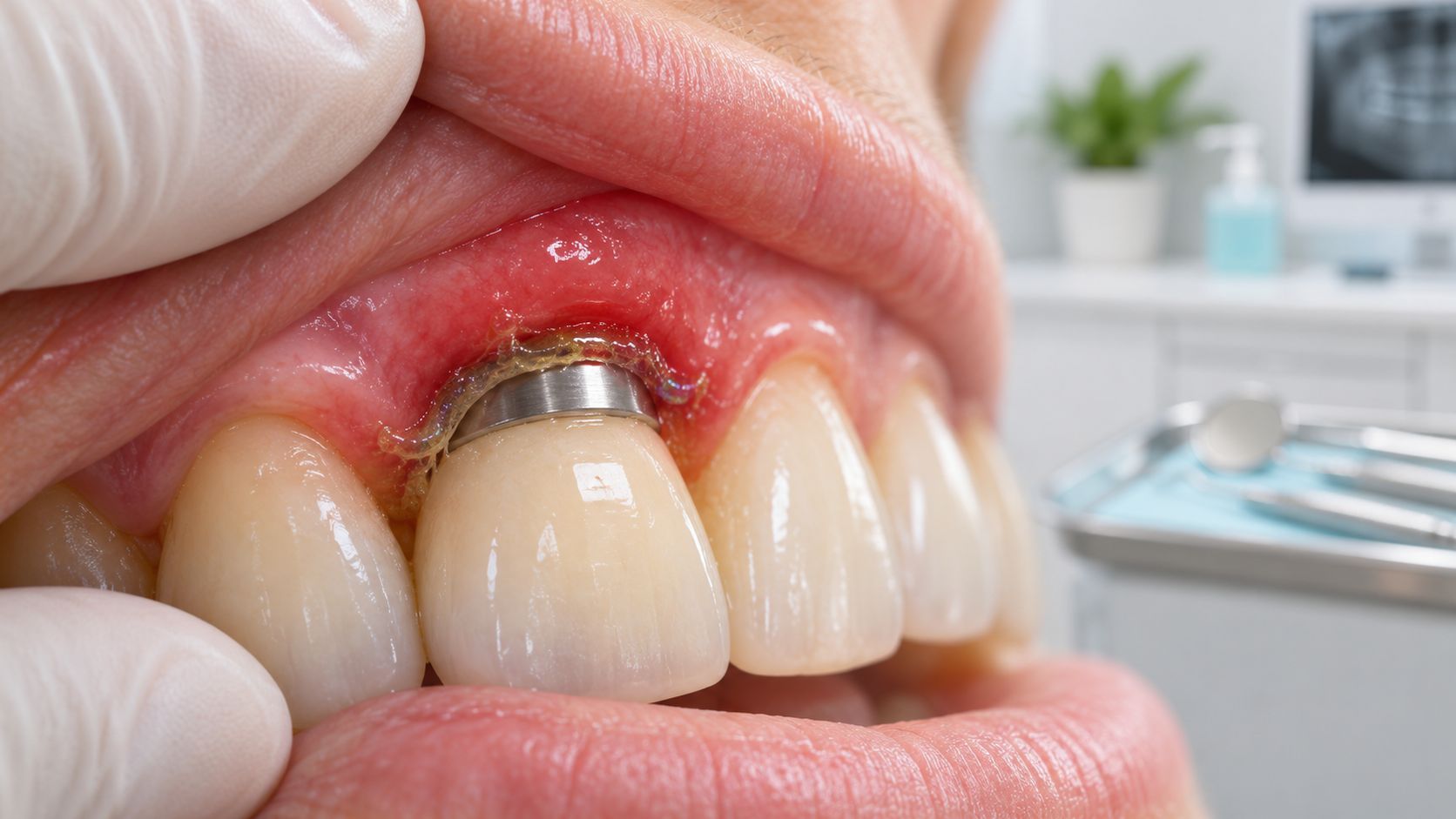
That sticky film is biofilm. Left alone, it hardens into calculus, inflames the surrounding gum, and can spread to the bone anchoring the post. Nothing about the implant itself is at fault. The disease starts in what accumulates around it.
Risk isn't evenly distributed. The systematic review of peri-implant disease risk found median prevalence of 9.0% among patients enrolled in regular preventive-maintenance programs versus 18.8% among those without regular maintenance, with prevalence reaching 26.0% when implants had functioned for at least 5 years. The same review calculated an odds ratio of 1.7 for smoking (95% confidence interval 1.25 to 2.3) and 2.5 for diabetes (1.4 to 4.5), and named previous or active periodontitis and inadequate professional maintenance as established risk factors.
In plain terms, tobacco and uncontrolled blood sugar each raise the odds of trouble, and gum disease elsewhere in the mouth raises them again. So does skipping the cleanings that clear the tartar driving the inflammation.
Regular cleanings help prevent tartar buildup, bone loss, bad breath and cavities, and Ultra Smile DentalSpa asks patients when their next cleaning is due, which is a simple way of keeping that interval honest. Home care matters just as much, and the technique for how to clean dental implants differs from cleaning natural teeth. If disease has already taken hold, it helps to understand how peri-implantitis is treated before the conversation turns to surgery.
Book checkups more often, rather than once a year, if any of these describe you:
- Smoking or vaping, because nicotine narrows blood vessels and slows tissue repair.
- Diabetes, especially with blood sugar that swings.
- Past gum disease, since treated periodontitis still leaves you more susceptible.
- Older implants, particularly any post that has been in function for five years or more.
- Crowns that trap food, along with bridges and implant restorations that are hard to floss.
When to Contact a Dentist Urgently
The absence of pain does not mean an implant is healthy. Use the timing below as a guide, and contact a dentist if bleeding, discharge or tenderness persists or worsens.
| Situation | Timing | Action |
|---|---|---|
| Swelling that spreads quickly, or trouble breathing or swallowing | Immediately | Seek emergency medical care |
| Pus or drainage, or swelling with pain or fever | Same day | Call the dentist to arrange an urgent assessment |
| Implant that feels loose or moves | Within 1 to 2 days | Arrange an examination |
| Persistent bleeding, bad taste or new gum tenderness | Within a few days | Book an exam |
| Mild bleeding that stops and does not return | Within 1 week | Track symptoms and book a routine exam |
Why Timing Depends on Tissue, Not Discomfort
Pain is only one clue, and it may be absent even when an implant needs attention. The 2017 World Workshop consensus on peri-implant diseases defines peri-implantitis as inflammation around an implant with progressive loss of supporting bone. Signs include bleeding or pus when the area is gently probed, deeper probing measurements than before, and bone loss on X-rays beyond normal changes after placement.
That is why a comfortable implant is not automatically a healthy one. Previous probing records and earlier X-rays help a dentist see whether the tissue or bone has changed. If bleeding or discharge appears, or the gum looks different, arrange an assessment rather than relying on pain to decide whether to act.
A Side-by-Side Example
A streak of blood on the brush on Tuesday that has stopped by Thursday, with no other symptoms, can usually be noted and discussed at a routine exam within a week. Pus near the implant with a cheek that looks fuller calls for a same-day call to the dentist. If swelling spreads quickly or swallowing becomes difficult, seek emergency medical care.
What to Say When You Call
Clear details help the dental team understand what is changing. Be ready to share:
- The implant date, or your best estimate if it was placed elsewhere.
- When symptoms started, and whether they are improving, staying the same or worsening.
- Current medications, especially blood thinners and medication for blood sugar.
- Smoking status and diabetes, which can affect tissue healing.
Patients in Downtown Miami, Midtown Miami and Hallandale Beach can call Ultra Smile DentalSpa to arrange an implant exam.
How Dentists Diagnose and Treat an Infected Implant
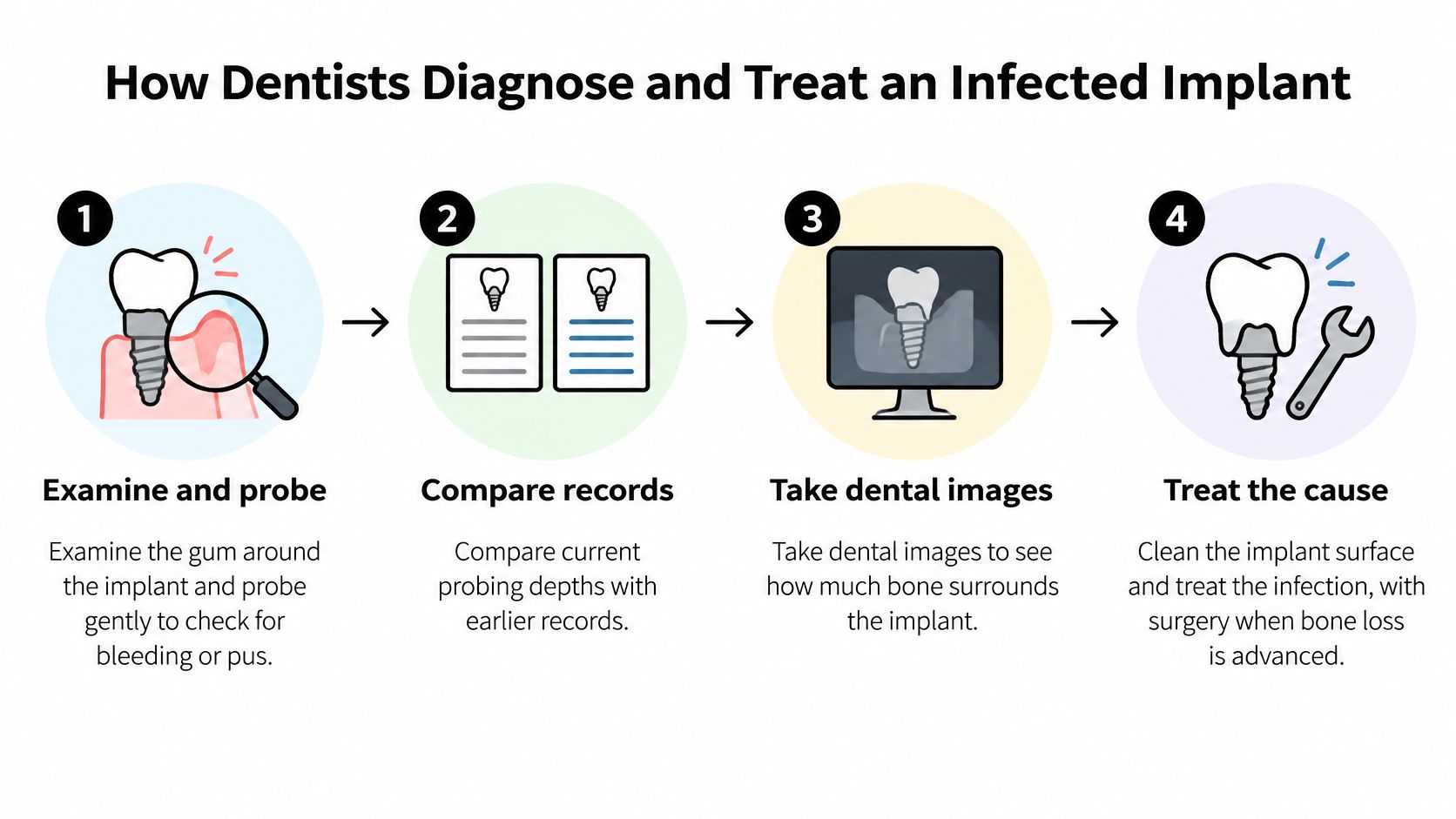
How can an implant infection be treated when pain is absent? Dentists look at the gum, measure changes over time, and check the bone, then match treatment to how far the infection has progressed.
- Examine and probe. The dentist checks the gum around the implant and gently probes several points for bleeding or pus.
- Compare with your records. Current pocket depths are compared with earlier readings. A change over time can reveal a problem even when the implant feels comfortable.
- Take dental X-rays. Imaging helps show how much bone remains around the implant and whether its level has changed since placement.
- Clean biofilm and calculus. For mild to moderate disease, the dentist mechanically removes infected tissue and deposits from the implant surface. This targets the material driving inflammation.
- Consider local antimicrobials. In selected cases, a clinician may place chlorhexidine or an antibiotic directly at the site.
- Use surgery when needed. Severe disease, infection extending beyond the peri-implant tissues, or a defect that cannot be reached with nonsurgical cleaning may require surgery to remove the pocket and clean the implant surface.
Why Antibiotics Aren't the Whole Answer
Antibiotics may reduce swelling for a time, but they do not remove biofilm, clean the pocket, or restore lost bone. A review of infected tissues around dental implants describes mechanical cleaning as the basis of nonsurgical care, with local antimicrobials used selectively and surgery reserved for severe disease or areas cleaning cannot reach.
If swelling fades after antibiotics but the pocket measures deeper at follow-up, the area still needs direct treatment. The medicine may have eased a symptom without addressing its cause.
What Follow-Up Looks Like
The first review is usually a few weeks after treatment. The dentist checks whether the tissue is tightening and bleeding has stopped, then compares new probing measurements with the earlier ones. Imaging may be repeated if bone changes need assessment.
Cleanings may then be scheduled more often than before, often every three to four months, because the site has shown it can flare. Each visit checks for a returning pocket while the problem is still limited to soft tissue. Implants are permanent replacements for missing teeth, and maintenance helps protect the bone that supports them.
Book an Implant Check at Ultra Smile DentalSpa in Miami
Bleeding that persists, pus or drainage, swelling, a recurring bad taste, or movement in an implant warrants a dental exam. Pain may be absent, so pay attention to these changes rather than waiting for discomfort. Ultra Smile DentalSpa serves Downtown Miami, Midtown Miami, and Hallandale Beach, with implant and general dentistry services.
At the visit, the dentist examines the gum around the implant, gently checks for bleeding and discharge, and takes dental X-rays. You can ask whether the concern appears limited to soft tissue or involves the bone, and what the findings mean for your next steps.
Related care at the same office includes implants and bone grafts, wisdom teeth extraction, and general and cosmetic dentistry. Ultra Smile DentalSpa's website has a free consultation request form; completing it secures a 30% discount on dental treatments. If symptoms are urgent, call the office instead of submitting a form and waiting.
The first step is an assessment, not a decision to remove the implant. A check can clarify what is changing and help you discuss a suitable plan.
If a symptom around your implant persists, arrange an assessment rather than relying on pain as your guide. Request a consultation at Ultra Smile DentalSpa to have the area examined.