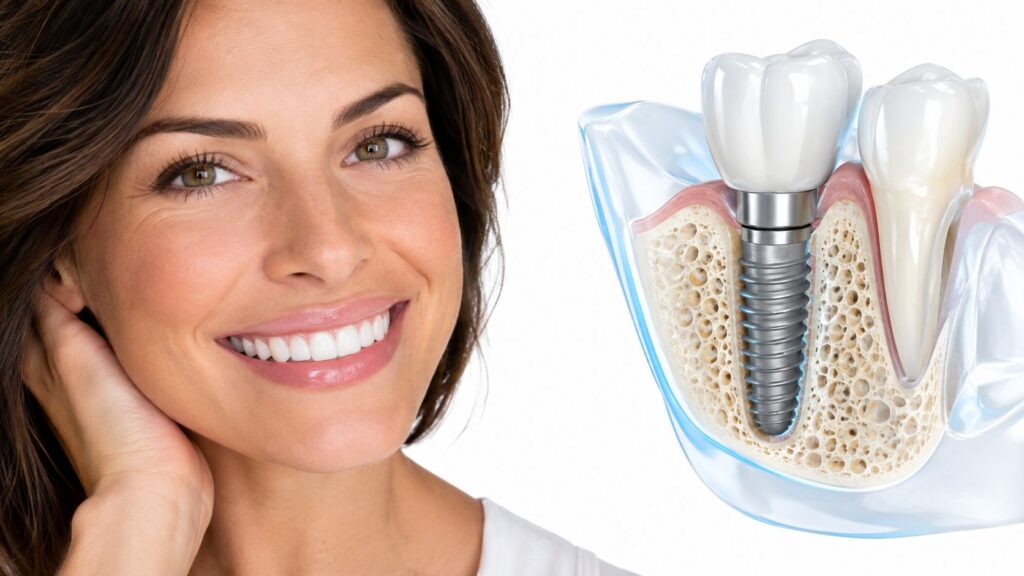
Dental implants without bone grafting are a predictable reality for many Miami patients, especially through modern alternatives such as short, mini, and zygomatic implants. Short implants have shown a mean survival rate of 96% versus 98% for longer implants over 1 to 5 years, while a long-term review reported 91.2% patient-level survival at 10 years.
A missing tooth, an uncomfortable denture, or a recent tooth extraction can make implant treatment feel urgent. Then a scan reveals reduced bone height, and the conversation seems to shift toward grafting, sinus surgery, extra healing, and more appointments. Many patients searching for a dentist near me, dental implants near me, or a dentist in Miami, FL want to know whether there's another safe path.
For appropriately selected patients, there often is. The right solution may involve a shorter implant, a narrow mini implant, an angled full-arch design, a zygomatic implant, or sinus elevation without added graft material. The decision depends on anatomy, stability, gum health, medical history, and the location of the missing tooth, not on a single promise that every patient can avoid augmentation.
Table of Contents
- Why Dental Implants Without Bone Grafting Are Changing Care in Miami
- Comparing Your Graft-Free Implant Options
- Success Rates and Long-Term Evidence for Graft-Free Implants
- Am I a Candidate for Dental Implants Without Bone Grafting?
- Cost Considerations and Insurance for Graft-Free Implants in Miami
- The Ultra Smile DentalSpa Difference in Graft-Free Implant Care
- Your Next Steps for Graft-Free Implants in Miami
Why Dental Implants Without Bone Grafting Are Changing Care in Miami
A patient from Downtown Miami may arrive after delaying treatment because the phrase “bone graft sounds more intimidating than the missing tooth itself. Someone from Midtown may have already searched for an emergency dentist after a cracked tooth, only to learn that extraction and replacement require more planning than expected. A patient from Hallandale Beach may be living with a loose denture and assume that limited bone rules out fixed teeth altogether.
Those concerns are understandable. Traditional implant treatment sometimes requires rebuilding the ridge or lifting the sinus before a conventional implant can be placed. That approach remains appropriate when the existing bone cannot provide reliable support. But it isn't the only approach available.
Modern implant planning can use the bone that remains more strategically. A shorter fixture may avoid the sinus. A narrow implant may fit a restricted ridge in a carefully selected location. Angled implants can engage stronger areas of bone, while zygomatic implants use the cheekbone for support in severe upper-jaw atrophy. Some patients may also qualify for sinus floor elevation without bone graft material.

The patient experience matters
Graft-free treatment can reduce the number of surgical stages, but it isn't automatically simpler. Each technique has its own planning requirements, recovery pattern, and potential complications. The practical benefit is that a patient may receive a treatment plan built around existing anatomy rather than being sent directly into a grafting sequence.
That distinction helps reduce anxiety. A consultation should answer whether the patient is a candidate for dental implants without bone graft, a candidate for a different graftless approach, or someone who still needs augmentation for predictable support.
Ultra Smile DentalSpa serves patients in Downtown Miami, Midtown Miami, and Hallandale Beach with implant planning, tooth extraction, restorative dentistry, cosmetic dentistry, and related dental care. Its spa-like setting, including aromatherapy, entertainment, refreshments, and a hot towel finish, addresses comfort while the clinical team evaluates whether a graft-free plan is safe.
Practical rule: Avoiding a graft is worthwhile only when the alternative provides stable support, healthy tissue, and a restoration that can function for the long term.
Comparing Your Graft-Free Implant Options
The phrase dental implants without bone graft describes several different strategies, not one universal procedure. Short implants may suit limited vertical height in the back of the jaw. Mini implants may help stabilize a lower denture. Zygomatic implants address severe upper-jaw bone loss, while ridge expansion changes the width of a narrow ridge rather than adding height.
| Implant Type | Best For | Key Characteristics |
|---|---|---|
| Short implants | Limited vertical bone height in posterior jaw areas | Implants measuring 6 mm or less may avoid sinus augmentation or other vertical bone-building procedures in selected cases. |
| Mini implants | Loose lower dentures or narrow replacement sites | Smaller-diameter implants require less ridge width, but their use depends on loading demands, bone quality, and the planned restoration. |
| Tilted implants | Full-arch treatment with bone concentrated toward the front | Angled placement can use available denser bone and bypass severely resorbed posterior areas. |
| Zygomatic implants | Severe upper-jaw atrophy | These implants anchor in the cheekbone rather than relying solely on the weakened posterior maxilla. |
| Ridge expansion | A narrow ridge with usable bone height | The ridge is carefully widened to create implant space. This remains a surgical procedure and isn't the same as simply placing an implant into existing bone. |
Short implants for reduced vertical height
Short implants are most relevant when the missing tooth is near the maxillary sinus or another anatomical boundary. Their reduced length can make placement possible without increasing vertical bone volume, provided the remaining bone can deliver primary stability and the implant can support the planned crown or bridge.
The evidence is strongest for carefully selected posterior sites, not every full-mouth situation. An international consensus found that there isn't enough long-term evidence to recommend using only short implants for full rehabilitation of an atrophic, toothless upper jaw with an implant-supported prosthesis. That doesn't make short implants unsuitable. It defines where caution is needed.
Mini, tilted, and zygomatic solutions
Mini implants can be useful when the primary goal is denture stabilization or when a narrow space limits the diameter of a conventional implant. They aren't interchangeable with standard implants in every load-bearing situation, and a dentist must match the implant design to the restoration.
Tilted and zygomatic implants serve more advanced cases. Tilted implants can help support a full arch by reaching stronger available bone. Zygomatic implants are reserved for substantial upper-jaw atrophy and require advanced surgical planning. They may eliminate the need for a traditional graft, but they introduce a more complex procedure and should be discussed with a clinician experienced in that treatment category.
Ridge expansion occupies a middle ground. It can avoid a separate graft in some narrow-ridge cases, but it still involves surgery and does not solve inadequate vertical height or poor tissue health.
Success Rates and Long-Term Evidence for Graft-Free Implants
Patients often ask whether avoiding grafting means accepting a weaker result. The evidence gives a more balanced answer. In selected cases, graft-free techniques can be predictable, but outcomes depend on the implant design, site, stability, restoration, and follow-up care.
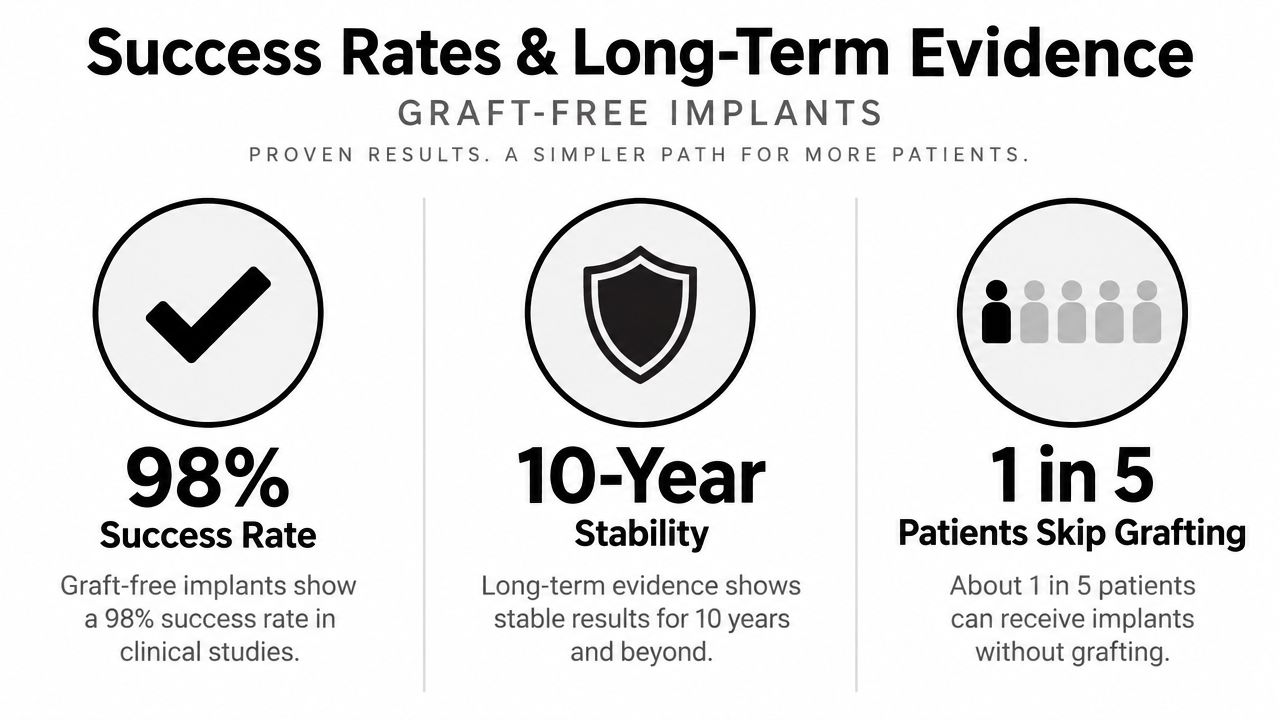
A 2024 meta-analysis of posterior-jaw short implants reported a mean survival rate of 96% for short implants versus 98% for longer implants over 1 to 5 years. The same evidence base supports short fixtures as a reasonable alternative when clinicians want to avoid augmentation in appropriately selected patients. Details are available in the 2024 systematic evidence on posterior-jaw short implants.
What longer follow-up adds
A 2026 systematic review reported a 10-year survival rate of 91.2% at the patient level and 93.7% at the implant level for short dental implants. Those figures don't mean every patient can receive a short implant, and they don't eliminate the need for careful diagnosis. They do show that avoiding a graft can be compatible with durable treatment when the case is selected properly. The long-term findings are reported in this systematic review of short dental implant survival.
Graftless sinus approaches also have supportive long-term data. A retrospective study of osteotome sinus floor elevation without grafts reported 9-year cumulative survival of 90.6% by implant and 91.3% by patient, with mean marginal bone loss of 0.46 ± 0.88 mm at 4 years and 0.50 ± 1.69 mm at 9 years. The study supports graftless sinus elevation as a predictable option in selected posterior maxilla cases, as described in the long-term clinical study of graftless sinus floor elevation.
Another review found no significant survival difference between short implants and longer implants placed with sinus floor elevation at early and longer follow-up periods. Short implants also showed less marginal bone loss and fewer sinus-related complications in that comparison, as reported in the systematic review of short implants for the atrophic posterior maxilla.
The responsible conclusion is neither “grafts are unnecessary nor “implants cannot work without them. The evidence supports a plan built to the individual case, with uncertainty remaining for more severe atrophy and broader full-arch applications.
Am I a Candidate for Dental Implants Without Bone Grafting?
A patient may be a candidate for graft-free treatment when the remaining bone can provide stability in the planned position and the restoration can function without placing excessive stress on the implant. That assessment begins with the missing tooth's location. A posterior upper-jaw site near the sinus presents a different problem from a narrow lower-front ridge or a severely resorbed upper arch.
Four clinical questions guide the decision
Is there enough usable bone in the right position?
A CBCT scan helps map height, width, density, the sinus, and nearby nerves. The question isn't just how much bone exists. It's whether the implant can be positioned safely while supporting the planned crown or bridge.Can the implant achieve primary stability?
Immediate placement typically requires engagement of approximately 3 to 4 mm of apical bone, with positioning slightly toward the palate or tongue rather than the facial side, according to clinical guidance on immediate implants. If the facial wall is missing, immediate placement becomes less predictable and delayed or regenerative treatment may be safer. See the clinical guidance on immediate implant placement and primary stability.Are the gums and remaining teeth healthy?
Active gum disease, untreated decay, poor oral hygiene, and an unstable bite can undermine any implant plan. A tooth extraction may need to happen first, followed by infection control and tissue evaluation.Can the medical history support healing?
Smoking, uncontrolled systemic conditions, and certain medications may change the risk profile. They don't always rule out treatment, but they must be disclosed and considered before surgery.
Immediate implants can sometimes be placed without grafting in a type I extraction socket when the facial bone and surrounding tissues remain suitable. Precise positioning matters, including approximately 3 mm apical to the planned crown contour and about 2.0 mm palatal or lingual, preserving roughly 1.8 to 2.0 mm of buccal bone, as described in this clinical discussion of immediate implant positioning.
Patients with bone loss can review additional treatment considerations through this guide to dental implants with bone loss. The final decision still belongs to a qualified clinician after examination, imaging, and restorative planning.
Cost Considerations and Insurance for Graft-Free Implants in Miami
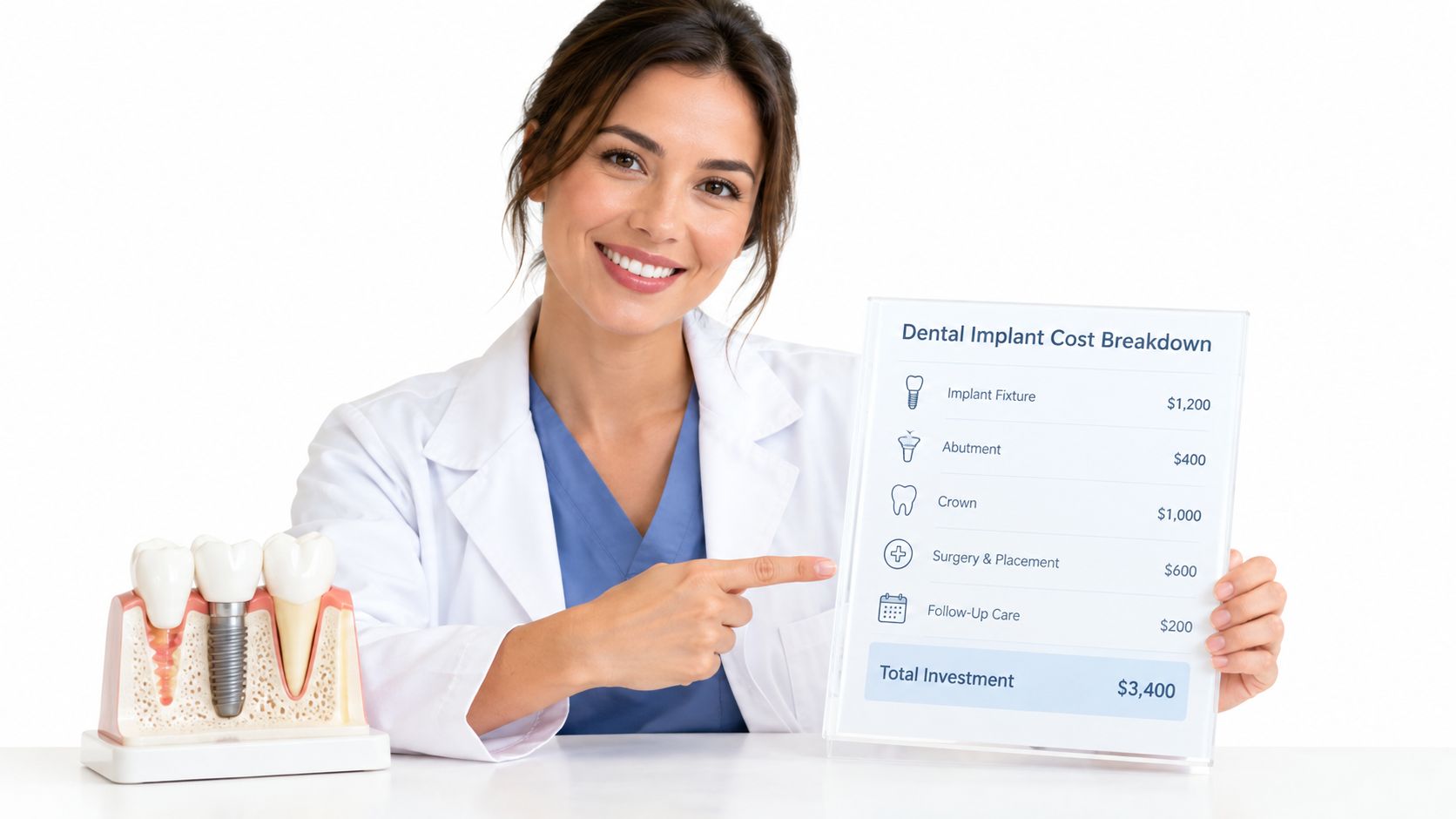
The financial advantage of a graft-free plan may come from avoiding a separate grafting procedure, but the total price can't be determined from the implant alone. Patients should receive a written breakdown covering the examination, CBCT imaging, extraction if needed, implant placement, abutment, temporary tooth, final crown or bridge, sedation, and follow-up care.
What changes the estimate
Material selection, the number of teeth being replaced, the complexity of the anatomy, the need for an extraction, the type of prosthesis, and the surgical technique all affect the fee. A short implant for one posterior tooth is a different financial plan from a full-arch restoration using tilted or zygomatic implants.
Avoiding grafting may reduce surgical stages and healing-related visits, but a more advanced graft-free technique can require specialized planning, equipment, or prosthetic design. Patients should ask whether the quoted fee includes temporary teeth, final restorations, adjustments, and management of complications.
Dental insurance may treat the surgical implant, crown, extraction, and bone-related procedures as separate benefits. Some plans contribute toward the prosthetic tooth but exclude implant surgery, while others impose waiting periods, annual limits, or missing-tooth exclusions. The financial coordinator should verify benefits rather than promise coverage.
For patients comparing options, this guide to bone grafts in Miami can clarify why a graft may be proposed and what a graft-free alternative is intended to avoid.
Patients can also ask about accepted insurance, staged treatment, and available payment arrangements before scheduling surgery.
The Ultra Smile DentalSpa Difference in Graft-Free Implant Care
Graft-free implant care requires more than selecting a smaller or longer implant. The clinician must connect imaging, surgery, bite design, gum health, and the final appearance. Dr. Neda Bahmadi, DMD, maintains ongoing education and professional memberships that include the ADA, FDA, SFDA, AACD, and AAFE.
Ultra Smile DentalSpa provides implant and bone-graft services alongside general, cosmetic, and restorative dentistry. That broader scope matters when a patient also needs a tooth extraction, crown, bridge, root canal, periodontal stabilization, or cosmetic finishing after implant treatment.
Comfort is part of the treatment plan
Dental anxiety can cause patients to postpone care until pain or tooth damage becomes harder to manage. A calmer environment, bilingual staff, streaming entertainment, custom aromatherapy, refreshments, and a hot towel finish can make appointments feel more manageable without replacing clinical safety or careful planning.
The practice also uses modern technology for implant evaluation and offers care for patients searching for a cosmetic dentist near me, teeth whitening, cleaning and exams, Invisalign, restorative treatment, and emergency dental services. Those services support continuity when implant candidates need other problems addressed before surgery.
A comfortable visit doesn't lower the clinical standard. It helps patients stay engaged with the examinations, treatment decisions, and maintenance that protect the result.
Your Next Steps for Graft-Free Implants in Miami
The process begins with a consultation for the missing tooth, damaged tooth, loose denture, or recent extraction site. The dentist reviews medical history, gum health, bite, existing restorations, and the patient's priorities for appearance, chewing, timing, and comfort.
The next step is diagnostic imaging, often including 3D CBCT evaluation. That scan helps determine whether the case fits a short implant, mini implant, angled full-arch approach, zygomatic solution, graftless sinus technique, ridge expansion, or conventional augmentation.
Patients should leave with a clear plan that explains:
- The recommended technique: Why it fits the available anatomy.
- The alternatives: Including grafting, a bridge, or a removable restoration when appropriate.
- The sequence: Extraction, implant placement, temporary teeth, healing, and final restoration.
- The financial details: What insurance may contribute and what the patient will pay.
New patients can access Ultra Smile DentalSpa locations serving Downtown Miami, Midtown Miami, and Hallandale Beach, with bilingual staff available to support the process.
Ultra Smile DentalSpa offers CBCT-guided implant planning, short and other graft-free implant approaches, tooth extraction, restorative dentistry, and bone-grafting care when augmentation is the safer choice. Patients considering dental implants without bone graft can visit Ultra Smile DentalSpa to request a consultation and take the next step toward comfortable eating and confident smiling.