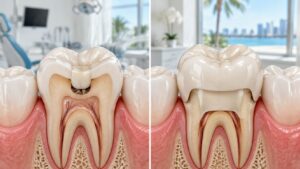
A patient in Coral Gables may leave an endodontist's office with a numb lip, a temporary filling, and one phrase repeating in her mind: “full coverage restoration. The root canal is finished, the pain is easing, and yet another procedure is already being recommended. That can feel confusing, especially when the tooth seems better.
The question, after root canal is crown necessary, doesn't have a universal yes-or-no answer. The right choice depends on the tooth's location, the amount of healthy structure left, the patient's bite, and whether cracks are present. This guide explains when a crown is difficult to avoid, when an onlay or direct restoration may be reasonable, and how a Miami patient can think through timing and financial planning without feeling pressured.
Table of Contents
- Leaving the Endodontist With One Big Question
- Why a Root Canal Changes How the Tooth Behaves
- The Four Clinical Factors That Drive the Decision
- Crown Alternatives Worth Considering in Miami
- What Really Happens If You Skip the Crown
- Timeline From Root Canal to Final Crown
- Crown Cost in Miami by Material and Coverage
- Patient Questions Miami Dentists Hear Most
Leaving the Endodontist With One Big Question
Root canal therapy treats the infection inside the tooth. A crown addresses what remains outside it. Those are connected treatments, but they solve different problems, which is why a patient can feel relief and still need restorative care.
A temporary filling protects the access opening while the tooth awaits its definitive restoration. It isn't designed to replace the long-term strength or seal provided by a properly selected crown, onlay, or bonded filling. The next step should be based on an examination of the tooth, not on the fact that root canal therapy occurred.
The three answers a patient needs
A careful consultation should give the patient three practical answers:
- Whether coverage is essential: Back teeth with missing walls, large restorations, or cracks generally face greater fracture risk.
- Whether a conservative option fits: A front tooth or a tooth with substantial healthy structure may sometimes be restored without a full crown.
- What timeline is sensible: The dentist should explain how soon the temporary restoration should be replaced and whether a same-day workflow is appropriate.
Evidence supports a conditional approach. A review of restored root-filled teeth states that crowns can protect cusps and support long-term survival, while also recognizing that the available evidence doesn't prove crowns are superior in every situation (peer-reviewed review of restored root-filled teeth).
Practical rule: The label “root canal doesn't make the crown decision by itself. The tooth's remaining structure does.
Patients searching for a dentist near me, an emergency dentist, or a dentist in Miami, FL often need this conversation after urgent pain treatment. The safest next step is a restorative exam with dental X-rays, a bite assessment, and a direct explanation of what the tooth can realistically withstand.
Why a Root Canal Changes How the Tooth Behaves
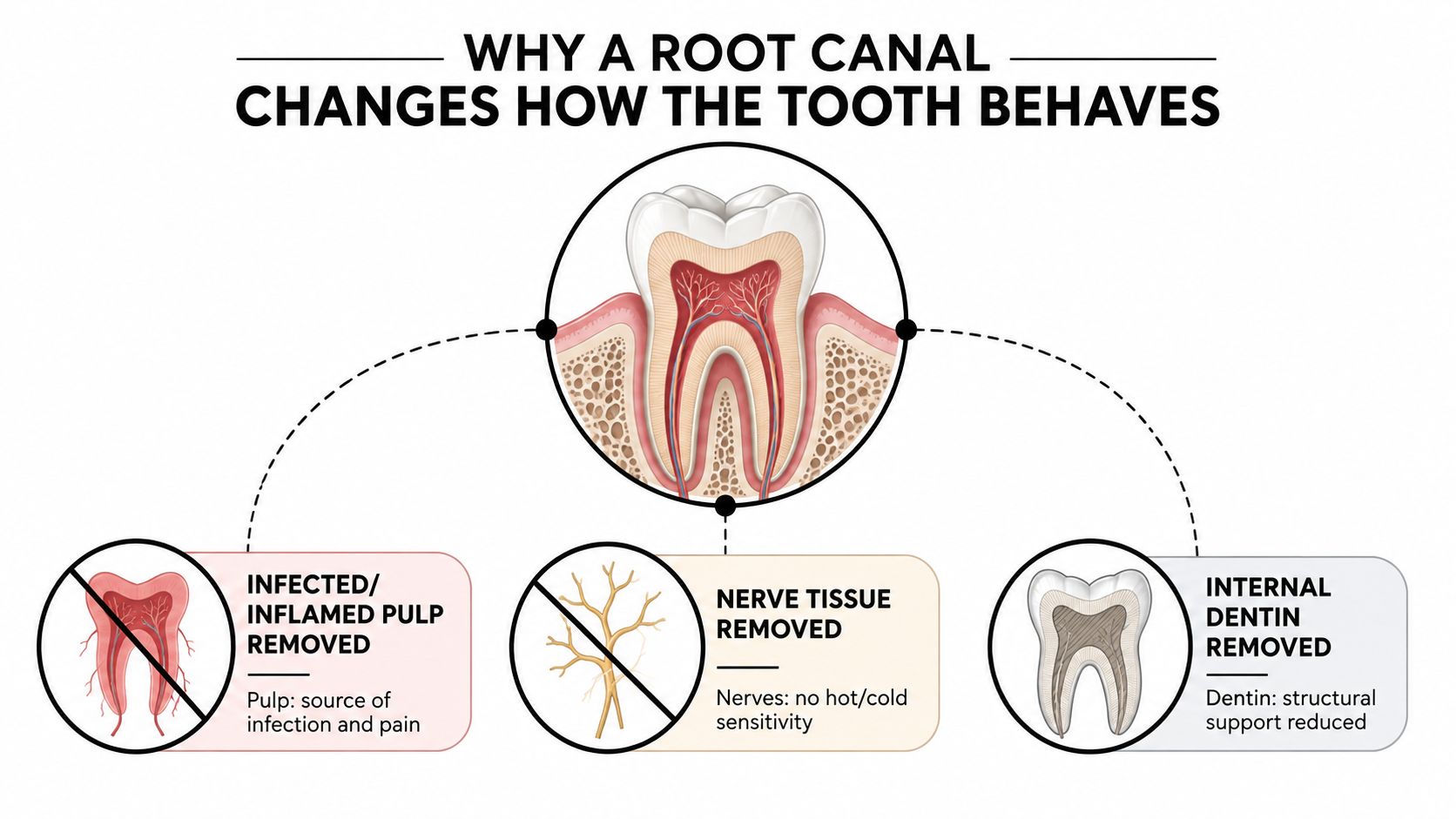
Root canal therapy removes inflamed or infected pulp, including the nerve tissue inside the tooth. The dentist also creates an access opening and removes compromised areas to clean and seal the canals. The tooth's vulnerability comes primarily from the loss of solid structure, not from the absence of a nerve.
What remains is more like a thinner shell supported by the walls left above the gumline. Under chewing pressure, those walls can flex. A molar or premolar that has already lost substantial structure may be much less forgiving when it encounters a hard food, an uneven bite, or repeated clenching.
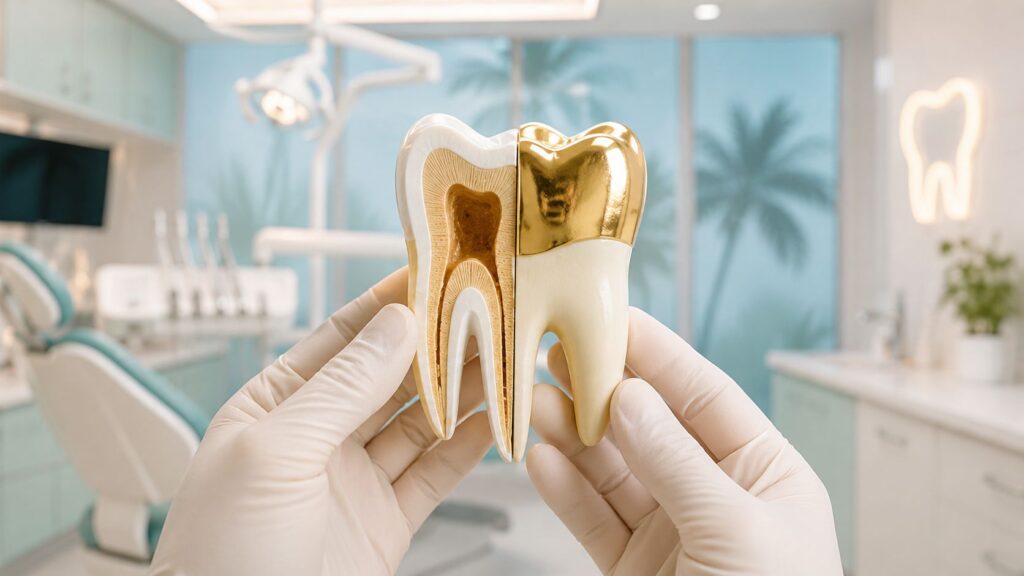
A useful analogy is a helmet for a weakened tooth. A motorcycle can still move without a helmet, but one impact can change the outcome. A crown works as cuspal coverage, helping hold the remaining tooth together and distribute forces across the visible portion of the tooth.
What the survival evidence shows
A major long-term study found a median survival time of 11.1 years for root canal-treated teeth overall, with 26.1% estimated to survive beyond 20 years (long-term study of root canal-treated tooth survival). The same evidence associated adding a crown with about 5.3 more years of tooth survival.
The restoration made a particularly clear difference in the study. Teeth that received both a filling and a crown lasted about 20.1 years, compared with 6.5 years when no restorative work was done (same long-term survival study). These figures don't mean every tooth follows the same path, but they show why a crown is often a structural decision rather than a cosmetic upgrade.
A separate systematic review reported 81% survival at 10 years for crowned root canal-treated teeth, compared with 63% for teeth restored directly with materials such as composite, amalgam, or cement (systematic review of crowned and directly restored teeth). The clinical question is therefore straightforward: how much protection does this particular tooth need to handle its daily load?
The Four Clinical Factors That Drive the Decision
A Miami dentist evaluates the tooth as a set of interacting risks. Tooth type matters, but it doesn't work alone. A lightly damaged premolar in a stable bite may be managed differently from a heavily filled premolar in a patient who clenches at night.
| Clinical Factor | Favors Crown | Favors Onlay | Favors Direct Filling |
|---|---|---|---|
| Tooth type | Molar, or a heavily loaded premolar | Premolar with selected cusp damage | Front tooth with limited access opening |
| Remaining structure | Thin walls or extensive loss | One or more strong cusps remain | Most walls and enamel remain intact |
| Occlusion and parafunction | Heavy bite, clenching, or grinding | Moderate load with controlled contacts | Light, stable bite |
| Visible cracks | Crack crossing a cusp or extending through the tooth | Localized crack with sound surrounding structure | No visible crack |
Tooth type and chewing load
Molars usually receive the strongest recommendation for cuspal coverage because they grind food and absorb significant chewing forces. Premolars require more individual assessment. Front teeth often can avoid a crown when their structure remains sound, because they primarily bite and tear rather than grind.
Remaining structure
The dentist checks the thickness, height, and continuity of the walls above the gumline. A tooth with plenty of healthy enamel and dentin may accept a bonded filling or onlay. A tooth with thin, unsupported walls may need a crown, and sometimes a post and core, so the final restoration has a stable foundation.
The evidence is more nuanced when structural loss is limited. Reviews report pooled crown survival rates of 94% to 100% and resin-composite survival rates of 91.9% to 100% in selected posterior teeth with minimum to moderate loss of structure (review of restorations for endodontically treated teeth). That supports conservative care in carefully selected cases, not a blanket rule against crowns.
Bite habits and cracks
Clenching and grinding increase the demand placed on a restoration. A visible crack that crosses a cusp raises the concern further because chewing can drive the crack deeper. In those situations, full coverage often becomes the more protective option.
Crown Alternatives Worth Considering in Miami
A full-coverage crown is not the only possible restoration, but the alternatives aren't interchangeable. Each one fits a different level of structural loss and chewing stress.
Full-coverage crown
A crown covers the visible tooth and its cusps. It usually requires more reshaping than a direct filling or onlay, but it offers broad protection for posterior teeth with extensive damage. This is often the clearest choice when a molar has large cavities, weakened walls, or cracks.
Onlay or three-quarter crown
An onlay covers damaged cusps while preserving stronger areas of the natural tooth. It can suit a tooth where one or more cusps remain intact and the dentist can create a reliable bonded seal. It removes less structure than a full crown, but its success still depends on the bite and the amount of tooth left.
Post and core
A post doesn't strengthen the root. It helps retain a core when too little coronal tooth structure remains to hold the crown by itself. The dentist places the post inside a prepared canal space, builds the core, and then evaluates whether the tooth can support final coverage.
Direct composite or amalgam restoration
A direct filling can make sense for a front tooth with a small access opening or for a selected low-load situation. It may also serve as a short-term measure while the patient arranges definitive treatment. For a heavily weakened back tooth, however, a filling may not provide the cuspal protection needed against fracture.
| Option | Best For | Tooth Removal | Expected Longevity | Typical Use |
|---|---|---|---|---|
| Full-coverage crown | Extensive posterior damage | More preparation for complete coverage | Long-term protective restoration | Molars and weakened premolars |
| Onlay | Localized cusp damage with strong tooth walls | Less than a full crown | Case-dependent | Conservative posterior coverage |
| Post and core | Minimal coronal structure | Preparation for retention | Supports a later crown | Rebuilding the crown foundation |
| Direct filling | Limited structure loss and lower stress | Minimal | Short-term or selected long-term use | Some front teeth and carefully selected cases |
The evidence also leaves room for judgment. A 2007 systematic review found higher survival with crowns, but more recent review-level discussion emphasizes that the remaining structure and fracture risk still determine whether a crown is appropriate. A patient comparing cosmetic dentist near me results with restorative options should ask for a structural explanation, not choose based on appearance alone.
What Really Happens If You Skip the Crown
Skipping final coverage can seem practical when the tooth feels comfortable. A root canal removes the nerve, though, so the tooth may not provide the same warning if decay or a crack develops. The absence of pain doesn't prove that the restoration is safe.
As the tooth receives repeated chewing pressure, unsupported cusps can flex. A filling may seal the access opening while the surrounding walls continue to move. A crack can then extend beneath the restoration, along the side of the tooth, or toward the root.
Common failure paths
Clinical literature summarized for posterior teeth reports that root canal-treated teeth without crowns were about six times more likely to be lost than those with crowns, while a separate retrospective study found resin-composite restorations were 2.78 times more likely to end in an unrestorable fracture than crowns (clinical discussion of crowns after root canal therapy).
The practical failure patterns include:
- Cuspal fracture: A weakened cusp breaks while chewing something hard.
- Deep crack propagation: A crack travels beneath a filling and reaches a part of the tooth that cannot be restored.
- Vertical root fracture: A split extends toward or along the root, sometimes leaving extraction as the only predictable treatment.
- Recurrent leakage: A compromised margin allows bacteria to enter around the restoration and threaten the sealed canal system.
A planned restoration preserves options. An unexpected fracture can turn a filling appointment into a discussion about tooth extraction, a bridge, or dental implants near me.
Patients often regret waiting after biting a hard object months later or noticing sudden pain on chewing. Once a crack reaches an unrestorable area, another filling won't solve the problem. A dentist must determine whether the tooth remains restorable, whether retreatment is possible, or whether extraction and replacement should be discussed.
Timeline From Root Canal to Final Crown
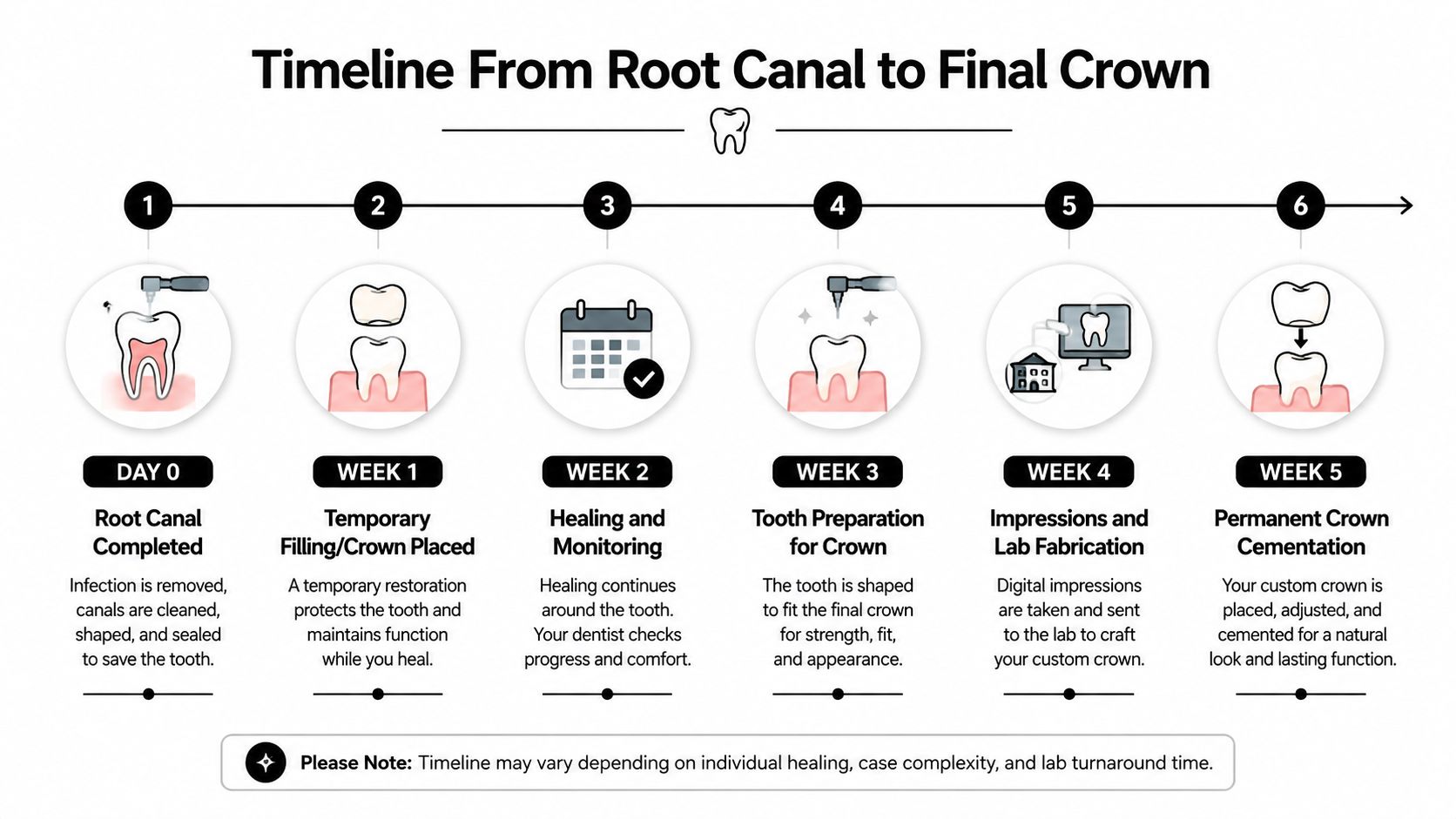
The endodontic appointment is usually the beginning of the restorative phase, not the end of treatment. The temporary filling seals the access opening while the restorative dentist checks healing, remaining structure, and bite contacts.
A practical Miami schedule often moves from a temporary restoration to definitive coverage within a few weeks. A thesis analyzing endodontic therapy survival found significantly higher long-term survival when the crown was placed within 60 days after the core or post (thesis on timing and endodontic survival). That finding supports prompt planning, although inflammation, healing concerns, and tooth complexity can change the schedule.
What happens at each stage
- Root canal completion: The canals are cleaned, shaped, filled, and sealed.
- Temporary protection: A temporary filling or provisional crown protects the tooth while the final plan is confirmed.
- Healing and monitoring: The dentist reviews symptoms, X-rays, gum tissue, and the quality of the seal.
- Tooth preparation: If a crown is appropriate, the dentist reshapes the tooth conservatively and checks whether a core or post is needed.
- Digital design: An intraoral scan can capture the prepared tooth for a laboratory or in-office CAD/CAM workflow.
- Final seating: The permanent crown is checked for fit, contacts, shade, and bite before adhesive bonding or cementation.
Patients with busy schedules can ask whether same-day crown technology is suitable. In-office milling may compress several visits into one when the tooth, bite, material, and clinical findings allow it. A same-day option still requires careful examination, preparation, design, milling, finishing, and bite adjustment.
Crown Cost in Miami by Material and Coverage
Crown fees in Miami vary according to material, tooth location, laboratory or in-office fabrication, preparation complexity, and whether a post and core is needed. A responsible quote should identify the restoration itself and the related services separately, rather than offering a single unclear number.
The requested 2026 Miami estimates below cannot be responsibly filled with invented dollar ranges because the available verified information doesn't provide material-specific prices. Patients should treat any phone estimate as preliminary until a dentist confirms the tooth's condition.
| Material | Typical Miami Range per Crown | Best For | Insurance Status |
|---|---|---|---|
| All-ceramic | Varies by practice and case | Visible teeth and appearance-focused restorations | Often evaluated as major restorative care |
| Zirconia | Varies by practice and case | Posterior strength and selected cosmetic needs | Often evaluated as major restorative care |
| Porcelain-fused-to-metal | Varies by practice and case | Functional coverage with a traditional material choice | Often evaluated as major restorative care |
| Gold | Varies by practice and case | Selected posterior restorations where material properties fit | Often evaluated as major restorative care |
What changes the final fee
The location of the tooth affects design and material selection. A front tooth may prioritize translucency and shade, while a molar may require a material selected for chewing forces. A post and core, additional imaging, buildup, removal of an old restoration, or treatment of a crack can add separate clinical steps.
Same-day CAD/CAM milling can change the workflow and laboratory component. It may reduce the need for a second crown appointment, but eligibility depends on the tooth, the bite, the restoration design, and whether the clinical team can verify a precise fit during the visit.
Dental insurance commonly classifies crowns as major restorative treatment, but the exact benefit depends on the plan, deductible, exclusions, waiting rules, frequency limits, and annual maximum. Patients should request a pre-treatment estimate and ask whether the plan contributes after the deductible. A dental membership plan, third-party financing, or phased treatment may help patients without coverage, but each arrangement has its own terms and should be reviewed before treatment begins.
What a clear Miami consultation includes
At Ultra Smile DentalSpa, the restorative handoff can begin with a consultation that reviews the endodontist's report, dental X-rays, and the tooth's remaining structure. Digital scans can replace traditional impression material when appropriate, and qualifying same-day CEREC workflows can support in-office crown fabrication. Patients with dental anxiety can also ask about comfort and sedation options before the appointment.
The practical goal is transparency. A patient should understand whether the quote includes the examination, imaging, buildup, crown design, milling or laboratory work, temporary protection, cementation, bite adjustment, and follow-up. For a detailed comparison of material choices, patients can review porcelain crowns versus metal crowns, then discuss which option fits the treated tooth rather than selecting by appearance or price alone.
Patient Questions Miami Dentists Hear Most
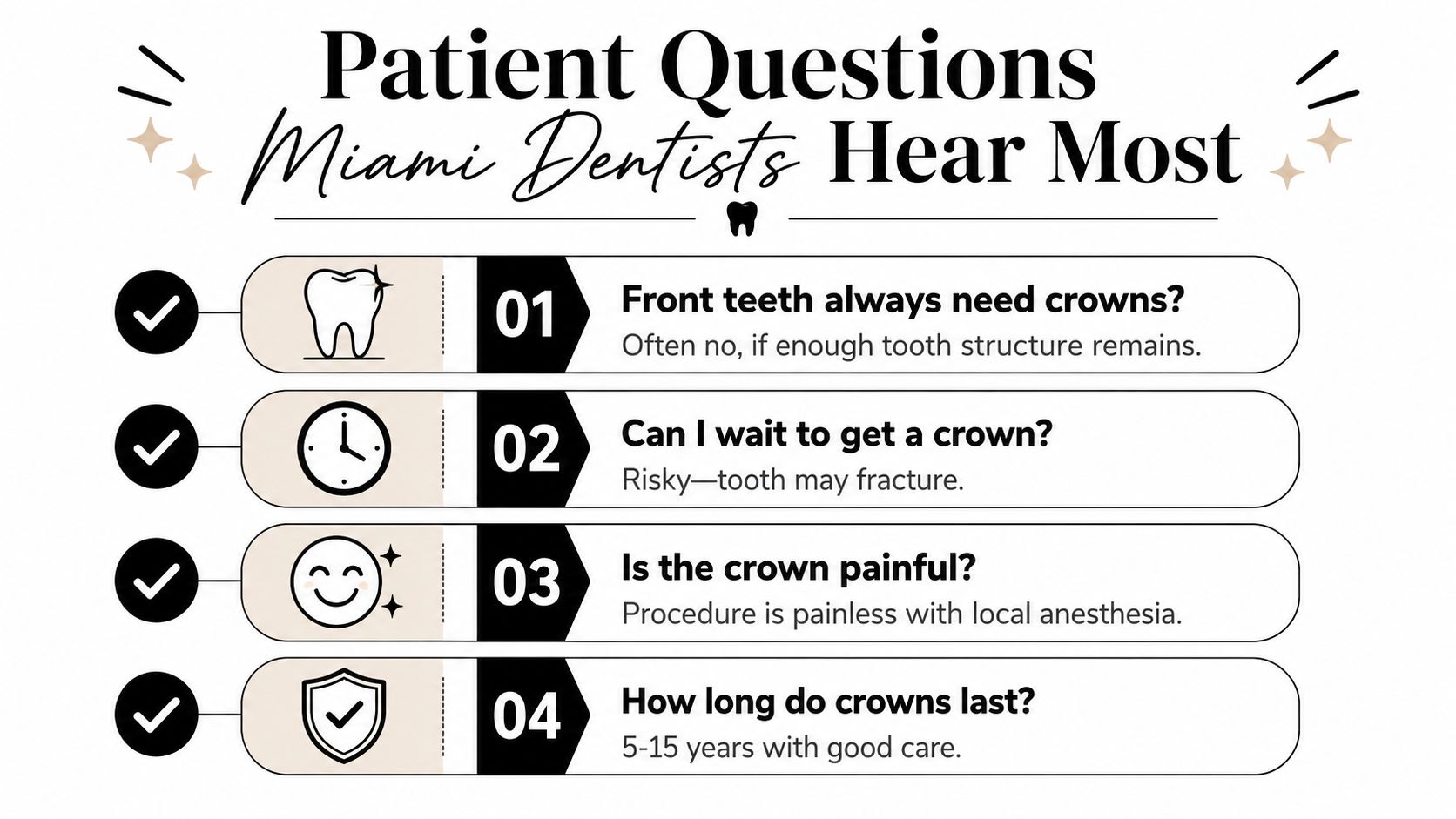
Do front teeth always need crowns?
Often, no. An anterior tooth with a small access opening, intact surrounding enamel and dentin, and no major crack may be restored conservatively. A crown can still be considered for appearance, discoloration, or additional protection, but the root canal alone doesn't make full coverage mandatory.
Back teeth deserve closer scrutiny because their grinding role exposes them to heavier chewing loads. The same review evidence discussed earlier supports a conditional decision based on structure and fracture risk, not a universal rule (review of endodontically treated posterior restorations).
What happens if a patient waits beyond 60 days?
The temporary restoration can wear, loosen, or leak. A longer delay also leaves weakened walls exposed to chewing forces, increasing concern about fracture and bacterial re-entry. The timing evidence associated placement within 60 days with higher long-term survival, so patients should contact the restorative office promptly if healing or scheduling problems arise (timing thesis for crown placement after endodontic therapy).
When is a post and core genuinely needed?
A post and core may be needed when too little coronal tooth remains to retain the core and crown. It isn't automatically required after root canal therapy, and it shouldn't be used as a substitute for sound remaining structure. The dentist first determines whether the tooth can support a crown without excessive removal or unnecessary canal preparation.
How does insurance usually treat the crown?
Many plans place crowns under major restorative benefits, but coverage differs. The patient's deductible, annual maximum, plan exclusions, frequency limits, and eligibility rules can all affect the out-of-pocket amount. A pre-treatment estimate gives a more reliable answer than a general insurance percentage.
A useful appointment checklist
Patients can make the consultation more efficient by bringing:
- Recent records: Include dental X-rays and the endodontic report.
- Medication details: List prescription medicines, supplements, and allergies.
- Bite habits: Mention clenching, grinding, jaw soreness, or a night guard.
- Time concerns: Ask whether the tooth qualifies for a same-day crown workflow.
- Cost questions: Request an itemized estimate and insurance pre-treatment review.
The crown-versus-no-crown decision should be made after examining the tooth, not rushed at the front desk. Patients in Downtown Miami, Midtown Miami, and nearby areas can seek a comfort-focused exam, clear imaging, and a staged restorative plan that addresses the tooth before a crack, decay, or extraction changes the available options.
Ultra Smile DentalSpa offers restorative consultations, crowns, same-day crown options for qualifying cases, and coordinated care after root canal therapy. Patients who want a clear explanation of their tooth, timeline, and restoration choices can visit Ultra Smile DentalSpa to schedule an appointment in Miami.