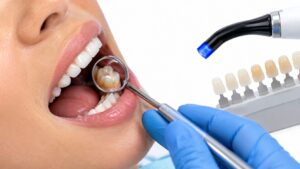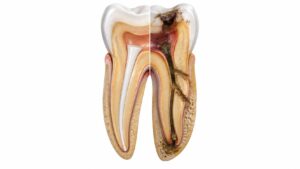
A lot of patients in Miami hear the same sentence and immediately feel stuck: “You need a crown. The next question usually comes fast. Should it be porcelain or metal?
That choice affects more than how the tooth looks. It affects how the crown handles chewing pressure, how much natural tooth structure has to be removed, how the restoration may age over time, and how confident a patient feels when smiling, eating, or speaking. For someone balancing appearance, durability, cost, and comfort, the decision can feel bigger than expected.
For patients looking for a dentist in Miami, FL, especially those comparing restorative and cosmetic options, porcelain crowns vs metal crowns is one of the most important treatment conversations. The right answer depends on the tooth, the bite, the smile line, and long-term goals for oral health. A crown isn't just a cap. It's a long-term plan for protecting a damaged tooth while keeping future treatment options as open as possible.
Table of Contents
- Choosing Your Crown A Guide for Patients in Miami
- Understanding Your Dental Crown Options
- Porcelain vs Metal Crowns A Detailed Comparison
- Ideal Use Cases Which Crown Is Right for You
- The Crown Procedure What to Expect in Miami
- Cost Insurance and Aftercare for Your New Crown
- Your Crown at Ultra Smile DentalSpa The Miami Experience
- Patient FAQs About Dental Crowns
Choosing Your Crown A Guide for Patients in Miami
A common Miami patient scenario looks like this: a cracked tooth starts hurting while chewing, an old filling breaks down, or a front tooth becomes weak after trauma. The dentist recommends a crown, and suddenly the conversation turns to materials, shade, strength, and long-term maintenance. That's when uncertainty usually starts.
For many adults, the concern isn't only “Which crown is stronger? It's also “Will it look natural? “Will this require a lot of drilling? and “Is this the kind of decision that affects the tooth years from now? Those are the right questions.
Patients searching for a cosmetic dentist near me, an emergency dentist, or a trusted office for restorative dental care often need both immediate relief and a plan that respects their smile goals. A well-chosen crown can protect a weakened tooth, reduce pain when biting, and restore confidence in everyday situations like work meetings, dinners, or family photos.
A crown decision works best when it matches the tooth's job. Front teeth need appearance. Back teeth need force management. Some cases need both.
In a city like Miami, where patients often prioritize aesthetics but also want practical, durable dentistry, the porcelain-versus-metal discussion matters. A visible front tooth may push the decision toward a more lifelike material. A heavily loaded molar may point the conversation in a different direction.
The strongest treatment plans usually come from looking beyond the immediate repair. The material choice should fit the bite, the amount of remaining tooth, any grinding habits, and whether the patient may need related services later, such as a root canal, night guard, bridge, or even dental implants near me if a tooth can't be saved.
Understanding Your Dental Crown Options
A dental crown is a custom restoration that covers a damaged tooth to protect it and restore its shape, function, and appearance. Dentists commonly recommend crowns when a tooth is too weak for a filling alone, when a large old restoration has failed, or when a tooth has been treated and needs full coverage support.
Patients usually hear several material names at once, which can make the consultation feel more complicated than it needs to be. The simplest way to think about crowns is to group them into three main families.
All-Ceramic and All-Porcelain Crowns
These crowns are made without a metal base. They're chosen most often when a natural-looking result matters most, especially in the smile zone. Many patients also hear the term zirconia in this category, which refers to a strong ceramic-based material often used when appearance and strength both matter.
Patients who want a more complete overview of available materials can review these types of dental crowns.
Porcelain-Fused-to-Metal Crowns
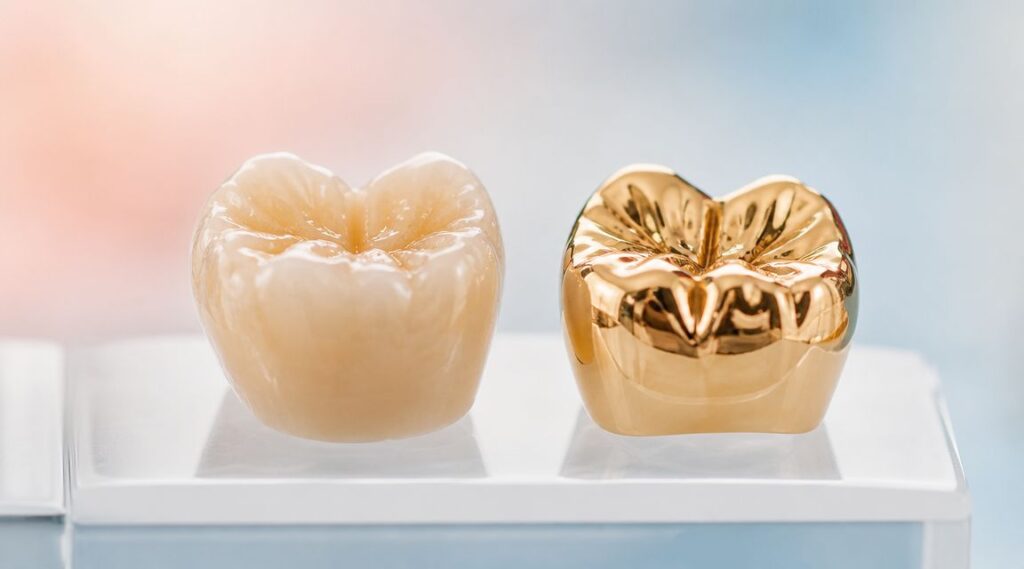
A porcelain-fused-to-metal crown, often called a PFM crown, combines a metal inner structure with porcelain layered on top. The metal gives the crown a strong framework. The porcelain adds a tooth-colored outer surface.
This combination became a long-standing restorative standard because it balanced appearance with dependable support.
All-Metal Crowns
All-metal crowns are made from dental metal alloys, including gold alloy options. They don't blend with natural tooth color, so they're usually considered for less visible teeth. Their practical appeal is strength, wear resistance, and conservative tooth preparation.
Practical rule: If a tooth is far back in the mouth and takes heavy chewing force, appearance may become less important than preserving tooth structure and preventing fracture.
For patients trying to decide between porcelain crowns vs metal crowns, these categories create the basic roadmap. The next step is comparing how each material performs in real life, not just how it sounds in a brochure.
Porcelain vs Metal Crowns A Detailed Comparison
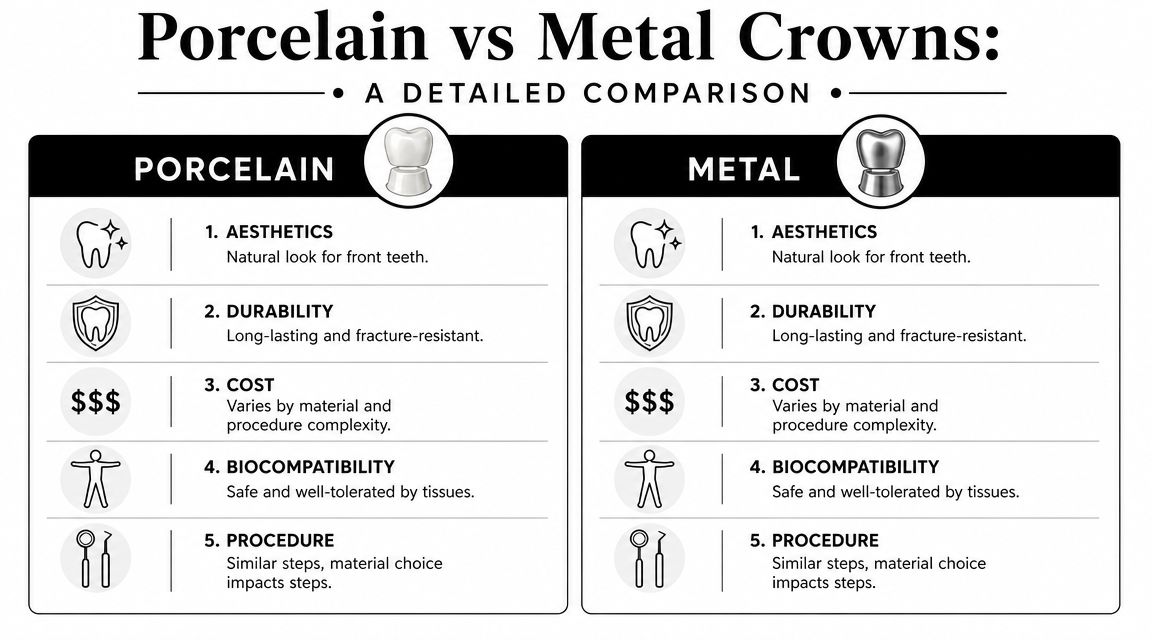
A patient in my chair may be deciding between a crown that disappears into the smile and one that preserves more of the natural tooth underneath. That choice affects more than appearance on the day the crown is placed. It can influence how much healthy tooth structure we keep, how the bite holds up over time, and how easy future dental work may be if that tooth ever needs attention again.
Quick Comparison Table
| Feature | All-Porcelain / Zirconia | Porcelain-Fused-to-Metal (PFM) | All-Metal (Gold Alloy) |
|---|---|---|---|
| Appearance | Most natural-looking for visible teeth | Tooth-colored outside with metal support underneath | Metallic appearance, not tooth-colored |
| Strength profile | Esthetic-focused, with some ceramic options designed for higher strength | Balanced strength and esthetics | Strongest and most wear-resistant |
| Long-term track record | Improved over time, but older evidence showed lower long-term survival than metal-supported options | Strong historical benchmark for longevity | Known for durability in high-force areas |
| Tooth reduction | Typically requires more tooth preparation | Moderate preparation | Usually requires the least removal |
| Best fit | Front teeth, smile zone, esthetic cases | Many front and back tooth cases | Back molars and heavy-bite situations |
| Cost trend | Can be higher | Varies by case | Often lower than all-porcelain, depending on alloy and case details |
Aesthetics and Smile Design
Porcelain crowns usually lead the conversation for teeth that show when you smile or speak. Their main advantage is visual realism. They can reflect light more like natural enamel, which matters in Miami patients with bright, expressive smiles and high cosmetic expectations.
PFM crowns can still produce a good-looking result, especially outside the most visible part of the smile. Their limitation is the metal framework under the porcelain, which can affect translucency and, in some cases, create a darker line near the gum over time. All-metal crowns are the least cosmetic option, so they are rarely the first choice for front teeth.
Cost also enters the discussion. A clinical summary notes that all-porcelain crowns are about 30% to 50% more expensive than metal crowns, reflecting the added esthetic demand and fabrication complexity, as described in this porcelain vs metal crowns overview.
Patients notice different things depending on the tooth involved. A visible tooth usually brings color, shape, and symmetry into focus. A back tooth tends to be judged by comfort, chewing confidence, and whether it does its job every day without trouble.
Durability and Long-Term Performance
Metal has a long clinical history for a reason. It tolerates heavy bite forces well, wears predictably, and is less likely to chip than layered porcelain. That matters for patients who clench, grind, or place a lot of pressure on back teeth.
Older long-term studies favored metal-supported crowns over earlier all-ceramic systems. That does not make porcelain a weak option today. It does explain why experienced dentists still weigh bite force, crown location, and grinding habits carefully before recommending a ceramic crown for a hard-working molar.
Gold alloy crowns also remain a benchmark for longevity. The same clinical summary reports that full gold alloy crowns demonstrate clinical failure rates below 2% at 15 years, which helps explain why many dentists still view metal as one of the most dependable choices for back teeth under heavy function.
Tooth Preparation and Tissue Response
This is often the part patients have not been told clearly enough. The crown material affects how much natural tooth must be removed before the final restoration can fit properly.
All-porcelain crowns usually need more thickness to look and function as intended, so they often require more tooth reduction. Metal crowns generally need less. PFM crowns fall somewhere in the middle. Cleveland Clinic's dental crown guidance notes this same pattern, with metal crowns requiring the least removal.
That difference matters. A tooth with more healthy structure left inside the crown often has a better reserve for the future, especially if it has already been filled, cracked, or root canal treated. In practical terms, preserving tooth structure can reduce stress on the remaining tooth and may leave more options open if the restoration ever needs to be replaced years from now.
In a personalized Miami dental setting, the decision becomes more than a material comparison. It becomes a treatment-planning conversation. Some patients want the most lifelike cosmetic result possible. Others benefit more from a conservative preparation that protects what is left of the tooth. The right answer depends on the tooth, the bite, the smile line, and the patient sitting in front of me.
Ideal Use Cases Which Crown Is Right for You
A patient in Miami often sits down wanting a crown that looks beautiful, then realizes the better question is what that tooth will need five or ten years from now.

When Porcelain Makes Sense
Porcelain is usually the stronger choice for teeth that show when you smile, talk, or take photos. If the goal is to match nearby enamel closely, especially on a front tooth, porcelain often gives the most natural result.
It also fits patients who want a metal-free restoration and are willing to accept the planning that comes with that choice. The cosmetic result can be excellent, but I also look at how much healthy tooth remains, how the upper and lower teeth meet, and whether the patient has a history of grinding. A front tooth in a low-stress bite is a very different case from a premolar in a patient who clenches every night.
Porcelain can also make sense on an implant in the smile zone, where appearance matters every day. In that setting, shade, translucency, gum contours, and bite control all matter as much as the material itself.
When Metal or PFM Makes More Sense
Back teeth often call for a different standard. A molar that handles heavy chewing, a patient with a strong bite, or a tooth that has already lost a lot of structure may benefit more from metal or PFM than from an all-porcelain crown.
That is not just a strength question. It is also a conservation question. If a tooth is already heavily filled, cracked, or root canal treated, preserving every practical bit of remaining structure can matter for its long-term outlook. In those cases, a crown that allows a more conservative preparation may leave the tooth with a better reserve if future treatment is ever needed.
PFM often works well when a patient wants some tooth-colored appearance but still needs a restoration with a long clinical track record under function. All-metal crowns still have a place, especially on second molars and other areas that are rarely visible.
If a patient grinds, clenches, or has broken crowns before, force management should lead the discussion.
In a personalized, spa-like Miami practice, this decision should never be made from a chart alone. The right answer depends on visibility, bite force, remaining tooth structure, habits, and how the patient wants that tooth to serve them over time.
A practical guide looks like this:
- Front tooth with high cosmetic demands: Porcelain is often the best visual match.
- Back molar with heavy chewing forces: Metal or PFM may be the safer functional choice.
- Patient who grinds or clenches: Material strength matters, and a night guard may matter just as much.
- Tooth with limited healthy structure left: A crown that preserves more natural tooth can be the smarter long-term decision.
The Crown Procedure What to Expect in Miami
A crown appointment feels easier when the process is clear before treatment starts.
Your First Visit and Treatment Planning
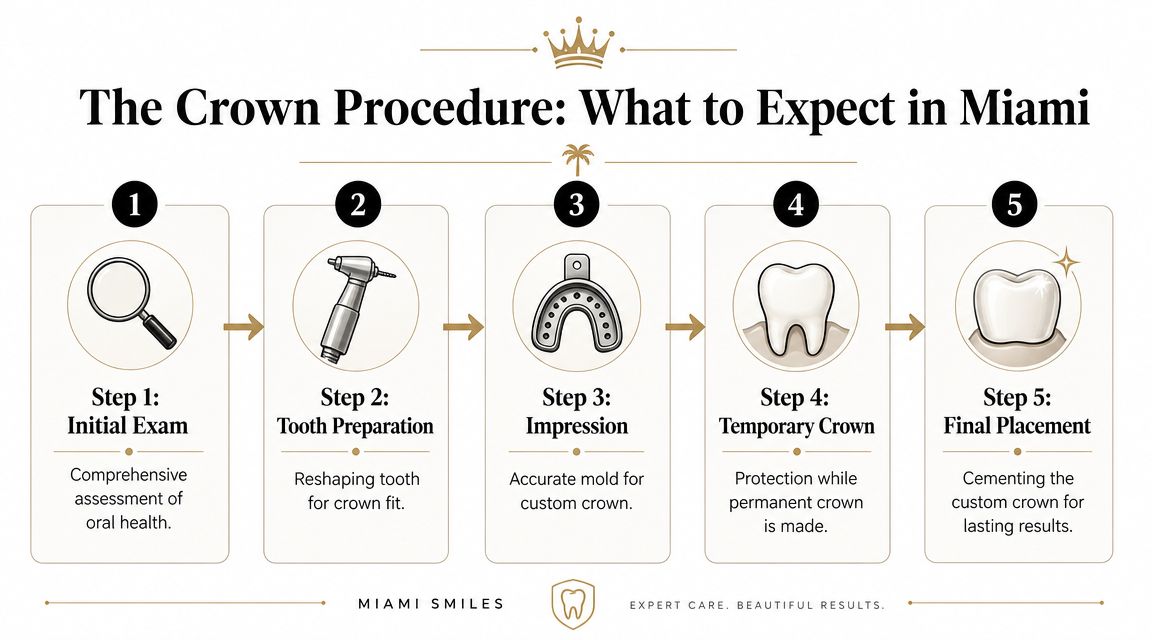
The process usually begins with a full exam, a review of symptoms, and dental X-rays to evaluate the tooth and the surrounding bone. If the tooth has deep decay, a crack, or nerve involvement, the dentist may recommend another procedure first, such as a filling replacement, root canal, or build-up.
This is also when material selection gets finalized. The dentist considers the tooth's location, the patient's bite, smile visibility, habits like clenching, and whether the tooth needs a more cosmetic or more force-resistant restoration.
For busy patients in Miami, same-day digital crown options may be available in some cases. Cleveland Clinic notes that same-day CAD/CAM crowns are an option for certain patients, while other cases still follow the traditional lab-made process.
A brief visual overview often helps before treatment begins:
Preparation Temporary and Final Fit
Once the plan is set, the tooth is numbed and carefully shaped so the crown can fit securely. This is the step where material choice matters, because some crowns need more reduction than others. After preparation, the dentist captures an impression or digital scan.
If the crown is made through a traditional lab process, the patient usually leaves with a temporary crown while the final one is fabricated. At the placement visit, the dentist checks the fit, bite, contour, and appearance before cementing it into place.
Patients often want to know what the appointment feels like, especially if they've been searching for a dentist near me because of pain or anxiety. The best experiences are usually the ones where the team explains each step clearly, keeps the bite adjustments precise, and builds in comfort details rather than rushing through the visit.
A crown should feel secure and natural when biting. If the bite feels high, awkward, or sharp, it needs adjustment, not patience.
Many modern practices also pair restorative care with comfort-focused touches such as calming operatories, streaming entertainment, and a more relaxed setting than patients expect from a typical dental visit.
Cost Insurance and Aftercare for Your New Crown
Patients almost always ask two practical questions after choosing a material. How much will this cost, and how long will it last if it's cared for properly?
What Affects the Final Price
Crown fees in Miami vary based on the material, the complexity of the tooth, whether a build-up is needed, whether root canal treatment is involved, and whether the case is completed traditionally or with digital same-day technology. Insurance can reduce out-of-pocket cost in some medically necessary cases, but coverage depends on the plan's rules, waiting periods, annual maximums, and how the insurer classifies the procedure.
Patients comparing estimates often focus only on the crown fee. That's understandable, but it misses an important planning detail. The amount of tooth reduction required can influence the long-term restorative path of that tooth. As discussed in this guide to dental crown cost in Miami 2026, treatment value isn't just about the day of placement. It's also about preserving options for the future.
How to Protect the Crown After Placement
Aftercare is straightforward, but it matters. A crown can't decay, but the tooth underneath and around it still can.
A few habits make the biggest difference:
- Brush thoroughly: Clean the crown like a natural tooth, especially near the gumline.
- Floss daily: Plaque around the crown margin is one of the main reasons supporting tooth structure fails.
- Avoid using teeth as tools: Opening packages or biting ice can damage even strong restorations.
- Wear a night guard if recommended: Patients who grind can overload crowns and natural teeth alike.
- Keep recall visits on schedule: Regular cleaning and exams help the dentist catch bite or margin issues early.
The overlooked issue here is preservation. All-porcelain crowns typically require more aggressive preparation than metal crowns, which require the least removal, and that matters when a tooth has already lost structure over time. The more carefully that remaining tooth is protected after treatment, the better the long-term outlook.
Your Crown at Ultra Smile DentalSpa The Miami Experience
For patients in Downtown Miami, Midtown Miami, and Hallandale Beach, crown treatment often comes down to two priorities at once. They want clinical precision, and they want the visit to feel manageable.
A More Personalized Way to Plan Treatment
At Ultra Smile DentalSpa, crown planning includes cosmetic and restorative considerations together. Dr. Neda Bahmadi and the team evaluate where the tooth sits in the smile, how the patient bites, how much natural structure remains, and whether a same-day or lab-fabricated crown is the better fit.
That matters because not every damaged tooth should be treated the same way. One patient may need a highly esthetic crown on a visible front tooth. Another may need a more conservative, force-resistant option on a molar after years of grinding. The material choice has to match the case, not the trend.
Comfort Matters During Restorative Care
Many adults delay treatment because they associate crowns with stress, noise, or a long uncomfortable appointment. A calmer office environment changes that. Amenities such as refreshments, custom aromatherapy, streaming entertainment during procedures, and a soothing hot towel finish can make restorative dentistry feel far less clinical.
Patients looking for help with crowns often need more than one service. They may also need cleaning and exams, new patient exams, teeth whitening, night guards, root canals, or follow-up restorative dentistry. Having those services coordinated in one setting makes treatment planning simpler and more consistent.
For patients choosing between porcelain crowns vs metal crowns, the most useful consultation is one that keeps the discussion personal. The right crown isn't the same for every smile. It's the one that protects the tooth, fits the bite, and aligns with the patient's priorities.
Patient FAQs About Dental Crowns
Can a crown feel strange at first
Yes. A new crown can feel slightly different for a short time because the contours and bite surface are new. It shouldn't feel painfully high or unstable. If chewing feels off, the dentist should adjust it.
Can a crown be whitened later
No. Crowns don't respond to whitening the way natural enamel does. Patients who are considering teeth whitening should usually discuss shade planning before the final crown is made, especially for front teeth.
Is zirconia the same as porcelain
Not exactly. Patients often group them together because both are tooth-colored options, but zirconia is a ceramic-based material with its own strength and esthetic profile. The right choice depends on where the crown is placed, the bite forces involved, and how natural the final result needs to look.
If a damaged tooth is making eating uncomfortable or a visible tooth is affecting confidence, scheduling a consultation with Ultra Smile DentalSpa is the next step. Patients in Miami can get a clear exam, thoughtful material recommendations, and a crown plan built around function, appearance, and long-term tooth preservation.