Waking up with a sore jaw, a dull temple headache, or teeth that feel flatter than they used to can be unsettling. For many Miami patients, that morning soreness turns into a pattern, clenching at night, tension during the day, and the feeling that the jaw never fully relaxes.
At Ultra Smile DentalSpa in Miami, that kind of discomfort is taken seriously. Botox for jaw clenching can be a practical option when a custom guard alone isn't enough, especially when clenching has started to affect comfort, sleep, or tooth wear. The right plan still starts with a careful dental evaluation, but it may include muscle relaxation, a night guard, and other restorative or cosmetic services when they're needed.
Table of Contents
- Waking Up to Jaw Pain and Finding Relief in Miami
- How Botox Relieves Jaw Clenching and Bruxism
- Realistic Benefits and Treatment Longevity
- Comparing Botox to Night Guards and Other Alternatives
- Your Experience at Ultra Smile DentalSpa
- Safety, Candidacy, and Aftercare Essentials
- Frequently Asked Questions About Masseter Botox
Waking Up to Jaw Pain and Finding Relief in Miami
A lot of patients describe the same routine. They wake up with a tight jaw, then realize they've been clenching through work stress, traffic, or sleep without knowing it. Over time, that constant pressure can leave the face sore and the teeth worn down.
Bruxism is the clinical umbrella that includes jaw clenching and grinding. Adult clenching and grinding are common, and persistent symptoms help explain why dentists see this problem so often in everyday care. That does not mean every person with occasional clenching needs treatment, but it does show why ongoing jaw tension deserves attention before it starts affecting the teeth and muscles.
When clenching starts affecting daily life
The concern isn't just the noise of grinding. Severe clenching can lead to pain, headaches, and visible wear on teeth, so dentists usually start talking about treatment once the pattern stops being a minor annoyance and becomes a real oral health issue. In Miami, that often shows up in patients who want relief without moving straight into more invasive care.
Some people first notice the issue during a cleaning and exam, when worn enamel or bite marks tell the story before symptoms do. Others feel it in the morning and assume they slept wrong. When it keeps happening, the masseter muscles are often part of the problem.
A practical response is to evaluate the muscle activity, the bite, and the pattern of symptoms together. A local practice like Ultra Smile DentalSpa can help with that, especially for patients who want care that feels calm and unhurried instead of rushed.
Practical rule: If the jaw pain keeps returning after a guard, a bite check and a muscle-focused treatment plan are worth a closer look.
How Botox Relieves Jaw Clenching and Bruxism
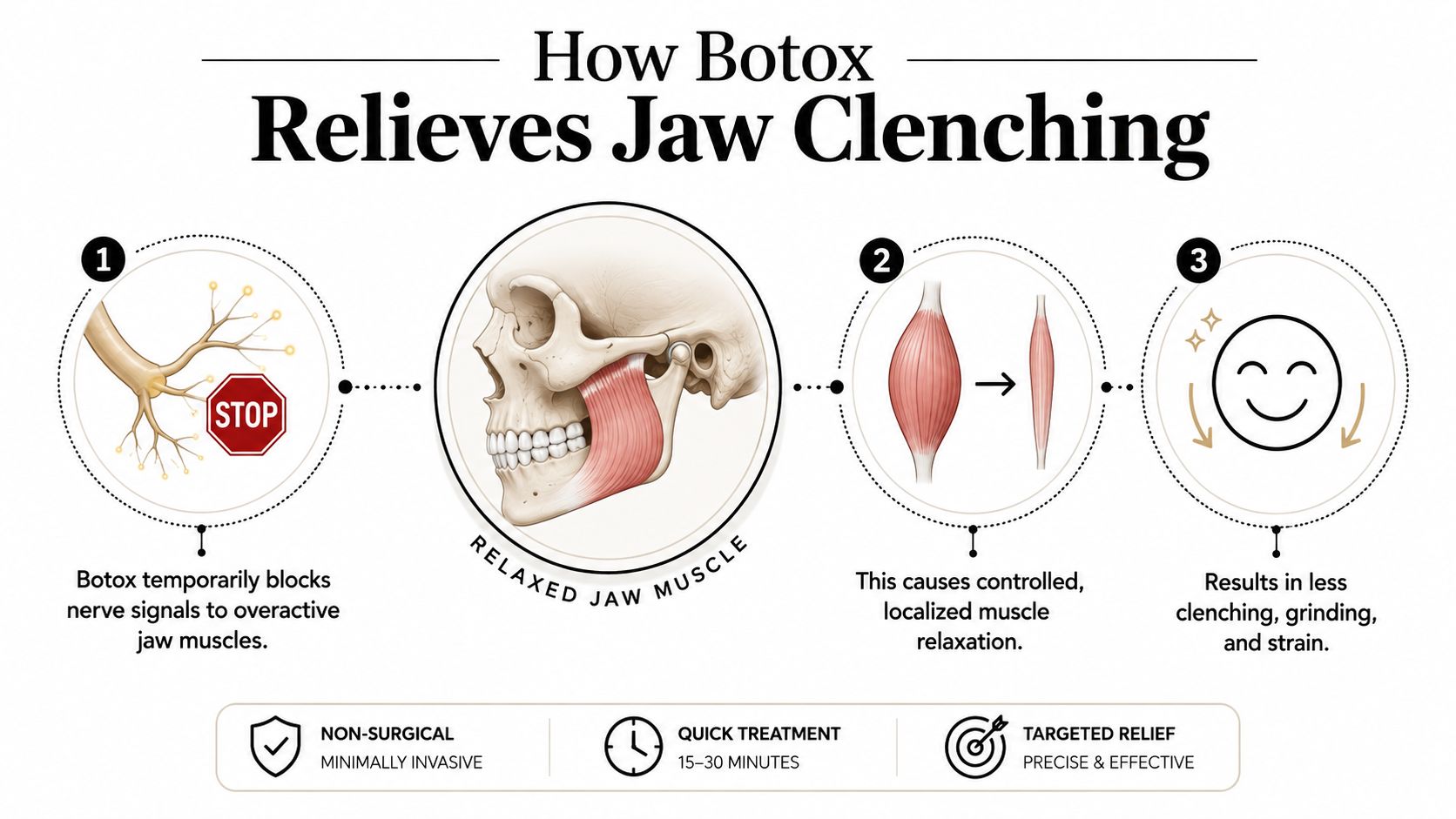
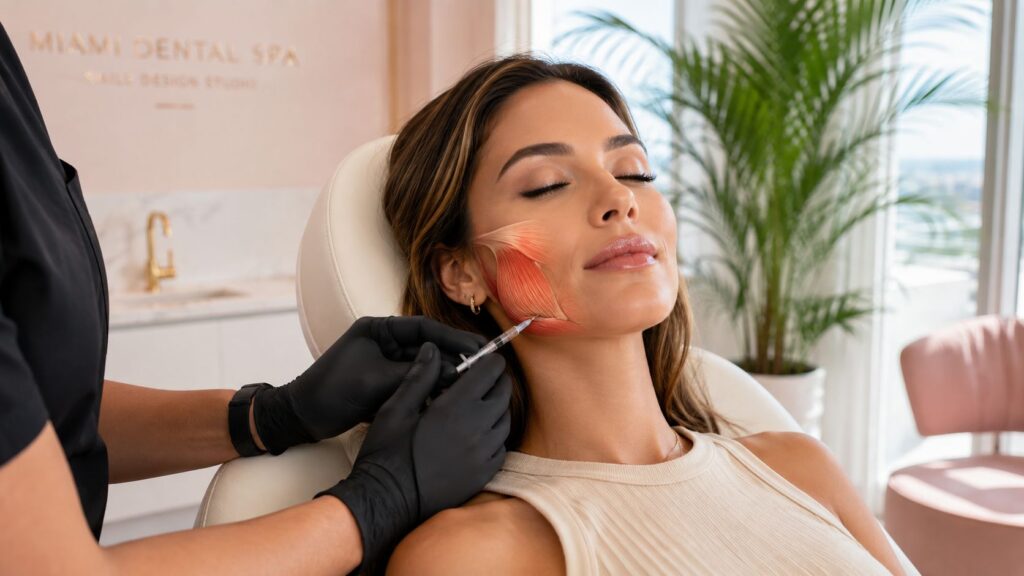
A patient may come in after months of waking with a tight jaw, sore cheeks, and teeth that feel overworked by morning. In that setting, Botox can be part of a practical plan because it reduces the force of the clench without trying to remove normal jaw movement. It works by blocking acetylcholine release at the neuromuscular junction, which temporarily reduces contraction in the masseter and sometimes temporalis muscles (PMC review). The nerve still sends the signal, but the muscle cannot respond with the same intensity.
What changes in the muscle
That drop in force matters because bruxism injury comes from repeated, strong contraction over time. Reviews report that injections into the masseter can reduce pain scores, bite force, and sometimes the frequency of bruxism events, with the strongest effects often seen in the first month after treatment (Harley Street Institute review). More recent summaries also note that a single BTX-A injection can help manage sleep bruxism for over a month by lowering the intensity of jaw-closing contractions instead of stopping them completely (PMC review).
Common clinical protocols describe about 25–30 units per masseter and 15–20 units per temporalis on each side, with effect duration typically 3–6 months before retreatment is needed (PMC review). That time frame is one reason I explain Botox as muscle management, not a permanent fix.
Why dentists still call it off-label
Botulinum toxin is used in dentistry for jaw clenching, but it remains off-label for this purpose. A TMJ-focused patient-safety review notes that the National Institute of Dental and Craniofacial Research still lists Botox as an option, while also saying recent clinical trials have been inconclusive and the benefit-risk balance has not been clearly established in adequately sized randomized trials (TMJ safety review).
That mixed evidence is why careful case selection matters. A 2024 systematic review found 24 randomized controlled trials, with the strongest scientific support for masseter hypertrophy, but only equivocal evidence for myogenous TMDs and very little for TMJ articular disorders (PubMed). For a Miami patient, the takeaway is straightforward, Botox can help the right muscle-driven case, but it should not replace a guard, bite stabilization, or stress-related habit control when those are needed.
Relief comes from reducing force, not erasing the habit. That distinction matters when someone still needs a guard, stress control, or bite stabilization.
Realistic Benefits and Treatment Longevity
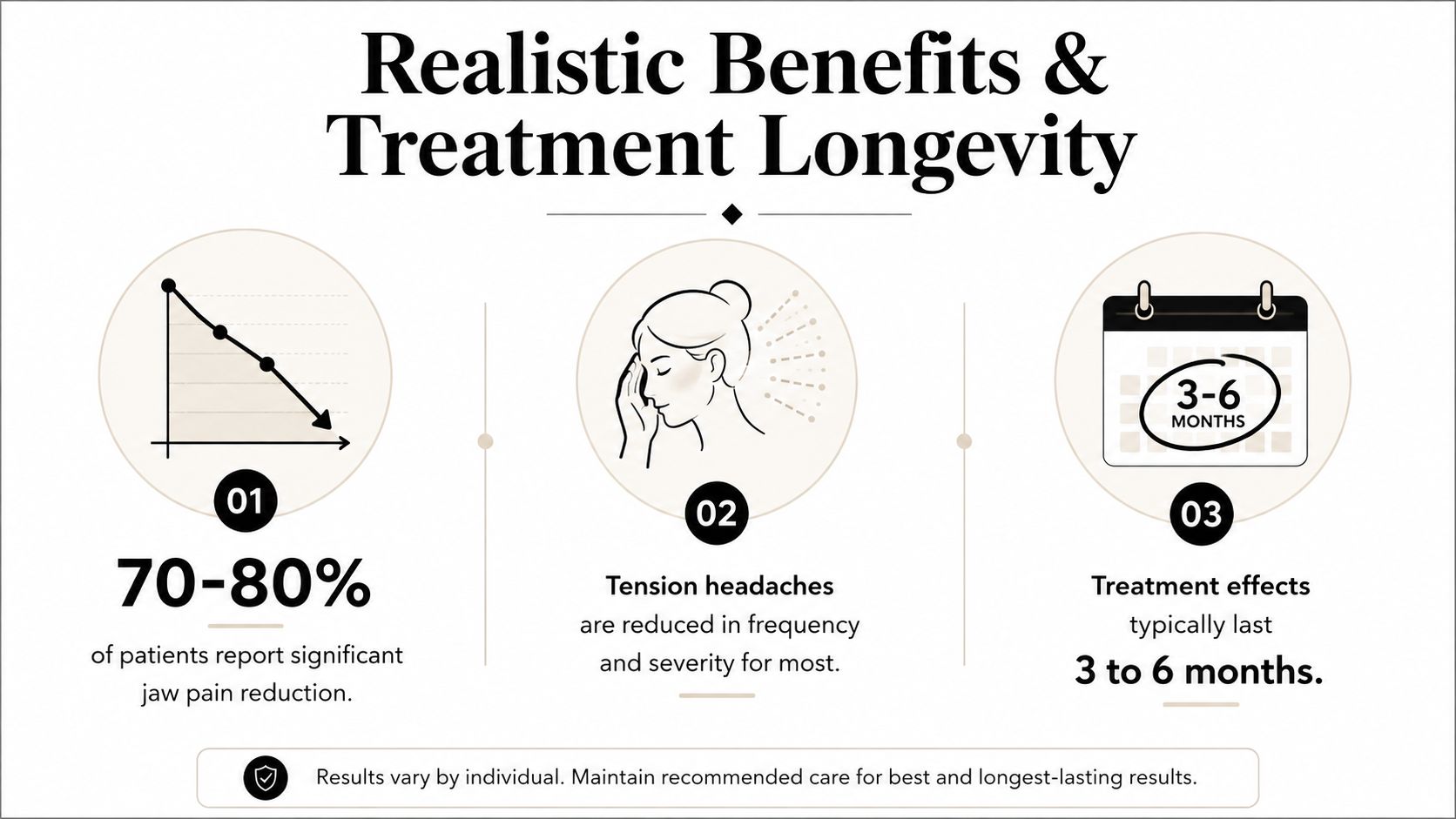
Patients usually want three things from treatment, less pain, less morning stiffness, and less damage to the teeth. Botox can help when clenching is muscle-driven, but the size of the benefit varies, and the improvement is not permanent.
What patients often notice first is not a dramatic change, but a quieter jaw. Chewing may feel less tiring, the morning jaw tightness can ease, and some patients report fewer headaches linked to nighttime clenching. That kind of response matters because it is tied to day-to-day comfort, not just a number on a chart.
The strongest value is often in how treatment fits into real life. Some patients use Botox as part of a broader plan that includes a protective appliance, better sleep habits, and stress management, rather than as a stand-alone fix. In that setting, the treatment can reduce how hard the muscles fire while the other measures protect the teeth and help limit repeat strain. If you are comparing options, our night guard for teeth grinding page explains why many patients need both approaches.
How long relief lasts
The honest answer is that the effect wears off. Patients usually need maintenance visits because the muscle activity returns gradually as the toxin's effect fades.
That is why planning matters from the start. Some patients do best with repeat treatment at intervals, while others use Botox as a bridge while they stabilize sleep, reduce stress-related clenching, or protect the teeth with a guard. The goal is not to chase every sensation. It is to lower the load on the jaw long enough for the muscle to stop overperforming.
What patients notice first
The earliest wins are usually functional. The jaw feels less tired, chewing does not start the day with the same tension, and morning headaches may ease. For a patient, those changes are often easier to judge than a clinical measurement because they show up in eating, talking, and waking up without the same stiffness.
A 2024 review of botulinum toxin for myogenous temporomandibular disorders found it was better than placebo for pain reduction, but not superior to placebo or standard treatments for mandibular movement outcomes, and it carried a higher risk of muscle and bony adverse events than comparators (PMC systematic review).
That tradeoff is important. Relief can be meaningful, but the plan has to stay conservative and monitored so the jaw is not overtreated.
Patients at Ultra Smile DentalSpa in Miami often want that balance, comfort without a harsh clinical feel. In practice, that means a calm visit, careful dosing, and a treatment plan that is coordinated with home care and the right appliance when needed.
Comparing Botox to Night Guards and Other Alternatives
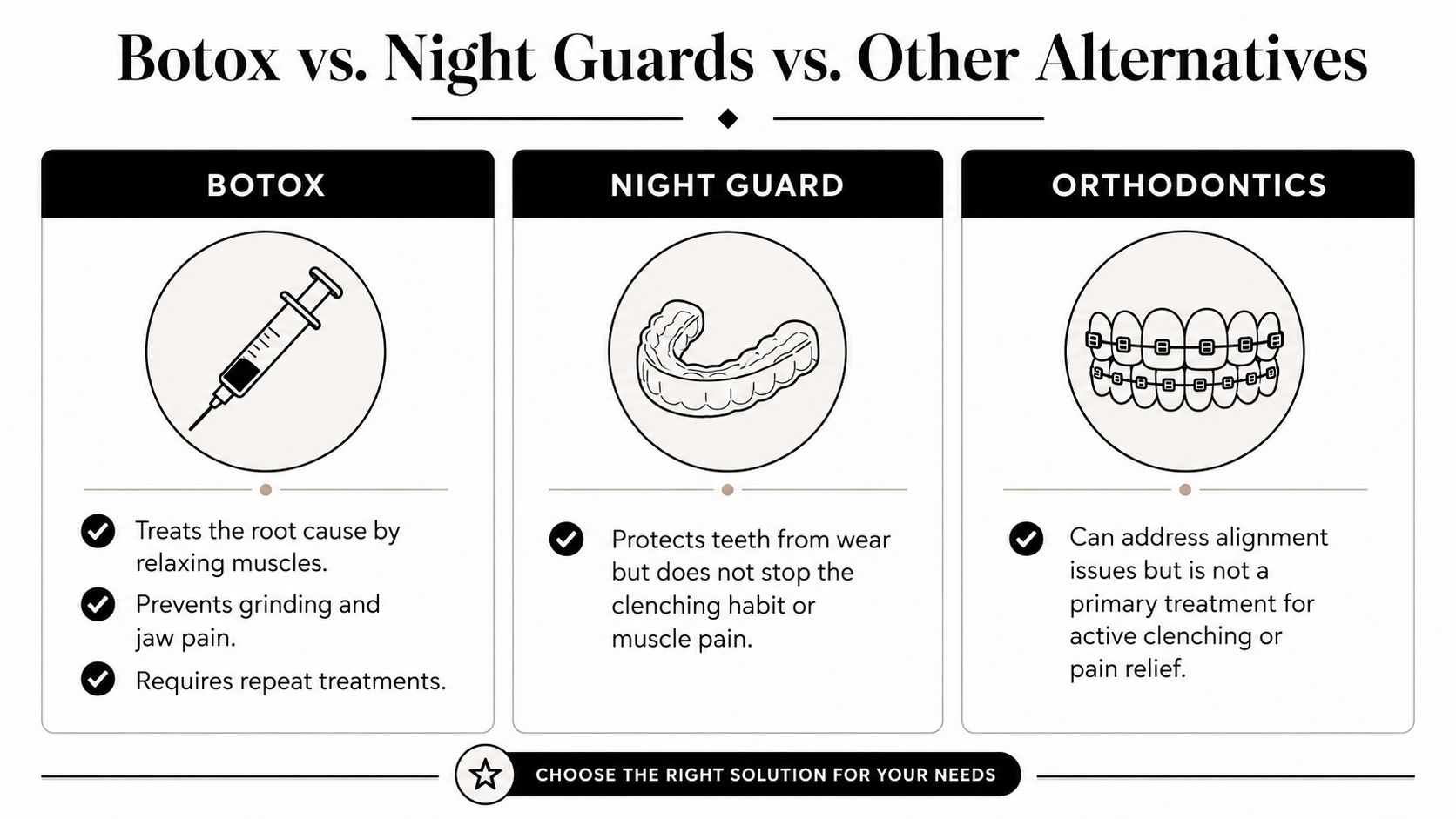
A night guard and Botox serve different purposes. A guard shields the teeth from force, while Botox reduces the strength of the clench itself. That is why many patients do best with both, especially when visible wear and jaw pain are happening at the same time.
Botox can reduce pain and bite force for some patients, but the response is not the same for everyone, and the benefit is usually temporary. That is the practical point. The treatment has to fit the problem in front of you, not a promise of a permanent fix.
Where each option fits
- Botox. Best suited for muscle-heavy clenching when pain, headaches, or wear keep coming back. It can lower the force of clenching, but repeat visits are part of the plan.
- Night guard. Protects enamel and restorations, which matters for patients with visible wear. It does not stop the muscle from clenching, so it works best as protection, not as a cure.
- Orthodontics or bite correction. Helpful when alignment problems are contributing, but not a fast way to calm active clenching pain.
A careful plan usually starts with conservative care first. A British Dental Journal review found the evidence for botulinum toxin in TMD and bruxism is not entirely clear and advised conservative options before more invasive treatment, especially because of cost and possible side effects. That is why the exam comes first, then the treatment is matched to the actual cause.
For patients who want to understand the guard side of care, a custom appliance can be part of the answer, and this night guard resource explains how protection fits into treatment. If worn restorations, missing teeth, or bite changes are part of the picture, restorative dentistry or orthodontic care may need to be added as well.
The right sequence is often protection first, muscle control second, and bite correction when the exam shows it is needed.
Your Experience at Ultra Smile DentalSpa
Patients who are nervous about treatment usually care less about the label and more about the experience. At Ultra Smile DentalSpa, that experience is designed to feel calm from the moment the patient arrives, with refreshments, custom aromatherapy, streaming entertainment during procedures, and a soothing hot towel finish. For someone already tense from jaw clenching, that atmosphere matters.
Dr. Neda Bahmadi, DMD, leads the consultative process with a focus on comfort and clinical judgment. The visit typically starts with a discussion of symptoms, then a look at the jaw muscles, bite, and wear patterns, so the treatment plan matches the actual cause rather than a guess.
What the consultation tends to cover
The consultation usually includes whether the problem looks muscular, whether a guard should stay in the plan, and whether injectables are appropriate for both function and facial balance. Some patients are also interested in the cosmetic side, such as a slimmer lower face from masseter reduction, but the therapeutic goal stays centered on comfort and jaw function.
Ultra Smile DentalSpa also has the advantage of offering other services under one roof, including cleanings and exams, cosmetic dentistry, restorative dentistry, dental implants, tooth extraction, and emergency dentist visits when needed. That broader scope helps when jaw clenching is part of a larger oral health picture, such as fractured fillings, worn restorations, or bite concerns that need follow-up care.
The practical value is continuity. Patients don't have to piece together care from multiple offices when the jaw, teeth, and smile all need attention in the same treatment plan.
Safety, Candidacy, and Aftercare Essentials
Jaw Botox is not a fit for every patient, and that decision should start with the cause of the symptoms. Some people have pain and tightness from overactive chewing muscles, while others have joint-driven TMJ problems, tooth-related wear patterns, or pain that needs a different plan. A careful consult separates those situations before any injection is considered.
The treatment also works best when the goal is realistic. Botox can reduce clenching force and ease muscle strain, but it does not replace a night guard, bite evaluation, or other conservative care when those are still needed. In practice, the best results often come from combining Botox with the right home and dental supports instead of expecting the injections to do everything on their own.
Common safety points
- Good candidates are usually patients with persistent clenching, jaw soreness, headaches, or tooth wear, especially when simpler measures have not been enough.
- Poor candidates may include people with neuromuscular disorders or pain that comes mainly from the joint rather than the chewing muscles.
- Possible side effects include temporary chewing weakness, a change in bite feel, or mild asymmetry if the dose or placement does not match the patient's anatomy closely.
The injection visit itself is usually straightforward. At Ultra Smile DentalSpa, patients are treated in a calm setting that feels more like a spa visit than a rushed procedure, which helps if jaw tension is already part of the problem. Comfort matters, especially for someone who is coming in sore, guarded, or anxious about how the treatment will feel.
Aftercare is simple, but it should still be followed closely. Patients are usually told not to rub the area and to avoid strenuous exercise for the first day so the medication can settle where it was placed. Results come on gradually over several days, so the jaw will not feel different the moment the appointment ends.
For patients who want general injectable aftercare guidance in a similar format, these aftercare tips for injectable fillers can help set expectations for recovery behavior, even though the treatment is different. The main idea is straightforward, protect the treated area and give the product time to settle.
Frequently Asked Questions About Masseter Botox
Does insurance cover Botox for bruxism? Coverage can vary by plan and by how the treatment is documented. Because bruxism Botox is off-label, benefits aren't automatic, so the office should review the patient's specific insurance and treatment goals before moving forward.
Will it change the smile or facial shape? It can, but usually in a subtle way when the masseter is the target. Some patients like the softer lower-face look, while others care more about keeping chewing strength and natural expression intact, which is why careful dosing matters.
How much does it cost in Miami? The price depends on the number of units needed and whether the treatment is being paired with other dental services. The more useful question is whether the patient needs a single muscle-relaxing visit, a guard, or a broader plan that includes restorations, because the right answer changes the overall value.
The best next step is a consultation that evaluates the jaw, the bite, and the tooth wear together. Ultra Smile DentalSpa can help patients decide whether masseter Botox fits their needs or whether a different dental solution makes more sense.
If jaw clenching is waking you up sore, wearing down your teeth, or making headaches part of the week, Ultra Smile DentalSpa can evaluate the cause and talk through realistic options, including Botox, night guards, and other dental care. Visit Ultra Smile DentalSpa to schedule a consultation in Miami and get a treatment plan that fits your symptoms, your comfort, and your smile.