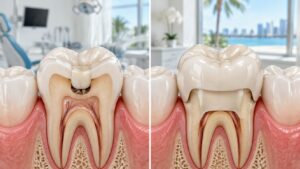
You have tabs open for half a dozen practices, each one showing bright smiles, polished testimonials, and a different price for what sounds like the same veneers. That is the normal starting point for people looking up cosmetic dentist near me or dentist in Miami, FL. Photos cannot tell you how much healthy enamel a plan removes, whether a simpler option would work, or who fixes a problem six months later. Knowing how to choose a cosmetic dentist means judging the treatment plan first, then the portfolio. The checklist below gives you a calm way to compare any dentist near me before you commit to cosmetic dentistry, restorative dentistry, or dental implants near me.
Table of Contents
- The Cosmetic Dentist Checklist at a Glance
- Checking Credentials and Reading Before-and-After Photos
- Materials and Veneer Results You Should Ask About
- Consultation Questions and Treatment Plans That Protect Healthy Teeth
- Emergency Dental Care in Miami, FL
- Quote, Aftercare and Booking Your Consultation in Miami
The Cosmetic Dentist Checklist at a Glance
Save this scorecard and take it to your first consultation. Mark each row pass, fail, or unclear. A friendly office and fair financing matter, but they do not outweigh a weak clinical plan.
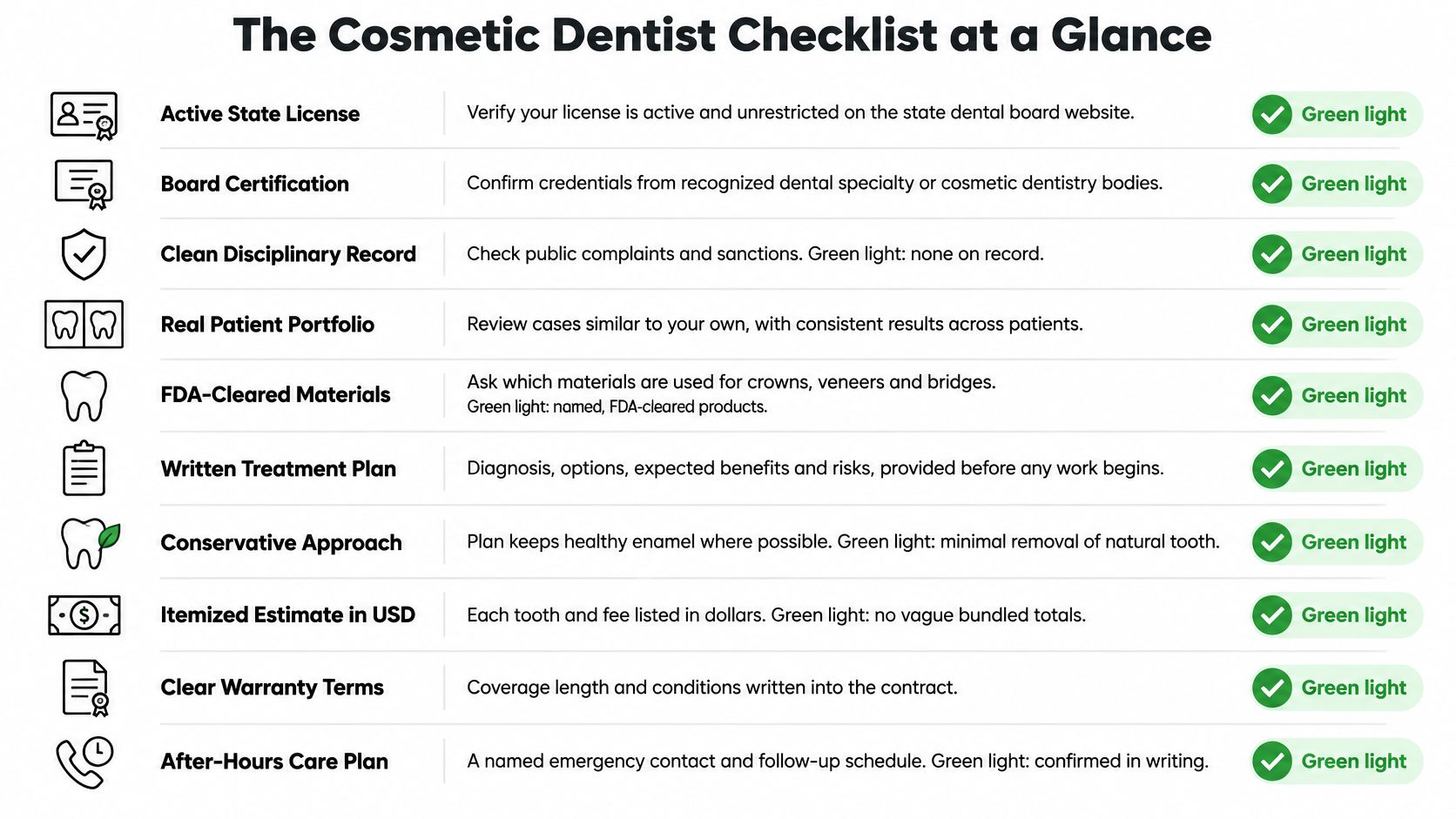
| Criterion | What to Verify | Green Light |
|---|---|---|
| Active state license | Look up status on the state dental board's public search | Active license with no public discipline |
| Formal credentials | Ask about advanced training and AACD Accreditation | A credential you can confirm by name |
| Before-and-after cases | Request cases of the exact procedure you want | Similar starting teeth, unretouched photos |
| Material and lab process | Ask which material is used and where it is made | A specific material and a clear lab or milling process |
| Written treatment plan | Check sequence, visits, reversibility and total cost | A written plan before you commit |
| Least invasive options | Ask about whitening, bonding, alignment or no treatment | Alternatives explained side by side |
| Complication and remake rates | Ask for the practice's own five-year data | Numbers shared by material and procedure |
| Urgent care and aftercare | Ask how urgent calls are triaged and who handles repairs | A defined triage and repair process |
| Language and comfort | Ask about bilingual staff and anxiety-friendly visits | Staff who explain care in your preferred language |
| Financing and insurance | Request an itemized quote and payment options | Itemized pricing with no pressure to pay today |
How to Score It
Treat materials, the written treatment plan, and complication data as deciding rows. If a practice clears most rows but cannot answer those three, pause and get a second opinion. Vague answers at the consultation usually become vague accountability after treatment.
If a dentist cannot name the material, the lab process, and the repair path, the quote is not ready to sign.
Use the rest of this guide row by row. By the end, you should know what to ask, what a good answer sounds like, and when to walk away.
Checking Credentials and Reading Before-and-After Photos
The title itself proves less than most patients expect. "Cosmetic dentist" is not a regulated dental specialty recognized by the American Dental Association, and it does not require a specific residency, board examination, or standardized credential, as explained in this guide to cosmetic dentist qualifications. Any licensed dentist can use the label, so your screening does the credentialing work.
Start with facts you can verify without an appointment. Confirm an active state license on the state dental board's public search and read any disciplinary history in full, not just the headline. Next, ask what postgraduate training and continuing education specifically cover cosmetic work. Named programs, recent coursework, and case volume for your exact procedure tell you more than a general claim of experience.
Membership Is Not the Same as Accreditation
Belonging to a professional organization shows involvement. It is not the same as passing an examination process. AACD Accreditation, for example, involves written, clinical, and oral examinations plus documented case submissions. Ask which category applies, then confirm the answer by name. A dentist in Miami, FL who answers plainly, even when the answer is membership only, is easier to trust than one who blurs the distinction.
Reading Photos Like a Skeptic
Ask for cases that match the treatment you want. A strong teeth whitening gallery says little about veneers, crowns, or composite bonding. Review real examples in a cosmetic dentistry before and after gallery and look for consistent lighting, angle, and shade. Ask whether images were retouched and whether they show the dentist's own patients.
- Match the starting point: Say you want six veneers for worn, uneven front teeth. Request two patients who started with similar wear.
- Check the age of the result: Ask for at least one case photographed two to three years after placement, because fresh photos show appearance, not wear.
- Ask about contactable patients: Some practices can connect you with a past patient who agreed in advance to be contacted.
Photos still have a limit. They show color and shape on one day. They do not show how much tooth was removed, how the bite feels, or how well margins hold up during cleaning and exams.
Materials and Veneer Results You Should Ask About
A veneer's shade is only part of the decision. The material and the preparation plan affect strength, stain resistance, repair options, and how much healthy tooth remains. Ask what material the dentist recommends and why it suits your teeth.
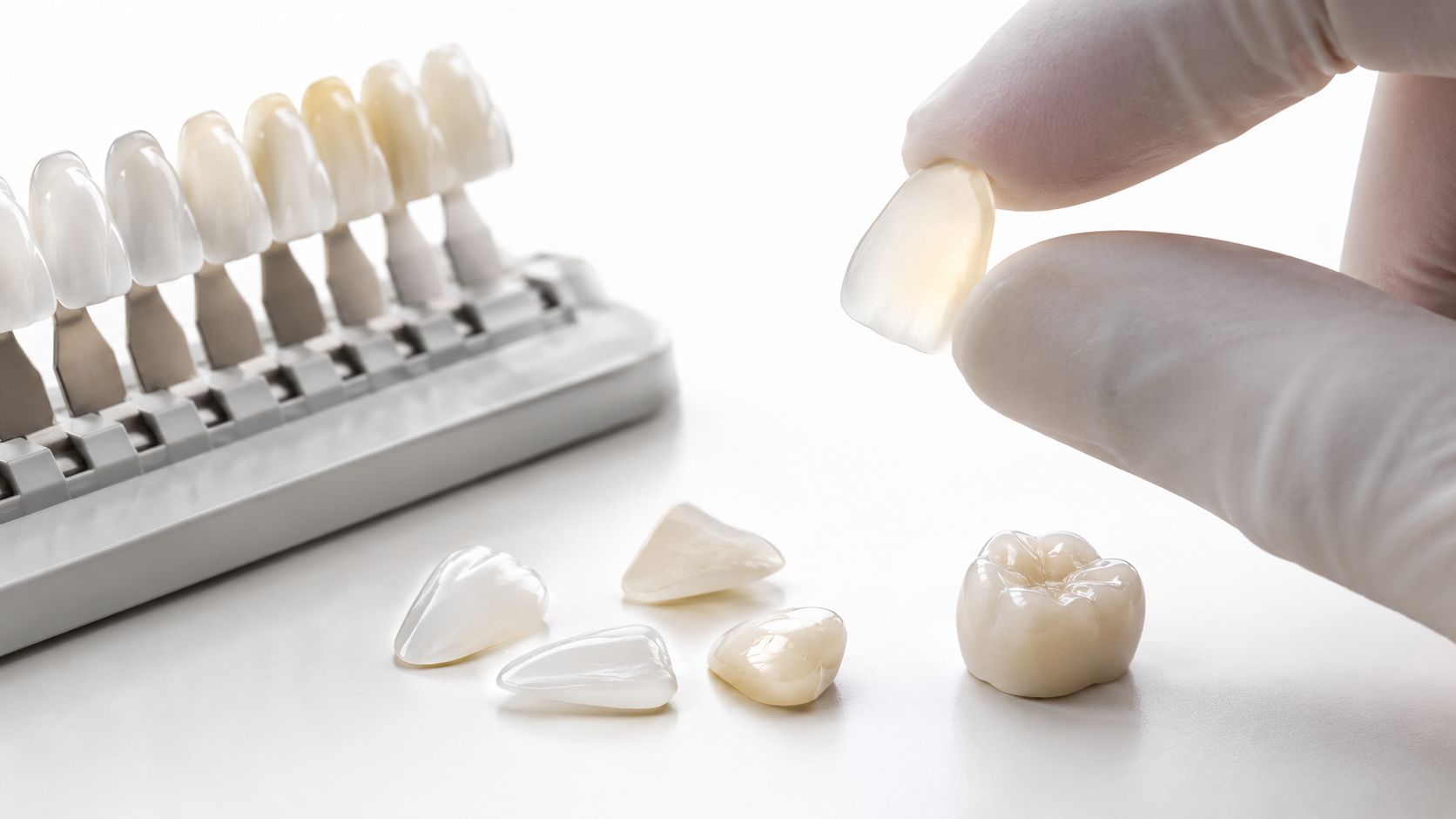
Ask the dentist to name the exact material, such as porcelain, zirconia, or composite, and explain its trade-offs for your case. The National Institute of Dental and Craniofacial Research dental materials guide explains that dental materials must meet U.S. Food and Drug Administration safety requirements before clinical use. It also describes how indirect restorations are custom-made in laboratories using digital design, milling, or 3D printing, and may require several appointments. Ask whether the restoration is milled in-house, made by a partner lab, or completed the same day, and how that choice affects fit and strength.
What Published Veneer Data Actually Say
Survival figures depend on follow-up length and how researchers define success. A systematic review of porcelain laminate veneers estimated a 10-year cumulative survival rate of 95.5%. That figure describes a group of cases, not the result any one patient can expect.
| Outcome | Systematic Review |
|---|---|
| Overall survival | 95.5% at 10 years |
| Fracture or chipping | 96.3% survival |
| Debonding (coming off) | 99.2% survival |
| Secondary decay | 99.3% survival |
| Severe marginal discoloration | No survival figure reported |
| Endodontic (root canal) treatment | 99.0% survival |
These figures describe different outcomes, so compare like with like. Ask how the dentist's material recommendation and tooth preparation relate to the risks that matter in your case.
Fracture or chipping is the leading technical complication listed in the review. Bruxism, deep overbite, limited occlusal clearance, parafunction, and insufficient enamel can raise that risk. Ask whether a night guard is included in the plan, how often recall visits are recommended, and what would prompt repair rather than full replacement.
Also ask for the practice's own complication and remake rates, separated by material and indication. Request the sample size, follow-up period, and whether outcomes are independently audited. Specific figures with clear limits are more useful than descriptions such as “premium or “state of the art.
Consultation Questions and Treatment Plans That Protect Healthy Teeth
A polished smile photo cannot show how much healthy tooth was removed to create it. Before comparing results, ask to see a treatment plan that explains the biological cost, the alternatives, and how the dentist will address problems later. Tooth structure removed during preparation does not grow back, so the plan matters as much as the portfolio.

Informed consent should be a discussion, not just a signature. The American Dental Association code of ethics describes that discussion as covering the diagnosed problem, proposed treatment, expected benefits, risks, alternatives, and the likely consequences of declining care. The more involved the procedure, the more important it is to review these points early enough to consider them calmly.
The Question Most Guides Skip
Ask before shade selection or mock-ups:
Deciding question: What is the least invasive option that could reach this goal, and what happens if treatment is declined?
A sound consultation compares teeth whitening, bonding, alignment, veneers, and no treatment when they are reasonable options. The dentist should explain what each can and cannot correct, along with the amount of enamel each approach may remove. Ask how that applies to your teeth, not just whether veneers damage natural teeth in general.
Use three checks during the exam. The plan should follow an assessment of oral health and bite, rather than begin with tooth preparation. It should describe the sequence of care, number of visits, reversibility, possible sensitivity, repair expectations, and total cost. You should also have time to decide without pressure from a same-day discount.
Testing the Diagnostic Logic
Ask why each image is needed and how it could change the treatment decision. The American Dental Association guide to dental x-rays explains that there is no universal interval for radiographs. The need depends on age, oral health, disease risk, and symptoms, and a clinical examination comes first. A dentist should connect each image to a specific diagnostic question, rather than order routine imaging without an individual reason.
For dental implants near me, ask for a plain explanation of osseointegration, the process by which an implant integrates with surrounding bone. Population-level studies show high implant survival, but that does not predict an individual result. Bone volume, gum health, smoking, medical conditions, hygiene, and maintenance can all affect the outcome. Ask whether bone grafting may be needed, how healing will be monitored, and which maintenance visits follow placement.
The National Dental Practice-Based Research Network provides protocol materials for an implant registry, not a personal forecast of implant success. Focus the discussion on your own risk factors, how the implant crown will fit your bite, and who will manage restorative care if the plan also includes crowns or bridges. Those details show whether the dentist has considered the surrounding biology and the long-term restoration.
Five Questions and the Answers That Signal a Good Fit
- How much healthy tooth will be removed: Expect a clear preparation approach, explained tooth by tooth.
- What are the alternatives: Ask about whitening, bonding, alignment, or no treatment, with the realistic limits of each.
- What can go wrong: Discuss sensitivity, chipping, debonding, and bite issues, then ask how each would be handled.
- What happens over time: Clarify recall intervals, hygiene needs, night guard use, and replacement expectations.
- What is the full cost: Request a written total that matches the written sequence of care.
Look for a plan that explains what happens after you leave, including who to contact if a restoration loosens or causes a problem. Pressure to start immediately, a promised finished smile in a few days without a written plan, vague bundled pricing, or refusal to discuss risks are reasons to pause. Let the diagnosis, alternatives, and preparation details guide the decision, not urgency created by the office.
Emergency Dental Care in Miami, FL
Cosmetic planning should never crowd out urgent care. Knowing how a practice triages pain tells you a lot about how it will respond if a veneer loosens, a crown fails, or sensitivity turns into something worse.
Some signs need immediate medical attention. The American Dental Association dental emergency guidance identifies uncontrolled bleeding, infections with swelling that may compromise the airway, and facial trauma affecting the airway as potentially life threatening emergencies. Go to a hospital emergency department for those symptoms rather than waiting for a dental appointment.
What Should Be Seen Within One to Two Days
Persistent pain, fever or swelling, a knocked out or fractured tooth, pain that interrupts sleep, and postsurgical bleeding or complications need prompt evaluation. An emergency dentist should explain the triage order clearly, including when to seek hospital care first.
- Call early and describe the symptom plainly: Note when it started, whether swelling or fever is present, and whether a tooth was knocked out or broken.
- Ask how urgent calls get triaged: Confirm how soon a new patient can be seen and who returns after hours calls.
- Ask who handles the repair: A loose veneer or failed crown should have a named contact and a defined next step.
If a tooth extraction becomes necessary, keep planning connected. The team that removes the tooth should discuss healing, replacement timing, and any later dental implants near me search before records scatter across offices. Patients in Downtown Miami, Midtown Miami, and Hallandale Beach should call at the first sign of escalating pain or swelling, not after a weekend of waiting.
Quote, Aftercare and Booking Your Consultation in Miami
Price and aftercare belong in the same conversation. A low quote that excludes temporaries, follow up adjustments, and repairs is not cheaper. It is incomplete.
Use national figures only as a sanity check. In 2024, the average U.S. price for a single porcelain veneer was $1,765, while a full set of six to eight porcelain veneers averaged $15,486, according to Becker's Dental benchmarking. A Miami quote far outside that range is not automatically wrong, but it should come with itemized reasons tied to materials, lab work, visits, and aftercare.
| Line Item | Why It Matters | What to Ask |
|---|---|---|
| Exam and X-rays | Shows the diagnosis the plan is based on | Which images are needed and why |
| Preparation or procedure fee | Reflects how much tooth is treated | How much enamel is removed |
| Material and lab fees | Drives cost and durability | Which material and which lab |
| Temporary restorations | Protects teeth between visits | Whether they are included |
| Follow-up adjustments | Covers fit and bite changes | How many visits are included |
| Night guard | Protects veneers and crowns from grinding | Whether it is part of the plan |
| Remake or repair policy | Defines who pays if something fails | Time limit and conditions |
| Insurance estimate | Shows what your plan may cover | Whether the estimate is in writing |
| Financing terms | Sets monthly cost and interest | Total amount paid over the term |
Continuity of Care Is Part of the Price
Ask who manages pain, infection, bite problems, or a failed restoration after you go home. A British Dental Journal discussion of continuity and complications highlights continuity of care, infection control, and regulatory standards, and notes that complications or surgical revisions can increase total costs. That warning often appears in advice about low cost treatment abroad, but the same logic applies when choosing a local dentist in Miami, FL.
Who pays for diagnosis, repair, retreatment, and follow up if a veneer, crown, implant, or surgical site fails, and where will that care happen?
Get written aftercare terms, material and laboratory details, emergency contact procedures, and a realistic recall schedule. Confirm how records get shared if a specialist needs to join the case. Headline price is a poor measure of value when remediation is difficult to access.
Your Five Step Path to Booking
- Shortlist two or three practices: Keep only those that pass the license, plan, and materials checks.
- Score each against the checklist: Treat a clinical red flag as disqualifying, even if the office feels comfortable.
- Book a consultation, not a procedure: The first visit should produce diagnosis and options, not an on the spot commitment.
- Bring useful records: Old dental x-rays, photos of your smile, and your written questions help the dentist answer specifically.
- Compare written documents calmly: Request the plan, quote, and aftercare terms within a few days, then review them side by side at home.
One local option to include in that comparison is Ultra Smile DentalSpa, led by Dr. Neda Bahmadi, DMD, which offers cosmetic services such as veneers, teeth whitening, and invisible braces alongside restorative care such as implants and root canals. Confirm insurance, financing, and appointment availability directly with any office before deciding.
Bring the checklist to the consultation and use it openly. A practice that welcomes specific questions about enamel, materials, outcomes, and aftercare is showing you how it handles accountability. That is the clearest answer to how to choose a cosmetic dentist in Miami.
If you are comparing a cosmetic dentist near me and want a documented plan before treatment begins, Ultra Smile DentalSpa offers consultations covering veneers, whitening, invisible braces, implants, and restorative care in Miami. Request a consultation, bring your checklist and questions, and ask for the written treatment plan, itemized quote, and aftercare terms before you decide.