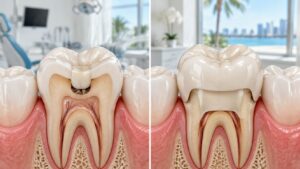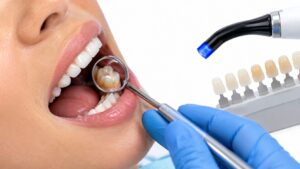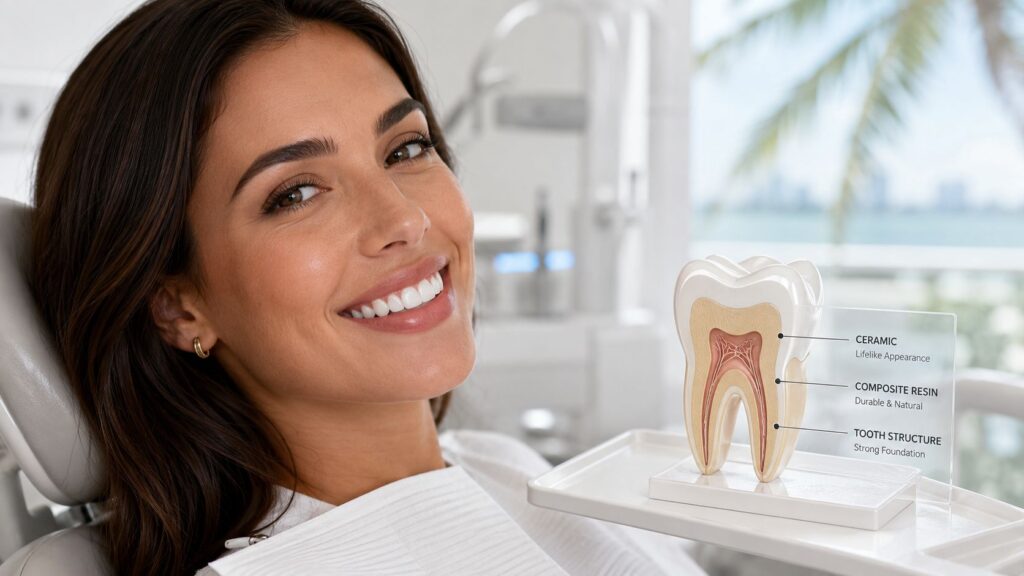
A lot of people in Miami start the veneer search the same way. They catch their reflection in bright sunlight, notice the chips, uneven edges, or stains that whitening won't fix, then open a dozen tabs and get buried in conflicting advice. Porcelain looks beautiful but feels expensive. Composite sounds simpler but raises questions about staining and durability. For patients searching terms like cosmetic dentist near me or dentist in Miami, FL, the biggest problem usually isn't motivation. It's clarity.
Hybrid veneers have entered that conversation because they sit in the middle of two familiar choices. They're often appealing to busy professionals, image-conscious adults, and patients who want a smile upgrade without jumping straight to a full porcelain plan. Interest in veneers overall is strong. The global dental veneers market was valued at approximately US$2.3 billion in 2025 and is projected to reach US$3.8 billion by 2032, while the United States accounts for roughly 36% of the global share in 2026 according to Research and Markets reporting on the dental veneers market. That doesn't mean every veneer option fits every patient. It does mean many people are actively investing in smile treatment and asking sharper questions before they commit.
This guide gives a practical look at Hybrid Veneers, with the trade-offs laid out clearly. It also focuses on a question many veneer pages skip. Are hybrid veneers a smart financial choice over time for a smile makeover in Miami?
Table of Contents
- Your Guide to a Perfect Smile in Miami
- What Exactly Are Hybrid Veneers
- Hybrid Veneers vs Porcelain vs Composite
- The Hybrid Veneer Process at Ultra Smile Miami
- Are You a Good Candidate for Hybrid Veneers
- Longevity Maintenance and Realistic Costs in Miami
- Your Hybrid Veneer Questions Answered
Your Guide to a Perfect Smile in Miami
Miami patients usually aren't looking for a generic cosmetic answer. They want a smile that fits their face, holds up in real life, and doesn't leave them regretting the cost. That's especially true for people balancing work, events, photos, and social confidence in neighborhoods like Downtown Miami, Midtown, and Hallandale Beach.
A common pattern shows up during new patient exams. Someone has been thinking about veneers for months, sometimes years. They may have searched dentist near me, cosmetic dentist near me, or even related services such as teeth whitening, dental x-rays, and new patient exams, hoping to find a dentist who can explain all the options without pressure. What usually stops them isn't lack of interest. It's fear of choosing the wrong material.
The practical concerns most patients bring in
Patients considering veneers often mention the same issues:
- Cost confusion because porcelain, composite, and hybrid options don't sound dramatically different at first.
- Dental anxiety about drilling, discomfort, or a result that looks too obvious.
- Long-term value because no one wants to pay for a smile makeover and then face early replacement.
- Appearance worries about chipped teeth, worn edges, spacing, discoloration, or minor unevenness.
Practical rule: The best veneer choice isn't the “best material on paper. It's the one that matches the patient's bite, goals, maintenance habits, and budget.
That's where hybrid veneers become worth discussing. They're often considered by patients who want more polish and durability than direct composite bonding but don't want to commit to the full cost profile of traditional porcelain. For someone comparing cosmetic dentistry in Miami, that middle-ground position matters.
Why this matters for local dental decisions
A veneer consultation shouldn't happen in isolation. A responsible dentist also checks gum health, bite pressure, clenching patterns, and whether any restorative work should come first. In some cases, a patient searching for a dentist in Miami, FL for veneers may also need cleaning and exams, a night guard, a filling, or another step before cosmetic work begins.
That kind of planning matters just as much as the veneer material itself. A bright smile looks better when it's built on healthy teeth and stable gums, not rushed cosmetic treatment.
What Exactly Are Hybrid Veneers
Hybrid veneers are best understood as a blended material solution. Instead of being purely porcelain or purely composite, they combine properties from both categories to create a restoration that aims to look refined while staying more budget-conscious.
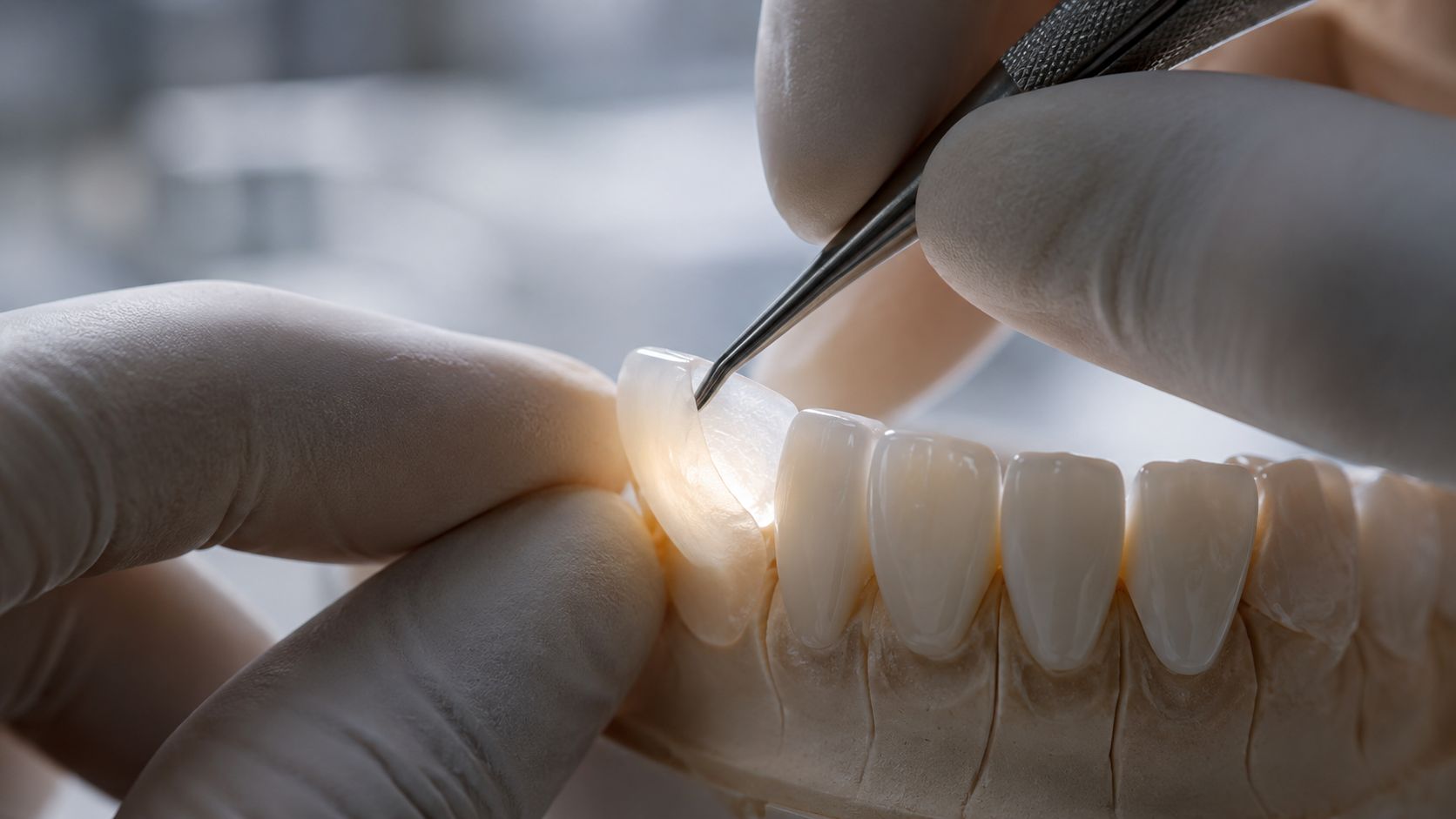
According to Bangkok Dental Center's description of hybrid veneers, hybrid veneers are prefabricated dental restorations composed of nano-hybrid composite resin, fabricated in a lab using modern laser technology before being cemented onto the tooth, and they're designed to offer a balance between the durability of porcelain and the affordability of composite.
A simple way to think about the material
A useful comparison is a high-performance alloy. Pure metals each have strengths and weaknesses, so engineers combine them to improve the overall result. Hybrid veneers follow a similar idea. They use a mixed material approach to soften some of the downsides of each traditional option.
For patients, that usually means they're looking for a veneer that can offer:
- A polished look that's more refined than standard direct composite in many cases
- A more conservative feel than full porcelain treatment for some smiles
- A lab-made restoration rather than fully hand-layered chairside bonding
- A practical budget position between premium porcelain and basic composite approaches
Why some patients choose them
Hybrid veneers often appeal to adults who want visible cosmetic improvement but don't want the decision framed as all-or-nothing. Some want to close small gaps, smooth chipped front teeth, improve shape, or create a brighter, more even smile without feeling locked into the highest-cost option.
A good veneer plan should solve the visible problem and respect the unseen factors, especially bite force, enamel quality, and daily habits.
That said, “hybrid shouldn't be mistaken for “zero prep in every case. Some patients will still need enamel adjustment for ideal fit and contour. The word points to the material concept, not a guaranteed no-drill technique. That's one reason a proper consultation matters more than marketing language.
Hybrid Veneers vs Porcelain vs Composite
The decision usually becomes clearer. Each veneer type can work well when matched to the right patient. Problems start when patients choose based on a single factor, usually price or social media appearance, and ignore maintenance, prep, or bite demands.
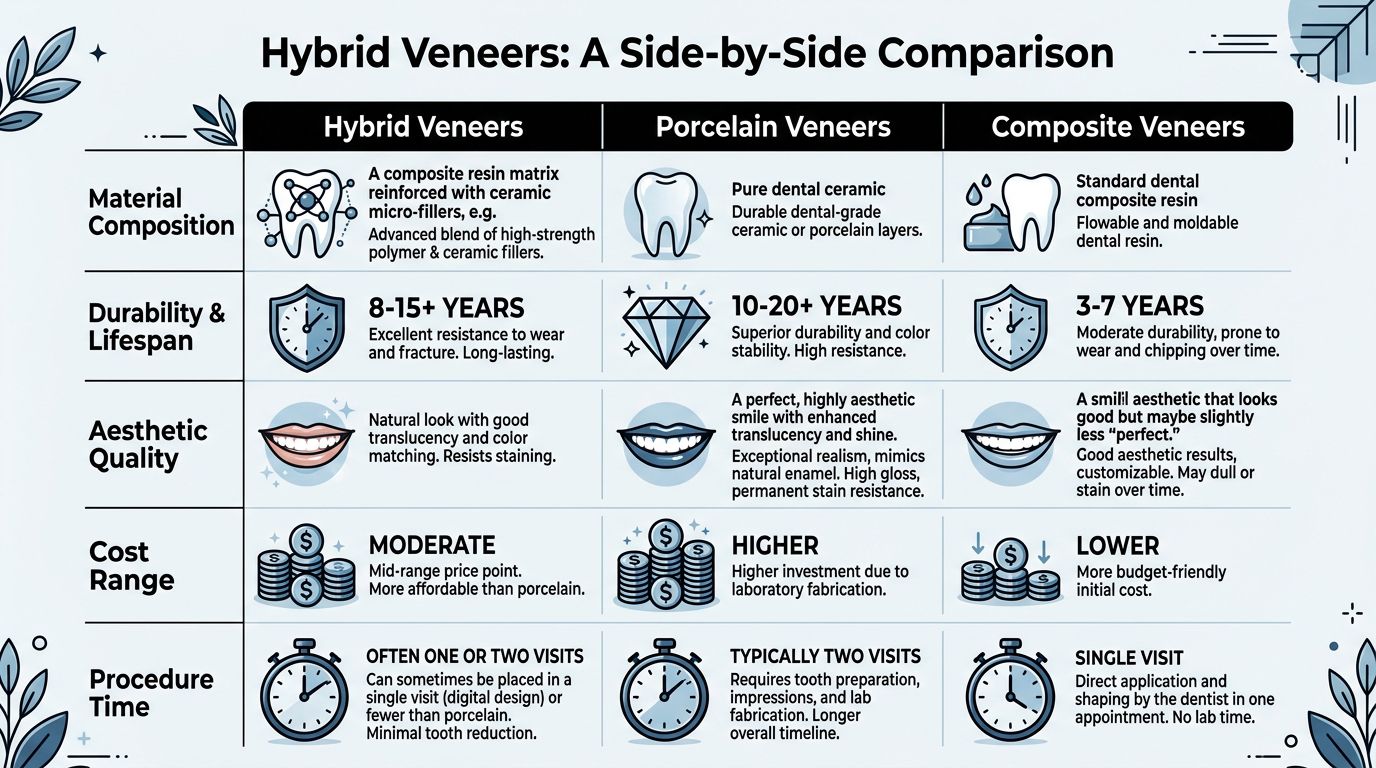
A helpful way to frame hybrid veneers is this. They're designed as the in-between option. As explained in Vogue Dental Studios' comparison of veneer types, hybrid veneers are crafted from a unique blend of ceramic and composite resin, meant to provide a middle ground between the high durability of porcelain and the affordability of composite, and they often cost almost half the price of full porcelain veneers.
Where each option tends to fit
Porcelain veneers are often chosen when maximum stain resistance, long-term polish, and high-end esthetics are the top priority. They're usually the premium route.
Composite veneers can be attractive when patients want a lower upfront investment and same-day reshaping for smaller cosmetic changes. They can work well, but they're more sensitive to wear, chipping, and maintenance over time.
Hybrid veneers tend to fit patients who want more than basic bonding but aren't ready for a full porcelain commitment. They often suit smile makeovers that need stronger visual improvement with a balanced financial approach.
For patients exploring minimal prep veneers in Miami, this middle category is often where the conversation gets interesting. Minimal prep depends on tooth position, smile design goals, and the thickness required for the final result, not just the veneer label.
Veneer Comparison Hybrid vs Porcelain vs Composite
| Feature | Hybrid Veneers | Porcelain Veneers | Composite Veneers |
|---|---|---|---|
| Material | Blend of ceramic and composite resin | Ceramic-based porcelain | Composite resin |
| Look | Natural-looking with a polished finish | Usually the highest-end enamel-like appearance | Can look very good, especially for smaller corrections |
| Durability | Middle ground between porcelain and composite | Strong long-term option | More prone to wear and staining over time |
| Cost position | Typically between porcelain and composite, often close to half the cost of full porcelain in cited market descriptions | Highest upfront cost category | Lowest upfront cost category |
| Treatment style | Lab-fabricated and bonded to the teeth | Lab-fabricated and bonded to the teeth | Often sculpted directly on the teeth |
| Maintenance | Needs polishing, good hygiene, and habit control | Needs habit control and regular maintenance | Usually needs more touch-ups and maintenance sooner |
| Prep level | Often conservative, but not always no-prep | May require more preparation depending on case | Often more conservative for small changes |
Some patients also confuse veneers with other cosmetic and restorative services. Veneers won't replace teeth, so they aren't an alternative to dental implants near me searches when a tooth is missing. They also don't solve pain from infection or trauma, where an emergency dentist, root canal, or even tooth extraction may be the right first step.
The Hybrid Veneer Process at Ultra Smile Miami
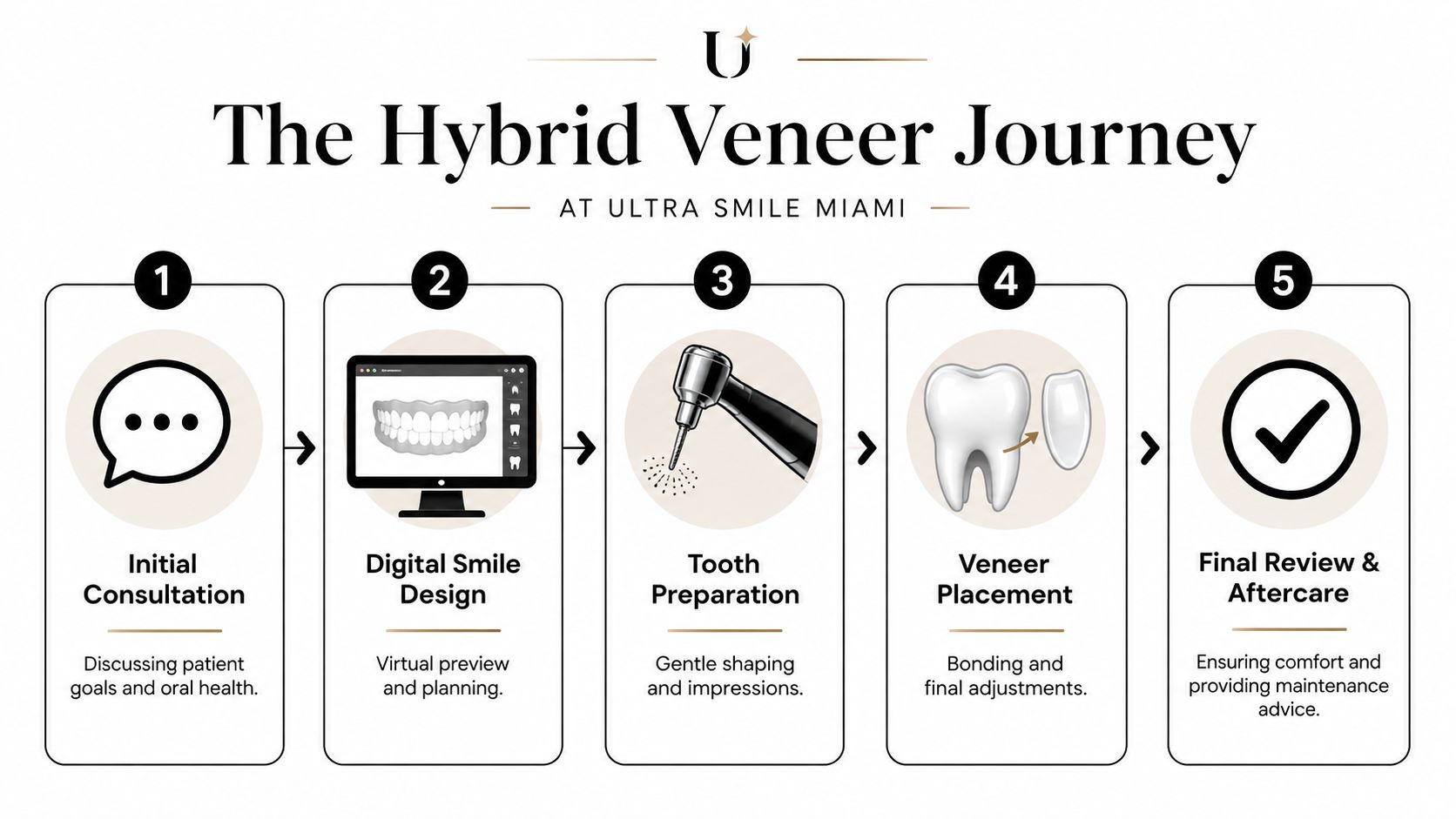
The process tends to feel less intimidating when patients know what happens before they sit in the chair. Hybrid veneer treatment is usually organized around planning, preparation, fabrication, placement, and follow-up. The exact details vary by case, but the rhythm is predictable and manageable.
A key reason hybrid materials are getting attention is that some CAD/CAM-adaptable options have shown strong early performance. According to Shofu's materials update on CAD/CAM hybrid restorations, hybrid veneers fabricated from CAD/CAM-adaptable materials showed a 100% survival rate after one year of observation, with increased flexural capability and reduced abrasiveness compared with traditional ceramics, and they often allow for more minimally invasive tooth preparation.
What the appointment flow usually looks like
The first visit usually starts with smile goals and a full oral evaluation. That includes checking enamel, gum health, bite balance, and whether any treatment should happen first, such as fillings, cleaning and exams, or a night guard for clenching.
Digital planning comes next. Photos, scans, and smile design help map out shape, length, edge position, and how the veneers will blend with facial features. This planning step matters because a veneer that looks good on a screen still has to work when the patient talks, smiles, and bites.
Later in the process, the teeth may need light preparation. Then the veneers are bonded, adjusted, and polished so the fit feels natural.
To help patients visualize the journey, this short video gives helpful context:
What makes the visit feel easier
For anxious patients, comfort details can change the whole experience. A spa-like dental setting often helps people who've delayed treatment because they associate cosmetic procedures with noise, tension, and long appointments.
Common comfort features that patients value include:
- Custom aromatherapy to make the room feel calmer from the start
- Streaming entertainment during treatment so attention isn't fixed on every sound
- Refreshments and a more relaxed check-in instead of a rushed clinical feel
- A soothing hot towel finish that makes the appointment feel complete rather than abrupt
Comfort doesn't replace good dentistry. It supports it. Patients stay more relaxed, and that usually makes cosmetic treatment feel more manageable.
For patients comparing a dentist in Miami, FL for veneers, that combination of digital precision and a gentler in-office experience often matters just as much as the material choice.
Are You a Good Candidate for Hybrid Veneers
Hybrid veneers can be an excellent fit, but they aren't the default answer for every smile. The right candidate usually wants cosmetic improvement, has generally healthy teeth and gums, and understands that veneers still need maintenance.
Who usually does well with hybrid veneers
Hybrid veneers are often worth considering for patients with concerns such as:
- Small chips or worn edges that make front teeth look uneven
- Color problems that don't respond well to whitening
- Minor spacing where a subtle closure would improve the smile
- Mild shape irregularities that make teeth look short, narrow, or mismatched
- Slight alignment concerns where the issue is visual and limited, not a major orthodontic problem
Patients who want a noticeable cosmetic upgrade without automatically choosing full porcelain often fall into this category. They're usually looking for a smile that photographs well, feels natural in conversation, and fits a realistic budget.
When another treatment may make more sense
Hybrid veneers may not be ideal when the underlying problem is functional rather than cosmetic. Severe grinding, unstable bite pressure, untreated decay, active gum disease, or very poor oral hygiene can shorten the life of any veneer.
Other treatments may be better when:
- Orthodontic movement is needed because the teeth are significantly misaligned
- A crown is more appropriate because the tooth is heavily damaged
- Emergency treatment comes first because there's pain, infection, or fracture
- A missing tooth is the issue and the patient needs restorative care such as implants rather than veneers
Patients often search emergency dentist, tooth extraction, or dental implants near me before they realize the main issue isn't cosmetic veneer treatment at all. A careful exam sorts that out quickly.
The best cosmetic plan starts by ruling out what veneers can't fix.
A stable bite and healthy foundation usually lead to better veneer outcomes. If those aren't in place yet, a phased treatment plan is often the smartest route.
Longevity Maintenance and Realistic Costs in Miami
The hardest hybrid veneer question is also the most important one. How much value does the patient get over time?

What longevity data says and what it doesn't
There's a solid amount of data on porcelain and composite veneers, but much less long-term clarity for hybrids. According to the clinical review in PMC covering veneer outcomes and Florida porcelain pricing, porcelain veneers have a 95% survival rate over 7 years, while composite veneers have an 89% survival rate after 5 years. The same source notes that veneer longevity depends heavily on care, and that porcelain veneers in Florida can cost between $925 and $2,500 per tooth.
That creates the practical gap patients keep running into. Hybrid veneers are marketed as the middle option, but long-range lifespan data is still limited compared with the clearer porcelain versus composite track record. So a sensible approach is not to promise a precise lifespan that current evidence doesn't firmly establish.
A practical way to think about cost per year
Instead of chasing a neat number that may not hold up clinically, patients should think in terms of cost per useful year, balanced against appearance, maintenance, and the likelihood of future repair or replacement.
A practical framework looks like this:
- Porcelain may cost more upfront, but patients often accept that because the long-term track record is stronger.
- Composite may lower the initial bill, but more maintenance and earlier replacement can change the overall value over time.
- Hybrid veneers can make sense financially when the patient wants a better esthetic finish than standard composite and a lower entry point than porcelain.
That's why the cost conversation in Miami shouldn't focus only on the first invoice. It should include likely upkeep, how hard the patient bites, whether a night guard is needed, and how important stain resistance is in daily life. Patients comparing options can get more background in this guide on how much veneers cost.
Maintenance that protects the investment
Hybrid veneers tend to do best when patients treat them like precision cosmetic work, not indestructible surfaces.
- Brush gently but consistently with non-abrasive products so the finish stays smoother.
- Keep recall visits on schedule because polishing and bite checks help catch small issues early.
- Use a night guard if recommended since clenching can damage even well-made veneers.
- Avoid risky habits such as opening packages with teeth or biting hard objects.
For Miami patients balancing esthetics and budget, hybrid veneers can be a smart option. They just need to be chosen with honest expectations, not optimistic guesses.
Your Hybrid Veneer Questions Answered
Patients usually reach the same final questions before booking a consultation. The answers matter because veneers aren't just cosmetic purchases. They're treatment decisions.
Do hybrid veneers look natural
They can look very natural when the case is designed well. Shape, surface texture, edge length, and how the restoration works with the patient's lips and facial features matter more than the label alone. A natural smile usually comes from restraint. Teeth that are too opaque, too uniform, or too bulky tend to look artificial regardless of material.
Is the process painful
Most patients tolerate veneer treatment well, especially when planning is thorough and preparation is conservative. Anxiety is often a bigger barrier than physical discomfort. That's why a calm setting, clear explanation, and gentle pacing make such a difference during cosmetic dentistry visits.
Can hybrid veneers help avoid bigger treatment
Sometimes yes, but not always. They can correct several visible issues at once, which may let a patient avoid stacking multiple smaller cosmetic procedures. They won't replace orthodontics when the alignment problem is substantial, and they won't solve underlying disease or structural damage that needs restorative treatment first.
What if someone also needs general or restorative dental care
That's common. A patient may come in for veneers and learn that a cleaning, filling, gum treatment, or night guard should happen first. Others may need same-day crowns, root canal treatment, or a replacement plan for a failing tooth. Cosmetic care works best when it's coordinated with overall oral health.
Why do patients looking for a dentist near me ask about comfort so early
Because many adults have postponed treatment for years. They're not only searching for a provider with cosmetic skill. They're searching for a dental office where they'll feel heard, informed, and physically at ease. That matters for veneer patients, but it matters just as much for people seeking emergency dentist care, dental x-rays, restorative dentistry, or even tooth extraction.
A good consultation should leave the patient with a clearer plan, even if veneers turn out not to be the right answer.
For patients in Downtown Miami, Midtown Miami, and Hallandale Beach, the next step is a thorough evaluation. That's where the significant decision happens. Not in a social media clip, and not in a price list without context.
If a brighter, more even smile has been on the mind, Ultra Smile DentalSpa offers a comfortable, high-tech setting for cosmetic and restorative care in Miami. Patients can schedule a consultation to discuss Hybrid Veneers, teeth whitening, Invisalign, dental implants, emergency dental needs, and full smile planning with a team that combines advanced dentistry with a calm, spa-like experience.