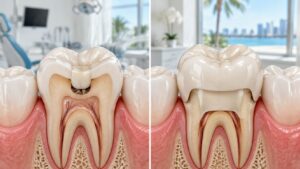
Replacing a filling in Miami usually falls within a wide range because the material matters most. Composite fillings commonly range from $173 to $439 per tooth, while porcelain can range from $755 to $1,774 per tooth before insurance. If a tooth has started to feel sensitive, a dark edge is showing around an old filling, or a piece has chipped off, that wide range suddenly becomes a very practical question.
That situation is common. Around 90% of adults have experienced tooth decay, and the average person has five to eight dental fillings according to CareCredit's overview of filling prevalence and costs. For many adults in Miami, a filling replacement isn't a surprise. It's part of maintaining teeth that have already been restored over the years.
Patients looking for a dentist in Miami, FL, an emergency dentist, or a cosmetic dentist near me often want the same thing. They want a straightforward explanation of what the procedure costs, why one replacement is simple while another is more involved, and what kind of experience they can expect in the chair. That's especially true when the old filling sits in a visible area or the tooth has started to bother them during meals.
Table of Contents
- Your Guide to Filling Replacement Costs in Miami
- Common Reasons Old Fillings Need Replacing
- Filling Replacement Cost in Miami by Material
- Key Factors That Also Affect Your Final Cost
- Navigating Insurance and Financing for Your Treatment
- Your Filling Replacement at Ultra Smile DentalSpa
- Frequently Asked Questions About Filling Replacements
Your Guide to Filling Replacement Costs in Miami
You bite into something cold, and a tooth that has been quiet for years suddenly feels sharp and different. In Miami, the first question many patients ask is simple. How much will it cost to replace the filling?
The honest answer depends on what I find after I remove the old restoration. Two details shape the estimate more than anything else. The material going back into the tooth, and how much healthy structure is still strong enough to support it.
Why the price range can vary so much
A filling replacement is not always a simple swap. Some teeth need very little beyond removing the old material and placing a new restoration. Others need decay cleaned out, weakened areas rebuilt, or a stronger material because the tooth is carrying heavy bite force.
That is why the fee can vary from one patient to the next, even when both are told they need a filling replaced.
A small replacement on one surface is usually more straightforward than a larger restoration that extends across several parts of the tooth. Front teeth and back teeth also create different priorities. A front tooth usually calls for close shade matching and natural polish. A molar often needs a material and shape that can hold up under daily chewing pressure.
At Ultra Smile DentalSpa, I want patients to understand what they are paying for. Cost is tied to clinical complexity, but it is also tied to the quality of the experience. High-grade materials, digital imaging, careful isolation, precise bite adjustment, and a calm, comfortable visit all affect the final fee. In a spa-like Miami practice, those details are part of the treatment, not extras added at the end.
What patients in Miami should expect
Patients are usually not just comparing numbers. They are weighing value, appearance, durability, and comfort during the appointment.
In a premium setting, replacing a filling should feel organized and reassuring. The tooth is examined closely, the area is numbed thoroughly, the old filling is removed with care, and the new restoration is shaped so it feels natural when you bite. If the filling is visible when you smile, aesthetics matter. If it is on a back tooth, strength and fit matter just as much.
Many patients in Downtown Miami, Midtown Miami, and nearby neighborhoods also want the appointment to fit into a bigger plan for their oral health. A replacement filling may be the immediate need, but the visit can also help clarify whether other worn restorations should be monitored, whether the tooth is better served by a larger restoration, or whether cosmetic goals should factor into the material choice.
Common Reasons Old Fillings Need Replacing
Most fillings aren't replaced because they hit a specific birthday. They're replaced because the tooth or the restoration starts showing signs that the seal is no longer dependable.

Recurrent decay around the edges
One of the most common reasons for replacement is new decay forming around an older filling. Patients often hear this called recurrent decay. It happens when bacteria find a weak point at the margin where the filling meets the tooth.
This doesn't always cause pain right away. A dentist may notice a darkened edge on an exam, or the issue may show up on dental x-rays before the patient feels anything at all. Catching it early can keep the treatment in the filling category instead of turning into a crown or root canal conversation.
Cracks, wear, and bite pressure
Old fillings also fail from simple mechanical stress. Back teeth handle repeated biting pressure every day, and some materials wear differently over time. A filling can chip, flatten, loosen, or fracture, especially if the patient clenches, grinds, or chews hard foods often.
Signs patients notice at home include:
- Sudden roughness: The filling no longer feels smooth to the tongue.
- Sensitivity when chewing: Biting down creates a sharp or brief uncomfortable spot.
- Visible line or missing piece: Part of the restoration looks broken or sunken.
- Food trapping: Floss starts catching, or food packs around that tooth more than before.
A filling doesn't have to fall out completely to stop protecting the tooth well.
Aesthetic concerns are real concerns
Not every replacement is driven by pain or decay. Some patients are tired of seeing dark metal or stained, aging white fillings when they smile. That isn't vanity. It's a reasonable part of oral health decision-making, especially when a restoration is already worn and due for review.
For patients looking for a cosmetic dentist near me, replacing an outdated filling can be one of the simplest ways to make a smile look cleaner and more uniform. When the restoration is in a visible area, color match, shape, and polish matter just as much as function.
Filling Replacement Cost in Miami by Material
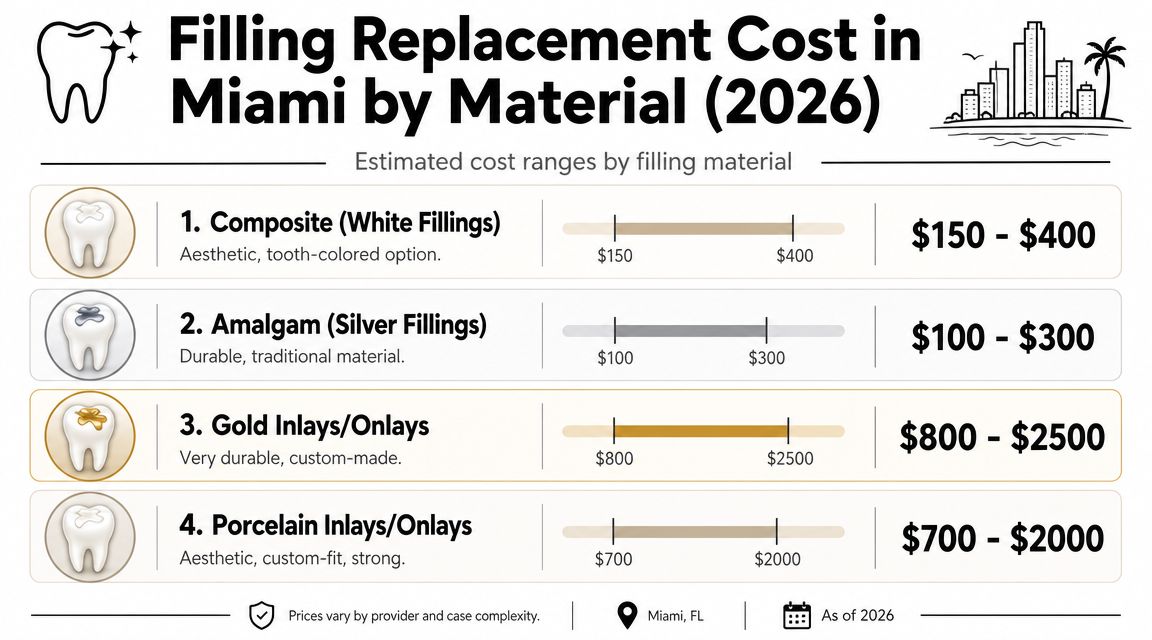
Material usually sets the starting range for a filling replacement, but patients feel the difference in more than the invoice. The material affects how the tooth is prepared, how natural the result looks, how it holds up under bite pressure, and whether the restoration can be completed in one visit or needs outside fabrication. In a Miami practice like Ultra Smile DentalSpa, those choices also tie directly to comfort features, digital imaging, and the level of finish patients expect.
Composite fillings
Composite is the replacement material I recommend most often for patients who want a natural look and a conservative repair. A typical national range for composite fillings is about $191 to $226 on average per tooth, based on GoodRx's cavity filling cost overview, but Miami fees can run higher depending on the tooth, the number of surfaces, and the level of detail needed to match your enamel well.
Composite earns its place because it bonds directly to the tooth. That lets the dentist rebuild shape with a more precise, aesthetic result, especially in visible areas. It is also a practical choice for many back teeth, though very large restorations or heavy grinding sometimes point us toward a stronger indirect option.
Patients usually choose composite for three main reasons:
- Natural appearance: The shade can be matched closely to surrounding enamel.
- Tooth preservation: The preparation is often more conservative than older filling methods.
- Versatility: It works well for many front teeth and many routine back-tooth replacements.
Patients who want a clearer explanation of the trade-offs between white and metal restorations can review our guide to composite fillings and amalgam fillings.
Porcelain restorations
Porcelain belongs in a different category from a direct filling. It is usually selected when the old filling is large, the tooth needs more reinforcement, or the patient wants a highly refined cosmetic result with custom fabrication. That added strength and polish come with a higher fee and a more involved process.
National consumer pricing often places porcelain restorations around $1,150 per tooth on average before insurance. In practice, the final number depends on how much tooth structure remains, whether the bite needs careful adjustment, and whether the restoration is being made to improve both function and appearance. For many Miami patients, porcelain is less about getting the cheapest fix and more about getting a restoration that looks excellent, feels precise, and lasts well under daily use.
A well-made porcelain restoration can be a smart investment. It also asks more of the process. More planning, more customization, and more finishing time usually mean a higher fee.
Real trade-off: Composite is often the better value for small to moderate replacements. Porcelain usually costs more because the restoration is custom-made and used in more demanding situations.
2026 Filling Material Cost Comparison Miami
| Material | Average Cost per Tooth | Pros | Best For |
|---|---|---|---|
| Amalgam | About $160 | Durable, traditional, often lower cost | Back teeth where appearance matters less |
| Composite | About $191 | Tooth-colored, versatile, aesthetic | Visible areas and many routine replacements |
| Gold | About $400 | Durable | Select custom restorative cases |
| Porcelain | About $1,150 | Strong, aesthetic, custom fit | Larger or more demanding restorations |
Table note: Average per-tooth estimates above are based on national consumer cost figures cited by GoodRx. Actual Miami replacement fees vary based on tooth location, restoration size, and the clinical condition found after the old filling is removed.
Key Factors That Also Affect Your Final Cost
Two patients can both need a filling replaced on one tooth and still receive different estimates. In practice, the final fee depends on how much of the tooth needs to be rebuilt, how difficult the area is to reach, and what we find after the old filling is removed.

How surface count changes the fee
Surface count is one of the biggest pricing factors. A one-surface replacement is usually more straightforward than a filling that extends across two or three surfaces and requires the tooth to be shaped carefully so your bite feels right and food does not trap between teeth.
Independent pricing cited by Canyon Country Dental Care's cost breakdown places a one-surface composite filling around $135 to $370 and a two- or three-surface composite filling around $175 to $450. The same source notes fair-price benchmarks near $155 for one surface, $215 for two surfaces, and $305 for three surfaces, and it describes composite longevity at about 5 to 7 years, compared with roughly 12 years for amalgam.
That range helps explain why “just one tooth can mean very different treatment. A small replacement is faster and simpler. A larger restoration takes more time, more shaping, and more polishing to make it look natural and hold up under daily chewing.
Other clinical details that change the estimate
The condition under the old filling matters just as much as the material on top. Once the existing restoration comes out, I may find healthy tooth structure with a clean margin, or I may find recurrent decay, a weakened wall, or a crack that changes the treatment plan.
Common cost factors include:
- Tooth position: Front teeth often demand more cosmetic precision. Back teeth usually face heavier bite forces and can be harder to access.
- Depth of damage: Decay that extends deeper into the tooth takes more time and care to remove safely.
- Removal of the old restoration: Some older fillings come out easily. Others require a more careful approach to preserve as much healthy tooth as possible.
- Bite adjustment and finishing: Replacements need to feel comfortable when you close, chew, and floss. Fine adjustments take time, but they matter.
- Comfort options: Local anesthesia is standard. Sedation or additional comfort services can change the appointment fee.
At a practice like Ultra Smile DentalSpa, cost also reflects the experience around the procedure. Patients are not only paying for filling material. They are paying for careful diagnosis, modern imaging, precise shade matching when aesthetics matter, and a calmer appointment in a spa-like setting. That difference is real, especially for patients who value comfort or feel anxious about dental work.
Insurance can affect the final out-of-pocket number as well. Patients who want to prepare before treatment can review our insurance and payment information for dental care in Miami so there are fewer surprises once the treatment plan is finalized.
Navigating Insurance and Financing for Your Treatment
The number most patients care about isn't the office fee by itself. It's what they'll pay out of pocket after insurance applies. That's where a lot of confusion starts.
What insurance usually covers
Many dental plans treat fillings as basic restorative care. Cigna's guidance on cavity filling costs and coverage notes that many plans cover up to 80% of filling costs after a deductible, but the patient portion can still vary widely depending on the provider, plan rules, and case details.
That last part matters. A policy may help with a standard filling replacement but apply limits based on timing, replacement frequency, annual maximums, or the material chosen. A plan may also reimburse differently for a white filling on a back tooth than a simpler alternative.
The best insurance question isn't “Do you take my plan? It's “How will my plan apply to this specific replacement?
What patients should check before treatment
Before approving treatment, patients should ask the front desk to review the practical parts of their policy. That step often prevents frustration later.
Useful items to confirm include:
- Deductible status: Has it already been met this year?
- Annual maximum: Is there enough remaining benefit for this treatment?
- Frequency limits: Will the plan pay to replace this restoration now?
- Material rules: Does the plan downgrade reimbursement based on material choice?
Patients who don't have coverage still have options. Offices may offer phased treatment, financing, or payment arrangements that let a patient address the urgent tooth first and stage less urgent work later. For readers who want to review plan logistics in advance, insurance information at Ultra Smile DentalSpa outlines accepted coverage categories and patient support.
For anyone comparing a filling replacement with other treatments such as a tooth extraction, root canal, or crown, benefit coordination matters even more. In many cases, preserving the tooth with timely restorative care is the simpler and less disruptive path.
Your Filling Replacement at Ultra Smile DentalSpa
A filling replacement often starts the same way. A patient bites on one side, feels a sharp catch, then wonders whether the tooth needs a quick fix or something more involved. By the time they sit in the chair, the primary questions are usually practical ones: how long this will take, whether it will hurt, and whether the final result will feel normal again.

What the appointment feels like
A well-run replacement visit should feel calm, organized, and respectful of a patient's time. At Ultra Smile DentalSpa, comfort is built into the appointment, not treated as an extra. Patients may have refreshments, custom aromatherapy, streaming entertainment, and a warm towel at the end of the visit. In a city like Miami, that experience matters. Busy professionals and anxious patients alike want dentistry that feels careful from the first conversation to the final bite check.
The clinical side starts with a close look at the tooth, the old filling, and the way the teeth come together. If the restoration has cracked, leaked, or shifted the bite, the next step is deciding whether a new filling will still protect the tooth well or whether it now needs more coverage. Digital imaging and a precise visual exam help make that call.
What happens during the procedure
Once the plan is clear, the tooth is fully numbed and isolated so the area stays clean and dry. The old filling is removed carefully, and any weak or decayed tooth structure is cleaned out before the new material is placed. That step affects comfort later. If compromised structure is left behind, the tooth is more likely to stay sensitive or fail again sooner than expected.
The new restoration is then shaped with attention to edges, contact points, and bite. Patients usually notice the difference in simple ways:
- The tooth looks cleaner, especially after replacing a stained or dark older filling.
- The bite feels even, so chewing does not hit one high spot first.
- Floss moves more naturally, without shredding or catching as much.
- The surface feels smooth, not bulky, sharp, or rough against the tongue.
A short video can also help patients see what restorative visits involve in a modern practice.
When a replacement leads to a bigger conversation
Sometimes removing the old filling reveals a larger issue. I tell patients this before we start, because transparency matters. A tooth that looks like a straightforward replacement on the surface may have a deeper crack, decay underneath the margins, or not enough healthy structure left to hold another filling predictably.
In those cases, the conversation may shift to broader restorative care, bite protection for clenching or grinding, or a treatment plan that improves both function and appearance. That does not mean the appointment became more complicated than necessary. It means the tooth was evaluated accurately.
A careful replacement takes more attention, but that extra care usually pays off in the hours and days after the visit. Patients remember whether they felt rushed, whether the numbness wore off into comfort instead of irritation, and whether the tooth felt like their own again by dinner time.
Frequently Asked Questions About Filling Replacements
How long does the appointment take
The timing depends on how large the old filling is, how many surfaces need repair, and whether the tooth needs any rebuilding before the new material goes in. A simple replacement is usually more straightforward than a larger back-tooth restoration. During scheduling, the office can give a more accurate time estimate once the dentist has examined the tooth.
Does replacing a filling hurt
The procedure itself shouldn't be painful once the tooth is fully numb. Patients may feel pressure, vibration, or water spray, but not sharp pain. Mild sensitivity afterward can happen, especially with hot or cold foods, though it often settles as the tooth adjusts.
What should patients do after the appointment
Aftercare is usually simple. It helps to avoid very hard or sticky foods right away, brush gently that evening, and keep flossing around the area once the dentist says it's appropriate. If the bite feels high after the numbness wears off, patients shouldn't wait it out for days. A quick adjustment can make a big difference.
Does a new patient exam come first
If a patient is new to the office, an exam usually comes first so the dentist can confirm that the tooth is still suitable for a filling replacement. That visit may include dental x-rays, a review of symptoms, and a discussion about whether the problem is isolated or connected to other restorative needs. For someone searching for an emergency dentist or a dentist in Miami, FL, this step protects against under-treating a tooth that needs more than a filling.
If an old filling has cracked, stained, or started to feel sensitive, the next step is a proper evaluation. Ultra Smile DentalSpa provides filling replacement, restorative dentistry, cosmetic dentistry, and new patient exams for adults in Miami who want clear treatment guidance and a more comfortable dental experience.