If a routine cleaning is meant to protect teeth, why do so many adults search "dental cleaning hurts" before they ever search for a dentist near me? The gap is in the word "cleaning." Patients picture one simple appointment, then arrive for something quite different: a first visit after years away, tender gums, exposed roots, or a deeper treatment below the gumline. Those aren't the same experience, and they shouldn't be described with the same reassurance. At Ultra Smile DentalSpa, a dentist in Miami, FL serving Downtown Miami, Midtown Miami and Hallandale Beach, the team explains what each stage feels like before an instrument ever touches a tooth.
Table of Contents
- Is Dental Cleaning Supposed to Hurt
- What Sensations to Expect and How Long They Last
- Why Inflamed Gums and Tartar Make Cleaning Feel Worse
- How to Make Your Cleaning More Comfortable
- When Post-Cleaning Pain Needs a Dentist Visit
- Book a Gentle Dental Cleaning in Miami
Is Dental Cleaning Supposed to Hurt
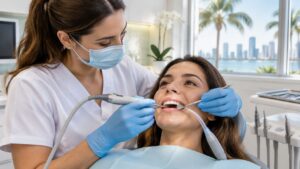
A routine cleaning typically feels like pressure, scraping, buzzing and a few minutes of tenderness, not sharp pain. The ultrasonic scaler is the loudest part of the visit and the mildest: its tip vibrates while a fine water spray flushes debris away, so the sound and vibration reach the ear far more forcefully than the tooth. What patients dislike most is the hand instrument pressing against hardened tartar near the gum edge, a deliberate, controlled scrape that lasts seconds per tooth.
Worry about that sensation is common rather than unusual. A 2021 systematic review and meta-analysis of 72,577 adults worldwide estimated that 15.3% experienced dental fear and anxiety, with 3.3% reporting severe anxiety.
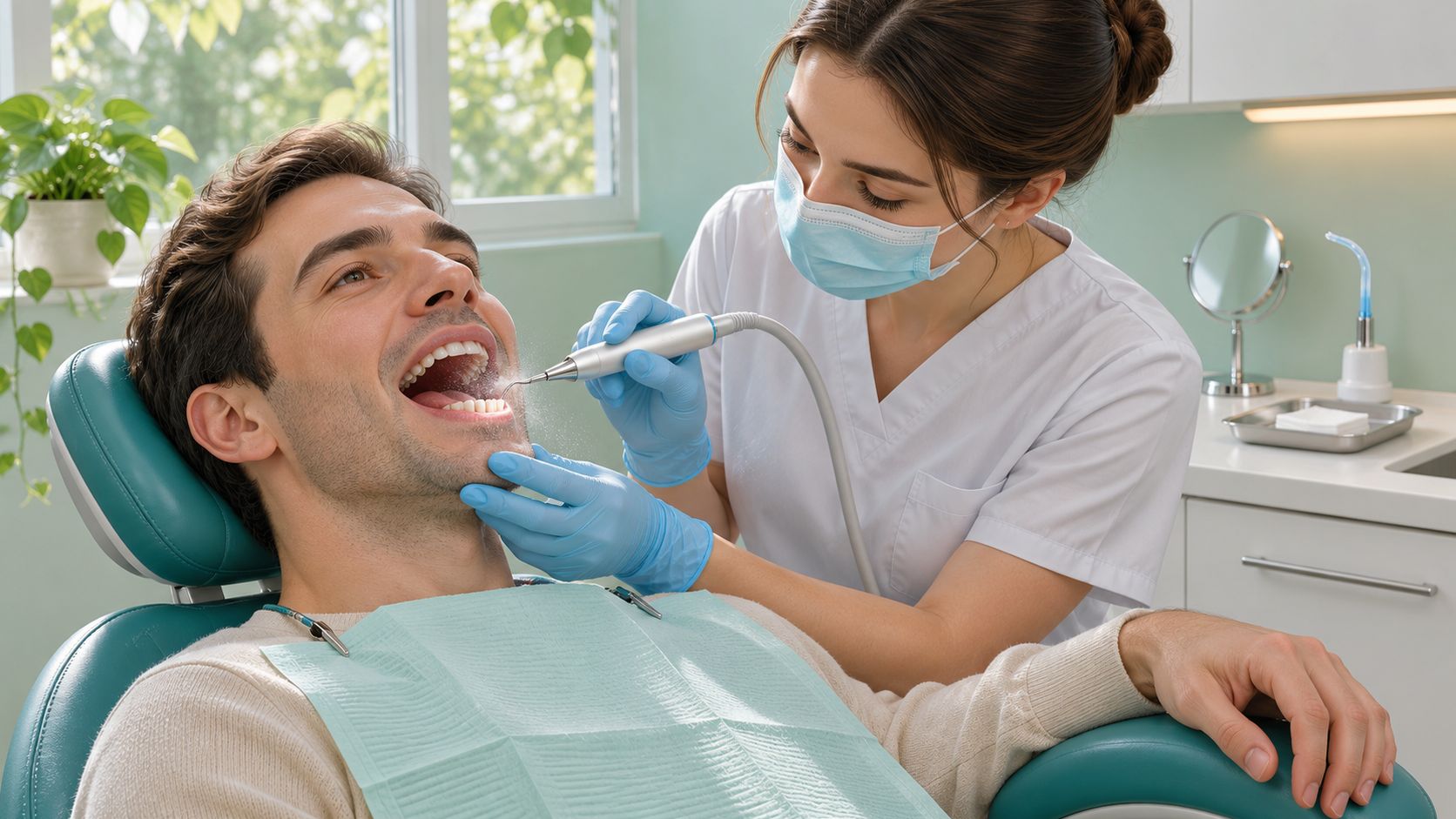
Anxiety tightens the jaw and sharpens how the nervous system reads ordinary pressure, which is why a calm explanation before each step changes the experience so much. Avoidance works the other way: skipped visits let plaque and tartar accumulate, so the appointment eventually needed is longer and more involved. Readers who want a second plain-language explanation of the sensation itself will find Grand Parkway Smiles on cleaning pain a useful companion read.
The rule in the chair: mild, brief discomfort is common. Sharp, lingering or sharply localized pain means speaking up during the visit, not after it.
Patients at Ultra Smile DentalSpa can say how they feel at any moment, and the hygienist slows the pace or adjusts technique for a tender area.
What Sensations to Expect and How Long They Last
A standard cleaning at Ultra Smile DentalSpa runs in three steps: plaque and tartar removal, an irrigation solution treatment, and a fluoride treatment. Knowing the order helps, because the scraping stage patients brace for sits in the middle of the visit rather than spanning all of it.
Routine cleaning versus deep cleaning
A routine cleaning works on tooth surfaces at and just below the gum edge. Scaling and root planing, the treatment people call a deep cleaning, reaches tartar and bacteria around and below the gumline, including the roots, which is why it feels different afterward. Cleveland Clinic's guidance on tooth scaling and root planing notes that gum soreness may last a couple of days, while sensitivity to heat and cold can continue for one or two months. Patients weighing that recommendation can read when a deep cleaning is needed from Paul L. Gregory, DDS for a clear description of the procedure itself.
Root sensitivity is the most quantified part of recovery. Summarizing systematic review evidence, a patient explanation from Lou Dental Studio puts root sensitivity after nonsurgical periodontal treatment at roughly 62.5% to 90% of patients on the first day, falling to about half after one week.
Typical sensations during and after cleaning
| Sensation | When it happens | Typical duration | Usually normal? |
|---|---|---|---|
| Scraping or buzzing from the ultrasonic tool | During tartar removal | Only during the appointment | Yes |
| Light pressure on tartar near the gumline | Hand-instrument scaling below the gum edge | During the appointment | Yes, if brief |
| Gums bleed when brushed or flossed | Inflamed gums after plaque and tartar removal | A few days, improving as gums heal | Yes, if it improves |
| Sore or tender gums | After a routine cleaning | A few days | Yes |
| Sensitivity to cold or sweet foods | Exposed tooth surfaces after cleaning | Usually a few days to one week | Yes |
| Gum soreness after deep cleaning | Scaling and root planing | A couple of days | Yes |
| Heat and cold sensitivity after deep cleaning | Exposed roots below the gumline | One to two months | Often, report it if it worsens |
| Root sensitivity after nonsurgical periodontal treatment | Exposed root surfaces after deposits are removed | About 62.5% to 90% of patients on day one, about half after one week | Yes, if mild and fading |
Read the table by duration, not by intensity alone. A sensation that fades inside its expected window is ordinary recovery. The same sensation stretching past that window, or getting stronger instead of weaker, belongs in the warning category. Most sensations peak during the appointment or within the first few days.
Why Inflamed Gums and Tartar Make Cleaning Feel Worse
Discomfort during a cleaning usually traces back to the condition of the mouth, and the chain has three links.
From hardened plaque to tender tissue
During the dental cleaning, hygienists remove tartar, which is hardened plaque that regular brushing and flossing cannot remove. Because it bonds to the tooth at and below the gumline, it has to be lifted mechanically, and that means instrument contact right where tissue is most irritated. Readers who want the full picture of how deposits form can review how to remove tartar buildup.
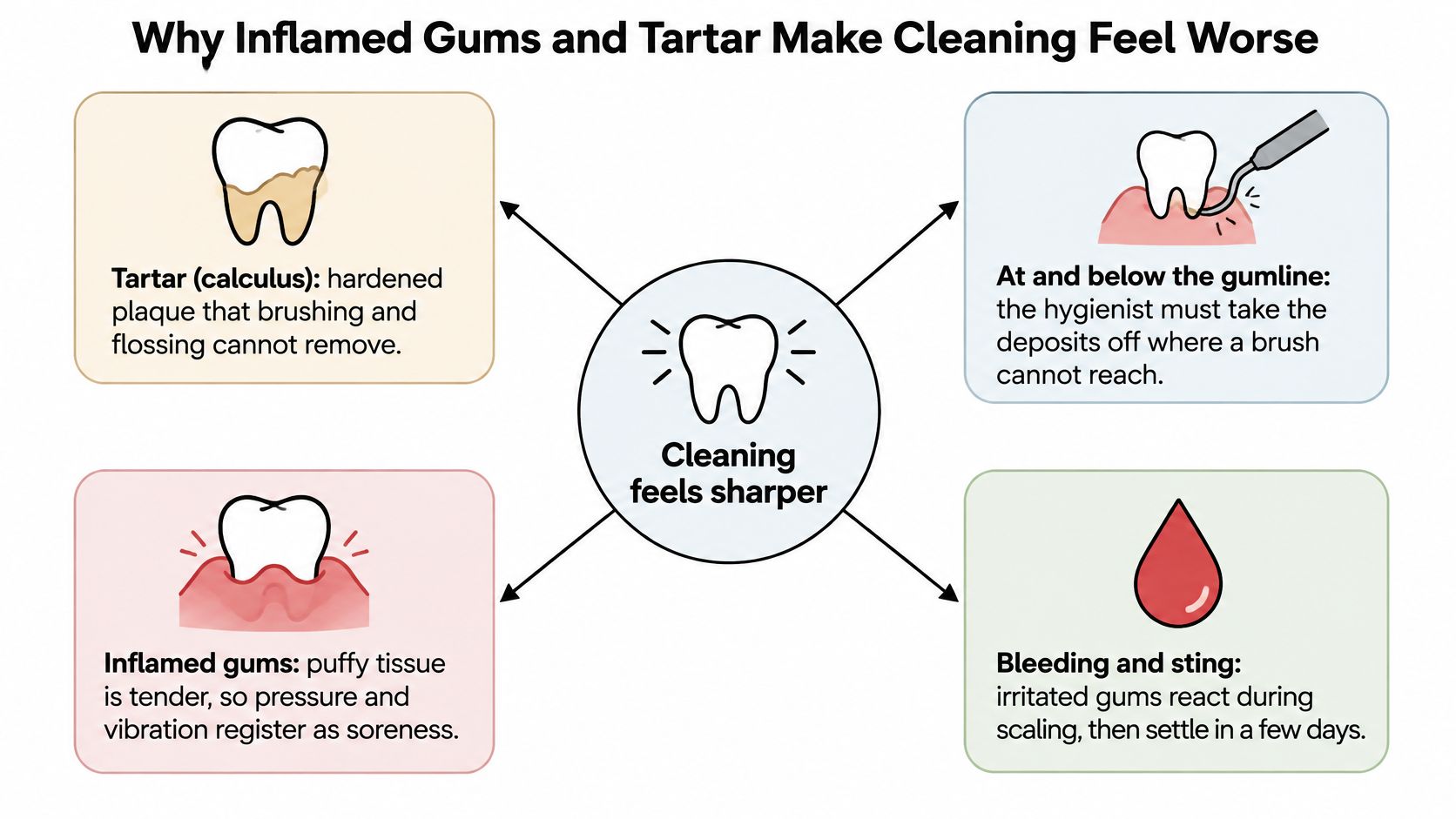
Inflamed gum tissue behaves like a bruise. With gingivitis or periodontitis it swells, bleeds easily and registers pressure as soreness, so the same instrument pass that a healthy gum barely notices feels sharp on inflamed tissue. Many patients arrive in exactly that state: CDC oral health surveillance reports that 21% of adults aged 20 to 64 have at least one untreated cavity, and 46% of adults aged 30 or older show signs of gum disease.
Exposed roots change the sensation completely
The third link is recession. Gum disease or vigorous brushing can pull the gum margin down and expose root surfaces, which lack the enamel covering that protects the visible crown. Cold water, air from the scaler and instrument contact then reach a surface with far less insulation, producing a quick, electric twinge rather than dull pressure.
Factors that raise sensitivity during a cleaning:
- A long gap since the last visit: more deposit means more instrument time per tooth.
- Active gum disease: bleeding tissue tolerates pressure poorly.
- Recession and existing sensitivity: exposed root surfaces react to cold and touch.
- Previous dental work: cleaning is particularly beneficial for people prone to cavities and gum disease and for those with fillings or crowns, where margins need careful attention.
Pain during a cleaning is information about the mouth, not proof that the cleaning caused damage.
Sharp or persistent pain still deserves an examination for decay, a cracked tooth or infection, because those problems produce sensations a scaler reveals.
How to Make Your Cleaning More Comfortable
Comfort is negotiated before the appointment and adjusted during it. These requests are routine, and each has a clinical reason behind it.
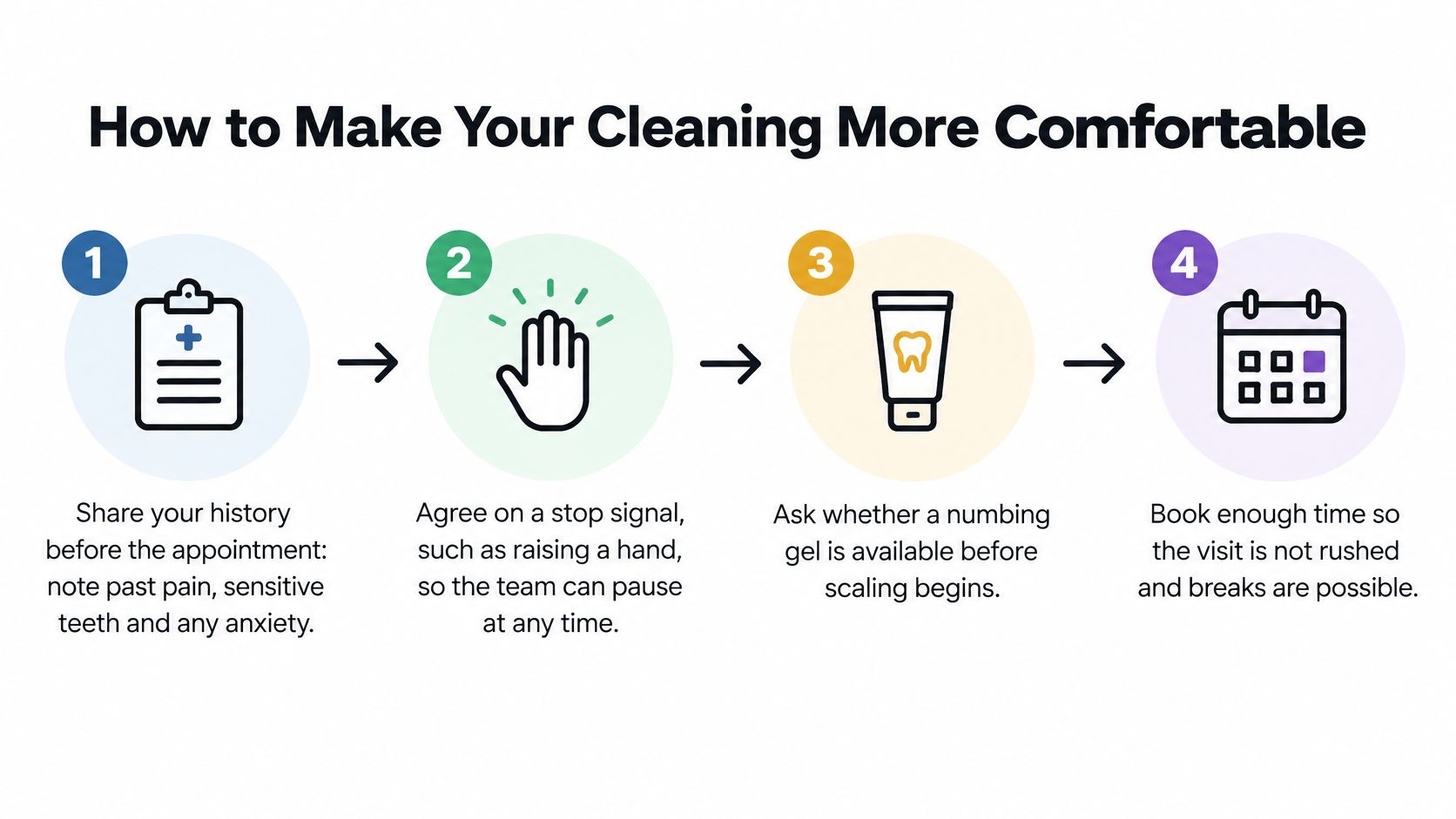
- Share the history first. Past painful visits, known sensitive teeth and specific fears tell the hygienist which areas to approach gently and in what order.
- Agree on a stop signal. Raising a hand pauses treatment instantly, which restores control for patients who fear gagging, needles or not being heard.
- Ask about numbing gel for tender areas. A systematic review referenced in the Scottish Dental Clinical Effectiveness Programme guidance on periodontal probing found that intra-pocket anesthetic gel reduces both the likelihood and intensity of pain during probing and scaling and root planing.
- Request staged treatment. Working in sections lets a sensitive quadrant be finished in a shorter session or spread across visits instead of pushed through in one sitting.
- Use fluoride toothpaste on sensitive roots the right way. NHS guidance reproduced by Leicester Hospitals recommends applying a small amount to the sensitive root, spitting out the excess and not rinsing immediately, so the fluoride stays in contact.
- Keep the fluoride step at the end. Ultra Smile DentalSpa finishes the cleaning with a fluoride treatment, which strengthens teeth and reduces sensitivity.
- Discuss relaxation options. Nitrous oxide and other sedation come after a medical-history screening and informed consent, not as a default add-on.
A short walkthrough of the appointment itself helps patients who feel better knowing the sequence in advance.
Naming the feared sensation matters more than any gadget. Someone afraid of losing control needs a stop agreement; someone afraid of a specific twinge needs gel and a slower approach. Patients whose worry starts days before the visit can work through how to calm dental anxiety alongside these practical requests, and tell the clinician whenever discomfort is sharp or localized so pressure and technique can change on the spot.
When Post-Cleaning Pain Needs a Dentist Visit
Brief, mild sensitivity that fades is expected. Pain that is spontaneous, lingering, worsening, tied to swelling, or lasting beyond the expected recovery period needs assessment.
The mechanism explains the difference. Removing calculus and inflamed tissue temporarily uncovers root surfaces, and unlike enamel, cementum and dentin insulate the nerve poorly, so cold or sweet stimuli trigger short, sharp signals through exposed dentinal tubules. A systematic review of root sensitivity after periodontal therapy describes these symptoms as generally mild to moderate and transient, and recommends a soft-bristled brush, briefly avoiding very cold or acidic foods, and asking about professionally applied desensitizing agents or an evidence-based desensitizing toothpaste.
Post-cleaning symptoms, likely causes and next steps
| Symptom | What it may mean | What to do |
|---|---|---|
| Brief cold sensitivity that fades within days | Normal exposure after tartar removal | Use a soft brush and desensitizing toothpaste, then monitor |
| Sensitivity lasting beyond the expected recovery period | Ongoing root sensitivity or early decay | Book a check-up |
| Spontaneous throbbing with no temperature trigger | Possible tooth nerve irritation | Contact the office promptly |
| Swelling, fever or pus around the gums | Possible gum infection | Contact a dentist urgently |
| Sensitivity that worsens over several weeks | Crack, decay or active periodontal infection | Schedule an evaluation |
| Sharp pain when biting | Possible cracked tooth | Schedule an exam and avoid chewing on that side |
The first two rows describe healing. The middle rows describe a tooth or gum problem that the cleaning happened to expose, which is why an exam matters more than waiting it out. Swelling with fever is the one row that shouldn't wait for a routine slot; an emergency dentist visit that day is the appropriate response.
Calling early is never an overreaction. A prompt look usually means a simpler fix.
Over-the-counter pain relievers may help with discomfort when they're appropriate for a patient's health history, but persistent or worsening symptoms still need a dental review rather than another dose.
Book a Gentle Dental Cleaning in Miami
The decision is straightforward: book the cleaning, especially if sensitivity or fear has been the reason for postponing it. Dental cleaning at Ultra Smile DentalSpa is suitable for everyone, from children to adults, and it's particularly valuable for patients prone to cavities and gum disease or those with previous fillings and crowns.
Regular cleanings help prevent tartar buildup, bone loss, bad breath and cavities, and the office asks patients when their next cleaning is due so the interval matches their gum health rather than a guess. Shorter gaps between visits generally mean lighter deposits and a gentler appointment.
Before booking, patients should gather four things:
- Sensitive areas: which teeth react to cold, sweet or brushing.
- Past pain: what happened at previous cleanings and when.
- Anxiety triggers: needles, gagging, sounds, loss of control.
- Current medications: a complete list, including anything affecting bleeding.
Ultra Smile DentalSpa pairs cleanings and exams with digital X-rays, new patient exams, composite fillings, crowns and bridges, root canals, wisdom teeth extraction, implants and bone grafts, veneers, invisible braces and teeth whitening, and a free consultation request form on its website secures a 30% discount on dental treatments. Patients across Miami, FL, Downtown Miami, Midtown Miami and Hallandale Beach can plan a visit around work and family schedules with bilingual staff and transparent treatment planning.
Ultra Smile DentalSpa offers gentle cleanings with a hygienist who adjusts pace and technique for tender areas, numbing and relaxation options discussed before treatment begins, and clear guidance on which sensations are normal afterward. Patients who've been avoiding a cleaning because the last one hurt can start with a conversation instead of an instrument. Visit Ultra Smile DentalSpa to request an appointment or free consultation and have the team map out a comfortable first visit.